
Many sellers of charging products targeting the UK market initially focus on common electrical compliance requirements such as UKCA and RoHS. They only realize that there is another chemical compliance requirement that cannot be missed when their goods are detained during customs clearance or e-commerce platforms request submission of UK REACH documents. Although UK REACH sounds professional, for small and medium-sized importers of finished products such as chargers, charging cables, and plugs, the core logic is not complicated. As long as they clarify their identity, required tasks, and common pitfalls, they can clearly sort out their own responsibilities and control compliance risks within a reasonable range.
Basic Understanding: The Connection Between UK REACH and Charging Products
UK REACH is a chemical regulation implemented independently by the UK after Brexit, with the core purpose of controlling the health and environmental risks of chemical substances in products entering the UK market. Its scope of application is clear: it only covers Great Britain (England, Scotland, and Wales), and Northern Ireland is subject to EU REACH due to its special status. The two systems have similar frameworks but are completely independent, and their documents, registrations, and notifications are not interchangeable — do not use EU REACH reports to deal with UK regulators, as they have no legal effect.
Under the UK REACH classification, charging products fall into the category of “articles”. Let’s first explain the three types of regulated objects in plain terms: pure chemicals (such as plastic pellets) are called “substances”; mixtures of several chemicals (such as solder paste, glue) are called “mixtures”; and products such as chargers and charging cables, whose shape and function take priority over chemical composition, are classified as “articles”. Articles do not require substance registration like pure chemicals, but they must comply with the limit requirements for internal chemical substances. There is a common misconception: REACH only regulates pure chemicals, and finished electronic products do not need to comply — this is wrong. If the chemical substances in finished products exceed the standard, they will also be prohibited from sale.
High-risk components of charging products are concentrated in several categories: plastic housings, PVC charging cable sheaths, metal plug coatings, PCB solder, and USB contact coatings. These components either require the addition of plasticizers and flame retardants, or their coatings may contain harmful heavy metals, making them the focus of UK REACH regulation.
As for why importers are the primary responsible parties, the logic is simple: UK regulatory authorities prioritize tracing domestic contactable entities, and tracing overseas factories is too costly, so importers are designated as the primary responsible parties for placing products on the market. Here we need to correct another misconception: as long as the supplier issues a compliance declaration, the importer is not liable — this is incorrect. The importer is responsible for the authenticity of the declaration. If the supplier provides false documents, the regulator will still hold the importer accountable first.
Identity Determination: Whether You Are a UK REACH Importer
Many people are confused about whether they need to bear responsibility. In fact, the core judgment criterion is very clear: a domestic entity in the UK that brings charging products from overseas into the Great Britain market for sale or commercial use is an importer under UK REACH. Specific judgment can be based on three key points: who is the customs declaration entity, who is the buyer on the commercial invoice, and who decides to place the product on the UK market. It should be noted that logistics companies only responsible for transportation and customs clearance do not bear REACH responsibilities.
We sort out the responsibility attribution of different import modes one by one according to common scenarios for sellers:
• General trade: If a UK trader purchases charging products from overseas and sells them in the UK, the UK trader is the importer and bears full responsibility.
• Cross-border direct mail: Overseas sellers ship goods directly from overseas to UK consumers. Since the seller is not located in GB, a domestic responsible entity must be clarified; if a UK Only Representative (OR for short) is entrusted to undertake UK REACH-related obligations, a written appointment agreement must be signed to clarify the covered product scope, substance types, tonnage ranges, and specific obligation items.
• Overseas warehouse fulfillment: Overseas sellers stock goods in UK overseas warehouses in advance before sale, which also constitutes an act of placing products on the UK market, and a domestic responsible entity in GB must be clarified; if an OR is entrusted to perform obligations, the scope of responsibility must also be agreed in writing.
• Private label OEM: If a UK brand party commissions an overseas factory to produce charging products and then imports them, the UK brand party is the importer.
A special reminder here: appointing an OR cannot be based on oral agreement only. There must be formal written appointment documents clarifying the covered product scope, substance types, tonnage ranges, and specific obligation items. Otherwise, it cannot be proven that relevant obligations have been implemented as required, and it cannot be assumed that all market placement responsibilities are transferred after appointing an OR.
There are several other easily confused roles with clear responsibility boundaries: manufacturers of charging products produced domestically in the UK bear exactly the same responsibilities as importers; distributors who only store and resell products without altering them only need to pass on compliance information and have no primary responsibility; the OR is a domestic performance entity designated by the overseas seller, and performs the importer’s UK REACH-related obligations on behalf of the importer within the scope agreed in the written appointment.
Core Responsibilities: Mandatory Obligations of Charging Product Importers
After clarifying your identity, let’s look at the specific tasks to be done. For importers of finished charging products, there are four core obligations: restricted substance compliance, SVHC-related obligations, registration obligations (which the vast majority do not need to perform), and record keeping.
Restricted Substances: Hard Red Line with No Threshold
Restricted substances are highly hazardous chemical substances explicitly prohibited or restricted by UK REACH, with no import volume threshold at all — even if only one piece of charging product is imported, as long as the content of restricted substances exceeds the legal limit, sale is prohibited.
Common restricted substances related to charging products and their corresponding components include: phthalates (plasticizers, used in PVC cable sheaths and soft rubber plugs), polybrominated diphenyl ethers (flame retardants, used in plastic housings and PCB boards), hexavalent chromium (used in metal plug coatings and USB contact anti-corrosion layers), and short-chain chlorinated paraffins (used in rubber cable sheaths and plastic flame retardants). These are high-risk items that must be confirmed with priority during the product selection stage.
The above are the restricted substances frequently involved in charging products. The specific limits, applicable material scopes, and regulatory provisions of different substances shall be subject to the latest version of the UK REACH restriction list and current relevant UK chemical regulations; some substances (such as polybrominated diphenyl ethers and short-chain chlorinated paraffins) are also regulated by parallel regulations such as RoHS and POPs, and must meet the corresponding requirements respectively, which cannot replace each other.
Substances of Very High Concern (SVHC): Two Types of Responsibilities Triggered by Different Conditions
SVHC is a continuously updated list of highly hazardous substances. Responsibilities are divided based on “content + import volume”, and it is not a violation as soon as the substance is present. This is also the part that most sellers are confused about.
The first type is information transmission responsibility, triggered when: the SVHC content of a single component (i.e., an independently identifiable article unit) that makes up the charging product exceeds 0.1% by mass. Here we must emphasize and correct a common misconception: calculation cannot be based on the average content of the whole machine. Note that this judgment criterion is different from the “homogeneous material” required by RoHS: RoHS requires disassembly to the smallest material unit that cannot be mechanically split, while the SVHC information transmission responsibility under UK REACH can be judged at the independent component level, without excessive disassembly.
For example: a charger has a total weight of 100 grams, of which the PVC cable sheath weighs 1 gram, and the sheath contains 0.002 grams of a certain SVHC. Calculated based on the whole machine, the content is only 0.002%, but calculated based on the independently identifiable PVC cable sheath component, it is 0.2%, which already triggers the information transmission responsibility.
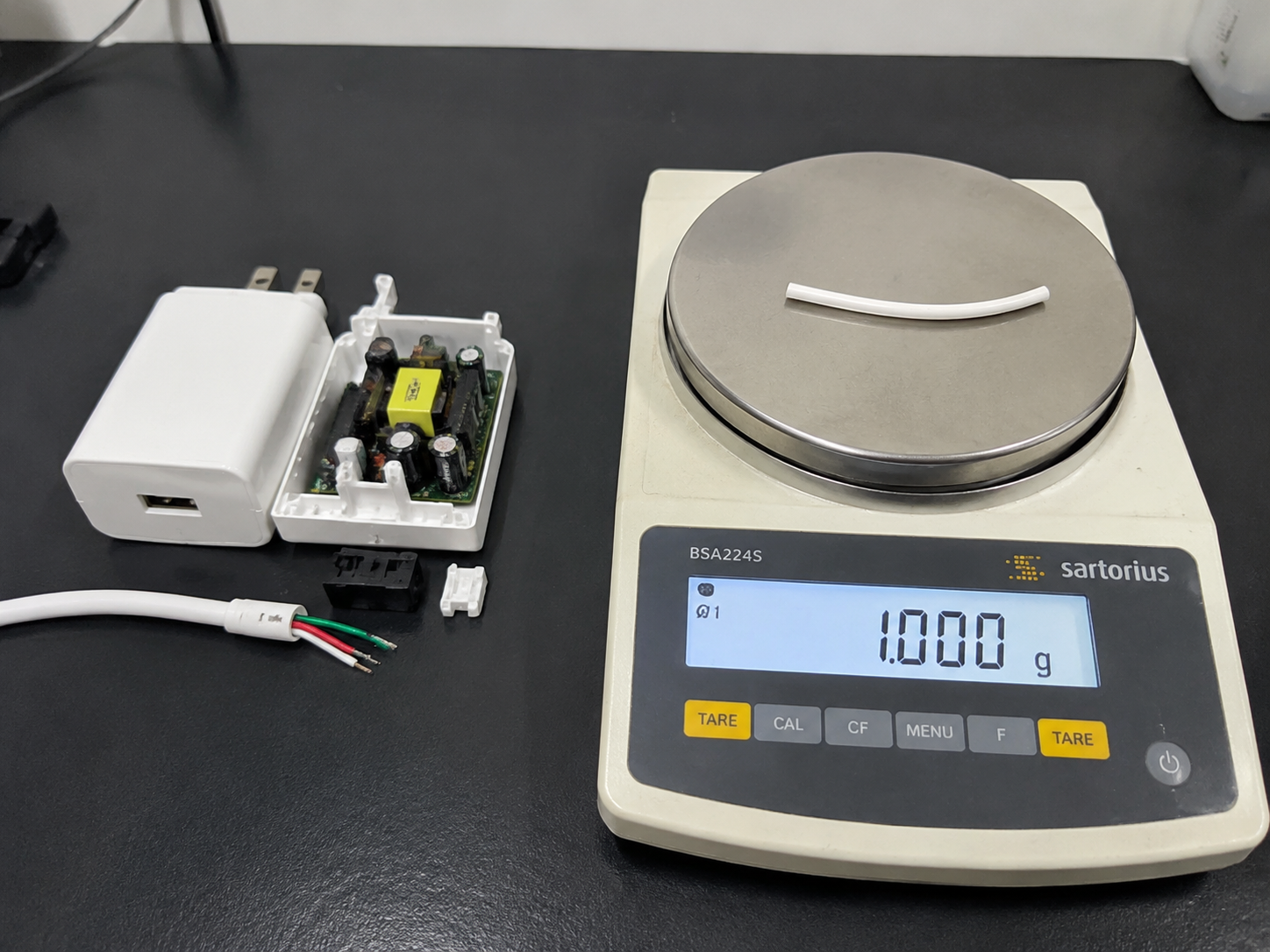
The information transmission responsibility is divided into two scenarios: if the customer is an enterprise (such as wholesale to UK offline distributors), it is necessary to proactively provide a compliance statement, including the substance name, the component it is in, and safe use recommendations; if sold to individual consumers, there is no need for proactive labeling or public disclosure, and you only need to reply free of charge within 45 days after receiving an inquiry.
The second type is notification responsibility, with stricter trigger conditions: notification to the UK Health and Safety Executive (HSE) is required only when the SVHC content of a single component exceeds 0.1% and the total annual import weight of the substance is ≥ 1 ton. For the vast majority of small and medium-sized sellers, the annual import volume of a single SVHC is difficult to reach 1 ton, so the notification responsibility is far from most people, and there is no need for excessive anxiety.
Registration Obligation: The Vast Majority of Finished Product Importers Do Not Need to Perform It
Let’s give the conclusion directly here: Almost all importers of finished charging products do not need to conduct UK REACH registration. The reason is simple: registration is for the chemical substance itself, and only applies to the import of substances or mixtures. Finished charging products are “articles” and do not intentionally release chemical substances during normal use, so they are directly exempt from registration.
There are only two exceptional scenarios where registration needs to be considered: first, importing chemical raw materials for production (such as solder paste, plastic pellets, glue) with an annual import volume of ≥ 1 ton; second, importing charging accessories with intentionally released chemical substances (such as charging cables with sterilizing coatings and the release volume meets the standard). Additionally: finished charging products do not need to provide SDS (Safety Data Sheet), and rarely involve authorization requirements. Don’t be fooled by third-party agencies into spending unnecessary money.
Compliance Record Keeping: Retain for At Least 10 Years
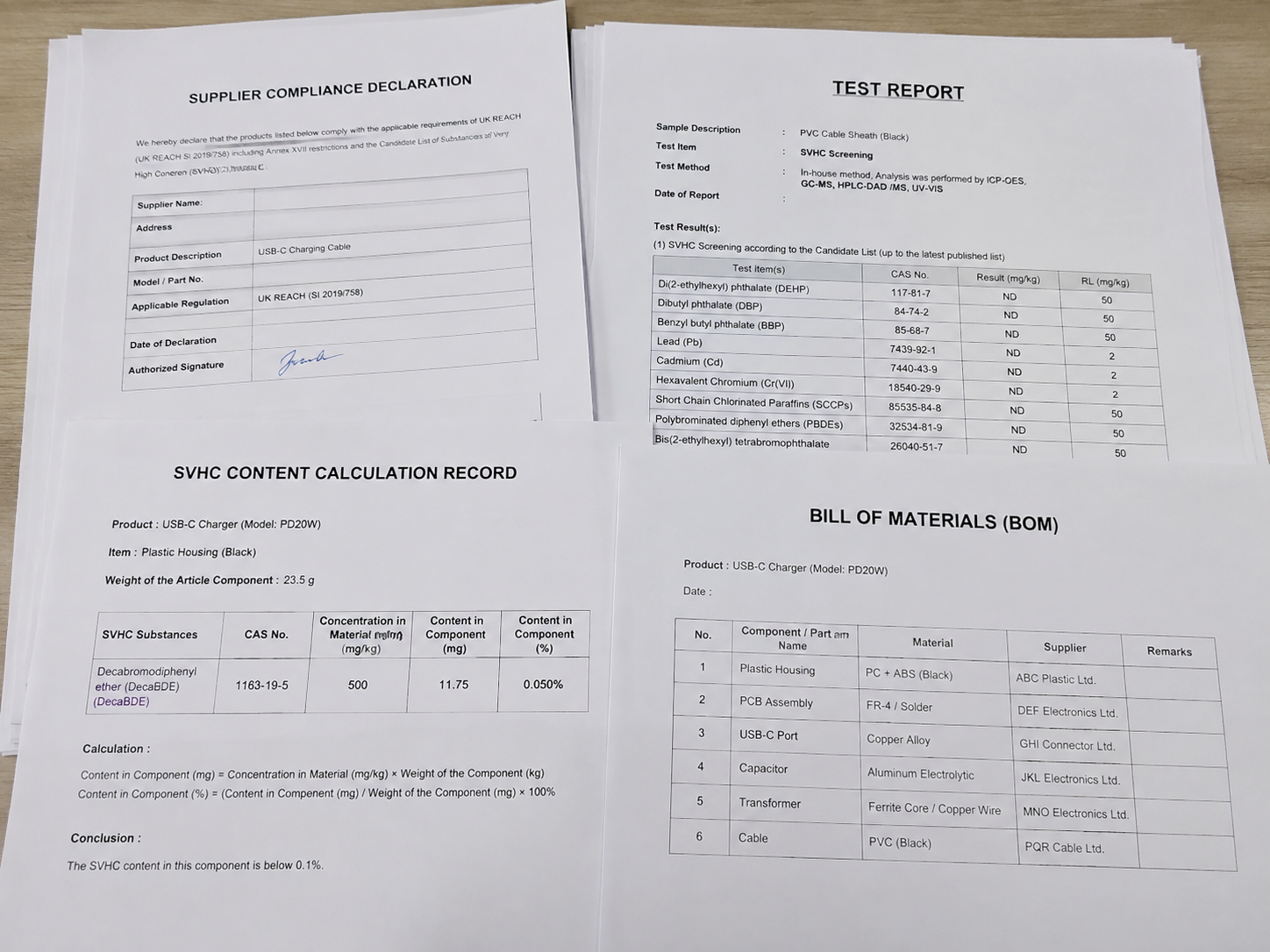
Compliance documents that importers need to keep include: supplier compliance declarations, third-party test reports for high-risk components, SVHC content calculation records, and product bill of materials (BOM). The retention period requirement is: at least 10 years from the last time the product was placed on the UK market. There is only one core requirement: the documents must be provided in a timely manner during regulatory spot checks; failure to provide them directly constitutes a violation.
Practical Process: Full Step Compliance from Order Placement to After-Sales
After finishing the obligations, let’s sort out the complete practical process from supplier selection to after-sales maintenance. Following the steps will ensure no items are missed.
Before Order Placement: Supplier Screening and Document Request
When selecting suppliers, prioritize those that can provide UK REACH compliance declarations, which can save a lot of subsequent costs. Three types of documents need to be requested from suppliers:
First, the compliance declaration. Note that this declaration must clearly indicate that it applies to the Great Britain (GB) market, covers specific product models/materials, and corresponds to the latest UK REACH list version — declarations that only state “compliant with REACH” without any specific information have no evidentiary value.
Second, third-party test reports for high-risk components, that is, reports for key components such as cable sheaths, housings, and metal coatings.
Third, material information of core components, used to calculate SVHC content.
Before Market Launch: Risk Investigation and Verification
Pre-market risk investigation is divided into three steps:
Step 1: Disassemble core components: housing, cable sheath, plug, USB contacts, PCB board, solder;
Step 2: Mark high-risk components (PVC cable sheath, plastic housing, metal coating, PCB solder, USB contacts) for key verification;
Step 3: Determine SVHC content: if the supplier provides a clear material formula, calculate the proportion based on individual independent components; for high-risk components without a clear formula, send them to a third party for SVHC screening.
Here is a practical cost control idea: there is no need to adopt a one-size-fits-all approach of testing all components. You can first test the three highest-risk components: PVC cable sheath, plastic housing, and metal coating according to risk priority; components such as PCB solder and USB contacts can be tested additionally if the supplier cannot provide clear compliance documents or materials are changed.
During Sales: Information Transmission and Platform Compliance
If the customer is a B-end customer and the product’s SVHC content exceeds 0.1%, you must proactively provide compliance statement documents; if it is a C-end consumer, there is no need for proactive public disclosure, and you only need to reserve an inquiry channel to ensure a reply within 45 days. In addition, e-commerce platforms such as Amazon’s UK site may require uploading UK REACH compliance documents, so it is best to prepare in advance to avoid products being temporarily removed from the shelves.
Customs Clearance and After-Sales: Continuous Compliance Maintenance
During customs clearance, there is no need to proactively submit UK REACH documents, but they must be retained for inspection. Among them, low-cost PVC charging cables have a relatively higher probability of being spot-checked.
In daily operations, regularly pay attention to updates of the SVHC list and restricted substance list, which are usually updated twice a year. Do not use outdated standards for compliance. If the product’s material or color is changed (for example, black PVC cable sheath is replaced with gray), the formula may be adjusted, and compliance needs to be re-evaluated.
If a batch is found to be non-compliant, first suspend the sale of that batch of products, trace the supplier’s responsibility, take measures such as material replacement and supplementary testing according to the situation, and take the initiative to recall in serious cases.
Advanced Judgment: Responsibility Boundaries in Different Scenarios
If you have already completed basic compliance and want to more accurately judge responsibility boundaries and avoid spending unnecessary money, you can refer to this part of the content.
Exemptions and Exceptions for Charging Products
There are two types of scenarios that usually do not constitute the importer’s performance obligations for commercial placement in the GB market: first, charging samples for exhibitions that enter temporarily (not for sale); second, charging products for personal use with reasonable quantity (such as chargers brought by tourists). It should be noted that this does not mean that the chemical restriction requirements of the product itself are automatically exempted, but only that there is no need to complete procedures such as notification and registration in accordance with importer obligations.
However, the following situations do not fall into the above categories: even if there is only one piece of commercially imported charging product, it must meet the restricted substance requirements; given commercial charging samples still constitute market placement behavior, and importer compliance obligations must be fulfilled.
Accurate Judgment Method for Registration Obligation
If you are unsure whether you need to register, judge according to three steps:
Step 1: Determine the type of imported object: finished chargers/cables/plugs are “articles” and usually do not require registration; plastic pellets, solder paste, and glue are substances/mixtures, which require further judgment.
Step 2: Calculate tonnage: calculated based on the total annual import volume of a single substance, not the total weight of the product; the import volume of the same importer, the same substance, and the same year must be calculated cumulatively (including sources from multiple suppliers).
Step 3: Confirm the compliance path: if a UK OR is appointed, it is necessary to confirm whether the OR covers the registered tonnage of the corresponding substance; it is emphasized again that EU REACH registration cannot automatically replace UK REACH registration.
Responsibility Boundaries with Other Charging-Related Regulations
Many sellers easily confuse UK REACH with other compliance requirements. Here is a table for quick differentiation:
| Regulation Name | Core of Regulation | Requirements Related to Charging Products | Relationship with UK REACH |
| UKCA | Electrical safety, electromagnetic compatibility | Finished products must bear the UKCA mark and comply with safety standards | Parallel requirements, mutually irreplaceable |
| RoHS | 10 types of hazardous substances in electrical and electronic equipment | Restricts 10 types of substances such as lead, cadmium, mercury, hexavalent chromium, polybrominated biphenyls, polybrominated diphenyl ethers, and 4 phthalates, which must not exceed legal limits | Partial overlap of substances, must comply with both |
| WEEE | E-waste recycling | Must register for recycling and affix recycling marks | Independent obligations, unrelated to each other |
| UK REACH | All-category chemical risks | Restricted substances, SVHC-related obligations | Special chemical requirements |
In short, UKCA is the general access for electrical safety, RoHS restricts 10 types of hazardous substances for electrical and electronic products, WEEE manages recycling, and UK REACH is a special chemical requirement covering far more substances than RoHS. Substances such as lead, cadmium, and phthalates are regulated by both RoHS and UK REACH, and the limits of both must be met simultaneously.
Responsibility Determination and Recourse for Supplier Non-Compliance
If the supplier provides false documents resulting in product non-compliance, the core conclusion is very clear: the importer still bears primary responsibility, and the regulator will definitely hold the importer accountable first.
The importer can seek recourse from the supplier, but this is a subsequent civil dispute. It is necessary to agree on compliance responsibilities and breach of contract compensation clauses in the procurement contract in advance, otherwise it is difficult to protect rights. The prevention method is also simple: prioritize suppliers with formal test reports, and you can conduct self-sampling re-testing for high-risk batches, using small costs to avoid major risks.
Pitfall Avoidance Guide: Violation Risks and Low-Cost Compliance
We have sorted out 6 most common pitfalls for importers. Avoiding them in advance can save a lot of trouble:
1. Thinking RoHS/UKCA is equivalent to UK REACH: UK REACH regulates more substances and also has SVHC-related obligations, which are completely two sets of requirements.
2. Calculating SVHC based on the average content of the whole machine: it must be calculated at the level of individual components that make up the product.
3. Thinking small-batch direct mail does not require compliance: restricted substances have no import volume threshold, and even one piece exceeding the standard is a violation.
4. Using EU REACH documents to cope: the two systems are independent, and compliance documents are not interchangeable.
5. Failing to retain compliance records: failure to provide documents during spot checks directly constitutes a violation.
6. Thinking finished products need registration/provision of SDS: only substances/mixtures need it, finished products do not need to handle it.
The consequences of violations also need to be clarified: the enforcement bodies of UK REACH are the UK HSE and local trading standards departments. If non-compliance is identified during customs clearance, goods may be detained, returned, or destroyed; if identified by market regulatory authorities, fines ranging from thousands to hundreds of thousands of pounds will be imposed, and import may be prohibited in serious cases; on e-commerce channels, it may lead to product removal and store fund freezing.
However, small and medium-sized sellers do not need to be anxious. There are several practical methods for low-cost compliance:
First, prioritize purchasing products that have provided UK REACH compliance declarations to reduce self-testing costs;
Second, only test high-risk components (PVC cable sheath, plastic housing, metal coating), no need to test all components;
Third, sellers with small annual import volumes should first confirm whether SVHC is below 0.1%, and if so, no notification is required;
Fourth, small sellers can use a simplified BOM to record core component suppliers, which is sufficient to meet basic traceability requirements.
Quick Self-Check: Importer Responsibility Checklist
If you are currently selling charging products in the UK market, you can quickly judge your responsibilities in 4 steps:
Step 1: Identity determination: Are you the entity that brings charging products into the GB market for sale? Do you need to appoint an OR?
Step 2: Scope determination: Is it a commercial charging product? Are there any exemption situations?
Step 3: Obligation check: Do restricted substances meet the requirements? Is information transmission performed if SVHC exceeds 0.1%? Is notification made if annual import exceeds 1 ton? Are compliance records retained for 10 years?
Step 4: Action matching: Adjust the performance method according to the import mode (general trade/direct mail/overseas warehouse).
After mastering these contents, you should have several core capabilities: determine whether you are an importer of charging products under UK REACH, identify high-risk chemical components and common restricted substances, distinguish between mandatory compliance items and registration obligations that do not need to be performed, complete the full chain of basic compliance from supplier selection to market launch, clarify the boundaries between UK REACH, RoHS, and UKCA, and avoid common misconceptions.
In general, although UK REACH has many professional terms and detailed rules, for small and medium-sized importers of finished charging products, the core logic is not complicated: control the chemical compliance of high-risk components, retain compliance records for the required duration, clarify the boundaries with other common regulations, and do not be overly troubled by concepts that sound complicated such as “registration” and “SDS”. Sorting out step by step according to the process will allow you to clearly grasp your own responsibilities and do a good job in compliance management.