
Many people who have bought charging accessories in the U.S. may have encountered this situation: the package is printed with “65W Super Fast Charging”, but the actual power when charging a laptop is less than 40W; or there is a large American flag on the front cover, and only when you turn to the back do you see the small print “Made in China” in the corner. These seemingly “wordplay” practices may actually violate the relevant regulations of the U.S. Federal Trade Commission (FTC).
Many people have misunderstandings about the FTC’s labeling requirements: some think it regulates the mandatory labeling content of all products, while others think it only manages “small labels stuck on products”. In fact, the FTC’s core regulatory logic revolves around the truthfulness of advertising: all public advertising targeted at consumers must not be misleading, whether it is printed on the product, on the packaging, or written on e-commerce pages or in customer service scripts. The following will take commonly used consumer-grade charging accessories such as wall chargers, USB charging cables, and multi-port chargers as examples to systematically sort out the FTC’s labeling and advertising compliance requirements, covering practical content for ordinary consumers to identify violations and for practitioners to conduct self-inspection before product launch.
Basic Understanding: FTC’s Regulatory Position and Industry Division of Labor
Core Position and Regulatory Scope
The core function of the FTC is to regulate the truthfulness of public advertising targeted at consumers, prohibit false or misleading commercial practices, and at the same time formulate special advertising, warranty, or information disclosure rules for specific fields. Its regulatory scope is far more than just the labels on the product itself; it also includes all public-facing information channels such as packaging, manuals, e-commerce product pages, social media promotions, and customer service scripts.
If FTC rules are violated, the violator may be required to stop the illegal advertising, rectify public information, refund consumers’ payments, pay civil fines, etc. The amount of the fine is determined on a case-by-case basis and there is no unified standard. If product safety hazards are involved and a recall is required, it is usually led by product safety regulatory authorities such as the CPSC (U.S. Consumer Product Safety Commission), and the FTC may also cooperate in law enforcement to put forward relevant relief requirements. Whether a recall is required depends on the specific case facts and product safety risks.
It is necessary to clarify the regulatory boundary here: for consumer-grade charging accessories such as chargers and charging cables, there is currently no general mandatory label list uniformly issued by the FTC; the specific content that belongs to mandatory labeling items needs to be checked item by item in combination with CBP, DOE, FCC, state laws, and applicable product safety standards. The core role of the FTC is to ensure that all public advertising (whether it is a mandatory labeling item or not) does not mislead ordinary consumers.
Division of Charging-Related Regulations/Certifications
Many people confuse the requirements of the FTC with those of other agencies. We can use a table to quickly sort out the common regulatory division of labor in the field of charging accessories. The specific applicable conditions need to be checked in combination with product categories:
| Regulatory Agency/Certification Type | Core Regulatory Content | Mandatory or Not | Connection with FTC Rules |
|---|---|---|---|
| FTC | Truthfulness of all consumer-facing advertising, prohibition of misleading | Yes (the bottom line for all advertising targeted at U.S. consumers) | Any false/misleading advertising directly violates FTC rules |
| CBP (U.S. Customs and Border Protection) | Country of origin labeling for imported products, requirements for import customs clearance-related information | Depends on rules: country of origin is a common mandatory requirement for imports, and importer information labeling needs to be checked according to specific product/customs rules | False country of origin labeling also violates FTC misleading advertising rules |
| DOE (U.S. Department of Energy) | Energy efficiency requirements for external power adapters that meet the definition and are not excluded | Yes (only applicable to covered external power adapters) | False energy efficiency claims also violate FTC rules |
| FCC (U.S. Federal Communications Commission) | Electromagnetic compatibility and radio frequency emission compliance of regulated radio frequency equipment | Depends on product category: products that are regulated radio frequency equipment need to obtain corresponding authorization according to rules; charging cables usually do not separately apply the same requirements as chargers | Claiming FCC compliance or authorization as a “safety certification” is a misleading act under FTC regulation |
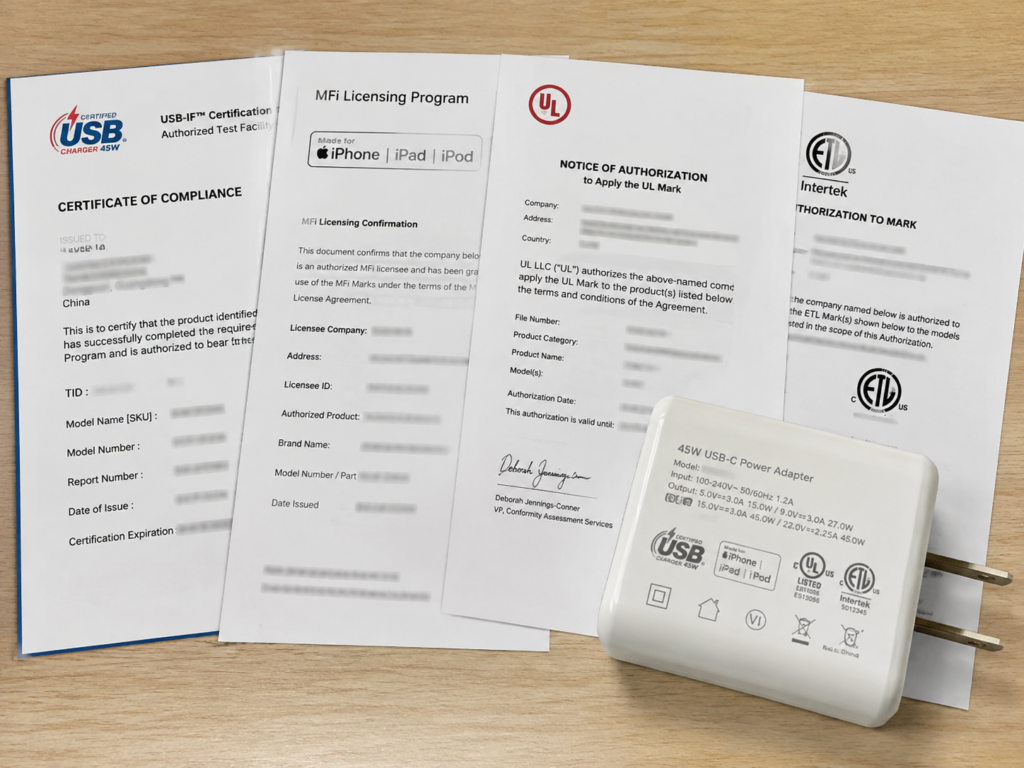
| Third-party certifications/authorizations such as UL/ETL/USB-IF/MFi | Third-party verification of product safety, protocol compatibility, etc., and authorized use of corresponding marks/trademarks (UL/ETL mainly focus on safety certification, USB-IF mainly focuses on USB protocol/product certification, and MFi is Apple’s accessory authorization system) | No (voluntary) | Labeling with certification marks without official authorization, or implying that official certification has been obtained, constitutes false advertising under FTC regulation; false compatibility claims also violate FTC rules |
| State laws/product safety rules | Format and durability requirements for some labels | Depends on state/product | Non-compliance may trigger the risk of FTC misleading advertising |
Applicable Product Scope
The following content mainly focuses on consumer-grade charging accessories for daily use by ordinary consumers, including wall chargers (power adapters), USB charging cables, multi-port chargers, adapters, etc.; for charging equipment for special purposes such as industrial, medical, and special vehicles, their labeling and safety requirements are usually managed by other special regulations or agencies, which will not be discussed in depth, but as long as such products are sold or advertised to consumers, the FTC’s misleading advertising regulatory principles may still apply.
Core Judgment Logic of FTC Compliance
Many people think that “as long as the literal meaning is not a lie, it is not a violation”. In fact, the core of the FTC’s judgment is: whether the overall presentation will cause an ordinary, reasonable consumer to have a wrong perception. There are three key details here:
First, the judgment should be based on the overall impression of text, patterns, symbols, and typography, not just the literal meaning. For example, if a large American flag is printed on the front of the package, even if the small print on the back says “Made in China”, the overall presentation may still be deemed misleading, because most consumers will default to thinking it is made in the U.S. at a glance.
Second, subjective intent on the part of the merchant is not required. Even if it is not intended to deceive, as long as the advertising content may objectively mislead consumers, it is a violation.
Third, disclaimers are not universally invalid. The key is whether they are clear, prominent, and easy to understand, whether they can promptly correct the main misunderstandings that consumers may form, and the content must not conflict with the main advertising; you cannot rely on small print hidden in corners, with too small a font, or with obscure expressions to offset the misleading impression of the main advertising.
Four-Step Compliance Analysis Method
Ordinary people can also use a simple four-step method to judge whether an advertisement is compliant:
Step 1: Find express statements: these are clear statements written directly, such as “100W PD Fast Charging” and “MFi Certified”.
Step 2: Find implied statements: these are information that is not directly written but implied through images, typography, and symbols. For example, if a picture of the latest iPhone is printed on the package, even if “MFi Certified” is not written, it may imply that the product is officially authorized by Apple; another example is using an American flag pattern to imply that the product is made in the U.S.
Step 3: Judge the overall impression: from the perspective of an ordinary consumer, what is the first conclusion drawn after a glance?
Step 4: Check restriction/disclaimer information: if the advertisement has preconditions, are these conditions clear and prominent enough to offset the possibility of misleading?
For example: the package of a multi-port charger says “65W Fast Charging”, with a picture of two ports charging at the same time next to it, with no other explanation. According to the four-step method, the express statement is “65W Fast Charging”, the implied statement is “65W can be achieved even when both ports are used at the same time”, and the first impression of ordinary consumers is “total power 65W, both ports can fast charge”; if in fact only a single port can reach 65W and the total power of dual ports is only 45W, it is necessary to label “only single port maximum 65W, dual port total power 45W” next to “65W Fast Charging” in an equally readable way to avoid misleading.
Two Rigid Rules
In addition to the core judgment criteria, there are two rigid rules with no room for negotiation:
First, all public statements must have verifiable and reliable evidence before being released. For example, if a product is claimed to be 65W, the corresponding test report must be obtained before launch; if it is claimed to have UL certification, official authorization must be obtained first, and evidence cannot be supplemented after being investigated.
Second, core information across all channels must not contradict each other. The content of different carriers such as the product itself, packaging, manuals, e-commerce pages, and social media advertising can be detailed or brief, but key information such as power, origin, and certification status must be consistent. You cannot label 45W on the product but boast 100W on the e-commerce page.
Liability Boundary
Many people also think that “if something goes wrong, the brand side is fully responsible”. In fact, liability is divided according to control:
Brands are responsible for the advertising content they produce, approve, and control; if they know that third parties (such as distributors, influencers) are making false advertisements but fail to take reasonable corrective measures in a timely manner, they may also be held liable.
Whether distributors, platforms, and advertisers bear FTC-related liabilities depends on whether they produce, modify, control, or substantially participate in specific advertising, as well as the corresponding legal relationships and facts. Not all liabilities are borne by the brand, nor can liability be directly determined simply by “knowing but not removing the product from shelves”.
Compliance Requirements for Core Claims
The FTC does not mandate that charging products be labeled with all parameters, but as long as a claim is made, it must be true and accurate and must not cause ordinary consumers to have wrong perceptions. The following are the compliance points for the most common advertising content of charging products, some of which mandatory labeling requirements need to be confirmed in combination with other regulations:
Electrical Performance Information
Electrical performance is the core selling point of charging accessories, and it is also the area where false labeling is most prevalent.
General requirements: The nominal input and output parameters and rated power must be consistent with the actual product performance. Short-term peak power must not be passed off as continuous output power under normal usage scenarios. The specific meaning of power needs to be judged in combination with factors such as product type, applicable standards, output gears, load conditions, and protocol negotiation. If the nominal power has applicable restrictions (such as only achievable in specific gears, only achievable with a single port), the restriction conditions must be clearly disclosed to avoid consumers’ misunderstanding that it is applicable to all scenarios by default.
Supplementary requirements for different products (all are necessary disclosures when making relevant claims, not unified mandatory labels by the FTC):
- Multi-port chargers: If advertising multi-port output capability, the maximum power of a single port, the total power when multiple ports are used at the same time, and the power distribution rules should be clearly stated to avoid consumers mistakenly thinking that each port can independently reach the maximum power.
- Fast charging/USB-C products: If labeled as “fast charging” or “high power”, information such as supported protocols, output gears, and applicable scenarios sufficient to avoid misunderstanding should be disclosed according to the specific claim content.
- USB charging cables: If performance such as “high current”, “PD fast charging”, or “data transmission” is claimed, key parameters such as rated current, transmission rate, and supported protocols should be clearly disclosed to avoid consumers having wrong expectations about actual performance. For example, if only “fast charging cable” is written without stating how much current it can carry, and consumers find after buying that it cannot support 65W, it may constitute misleading.
Product Identity and Accessory Information
The following items are practical check items to reduce the risk of misleading and meet specific product rules, and are not a mandatory label list uniformly stipulated by the FTC for all charging accessories.
General requirements: Clearly label the brand name, product model, and clear product type (such as “USB-C 20W Power Adapter”) to facilitate consumers to accurately identify the product; if only vague expressions such as “fast charging magic device” or “charging head” are used, causing consumers unable to judge the product type and specifications, it may constitute misleading. Specific mandatory labeling requirements need to be determined in combination with corresponding safety certifications, customs and other regulations.
If it is a combo set (such as charger + charging cable) and the overall performance of the set is advertised (such as “65W Fast Charging Set”), the specifications of the included items should be listed item by item, including quantity, interface type, length, power/current, etc., to avoid consumers mistakenly thinking that all accessories can reach the advertised overall performance. For example, if only “65W Fast Charging Set” is written, but the cable inside can only carry 3A and supports a maximum of 60W, which cannot actually achieve the 65W fast charging effect, it is misleading.
Country of Origin and Responsible Entity Information
Country of origin is a point where many merchants easily make mistakes, and it is also one of the FTC’s key regulatory areas.
First, the country of origin labeling of imported products must meet the requirements of customs and corresponding product regulations. The actual country of origin must be labeled, and it is not allowed to only label the place of assembly, packaging, or testing. For example, if the core components are all produced in China and only labeled and boxed in the U.S., it cannot be labeled “Made in USA”, otherwise it will not only violate customs rules but also constitute misleading advertising under the FTC.
Two different types of requirements should be distinguished here: country of origin labeling is a common mandatory requirement for import customs clearance and product labeling, while whether the name and address of the U.S. importer/distributor must appear on the product or packaging needs to be checked according to the specifically applicable product safety rules and customs declaration requirements. Not all charging accessories have a unified packaging labeling obligation, and this requirement is not within the mandatory scope of the FTC.
There is also the labeling issue for small-volume products: for example, for a very small charging head, can the country of origin be labeled on the package instead of the product? This depends on the requirements of the CBP or corresponding certification standards. The FTC has no unified exemption rules, and the core principle is still not to mislead consumers.
Energy Efficiency Related Information
The pitfall of energy efficiency advertising is mainly conceptual confusion.
The general requirement is: as long as energy efficiency grades or energy-saving effects are claimed, there must be measured basis.
The EnergyGuide label that many people have heard of actually only needs to be affixed mandatorily for categories designated by the FTC, and external power adapters are usually not on the mandatory list.
Three easily confused concepts should also be clarified here:
- DOE Level VI Energy Efficiency: It is a mandatory compliance requirement of the U.S. Department of Energy. External power adapters that are within the scope of DOE coverage and do not apply exclusions must meet the applicable DOE energy efficiency standards, which need to be checked specifically according to the current DOE definitions and applicable standards.
- Energy Star: It is a voluntary government program certification managed by the U.S. Environmental Protection Agency (EPA) with the participation of the Department of Energy (DOE). Specific product certification is carried out by accredited third-party institutions. Meeting the minimum DOE requirements does not necessarily mean obtaining Energy Star certification.
- Third-party energy efficiency testing: It is only a sample test report issued by an institution, and is not equivalent to official certification or program participation qualification.
Claiming DOE compliance as “Energy Star certification” constitutes false advertising.
Certification and Compatibility Information
Certification and compatibility claims are high-incidence areas of violations. It is necessary to pay attention to distinguishing the validity of different types of supporting documents and not to confuse boundaries. They can be divided into five levels from shallow to deep according to the verification logic, and each level cannot be confused with the others:
- Standard Compliance Statement: Refers to the product claiming to meet the requirements of a certain standard, which may be based on testing, technical documents, or supplier statements. It is not equivalent to third-party official certification, and cannot exceed the scope of its evidence support and applicable model coverage.
- Test Report: Only proves the performance of the submitted sample under specific test conditions. It is necessary to check whether the sample model, version, and test items are consistent with the mass-produced product, and cannot be directly equated with full-series compliance or official certification.
- Official Certification: Formally approved by the certification body, can be queried in the official directory or certificate of the corresponding institution, and only covers the specific models that have passed the certification.
- Mark/Trademark Authorization: Only with clear official authorization can the official logo or trademark of the certification body (such as UL mark, USB-IF mark, MFi mark) be used, and the scope of use must be consistent with the authorized models and product categories.
- Compatibility Claim: Belongs to performance description, such as “compatible with PD protocol” or “supports iPhone fast charging”. It requires corresponding test evidence to clarify applicable devices, protocol versions, and restrictions; if the claim itself lacks basis, is too broad in scope, or omits key restrictions, it may constitute misleading advertising. If at the same time, through text, typography, or visual design, consumers are misled into thinking that the product has obtained official certification, it will also trigger compliance risks related to certification marks or certification status.
Simply put, those who label third-party certification marks must have obtained official formal authorization for the corresponding model; those who claim that the product is compatible with a certain type of device need to explain the applicable scope and restriction conditions, and cannot exaggerate.
Warranty Information
General requirements: If the product provides a written warranty, key information such as warranty scope, warranty period, claim method, exclusion of liability, and freight bearing must be clearly stated.
Note: Not all charging products must provide a written warranty, but warranty promises made in public channels such as advertisements, packaging, and e-commerce pages may constitute a written warranty or an enforceable advertising promise. The specific situation needs to be checked in combination with applicable federal and state laws and warranty types, and performance cannot be refused afterwards on the grounds that “the advertisement does not count, and the manual shall prevail”.
Key Points to Avoid Pitfalls in High-Risk Claims
The following types of advertising are key regulatory targets of the FTC, and are also high-incidence areas of violations in the charging accessories industry, which require special attention:
Rules for “Made in USA” Statements
“Made in USA” is one of the easiest pitfalls, and the FTC has very clear regulations on this.
If it is an unqualified “Made in USA” statement (that is, directly saying made in the U.S. without any qualification), it requires that all or almost all raw materials and production links of the product are completed in the U.S. Only assembly, packaging, and testing in the U.S. do not count. For example, if all parts are shipped from China and only assembled with a shell and labeled in the U.S., it cannot be labeled “Made in USA”.
If the product has a lot of imported components and needs to mention its connection with the U.S., accurate and clear qualifiers must be used (such as “Assembled in USA, core components made in China”); qualified statements must still be consistent with the overall visual presentation, and must not conceal the facts of the main manufacturing links or imported components of the product, and must not make consumers still mistakenly think that it is unqualified made in the U.S. as a whole.
It is also necessary to pay attention to several easily confused expressions: “Assembled in USA” only means assembled in the U.S. and is not equivalent to made in the U.S.; visual elements such as the American flag and U.S. map on the package will be judged in combination with the overall presentation whether they cause misleading about U.S. production — if there is a large flag on the front and the origin is only labeled in the corner on the back, it will most likely be deemed misleading.
The most common pitfall for charging products is: products made in China are only shipped from U.S. warehouses, and expressions such as “shipped directly from U.S. warehouse” or “shipped from U.S. mainland” are used to imply that they are made in the U.S.; or they dare to label “Made in USA” just by putting a label on them in the U.S.
Rules for Fast Charging and Performance Claims
Fast charging is the most commonly used selling point for charging accessories, and it is also a hard-hit area for exaggerated advertising.
First, vague expressions such as “fast charging”, “high-speed charging”, and “super fast charging” need to be matched with key information sufficient to avoid misunderstanding. Five core elements can be uniformly referenced: supported protocols, applicable devices, output gears, test conditions (such as initial power, ambient temperature), and power attributes (peak/continuous, single port/total). For example, “supports PD3.0 65W single-port peak output, and can achieve fast charging on designated laptop devices that support PD protocol, with initial power below 50%, and at room temperature”; if a specific effect such as “charge to 50% in 30 minutes” is claimed, the corresponding test conditions must be clearly stated, and the test effect of a certain device cannot be packaged as a universally applicable performance.
Second, power claims cannot treat theoretical peak power as general continuous power for advertising. The applicable conditions for the power upper limit must be stated, such as “peak power 65W, continuous output power 45W”.
Finally, compatibility claims cannot use absolute expressions. For example, words like “compatible with all USB-C devices” must never be said, and restriction conditions must be noted, such as “compatible with most USB-C devices that support PD protocol, and some old devices may not support fast charging”.
Rules for the Use of Certification Marks
For certification-related violations, in addition to direct fraud, there are many covert operations.
First, third-party certifications (USB-IF, MFi, UL, ETL, etc.) must obtain official authorization for the corresponding model before labeling the mark, and cannot imply that certification has been obtained through text or typography.
Second, the scope of certification cannot be expanded: for example, only one model has passed UL certification, but it is said that the entire series has passed; or FCC is only radio frequency-related compliance, but it is advertised as “U.S. safety certification”. These are all violations.
There is also a type of covert violation: using expressions that originally belong to compliance or performance descriptions, such as “meets UL standards” and “compatible with PD protocol”, but typesetting them to be highly similar to official certification marks, even imitating the style of certification logos, or deliberately blurring the boundary between “meeting standards” and “official certification”, making consumers mistakenly think that the product has obtained official certification. This will also be deemed misleading, and the specific judgment can refer to the five-level verification framework mentioned above.
Rules for Energy Efficiency and Environmental Claims
The pitfalls of energy efficiency and environmental protection advertising are mainly concept swapping and empty claims without evidence.
In terms of energy efficiency, unobtained qualifications cannot be fabricated. The differences between DOE compliance, Energy Star certification, and third-party testing must be clearly distinguished, and DOE compliance cannot be claimed as “obtained Energy Star certification”.
In terms of environmental protection, claims such as “energy saving” and “zero standby power consumption” must be supported by measured data; expressions such as “recyclable” and “eco-friendly materials” need to clearly state whether the recyclable object is the product itself, packaging, or specific materials, as well as the recycling conditions that consumers can actually obtain; if there are no universally accessible corresponding recycling facilities locally, unconditional or vague recyclable claims must not be made.
Rules for Warranty Promises
The problem with warranty advertising is mainly ambiguity.
Especially for high-risk expressions such as “lifetime warranty”, it is necessary to clearly define what “lifetime” refers to — is it within the service life of the product, or the lifetime of the purchaser? At the same time, the applicable conditions must be clarified, for example, man-made damage is not covered by the warranty.
It should be noted that the warranty promise in public advertising must be consistent with the formal warranty terms, and the restriction conditions must be notified to consumers in a prominent manner.
Presentation Requirements for Different Information Carriers
No matter what carrier the information is placed on, it must comply with the FTC’s core judgment rules: important information is clear, prominent, and easy to understand, and restriction conditions must not be weakened or hidden. Information on different carriers can have differences in detail, but the core information must remain consistent. The following is the division of labor and requirements for four types of common carriers:
| Information Carrier | Common Labeling/Advertising Content | Core FTC Requirements | Main Basis for Mandatory Labeling |
|---|---|---|---|
| Product itself | Core parameters, brand model, origin, certification marks, etc. | All labeled content must be true and must not be misleading | Applicable regulations such as safety certification standards, CBP, FCC, etc. |
| Retail packaging | Complete product information, performance advertising, selling point descriptions, etc. | Must not contradict the core information of the product itself, and restriction conditions must be clear and prominent | Corresponding product regulations, state laws, FTC advertising rules |
| Manual | Detailed usage conditions, performance limitations, warranty details, etc. | Must not conflict with core advertising information, and supplementary explanations must be clear | Product safety standards, warranty-related rules |
| E-commerce page/online advertising | Scene display, performance introduction, user guidance, etc. | Must be consistent with the core information of the physical product, and must not exaggerate performance or conceal restrictions | FTC advertising rules, platform rules |
Supplementary explanations for two common questions:
The first is the durability requirement of labels: that is, the label must be firm, wear-resistant, and not easy to fall off. This requirement usually comes from safety certification standards or state laws, not a unified requirement of the FTC. For example, some safety standards require that the parameter label on the product cannot be scraped off by hand, otherwise it cannot pass the certification.
The second is alternative labeling for small-volume products: for example, for very small charging heads and adapters, can the information be moved to the package or manual? This needs to be judged according to specific regulations and certification standards. The FTC has no general exemption rules, and the core is still not to mislead consumers.
Common Violation Types and Cognitive Misconceptions
Combined with the regulatory situation of charging products, the following are the 7 most common types of violations and corresponding quick verification methods:
- False parameter labeling
Typical case: The charger is nominally 65W, but the actual continuous output is only 40W; the multi-port charger uses single-port peak power to pass off as total power.
Verification action: Check the attributes of the nominal power (peak/continuous, single port/total) and the test report of the corresponding mass-produced model. - Misleading origin
Typical case: The front of the package is printed with an American flag + “American brand”, and the small print in the corner on the back says “Made in China”, which overall easily makes consumers mistakenly think it is made in the U.S.
Verification action: Check whether the country of origin label is clear and prominent, and whether visual elements conflict with origin information. - Certification confusion
Typical case: Only passed FCC radio frequency-related compliance, but advertised as “U.S. safety certification”; only did UL standard testing, but printed UL certification mark.
Verification action: According to the five-level verification framework mentioned above, check whether the certification authorization scope, expression boundaries, and actual qualifications are consistent. - Exaggerated fast charging
Typical case: Only “super fast charging” is written without any parameters; advertising “full charge in 30 minutes” without explaining conditions such as test equipment and initial power.
Verification action: Check whether the fast charging claim is equipped with five core information: protocol, device, output gear, test condition, and power attribute. - False energy efficiency
Typical case: Not meeting DOE Level VI energy efficiency but claiming to meet the standard; claiming DOE compliance as Energy Star certification.
Verification action: Check the qualification documents corresponding to energy efficiency claims, and clearly distinguish DOE requirements, Energy Star certification, and third-party testing. - Vague warranty
Typical case: Advertising “lifetime warranty” without explaining the period and applicable conditions; claiming “replacement only, no repair”, but implying restrictions such as freight at own expense and only one replacement supported.
Verification action: Check whether the scope, period, claim method, and restriction conditions of the warranty promise are clear and publicly consistent. - Carrier contradiction
Typical case: The product itself is labeled 45W, the package is labeled 65W, and the e-commerce page advertises 100W; the parameter label is printed on the plastic film and is lost after unpacking.
Verification action: Compare whether the core information of all channels is consistent, and whether the label durability and labeling position meet the requirements of corresponding regulations.
There are also several common cognitive misconceptions, which are specially corrected here:
- Misconception 1: The FTC only manages U.S. local brands, not foreign brands. — All products sold to U.S. consumers, regardless of which country the brand comes from, are regulated by the FTC.
- Misconception 2: Having UL/ETL certification is equivalent to meeting FTC requirements. — Third-party certification is third-party verification of product safety or performance, and the FTC manages the truthfulness of advertising. The two cannot replace each other; even if there is certification, if you exaggerate the scope of certification, you will still violate FTC rules.
- Misconception 3: Charging cables do not need to be labeled with any parameters. — The FTC does not mandate that charging cables be labeled with parameters, but as long as you claim performance such as fast charging, high current, or data transmission, it must be true and accurate, and cannot be falsely labeled.
Practical Self-Inspection and Violation Handling
Quick Identification Methods for Ordinary Consumers
3-Step Quick Judgment Method
Step 1: Check core information: See if the brand, model, origin, and key performance parameters on the product itself and packaging are clear, and whether there is any vague or deliberately hidden situation.
Step 2: Compare information consistency: Compare the core parameters, origin, and certification information on the e-commerce page, packaging, and product itself to see if there are any contradictions, for example, the e-commerce page says 65W but the product is labeled 45W.
Step 3: Verify sensitive claims: If “Made in USA” is labeled, see if there is a clear qualifier; if official certification is labeled, you can first check through the official certification directory, authorization page, or brand official verification channel provided by the corresponding institution; if the relevant information is not publicly queryable, you can require the merchant to provide authorization documents or certification certificates corresponding to the final sales model. Note: Querying that a certain model is certified does not mean that all products of the same brand series have obtained certification.
Simple Performance Screening Method
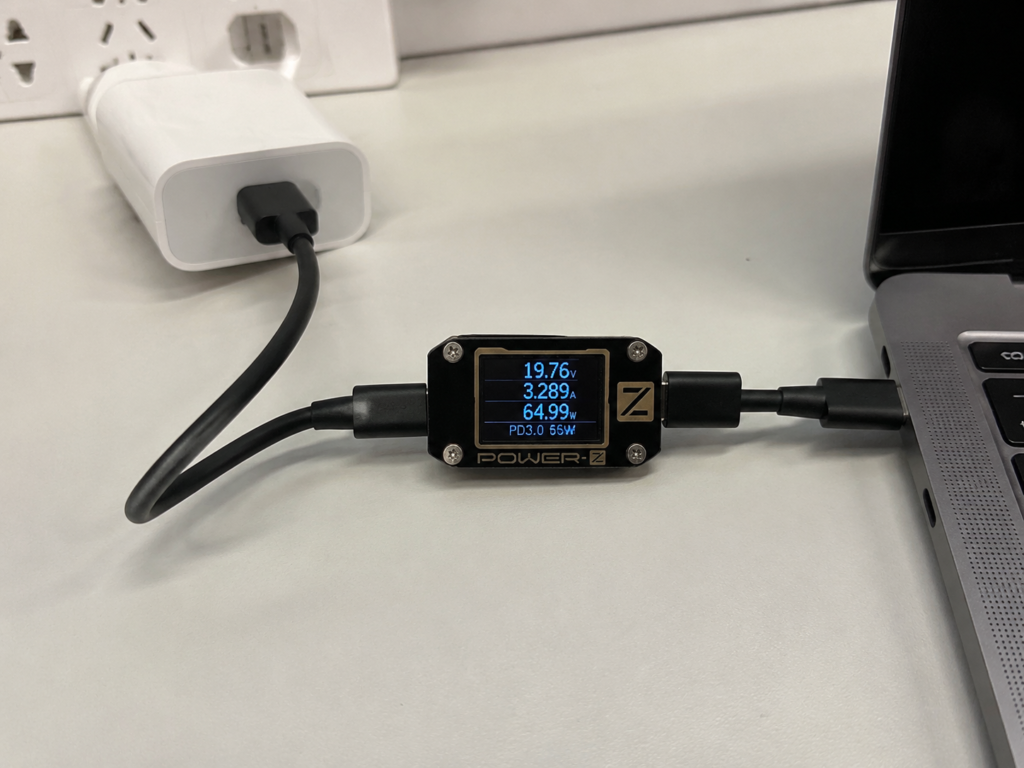
If you want to roughly verify whether the power is falsely labeled, you can use an entry-level USB power meter, paired with a device that supports the corresponding fast charging protocol, to test the approximate power at the nominal maximum output gear.
However, it is necessary to pay attention to the limitations of this method: the test results will be affected by factors such as the accuracy of the power meter, cable loss, and the current power of the device (for example, the power will automatically decrease when the phone is almost fully charged). It can only be used as a trend screening and cannot be used as a legal basis. If the test value is particularly different from the nominal value (for example, the nominal 65W is actually only about 30W), you can require the merchant to provide an official test report.
Pre-Launch Compliance Self-Inspection Tools for Practitioners
Pre-Launch Evidence Matrix
Different types of advertising claims require corresponding evidence, and such evidence must be available before the advertisement is released:
- Performance statement → Test report of the corresponding final mass-produced model
- Certification statement → Official authorization document for the corresponding model
- Origin statement → Supply chain records, country of origin certification documents
- Energy efficiency statement → DOE compliance test report (if applicable)
- Warranty statement → Formal warranty terms document
It should be noted that if a sample test report is used as evidence, it must be accompanied by mass production consistency control measures to ensure that the performance of mass-produced products is consistent with the sample. Otherwise, the qualification of the sample does not mean that the mass production is qualified.
Pre-Launch Compliance Decision Tree
Following these seven steps can cover most compliance risks:
- Identify product type: Clarify whether it is a charger, charging cable, or adapter, and whether it is an external power adapter (different products are subject to different regulations).
- Confirm sales channels and applicable regions: Whether it is sold online or offline, which states are covered, and whether there are special state-level labeling or regulatory requirements.
- Check mandatory labeling and compliance requirements:
- Imported products must meet CBP country of origin labeling requirements;
- External power adapters within the scope of DOE coverage must meet energy efficiency requirements;
- Radio frequency equipment within the scope of FCC regulation must obtain corresponding authorization and label the required marks according to rules;
- Check applicable state law special labeling requirements;
- Third-party safety certification marks such as UL and ETL are usually voluntary requirements, which need to be confirmed according to sales channels, customer requirements, or market strategies, and are not unified mandatory labels of the FTC.
- Sort out all advertising claims: including express and implied ones, covering all carriers such as the product itself, packaging, manuals, e-commerce pages, social media, and customer service scripts.
- Verify corresponding evidence: Check whether the evidence for each claim is complete, true, and corresponds to the final sales model.
- Check information presentation: Confirm that important information is clear and prominent, core information across all channels is consistent, and there is no contradictory or misleading content.
- Post-launch monitoring: Regularly monitor the advertising content of third parties (distributors, cooperative bloggers, platform users), and take timely measures such as correction and removal from shelves to reduce liability risks according to their own degree of control and legal relationships.
Violation Handling Methods
If ordinary consumers encounter non-compliant products, those who purchased online can first contact the merchant for return or exchange, and then complain to the sales platform; users in the U.S. can also directly submit a complaint through the FTC official website.
If a practitioner receives a warning or investigation notice from the FTC, they should rectify the relevant advertising content as soon as possible and prepare corresponding evidence materials to cooperate with the investigation.
The core of FTC compliance for charging products always revolves around the basic principle of “not misleading ordinary consumers”. Whether it is ordinary consumers identifying violations when purchasing, or practitioners conducting compliance self-inspection before launch, they can judge from three core dimensions: “whether the information is true, whether the restrictions are clear, and whether all channels are consistent”, and then check the mandatory requirements in combination with the applicable regulations of specific products, which can effectively avoid most compliance risks.