
When purchasing products such as chargers and power adapters in Australia, you may often hear terms like “ACRI energy efficiency” and “Australian energy efficiency star rating”, and even worry that products without energy efficiency labels are non-compliant counterfeits. In fact, the ACRI that many people talk about is not the official name of Australia’s energy efficiency system, and many commonly circulated claims also differ from official rules. The statutory energy efficiency regulatory system at the Australian federal level is centered on GEMS. Today, from the perspective of ordinary users, we will clearly explain the energy efficiency regulatory rules for charging products, covering everything from entry-level comprehension to advanced purchasing skills and pitfall avoidance.
Entry-Level Essentials: Core Framework of Energy Efficiency Regulation
First, understand a few core concepts, and you will not be confused by various abbreviations:
The statutory regulatory framework for energy efficiency and greenhouse gas emission reduction at the Australian federal level is called GEMS, which is equivalent to the general basis for energy efficiency rules of all regulated products. The E3 Program that people often hear about is an energy efficiency project system carried out in collaboration between the Australian and New Zealand governments. It provides technical and implementation support for energy efficiency regulation in both countries (including product registration, energy efficiency label management and other implementation work under Australia’s GEMS framework). The two are not in a simple superior-subordinate relationship.
The MEPS that people often hear about, whose full name is Minimum Energy Performance Standards, is equivalent to the energy efficiency access threshold for regulated products — products that fail to meet the corresponding standards cannot be commercially sold in Australia, nor can they be imported for the purpose of commercial sale.
Here we need to particularly clarify one of the most common misunderstandings: meeting MEPS requirements, needing to complete registration, and needing to affix an energy label are three independent requirements. Which obligations a specific product needs to fulfill cannot be generalized, and must be judged only after finding the rule document for the corresponding category. The “energy efficiency star rating” promoted by many merchants has no official validity if it is not the label for the corresponding category officially recognized by Australia.
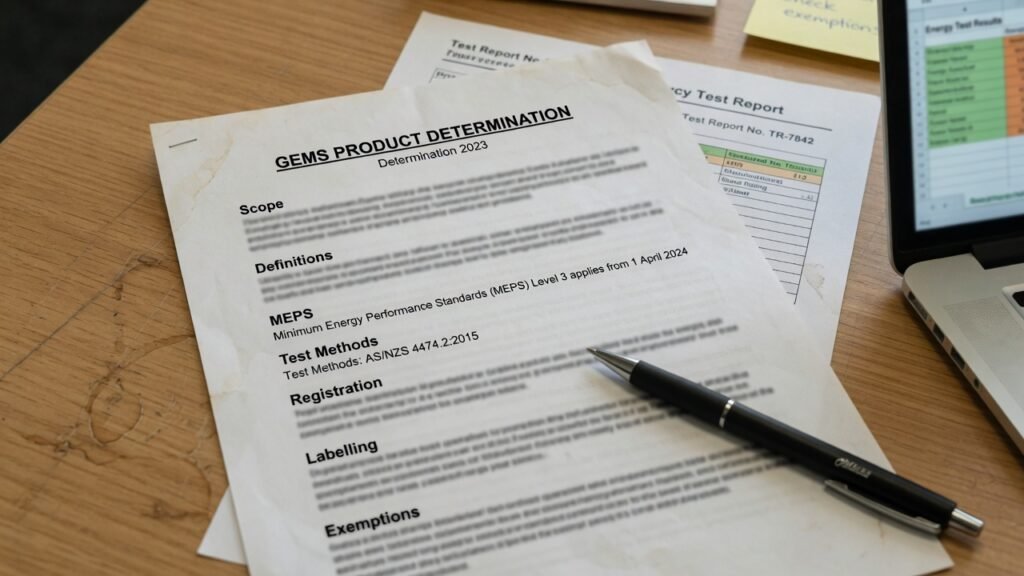
So how are these specific requirements determined? The answer is GEMS Product Determination. This is a specific rule document formulated separately for each category of regulated products under the GEMS system. For example, there is a corresponding Product Determination for external power supplies, and separate rules for battery chargers. These documents will clearly state the scope of application, product definition, MEPS limits, test methods, registration requirements, labelling requirements, and exemption situations for this type of product. If you need to check official rules, you can search for currently effective Product Determinations and their transition clauses by product category through the official regulatory pages of the GEMS Regulator or Energy Rating, and verify the determination name, effective date and cited test standards. Charging products must be judged for compliance based on the corresponding Product Determination that has taken effect at the time of sale; general rules cannot be applied, nor can requirements of other categories be used as a substitute. These rules are updated from time to time. To judge whether a product is compliant, the latest version in effect at the time of product sale shall prevail, and transition arrangements shall be subject to the content of official announcements.
Some people may ask: I am just an ordinary user, what is the use of understanding energy efficiency rules? In fact, it is closely related to you:
The first is saving money. Many people are used to leaving chargers plugged into sockets by the bed or on the desk all year round. The standby power consumption may seem insignificant, but it will accumulate a lot of electricity bills over a year. Take a simple calculation example: assume the standby power consumption of an old low-power charger is 0.5W (this is only a hypothetical example, the actual value shall be subject to the standard test result of the specific product). If it is plugged in 24 hours a day for 365 days a year, the annual standby power consumption is approximately 0.5W × 24h × 365 ÷ 1000 ≈ 4.38 kWh; if it is a more energy-efficient product, the standby power consumption may be as low as 0.05W, and the annual standby power consumption under the same usage scenario is only about 0.44 kWh. If there are several chargers that are plugged in all year round at home, the difference in electricity bills will be more obvious in the long run.
The second is more stable usage experience. MEPS is the energy efficiency access threshold under specified test conditions. Although it does not directly prove the material, service life or safety of the product, compliant products usually need to optimize circuit design to reduce heat caused by useless power consumption, so their heat generation performance during daily use is usually better.
The third is facilitating rights protection. If you buy a suspected non-compliant product sold commercially, you can use relevant clues as a basis for communicating with the supplier or reporting to the regulatory authority. Specific consumer remedies such as returns, exchanges and compensation still need to comply with the Australian Consumer Law and the actual situation of the corresponding transaction.
Entry-Level Core: Which Products Are Regulated and Which Are Not
After understanding the core concepts, the next question that everyone is most concerned about must be: which charging products are subject to these rules? Which ones are not? Many people think that “all plug-in active products are regulated”, but that is not the case. We can first conduct a preliminary screening from four dimensions, but whether a product is ultimately a regulated product must be confirmed item by item against the definition, scope, exclusions and cited test standards of the currently applicable GEMS Product Determination, and cannot be concluded based on a single item alone:
The first is product type, which must conform to the definition of “external power supply” or “battery charger” in the corresponding GEMS Product Determination. Common daily products such as USB wall chargers, laptop power adapters, and standalone AA/AAA battery chargers can only be used as common reference categories for preliminary screening. The final classification must be verified against the clear definitions, exclusion conditions (such as whether specific output types or specific-purpose products are excluded) and cited test standards in the corresponding Product Determination, and cannot be presumed solely based on interface type or number of ports.
The second is input and output characteristics. Preliminary screening needs to meet the basic characteristics of being connected to Australian standard 230V mains electricity and having voltage/current conversion functions, but the final judgment must also be combined with the specific provisions on output configuration and electric energy conversion form in the Product Determination. For example, car chargers, whose input is 12V/24V low-voltage direct current from a car, do not fall within the scope of mains-regulated products.
The third is rated power, which must be within the power range specified in the corresponding Product Determination. Different categories have different power coverage ranges, and not all power levels of similar products are regulated.
The fourth is nature of supply, which must fall within the scope of commercial sale or import for the purpose of commercial sale, including commercial orders from cross-border e-commerce.
Charging-Related Products That Are Usually Not Subject to Energy Efficiency Regulation
There are three main categories, and the specific situation still needs to be confirmed in combination with regulatory scenarios:
The first category is passive accessories, such as ordinary charging cables and adapters without power conversion circuits, which are usually not subject to GEMS energy efficiency requirements. Their safety, electromagnetic compatibility, labelling and other obligations need to be judged separately according to the corresponding Australian regulations based on product attributes.
The second category is built-in power supplies, such as power modules integrated inside mobile phones and laptops. These need to be judged according to the energy efficiency rules corresponding to the complete device, and do not fall under the regulatory category of separate external power supplies.
The third category is non-commercially supplied products. For products carried into the country for personal use, samples for non-sales purposes, and second-hand transfers between individuals, whether regulation applies needs to be comprehensively judged based on whether it constitutes a “supply” act as defined by law, the purpose of import, and specific product rules, and it is not automatically exempt.
Judgment Rules for Easily Confused Scenarios
There are also several scenarios that people often mix up, which we will explain separately:
For example, chargers bundled with complete devices, such as charging heads given with mobile phones and adapters given with laptops, need to be judged separately whether they are regulated according to the corresponding Product Determination. The responsibility is borne by the supplier of the complete device; it is not that if the complete device is compliant, the bundled charger will automatically be compliant.
Another example is multi-port USB/USB-C charging stations, which can only be preliminarily classified into the external power supply category for pre-judgment. The final rated output determination and test configuration (such as total load vs single-port load, requirements for simultaneous multi-port output, etc.) shall be subject to the applicable Product Determination and cited test standards, and cannot be classified solely based on single-port power, total power or number of ports.
There are also car chargers: as long as the input is on-board low-voltage direct current, they are not mains-regulated products and do not need to meet the GEMS energy efficiency requirements for mains products.
Entry-Level Practical Guide: How to Read Energy Efficiency Parameters
Many people see parameters such as “95% conversion efficiency” and “0.01W standby power consumption” on product detail pages, and do not know whether they are true or false, nor how to compare them. First of all, we must clarify a premise: official energy labels only apply to categories clearly specified by regulations, such as large household appliances like refrigerators, air conditioners, and washing machines. Whether charging products need to be labelled depends entirely on the requirements of the corresponding Product Determination. Do not default to a charger being non-compliant just because you do not see an energy efficiency star label on it — the core of compliance judgment for charging products is all the requirements of the corresponding Product Determination, not whether there is a label. Labels such as “5-star energy efficiency” and “super energy-saving” printed by merchants themselves have no official validity if they are not supported by official testing or registration.
Core Energy Efficiency Parameters and Premises for Reading
There are four core energy efficiency parameters that ordinary users can access, and corresponding preconditions must be noted when comparing:
The first is conversion efficiency, which simply refers to the ratio of mains electricity converted to charging voltage. For example, if 100W of mains electricity is input and 90W is output, the efficiency is 90%. The higher the efficiency, the less electricity is wasted, and the lower the heat generated by the charger. However, conversion efficiency is only meaningful for comparison when corresponding to specified test conditions and for products of the same type and power range. Products of different power and different types have no direct comparability in efficiency itself.
The second is standby power consumption (no-load power consumption), which is the power consumption of the charger when it is plugged into the socket and not connected to a device for charging. This parameter has a great impact on chargers that are plugged in all year round, and is one of the core factors affecting long-term total power consumption. The compliance limit for standby power consumption shall be subject to the test conditions and limits specified in the corresponding GEMS Product Determination.
The third is rated power, which is the maximum power that the charger can output. When comparing energy efficiency, it must be carried out between products of the same power range and same product type; cross-power-range efficiency comparison has no practical significance.
For multi-port products, also note that you cannot only look at the maximum efficiency of a single port; you need to judge based on the overall efficiency under total load, and the specific test method shall be subject to applicable standards. For example, a 65W dual-port charger has higher efficiency when a single port is used alone, but when both ports output at full load at the same time, the total efficiency may change. In this case, the result of the test scenario specified by the standard shall prevail.
Where to Find Energy Efficiency Information
The display location of energy efficiency information varies for different products:
For ordinary single-port wall chargers, most basic parameters are printed on the nameplate on the side of the plug, and more detailed compliance declarations can be found on the product detail page or packaging.
For multi-port fast charging chargers, the total power and output specifications of each interface are usually marked; specific energy efficiency test data may not be publicly available. You can request it from the supplier and verify its test conditions, product version and applicable regulations, or query public registration records to check visible filing fields such as brand and model, but the registration database usually does not disclose complete test reports.
If it is a charging kit (charger + cable), the energy efficiency requirement only applies to the charger inside. Passive charging cables have no separate GEMS energy efficiency requirements, so there is no need to worry about the energy efficiency of the cable.
Semi-Proficient: Core Logic of GEMS Compliance
If you want to have a deeper understanding of compliance judgment standards, or are a practitioner in the Australian market, you need to understand the core assessment logic of MEPS access and the key prerequisites for judging compliance.
Core Assessment Dimensions of MEPS Access
MEPS assessment does not only look at a single parameter; specific items are subject to the provisions of the corresponding GEMS Product Determination, and the core usually includes several directions:
The first is average conversion efficiency: the calculation method of average efficiency, specified load points and output modes are all subject to the test standards cited in the applicable Product Determination, not just the maximum efficiency at full load. Many merchants promote “95% full-load efficiency”, but the efficiency under other operating conditions such as low load may be very low, and the average may not meet the requirements.
The second is standby power consumption: that is, the power consumption at no load, which is a core factor affecting total power consumption in year-round plug-in scenarios, and is also one of the key points of MEPS assessment. The specific limits and test conditions are subject to the corresponding rules.
The third is multi-level/multi-mode efficiency: for fast charging products that support multiple voltage levels and multiple output modes, the test requirements and compliance judgment rules for each level must also be implemented in accordance with applicable standards and Product Determinations, and there is no general rule that “compliance is achieved as long as a single level meets the standard”.
Key Prerequisites for Compliance Judgment
There are several prerequisites that must be met for compliance judgment. Conclusions drawn by ignoring these prerequisites are invalid:
The first is accurate product classification. The rules for external power supplies and battery chargers are different, and standards cannot be mixed. For example, applying the requirements of external power supplies to battery chargers will definitely lead to wrong conclusions.
The second is corresponding to the correct power range. MEPS limits are different for different power ranges. Cross-power-range efficiency comparison is meaningless, and comparison must be carried out within the same power range.
The third is unified test conditions. Standard energy efficiency tests are conducted under specified room temperature, 230V Australian standard voltage, specified load points and output modes. In actual use, due to voltage fluctuations, different ambient temperatures, and different load conditions, the actual efficiency will deviate from the test value, which is a normal phenomenon. The performance in actual usage scenarios cannot be used to directly determine compliance.
The fourth is reviewing the currently applicable regulatory version and transition provisions, to avoid using old rules to judge newly launched products, and also not using new versions of rules to randomly retroactively judge previously sold products.
Correction of Common Cognitive Biases
There are also several common cognitive biases that many people even sellers get wrong:
The first is believing that the interface type determines energy efficiency, for example, thinking that USB-C chargers are necessarily more energy efficient than USB-A ones. In fact, the interface is only the physical form of output, and has no direct relation to energy efficiency. Whether the energy efficiency is high depends on the measured data under the same test conditions; there are low-energy-efficiency USB-C chargers, and high-energy-efficiency USB-A ones.
The second is believing that annual power consumption is a mandatory parameter required by the authorities. In fact, there is no unified requirement for mandatory marking of annual power consumption for charging products. Most of the annual power consumption marked by merchants is estimated based on their own assumed usage scenarios, which can only be used as a reference and cannot be used as a basis for official judgment.
The third is believing that there is a general efficiency compliance range, for example, “efficiency above 85% is compliant”. In fact, the efficiency of products with different power, different types, and different designs varies greatly. Compliance depends on the specific MEPS limits of the corresponding category and power range, and there is no general judgment standard.
Semi-Proficient: Supply Chain Responsibility and Compliance Practical Process
Many people are curious: who is actually responsible for compliance? If you buy a non-compliant product, who should you contact?
Division of Compliance Responsible Entities
There is no fixed general list of responsible entities for compliance of regulated products, which must be confirmed one by one in combination with the applicable GEMS Product Determination, actual import/supply arrangements, and registration requirements. For regulated products that require registration, statutory responsibility is usually borne by the corresponding supply chain role — Australian local manufacturers, importers, and local suppliers may become the primary responsible entities depending on the supply model; cross-border sellers that commercially sell regulated products to Australia must fulfill compliance obligations in accordance with regulatory requirements, and may not directly use CE marks, energy efficiency labels from other countries/regions, or self-test reports not issued in accordance with Australian designated standards as a substitute for GEMS compliance certification. Test methods, reporting entities, and document retention requirements are all subject to the provisions of the corresponding Product Determination.
Basic GEMS Compliance Process
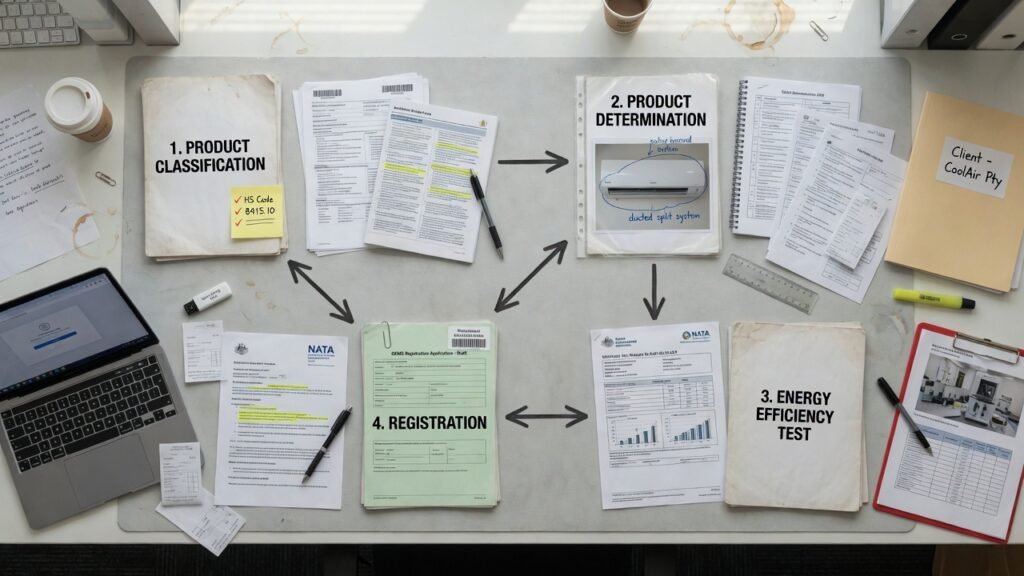
The basic logic of GEMS compliance is divided into four steps, and specific requirements need to be adjusted in combination with the corresponding Product Determination:
The first step is product classification: first confirm whether the product is an external power supply, a battery charger, or a non-regulated product. This is the most basic step; incorrect classification will invalidate all subsequent judgments.
The second step is finding the corresponding effective GEMS Product Determination, to clarify the MEPS limits, test standards, registration requirements, labelling requirements and exemption situations specified in it.
The third step is completing energy efficiency testing according to specified standards, and keeping the test report and related technical materials properly for random inspection by regulatory authorities.
The fourth step is completing registration (if required): if the Product Determination requires registration, the responsible entity that meets the requirements shall complete the registration to ensure that the registered model and parameters are completely consistent with the actual product.
Notes on Regulatory Updates and Transition Periods
GEMS Product Determinations will update limits or expand the scope of application from time to time, and a transition period is usually set when updating. However, the specific transition duration, scope of application, and retroactive rules for sold products are all subject to the official announcement of the update and the transition provisions in the Product Determination, and cannot be generalized. In addition, if the product is revised, such as modifying the circuit, adjusting the power, or changing the model, compliance needs to be re-evaluated, and the registration information of the old model cannot be directly used.
Purchasing and Verification: From Entry to Advanced
After talking about so many rules, let’s return to the question that ordinary users are most concerned about: how to judge whether the energy efficiency is compliant when buying a charger? How to choose a product that suits you?
Three-Step Purchasing Judgment Method
Here is a simple three-step purchasing method for everyone, which is practical and easy to operate:
First step, first confirm that the product’s power and fast charging protocol match your own device. For example, if your mobile phone only supports 20W PD fast charging, even if you buy a 100W high-energy-efficiency charger, it will not work and is a waste of money. This step is the foundation; no matter how high the energy efficiency is, it is useless if it does not match.
Second step, check whether the merchant provides clear GEMS compliance-related instructions, or verifiable energy efficiency test data and registration information. If the merchant only vaguely says “compliant with Australian regulations” but cannot provide any specific basis, you should be cautious.
Third step, compare energy efficiency parameters between products of the same power range and same type, and prioritize those with higher conversion efficiency and lower standby power consumption. Of course, you should also consider the price comprehensively.
Purchasing Priorities for Different Scenarios
For different usage scenarios, the priority of purchasing is also different, and there is no need to blindly pursue the highest energy efficiency:
For year-round plug-in scenarios, such as fixed chargers by the bed or on the desk, prioritize high-energy-efficiency products with lower standby power consumption. You can estimate whether it is worth paying a premium for lower power consumption based on the standby power consumption difference, daily plug-in duration, local electricity price, and product price difference.
For occasional use scenarios, such as backup for business trips or temporary charging, prioritize portability and cost-effectiveness. There is no need to spend a lot of money on the highest energy efficiency, after all, the frequency of use is low, and the total amount of electricity saved is limited.
For buying a multi-port charger, prioritize referring to the overall efficiency under total load specified by the standard, do not only look at the maximum efficiency of a single port, after all, multi-port chargers are mostly used with multiple devices at the same time.
Methods for Querying Official Compliance Information
If you want to verify the compliance status of a product, there are two official query portals, each with different uses:
One is the Product Registration Database on the official website of the GEMS Regulator, which can be used to query registration information such as brand and model of regulated products that require registration. The public fields of the database are subject to the product category and current registration rules, and usually do not include complete test efficiency or technical materials, and cannot replace the test report held by the supplier; moreover, database records only represent the filing status at the time of registration, and do not constitute a complete guarantee of the continuous compliance of the actual product.
The other is the Energy Rating website. However, this website only displays products with official energy labels, and the vast majority of charging products are not within the display scope of this website, so do not think that a charger is non-compliant just because you cannot find it on this website.
When querying, note that you must enter the accurate brand and model. If you enter the wrong letter or the model suffix is different, you may not find results. There is also a very important point: no query result does not mean the product is definitely non-compliant. There are several common reasons: the product may not be within the scope of GEMS regulated or registration-required products, the entered brand model or suffix is inconsistent with the filing information; if it is confirmed that the product falls within the regulated scope requiring registration but cannot be found, you need to further verify with the supplier or report to the regulatory authority.
Pitfall Avoidance Essentials: Common Misconceptions and Judgment of Genuine vs. Fake Compliance
Finally, we have sorted out the most common cognitive misconceptions, as well as methods for judging genuine and fake compliance, to help everyone avoid pitfalls.
5 Common Cognitive Misconceptions
We have organized them into a comparison table for quick reference:
| Common Misconception | Correct Statement |
|---|---|
| The higher the energy efficiency star rating, the faster the charging speed | Energy efficiency refers to power-saving ability and has nothing to do with charging speed; most charging products do not have an official energy efficiency star rating, and self-awarded ratings by merchants have no official validity |
| Charging cables need to comply with GEMS energy efficiency requirements | Passive charging cables have no power conversion circuit and are usually not subject to GEMS energy efficiency regulation; their safety, EMC and other obligations are implemented in accordance with corresponding regulations |
| If a product has the RCM mark, GEMS compliance does not need to be considered | RCM covers safety, EMC, radio and other categories, does not include energy efficiency requirements, and cannot replace GEMS compliance |
| The CE mark can replace Australian energy efficiency requirements | CE is a European Union compliance mark, not recognized by the Australian energy efficiency system, and cannot be directly used as proof of GEMS compliance |
| All active charging products are regulated by GEMS | A comprehensive judgment must be made by referring to the applicable Product Determination, combining factors such as product type, input characteristics, power rating, and nature of supply |
Three Steps to Initially Judge Genuine vs. Fake Compliance
If you want to initially judge whether the compliance promoted by merchants is true or false, you can follow these three steps:
First step, Check the reasonableness of the declaration. If a merchant only promotes “compliant with Australian energy efficiency” but has no specific parameters, test basis or registration information, just making empty claims, then you should be cautious.
Second step, Check official registration. If the product is within the regulated scope and requires registration according to the Product Determination, you can go to the GEMS Registration Database to query the filing status of the corresponding model, and check whether the brand and model are consistent.
Third step, Check information consistency. The model and rated power on the product nameplate must be completely consistent with the information on the packaging and product detail page. If even the model does not match, there is a high probability of a problem.
Common Invalid Compliance Certifications
There are also several common invalid compliance certifications, do not be fooled:
The first type is energy efficiency labels from other countries, such as the China Energy Efficiency Label, EU ErP label, etc. Because each country has different test standards and limit requirements, they cannot be directly used as proof of compliance in Australia.
The second type is self-awarded “energy-saving” and “high-efficiency” promotions by merchants, which are not supported by officially recognized test reports or registration information. These have no compliance validity and are just marketing rhetoric.
The third type is only a single efficiency value is marked without explaining the test conditions and corresponding regulatory version. It is impossible to judge under what circumstances this efficiency was measured, nor can it be judged whether it is compliant against the MEPS limit, so the reference value is very low.
Summary
Overall, the energy efficiency regulation of charging products in Australia may seem to have numerous provisions, but its core logic can actually be summarized into four steps: first, conduct a preliminary screening of whether the product may be regulated by combining product type, input characteristics, power rating, and nature of supply; then, find the corresponding currently effective GEMS Product Determination through official channels to verify the rules; next, compare energy efficiency parameters under the premise of the same type and same power range; finally, verify the authenticity of compliance through public registration channels or supplier materials.
For ordinary users, there is no need to memorize all the rules by rote. As long as you can distinguish the core concepts, avoid common cognitive misconceptions, and choose products suitable for your own usage scenarios according to your needs, you can avoid being misled by marketing rhetoric and choose compliant and easy-to-use charging products.