
Most sellers of electronic and electrical products in the Australian market have probably heard of the RCM mark, but many still understand it as “just stick a label and you can list the product” — until they receive a regulatory notice, have their products removed from shelves, or even face fines, only then do they realize that RCM is not a formalistic labeling requirement, but has a complete enforcement and penalty system behind it. This article explains RCM’s enforcement entities, violation consequences, pitfall avoidance methods, and response strategies from basic entry-level knowledge to practical judgment, suitable for cross-border sellers, suppliers, and compliance beginners to reference.
First, Understand the Basics: Core Concepts of RCM and Enforcement
Let’s first clarify the two most easily confused concepts to avoid going astray from the start.
The full name of RCM is Regulatory Compliance Mark, which is a compliance mark used to indicate that the supplier has fulfilled the applicable regulatory requirements, and is affixed to the product by the supplier in accordance with the rules. It is neither a certification certificate issued by the Australian government, nor a substitute for statutory compliance obligations such as product testing, declaration of conformity, and responsible supplier registration. In essence, it is a “public disclosure mark” for product compliance.
RCM enforcement refers to the compliance verification and accountability actions of regulatory authorities for regulated products after they are placed on the market, which belongs to ex-post supervision — enterprises must first complete their compliance obligations before selling products on the market, and regulators verify whether the compliance commitments are true after the fact.
The core purpose of this mechanism is very clear: to prevent three types of risks — electric shock, fire, and radio interference — and to protect consumers’ personal safety and public communication order. A key boundary must be drawn here: RCM compliance is an obligation that must be completed before marketing, while enforcement is a verification link after marketing, and the two belong to different regulatory stages.
Quickly Determine Whether a Product is Regulated with Three Questions
Australia does not have a unified “RCM product catalog”. You can make a preliminary judgment layer by layer through three questions. The same product may meet multiple regulated conditions at the same time, and needs to meet the compliance requirements of the corresponding fields respectively.
First question: Is it in-scope electrical equipment for electrical safety?
The determination of in-scope electrical equipment for electrical safety needs to combine two core conditions: first, whether the voltage of the power supply system connected to the product is within the statutory range; second, whether the product belongs to the categories covered by EESS. EESS here refers to the Electrical Equipment Safety System, which is a collaborative framework for Australian states/territories to coordinate electrical safety rules, not a single enforcement agency.
Several easily confused boundaries need attention:
- Products powered only by USB or battery cannot be directly determined to be exempt, and need to be confirmed in combination with specific product standards, voltage levels, and applicable rules;
- Purely mechanical non-electrical products (such as manual screwdrivers) are not within the scope of electrical safety regulation;
- Second-hand items transferred privately for non-commercial purposes usually do not apply to the compliance requirements of commercial supply, but this does not exempt other statutory liabilities, and cannot be generally inferred from individual cases;
- In addition to RCM-related requirements, medical devices may also be subject to special supervision by the Therapeutic Goods Administration (TGA) of Australia.
Second question: Is it regulated equipment for electromagnetic compatibility (EMC)?
The core of Electromagnetic Compatibility (EMC) rules is to prevent products from generating electromagnetic interference that affects public communication or the normal use of other equipment, while ensuring that the product itself can resist common electromagnetic interference. Any electronic and electrical product that can generate electromagnetic interference or is susceptible to electromagnetic interference may be subject to EMC rules. For example, ordinary plug-in desk lamps, although they have no wireless function, also need to meet EMC requirements. The specific scope of regulation needs to be verified in combination with product types and applicable standards.
Third question: Is it regulated equipment for radiocommunications?
Devices with wireless transmission functions (such as products with WiFi, Bluetooth, or specific frequency band remote control functions) usually need to verify radio compliance requirements. Whether they are regulated and what requirements need to be met need to be confirmed item by item in combination with the operating frequency band, transmission power, device type, and applicable exemption rules of the device. Not all remote control devices and receiving devices are subject to the same rules. For example, a smart light bulb with Bluetooth needs to verify compliance requirements in three fields: electrical safety, EMC, and radiocommunications at the same time.
Responsible Entities and Accountability Logic
Many cross-border sellers have a fluke mentality: I ship from China, so Australian regulators can’t control me? That’s not the case.
Australian local responsible suppliers registered in accordance with EESS and ACMA related rules are the core entities bearing compliance obligations, responsible for completing corresponding registrations, retaining compliance evidence, and cooperating with supervision. In addition, local manufacturers, importers, distributors, and retailers may all bear corresponding responsibilities according to specific violations and applicable regulations. The scope of obligations of different entities is determined according to their roles in the supply chain, and retailers do not necessarily bear the same pre-compliance obligations as importers.
As for overseas cross-border sellers, they are also within the scope of supervision: regulators can hold them accountable through border interception, e-commerce platform cooperation, cross-border regulatory cooperation and other means, it is not that “you don’t need to be responsible if you are overseas”.
3 Cognitive Misconceptions Beginners Must Avoid
These three pitfalls are most likely to be stepped on by beginners, and clarifying them in advance can save a lot of trouble:
First, Can you use RCM directly if you have CE/FCC? Wrong. Australia has exclusive safety, EMC, and radio standards, as well as requirements for local responsible entities. Overseas CE or FCC reports can only be used as a reference and cannot directly replace the RCM compliance process.
Second, Is sticking the RCM mark equal to compliance? Wrong. If there is no corresponding compliance document support and the product actually does not meet the standards, sticking the RCM mark is instead a false compliance statement, which may face heavier penalties.
Third, Is RCM a quality certification? Wrong. It only means that the product meets the minimum safety, EMC, and radio requirements of the regulations, and does not represent the quality of product performance — for example, a hair dryer with RCM can only be said to meet basic safety and anti-interference requirements, not that it has strong wind power or is durable.
Who is in Charge? Entities and Division of Labor of RCM Enforcement
Australia’s RCM enforcement is not handled by a single agency, but managed by field and level. Many people confuse the responsibilities of departments such as ACMA, state-level safety agencies, and ACCC. Let’s first sort out the positioning of core entities through a table, and then explain them one by one.
| Agency/Entity | Jurisdiction | Has Direct RCM Enforcement Power | Common Actions |
|---|---|---|---|
| ACMA (Australian Communications and Media Authority) | RCM compliance of radio and EMC products nationwide | Yes | Cross-state random inspection, requiring submission of compliance documents, issuing penalty decisions |
| State/territory electrical safety authorities | RCM compliance of electrical safety products within their jurisdiction | Yes | On-site inspection, registration management of high-risk Level 3 products, in-state enforcement and penalties |
| EESS (Electrical Equipment Safety System) | Cross-state electrical safety rule coordination and registration database management | No | Maintaining equipment risk classification database and responsible supplier registration system |
| ABF (Australian Border Force) | Border entry cargo inspection | No direct RCM enforcement power | Intercepting suspected non-compliant goods in accordance with other regulations or regulatory cooperation, and transferring them to corresponding enforcement agencies |
| ACCC (Australian Competition and Consumer Commission) | Federal-level product safety system coordination, recall monitoring and guidance | No direct RCM enforcement power | Guiding/registering voluntary recalls, coordinating cross-agency product safety supervision |
| E-commerce platforms | Compliance management of merchants on the platform | No (only commercial measures) | Removing products from shelves, freezing funds, cooperating with regulatory requirements |
| Third-party testing institutions | Providing product testing services | No | Issuing test reports, having no right to issue RCM or decide penalties |
Federal Core Enforcement Agency: ACMA
ACMA is the official agency responsible for radio and EMC regulation at the federal level, with jurisdiction covering the whole country. Its core powers include cross-state investigation, random market inspection, issuing penalty decisions, and requiring enterprises to submit compliance documents. It is the main regulator for compliance of wireless and EMC products.
State/Territory Electrical Safety Enforcement Agencies
The regulatory enforcement power for electrical safety is exercised by statutory agencies of each state/territory. Each state has its own electrical safety authority, such as Energy Safe Victoria in Victoria and the electrical safety department of Fair Trading NSW in New South Wales. You can query the corresponding official agency according to the jurisdiction involved in the product.
Such agencies only enforce laws within their own jurisdictions, and the penalty standards and procedures for electrical safety vary slightly from state to state. The EESS mentioned earlier is only a cross-jurisdictional rule coordination and registration framework, not an enforcement entity. In addition, the registration management of high-risk Level 3 electrical products (such as water heaters and power sockets) is implemented by the corresponding state/territory regulatory agencies under the EESS framework in accordance with the rules, and the enforcement power is still exercised by the statutory agencies of each state/territory.
Don’t Underestimate the Role of Collaborative Entities
Although most of the collaborative entities in the above table do not have direct RCM enforcement power, their impact on operators may be greater than direct fines. Here we focus on clarifying several easily misunderstood points:
One is ABF (Australian Border Force). Many people think that RCM non-compliance will definitely result in goods being detained at the border, but that’s not the case — ABF only intercepts non-compliant goods when there is a specific legal basis or when entrusted by regulatory agencies. RCM non-compliance does not necessarily lead to detention, return or destruction of goods.
The other is the regulatory division of labor related to recalls. ACCC is responsible for the management, monitoring and coordination of the product safety system at the federal level. Voluntary recalls are implemented by suppliers themselves, and ACCC provides guidance, registration and monitoring; mandatory recalls must be made by authorized federal or state/territory competent authorities in accordance with the Australian Consumer Law, and not all recalls are led by ACCC. Similarly, RCM non-compliance does not necessarily trigger a recall. Only when the product has safety risks, injury risks or other product safety facts will it enter the recall evaluation process.
As for e-commerce platforms, they are the most common linkage parties encountered by cross-border sellers. They will take commercial measures such as removing products from shelves and freezing funds in cooperation with regulatory requirements. These are commercial behaviors of the platforms, not law enforcement, but their impact on sellers is often the most direct.
Method to Quickly Determine the Jurisdictional Agency
If you encounter a problem, you don’t need to look around randomly. You can make a preliminary correspondence according to this logic:
- If it is a problem related to wireless function or EMC interference, it corresponds to ACMA;
- If it is a problem related to electrical safety or high-risk electrical equipment, it is necessary to combine the connection points such as the place of product supply, the location of inventory, the place of installation and use, the place of accident, and the place of registration of the responsible supplier, to correspond to the electrical safety authority of the relevant state/territory, and the specific jurisdiction is determined according to the laws of each state;
- If it involves product injury, false publicity, or recall, it will simultaneously involve the product safety authority and the enforcement agency of the corresponding field.
It should be noted that cross-state sales may involve enforcement procedures in multiple jurisdictions. Whether they will be penalized by multiple agencies is determined according to the filing rules of each jurisdiction and the specific circumstances of the case, and cannot be generalized.
How is Supervision Initiated? Common Enforcement Paths and Processes
After understanding the enforcement entities, let’s talk about the common initiation methods and investigation processes of supervision. Only when you have a clear idea will you not panic.
4 Common Types of Clues That Trigger Enforcement
Common clues that trigger enforcement include the following four categories:
The first category is random market inspection. Regulators will conduct sampling inspections from offline stores, e-commerce platforms, and warehouses, focusing on high-risk categories and products with concentrated complaints. Operators of all sizes may be selected.
The second category is complaints and reports. Consumers, peers, and distributors can all submit evidence of violations. For example, products causing electric shock, radio interference to other equipment, or non-compliant RCM marks may trigger investigations.
The third category is safety accidents. If the product causes personal or property losses such as electric shock, fire, or communication interference, the investigation priority will be directly raised — of course, a single accident does not necessarily prove that the product is illegal, and the final result still depends on the test results and compliance evidence, but it will definitely be given priority verification.
The fourth category is border clues. If ABF finds suspected non-compliant goods during the entry process, it will transfer them to the corresponding enforcement agency for handling.
3 Common Inspection Methods
There are three main methods of regulatory verification, and the powers of different enforcement agencies vary slightly:
The first is written verification, which is also the most common — regulators will issue a notice requiring operators to submit compliance documents, test reports, sales records and other materials within a time limit.
The second is on-site inspection. Regulators will go to warehouses, physical stores and other places to verify product labels, inventory status, and compliance records on site.
The third is sampling testing. Regulators will take samples and send them to designated laboratories to test whether the products meet the corresponding safety, EMC or radio standards.
General Investigation Logic
Australia does not have a unified national statutory RCM enforcement process. According to common practice, it generally follows the following logic, and the specific situation shall be subject to the official documents issued by the enforcement agency:
First is preliminary verification. Regulators will first check product information, sales records, and import records, determine the risk level, and decide whether to launch a formal investigation.
Then is issuing a cooperation notice, clarifying the scope of verification, involved products, materials to be submitted, and the deadline.
Next is violation determination. Regulators will check the submitted materials or test results, and operators can also submit defense materials to explain their compliance reasons.
Then is issuing a disposal decision. According to the degree of violation and applicable regulations, different results such as warning, rectification, fine, and recall will be given.
Finally is rectification review. After the operator completes the rectification as required, they submit supporting materials, and the case can be closed after the regulator passes the review. Special reminder here: even if the involved products have been stopped from sale, it does not mean exemption from liability, and previous illegal sales behaviors may still be traced back.
Key Points of Relief and Enforcement After the Decision
If you receive a penalty or disposal decision, first check several core information: the nature of the decision, the issuing agency, the date of service, and the applicable regulatory provisions, to ensure that it is a formal legal document.
If you are not satisfied with the decision, you need to apply for relief through the channels and within the time limit specified in the document: whether you can apply for review to the Administrative Review Tribunal (ART) depends on whether the specific decision is a statutory reviewable matter; other decisions can apply for internal review or be handled through court procedures in accordance with regulations. Don’t trust the general relief paths circulated on the Internet.
As for enforcement rules, such as the payment deadline, conditions for suspension of enforcement, and methods of compulsory enforcement, all shall be subject to the corresponding regulations and decision documents. Statements such as “entry will be restricted if overdue” circulated on the Internet have no general basis, so don’t trust them.
Necessary Compliance Evidence for Responding to Verification
Whether you are inspected or not, these materials should be kept in advance. If you really encounter verification, it can save a lot of trouble:
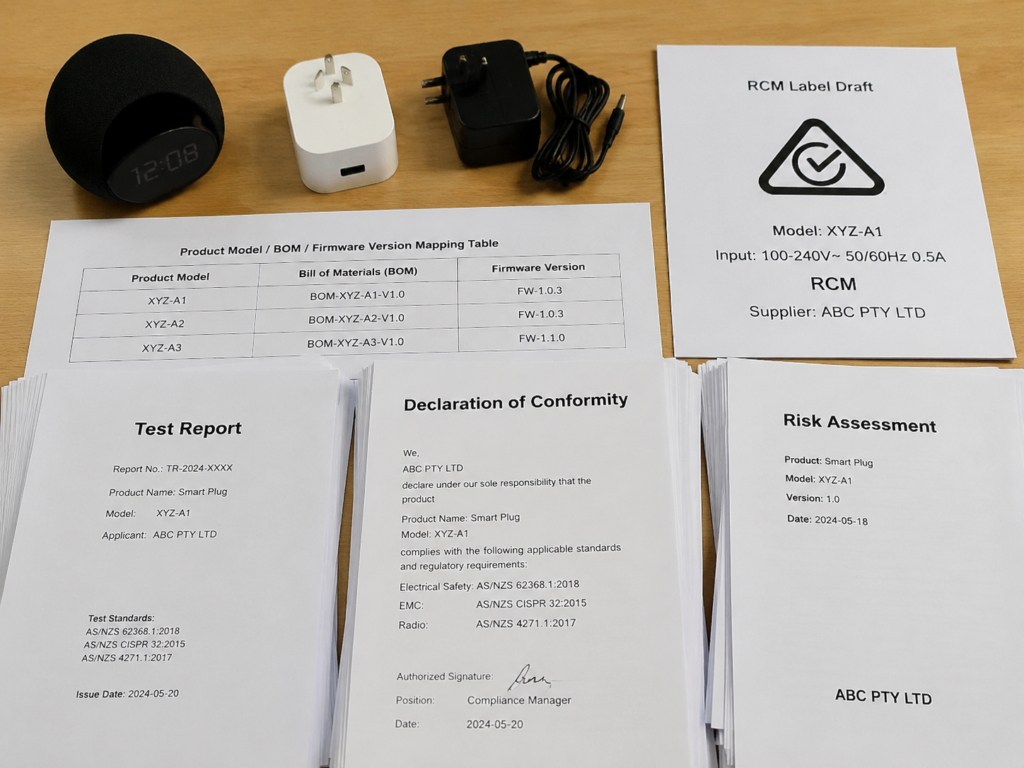
First, the actual product, label draft, and the corresponding mapping table of product model, Bill of Materials (BOM), and firmware version, to avoid the situation that “the product does not match the documents”;
Second, a complete compliance document package, including test reports, declarations of conformity, risk assessments, etc.;
Third, import records, sales records, and supply chain authorization documents to prove the source and sales situation of the products.
What Happens If You Violate the Rules? Penalty Types and Risk Grading
The question that many people are most concerned about is: how much will you be fined for violating the rules? Will you go to jail? In fact, the RCM penalty is not a fixed number, but is comprehensively determined according to the severity of the violation, applicable regulations, and specific circumstances.
5-Level Violation Risk Reference
Australia does not have a statutory unified violation grading. You can use the following internal assessment logic to initially judge your own risk level. Note: This grading is only for internal enterprise risk assessment reference, not an official statutory grading in Australia. The actual disposal result depends on the specific illegal provisions, evidence, degree of harm, subjective state, cooperation situation, and the discretion of the enforcement agency.
| Risk Level | Violation Situation | Risk Reminder |
|---|---|---|
| Level 1 (Lowest) | Minor procedural issues such as non-standard labels and incomplete document retention, first negligence | Low regulatory attention, mostly focused on rectification requirements |
| Level 2 | Unable to provide valid compliance documents, but no evidence to prove that the product is substantially non-compliant | Need to supplement compliance certificates, there is a penalty risk |
| Level 3 | Substantial non-compliance such as product testing failing to meet standards, wireless parameters exceeding limits, no harm caused | Substantially violates compliance requirements, high penalty risk |
| Level 4 | Acts obstructing enforcement such as forging RCM marks/test reports, concealing problems, providing false materials | Relatively bad in nature, may trigger more severe enforcement measures |
| Level 5 (Highest) | Causing safety accidents, repeated violations refusing to rectify, selling even when knowing non-compliance | Highest risk, serious penalty tools may apply |
Statutory Penalty Tools
There are many enforcement tools available to regulators, not just fines. Different tools apply to violations in different fields and of different severity:
The most basic are general enforcement tools, including warnings, rectification orders, temporary or permanent sales bans, and confiscation of illegal goods, which apply to minor or moderate violations.
Then are fine-type measures, which are divided into two types: one is infringement notice, which is an enforcement document issued by regulatory agencies for specific illegal acts. Accepting the notice is not equivalent to admitting illegal liability. The party concerned can choose to pay the amount specified in the notice to close the case, or raise an objection to enter the follow-up procedure; the other is a fine imposed by the court, which applies to more serious illegal situations.
It should be noted that some federal and state/territory regulations use “Penalty Unit” as the basis for fine calculation, but the amount, scope of application and upper limit of penalty units vary in different jurisdictions and different regulations. There is no unified fine calculation method applicable to all RCM violations.
The most serious cases will trigger mandatory recalls and even criminal liability (including imprisonment), but this only applies to particularly serious illegal situations, such as selling a large number of products even when knowing they have fatal safety hazards, causing major accidents.
Verification Logic of Fine Amount
There are often statements on the Internet that “RCM fines are tens of thousands of Australian dollars”. In fact, there is no general fixed fine range, and it cannot be directly applied.
The calculation of the fine amount needs to combine multiple variables such as the applicable jurisdiction, specific regulatory provisions, whether the entity is an individual or a company, the number of illegal sales, the duration of the violation, and illegal gains. The amount of the penalty unit is adjusted by the corresponding jurisdiction in accordance with statutory procedures, and shall be subject to the statutory amount in effect at the time of the violation and at the time of the decision. When encountering specific problems, you must judge in combination with the corresponding regulations and scenarios, and don’t trust the fixed numbers on the Internet casually.
Concomitant Risks That Are More Expensive Than Fines
Many people only focus on the amount of the fine, but in fact, non-fine losses are often much larger than the fine:
First, cargo loss: the cost of goods confiscated, returned, or destroyed shall be borne by the responsible party;
Second, market loss: temporary or permanent sales ban, full store removal on e-commerce platforms, and account permission restrictions have a far greater impact on business than a single fine;
Third, credit loss: violation information may be published on the official regulatory website, affecting the brand’s reputation in the Australian market;
Fourth, recall cost: if a recall is required, the total cost of notifying consumers, repair, refund, logistics, and announcement is often a large sum;
Fifth, civil remedy risk: if consumers suffer losses due to product problems, they can seek remedies in accordance with applicable consumer law, product liability rules, contract agreements, or tort law provisions. The responsible entity, type of liability, and scope of compensation need to be determined in combination with specific facts and applicable laws.
Corresponding Legal Sources for Different Violation Fields (Semi-Proficient)
If you want to further verify specific rules, you can find official basis according to the violation field:
- Electrical safety violations: corresponding to state-level electrical safety regulations and EESS rules, enforcement tools include rectification, fines, and confiscation, which can be verified on the official website of state-level enforcement agencies and the EESS database;
- EMC violations: corresponding to EMC-related regulations under the jurisdiction of ACMA, enforcement tools include warnings, fines, and sales bans, which can be verified on the EMC compliance page of ACMA’s official website;
- Radio violations: corresponding to radiocommunications regulations under the jurisdiction of ACMA, enforcement tools include fines, confiscation, and sales bans, which can be verified on the radio compliance page of ACMA’s official website;
- Product safety/consumer rights violations: corresponding to the Australian Consumer Law, enforcement tools include recalls and fines, which can be verified on the ACCC official website and the Federal Register of Legislation.
How is the Penalty Amount Determined? Core Discretionary Factors
For the same RCM non-compliance, why do some people only receive a warning while others are fined a high amount? Behind this is a set of regulatory discretion logic. Understanding these, you can not only estimate the risk, but also know how to strive for a more favorable result.
Product Risk Dimension
The risk level of the product itself will affect the degree of regulatory attention and potential violation consequences:
Electrical safety products are divided into three levels: Level 1/2/3 according to EESS’s official equipment risk classification database. This is the risk classification of the equipment itself, not the grading of the severity of the violation. The higher the level of equipment, the stricter the compliance requirements (for example, Level 3 requires registration), and may face higher regulatory attention after violations, but this does not constitute a statutory basis for necessarily heavier penalties.
For wireless/EMC products, the larger the impact scope of the violation, the higher the potential penalty risk — for example, equipment that illegally uses emergency communication frequency bands has a much greater interference impact than ordinary consumer wireless products, and the penalty risk is also higher.
If it is a product that is also subject to other special supervision, such as medical devices and children’s products, penalties under other regulations may also be applied concurrently.
Violation Nature Dimension
The nature of the violation is the core factor of discretion:
Procedural violations (such as non-standard labels, non-compliant document organization) have relatively low penalty risks, and proper rectification can usually result in more lenient treatment;
Substantial violations (such as product testing indeed failing to meet standards) have higher penalty risks, and may face fines even for the first violation;
Subjective intentional violations (such as sticking fake labels even when knowing non-compliance, forging test reports) are the worst in nature, and may even trigger criminal liability.
Sales and Entity Dimension
Sales scale and entity type also affect discretion:
The larger the sales scale and the longer the violation duration, the higher the penalty risk — violations of large-volume, long-term, cross-state sales are more serious than violations of small-batch trial sales. Of course, small-batch trial sales do not mean exemption from compliance obligations, but may result in lighter treatment as appropriate.
In terms of entity type, locally registered responsible suppliers in Australia bear core compliance obligations, and other supply chain entities bear corresponding responsibilities according to their degree of participation; local entities can be directly enforced, while overseas sellers are mainly held accountable through borders, platforms, and cross-border cooperation.
The impact of sales channels is mainly reflected in the enforcement method: offline physical stores are mainly subject to on-site inspections, cross-border e-commerce is mainly subject to platform batch inspections, and cross-border sellers mostly encounter combined measures of “removal + fine”.
Cooperation and Rectification Dimension
This is the only discretionary factor that operators can actively influence, and it must be taken seriously:
Voluntarily stopping sales, cooperating with investigations, initiating voluntary recalls, and completing rectification in a timely manner can usually be used as favorable factors for enforcement agencies when exercising discretion, but they do not necessarily lead to penalty reduction or exemption. The specific application is determined according to the corresponding regulations and case circumstances.
Conversely, concealing problems, continuing to sell, delaying submission of materials, providing false documents, and obstructing investigations will all lead to increased penalty risks.
Special reminder here: supply chain faults cannot directly exempt liability — for example, if an upstream supplier provides a fake test report, the operator cannot directly exempt liability on the grounds that “I am also a victim”. They must prove that they have fulfilled their reasonable review obligations (such as checking the qualification of the testing institution and verifying the authenticity of the report) before it is possible to reduce the corresponding liability.
Jurisdiction and Enforcement Field Dimension
There are differences in discretion standards among different jurisdictions and enforcement fields:
At the federal level, the penalty rules for EMC and radio under the jurisdiction of ACMA are unified nationwide, with no interstate differences.
At the state/territory level, the fine amount and procedures for electrical safety vary slightly from state to state, and are implemented according to the standards of the state/territory with jurisdiction. If the product is sold in multiple states, it may involve enforcement procedures in multiple jurisdictions, and needs to be handled separately according to the rules of each jurisdiction.
Avoiding Pitfalls in Advance: Compliance Key Points From Market Entry to Daily Operations
After understanding the logic of enforcement and penalties, in fact, most risks can be avoided in advance, as long as you do these things well before market entry and in daily operations.
Core Compliance Actions Before Market Entry
First step: first make an applicability determination. Use the “three questions” mentioned earlier to initially confirm whether the product is regulated, which regulatory field it belongs to, and what the risk level is. Don’t take it for granted that “my product doesn’t need RCM”. The final result shall be subject to official rule verification.
Second step: implement the responsible entity, and complete the corresponding registration obligations according to the product type: such as EESS responsible supplier registration, Level 3 high-risk product registration; for radio products, it is necessary to verify the required testing, records, labels and supplier obligations according to the device category, applicable standards, transmission conditions and ACMA related systems. Not all wireless products need unified registration.
Third step: prepare a compliance evidence package, and organize documents according to the corresponding regulatory requirements, including test reports, declarations of conformity, risk assessments, model/BOM/version mapping tables, supply chain authorization documents, and label drafts, to ensure that the “actual product, model, and documents” can correspond to each other.
Fourth step: ensure label compliance: place the RCM mark in accordance with the corresponding rules, pay attention to size, readability, and position requirements; alternative labeling methods for small-sized products and special scenarios (such as packaging labeling, electronic labels) can only be used when explicitly permitted by the corresponding regulatory rules and meet relevant conditions, and cannot be chosen arbitrarily; in addition, supplier identification information does not have to be on the same label as the RCM mark, there is no need to squeeze them together.
Key Points of Self-Inspection in Daily Operations
Compliance is not a one-time thing done after market entry, and regular self-inspection is required in daily operations:
First is document retention. Compliance documents must be kept in accordance with the requirements of applicable regulations and regulatory systems. The statutory retention period for some records may be no less than five years, and the specific period shall be subject to the corresponding official rules. It is also necessary to regularly check whether regulations and standards are updated to avoid the invalidation of compliance done with old standards.
Second is product change control: if key safety components, power supplies, wireless modules, antennas, PCB boards are replaced, or the firmware’s radio frequency parameters, product model, brand, or manufacturing factory are adjusted, compliance must be re-evaluated. If necessary, supplement testing, update compliance documents or registration information — these changes may affect the safety, EMC or radio performance of the product, and cannot be changed at will.
Also pay attention to the judgment of combined sales: each regulated product in a set needs to be compliant separately, and you cannot only do one RCM for the entire set; if accessories are sold separately, they also need to meet the corresponding compliance requirements.
If it is a high-risk Level 3 product, regularly confirm that the registration is within the validity period and update the information in a timely manner.
4 Most Common Pre-Event Pitfall Avoidance Misconceptions
These four misconceptions are the reason why many operators suffer losses, and they must be avoided:
First, Small sellers/small orders won’t be inspected? Wrong. The platform’s batch random inspection covers sellers of all sizes, and high-risk categories may be selected regardless of sales volume, which has nothing to do with how much you sell.
Second, No penalty if the product has no accident? Wrong. Regulators can directly impose penalties based on non-standard labels, incomplete documents, or unqualified random inspections. Accidents are only aggravating circumstances, not a necessary condition for penalties.
Third, Can you avoid penalty by making up compliance after the fact? Wrong. Compliance obligations must be completed before marketing. Post-event supplementary testing and supplementary documents only show that you are compliant now, and cannot offset the previous illegal sales behavior without compliance. At most, it can be used as a favorable factor in discretion.
Fourth, It’s okay if the platform removes the product? Wrong. Platform removal is a commercial measure, which does not mean that regulators will not investigate. Regulators can still trace your previous sales behavior. You must take the initiative to cooperate with regulators to close the case, and don’t think that removal is the end of the story.
Don’t Panic When Receiving an Enforcement Notice: Four Steps for Emergency Response
No matter how careful you are usually, you may receive an enforcement notice. If you really encounter it, don’t act randomly. Follow these steps to minimize losses.
Step 1: Verify the Authenticity of the Notice and Identify the Notice Type
There are also scams impersonating regulatory agencies in Australia. First, you must check the sending agency, legal basis, involved product models, and submission deadline. Don’t click on unfamiliar links casually. It is best to verify the authenticity of the notice through official public channels (such as the contact number on the agency’s official website, official email). At the same time, clarify the type of notice: whether it is an information verification request, rectification notice, infringement notice, or formal penalty decision. Different notices have different legal consequences and response requirements.
Step 2: Do a Good Job in Risk Control and Evidence Preservation
Immediately suspend the import, sales, and promotion of the involved products, isolate inventory, avoid new illegal sales, and prevent further expansion of losses; at the same time, preserve all relevant compliance documents, sales records, and supply chain vouchers, and must not tamper with, destroy, or backdate them. Note: stopping sales and isolating inventory are risk control measures. Whether they will affect penalty discretion is determined by the enforcement agency according to the specific situation.
Step 3: Organize Evidence and Submit It on Time
Submit complete compliance materials within the specified time limit, do not conceal or tamper with them, and organize them clearly according to the corresponding relationship of “actual product – model – document – sales record” to facilitate regulatory verification — the clearer you organize, the more it can reflect your attitude of cooperation.
Step 4: Formulate a Response Strategy
If the violation is confirmed, you can voluntarily submit a rectification plan and a voluntary recall plan, explain your willingness to rectify to the regulator, and strive for a more favorable treatment result; if you think you have not violated the rules, submit evidence to apply for review or appeal through the channels and within the time limit specified in the decision document. If the situation is particularly serious, such as involving safety accidents or large fines, you must promptly seek the assistance of a local Australian compliance lawyer, and don’t carry it alone.
Finally, let’s talk about several forbidden actions that must never be done: do not destroy or tamper with compliance documents and sales records; do not delay responding or conceal problems; do not continue to sell the involved products — these behaviors will not only lead to increased penalty risks, but may even constitute obstruction of enforcement, bringing more serious consequences.
Rule Verification and Competency Summary
Finally, I would like to remind everyone that Australia’s regulations, rates, and institutional settings are regularly adjusted, and all compliance requirements shall be subject to the latest official effective text.
Official Verification Channels
The most authoritative verification channels are the following. Don’t trust outdated information from third parties casually:
- ACMA official website: query compliance requirements and enforcement rules for radio and EMC categories;
- EESS official website: query the rules, product risk classification, and registration requirements of the Electrical Equipment Safety System;
- Official websites of state/territory electrical safety authorities: query the electrical safety penalty standards and procedures of the state;
- Federal Register of Legislation: query the latest regulatory texts;
- ACCC official website: query federal-level rules related to product safety and recalls.
Content that needs to be verified regularly includes: penalty unit rates, agency names, mandatory standards, enforcement procedures, and exemption lists. These contents may be adjusted with regulatory revisions. This article is an entry-level learning reference, and all rules shall be subject to the latest official effective text on the day of query.
Competencies You Can Master After Learning
After learning this article, you can master three core competencies: first, you can use the “three applicability questions” to initially judge the RCM regulated scope of products and the corresponding regulatory fields; second, you can distinguish the responsibility boundaries of each regulatory agency and understand the basic assessment logic of violation risks; third, you can complete basic compliance self-inspection before market entry and in daily operations, and respond according to standardized procedures when encountering enforcement notices.
Frequently Asked Questions
How much is the general RCM fine in Australia?
There is no general fixed fine amount. The calculation basis for fines varies in different regulatory fields and jurisdictions. Some regulations use penalty units as the calculation basis. The final amount needs to be combined with factors such as the type of violation, applicable regulations, entity type, and illegal circumstances, and shall be subject to the official decision. Do not apply fixed numbers circulated on the Internet.
Will cross-border e-commerce sellers’ products be inspected if they don’t have RCM?
They will be included in the scope of supervision. Common triggering channels include platform batch inspection, border clue transfer, complaints and reports, etc. Regulators can hold them accountable through platform cooperation, border control, cross-border regulatory cooperation and other means. It is not that overseas sellers are not subject to jurisdiction.
Must the RCM mark be affixed to the product body?
It needs to be determined according to the labeling rules of the corresponding regulatory field. For special scenarios such as small-sized products, alternative methods such as packaging labeling and electronic labels can be used in accordance with the rules, but they must meet the clear requirements of the corresponding rules, and the labeling position cannot be chosen arbitrarily.
Is RCM compliance still required if there is CE/FCC certification?
Yes. Australia has exclusive safety, EMC, radio standards and local responsible entity requirements. CE/FCC reports can only be used as a reference and cannot directly replace the RCM compliance process.
Will you still be fined after rectification upon receiving an RCM enforcement notice?
Voluntary rectification can usually be used as a favorable discretionary factor, but it cannot directly offset the previous non-compliance behavior before marketing. Whether to impose a penalty and the severity of the penalty need to be judged in combination with the specific situation of the violation and applicable regulations.
The core logic of RCM supervision is “suppliers commit to compliance, regulators verify after the fact”, which essentially uses market-oriented methods to ensure product safety and public order. For operators entering the Australian market, implementing compliance requirements in advance and retaining complete evidence is far more efficient and lower cost than dealing with penalties after the fact.