
Many importers and cross-border sellers entering the Australia-New Zealand market for the first time have heard of RCM, but the first most common pitfall is: thinking that RCM is a “certificate” that can be bought with money. In fact, RCM is just a compliance mark printed on products, supported by two completely independent regulatory systems. You cannot mark it casually if any requirement is missing. Whether you are doing e-commerce direct mail or large-batch import, only by figuring out the real rules of RCM can you avoid losses such as goods being detained and stores being closed.
Basic Understanding of RCM: It is a Compliance Mark, Not a Unified Certificate
The full name of RCM is Regulatory Compliance Mark, which is a compliance mark and a mandatory access mark required for the Australian and New Zealand markets. Its core function is to prove that products comply with local relevant regulations. It is not only the core basis for customs spot checks and market supervision verification, but also a necessary condition for e-commerce platform listing review.
Many people think that RCM is a unified certification project, but in fact it is just a “shared mark” — it is separately managed by two independent regulatory authorities, with non-interchangeable processes, obligations and responsible entities: one is the Australian Communications and Media Authority (ACMA) responsible for electromagnetic compatibility and wireless communication supervision, and the other is the Electrical Equipment Safety System (EESS) responsible for electrical safety supervision. The two systems manage their own areas. A product may be regulated by only one of them, or may need to comply with both, and they cannot be confused.
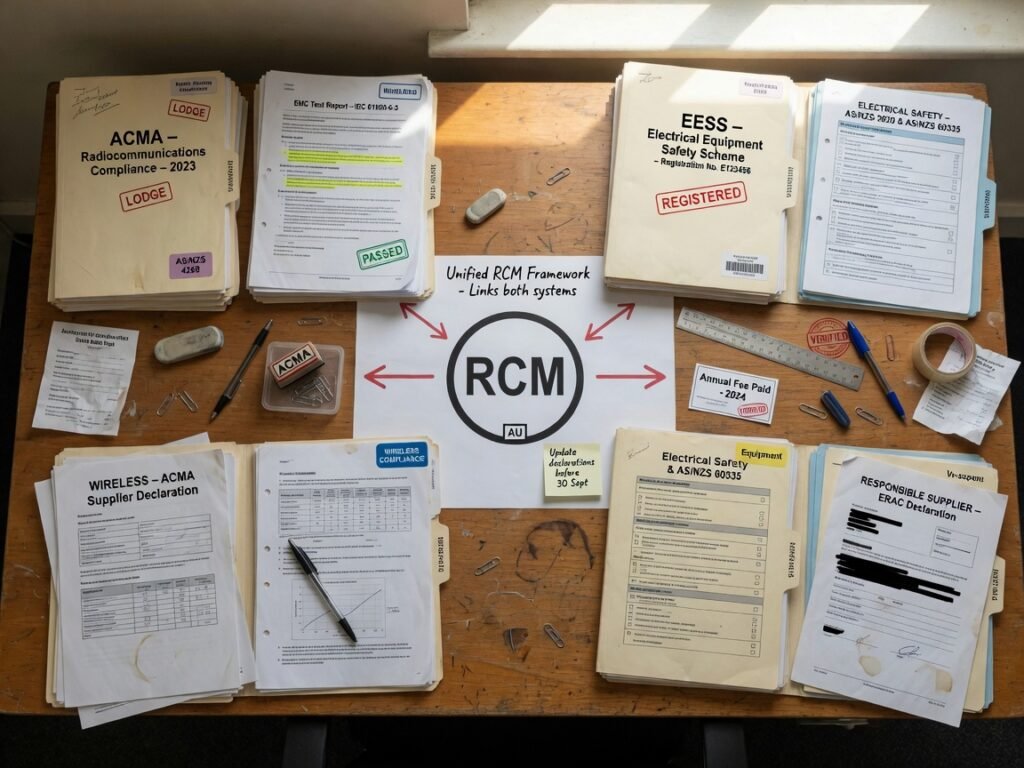
From the perspective of institutional evolution, Australia and New Zealand have gradually implemented RCM as a unified mark since 2013, replacing the original C-Tick and A-Tick marks. The transition period has now ended, and all regulated products must use the RCM mark. In addition, it should be noted that although the RCM mark is universal in the regulatory systems of Australia and New Zealand, the specific requirements for electrical safety, EMC and wireless of the two countries are not 100% automatically mutually recognized. If you want to enter both markets at the same time, you need to verify according to the rules of the corresponding countries respectively, and you cannot directly sell to New Zealand after completing the Australian compliance.
If RCM compliance is not completed as required, the consequences in different scenarios are quite serious. If detected by regulatory spot checks during customs clearance, goods may be detained, returned or even directly destroyed, and additional demurrage fees and storage fees will be incurred. Many small sellers lose more than half of their investment directly because a batch of goods is detained. If non-compliance is found after entering the market, the light consequence is fines and product removal, and the serious consequence is mandatory recall across all channels, which affects brand reputation. If you sell on e-commerce platforms, such as Amazon Australia, Catch, etc., if the platform finds no compliance certificate during review, it will directly remove the product, and in serious cases, restrict account permissions.
Special reminder: RCM only covers three types of requirements: electromagnetic compatibility, wireless, and electrical safety. There are many independent regulatory rules that cannot replace each other with it, such as energy efficiency labels, Australian plug adaptation requirements, lithium battery transportation rules, and supervision of special categories such as medical devices, food, cosmetics, and children’s products, all of which need to meet corresponding requirements separately and cannot be replaced by RCM.
Product Scope Requiring RCM Compliance and Quick Judgment
To judge whether your product needs RCM compliance, you must first figure out what ACMA and EESS respectively regulate, and then check against the product attributes.
Coverage of the Two Regulatory Systems
ACMA’s jurisdiction has no voltage threshold. As long as the product is electrical or has wireless transmission function, it is basically within its jurisdiction. It mainly manages two things: one is electromagnetic compatibility (EMC), that is, the product must not interfere with the normal operation of other equipment, and must also have basic anti-interference ability; the other is wireless communication compliance, that is, products with Bluetooth, WiFi, cellular, remote control and other transmission functions must use the spectrum allowed in Australia and cannot occupy frequency bands without authorization. The core obligations of ACMA are: complete local supplier registration, retain compliance records, and apply RCM mark as required.
EESS only manages electrical safety, that is, risks such as electric shock prevention, fire prevention, and mechanical injury prevention. Its coverage usually includes electrical equipment with AC 50V~1000V and DC 120V~1500V. But note that you cannot judge only by voltage. For example, some low-voltage USB-powered or button battery-powered products may also be included in the jurisdiction if there are safety risks, and there are some specially exempted products, all subject to the official list. The core obligations of EESS are: complete responsible supplier registration, complete testing or registration according to risk levels, and apply RCM mark as required.
Risk Level Differences for EESS Electrical Products
Only electrical safety products under EESS jurisdiction are classified into three risk levels. This classification does not apply to ACMA EMC and wireless products, so don’t confuse them. The risk level is completely determined by the official according to product type, and has nothing to do with product price:
- High Risk (Level 3): Such as plugs, major home appliances, medical electrical equipment, etc., with the strictest requirements, requiring mandatory testing + official product registration + responsible supplier filing.
- Medium Risk (Level 2): Such as small home appliances, chargers, LED lamps, etc., requiring compliance with corresponding standards + product registration + responsible supplier filing.
- Low Risk (Level 1): Such as ordinary low-risk electronic accessories, etc., mainly with EMC obligations, only need to retain compliance documents, no separate product registration required.
Quick Reference for Compliance Paths of Common Products
To facilitate quick judgment, here are the compliance paths of common products sorted out for preliminary reference. The final shall be subject to the official list:
| Product Type | Core Compliance Requirements | Remarks |
|---|---|---|
| Purely mechanical non-electrical products (e.g., ordinary suitcases) | No RCM requirements | Must comply with general consumer product safety rules for the corresponding category |
| Low-voltage non-wireless electronic products (<50V AC/<120V DC, e.g., wired headphones) | Only ACMA EMC compliance required | No EESS electrical safety registration required |
| Power adapters, major home appliances | EESS Level 2/3 + ACMA EMC | EESS product registration is required |
| Bluetooth/WiFi devices (e.g., smart speakers) | ACMA EMC + wireless compliance; EESS required if voltage meets the threshold | Products with transmission functions must comply with spectrum requirements |
| Cellular communication devices (e.g., mobile phones) | ACMA EMC + wireless + telecommunications band/SAR compliance; EESS required if voltage meets the threshold | Telecommunications products have additional regulatory requirements |
| Products containing lithium batteries (e.g., power banks) | RCM is determined based on the main attributes of the product | Additional compliance with lithium battery transportation rules is required |
| LED lighting products | EESS safety + ACMA EMC | Additional compliance with energy efficiency label requirements is required |
Exemption Boundaries and Quick Self-Inspection Methods
First of all, it should be clear that all “exemptions” only exempt administrative obligations such as supplier registration and mandatory marking, which does not mean that products can fail to meet safety requirements, let alone be sold casually.
The most common exemption scenario is personal use, but there is no unified “safe quantity line for personal use” at all. The customs will make a comprehensive judgment based on commercial purpose, quantity, consignee identity, import documents, etc. For example, importing 1 hair dryer for personal use may be considered personal use, while importing 10 will most likely be deemed as commercial use. Another is temporary import, such as exhibition exhibits and scientific research samples, which require special arrangements to be applied for from the customs and regulatory authorities in advance. Simplified compliance requirements are only available within a limited time and for limited purposes. If they are later converted to sales inventory, all RCM procedures must be completed.
There are also several points that are particularly easy to misjudge: small commercial batches, trial sales goods, and gifts are not exempt. As long as they are for commercial sale, even 1 piece needs to be compliant. Even if low-voltage products do not need EESS safety registration, they may still need ACMA EMC or wireless compliance. You cannot say that low voltage means nothing needs to be done.
If you are not sure whether your product needs to be done, you can use the 30-second three-question method for preliminary judgment: First, is the product electrical/rechargeable? Second, does it have wireless, Bluetooth, WiFi and other communication functions? Third, is it for commercial sale? If the answer to any of the first two questions is “yes” and the third is also “yes”, then basically you need to do corresponding RCM compliance. If you are still unsure, you can check the regulated list on the official ACMA website, the product scope list on the official EESS website, or consult a service provider with Australia-New Zealand compliance experience.
Core Prerequisites for RCM Import Compliance
After confirming that the product requires RCM compliance, several core conditions must be met. Missing any one means it is not compliant.
Products Must Comply with Corresponding Australian and New Zealand Standards
RCM applies to Australia-New Zealand joint standards prefixed with AS/NZS, and cannot be directly replaced by CE EN standards, US FCC standards or Chinese national standards. If you already have test reports for other mainstream standards, you can apply for differential testing, that is, only test the parts that are different from the Australia-New Zealand standards, without retesting all, which can save time and cost. If the product has multiple attributes, such as a Bluetooth desk lamp, it must meet the corresponding standards of safety, EMC and wireless at the same time, and missing any one is not allowed. In addition, it should be noted that the standard version must be currently valid, and reports issued with expired standards are not recognized.
Four Types of Required Compliance Certification Documents
Compliance is not just verbal, it must be supported by corresponding documents. The core is four types of documents:
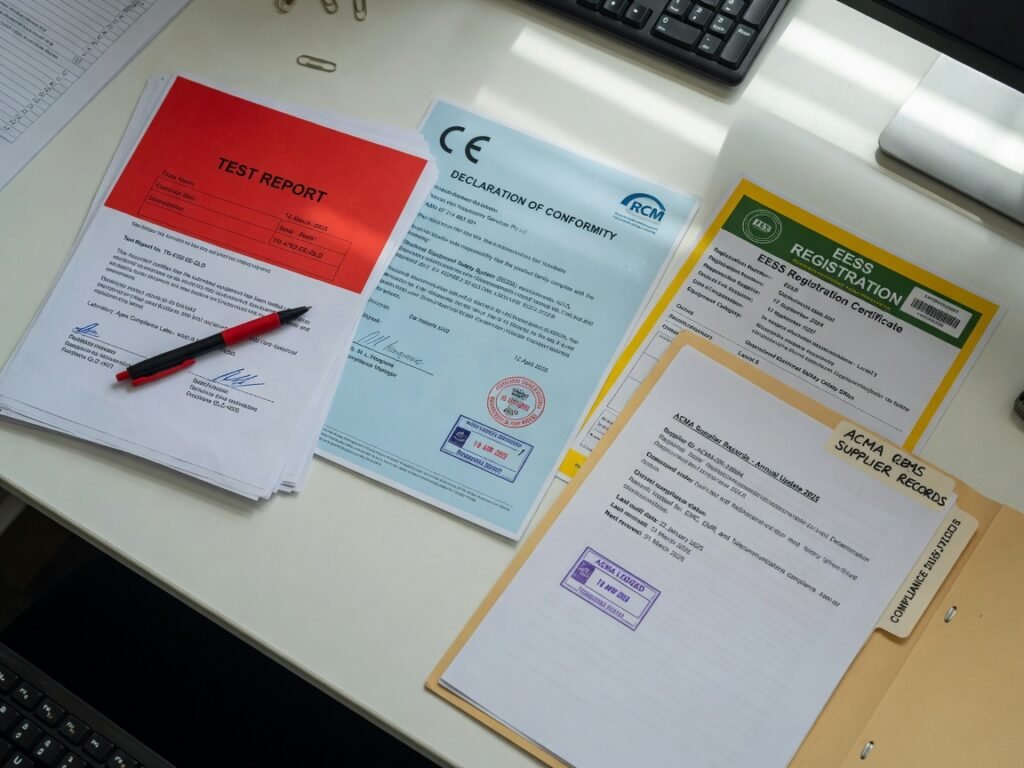
The first type is technical evidence (test report), which must be issued by an institution with qualifications recognized by corresponding regulations, such as laboratories with NATA (National Association of Testing Authorities, Australia) qualification or belonging to the ILAC (International Laboratory Accreditation Cooperation) mutual recognition system. The report must cover the specific model, configuration of the product, and the applicable Australia-New Zealand standards.
The second type is Declaration of Conformity (DoC), signed by the responsible party. It must clearly indicate the specific standard number applied, and cannot only write “complies with RCM requirements”, otherwise it is invalid.
The third type is EESS registration certificate. For Level 2 and Level 3 electrical products, it is necessary to complete responsible supplier registration and product registration in the EESS system, and obtain the registration certificate to be considered as meeting EESS requirements.
The fourth type is ACMA supplier records. For products under ACMA jurisdiction, you only need to complete supplier registration and keep all compliance records for inspection. There is no unified “model registration” requirement, which is different from EESS.
Responsible Entities and Role Division
Many overseas sellers will ask: I am a Chinese company, can I directly be the responsible party? The answer is no. Both EESS and ACMA require the responsible entity to be a local compliance entity in Australia or New Zealand. Overseas sellers or factories cannot directly serve as such, and must entrust a qualified local institution.
Specifically, the EESS Responsible Supplier needs to be an entity recognized by Australia-New Zealand rules, such as an Australian registered company or a qualified local agent, who bears all legal responsibilities for electrical safety. The ACMA supplier can be an importer, manufacturer or local agent, but also needs to be an Australian local entity, bearing EMC and wireless compliance responsibilities.
Special reminder: Importers and platform sellers are the primary compliance responsible persons. The local drop shipping and logistics service providers you find are only responsible for shipping and do not bear any compliance obligations. If problems occur, they will still be held against the seller.
Requirements for RCM Mark Placement
The RCM mark cannot be printed casually, and there are clear requirements: First, the mark must be clear and not easy to wear off, and cannot be scraped off by hand. It must also include the RCM graphic and the identification information of the responsible party, such as the registration number of the responsible supplier. The placement priority is the product body or nameplate. If the product is too small (such as Bluetooth earphones) or technically infeasible, it can be marked on the smallest sales package, manual or accompanying documents, but must meet the specific requirements of the corresponding regulatory system. It is absolutely impossible to only mark it on the outer shipping box that can be discarded at will, such marking is invalid.
Compliance Document Retention Requirements
All compliance documents, including test reports, DoC, registration certificates, etc., must be kept separately according to the requirements of ACMA, EESS and special regulations. The common requirement is at least 5 years, and the specific shall be subject to current rules. The retained documents must be retrievable at any time, and must be provided immediately when the regulatory department conducts spot checks. You cannot say that they are stored in a domestic factory and need to wait half a month.
Differences in Compliance Requirements for Different Import Scenarios
For the same product, different import scenarios have different compliance requirements, which cannot be generalized.
Import of Personal Use Items
The premise of personal use is only for personal or household use and non-commercial sale, which is specifically determined by the customs based on quantity, consignee identity, import documents, etc. Most low-risk products can have simplified procedures and do not need RCM, but high-risk electrical products and wireless devices may still be required to provide compliance certificates. As the saying goes, there is no unified “safe quantity line for personal use”. Once it exceeds the reasonable range for personal use, it will be implemented in accordance with commercial import requirements.
Small-Batch Commercial Import (E-commerce Direct Mail/Trial Sales Goods)
As long as it is for sale, or the quantity and use exceed the reasonable range for personal use, it is considered a small commercial batch, such as e-commerce direct mail and small trial sales goods. The compliance requirements are exactly the same as those for large-batch commercial import, and there is no such thing as “small-batch exemption”. Many novice sellers have fallen into this pit, thinking that sending a few express deliveries will not be checked and there is no need to do RCM, but as a result, the goods are detained if sampled. Now mainstream e-commerce platforms also require uploading compliance certificates for listing, and you cannot list without them.
Large-Batch Commercial Import (Full Batch by Sea/Air)
During customs clearance of large-batch imports, the customs may spot check the RCM mark, responsible party information, and validity of compliance documents, and there is no fixed spot check ratio. Regulatory spot checks are generally carried out based on product risks, complaints, historical violation records, safety accidents or special actions. The spot check probability for high-risk products is much higher. Therefore, prepare the materials before import, including the Declaration of Conformity, test reports, corresponding registration certificates, and responsible party qualification documents. Don’t wait until you are checked to supplement them.
Temporary Import (Exhibits/Scientific Research Samples)
For temporarily imported exhibits and scientific research samples, it is necessary to apply for special arrangements from the customs and regulatory authorities in advance. Simplified compliance requirements are only available within a limited time and for limited purposes, but it does not mean automatic exemption. High-risk products still need to meet basic safety requirements. If the samples are not shipped back after the exhibition but converted to sales inventory, all RCM compliance procedures must be completed, otherwise it is non-compliant.
Full Practical Steps for RCM Import Compliance
After figuring out the rules, the specific implementation can be carried out in five steps, and basically there will be no big mistakes.
The first step is product compliance attribute determination. First, use the three-question method and the common product path table mentioned earlier to initially confirm the regulatory category, then check against the official list to confirm the EESS risk level and ACMA jurisdiction scope. If you are unsure, be sure to consult a compliance service provider or a local Australian responsible entity, and don’t make arbitrary decisions.
The second step is complete testing and document preparation. Choose a laboratory that is familiar with Australia-New Zealand standards and has corresponding accreditation qualifications. Don’t find institutions that only do CE and don’t understand Australia-New Zealand rules, otherwise the report will be useless. Complete the corresponding tests according to the regulatory category of the product. For example, if safety, EMC and wireless are all required, do all of them. Then draft the Declaration of Conformity (DoC) to ensure that the model, configuration and standard number on it are completely consistent with the test report, and cannot be written randomly.
The third step is implement responsible entity and registration filing. Connect with qualified EESS responsible suppliers and ACMA suppliers, then complete corresponding registration according to product categories: EESS Level 2 and Level 3 products need product registration, and ACMA-jurisdicted products need supplier registration. When registering, be sure to check that the registration information is completely consistent with the product configuration and test report. Even a wrong letter may lead to invalid registration.
The fourth step is product marking and import declaration. Print the RCM mark and parameter label as required. Print them on the product if required, and print them on the package if required. Organize the full set of compliance documents, either accompanying the goods or kept separately, to ensure that they can be retrieved at any time. Declare the product category truthfully during customs clearance. Provide materials as required when the customs asks for them. Don’t conceal the declaration, as the consequences of concealment are more serious.
The fifth step is post-import compliance maintenance and change management. Record the product batches, suppliers, versions, and sales channels daily, and keep the full set of compliance documents as required. If the product has changes, first evaluate whether re-compliance is needed: if the power supply, wireless module, core circuit, key safety components, heat dissipation structure, antenna are changed, or the use purpose is changed, it is definitely necessary to re-evaluate, even conduct supplementary testing and re-registration. If only the appearance, packaging, silk screen are changed, and it is confirmed that there is no impact on safety, EMC, wireless performance, and it does not exceed the certification scope, there is no need for a full retest. For products of the same series, it is also necessary to confirm that the differences are within the certification coverage, otherwise a separate application is required.
Advanced Judgment and Pitfall Avoidance Tips
If you have already shipped several batches of goods, or have a large variety of products, mastering several advanced judgment methods can avoid most pitfalls, and you don’t need to ask the service provider for everything.
Four Core Judgment Methods
First, whether existing test reports can be used, just check four points: Is it an AS/NZS Australia-New Zealand standard? Does it correspond to the specific model and configuration of your product? Does the laboratory have NATA or ILAC accreditation for the corresponding project? Is the standard version currently valid? If all four are met, it can be used, otherwise differential testing or retesting is required.
Second, whether a compliance service provider is reliable, there are also several judgment criteria: first, it must be familiar with the entire Australia-New Zealand import process, not only understand testing, but also understand registration, customs clearance, and platform rules; second, it can provide formal local responsible entity services, not just find a shell company; finally, it will not promise you “quick certificate” or “guaranteed pass” — after all, RCM is not a certificate at all, compliance requires truly meeting standards, and those who say guaranteed pass are basically scams.
Third, whether product changes require re-compliance, the core judgment standard is “whether it will affect safety, EMC, wireless performance”, not whether the appearance is changed. For example, changing the charger shell from white to black with no internal changes does not require retesting; but if the internal transformer is replaced, it must be re-evaluated.
Fourth, how to prioritize compliance, if there are many products, first handle EESS high-risk products, which are most strictly checked and have the most serious consequences; for medium and low-risk products, focus on checking standard applicability and document retention, and don’t spend too much energy on trivial details first.
Clarification of Five Common Misconceptions
Almost everyone who does the Australia-New Zealand market has heard these wrong statements, and must avoid them:
- CE/FCC can directly replace RCM: Wrong. The standard systems are completely different, only differential testing can be done, and they cannot be used directly.
- RCM is a “certificate” that can be purchased: Wrong. RCM is a compliance mark, there is no unified “RCM certificate”, you can only mark it after meeting all requirements. Those who sell “RCM certificates” are scammers.
- High-risk products can be supplemented with compliance after arrival: Wrong. EESS Level 2/3 products must be registered before being placed on the market. If border spot checks find that they are not registered, the goods will be directly detained, and there is no time to supplement.
- Finding a local drop shipper means no need to worry about compliance: Wrong. Sellers and importers are the primary responsible persons. Drop shippers are only responsible for logistics and do not bear compliance responsibilities.
- Personal use/temporary import are all exempt: Wrong. Supplier obligations are only simplified under specific conditions. High-risk products still need to meet regulatory requirements. Temporary imports converted to sale must complete all procedures.
Remediation Logic After Non-Compliance
If something really goes wrong, don’t panic, just handle it according to the corresponding situation: if the goods are detained during customs clearance, quickly supplement compliance documents to apply for release. If you really can’t supplement, choose return or destruction, don’t resist; if the market spot check is unqualified, immediately stop sales, supplement testing if needed, register if needed, and apply for resumption of listing after the marking rectification is in place; if you find the problem proactively, timely remove the relevant products, complete the compliance procedures. If the problem is serious, proactively contact the regulatory department to explain the situation and strive for lenient treatment, don’t wait until you are caught.
Typical Product Compliance Path Cases
Take several commonly sold products as examples, which is more intuitive:
- USB-C charger: It belongs to EESS Level 2 medium-risk product, requires safety + ACMA EMC compliance, and also needs EESS product registration.
- Smart socket with Wi-Fi: Requires EESS Level 2 safety + ACMA EMC + wireless compliance, both systems need registration.
- Bluetooth earphones: Very low voltage, no EESS safety required, only ACMA EMC + wireless compliance, just do ACMA supplier registration.
- LED desk lamp: Requires EESS Level 2 safety + ACMA EMC compliance, and additionally needs to meet energy efficiency label requirements.
- Purely mechanical suitcase: Completely non-electrical, no RCM requirements, only need to comply with general consumer product safety rules.
Phased Self-Inspection Checklist and Capability Summary
Phased Self-Inspection Checklist for RCM Import Compliance
You can check whether your compliance work is in place by stages against the following checklist:
- □ Before import: Confirm product regulatory category and risk level, complete corresponding testing and registration, implement local responsible entity
- □ During customs clearance: Product has been marked as required, full set of compliance documents retrievable at any time, declaration information consistent with actual goods
- □ Before sale: Compliance certificates required by the platform have been uploaded, product labels meet requirements, document retention system has been established
- □ After change: Compliance evaluation has been completed for core configuration changes of the product, procedures for supplementary testing/re-registration have been completed if required
- □ After non-compliance: Sales have been stopped/goods detained as required, compliance materials are being supplemented, full-category risk investigation is being carried out simultaneously
What You Can Independently Judge After Learning
After reading this content, you can basically handle most common RCM import compliance issues: you can quickly judge whether a product needs RCM compliance and which regulatory requirements it corresponds to; you can distinguish compliance differences between different import scenarios and won’t fall into exemption pits; you can list the core steps that must be completed before import, and distinguish the different obligations of EESS and ACMA; you can identify common compliance misconceptions, and initially judge whether test reports and compliance service providers are reliable; you also know the handling direction when products change or encounter regulatory spot checks.
In general, RCM compliance seems to have many threads, but the core is actually three things: figure out what requirements the product must meet, find a legitimate local responsible entity, keep all compliance documents and mark as required. Don’t take chances with the idea that “small batches won’t be checked”. Although Australian regulatory spot checks are not conducted on every batch, once hit, the cost is much higher than the cost of doing compliance in advance. Only by understanding the rules in advance can you do business steadily in the Australia-New Zealand market.