
Electronics sellers operating in the Australian and New Zealand markets have most likely heard of the term RCM — some say it’s the Australian version of CE, others claim goods are detained by customs precisely because RCM wasn’t obtained. What exactly is RCM? Does your product need it? What specific processes are required? Are there legal ways to optimize costs? This article starts with the most basic judgment, covers all the way to post-market compliance maintenance, helps you sort out the entire application logic, and avoid common cognitive misunderstandings.
Understand Before Applying: RCM Basics and Quick Eligibility Judgment
Many people take detours when applying for RCM at the beginning, essentially because their basic cognition is wrong. First, clarify several core issues, and the subsequent process will be easier to understand.
What Exactly is RCM?
You can understand RCM as the regulatory compliance mark for electronic and electrical products in the Australian market (Regulatory Compliance Mark). It is not a single paper certificate uniformly issued by the official authority, but a general term for a set of compliance certificates — it covers the compliance results of three types of requirements: electrical safety, electromagnetic compatibility, and radio frequency (if the product has wireless functions). The final manifestation on the product is the RCM mark, which must be supported by a complete set of compliance files.
It should be noted that RCM is an Australian regulatory arrangement. When products are sold to New Zealand, relevant RCM compliance evidence is acceptable in some electromagnetic compatibility and radio compliance scenarios, but New Zealand’s electrical safety and market access requirements for specific products still need to be confirmed separately according to local regulations and product categories. You cannot simply assume that “obtaining RCM once allows entry into both markets”. Corresponding compliance certification materials are required for daily customs spot checks, e-commerce platform audits, and regulatory authority inspections.
What are the Risks of Not Obtaining RCM?
The degree of risk is directly related to the product’s risk level, applicable rules, and the circumstances of the violation. Common compliance risks include: customs detention of goods, requirement to complete supplementary compliance procedures, and in severe cases, goods may be destroyed or returned; e-commerce platforms may take measures such as removing product listings and deducting security deposits for non-compliant products; if high-risk products violate regulations, regulatory authorities may impose high fines (in some scenarios, enterprises may be fined up to millions of Australian dollars, subject to applicable laws and violation circumstances), and even require mandatory recall of sold products.
Note: Actual law enforcement measures, maximum penalties, and enforcing authorities depend on applicable laws, product categories, violation circumstances, and specific rules of the relevant state/territory. There is no uniform inevitable result, and the applicable rules at the time of issuance shall prevail.
Quickly Judge Whether Your Product Needs RCM
You don’t need to memorize complex standards by rote. You can conduct a preliminary screening in two steps, and the final result shall be subject to the official classification list:
Step 1: First confirm whether the product is electrical equipment within the jurisdiction of Australia’s EESS (Electrical Equipment Safety System). You can directly check the EESS Official Electrical Classification List;
Step 2: Then separately confirm whether the product is equipment subject to electromagnetic compatibility (EMC) or radio communications rules under the jurisdiction of ACMA (Australian Communications and Media Authority).
Common daily products such as mobile phone chargers, household large/small appliances, Bluetooth speakers, LED bulbs, and WiFi-enabled smart devices usually require further confirmation of compliance requirements based on specific classification, power supply method, and functions. Conversely, purely manual tools (such as ordinary screwdrivers), mechanical parts without any electronic components, and independently supplied passive low-voltage accessories (such as ordinary USB cables without chips) are usually not within the scope of RCM-related regulation.
If you are unsure, the safest method is to check the official classification list instead of guessing blindly. Also, note an easily overlooked boundary: whether matching power adapters, battery packs, and wireless modules need separate compliance must be evaluated in combination with their supply method and the compliance coverage of the complete machine.
Three Core Regulatory Requirements Involved in RCM
RCM seems complicated, but in fact, it embodies the requirements of two different regulatory agencies through a unified mark. The two regulatory frameworks are independent of each other, and their applicable scopes need to be judged separately:
The first category is electrical safety, which simply means preventing electric shock and fire, and avoiding safety accidents during product use. It is jointly managed by Australia’s national Electrical Equipment Safety System (EESS) and regulatory authorities of each state/territory.
The second category is electromagnetic compatibility (EMC), whose regulatory focus is whether the electromagnetic disturbance generated by the equipment meets applicable requirements, to avoid interfering with the normal operation of other equipment; whether immunity (i.e., the product’s ability not to be interfered with by other equipment) needs to be evaluated depends on the product category and corresponding applicable standards. This part of the requirements is regulated by ACMA.
The third category is radio frequency (RF), which only needs to be met by products with wireless transmission functions such as Bluetooth, WiFi, and 4G. The core is that the frequency band, transmission power, etc. of wireless signals comply with regulations to avoid interfering with public communication order. Such requirements are also regulated by ACMA.
4 Most Common Entry-Level Misconceptions
These four pitfalls are almost always encountered by people who are new to RCM. Clarifying them in advance can save a lot of unnecessary expenses:
- It is not a single certificate uniformly issued by the official authority: RCM is the general term for “mark + complete set of compliance files”. Only products of specific risk levels need to be registered in the corresponding official system. There is no such thing as a “universal RCM certificate” stamped with a government seal.
- CE/FCC cannot be directly converted to RCM: There are differences between European and US standards and applicable Australian and New Zealand standards. Even if you have CE or FCC certification, it can only be used as a reference for part of the test content, and cannot be directly converted into RCM compliance certification.
- Not all products require official registration: For some low-risk category products, you only need to complete testing and a declaration of conformity, and there is no need to go through an additional official registration process.
- Passing laboratory testing does not mean RCM is completed: Testing is only one step in the compliance process. Subsequent steps such as completing the declaration of conformity, registration for corresponding requirements (if required), product labeling, and file retention are also required. Only when all steps are completed can the product be deemed compliant.
Pre-Application Self-Assessment: Choose the Right Path and Prepare Materials
Before officially starting the application, spend 1-2 days on self-assessment and choose the right path for yourself, which can reduce unnecessary cost and time investment.
Select Application Type According to EESS Electrical Safety Risk Level
The risk classification here (Level 1-3) only applies to the electrical safety requirements of electrical equipment within the jurisdiction of EESS. It is two independent sets of rules from ACMA’s EMC and radio requirements, and cannot be confused.
| EESS Risk Level | Common Compliance Actions/Items to Verify | Description |
|---|---|---|
| Level 1 (Low Risk) | Confirm that the product is EESS-applicable equipment; retain compliance evidence, no official registration required | Such as low-power low-voltage accessories, simple electronic toys, etc. The specific product scope shall be subject to the EESS official equipment list |
| Level 2 (Medium Risk) | Confirm that the product is EESS-applicable equipment; prepare compliance evidence according to applicable requirements and complete responsible supplier and equipment registration | Such as ordinary household appliances, power adapters, ordinary IT equipment, etc. Registration obligations must be confirmed corresponding to the specific requirements of EESS and the rules of the sales location |
| Level 3 (High Risk) | Confirm that the product is EESS-applicable equipment; prepare compliance evidence, obtain a third-party accredited certificate and complete registration | Such as industrial electrical equipment, medical electronics, plugs and sockets, etc., usually involving higher-risk electrical products, which need to meet stricter assessment requirements |
You don’t have to memorize the EESS risk level of products by yourself. You can directly check the EESS electrical classification list. Most compliance service providers also provide free preliminary assessment services. You can get a reference result by sending the product model and parameters. It should be noted that special categories such as medical electronics may also be subject to other regulations such as medical devices, which need to be confirmed separately. EMC and radio requirements under the jurisdiction of ACMA shall be judged separately according to corresponding rules, and this classification system does not apply.
Confirm Compliance Items to Be Evaluated According to Product Functions
Power supply method and wireless function can only be used for preliminary screening, and the final confirmation shall be made according to EESS rules, ACMA rules, and the sales location respectively. After knowing which regulatory frameworks the product corresponds to, you can initially sort out the items that need to be evaluated against the product’s functions, to avoid unnecessary testing and missing items:
- Products only plugged into mains power/power supply: EESS electrical safety requirements + ACMA EMC requirements need to be evaluated;
- Pure battery-powered products (no wireless function): First confirm whether they are within the jurisdiction of EESS, then evaluate ACMA’s EMC requirements; very low-voltage products may be exempt from some requirements, subject to official classification;
- Products with wireless transmission functions (Bluetooth/Wi-Fi/4G, etc.): ACMA radio (RF) requirements need to be added on the basis of the above;
- Products that are both plugged in and have wireless functions: Three types of requirements, electrical safety, EMC, and RF, need to be evaluated simultaneously.
Matching power adapters, built-in battery packs, and wireless modules need to be evaluated for their independent compliance and whether they are fully covered by the compliance evidence of the complete machine, to avoid the entire batch of products being non-compliant due to unqualified matching parts.
Confirmation and Verification of Local Responsible Suppliers
Overseas sellers cannot directly apply for EESS registration or ACMA supplier registration as overseas entities. A local Australian responsible entity must assume compliance obligations, which can be confirmed in three steps:
Step 1: Clarify the identity of the responsible entity in the Australian market — it can be a local importer, compliance service provider, or other local legal entity/individual, but must have the qualifications under the corresponding regulatory framework;
Step 2: Verify the obligations of the entity under the two systems respectively: Under the EESS system, it is necessary to confirm whether it has the qualification for responsible supplier registration and the equipment registration and record-keeping obligations it needs to bear; under the ACMA system, it is necessary to confirm whether it has completed ACMA supplier registration and the labeling and compliance record obligations it needs to bear. You cannot assume that the service provider can cover all systems or the New Zealand market just because it provides affiliation services;
Step 3: Clarify rights and responsibilities in the service agreement — including the ownership of test reports, the right to issue declarations of conformity, the management authority of registration accounts, the right to confirm label styles, the notification process and assessment responsibility for product changes, and the responsibility for custody and retrieval of compliance files, to avoid subsequent disputes.
Do not randomly find an individual to affiliate as the responsible entity. On the one hand, most individuals are not familiar with compliance requirements and it is difficult to effectively respond to regulatory spot checks; on the other hand, if problems arise, the affiliated party may also need to bear joint and several liability. When choosing a formal compliance service company, check whether the other party has formal Australian and New Zealand company qualifications and past service cases. The fee is usually hundreds to thousands of Australian dollars per year, depending on the service content, number of products, and risk level.
4 Types of Basic Materials to Prepare in Advance
After confirming that you need to apply, prepare the materials in advance to avoid delays caused by repeatedly supplementing materials halfway:
The first type is basic product information: model, manual, specifications and parameters, clear photos of appearance and nameplate;
The second type is product technical data: circuit diagram, core bill of materials, models of key components such as power/wireless modules;
The third type is existing compliance documents: if you have done CB, CE, FCC tests before, bring the reports, which can be used as a reference during assessment and may reduce part of the test workload;
The fourth type is entity information: information of the applicant, as well as the qualification certificate of the responsible entity under the corresponding system.
Standard RCM Application Full Process (With Checkpoints for Each Step)
If your product does not belong to the low-risk category and there is no ready-made compliance report that can be reused, you can follow the standard process. The core steps are as follows, and each step has key points to check, so don’t miss them.
Step 1: Confirm the Applicable Compliance Requirements for the Product
Don’t rush to find a laboratory for testing first. The first step is to get the requirements right. The operation is very simple: either check the latest official classification list by yourself, or entrust a compliance service provider to conduct an assessment. Finally, three things must be clarified: which regulatory framework requirements the product corresponds to, the test/assessment items that need to be done, and whether it is necessary to go through the official registration process.
Checkpoint: Never judge based on experience. For example, you think a low-power charger is low-risk, but it may be classified as medium or high risk by the official authority. Be sure to follow the latest official classification, otherwise you may either miss items and fail the regulatory inspection, or do unnecessary items and waste money.
Step 2: Entrust a Suitable Laboratory to Conduct Testing
Testing is the core link in the entire process, and the validity of the report directly affects the subsequent compliance results. When choosing a laboratory, priority should be given to laboratories whose accreditation scope covers the corresponding test standards (such as ILAC international mutual recognition qualification or Australian and New Zealand NATA accreditation), and verify its accreditation body, accreditation scope, and report issuance status; whether reports from overseas laboratories are acceptable shall be confirmed by applicable regulations and the responsible supplier based on the applicability of the report.
The number of samples, spare samples, and configuration combinations shall be confirmed by the laboratory according to applicable standards and test plans; before placing an order, it is necessary to confirm in writing the mass-produced hardware, firmware, power supply, antenna, and coverage of the models to be tested, to avoid subsequent configuration mismatch problems. If you already have overseas test reports, such as CE or FCC, first ask the laboratory or compliance service provider to conduct an assessment of the differences with Australian and New Zealand standards to see which items can be reused and which need supplementary testing, instead of directly redoing all items.
After receiving the report, it is recommended to focus on checking the following content: whether the applicable standards and versions are correct, whether the sample model and hardware/software configuration are consistent with the mass-produced version, whether the power supply and antenna configuration meet the actual sales situation, whether the test conditions meet the requirements, whether there is a deviation description, and whether the corresponding relationship between the report content and the final mass-produced version is clear.
Checkpoint: The accreditation mark of the report must be within the laboratory’s accreditation scope and cover all applicable test items, to avoid the report being rejected due to inconsistent qualifications.
Step 3: Prepare the Declaration of Conformity (DoC)
After passing the test, a Declaration of Conformity (DoC) needs to be prepared. You can understand it as a compliance document issued or approved by the responsible entity required by the applicable system, used to prove that the product meets the corresponding Australian and New Zealand related requirements.
This declaration usually needs to include the product model, applicable standards, test/compliance evidence number, complete information of the responsible entity, etc. The specific requirements depend on the applicable regulatory rules.
Checkpoint: All information in the declaration must be completely consistent with the test report and compliance files, and must be confirmed and retained by the responsible entity for the corresponding requirements, to avoid invalid documents due to information errors or omissions.
Step 4: Complete Corresponding Registration/Notification Requirements (If Required)
Not all products require this step. Registration requirements for different regulatory frameworks are completely different and need to be confirmed separately. You can check them one by one according to the “dual-track verification” list (the following are all “if applicable” items, and applicability is subject to product category, state/territory, and current rules):
EESS Track to Verify:
- The responsible supplier has completed registration in the corresponding EESS system
- Level 2/3 equipment has completed EESS equipment registration
- Level 3 equipment has obtained a third-party compliance certificate issued by an accredited body
ACMA Track to Verify:
- The supplier has completed ACMA supplier registration (if required)
- The product has qualified EMC/radio compliance evidence (not all EMC or radio products require official registration by model, specific obligations shall be confirmed according to product category)
- Labeling and record-keeping obligations have been implemented in accordance with corresponding rules
Submitted materials usually include test reports, declarations of conformity, product information, qualification certificates of the responsible entity, etc., subject to the requirements of the corresponding system.
Checkpoint: Before submitting registration/notification, check the product model, specifications and parameters, and responsible entity information word by word to ensure they are completely consistent with those on the test report, to avoid rejection due to information errors or omissions. After submission, verify the validity of the registration/notification according to corresponding rules, and do not confirm completion solely based on a paper certificate; completion certificates are divided into three types by category: system registration records, third-party compliance certificates, and files retained by the responsible entity, which need to be stored correspondingly.
Step 5: Affix the RCM Mark on the Product
After completing the corresponding compliance process, the product needs to be affixed with the RCM mark as required, otherwise it may be judged unqualified during spot checks. The specific verification can be carried out according to the following points, and the final result shall be subject to the official RCM labeling rules:
- Mark pattern: must comply with the officially specified RCM style, and cannot be deformed or recolored at will;
- Size and durability: the mark must be clearly visible and not easy to wear. The minimum height of the mark on the product body is usually recommended to be no less than 3mm. Durable methods such as silk screen printing and laser marking are preferred, and easy-to-fall-off self-adhesive stickers should be avoided;
- Labeling position: it is preferred to affix it on the product body (such as the bottom, back). If the product cannot be labeled on the body due to size, material, etc., it can be labeled on the minimum sales package and accompanying manual according to the rules;
- Supplier identification: the labeling requirements for supplier identification content (such as registration number) shall be determined according to the EESS/ACMA rules applicable to the product and the product category. Not all products need to have the number labeled next to the mark, and a single rule cannot be applied universally.
Checkpoint: Before shipment, verify the consistency of the label style and compliance records, and do not arbitrarily change the style and position of the mark.
Step 6: Retain Compliance Files for Inspection
Many people think that it’s done after labeling, but in fact there is a very important step: organize all compliance documents into files and store them properly. Documents that need to be retained usually include: product and model descriptions, list of applicable rules and standards, compliance evidence such as test/certificates/risk assessments, declaration of conformity documents, registration/notification records (if applicable), label drafts, key configuration and change assessment records, etc., depending on the product and applicable system.
The file retention period must be checked separately according to different regulatory frameworks, subject to the applicable rules at the time of issuance:
- EESS-related records: The retention period must be checked according to the EESS rules of the state/territory where the product is sold. Most states/territories require retention for at least 5 years from the date of the last supply of the product, and some high-risk products or specific states require longer;
- ACMA-related compliance records: The retention period must be checked according to the current ACMA rules, usually requiring retention for at least 5 years from the date of product supply.
It is recommended that enterprises establish a file retention plan based on the strictest period among all applicable rules, and clarify that the responsible supplier is responsible for the retrieval and update of files. When products are discontinued, changed, or the responsible entity is changed, the validity of the files must be reviewed in a timely manner. When regulatory authorities conduct spot checks, complete files must be provided within the specified time, and failure to provide them may be deemed a violation.
Checkpoint: The versions of all documents must be unified and completely correspond to the products you are selling. You cannot sell a new model with modified configurations while the files are still for the old model.
Simplified Application Paths: Legal Methods to Optimize Cost and Cycle
Although the standard process is reliable, if your product meets certain conditions, you can completely optimize the cost and cycle through compliant methods. These are several commonly used ideas, and whether they are applicable needs to be evaluated first.
CB Report Reuse (The Most Commonly Used Optimization Method)
If you already have a CB test report from the IECEE CB system (hereinafter referred to as CB report), you can first have a laboratory or responsible supplier with corresponding capabilities conduct a comprehensive assessment of the applicability of the report, and then determine the items that need supplementary testing, instead of directly redoing all items.
During the assessment, at least the following four items must be compared, and the assessment conclusion and items requiring supplementary testing must be included in the compliance file:
- Coverage of applicable standards and versions, and Australian and New Zealand national difference clauses
- Consistency of the tested model and hardware configuration with the current mass-produced version
- Matching degree of models and parameters of matching power supplies and key safety components
- (For products with wireless functions) Consistency of wireless module model, antenna type, firmware version, and test conditions with mass production status
After passing the assessment, only the difference items need to be supplemented, and there is no need to retest all items. If the CB report covers most of the core standards, it can usually save 30%-50% of the test cost and shorten the cycle by 1-2 weeks, depending on product complexity and the number of difference items.
Note: The CB system does not have a unified statutory validity period. The core of whether it can be reused depends on whether the standard version corresponding to the report, the sample configuration matches the current product, and whether it covers the relevant difference requirements of Australia and New Zealand. Do not be fooled by the publicity of “direct CB to RCM conversion”.
Combined Assessment of Multiple Models in the Same Series
If you have several products in the same series, with the same core circuit, functions, and safety components, but only minor differences in appearance, color, and non-core parameters, you can select a main model for full testing, and other models for difference assessment, sharing a set of compliance files to reduce the cost of repeated testing.
New models only require a small assessment fee and do not need to be fully tested separately. However, whether the difference is acceptable must be determined by the impact assessment of safety, EMC, and radio performance. For example, changes that may affect compliance performance, such as significant power changes or core module replacement, cannot share the report and require separate testing.
Reuse of Pre-Certified Wireless Modules
If the wireless module used in your product (such as Bluetooth, WiFi module) itself has corresponding Australian and New Zealand RF compliance evidence, and the module’s operating frequency band, power, antenna type, software version, and installation method are completely consistent with those at the time of certification, it can be used as input material for the complete machine assessment, reducing part of the RF test workload.
If the reuse conditions are met, RF test costs can usually be saved by more than 50%, and the cycle is shortened by 2-3 weeks, depending on the product configuration.
Note: The compliance evidence of the module cannot automatically exempt the complete machine from radio, EMC, or labeling obligations. Any change in antenna, software, installation method, power supply, peripheral circuit, spurious emission, etc., may affect the final assessment conclusion and requires re-verification.
Reuse Boundary of Overseas Reports
Many people ask: I have a CE or FCC report, how much can I save? Here is the clear core boundary: overseas reports cannot be directly converted into RCM compliance certificates, and can only be used as reference materials during assessment. The specific amount of test workload that can be reduced depends on the standard version of the report, test content, sample configuration, and matching degree with Australian and New Zealand standards, and there is no fixed reuse ratio.
- CE report: Part of the EMC content may be referenced, but electrical safety and RF usually require supplementary testing of differences from Australian and New Zealand standards;
- FCC report: The RF part may be referenced, but EMC and electrical safety require supplementary testing of Australian standard requirements.
Self-Declaration Path for Low-Risk Products
If your product is a low-risk product in the official classification and has no mandatory registration requirement, you can follow the self-declaration path: complete the testing by yourself or entrust a laboratory, and directly label after issuing the declaration of conformity, without paying additional registration fees.
This path is suitable for sellers who test sales in small batches and want to test the market at low cost, but note that all compliance responsibilities must be borne by the responsible entity. Even if there is no mandatory registration, the authenticity and completeness of the test and files must be ensured, and do not just get a random report to cope with spot checks.
Common Application Pitfalls and Avoidance Guide
There are not many pitfalls in RCM application, but stepping on one can cause considerable losses. These are the most common ones, and avoiding them in advance can save a lot of trouble.
Pitfall of Choosing Local Responsible Entity
The most common problem is finding unqualified individuals or institutions for affiliation. Either the other party does not understand compliance and cannot cope with spot checks at all, or they directly lose contact, and then all responsibilities have to be borne by yourself.
Avoidance action: Before signing the agreement, verify the other party’s Australian and New Zealand company registration information, qualifications under the corresponding regulatory framework, and service cases of similar products. Use a written agreement to clarify the scope of responsibility, service content, and breach clauses, and don’t just look at the low price.
Pitfall of Test Report Validity
Invalid reports are the most wasteful: money and time are spent, but the official authority does not recognize them. There are three common situations: first, finding a laboratory without the corresponding accreditation scope, and the report is not accepted; second, the test coverage is incomplete, missing necessary items; third, products in the same series have great differences but share one report.
Avoidance action: Verify in advance whether the laboratory’s accreditation scope covers the products and standards you need to test; clarify all components and models that need to be evaluated before testing; after receiving the report, check the consistency between the report’s coverage and the mass production configuration.
Pitfall of Incorrect Registration/Notification Information
It is not uncommon to fill in incorrect information during registration, resulting in invalid registration and goods being detained by customs upon arrival. For example, a wrong letter in the model, parameters that do not match the test report, or using the wrong registration system.
Avoidance action: Before submission, check the product model, specifications, and responsible entity information word by word, and confirm that the submitted system corresponds to the correct regulatory framework; after submission, verify the validity of the result according to corresponding rules.
Pitfall of Non-Compliant RCM Labeling
Don’t underestimate labeling. Many people fail here: the mark is too small to see clearly, the style does not meet the specifications, it is affixed in a position that is easy to fall off, or it is blocked by packaging and cannot be seen.
Avoidance action: Make the mark strictly in accordance with applicable labeling rules, and prefer to label it on the product body in a durable way; if the product is too small, select the allowed alternative labeling position according to the rules, and verify the correctness of the label one by one before shipment.
Pitfall of Not Updating After Product Changes
After selling for a period of time, you change the power supply, replace the wireless module, modify the PCB layout, or even change the software resulting in changed wireless parameters, but still use the original compliance file. This kind of situation will definitely be caught during inspection.
Avoidance action: As long as there is a major change to the product, ask the laboratory or service provider to assess whether supplementary testing or file update is needed. Don’t think it’s okay just because “it’s just a small part change”. It is recommended to regularly check the consistency between the products on sale and the compliance files to avoid forgetting what has been changed over time.
Time and Cost Reference and Result Verification
What many people care about most is how long it takes and how much it costs to apply for RCM. This is only a conventional industry reference and does not constitute a legal or quotation commitment. The specific situation will vary greatly due to factors such as product complexity, laboratory scheduling, and sample pass rate, so you don’t have to fixate on the numbers.
Application Cycle and Cost Reference
The following is a reference for the cycle and cost composition of common product types, excluding sample rectification, model expansion, additional services, and taxes. The actual situation shall be subject to the written assessment of the laboratory and service provider:
| Product Type | Common Application Cycle (Reference) | Core Cost Components |
|---|---|---|
| Low-risk electrical/EMC products (no mandatory registration requirement) | 1-2 weeks | Testing fee, declaration of conformity preparation fee, file organization fee |
| Medium-risk electrical products requiring EESS registration | 3-6 weeks | Testing fee, EESS registration fee, responsible entity service fee, declaration of conformity preparation fee |
| Products with wireless transmission functions | 4-8 weeks | Electrical safety testing fee (if required), EMC testing fee, RF testing fee, ACMA-related registration fee (if required), responsible entity service fee |
It is recommended to request detailed quotations from at least 2 institutions with corresponding accreditation qualifications. The quotation must clearly include test items, accreditation qualifications, registration services, scope of responsible entity services, and after-sales support. Don’t be greedy for quotations that are far lower than the conventional market price. Many low prices correspond to fake reports or incomplete compliance processes, and the loss will be even greater when the goods are detained.
Verification Method of Application Results
How to judge whether the RCM you applied for is valid? You can check from the following levels:
- Responsible entity level: Confirm that the responsible entity under the applicable system has corresponding qualifications and registration status;
- Compliance evidence level: There are valid test/certificate documents covering all applicable standards, as well as a qualified declaration of conformity; if the product requires registration, there must be valid registration/notification records in the corresponding official system;
- Product level: The compliant RCM mark has been affixed as required;
- File level: There is a complete compliance file that completely corresponds to the products on sale.
It should be noted that the validity of ACMA’s compliance requirements usually cannot be judged solely by a public product number, and needs to be comprehensively confirmed in combination with the complete compliance file.
Remedial Methods for Unqualified Application
If there is a problem during the application process, don’t panic, just handle it step by step:
First, stop the supply of non-compliant products and isolate the affected inventory; then find a qualified institution to conduct a change impact assessment to determine the items that need supplementary testing, the conformity documents/registration/labels that need to be updated, and whether it is necessary to notify customers or regulators; only when the assessment confirms that the rectification does not affect other compliance requirements can you only retest the unqualified items, and do not blindly retest locally.
If the label does not meet the requirements, you should first assess whether it only involves the label issue, and after confirming that all other compliance requirements are met, then replace the label with a qualified one.
Post-Market Continuous Compliance and Risk Response
RCM is not a one-time thing that lasts forever. After the product is launched, you also need to pay attention to continuous compliance, otherwise previous efforts may be in vain.
Pre-Market Final Checklist
Before shipment, check against these points to avoid most low-level mistakes:
- The product model completely corresponds to that on the test report and declaration of conformity;
- Key configurations do not exceed the coverage of compliance evidence;
- The manual contains necessary safety warnings and usage instructions;
- The RCM mark has been labeled as required, and the style and position meet the specifications;
- All required official registrations/notifications have been completed and are in valid status;
- The compliance file has been organized and can be provided to the regulator at any time.
Compliance Judgment Logic After Product Changes
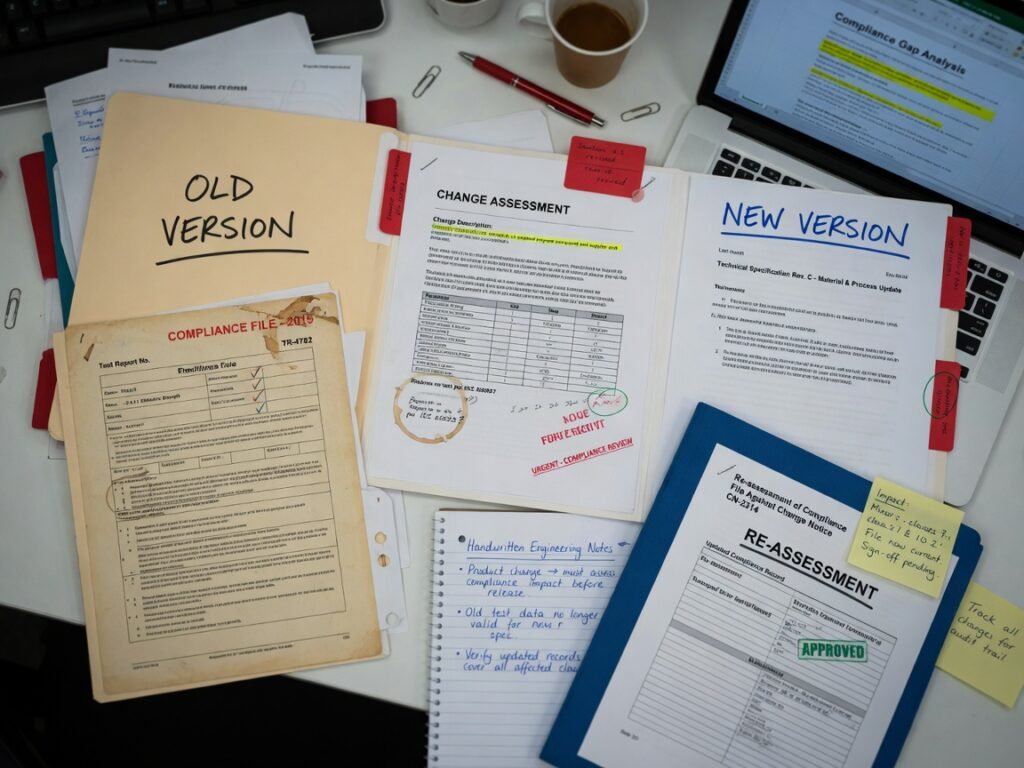
If a product sells well, it is inevitable to modify models or replace parts. Not all changes require a complete re-run of the process. You can judge according to this logic:
- Changes that require re-assessment: changing power supply specifications/power, replacing wireless modules/antennas, modifying PCB layout, replacing core safety components, modifying software resulting in changed wireless parameters — these changes may affect safety, EMC, or RF performance, so you must find a service provider to assess, and supplementary testing or registration update may be required;
- Changes that only require file update: changing appearance color, replacing packaging, replacing non-core small parts — these changes that do not affect compliance performance only need to update the file records.
When in doubt, be sure to find a professional to assess. Don’t make your own decision that “it’s okay”. The cost of a real problem is too high.
Common Violation Consequences and Responses
If you really encounter a spot check or violation, don’t panic, first clarify the situation:
Common violation consequences include customs detention of goods, platform delisting, fines, product recalls, etc. The specific severity depends on applicable laws, product risks, and violation circumstances, subject to the applicable rules at the time of issuance.
If you are spot-checked, cooperate with the regulator to provide compliance files as soon as possible, and rectify as required. Do not conceal or delay, to avoid aggravating the penalty.
If it is indeed a violation, immediately stop selling the relevant products, complete the supplementary compliance process as required, and re-launch after the rectification is completed and confirmed to meet the requirements. Do not continue to sell with a fluke mentality.
Overall, the core logic of RCM application is “match applicable rules according to product classification, and retain complete compliance evidence”. After reading this article, you should be able to independently complete the following tasks: quickly judge whether a product needs RCM, choose the right application path according to product risk and function, complete the standard application process and check the key points of each step, avoid more than 90% of common application pitfalls, verify the authenticity and validity of the application results, and judge whether the compliance file needs to be updated after product changes. Before going on the market, verify item by item according to product classification, applicable rules, compliance evidence, responsible entity, labels, and files, which can minimize compliance risks and smoothly enter the target market.