
If you run an electronic product business in Great Britain, UK, or often buy digital and home appliance products in the UK, you have most likely heard of the term UK RoHS. It is often associated with “market access” and “compliance”, but many people have only a partial understanding of its actual requirements and scope of application, and even easily confuse it with regulations with similar names such as EU RoHS and UK WEEE.
1. Basic Understanding of UK RoHS: Definition, Origin and Practical Significance
The UK RoHS regulations (usually abbreviated as UK RoHS, commonly known as “UK RoHS Directive” in Chinese-speaking circles) are a set of mandatory environmental protection rules for electrical and electronic products on the market of Great Britain (England, Scotland, Wales) in the UK. It should be noted that the legal form of UK domestic law is Regulations, not EU-level Directives. Below, we will uniformly refer to it as UK RoHS in the context of UK regulations. Its corresponding UK domestic legislation is , the core of which is to restrict the content of hazardous chemical substances inside products. Note that it is not a quality certification, nor does it govern whether the product leaks electricity or is durable — it only concerns whether the hazardous substances in the product will pollute the environment after being discarded or affect human health through long-term exposure.
Many people may wonder why the UK has its own independent RoHS rules. This starts with Brexit: before Brexit, as an EU member state, the UK directly applied EU RoHS rules, and these requirements had already been implemented in the UK through domestic legislation in 2012. After Brexit in 2020, the UK revised the original regulations, and since January 1, 2021, they have operated as an independent system applicable to the Great Britain market, becoming two parallel and independent sets of rules alongside EU RoHS. It is complementary to another set of regulations on e-waste recycling, the UK WEEE Regulations, which together cover the full-cycle environmental protection requirements of electronic products from production to disposal.
For different groups of people, the significance of UK RoHS is completely different: if you are an enterprise or seller, it is the access threshold for the Great Britain market, and non-compliant products cannot be placed on the market for sale; if you are an ordinary consumer, you do not bear any compliance obligations, and on the contrary, you can buy products with lower hazardous substance residues because of these rules; if you work in the supply chain industry, you should pay special attention — the compliance of upstream raw materials will directly determine whether downstream finished products can enter the UK market.
2. Quick Distinction of Easily Confused Regulations: Avoid Wrong Direction at the Start
The most common mistake made by people who are new to this is to confuse regulations with similar names, wasting effort and even falling into pitfalls. Let’s first clarify several of the most easily confused rules.
UK RoHS vs EU RoHS: Different Applicable Regions, Independent Rules
Many people think that the two can be used interchangeably because their contents are similar, but in fact they are two completely independent sets of regulations. The core differences can be quickly compared in the table below:
| Comparison Item | UK RoHS | EU RoHS |
| Applicable Region | Great Britain, UK (England, Scotland, Wales) | 27 EU member states + Northern Ireland, UK |
| Current Similarity of Rules | Adopted the EU framework at the time of Brexit, and the restricted substances and limits are currently basically the same | Same as left |
| Core Differences | Independent regulation, with its own control over the exemption list and update pace; the application of compliance marks needs to be verified according to product categories and the official transitional arrangements at the time, and the EU CE declaration of conformity cannot directly replace the UK declaration of conformity | Independent regulation, with CE as the compliance mark |
| Future Risks | The UK may adjust the rules independently, and it cannot be assumed that they will always be consistent with the EU | The EU updates its rules on its own, which has nothing to do with the UK |
UK RoHS vs UK WEEE: Completely Different Control Stages
Another often confused regulation is UK WEEE. Many people think it is the same thing as UK RoHS, but in fact the two regulate completely different stages: UK RoHS controls the content of hazardous substances before product production and market placement, reducing pollution from the source; UK WEEE controls the recycling, sorting and treatment of products after they are discarded, solving the problem of end-of-life e-waste. Both are environmental protection requirements that electrical and electronic products need to meet, and they often need to be complied with at the same time, but they can definitely not be handled with the same document.
Boundaries with Other Adjacent Regulations
There are two other misunderstandings that easily lead to scope expansion, which should be clarified in advance: First, UK RoHS is different from UK REACH. UK REACH is a general regulation governing the restriction of all categories of chemicals, while UK RoHS only targets 10 specific hazardous substances in electrical and electronic products, with a much narrower scope. Second, UK RoHS does not govern issues such as electrical safety and electromagnetic compatibility (EMC) — those are matters covered by safety regulations. For products to enter the UK market, they usually need to meet several regulations at the same time, and RoHS is just one of the environmental protection categories.
3. Scope of Application and Quick Judgment: First Figure Out Whether Your Product Is Regulated
After figuring out what it is, what you care about most must be: does my product need to comply with UK RoHS? We will first talk about the judgment criteria, and then give you a set of judgment methods that can be directly applied.
Judgment Criteria for Products That Must Comply
The applicable objects of UK RoHS can be understood at three levels to avoid too wide or too narrow scope judgment:
The first level is finished electrical and electronic equipment (EEE), which is the core applicable object. The judgment criteria are: the product relies on electric current or electromagnetic fields to work normally, and the rated voltage is usually below 1000V AC and 1500V DC. Common examples include mobile phones, refrigerators, computers, LED lights, electric toys, power banks, home monitoring equipment, etc.
The second level is related components placed on the market separately, such as separately sold supporting cables, replacement spare parts for product maintenance, etc. It is necessary to judge whether they fall within the scope of application in combination with the specific definitions of the regulations.
The third level is raw materials and ordinary parts and components. Such items are usually objects whose compliance is controlled by finished product manufacturers through bills of materials, supplier declarations, and test reports, and they generally do not directly bear the finished product obligations of UK RoHS as independent electrical and electronic equipment.
The category judgment of specific products shall still be subject to the official definition of current regulations.
Scope Exclusions and Substance Exemptions: Two Types of Special Situations to Distinguish
Many people confuse “not needing to comply with the regulation” with “specific substances being allowed to exceed the limit”, but in fact these are two completely different types of special rules:
The first type is scope exclusion, which means the product is completely not subject to the UK RoHS regulations and does not need to perform relevant compliance obligations. Common excluded categories include: equipment specially designed for military, aerospace or nuclear facility purposes and meeting statutory conditions, large stationary industrial tools and fixed installations, active implantable medical devices, professional non-road mobile machinery, some means of transport, components specially designed only for excluded equipment, specific organ components, and R&D equipment that meets statutory conditions such as “provided only in business-to-business scenarios for R&D purposes”, etc. Whether second-hand products and personal items for non-commercial use are applicable needs to be judged in combination with the regulatory definition of “commercial placing on the market”, and they are not automatically excluded. Items for private personal use, non-commercial carrying, or that do not constitute commercial placing on the market are usually not handled in accordance with the obligations of marketed products; but if second-hand EEE is re-placed on the Great Britain market as a commodity, the responsibility still needs to be confirmed in combination with the official definition.
The second type is substance use exemption, which means the product itself falls within the scope of application of UK RoHS, but due to reasons such as difficulty in technical substitution, specific hazardous substances can temporarily exceed the conventional limits under specific uses, such as some special medical equipment, professional measuring instruments, high-temperature solders, etc. Such exemptions have clear applicable product categories, uses, substance scopes and validity periods, and are not full-product exemptions, nor are they permanently valid.
In addition, there is a regional exception that is very easy to get wrong: Northern Ireland in the UK applies EU RoHS, not UK RoHS. If you are unsure about the applicability of the product, you can check the current RoHS regulations, official guidelines and updates from the product safety enforcement agency published on the UK government’s GOV.UK website, subject to the valid exclusion list and exemption schedule on the date of inquiry.
Steps to Quickly Judge Product Compliance Requirements
You can quickly sort out according to the following steps, which can basically cover most common scenarios:
The first step is to look at the function, confirm whether the product is an electrical and electronic equipment that works by electric current or electromagnetic field, and whether the voltage is within the conventional range;
The second step is to look at the market, confirm whether the product is to be sold to the three Great Britain regions: England, Scotland, and Wales;
The third step is to look at scope exclusions, and check against the official list to confirm whether the product is an excluded category that is completely not subject to the regulation.
If the product falls within the scope of application, further check the content of the 10 restricted substances; if you need to invoke a substance exemption, you must meet the three conditions of matching product category, matching use, and the exemption being within the validity period at the same time, and you still need to perform other regulatory obligations such as technical documentation and declaration of conformity.
4. Core Restriction Requirements: Only by Understanding the Rules Can You Know What Counts as Compliance
After confirming that the product falls within the scope of application, let’s look at the specific requirements to be met — the core is the content limit of 10 hazardous substances, as well as a calculation rule that is most easily misunderstood.
10 Restricted Hazardous Substances and Their Common Uses
Currently, there are 10 hazardous substances restricted by UK RoHS, divided into two categories:
The first category is the earliest 6 conventional hazardous substances, namely lead (commonly found in solders and alloys), mercury (found in some lighting equipment and switches), cadmium (commonly found in contacts and coatings), hexavalent chromium (used in anti-corrosion coatings), polybrominated biphenyls (PBB, flame retardants), and polybrominated diphenyl ethers (PBDE, flame retardants);
The second category is 4 phthalate plasticizers added later, namely DEHP, BBP, DBP, and DIBP. These substances are commonly used as plastic additives and may affect the endocrine system.
The common feature of these substances is that they enter soil and water sources along with e-waste, and long-term exposure will cause chronic harm to human health.
Limit Rules and Calculation Standards
The content limits are divided into two grades: cadmium has the strictest requirement, not exceeding 0.01% of the weight of the homogeneous material, that is, 100 ppm; the limit for the remaining 9 substances is 0.1% of the weight of the homogeneous material, that is, 1000 ppm.
It should be noted here that the limit is calculated for each substance separately, not by adding up the content of the 10 substances. Of course, this limit is for situations where there is no valid substance exemption; if the corresponding exemption conditions are met, specific substances may not be subject to this limit.
Key Concept: What is “Homogeneous Material”
Speaking of this, we must mention a concept that is most easily misunderstood — homogeneous material. Many people think it is calculated based on the total content of the whole machine, or based on a single part, but neither is correct.
In plain terms, a homogeneous material is the smallest unit of the same material that cannot be further split by mechanical methods (such as twisting, disassembling, scraping). For example, for a mobile phone charging cable, the copper core inside is one homogeneous material unit, the outer plastic insulation layer is another, and the coating on the metal contacts at both ends is a third — each unit must meet the limit requirements separately, and cannot be averaged together. This is also the place where many novices fall into the most pitfalls: they think that as long as the lead content of the whole machine does not exceed the limit, it is fine, but as a result, the cadmium content in the coating of a small part exceeds the standard, which is still non-compliant.
Rules for Using Exemption Clauses
Exemption does not mean “no need to comply”, but for certain specific scenarios, because there is currently no more environmentally friendly alternative, specific hazardous substances are allowed to temporarily exceed the limit.
There are three conditions that must be met at the same time to use an exemption: first, the product category matches, for example, if a certain exemption is for medical equipment, consumer electronics cannot use it; second, the use matches, for example, if the exemption is for high-temperature solder, ordinary solder cannot use it; third, it is within the validity period, each exemption has a fixed validity period, and after expiration, it must meet the conventional limits. In addition, for products that use exemptions, the number of the exemption clause on which they are based must be clearly stated in the technical documentation, and the scope of application cannot be expanded without authorization.
Special attention should be paid: exemptions are only for specific uses of specific substances, other restricted substances that are not exempted still need to meet the conventional limits, and the product still needs to meet the overall compliance requirements such as technical documentation and declaration of conformity.
5. Compliance Practical Process: From Entry-Level Implementation to Advanced Judgment
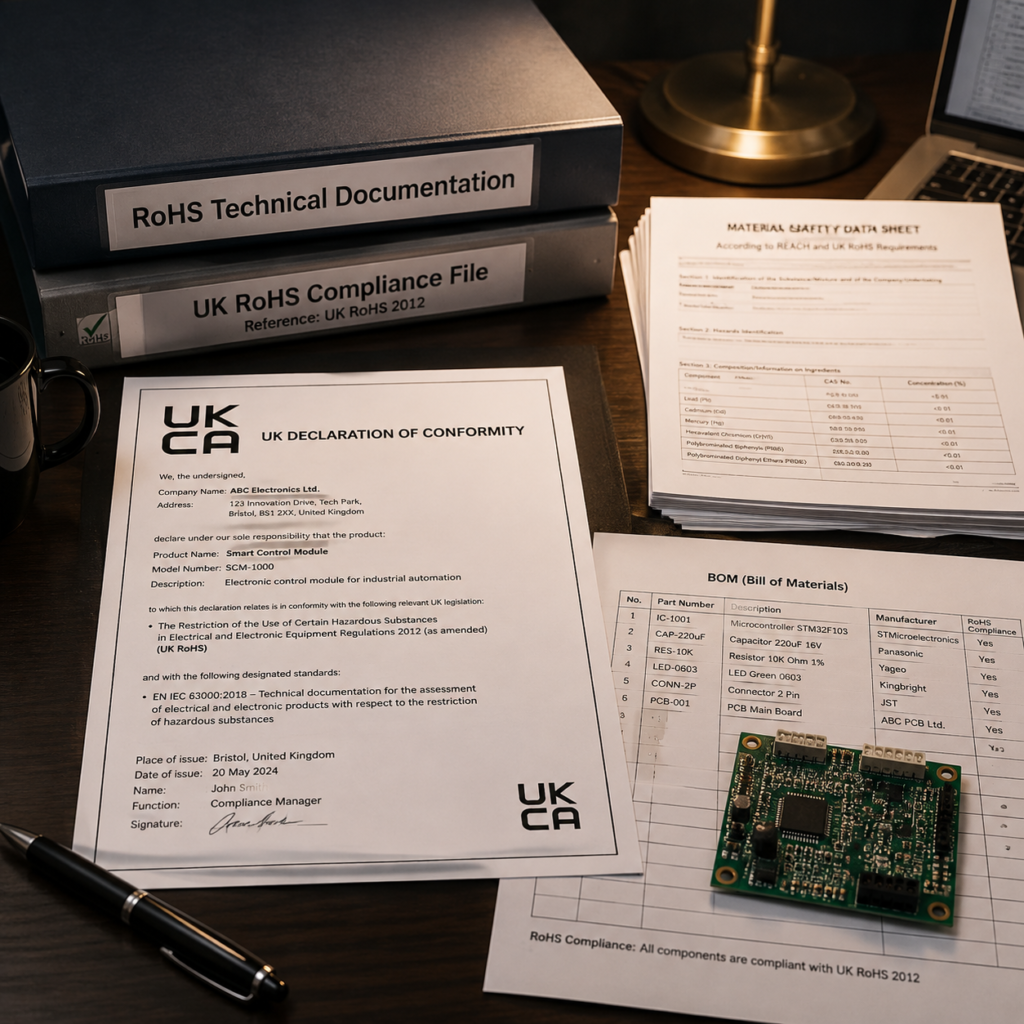
After talking about the requirements, let’s talk about how to achieve compliance specifically. People with different identities have different responsibilities. First, clarify the responsibilities, then give entry-level operation methods and several advanced judgment skills.
Obligation List for Different Responsible Entities
First of all, it is necessary to clarify the compliance obligations of different roles to avoid failing to take the responsibilities that should be taken and worrying unnecessarily about those that should not be taken:
• Manufacturer: The entity that designs, produces and places products on the market in its own name, responsible for the compliance of material selection, establishing complete technical documentation, issuing a declaration of conformity, and ensuring that products meet the mark requirements.
• Importer: The entity that first places products produced overseas on the Great Britain market, needs to verify whether the manufacturer’s compliance materials are complete, ensure that the products carry correct compliance information, keep supply records, and cooperate with regulatory spot checks.
• Distributor/Retailer: Cannot sell products that are known to be non-compliant, must also keep records of supply sources, and promptly report problems to the regulatory authority when found.
• Cross-border direct sales seller: Need to first clarify their role in the supply chain — if they sell directly to consumers in Great Britain from overseas and have not entrusted a domestic importer, they usually need to bear the corresponding obligations equivalent to those of a manufacturer or importer, subject to the regulatory definition of “placing on the market”.
• Authorized representative: Manufacturers outside the UK may appoint a UK local authorized representative to assist in performing compliance obligations and cooperating with regulatory inspections within the scope of the appointment, which is not a mandatory requirement for all overseas manufacturers.
3 Types of Core Certificates Necessary for Compliance
Usually, at least three types of compliance evidence need to be prepared, among which the specific form of the mark needs to be confirmed according to the product category and the official transitional arrangements at the time:
The first is compliance mark: Provided on the product body, packaging or accompanying documents in accordance with the applicable marking system and the marking method allowed by the official at the time (the applicability of CE or UKCA needs to be verified in combination with the product category and the latest transitional arrangements).
The second is Declaration of Conformity (UK DoC): A compliance certification document issued and kept by the manufacturer or its authorized signatory, which must at least include identifiable product information, manufacturer information, applicable regulatory basis, information of the signatory responsible person, etc. It does not require mandatory stamping, but needs to be able to prove the validity of the signature.
The third is technical documentation: Including all materials that can prove that the product meets the limit requirements, such as the product’s bill of materials, compliance declarations provided by suppliers, test reports, etc. This set of documents must be kept for at least 10 years and must be available when the regulatory authority conducts spot checks.
4 Steps for Entry-Level Compliance
For small sellers or small manufacturers who are new to this, there is no need to spend a lot of money on laboratory testing at the beginning. Following these 4 steps can complete basic compliance:
Step 1: Disassemble the product to the smallest unit of homogeneous material, and sort out a complete bill of materials (commonly known as BOM, listing clearly the material, use, and supplier of each unit);
Step 2: Request the hazardous substance content certificate of the corresponding material from each supplier, or the declaration of conformity issued by the supplier itself;
Step 3: Check the hazardous substance content of all homogeneous materials against the UK RoHS limits to confirm whether there is any excess and whether it is necessary to use exemption clauses;
Step 4: Organize all materials into technical documentation, issue a UK DoC that meets the requirements, and affix the compliance mark in accordance with the rules at the time.
When is Formal Laboratory Testing Required

UK RoHS does not uniformly require all products to undergo third-party laboratory testing in advance, but enterprises must have sufficient technical evidence to support the declaration of conformity. In the following situations, it is recommended to supplement verification through formal laboratory testing:
The supplier cannot provide valid and verifiable compliance certification materials; the product uses new materials with unknown composition, or the materials, formulas, or suppliers have changed; the product contains high-risk materials (such as coatings, solders, plastic parts, etc.), and the existing materials are insufficient to prove compliance; the regulatory authority requires formal test reports during spot checks.
It should be reminded here: handheld XRF equipment is suitable for rapid initial screening of some heavy metals such as lead, cadmium, and mercury, but it cannot reliably detect phthalates, nor can it directly distinguish hexavalent chromium from chromium in other valence states. Therefore, compliance judgment for all 10 substances cannot be completed solely based on XRF results, and appropriate confirmation methods must be combined.
Judgment Method for Whether EU RoHS Reports Can Be Reused
Many sellers who have done business in the EU market will ask: I already have an EU RoHS report, can I use it for UK RoHS? The answer is that it can be used as supporting evidence for technical documentation, but it needs to be checked according to the following steps:
Step 1: Check the test items: whether the report covers all 10 restricted substances required by UK RoHS; early EU reports that only tested 6 substances cannot be used directly.
Step 2: Check the test standards: whether the test is carried out by splitting homogeneous materials, whether the limit requirements are consistent with UK RoHS, and whether the test methods and detection limits are sufficient to support the judgment of the corresponding limits.
Step 3: Check the consistency: whether the product model, homogeneous materials, formula, supplier, and production process corresponding to the report are completely consistent with the product currently intended to be placed on the market; if materials, suppliers, processes or regulatory requirements change, re-evaluation or supplementary testing is required.
Even if the report fully meets the requirements, the EU CE declaration of conformity cannot directly replace the declaration of conformity required by UK RoHS, and a separate UK DoC that meets the requirements of UK regulations must be issued.
6. Pitfall Avoidance and Risks: Common Misconceptions and Consequences of Non-Compliance
7 Most Common Compliance Misconceptions
• Misconception 1: Confusing “scope exclusion” and “substance exemption”. Thinking that using an exemption means the product is not subject to UK RoHS jurisdiction. In fact, the exemption only allows specific substances to exceed the limit under specific uses, and the product still needs to perform all other obligations such as technical documentation and declaration.
• Misconception 2: Thinking that UK RoHS applies to the entire UK. In fact, Northern Ireland follows EU RoHS rules, and products sold there need to comply with EU requirements.
• Misconception 3: Thinking that small-batch or online-sold products do not need to comply. As long as it is an electrical and electronic product commercially placed on the Great Britain market, regardless of how much is sold and whether the sales channel is online or offline, it must meet the requirements, which has nothing to do with sales volume.
• Misconception 4: Thinking that getting a test report equals compliance. The test report is only part of the technical documentation; a complete set of materials such as a complete bill of materials, supplier certificates, and declaration of conformity is also required to form a complete compliance evidence chain.
• Misconception 5: Thinking that meeting the standard based on the total content of the whole machine counts as compliance. The actual requirement is that each homogeneous material must meet the standard separately, and the content cannot be lowered by averaging the whole machine.
• Misconception 6: Thinking that having an EU RoHS report can be directly used for UK RoHS compliance. The EU report can be used as technical evidence, but it needs to be checked whether it covers 10 substances, is tested according to homogeneous materials, and is consistent with the product model/materials, and a separate UK Declaration of Conformity (UK DoC) must be issued.
• Misconception 7: Thinking that a supplier’s verbal promise can prove compliance. There must be traceable written declarations, test reports or material composition certificates; verbal promises have no compliance validity.
Actual Consequences of Non-Compliance
If the product does not meet the UK RoHS requirements, the UK product safety regulatory authority may, based on the investigation results, require the enterprise to submit supplementary materials, take rectification measures, restrict or stop the supply of problematic products, and may require a recall if necessary. Illegal acts may lead to fines, and in serious cases, may also involve criminal liability. The specific penalty intensity depends on the type of obligation violated, the circumstances of the violation, the law enforcement procedure and the court’s discretion.
Risk Warning on Rule Changes
In addition, attention should be paid to the risk of rule changes: UK RoHS is an independent regulation of the UK, and the list of restricted substances, exemption clauses, or transitional rules for compliance marks may be adjusted independently in the future; the applicable rules for Northern Ireland may also change with the adjustment of the UK-EU agreement. It is recommended that merchants doing business in the UK market regularly check the updates of the RoHS column on the UK government’s GOV.UK website to avoid pitfalls due to rule changes.
7. Quick Product Compliance Self-Check List
For your convenience in quick checking, we have compiled a product compliance self-check list, which you can directly check off:
• □ The product is electrical and electronic equipment and is intended to be sold in Great Britain (England, Scotland, Wales)
• □ It has been confirmed against the official list that the product is not an excluded category of the regulation
• □ The content of all 10 restricted hazardous substances has been checked according to homogeneous materials, or it has been confirmed that the applicable conditions for the corresponding substance exemption are met
• □ Complete supporting materials such as supplier compliance declarations and test reports have been collected to form an effective evidence chain
• □ A Declaration of Conformity (UK DoC) that meets the requirements of UK regulations has been issued
• □ The compliance mark has been affixed in accordance with the then-effective marking rules, and the full set of technical documentation has been kept for at least 10 years
5 Things You Can Independently Judge After Learning
• Can quickly judge whether a product needs to meet UK RoHS requirements through 3 steps
• Can distinguish the core differences between UK RoHS, EU RoHS and UK WEEE
• Can understand the limit requirements of 10 restricted substances and the calculation rules of homogeneous materials
• Can complete basic compliance construction in 4 steps and know when formal laboratory testing is required
• Can judge whether EU RoHS reports can be reused and avoid common compliance misconceptions
In general, the core logic of UK RoHS is to reduce the residual hazardous substances in electronic products from the production source and reduce the long-term impact of e-waste on the environment and human health. Beginners can first clarify the scope of application of the product according to the judgment logic, and then gradually build a compliance evidence chain. When encountering complex scenarios such as exemptions and special materials, they can follow the latest official guidelines or consult a professional compliance agency.