
If you run a cross-border business selling electrical and electronic products, whether chargers, small home appliances, or industrial accessories, and you target both the EU and UK markets, you have most likely heard of RoHS. Many new sellers assume: since the UK used to be an EU member state, aren’t UK RoHS and EU RoHS the same thing? Won’t a CE certification work for both markets?
That is not the case. After the UK’s withdrawal from the EU, the two RoHS regimes are fully independent regulations. There are substantive differences ranging from labeling requirements to responsible entities and exemption clauses. Confusing them may result in rectification requirements at best, and cargo detention, product recalls, or even fines at worst.
This article starts with the most basic concepts, and clarifies the commonalities, differences, special regional rules, and practical judgment methods of the two RoHS regimes. Whether you are a new seller just entering the industry or an experienced seller looking to sort out compliance logic, you will find actionable information here.
Basic Introduction: First Understand the Identity, Scope, and Comparison Basis of the Two RoHS Regimes
Before discussing specific differences, let’s clarify the most basic concepts and rules first to avoid getting more confused later.
What Exactly Is RoHS
The full English name of RoHS is Restriction of Hazardous Substances, which means restriction of hazardous substances. It is a material environmental protection requirement for electrical and electronic products, not a safety certification. Its core purpose is to reduce the harm of harmful components in e-waste to the environment and human health. It usually applies to new electrical and electronic products placed on the corresponding market, including supporting parts, cables, and spare parts — from small items such as mobile phones, chargers, and small home appliances to large items such as lighting equipment and industrial monitoring devices, almost all new products that rely on electronic functions are within its scope.
Regulatory Identity and Scope of Application of the Two RoHS Regimes
Although both have RoHS in their names, the legal basis and applicable regions of the two sets of rules are completely independent:
• EU RoHS: It is a mandatory environmental protection rule uniformly implemented at the EU level, with the legal basis of the (Directive 2011/65/EU, including subsequent amendments). Its applicable scope covers the 27 EU member states + the European Economic Area (EEA, including Norway, Iceland, and Liechtenstein), and it is enforced separately by the market supervision authorities of each member state.
• UK RoHS: It is a domestic regulation converted from EU RoHS after the UK’s withdrawal from the EU. Its legal basis is the (including post-Brexit amendments). It only applies to Great Britain (GB, i.e., England, Scotland, and Wales), and is uniformly enforced by the UK Office for Product Safety and Standards (OPSS). After Brexit, UK RoHS will be updated independently and will no longer automatically follow EU regulatory amendments.
Don’t Confuse It with UK WEEE or UK REACH
Many new sellers confuse RoHS with two other common UK environmental regulations. In fact, the three are completely independent, with different scopes of jurisdiction and compliance obligations, and require separate compliance:
• Difference from UK WEEE: RoHS regulates the restriction of hazardous substance content during the product production stage, while UK WEEE regulates the recycling, treatment, and producer registration obligations for e-waste. One regulates front-end materials, the other regulates back-end recycling, and they cannot replace each other.
• Difference from UK REACH: RoHS only targets 10 specific hazardous substances in electrical and electronic products, while UK REACH regulates the registration, evaluation, authorization, and restriction of all types of chemicals. Its coverage is much wider than RoHS, and its requirements are more complex.
Basis of This Comparison and Conditions for Changes to Conclusions
To avoid cognitive bias, first clarify the comparison benchmark and the applicable scope of the conclusions in this article:
• The comparison benchmark is the currently officially effective mandatory version of both parties, excluding proposals or draft consultations that have not yet been implemented.
• The comparison dimensions cover five core aspects: scope of application, restriction requirements, exemption rules, compliance procedures, and law enforcement penalties.
• Three typical situations where conclusions may change: the product falls under a special exemption category, the sales location includes Northern Ireland, or either party issues an official regulatory amendment. In actual operation, please refer to the latest official requirements of the corresponding market.
Core Commonalities: Currently Highly Consistent Technical Benchmarks for Both Sides
Although they are two sets of independent regulations, since UK RoHS is converted from EU RoHS, most technical benchmarks are still highly consistent at present. Especially for ordinary consumer electronics, the impact of differences is minimal. It is easier to clarify the logic by first discussing commonalities and then differences.
10 Commonly Restricted Hazardous Substances and Thresholds
The types and thresholds of hazardous substances currently restricted by both sides are exactly the same, totaling 10: lead, mercury, cadmium, hexavalent chromium, polybrominated biphenyls (PBB), polybrominated diphenyl ethers (PBDE), plus 4 phthalate plasticizers (DEHP, BBP, DBP, DIBP).
The threshold rules are also exactly the same: the content of cadmium shall not exceed 0.01% (i.e., 100 ppm), and the content of the other 9 substances shall not exceed 0.1% (i.e., 1000 ppm).
Here we need to highlight one of the most common misconceptions: the threshold is judged based on homogeneous materials, not the total weight of the whole product. Many people think that testing the entire product and meeting the average content is enough, but that is not the case.
How to Judge Homogeneous Materials
“Homogeneous material” sounds professional, but it is actually easy to understand: it is the smallest unit that cannot be disassembled into different materials by ordinary mechanical methods (such as common tools like screwdrivers, pliers, scissors, etc.).
Put simply, it means when you disassemble the product as far as possible, each piece of material with completely uniform color and texture is a homogeneous material. Even if it is very small, such as the plating on the surface of a plug, solder joints on a circuit board, or additives in plastic, they are all separate homogeneous materials and must meet the threshold requirements respectively.
For example: an ordinary charging cable cannot be tested as a whole for average content. It must be disassembled into the plastic sheath, copper core wire, plug metal parts, and plating on the plug surface, and each part must meet the standard when tested separately. Conversely, an entire circuit board is definitely not a homogeneous material; it must be disassembled into solder, plastic encapsulation, metal pins, chip coating, etc., for separate judgment.
There is a simple judgment tip: if the color and texture of a piece of material are uniform from start to finish, it can basically be regarded as a homogeneous material.
Product Coverage and Exclusions
Currently, the main scope of coverage of both sides is highly consistent: all electrical and electronic products that rely on electric current or electromagnetic fields to achieve their main functions, with a rated voltage below 1000V AC / 1500V DC, are within the scope of jurisdiction.
Common core exclusions are roughly the same. For example, military equipment, large fixed industrial installations, aerospace equipment, etc., do not need to meet RoHS requirements under current rules. Purely mechanical products without any electronic components also do not require RoHS compliance in both markets.
However, note that after Brexit, the exclusion lists of the two sides may not be updated synchronously. If you deal with relatively niche industrial categories, it is best to check the latest official regulatory lists of the corresponding markets separately.
Difference Reminder for Ordinary Consumer Electronics
If you sell ordinary consumer electronics, such as mobile phones, chargers, small home appliances, and daily lighting equipment, you can basically breathe a sigh of relief first: such products rarely use exemption clauses, and the impact of differences between the two sides is very small. As long as they meet the homogeneous material threshold requirements, most material test reports can be shared. You only need to prepare compliance documents and labels for the corresponding markets separately. The specific sharing rules will be explained in detail in the practical operation section later.
Core Obvious Differences: Rule Differences That Can Be Distinguished at a Glance
After discussing commonalities, let’s talk about the most intuitive differences between the two sides. For quick comparison, we have first compiled a quick reference table of core differences, and then we will elaborate on the details later:
| Comparison Dimension | EU RoHS | UK RoHS (Great Britain / GB) |
| Applicable Region | 27 EU member states + European Economic Area (Norway, Iceland, Liechtenstein) | England, Scotland, Wales |
| Mandatory Access Label | CE mark | CE or UKCA mark optional (subject to the latest official transition policy) |
| Legal Basis | EU Directive 2011/65/EU and subsequent amendments | and post-Brexit amendments |
| Responsible Entity for Compliance | Legal entity within the EU (importer / manufacturer / authorized representative) | Legal entity within Great Britain (importer / manufacturer / authorized representative) |
| Exemption Updates | The EU independently issues updates | The UK updates independently, not in sync with the EU |
| Law Enforcement Agency | Enforced separately by market supervision authorities of each member state | Uniformly enforced by the UK Office for Product Safety and Standards (OPSS) |
Differences in Applicable Regions and Regulatory Systems
In terms of scope of application, EU RoHS covers the 27 EU member states plus the three EEA countries, and is enforced separately by the market supervision authorities of each member state. Enforcement standards and penalty criteria may vary between different countries.
UK RoHS only covers the Great Britain (GB) region, and is uniformly enforced by OPSS, with relatively unified rules and standards.
Here is a special reminder: when people usually say “export to the UK”, you cannot directly determine the compliance requirements. You must first clarify whether the products are sold to GB or Northern Ireland — the rules for Northern Ireland are completely different, which will be discussed separately later.
Differences in Market Access Label Requirements
Labeling is the most obvious difference, and it is also the issue that many new sellers are most concerned about:
EU market: The CE conformity mark is mandatory. The mark must be clear and legible, with a minimum size of no less than 5mm. If the product is too small and there is not enough label space, the mark can also be printed on accompanying documents such as manuals and packaging. In addition to the mark, the name and contact address of the economic operator within the EU must also be marked.
Great Britain (GB) market: At present, the UKCA mark is not mandatory; instead, either the CE or UKCA mark can be used. The specific scope of application and transition arrangements shall be subject to the latest list officially issued by the UK OPSS. The UKCA mark has clear size and style specifications, and can also be marked on the product together with the CE mark. Similar to EU requirements, if label space is insufficient, the mark can be placed on accompanying documents, but the information of the economic operator within GB must also be marked.
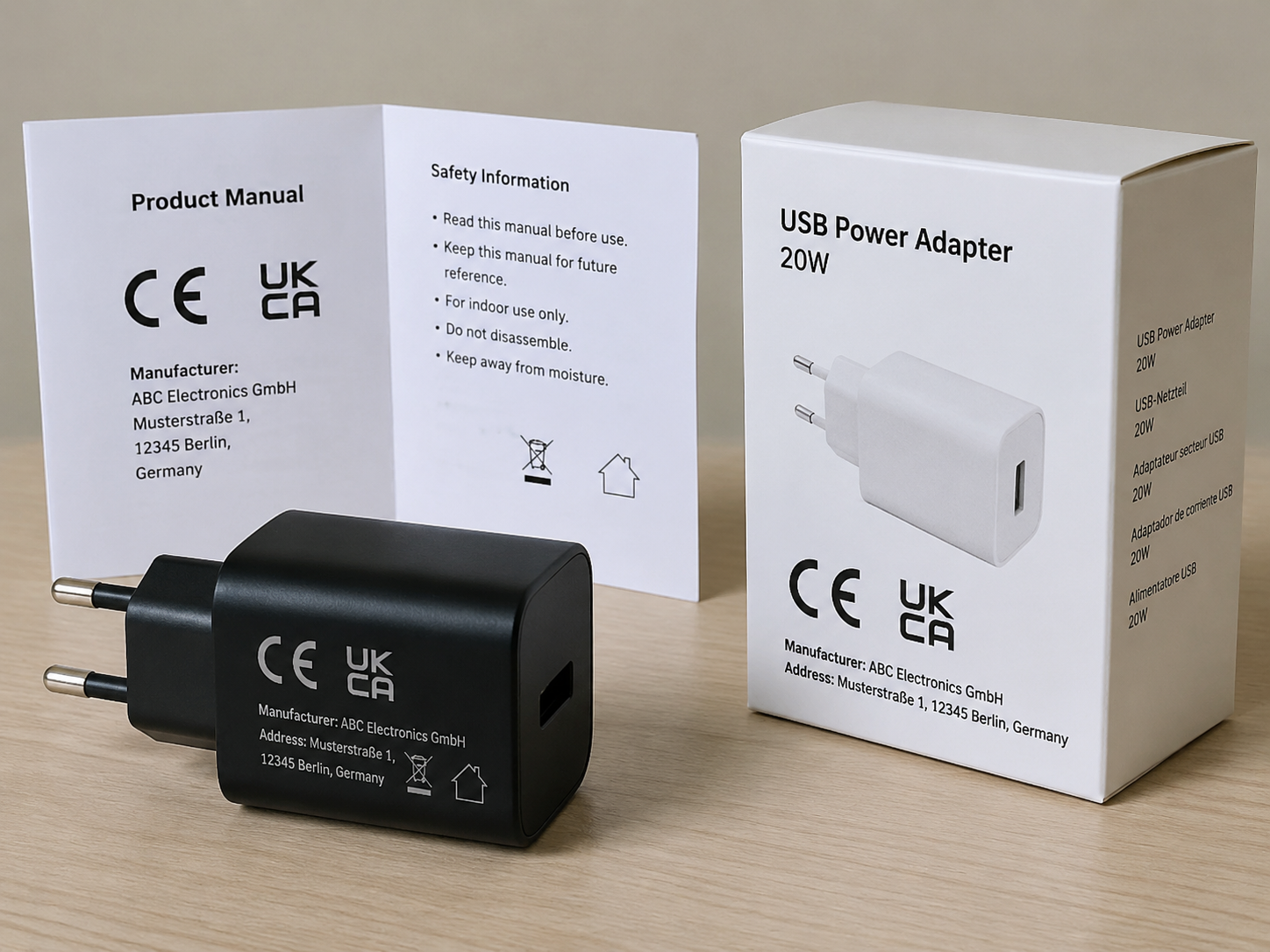
Many people have a misconception: they think the GB market has already made UKCA mandatory, and the CE mark is completely useless. That is not the case. The transition policy has been constantly adjusted. Be sure to follow the latest official requirements and do not trust unofficial rumors.
Commonalities and Differences in Compliance Document Packages
Most of the compliance document requirements of the two sides are consistent, after all, they share the same origin:
Common requirements:
First, both sides adopt a manufacturer self-declaration system. There is no mandatory requirement to find a third-party institution for certification. Enterprises themselves are responsible for the compliance of their products, and third-party testing is only a proof method chosen by enterprises on their own.
Second, the composition of the compliance document package is basically the same: it requires a BOM (Bill of Materials), homogeneous material disassembly list, supplier compliance declaration, material test report, exemption assessment report (if exemptions are used), risk assessment report, Declaration of Conformity (DoC, a document issued by the enterprise to prove that the product meets the requirements), product labels, and manuals.
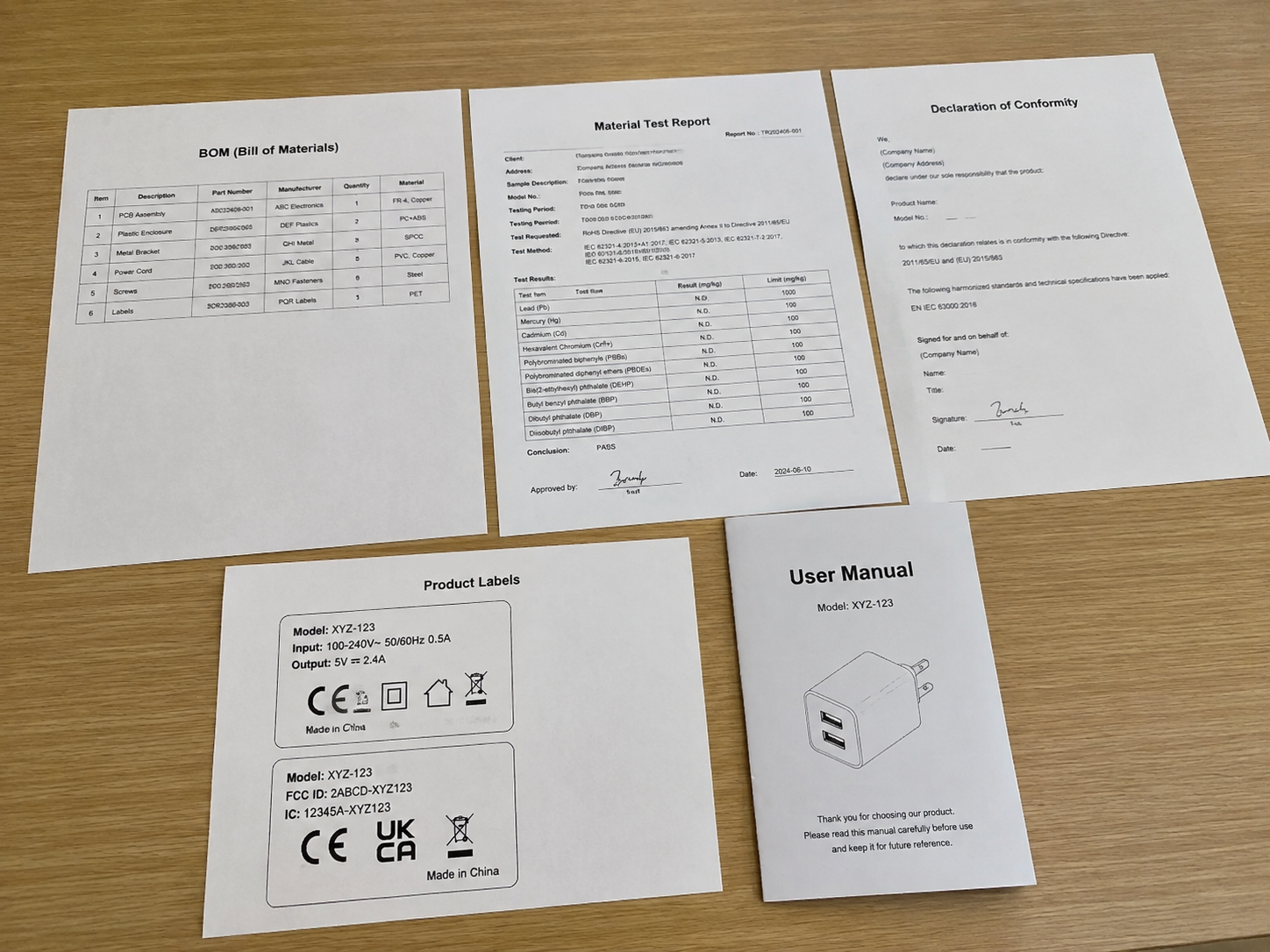
Finally, the document retention requirements are the same: documents must be kept for 10 years after the product is placed on the market, and must be provided within the specified time when the regulatory authority conducts random inspections.
Differences:
The core difference lies in the Declaration of Conformity (DoC):
• The EU DoC must reference the number of the EU RoHS Directive and list the information of the economic operator within the EU.
• The UK DoC must reference the number of the UK RoHS Regulations and list the information of the economic operator within Great Britain.
The two DoCs cannot be directly copied and pasted for use. The legal basis and responsible entity must correspond to their respective markets. Of course, you can merge the two contents into one document, as long as the information corresponding to the two sets of regulations is clearly marked separately.
Differences in Obligations of Economic Operators (Responsible Entities for Compliance)
“Economic operator” sounds convoluted, but it actually refers to the legal entity that bears compliance responsibility. This is a very core difference between the two sides, and it is also a place where many cross-border sellers easily make mistakes.
EU RoHS (combined with EU market supervision regulation EU 2019/1020) divides responsible entities into four categories: manufacturers, importers, distributors, and authorized representatives, each with clear obligations:
• If a manufacturer within the EU sells directly, it shall bear all compliance responsibilities on its own.
• If a manufacturer outside the EU places products on the EU market, there must be an importer within the EU that bears the primary compliance responsibility. An authorized representative can be voluntarily entrusted to assume part of the obligations on behalf of the importer, but it is not mandatory in all scenarios.
• The obligation of distributors is to verify the labels and documents of products, and they shall not sell obviously non-compliant products.
The responsible entities of UK RoHS are also divided into four categories: manufacturers, importers, distributors, and authorized representatives within GB:
• If a manufacturer within GB sells directly, it shall bear all responsibilities on its own.
• If an overseas manufacturer places products on the GB market (including direct mail and sales on e-commerce platforms), the importer or authorized representative within GB shall bear the corresponding compliance responsibilities. The specific division of responsibilities shall be determined according to the sales model and applicable regulatory scenarios.
There is a core rule here: an economic operator within the EU cannot concurrently serve as the compliance responsible entity for the UK; it must be a legal entity within the corresponding jurisdiction. Simply put, if you have found an EU importer, you cannot ask them to also act as the UK responsible person; you must separately find a local legal entity in the UK.
There is also a reminder for cross-border e-commerce sellers: as long as a product is sold to the corresponding market through an e-commerce platform, it is considered “placed on the market”. The responsible person’s information usually needs to be reflected on the product, packaging, and accompanying documents. If the e-commerce platform has clear requirements, it must also be publicized in the compliance information section of the product detail page. The specific requirements shall be subject to the regulations of the target market and platform rules.
Differences in Law Enforcement and Penalties
In terms of penalties, since the EU is enforced by each member state on its own, the penalty standards are not unified. Common penalties include fines, recalls, and market access bans, and the amount of fines may vary greatly between different countries.
In the UK, law enforcement is uniformly carried out by OPSS, with more unified rules. For serious violations, criminal liability may also be pursued.
Of course, the common ground between the two sides is also clear: as long as the product is non-compliant, it will face penalties such as cargo detention, recall, and sales ban. The consequences are relatively serious, so do not take any chances.
Hidden High-Risk Differences: Out-of-Sync Exemption Clauses
If differences such as labels and documents are obvious and can be avoided as long as you are careful, then the out-of-sync exemption clauses are hidden high-risk points. Especially for sellers of special categories such as industrial and medical products, it is very easy to make mistakes.
What Exactly Is an Exemption?
First, let’s explain “exemption” to new sellers: in some specific product scenarios, there is temporarily no technically feasible alternative to hazardous substances. In this case, regulations allow these scenarios to be temporarily exempt from threshold restrictions, which is called an exemption.
But exemptions are not permanent, nor are they applicable to an entire industry — they have clear applicable conditions, product scopes, and validity periods. After expiration, they are either renewed or become invalid, and the threshold requirements must be met.
Many people have a misconception: they think that since they sell medical / industrial equipment, they automatically have exemptions and don’t need to worry about RoHS. That is completely wrong. The hazardous substances used in your product and their specific purposes must fully meet the requirements of a certain exemption clause before you can use it; even a slight discrepancy is not allowed.
Ordinary consumer electronics basically do not use exemptions, so the differences in this part have little impact on ordinary sellers. If you sell ordinary consumer electronics, you only need to have a general understanding of this part.
Sources and Typical Types of Exemption Differences Between the Two Sides
Shortly after Brexit, the exemption lists of the two sides were exactly the same, but since they are now updated independently, some differences have emerged, and the differences may gradually expand in the future.
There are three typical differences:
1. The same exemption number has different validity periods on both sides — this is the most common pitfall in practice. For example, a certain exemption has expired in the EU but not in the UK, or vice versa. If you directly apply the rules of one side, you will violate the rules of the other.
2. The EU has added a new exemption that the UK has not adopted synchronously, or the UK has added a new one that the EU has not.
3. The UK has its own domestic special exemption clauses that the EU does not have at all.
Judgment and Recording Methods for Exemption Availability
If your product may use exemptions, you must follow these steps to judge, and do not take it for granted:
Step 1: First confirm which restricted substance is used in your product, where it is specifically used, and whether it fully matches the applicable scenario stated in the exemption clause. Even one missing condition is not allowed.
Step 2: Check the official exemption lists of the corresponding markets separately to confirm that the exemption is still valid when your product is placed on the market. The official EU list can be checked on the EUR-Lex official website, and the UK list on the UK Legislation official website, both of which are free and public.
Step 3: Clearly indicate the exemption number and applicable scenario in the Declaration of Conformity (DoC). The technical documents should also retain supporting materials for the applicability of the exemption and validity period verification records, so that they can be presented during random inspections.
Always remember: you cannot directly apply the exemption of one market to another. Even if the exemption number is the same, you must check the validity period separately.
High-Risk Categories That Require Special Attention to Exemptions
If you sell the following types of products, you must pay special attention to the differences in exemptions. It is best to check the latest exemption list before each shipment:
• Medical devices, in vitro diagnostic devices
• Industrial monitoring and control equipment
• Specialized scientific research instruments, special welding equipment
• Products containing special glass, sensors, high-temperature solder
Special Region: How RoHS Applies to Northern Ireland
After discussing the differences between GB and the EU, we must talk about Northern Ireland (NI) separately — many people think “all UK rules are the same”, but in fact Northern Ireland is a special case with completely different rules.
Origin of the Special Rules
The special rules for Northern Ireland come from the . Simply put, to avoid a hard border on the island of Ireland (Northern Ireland is part of the UK, while Ireland is an EU country), the rules for electrical and electronic products in Northern Ireland must be consistent with those of the EU. Therefore, Northern Ireland applies EU RoHS, not UK RoHS.
Specific Compliance Requirements for Northern Ireland
Since EU RoHS applies, most requirements are the same as those for the EU market:
• Labeling: The CE mark is used by default. If the applicable regulations for the product category require mandatory third-party conformity assessment, and the conformity assessment is completed by a UK accreditation body, it can be used together with the UKNI (UK Conformity Assessed mark). Note that RoHS itself is a manufacturer self-declaration system. UKNI is not a default requirement for ordinary RoHS products entering Northern Ireland; it is only used in the third-party assessment scenarios mentioned above.
• Documents: The Declaration of Conformity must reference the EU RoHS Directive and list the information of the economic operator within the EU.
• Responsible person: There must be an economic operator within the EU to bear compliance responsibility.
• Prohibition rules: The UKNI mark cannot be used alone, nor can it be used on the EU market or GB market.
Common Judgment Misconceptions
Regarding the rules for Northern Ireland, new sellers most often fall into these three pitfalls:
1. “All UK markets require UKCA”: Wrong. Northern Ireland applies EU rules, the CE mark is valid, and UKCA cannot be used in Northern Ireland.
2. “UKCA can be used in Northern Ireland”: Wrong. UKCA only applies to the Great Britain (GB) region, and is not recognized in Northern Ireland.
3. “UKNI is a mandatory mark exclusive to Northern Ireland”: Wrong. UKNI only needs to be used with the CE mark in specific third-party conformity assessment scenarios. It is not a general mandatory mark, let alone used alone.
Handling Method for Selling to Both GB and Northern Ireland
If your products are sold to both GB and Northern Ireland, it doesn’t have to be too troublesome:
Material test reports can be shared (provided they meet the sharing conditions described later), but you need to prepare two sets of documents and labels separately: use the UK DoC plus the corresponding mark (CE or UKCA) for the GB market, and the EU DoC plus the CE mark for Northern Ireland.
Be very careful: you cannot directly send products that only meet GB rules to Northern Ireland, otherwise they will be judged non-compliant.
Practical Guide: Quickly Determine Which RoHS Your Product Must Comply With
After talking about so many rules, it ultimately comes down to practical operation. This section teaches you how to quickly determine which RoHS your product should comply with, and how to save money while being compliant.
3-Step Method for Judgment by Sales Region
The simplest judgment method is based on the sales region, just follow three steps:
Step 1: First confirm where the final market for your product is: is it the EU / EEA? Great Britain (GB)? Or Northern Ireland? Don’t vaguely say “Europe” or “the UK”; you must be precise to the region.
Step 2: Find the corresponding regulation: comply with EU RoHS for the EU / EEA market, UK RoHS for Great Britain (GB), and EU RoHS for Northern Ireland.
Step 3: If you sell to multiple markets at the same time, meet the regulatory requirements of the corresponding markets simultaneously. Don’t try to muddle through.
There is a tip: confirm the target market first before doing compliance. Don’t do the full set right away to avoid unnecessary costs. For example, if you only sell to the EU market, you don’t need to worry about UK RoHS requirements.
Judge the Impact of Differences by Product Type
Different types of products are affected differently by the differences between the two sides. You can compare with your own products:
• Ordinary consumer electronics (mobile phones, chargers, small home appliances, daily lighting, etc.): The impact of differences is minimal. You can judge according to the test report sharing rules mentioned above, and only need to issue DoCs and labels for the corresponding markets separately.
• Industrial / medical / scientific research specialized electronics: Due to differences in exemption clauses, the impact is relatively large. You need to check the exemption lists of both sides separately to confirm whether they can be used and when the validity period expires.
• Purely mechanical products (without any electronic components): No need to comply with RoHS in both markets, so no need to consider.
Compliance Boundaries for Second-Hand / Refurbished / Repair Spare Parts
Many sellers sell second-hand products, refurbished products, or repair spare parts. Many people are unclear about the compliance boundaries of these products. Let’s clarify them all at once:
• If they are second-hand original products already in circulation in a compliant market, and are only resold without any modification, there is no need to redo compliance.
• If they are second-hand products first imported from a third country to the target market, they shall be counted as new products and must meet the RoHS requirements of the target market.
• If the product has been refurbished or significantly modified and then sold as a new product, compliance must be redone.
• Original factory repair spare parts: Only used for the repair of original compliant products, restoring the original design functions, and not placed on the market as independent new products or causing significant modification, can the compliance qualification of the original product be used; if the spare parts themselves are sold as independent new products, or the repair involves major material or functional changes, RoHS compliance must still be evaluated according to the requirements for newly placed products in the target market.
Judgment Conditions for Sharing Test Reports
Many people care about: I already have an EU RoHS test report, can I use it directly for UK RoHS?
The answer is: if the conditions are met, it can be shared, and there is no need to retest. There are three prerequisites for sharing:
1. It is the same product, the same material, and the same supply chain, without any changes.
2. The test report covers all 10 restricted substances, with no missing items.
3. The test is judged based on homogeneous materials, not based on the average of the whole machine.
In the following cases, it cannot be shared:
• The product, materials, or supply chain has changed.
• The product uses an exemption clause unique to a certain market.
• The same exemption has different validity periods in the two markets.
Even if the test report can be shared, you must issue separate DoCs and compliance marks for the corresponding markets. You cannot directly use the EU DoC for the UK market.
Minimum Cost Solution for Multi-Market Compliance
If your products are sold to multiple markets at the same time and you want to minimize compliance costs, you can refer to this idea:
• Material side: Unified management of the supply chain according to stricter requirements. For example, directly require suppliers to meet the strictest thresholds of both sides. This way, no matter which market you sell to, it will be compliant, and you don’t need to purchase in separate batches, which actually saves money.
• Document side: Prepare DoCs, labels, and responsible person information for the corresponding markets separately. This part has low cost but is mandatory.
• Special categories: If it is a product involving exemptions, check the exemption lists of both sides separately, and try to choose solutions that have exemptions on both sides and have similar validity periods to avoid additional costs.
• Cross-border e-commerce: Prepare all materials in advance according to the requirements of the target market. Don’t wait until the platform removes the product or the customs detains the goods to make up for it, as the loss will be greater by then.
Quick Compliance Checklist
Finally, we have compiled a quick self-check list for you. You can check off items when doing compliance to avoid missing anything:
□ Is the product an electrical and electronic product (relies on electric current / electromagnetic field to achieve main functions)
□ Is the sales market clear (EU / EEA, Great Britain, Northern Ireland)
□ Does it cover all 10 restricted substances and meet the homogeneous material threshold requirements
□ If exemptions are used, are they still within the validity period of the corresponding market
□ Does the Declaration of Conformity (DoC) reference the correct regulation and have the responsible person information of the corresponding market
□ Does the product label meet the requirements of the target market
□ Can technical documents be traced to specific materials and suppliers
□ Is there a compliant economic operator for the corresponding market
New Seller Pitfall Avoidance: Most Common Mistakes
Finally, we have compiled the most common cognitive misconceptions, practical suggestions, and easily overlooked risk points for new sellers to help you avoid detours.
5 Most Common Cognitive Misconceptions
1. “UK RoHS and EU RoHS are exactly the same”: Wrong. After Brexit, both sides update independently. There are already substantive differences in labeling requirements, compliance responsible entities, and exemption clauses, so they cannot be directly applied.
2. “With a CE mark, you can sell in the whole UK”: Wrong. Great Britain (GB) currently allows the choice of CE or UKCA mark, subject to the latest official transition policy; Northern Ireland applies EU rules, CE is valid, but UKCA cannot be used in Northern Ireland.
3. “RoHS requires mandatory third-party certification”: Wrong. RoHS is a manufacturer self-declaration system. There is no mandatory requirement to find a third-party institution to issue certificates. Third-party testing is only a compliance proof method chosen by enterprises on their own.
4. “Complying with EU RoHS automatically complies with UK RoHS”: Wrong. Although most technical requirements are consistent, the two sides are independent legal systems. Compliance documents, labels, and responsible entities need to correspond to their respective jurisdictions and cannot take effect automatically.
5. “Confusing UK RoHS with UK WEEE / UK REACH”: Wrong. The three are independent regulations with different scopes of jurisdiction and compliance obligations (see the basic explanation above for details), and compliance must be completed separately.
3 Practical Compliance Suggestions for New Sellers
1. Confirm the target market first before doing compliance. Don’t do the full set right away to avoid unnecessary costs. For example, if you only sell to the EU, you don’t need to worry about UK RoHS requirements.
2. For ordinary consumer electronics, qualified test reports can be shared. You only need to issue DoCs and labels for the corresponding markets separately, without repeated testing.
3. For those selling special categories (medical, industrial, scientific research, etc.), be sure to check the latest official exemption list of the corresponding market. Do not directly apply the rules of another market, otherwise it is easy to make mistakes.
3 Easily Overlooked Risk Points
1. Exemption clauses are updated regularly. If you continue to use them after expiration, you will be judged as violating the rules. It is best to set reminders and check the validity period in advance.
2. Without a compliant economic operator for the corresponding market, products are easily detained by customs, especially cross-border direct mail parcels, which are now being inspected more and more strictly.
3. Unclear labels on packaging or manuals, or missing responsible person information, may result in rectification requirements and delay sales, even if the product itself is compliant.
Summary
By now, you should be able to clarify the core differences between UK RoHS and EU RoHS. Finally, let’s sort it out for you. After reading this article, you should be able to do the following:
First, you can distinguish the applicable regions of EU RoHS, UK RoHS, and Northern Ireland rules, and will no longer vaguely say “European RoHS” or “UK RoHS”.
Second, you can explain the three core differences between the two sides: different label choices, different requirements for compliant economic operators, and different update rhythms of exemption clauses.
Third, you can quickly determine which regulation to comply with based on your product type and sales market.
Fourth, you can judge whether your test report can be shared between the two markets, and know when you need to redo it and when you only need to supplement documents.
Fifth, you can avoid the most common cognitive misconceptions for new sellers and reduce the risk of compliance pitfalls.
Sixth, you can use the checklist in the article to complete a preliminary compliance self-check.
The core of RoHS compliance is to clarify the boundaries of rules and implement them item by item corresponding to the requirements of the target market. The above judgment methods can help you quickly complete the preliminary sorting, but in actual operation, you still need to combine the specific product category and sales model, and check the latest official regulations, exemption validity periods, compliance documents, and responsible entity requirements of the corresponding market to ensure effective compliance.