
If you plan to sell electrical and electronic products to England, Scotland, or Wales in the UK, you will most likely encounter the compliance requirements of UK RoHS. The core of these requirements is this restricted substances list — it is equivalent to the “material access threshold” for products entering the UK market, and products that exceed the limits cannot be legally put on sale at all.
Many people are confused by concepts such as homogeneous materials, limit values, and exemption clauses when they first come into contact with them. In this article, we start from the most basic definitions, and explain the list content, judgment rules, usage of exemptions, and key points to avoid pitfalls all at once. It is suitable for beginners to quickly understand the core requirements, and can also help people with certain experience sort out compliance judgment logic and avoid common pitfalls.
The regulatory information in this article was verified in October 2024, and all official rules are subject to the latest content published on GOV.UK.
Which Products Must Comply? Scope of Application and Boundaries of Responsibility
Regulatory Basis and Applicable Regions
The core regulation of UK RoHS is the and subsequent amendments. All official requirements are subject to the content published on GOV.UK.
Pay special attention to differences in applicable regions: this list only applies to Great Britain (England, Scotland, Wales); due to special post-Brexit arrangements, Northern Ireland applies EU RoHS rules and does not implement this list.
How to Determine the Product Scope
Whether a product is regulated cannot be judged solely by its name. The core criterion is: whether the equipment relies on electric current or electromagnetic fields to operate, which is referred to in the industry as EEE (Electrical and Electronic Equipment).
Common covered categories include small household appliances (hair dryers, electric kettles, etc.), mobile phones, children’s electronic toys, lighting equipment, power tools, etc. There are also explicitly excluded categories, such as large fixed industrial tools/installations, military equipment, aerospace equipment, specific equipment dedicated to research and development, and some pipe organs, which do not need to comply with UK RoHS requirements.
There is also an easily overlooked cross-regulatory reminder: batteries, packaging, and chemicals in products are regulated by the corresponding UK battery regulations, packaging regulations, and chemical regulations respectively. Do not assume that passing RoHS means full compliance; responsibilities under different regulations must be determined separately.
Basic Obligations of Different Stakeholders
Compliance is not the responsibility of a single party; different stakeholders in the industrial chain have their own responsibilities:
• Manufacturer (the party that designs and produces the product): responsible for completing conformity assessment, establishing a full set of technical documentation, and issuing a Declaration of Conformity (DoC, the official declaration document proving that the product meets requirements).
• Importer (the entity that introduces products into the Great Britain market): must verify that the product’s compliance documents are complete, confirm that markings meet requirements, and retain traceable records.
• Distributor (including offline retailers and platform sellers): must not sell products known to be non-compliant, and must cooperate with traceability work during market supervision spot checks.
A Reminder on Several Easily Confused Concepts
Many people confuse UK RoHS with other regulations. Here is a quick overview of the core differences, which will be compared in detail later:
• vs. UK WEEE: The regulated stages are completely different. RoHS regulates material composition during production, while WEEE regulates recycling and treatment after disposal.
• vs. EU RoHS: The two sets of rules are maintained independently and are not automatically synchronized. Do not assume that compliance with EU requirements automatically meets UK requirements.
• vs. UKCA marking: The marking is only an external indicator of compliance and cannot alone prove RoHS material compliance. The recognition policy for CE marking in Great Britain is also subject to the latest official guidance.
Details of the Current 10 Mandatory Restricted Substances (with Comparison Table)
Currently, UK RoHS mandates the restriction of 10 substances, which can be divided into three groups by category: 4 heavy metals, 2 brominated flame retardants, and 4 phthalate plasticizers. Refer to the table below for specific information:
| Chinese Name | English Name | Abbreviation | Limit Value | Typical Sources | Testing Precautions | Common Exemption Associations |
| Lead | Lead | Pb | 0.1wt% (1000ppm) | Solder, glass glaze, ceramics, brass parts, pigments | XRF can be used for preliminary screening; chemical analysis is required for confirmation | Some high-temperature soldering scenarios |
| Mercury | Mercury | Hg | 0.1wt% (1000ppm) | Fluorescent lamps, old temperature control switches, some sensors | Volatile, requires special pretreatment | Special exemptions for different types of fluorescent lamps |
| Cadmium | Cadmium | Cd | 0.01wt% (100ppm) | Switch contacts, plastic colorants, metal coatings | XRF can be used for preliminary screening; chemical analysis is required for confirmation | Some specific industrial components |
| Hexavalent Chromium | Hexavalent Chromium | Cr(VI) | 0.1wt% (1000ppm) | Metal anti-rust coatings, galvanized passivation layers, pigments | Only the hexavalent chromium form is restricted; XRF cannot measure valence state, chemical analysis is required | Some specific industrial anti-corrosion scenarios |
| Polybrominated Biphenyls | Polybrominated Biphenyls | PBB | 0.1wt% (1000ppm) | Old plastic and rubber flame retardant additives | Chemical analysis testing is required | Very few |
| Polybrominated Diphenyl Ethers | Polybrominated Diphenyl Ethers | PBDE | 0.1wt% (1000ppm) | Old electronic housings, wires and cables, circuit board flame retardant layers | Chemical analysis testing is required | Some specific industrial equipment |
| Di(2-ethylhexyl) Phthalate | Di(2-ethylhexyl) Phthalate | DEHP | 0.1wt% (1000ppm) | PVC cable sheaths, soft plastic jackets, adhesives, inks, sealing rings | Cannot be detected by XRF; chemical analysis is required | Relatively few, need to check the official list |
| Butyl Benzyl Phthalate | Butyl Benzyl Phthalate | BBP | 0.1wt% (1000ppm) | Same as above | Same as above | Same as above |
| Dibutyl Phthalate | Dibutyl Phthalate | DBP | 0.1wt% (1000ppm) | Same as above | Same as above | Same as above |
| Diisobutyl Phthalate | Diisobutyl Phthalate | DIBP | 0.1wt% (1000ppm) | Same as above | Same as above | Same as above |
Several key points need to be highlighted separately:
• Cadmium has the strictest limit among all substances and is a high-risk substance, especially likely to be found in switch contacts and colored plastics. Also note that battery products such as nickel-cadmium batteries are mainly regulated by UK battery regulations, but if they are battery components built into electrical appliances, compliance responsibilities must be determined separately and cannot be lumped together.
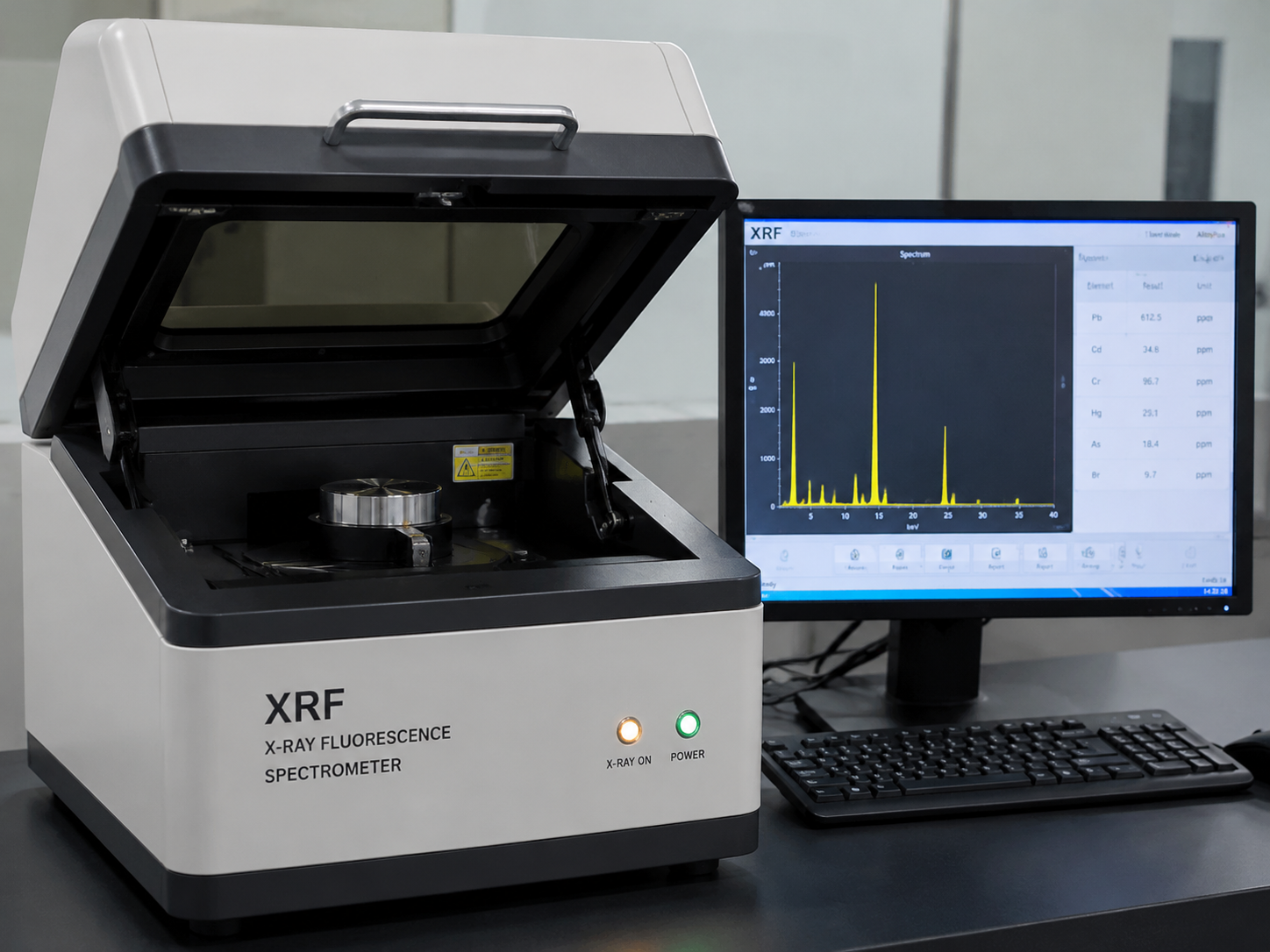
• Hexavalent chromium only restricts the “hexavalent” chemical form. A high total chromium content is fine as long as hexavalent chromium does not exceed the limit. X-ray Fluorescence Spectroscopy (XRF) can only measure total chromium, not valence state, so targeted chemical analysis must be performed.
• The 4 phthalates are judged individually, not by a combined total of no more than 0.1wt% — for example, if DEHP and DBP each contain 0.08wt%, although the total is 0.16wt%, neither individual substance exceeds the limit, so it is compliant. These substances are high-risk items in soft plastics and adhesives, cannot be detected by XRF at all, and must be tested by chemical analysis.
• Most brominated flame retardants have now been replaced, and are mainly found in old products. New products using halogen-free materials generally have low risk.
How to Use Exemption Clauses? Do Not Expand the Scope on Your Own
Many people hear about exemptions and think “you can exceed the limit at will”, but that is completely not the case — exemptions are very precise special arrangements, and improper use will lead to pitfalls.
Basic Logic of Exemptions
The essence of exemptions is: for some specific uses, either there is no mature alternative technically, or the harm and cost after replacement are far higher than the benefits, so the authorities temporarily allow exceeding the limit.
It has two core constraints: First, it only applies to specific products, components, and uses explicitly listed by the authorities, not to entire categories of products, and the scope cannot be expanded independently. Second, there is no unified fixed validity period. Some exemptions expire after a few years, some are renewed, and there are special transition arrangements. All statuses are subject to the current list on GOV.UK.
6-Field Verification Template to Avoid Misjudging Exemptions
Each exemption entry requires simultaneous verification of 6 pieces of information; you cannot apply it casually if any one is missing:
1. Clause number
2. Applicable product category
3. Specific use/component
4. Allowed limit requirements (some are completely unrestricted, some are relaxed to a specific value)
5. Applicable region
6. Validity period/transition arrangement/renewal status
For example, you cannot just see “lead exemption for high-temperature solder” and apply it directly. You must also verify clearly which category of product’s high-temperature solder it applies to, what the temperature requirement is, and when the exemption expires. It can only be applied if there is a complete match.
Common Exemption Reference (for example only, subject to the latest official list)
There are several types of exemptions that are commonly encountered: special mercury exemptions in different types of fluorescent lamps, lead exemptions in high-temperature solder for some industrial-grade electronic equipment, and special exemptions for specific medical/monitoring equipment components. These are only common directions; you must check the official list to see if they are applicable.
3-Step Quick Judgment of Whether an Exemption Applies
1. Step 1: First clarify your product category, the use and material of specific components, the more detailed the better.
2. Step 2: Log on to GOV.UK and search for the UK RoHS exemption list, check item by item against the 6-field template above; it must be a complete match to apply.
3. Step 3: Check the validity period and transition arrangements of the exemption. If it is about to expire, plan alternative solutions in advance to avoid sudden non-compliance after expiration.
Must-Read for Avoiding Pitfalls: Core Differences from EU RoHS and UK WEEE
Many people confuse these three regulations. The table below clarifies the core differences to avoid common pitfalls:
| Comparison Dimension | UK RoHS | EU RoHS | UK WEEE |
| Applicable Region | Great Britain (England, Scotland, Wales) | EU member states + European Economic Area, etc. | Great Britain (Northern Ireland has corresponding rules) |
| Regulated Stage | Content of hazardous substances in materials at production/import stage | Same as left | Recycling, treatment, and marking of products after disposal |
| Restricted Substance Requirements | 10 substances, judged by homogeneous material; cadmium 0.01wt%, the other 9 substances 0.1wt% | Currently basic substances and limit values are highly consistent | No restricted substance requirements, regulates recycling system |
| Exemption Rules | Maintained independently by the UK, subject to the GOV.UK list | Maintained independently by the EU, subject to the official EU list | No exemptions, recycling rates required by category |
| Compliance Documentation | Technical documentation + DoC | Technical documentation + DoC | Registration, recycling certificates, marking |
| Marking Association | UKCA/CE marking cannot alone prove compliance | CE marking cannot alone prove compliance | WEEE recycling marking must be affixed |
Two core conclusions are summarized below:
• Difference from EU RoHS: Although the limit values of the 10 basic substances and the homogeneous material judgment rules are currently highly consistent, the two sets of rules are maintained completely independently. Exemption clauses, revision pace, effective dates, and marking policies may all differ. They must be verified separately and cannot be assumed to be universally applicable.
• Difference from UK WEEE: The two are regulations for completely different stages. RoHS regulates “source harm reduction”, while WEEE regulates “end-of-life recycling”. Electrical and electronic products sold to Great Britain usually need to meet both requirements.
Compliance Self-Inspection Guide: From Beginner Preliminary Screening to Professional Verification
Compliance does not necessarily require spending a lot of money on testing. Beginner-level self-inspection can eliminate most risks, and combined with intermediate judgment logic, you can balance cost and risk well.
Beginner 3-Step Self-Inspection Method (No Testing Required, Preliminary Judgment)
1. Step 1: Confirm the prerequisite for application
First confirm that the product is sold to the Great Britain region and falls within the EEE category (not in the exclusion list). Here is another reminder: UKCA or CE marking cannot alone prove RoHS compliance, and can only be used as a preliminary reference. Specific compliance depends on documentation, and the marking recognition policy is also subject to the latest official guidance.
2. Step 2: Verify the Declaration of Conformity (DoC)
Request the DoC from the supplier, and focus on verifying the following points: whether the signing entity is the manufacturer or its authorized party, whether the product model matches your goods, whether the marked regulation version is correct, whether the applicable exemption clauses and numbers are clearly stated, and whether there is underlying material evidence to support it. Note: The DoC is not an unconditional liability exemption document. If the content is falsified or inconsistent with the actual product, you will still be held responsible.
3. Step 3: Preliminary screening of high-risk points
Compare with the high-risk component list below to see if your product has components that are likely to exceed limits, such as soft PVC materials, solder, or old fluorescent lamps, to have a preliminary risk assessment.
Intermediate Must-Know: Composition of the Compliance Evidence Chain
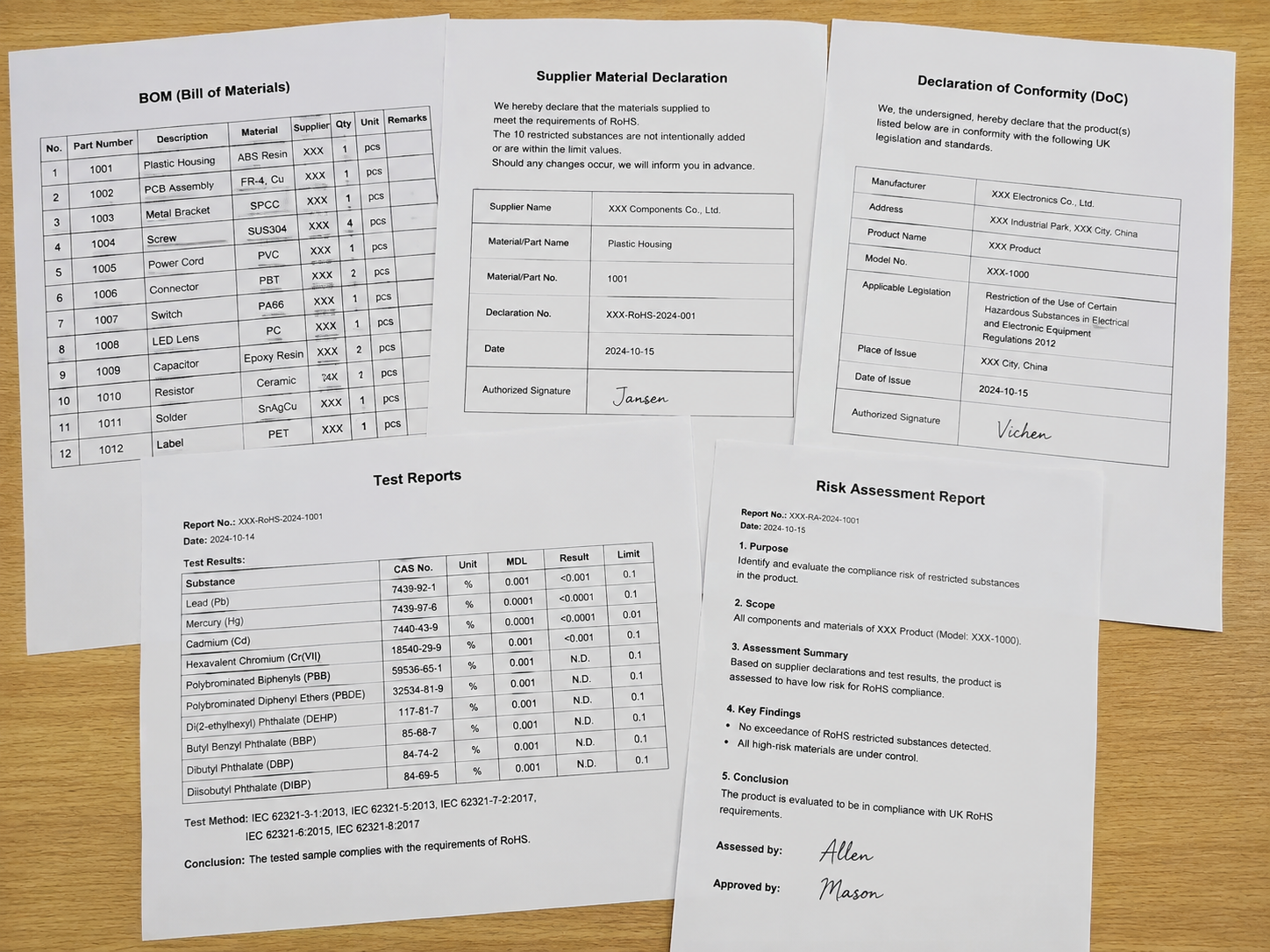
True compliance is not just a DoC, but a complete evidence chain, including:
• Core technical documents: BOM (Bill of Materials, which is the detail of all parts and materials of the product), basis for homogeneous material disassembly, supplier material declaration, DoC, test reports, risk assessment report.
• Control records: production change control records, sampling plans, version tracking records.
The retention requirement is: manufacturers need to retain the full set of documents, while importers and distributors need to verify core documents and retain traceability records.
When is Formal Testing Required?
Not all products require testing; it only needs to be considered in the following situations:
• The supplier cannot provide valid compliance certificates, and the product contains high-risk materials;
• The product falls under high-regulation categories, such as children’s electronic toys, small household appliances, and medical equipment;
• Receiving a spot check notice from UK market supervision and needing to provide evidence;
• Changing suppliers, materials, or production processes, resulting in the invalidation of the original compliance certificate.
Strategic Boundaries of Testing (Don’t Waste Money)
More expensive testing is not necessarily better; you need to choose the right method:
• X-ray Fluorescence Spectroscopy (XRF) can only be used for preliminary screening of heavy metals. It cannot detect phthalates, nor can it distinguish the valence state of hexavalent chromium, so it cannot be used alone as a basis for compliance judgment;
• Phthalates and hexavalent chromium must be confirmed by targeted chemical analysis;
• Testing must be carried out by disassembling into homogeneous materials for submission, and a sampling plan must be designed in combination with the risk level. Results from testing the entire product directly have no compliance validity.
Testing Reference for High-Risk Components
| Component Category | Key Regulated Substances | Recommended Testing Method |
| Metal connection/coating types (solder, switch contacts, metal coatings) | Lead, cadmium, hexavalent chromium | XRF preliminary screening + chemical analysis (hexavalent chromium requires valence testing) |
| Plastic/cable types (PVC soft materials, old flame-retardant plastics) | 4 phthalates, PBB, PBDE | Chemical analysis |
| Optical/sensing types (fluorescent lamps, old sensors) | Mercury | Chemical analysis |
How to Read a Formal Test Report?
When you get a test report, don’t just look at the word “qualified”. Focus on verifying the following points:
1. Confirm that the test object is a homogeneous material, not the entire product or entire component, otherwise the result is invalid;
2. Check the test results of the 10 restricted substances to see if they are all below the corresponding limits;
3. Check whether the applicable exemption clauses are marked and whether the numbers are correct;
4. Verify the issuance date of the report, applicable product model, and testing method to see if they are consistent with your current goods.
Two common misconceptions need to be clarified here: detected substance ≠ exceeding the limit — as long as the content is below the limit, it is compliant. Many substances exist in trace amounts and cannot be completely zero; conversely, not detected ≠ absolutely absent — it just means the content is below the minimum detection limit of the testing method, not that there is truly none at all.
Common Misconceptions and Regulatory Update Trends
Three Types of High-Frequency Compliance Misconceptions to Avoid
The first type is judgment misconceptions:
• Thinking “lead-free” equals full RoHS compliance — wrong. There are 10 restricted substances in total, lead is only one of them, and exceeding limits of other substances still means non-compliance;
• Thinking “as long as the whole machine meets the standard it’s fine” — wrong. Judgment is made separately for the smallest homogeneous materials, and the average compliance of the whole machine is useless;
• Thinking “EU RoHS compliance equals UK RoHS compliance” — wrong. The rules are maintained independently and must be verified separately.
The second type is document misconceptions:
• Thinking “having a UKCA mark means RoHS compliance” — wrong. The mark cannot replace technical documents and DoC, and a mark without document support is useless;
• Thinking “exemptions can be used permanently” — wrong. Exemptions have applicable conditions, are regularly reviewed, and may expire upon expiration. You must frequently check the latest official list.
The third type is testing misconceptions:
• Thinking “detecting a substance means exceeding the limit” — wrong. It is compliant if below the limit, and trace presence is normal;
• Thinking “an XRF report is a formal compliance report” — wrong. XRF is only a preliminary screening method, some substances require chemical analysis for confirmation, and it cannot be used alone as a final basis.
Regulatory Updates and Candidate Substances: Don’t Treat Assessment as Mandatory Requirements
People often say “a certain substance is going to be added to RoHS”, but in fact, most of the time it is still in the assessment stage, so there is no need to panic in advance. Here is a clear concept: candidate substances refer to substances that are in the official hazard assessment and public consultation stage, have not been formally included in the mandatory restriction list, and are not legally binding.
The channel for querying official assessment information is the UK RoHS assessment documents and announcements published on GOV.UK. When reading, pay attention to verifying the document type, publication date, and assessment stage, and do not treat discussion drafts as formal rules. Current common assessment directions include brominated flame retardants, organotin compounds, etc. These are only general directions, and specifics are subject to official documents.
Common Triggers for List Updates
Generally speaking, there are several main reasons for list adjustments: new scientific research results prove that the environmental/health hazards of a substance have increased; alternative technologies have matured, and existing exemptions or restriction standards can be further tightened; there are adjustment requirements for UK domestic environmental policies.
Practical Suggestions for Proactive Response
You don’t need to follow regulatory updates every day. Doing these few things well can handle most changes:
• Regularly follow RoHS-related announcements on GOV.UK; checking once every six months is basically sufficient;
• Prioritize the use of low-harm, halogen-free materials to reduce reliance on high-risk substances at the source;
• Update suppliers’ compliance documents every 1-2 years; do not use old documents from several years ago;
• Establish a material change control mechanism, reconfirm compliance when changing materials or suppliers, to avoid unexpected risks.
Frequently Asked Questions and Competency Summary
High-Frequency Q&A
What are the current UK RoHS limit values?
The limit value for 9 substances is 0.1wt% (1000ppm), and only cadmium has a limit of 0.01wt% (100ppm), judged separately for each homogeneous material.
What is the difference between UK RoHS and EU RoHS?
Currently, the limit values of the 10 basic substances are highly consistent, but the rules are maintained independently by the UK and the EU respectively. Applicable regions, exemption clauses, and update pace may all differ. They need to be verified separately and are not interchangeable.
How to check UK RoHS exemption clauses?
Log on to GOV.UK and search for “UK RoHS exemptions”, find the official exemption list, and verify the entry information using the 6-field template (clause number, applicable product category, specific use/component, allowed limit, applicable region, validity period). It can only be applied if there is a complete match.
How to read a UK RoHS test report?
First confirm that the test object is a homogeneous material, then check that the results of all 10 substances are below the corresponding limits, check whether the applicable exemption clauses and numbers match, and finally verify that the report issuance date, applicable product model, and testing method are consistent with the current goods.
Which RoHS applies to Northern Ireland?
Northern Ireland applies EU RoHS rules and does not implement the UK RoHS list.
Judgment Competencies You Can Master After Learning
After reading this article, you should be able to do the following:
• Can name the categories and basic limits of the current 10 UK RoHS restricted substances, and clarify that cadmium has the strictest limit;
• Can explain the judgment rules for homogeneous materials, and will not use the whole machine average as a basis for qualification;
• Can preliminarily judge whether a product is bound by the list, and master the verification method for exemption application;
• Can distinguish the core differences between UK RoHS, EU RoHS, and UK WEEE;
• Can complete basic compliance self-inspection, know when formal testing is required, and how to read test reports;
• Can identify three types of high-frequency compliance misconceptions and avoid common pitfalls.
Overall, the core logic of UK RoHS is actually not complicated: disassemble the product to the finest homogeneous material layer, ensure that hazardous substances in each layer do not exceed the limits, then verify the exemptions and supporting documents clearly, and there will basically be no major problems. For beginners, there is no need to tackle the full regulation at the beginning. First understand the core list, judgment rules, and common misconceptions, and you can solve 80% of compliance problems. For the rest, just check official documents according to the specific situation of the product.