
Most practitioners engaged in cross-border e-commerce or export trade to Australia and New Zealand will come into contact with the RCM mark. Many people have a vague understanding of its usage rules, such as regarding it as a government-issued quality certification, or directly affixing the mark with CE/FCC reports. These misunderstandings may lead to compliance risks. Starting from the basic definition, this article explains step by step the product application scope, responsible entity requirements, labeling specifications, key points for avoiding pitfalls, and self-inspection methods, to help you systematically master the compliant usage rules of the RCM mark.
Must-Know Basics: Core Understanding of the RCM Mark
When many people see RCM for the first time, they think it is a “quality certification medal” issued by the Australian or New Zealand government, but this is not the case. In plain terms, the RCM is a mandatory compliance declaration mark for regulated products in the Australian and New Zealand markets, more like a “compliance commitment letter” affixed to the product, by which the responsible supplier declares that the product meets the requirements of corresponding regulations. It covers three types of regulatory requirements: First, electrical safety, that is, the product has basic risk protection capabilities against electric leakage, fire and other hazards; Second, electromagnetic compatibility (EMC for short, which means the product will not excessively interfere with other electrical appliances and has basic anti-interference capability); Third, radio spectrum requirements, that is, products with wireless functions comply with management regulations such as frequency bands and power.
It should be clarified that the RCM is not a government-endorsed certification, and regulatory authorities will not “stamp” the mark in advance. However, the responsible supplier must fulfill obligations such as registration, retention of compliance documents, and cooperation with regulatory spot checks in accordance with corresponding regulatory requirements. As for whether other supply chain entities such as manufacturers, importers, and distributors bear responsibility, it shall be determined based on their role in the supply chain, specific actions, and applicable regulations, and not all responsibility shall be borne solely by the labeling entity.
Qualification Requirements for Responsible Entities
The core prerequisite for using the RCM mark is the existence of a qualified responsible supplier, and the qualification requirements vary slightly under different regulatory systems:
- EESS (Electrical Equipment Safety System, the national electrical equipment safety system of Australia and New Zealand) electrical safety category: The responsible supplier shall be an eligible registered entity in Australia or New Zealand, with qualifications such as a local contact address;
- EMC and radio categories under the jurisdiction of ACMA (Australian Communications and Media Authority): The requirements for responsible suppliers are subject to the current rules of ACMA, and usually need to be Australian registered entities.
Overseas manufacturers and cross-border intermediaries that do not meet the qualification requirements of the corresponding system cannot directly use the RCM mark solely based on their own identity. Importers, cross-border sellers who directly supply goods to Australian and New Zealand consumers in their own name, authorized distributors, etc., if they actually bear the main responsibility for product supply, need to confirm whether they have become a responsible supplier under the corresponding system; third-party platforms that only provide platform services and do not participate in product compliance management are not entities that directly bear labeling obligations. Ordinary consumers do not need to bear the responsibility for mark usage in commercial scenarios.
3 Common Basic Cognitive Misconceptions for Beginners
Practitioners who are new to RCM are most likely to fall into three basic cognitive misconceptions, and clarifying them in advance can avoid most elementary mistakes:
First, believing that having CE/FCC means you can directly use RCM. The regulatory systems of different markets are independent of each other. CE is a European Union requirement and FCC is a United States requirement. There are differences between them and Australian and New Zealand standards, so they cannot directly replace the compliance basis for Australia and New Zealand, and can only be used as a reference for assessment.
Second, believing that having a test report means you can directly affix the mark. In addition to the compliance test report, a qualified responsible supplier must complete the registration/filing under the corresponding regulatory system and obtain a valid responsible supplier number before the preconditions are met.
Third, believing that the RCM mark can be designed and beautified by oneself. The RCM mark has unified mandatory specifications. It is not allowed to arbitrarily change the font, distort letters, add artistic effects or irrelevant patterns, otherwise it will be a violation.
Step 1 Judgment: Whether Your Product Needs to Use the RCM Mark
To determine whether a product needs to use the RCM mark, you can first use three questions for quick preliminary screening to narrow the scope of verification:
First question: Does the product involve power connection, power storage, charging, heating, lighting, or electrical energy conversion? For example, power banks, desk lamps, power adapters, electric kettles, etc. all fall into this category.
Second question: Does the product contain digital circuits that may generate or be subject to electromagnetic interference? For example, products with electronic components such as computers, monitors, printers, and set-top boxes.
Third question: Does the product actively transmit wireless signals, or is it a communication terminal device? For example, Bluetooth headsets, smart door locks, remote control toys with Wi-Fi, Bluetooth, remote control, or cellular communication functions.
It should be noted that these three questions are only preliminary screening tools: if any answer is “yes”, or there is uncertainty about the product’s function, power supply method, or use, you must further verify the official rules; even if all three answers are “no”, this cannot replace the formal confirmation of specific regulatory provisions.
Division Logic of Regulatory Scope
The three types of requirements covered by the RCM mark correspond to different regulatory rules, and there is no unified RCM list covering all products: For electrical safety requirements, you need to check the equipment classification, scope of application, and exemption clauses of EESS; for EMC and radio spectrum requirements, you need to check the corresponding rules of ACMA. Some products may fall into multiple regulatory scopes at the same time and need to meet the requirements respectively.
From the perspective of common categories, products that usually require RCM mainly include three categories: First, electrical products that are powered and have safety risks, such as home appliances, power adapters, lamps, electric tools, wires and cables, etc.; Second, electronic products that contain digital circuits and may generate electromagnetic interference, such as computers, monitors, routers, etc.; Third, wireless/telecom products with radio transmission functions, such as devices with Wi-Fi, Bluetooth, and remote control functions. However, the final determination must be based on the latest official rules, and conclusions cannot be drawn solely based on the category.
Exemption Boundaries for RCM Mark Exemption
There are also some products that do not need to use the RCM mark, mainly divided into two categories, but both must be based on clear regulatory provisions, and exemption cannot be determined on one’s own:
The first category is general exemption situations: for example, ordinary consumer products that are completely unpowered, such as pure plastic toys and paper books; and items that enter temporarily and are not for sale, such as exhibition samples, personal use entry items, R&D and testing equipment, etc. It should be noted that not requiring RCM does not mean that you do not need to comply with Australia’s general product safety rules, and related products still need to meet the general safety requirements of the corresponding category.
The second category is the exclusive exemption boundaries for electrical/electronic products: for example, products such as medical devices, motor vehicle parts, and avionics equipment may be subject to special industry regulations, but this does not automatically exclude ACMA’s EMC/radio requirements or EESS’s electrical safety requirements. It is necessary to separately verify whether they fall under the exclusion or exemption clauses of the corresponding regulatory system. Only those that clearly meet the conditions can be exempted from using RCM under the corresponding system. In addition, some products that are only used in specific industrial/professional scenarios also need to be confirmed to have a clear exemption basis before being exempted from using RCM, and cannot be exempted on their own just because of “low risk” or “industrial use”.
Step 2 Confirmation: Who Is Eligible to Arrange the Use of the RCM Mark
After confirming that the product needs to use RCM, the next step is to clarify the qualifications and obligations of the responsible entity. The responsible supplier is the core entity of RCM compliance, and its core obligations include: taking primary responsibility for the compliance of the product and the correctness of the mark, being responsible for completing the registration/filing under the corresponding regulatory system, retaining a full set of compliance documents, cooperating with the spot checks and investigations of regulatory authorities, and ensuring that the actually sold products are completely consistent with the filing information.
Division of Responsibilities for Each Role in the Supply Chain
Different roles in the supply chain shall bear corresponding obligations according to their respective positions, with clear boundaries:
- Overseas manufacturers: Do not need to act as responsible suppliers, but need to provide complete product technical documentation, cooperate in completing compliance testing. If the product’s structure, key components or specifications are changed, they must notify the responsible supplier in advance and must not conceal the change.
- Authorized distributors/consignment sellers: Need to verify the compliance of the marks on the products they sell. They are not allowed to copy or reaffix marks without authorization, nor embezzle the filing numbers of other entities.
- Cross-border sellers who directly supply goods to the Australian and New Zealand markets under their own brand and in their own name: Need to confirm whether they have become a responsible supplier under the corresponding system. If they have assumed the main responsibility, they need to fulfill all compliance obligations and cannot rely solely on the information provided by upstream suppliers.
Labeling Rules for OEM/Private Label/Multi-Brand Sales
Practitioners engaged in OEM, private label, or multi-brand sales often encounter the situation of the same hardware being labeled with different brands. At this time, the core criterion for whether the RCM mark can be shared is: whether the change of brand, model, or responsible entity affects the validity of the original compliance documents, and whether it is still within the scope of filing coverage.
If only the brand mark is changed, and the product’s hardware, specifications, and key components remain unchanged, it is necessary to confirm whether the brand and other content in the filing information need to be updated. Even if re-testing is not required, it is necessary to ensure that the filing information is consistent with the actual product; if the change involves the model, internal structure, or key components, the compliance must be re-evaluated, and re-testing and re-filing shall be carried out if necessary.
Special attention should be paid: Unauthorized use of other companies’ filing numbers, certificates, or marks is a serious violation. If multiple entities share the same model of product, it must be ensured that the product’s brand, hardware version, and key components are completely consistent, and written authorization from the responsible entity is obtained before the corresponding RCM mark can be used.
Step 3 Preparation: Pre-Compliance Conditions for Using the RCM Mark
Before using the RCM mark, the corresponding pre-compliance conditions must be met. First, the product must pass the compliance testing of the corresponding category:
- Electrical safety category: Must comply with the corresponding Australian and New Zealand AS/NZS safety standards, and pass testing or assessment;
- EMC category: Must meet electromagnetic compatibility requirements, neither excessively interfering with other devices nor having basic anti-interference capability;
- Wireless category: In addition to meeting electrical safety and EMC requirements, must also comply with Australia’s radio spectrum management requirements, such as the used frequency band and transmission power meeting the regulations.
Overseas test reports such as CE and FCC can be used as a reference for assessment, but due to differences in standards, they cannot be directly used as the compliance basis for Australia and New Zealand. Equivalence confirmation or supplementary testing must be completed as required.
Regulatory Filing Requirements for Different Categories
After completing compliance testing, the responsible supplier must also complete registration/filing under the corresponding regulatory system. Filing requirements vary for different categories:
- EMC/Radio Category Filing
It is necessary to complete the responsible supplier registration at ACMA and obtain a valid responsible supplier number. The filed product information must be completely consistent with the actually sold product. - Electrical Safety Category Filing
Electrical safety products are managed hierarchically according to risk levels. The specific requirements are subject to the latest official rules of EESS. The core framework is as follows:
| Electrical Product Risk Level | Responsible Supplier Requirements | Equipment-Level Registration Requirements | Core Compliance Document Requirements |
|---|---|---|---|
| Low risk | Must complete responsible supplier registration under the EESS system | Usually no mandatory equipment registration | Test report and Declaration of Conformity meeting AS/NZS safety standards |
| Medium risk | Must complete responsible supplier registration under the EESS system | Must complete equipment registration in EESS | Third-party compliance assessment report, Declaration of Conformity |
| High risk | Must complete responsible supplier registration under the EESS system | Must complete equipment registration in EESS and obtain a product registration number | Mandatory third-party certification certificate, test report, Declaration of Conformity |
It should be specially noted here: The product registration number is the management information of EESS equipment registration, not a mandatory content that must be included in the RCM mark, and does not need to be printed on the mark.
Compliance Document Retention Requirements
All compliance-related documents must be retained for the period specified by regulatory requirements for official spot checks, mainly including: compliance test reports, Declarations of Conformity; product model, specifications, key components, version records; filing and registration vouchers, responsible entity information, etc. Missing documents may lead to failure of spot checks, and corresponding responsibilities shall be borne.
Pre-Verification Process for Legal Labeling
If you need to systematically judge whether labeling is legal, you can verify one by one according to the following process, and there will basically be no major omissions:
- Scope confirmation: Check the corresponding rules of ACMA and EESS respectively to confirm that the product indeed falls within the mandatory application scope of the RCM mark;
- Test confirmation: The product has completed the compliance test/assessment of the corresponding category and holds valid compliance documents;
- Entity confirmation: The responsible entity has completed the registration/filing of the corresponding system, and the responsible supplier number is real and valid;
- Scope matching: The model, specifications, and key components of the product to be labeled are all within the scope of the filing, and do not exceed the filing boundaries;
- Mark confirmation: The style and placement of the mark meet the requirements of the corresponding regulatory rules.
Style Specifications: Appearance Compliance Requirements for the RCM Mark
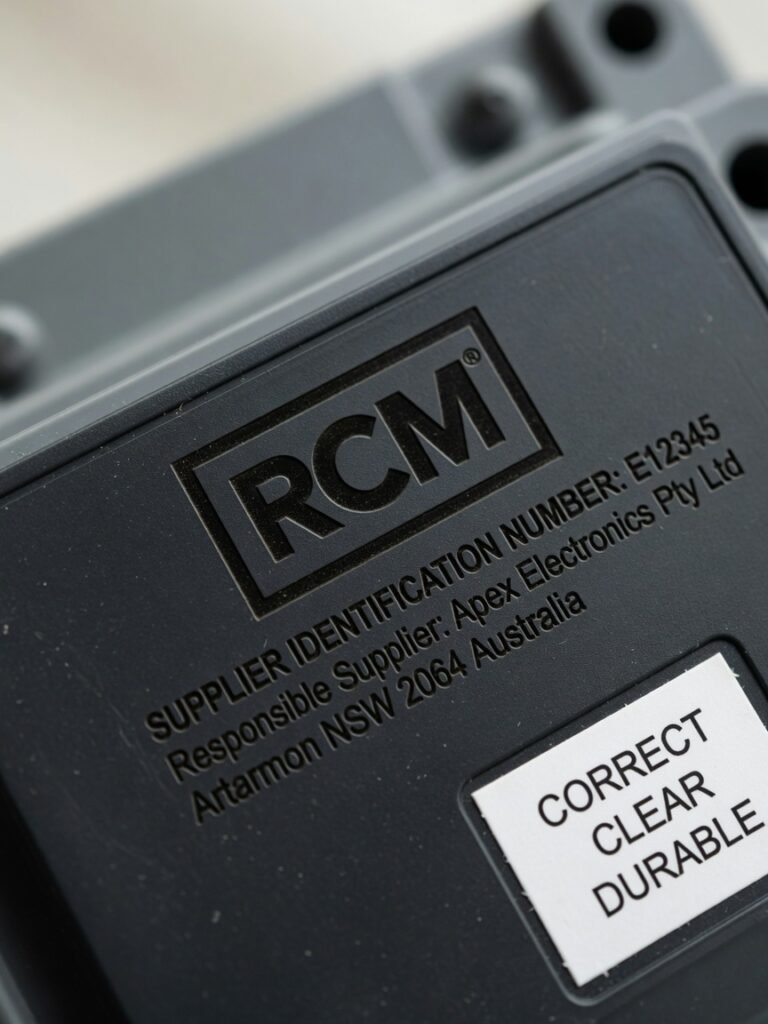
Many RCM mark violations occur in terms of style. In fact, the rules are very clear, and the core is divided into two parts:
The first part is the RCM mark graphic itself: It must be standard upright uppercase RCM letters. Distortion, character splitting, tilting, adding artistic effects are prohibited, nor can it be spliced or integrated with other brand logos or irrelevant patterns.
The second part is the responsible supplier identification information that must be marked together with the mark: that is, the validly filed responsible supplier number. The number must be real, valid, consistent with the filing information, and must not be missing, embezzled, or forged.
It should be clarified that the EESS product registration number is management information for equipment registration, not a mandatory component of the RCM mark, and does not need to be printed on the mark. In addition, it is prohibited to add words that are likely to mislead the public such as “qualified”, “certified”, “officially approved” on the mark.
Size and Color Requirements
The core requirement for the size of the mark is that it is clearly legible. For most conventional products, the overall minimum height of the RCM mark is recommended to be no less than 3mm. This is a common requirement in the general marking guidelines of ACMA and EESS, but the specific requirements shall be subject to the special rules of the corresponding product category.
For micro products (such as Bluetooth headsets, small modules, etc.) or products with limited space, it is necessary to first confirm that the body indeed cannot accommodate a clear mark of compliant size before applying for proportional reduction or using alternative display methods according to the rules. It is not allowed to reduce it to a level that is unrecognizable to the naked eye on its own, nor can the mark be omitted just because of “small size”.
The core principle for color is that the mark has obvious contrast with the background and can be clearly identified under normal indoor light. Common compliant combinations include solid color combinations such as black text on white background, white text on black background, and stamping on the natural color of metal shells. It is prohibited to use gradient, fluorescent, or low-contrast color schemes, nor to use ink or materials that fade easily, causing the mark to become blurred after a period of use.
Clarity and Durability Requirements
In addition to style, size, and color, the mark must also meet clarity and durability requirements: In terms of appearance, the printing or engraving is clear, without problems such as missing parts, blurring, or broken lines; in terms of durability, it must meet the requirements of corresponding product regulations or standards, and is not easy to fall off or wear under normal use scenarios.
Recommended marking processes include screen printing, laser engraving, and nameplate stamping; if adhesive labels are used, it is necessary to ensure that they are firmly attached, not easy to tear off, and can withstand the test of the product’s normal use environment.
Placement and Display Rules: Where to Affix the Label and How to Display It Compliantly
Style compliance is only the foundation, and non-compliant placement is also a violation. The placement of the RCM mark follows the principle of “product body first”:
The mark shall be affixed to a clearly visible position on the product, such as the bottom, back, or fixed nameplate of the product, which can be seen without disassembling the machine during normal inspection. It is prohibited to affix it to positions that are easily covered, easily removed, or easily worn, such as protective films, temporary hang tags, and detachable small accessories. Marks in such positions cannot meet the requirements of durability and visibility.
For multi-piece products, the regulated core components must be labeled separately, and cannot be labeled only on the outer packaging of the whole set. For example, for a set of electric tools, if the main unit is a regulated product, it must be labeled on the main unit body, not only on the outer packaging of the toolbox.
Display Rules for Packaging, Manuals, and E-Commerce Pages
Many people ask whether the RCM mark can be placed on packaging and manuals. The answer is yes, but its positioning must be clarified:
Only under exceptional circumstances explicitly permitted by the corresponding regulatory rules (such as the product being too small in size, having a special structure that makes it impossible to label the body, etc.) can the mark on the minimum sales packaging or accompanying documents be used to replace the body mark, and the applicable conditions must be checked one by one, and the scope of exceptions cannot be expanded on one’s own.
Except for statutory exceptions, the marks on packaging and manuals are only supplementary information and cannot replace the mark on the product body. The mark on the packaging shall not be covered by tape, barcodes, or other stickers; the RCM mark on the manual can be printed on the cover, first page, or other obvious positions, and the information must be completely consistent with the filing information.
The display of the RCM mark on online e-commerce pages falls under the category of information disclosure, and has two core prerequisites: First, the product has completed all compliance filings; second, the product body has been correctly labeled.
When displaying, it should be noted that the mark style and responsible supplier number on the page must be completely consistent with those on the actual product, and must not be modified or forged through photo editing; it is prohibited to use the RCM mark to exaggerate the compliance scope or performance of the product, nor to promote it as “Australian official certification” – RCM is only a compliance declaration, not an officially issued certification, and such promotion is a violation. Online display itself cannot replace physical marks, nor can it replace compliance filings.
Core Differences Between Easily Confused Marks
There are several types of marks on the market that are easily confused with RCM, which need to be clearly distinguished:
The first category is the old marks C-Tick and A-Tick: These two types are compliance marks previously used in Australia and New Zealand, and have now been integrated into RCM. Newly supplied products usually need to use RCM in accordance with current rules; whether existing compliant inventory can continue to be sold shall be subject to the transition period announcements of the corresponding regulatory systems and the original compliance status of the products, and cannot be generalized.
The second category is marks of third-party certification bodies such as SAA: SAA is the own mark of a third-party certification body, representing that the body has issued a certification certificate, while RCM is a statutory compliance declaration mark. The two have completely different meanings and cannot replace each other. Even if the product holds SAA certification, it must use the RCM mark as required.
The third category is other statutory labels: such as voltage, power, warning words, recycling marks, etc. The RCM mark cannot replace these mandatory nameplate information, and the required content must still be fully marked.
Placement Exceptions for Special Products
There may be exceptions to the mark placement of some special products, but they must meet clear rule requirements and cannot be adapted on one’s own:
- Micro/space-constrained products: It must first be confirmed that the body indeed cannot accommodate a clear mark of the minimum size before the mark can be moved to the minimum sales packaging or accompanying documents according to the rules. The body mark cannot be omitted under the pretext of “small size”.
- Multi-component combined products: If accessories are sold separately, each regulated accessory must be labeled separately; if accessories are bundled with the whole machine and not sold separately, they can be labeled together with the whole machine without separate marking.
- Electronic marks (screen display): Can only be used as a supplement or replacement under the premise that the specific product category has clear regulatory authorization, and users can view it on the product’s main screen without disassembling the machine, connecting to the network, or entering hidden menus; for products without a screen or requiring additional operations to view, electronic marks cannot replace physical marks.
Advanced Pitfall Avoidance: Common Violations and Cognitive Misconceptions
After mastering the basic rules, you also need to understand common violation situations and proactively avoid risks. The most common RCM mark violations in practice are divided into four categories:
The first category is pre-violations: Labeling before completing compliance testing or filing, or using the mark beyond the filed model and specification scope. For example, the filed product is a 5V1A adapter, but the mark is affixed to a 5V2A product. This type is a serious violation.
The second category is style violations: For example, distorted RCM letters, missing responsible supplier number, too small size, blurred color, etc. Such problems are usually immediately noticeable in spot checks.
The third category is placement violations: For example, the mark is affixed in a hidden place, a position where it is easy to fall off, or the packaging mark is used to replace the body mark without legal basis.
The fourth category is promotion violations: Non-compliant products illegally affix the RCM mark, or use RCM to exaggerate the compliance scope and performance of the product. For example, obviously only meeting electrical safety requirements, but promoting full-category compliance.
Common Advanced Cognitive Misconceptions
In addition to the three basic misconceptions mentioned earlier, there are several advanced cognitive misconceptions that are easily overlooked:
Misconception 1: All powered products need to be labeled with RCM. In fact, only products that fall within the mandatory application scope need it. Low-risk or special categories may meet exemption conditions, but there must be a clear regulatory basis, and it cannot be determined on one’s own.
Misconception 2: After product changes, the old mark can be directly used. If the product’s structure, key components, model, or responsible entity changes, compliance must be re-evaluated to confirm whether the existing filing can cover it. If necessary, re-filing is required, and the original mark cannot be used directly.
Misconception 3: Distributors can affix the RCM mark at will. Distributors must obtain explicit authorization from the responsible entity before labeling, and must fulfill the obligation to verify the authenticity of the mark; if a distributor supplies goods in its own name, it may also need to bear all the obligations of a responsible supplier.
Misconception 4: Having RCM equals good product quality. RCM only proves that the product meets the minimum compliance requirements, such as no electric leakage and no excessive interference with other devices. It does not mean that the product has higher quality levels such as performance and durability, and cannot be used as a quality selling point for exaggerated promotion.
Misconception 5: Having RCM means you can enter both the Australian and New Zealand markets at the same time. The RCM systems of Australia and New Zealand are linked, but their respective mandatory application scopes and filing requirements are not completely consistent. If you want to enter the New Zealand market, you need to separately confirm the local rule requirements.
Common Consequences of Improper Use
The specific consequences of improper use of the RCM mark depend on the nature of the violation, the applicable regulatory system, and the law enforcement decision. Common handling methods include: regulatory authorities requiring rectification, stopping supply, product recall, and imposing fines; products may be inspected or detained by regulatory authorities upon entry; e-commerce platforms may also take measures such as removing listings and restricting sales in accordance with platform rules.
In terms of responsibility bearing, the responsible supplier shall bear primary responsibility; if distributors or sellers have unauthorized mark modification, false promotion, or actually assume the role of responsible supplier but fail to fulfill obligations, they shall also bear corresponding legal responsibilities. The specific form of responsibility shall be determined in combination with the actions and applicable regulations.
Practical Implementation: Compliance Self-Inspection and Special Situation Handling
Entry-Level Compliance Self-Inspection Checklist
In daily work, you can quickly check the compliance of the RCM mark against the following list:
- The product has been confirmed to fall within the mandatory application scope of the RCM mark, with a clear regulatory basis
- The responsible entity has completed the registration/filing of the corresponding regulatory system, and the product model and specifications are within the scope of the filing
- The mark style meets the specifications: RCM letters are upright, with a valid responsible supplier number, and the size and color are clearly legible
- The placement of the mark meets the requirements, and the durability meets the standard
- The mark information on packaging, manuals, and e-commerce pages is completely consistent with the actual product and filing information
Official Verification Method for Filing Information
If you need to verify the authenticity of the RCM mark, you can query through official channels: EMC/radio products can be verified on the ACMA official website, and electrical safety products can be verified on the EESS official website.
When checking, it should be noted that you cannot only verify whether the responsible supplier number is real, but also check whether the filed entity, product model, and specifications are consistent with the actually sold product – a real number does not mean that all models are compliant. You must confirm that the filing coverage matches the product.
Handling Principles for Product and Entity Changes
Product or entity changes are common scenarios, and different changes have different compliance handling methods. The core principle is to first assess the impact on compliance and filing consistency, then take corresponding measures:
- Product changes (such as adjusting model, replacing key components, modifying specifications, adding or removing wireless functions, etc.): First assess whether the change affects electrical safety, EMC, radio compliance, and whether it changes product identification information, then confirm whether the existing test report, Declaration of Conformity, and filing information can still cover it; if it cannot be covered, re-testing or re-filing is required before using the mark.
- Change of responsible supplier: The registration/filing information must be updated in accordance with the requirements of the corresponding regulatory system, and the responsible supplier number on the mark shall be adjusted simultaneously.
- Change of importer: Only when the importer is also the responsible supplier, or the change leads to changes in filing information, is it necessary to adjust the mark and filing; if the importer only plays an auxiliary role such as logistics and customs clearance and does not affect the determination of the responsible entity, there is no need to change the mark.
- Brand/appearance change: It is necessary to first assess whether it affects product compliance and the consistency of filing information. If it is confirmed that it does not involve changes in technical parameters or key components, re-testing may not be required, but it is still necessary to update or check the relevant information in the filing materials and technical documents to ensure consistency with the actual product.
4 Steps to Quickly Check Mark Compliance
If you get a product with an RCM mark and want to quickly judge whether it is compliant, you can check it in four steps:
Step 1: Check elements: Whether there are both upright RCM letters and a clear responsible supplier number;
Step 2: Check appearance: Whether the size is clearly legible, whether the color has obvious contrast with the background, and whether there is distortion or missing parts;
Step 3: Check qualifications: Verify the authenticity of the number and the product scope covered by the filing through official channels;
Step 4: Compare information: Whether the model and entity information on the mark are completely consistent with the actual product and filing information.
Final Summary
The usage rules of the RCM mark seem trivial, but the core logic always revolves around “the compliance declaration is true and valid”. Practitioners at different stages can master the corresponding capabilities as needed:
At the entry stage, focus on mastering three basic capabilities: completing the preliminary screening of the product application scope with three questions, identifying whether the basic style of the RCM mark is compliant, clarifying the three pre-work of compliance testing, responsible entity filing, and scope matching before labeling, and avoiding basic cognitive misconceptions.
At the semi-proficient stage, you can further master four judgment capabilities: distinguishing the differences between RCM and other common marks, independently completing compliance self-inspection and official filing verification, reasonably handling compliance adjustments in common scenarios such as product and entity changes, and quickly identifying common violation situations.
Finally, three core rule boundaries are clarified: First, all application scopes and filing requirements are subject to the latest official announcements of regulatory agencies such as ACMA and EESS, and third-party information is for reference only; second, overseas test reports cannot be directly used as the compliance basis for Australia and New Zealand, and equivalence confirmation or supplementary testing must be completed as required; third, before confirming the product application scope, filing validity, and coverage scope, the RCM mark shall not be used arbitrarily.