
Whether you are a small business selling consumer electronics in the U.S. or an ordinary consumer who buys digital products regularly, you have most likely heard of CPSC. But when asked what it regulates, how it differs from FCC/UL, and which products need to comply, many people are confused. Many sellers have even fallen into real pitfalls: they clearly obtained FCC certification, but their goods were detained by customs; they thought only children’s watches needed testing and ordinary power banks didn’t, only to end up with six-figure fines.
In this article, we will start from the most basic concepts and thoroughly explain CPSC compliance for consumer electronics step by step — from beginner-friendly explanations to being able to assess risks yourself and avoid common pitfalls. It is useful for both sellers stocking goods and consumers making purchases.
First, Understand: What Exactly Does CPSC Regulate? How Is It Different from Other Agencies?
First, let’s clarify the most basic definition: CPSC is the abbreviation of the U.S. Consumer Product Safety Commission, an official federal-level regulatory agency. Its core work is to set safety rules for consumer products, investigate violations, and initiate recalls. Its core focus is “personal safety”, that is, whether a product will cause unreasonable injury or even death. As for whether the product works well or has sufficient performance — for example, poor headphone sound quality, or falsely labeled actual capacity of power banks — these are not under its jurisdiction.
The core law supporting CPSC regulation is the Consumer Product Safety Improvement Act (CPSIA for short). The main function of this act is to tighten safety requirements for children’s products under 12 years old, and it is also the source of the commonly heard terms “CPC certification” and “lead limit”.
For consumers, compliant products mean fewer safety hazards; for sellers and importers, the consequences of violations range from goods detention and product removal to fines, mandatory recalls, and even possible criminal liability.
Don’t Confuse Them: These Agencies Regulate Completely Different Things from CPSC
Many people confuse CPSC with other common certification and regulatory agencies. In fact, their responsibilities do not overlap at all, and neither can replace the other. We have compiled a table to help you quickly distinguish them:
| Regulatory/Certification Body | Core Jurisdiction | Relationship with CPSC |
|---|---|---|
| FCC | Electromagnetic interference, radio frequency compliance (e.g., products must not interfere with the normal operation of other electronic devices) | Completely independent. It regulates electromagnetic compatibility and has nothing to do with personal safety. Passing FCC certification does not mean meeting CPSC requirements. |
| FDA | Medical electronics, radiation-emitting health electronics (e.g., electronic blood pressure monitors, medical hair removal devices) | Such products are not regulated by CPSC; FDA is responsible for their safety supervision. |
| UL/ETL | Private third-party safety certification, testing according to industry standards | Not mandatory by CPSC, but if CPSC cites their standards as a basis for judgment, these standards have legal binding force. |
| DOE/FTC | DOE regulates energy efficiency grades; FTC regulates the authenticity of advertising labels (e.g., false capacity labeling, false publicity) | Their responsibilities do not overlap at all; each manages its own area. |
3 Most Common Misconceptions for Those New to CPSC
Many people have these misconceptions when they first start out. Let’s clarify them in advance to avoid detours later:
First misconception: CPSC only regulates children’s products. Wrong. As long as it is a consumer electronic product intended for personal or household daily use, whether it is an adult power bank or a children’s watch, it must meet CPSC safety requirements. It’s just that the rules for children’s products are stricter.
Second misconception: CPSC issues official certifications. Wrong. Whether it is CPC or GCC, which we will talk about later, they are issued by the enterprise itself, and the enterprise bears the responsibility. CPSC never issues “official certificates of conformity” for products.
Third misconception: Passing UL/ETL certification means meeting CPSC requirements. Wrong. UL is a private certification that tests within its own standard scope. For example, UL may test battery safety, but if the product has choking hazards from small parts or excessive chemical substances that UL does not cover, it still does not meet CPSC requirements.
3-Step Judgment: Does Your Product Need to Comply with CPSC?
Now that you understand the basic concepts, the most practical thing next is the judgment method — whether you are a seller selecting products or a consumer buying things, you can figure out the regulatory category of the product and the general requirements it needs to meet in just 3 steps.
Step 1: First Check If the Product Is Regulated by CPSC
The core criterion for judgment is simple: is this product mainly intended for personal or household daily use by consumers?
For example, common power banks, Bluetooth headsets, electric toothbrushes, children’s watches, and TV remote controls are all for household use, so they are definitely regulated by CPSC.
There are also clear boundaries of products not regulated by CPSC: for example, industrial-specific oscilloscopes and production line electronic equipment, which are not for ordinary consumers’ household use, are not under its jurisdiction; the built-in central control screens and car audio of original car manufacturers are regulated by the National Highway Traffic Safety Administration (NHTSA); medical electronic stethoscopes and blood glucose meters are regulated by FDA.
For multi-functional products, such as a massager with hot compress function that can be used both at home and for medical purposes, the competent authority is determined according to the main use and core risk — if it is mainly for home health care, it is regulated by CPSC; if it is medical-grade, it is regulated by FDA.
Step 2: Then Determine If It Is a Children’s Product for Under 12 Years Old
This step is very critical, because the requirements for children’s products are much stricter than those for adult products. Many sellers fall into pitfalls because their products are judged to be children’s products but they have not done the corresponding testing.
Judging whether a product is a children’s product does not depend on whether you label it as “children’s model”, but on a comprehensive assessment of the product’s design, packaging, marketing, size, theme, and sales channels, to see if it is intended for children aged 12 and under. For example, children’s watches, early education machines, electronic toy pianos, and children’s headsets are obviously for children, so they are definitely considered children’s products.
A common misconception to note: labeling products as “not a toy” or “suitable for adults” is useless. For example, a pink headset printed with a cartoon IP, whose sales page highlights “suitable for children aged 3-12 to take online classes”, will still be judged as a children’s product by CPSC even if you mark “not a toy” in a corner, and must meet the tightened requirements of CPSIA.
There is another special case: products shared by the family, such as TV remote controls and living room night lights, although not specifically bought for children, are easily accessible to children. In this case, it is necessary to assess the foreseeable exposure risk for children, such as whether button batteries can be pried out and swallowed by children, and necessary protective measures must be taken.
Step 3: Identify Core High-Risk Components
Whether it is an adult or children’s product, several types of components are the top priority of CPSC regulation, and are also the places where problems are most likely to occur and trigger recalls. You can go through your own product against these:
- Batteries: The most common are lithium batteries (fire and explosion risk), as well as button/coin batteries (which can burn the esophagus or even be fatal if swallowed by children).
- Mechanical parts: Small parts (choking hazard), sharp edges or pinching structures, strong magnets (if swallowed, they will attract each other and cause intestinal perforation).
- Chemical substances: Excessive lead and phthalates (plasticizers) in soft plastics, coatings, and metal trims, which can affect health with long-term exposure.
- Thermal hazards: Excessively high temperature of heating components and charging ports, which may cause burns or even fire.
What Are the Differences in Compliance Requirements for Different Products?
Now that you know the product categories and risk points, we will explain the specific compliance requirements by scenario, from ordinary adult models to children’s models, and then to high-risk components that all categories need to pay attention to, all in one go.
Basic Requirements for Ordinary Adult Consumer Electronics
The requirements for adult models are relatively lenient, but there are bottom lines that must be followed:
First is the general safety bottom line: products must not cause foreseeable injury under normal use and reasonably foreseeable misuse. For example, a power bank charged under a quilt (which is reasonably foreseeable misuse) must not catch fire or explode; a curling iron that accidentally touches the skin must not cause severe burns upon contact.
Second is the declaration of conformity: if the product is subject to CPSC mandatory rules, bans, safety standards, or similar applicable requirements, the enterprise needs to issue a General Certificate of Conformity (GCC for short) on its own, and must have corresponding test reports as support; it cannot issue a certificate out of thin air. For adult consumer electronics not included in specific mandatory standards, it is also necessary to retain safety assessments, test records, and compliance basis for their own risks to ensure compliance with the general safety bottom line.
Then there are labeling requirements: the product itself must be marked with the manufacturer’s or importer’s information, product model, batch number, or production date, to facilitate traceability when problems occur.
Finally, there are warning requirements: products with risks such as high temperature, batteries, or pinching must have English warning labels to remind consumers of the risks.
CPSIA Tightened Requirements for Children’s Consumer Electronics
If it is a children’s product for under 12 years old, it must meet the tightened requirements of CPSIA, which are much stricter than those for adult models:
- Chemical restrictions: For all accessible parts, the total lead content must not exceed 100 ppm (100 parts per million), and the lead content of surface coatings must not exceed 90 ppm; for 6 common phthalates (plasticizers), the content of each must not exceed 0.1%.
- Mechanical safety: There must be no easily detachable small parts, sharp edges or points; the battery compartment must have a structure that is difficult for children to open, for example, requiring screws to tighten, or pressing two places at the same time to open.
- Certificate requirements: Testing must be conducted by a laboratory officially recognized by CPSC, and then a Children’s Product Certificate (CPC for short) must be issued by the U.S. importer or manufacturer.
- Traceability requirements: The product itself must have a permanent tracking label, that is, one that cannot be torn off or worn off, with manufacturer information, batch number, production date, etc. It cannot only be attached to the packaging.
- Additional requirements for toys: If it is an electronic toy, it must also meet the requirements of the ASTM F963 U.S. toy safety standard.
Special Requirements for High-Risk Components That All Categories Need to Pay Attention To
There are several types of high-risk components that, whether used in adult or children’s products, must meet special requirements. Many people easily overlook this point:
Button/Coin Batteries (Reese’s Law)
This is the most strictly regulated area in recent years, originating from the U.S. Reese’s Battery Poisoning Prevention Act. As long as a product contains or is designed to use button/coin batteries, whether for adult or child use, it must comply.
There are two specific requirements: first, the product itself, packaging, and instructions must be marked with warnings about the risk of swallowing button batteries; second, the battery compartment must have a safety structure, for example, fixed with screws, or requiring tools or dual actions to open, and cannot be a snap-on type that children can pry open easily.
Lithium-Ion Batteries
Lithium battery fires are the number one cause of consumer electronics recalls. CPSC’s core requirement for lithium batteries is: they must not catch fire or explode under common conditions such as overcharge, overdischarge, short circuit, and extrusion.
Currently commonly used reference standards are: UL 2056 for power banks, UL 62368-1 for audio-visual and IT equipment. It should be noted that CPSC does not mandate UL certification, but if a product has an accident, these standards will be referenced to determine whether there is a defect. Once a defect is determined, a recall is required.
Strong Magnet Components
If a product contains detachable strong magnets that are relatively small in size, it will be restricted — because after a child swallows them, the magnets will attract each other in the intestines, causing perforation or even death. The requirements for children’s products are stricter, and they must meet more stringent drop-off test standards to ensure that magnets do not fall out easily.
How to Check the Validity of Compliance Documents? Don’t Take Templates Seriously
Many people think that having a CPC or GCC certificate means everything is fine, but in fact, the validity of these certificates needs to be verified. Many sellers use templates to make certificates, which simply fail when inspected.
What Is the Difference Between CPC and GCC?
Many people can’t tell the difference between these two certificates. We have also compiled a table:
| Certificate Type | Applicable Products | Testing Requirements | Issuer and Liability |
|---|---|---|---|
| CPC (Children’s Product Certificate) | Children’s products under 12 years old | Must be tested by a laboratory officially recognized by CPSC | Self-issued by U.S. importer/manufacturer, the enterprise bears full responsibility |
| GCC (General Certificate of Conformity) | Adult consumer electronics subject to CPSC mandatory rules/standards | Must be supported by genuine test reports (no mandatory laboratory qualification requirements, but must be able to prove compliance) | Self-issued by U.S. importer/manufacturer, the enterprise bears full responsibility |
Note: Neither type of certificate is officially issued by CPSC. They are self-issued by the U.S. importer/manufacturer, who bears full responsibility.
How to Verify the Validity of Test Reports?
The validity of the certificate is entirely supported by the test report behind it. When checking the report, pay attention to these three points:
First is check laboratory qualification: Testing of children’s products must be conducted by a laboratory listed and recognized by CPSC, otherwise the report is invalid; although there is no mandatory requirement for adult products, it is best to use a CPSC-recognized laboratory for stronger persuasiveness.
Second is check matching degree: The product model, material, structure, and age grading on the report must be completely consistent with the product you actually sell. For example, if you tested a model with a white plastic shell but actually sell one with a black silicone shell, the materials are different, so the report is useless.
Third is check coverage: The testing items must cover all risk points of the product. For example, if you sell a children’s watch and only test the lead content, but not battery safety or small part detachment, the report is also invalid.
A common misconception: those “general-purpose” test reports, or reports with mismatched models, are useless and will be invalidated as soon as they are checked.
What Documents Do E-Commerce Platforms and Customs Often Check?
If you are in e-commerce or import business, you will most likely encounter random inspections by platforms or customs. The commonly checked documents are of the following types:
- Core documents: CPC/GCC certificates, corresponding test reports, photos of warning labels.
- Additional checks for children’s products: photos of permanent tracking labels, age grading instructions.
- Additional checks for products containing button batteries: photos of battery compartment structure, location description of warning labels.
How Can Ordinary Consumers Self-Check If a Product Is Compliant?
If you are a consumer, you can also do a simple self-check when buying things to avoid unsafe products:
First, check the labeling: whether the product itself has manufacturer or importer information, batch number, and risk warnings. Those low-cost white-label products with no labeling at all are most likely non-compliant.
Then you can check recalls: go to the official CPSC website, search for the brand or model, and see if there are any public recall records.
If it is a product bought for children, additionally check whether there is a clear age grading and a permanent tracking label printed on the product — a label only on the packaging does not count; it must be the kind that cannot be torn off the product itself.
Quick Compliance Check for Common Consumer Electronics Categories
You may still be a bit confused at this point, not knowing what to pay attention to for a specific category of products. We have compiled the key compliance points of the 5 most common consumer electronics categories for your quick reference:
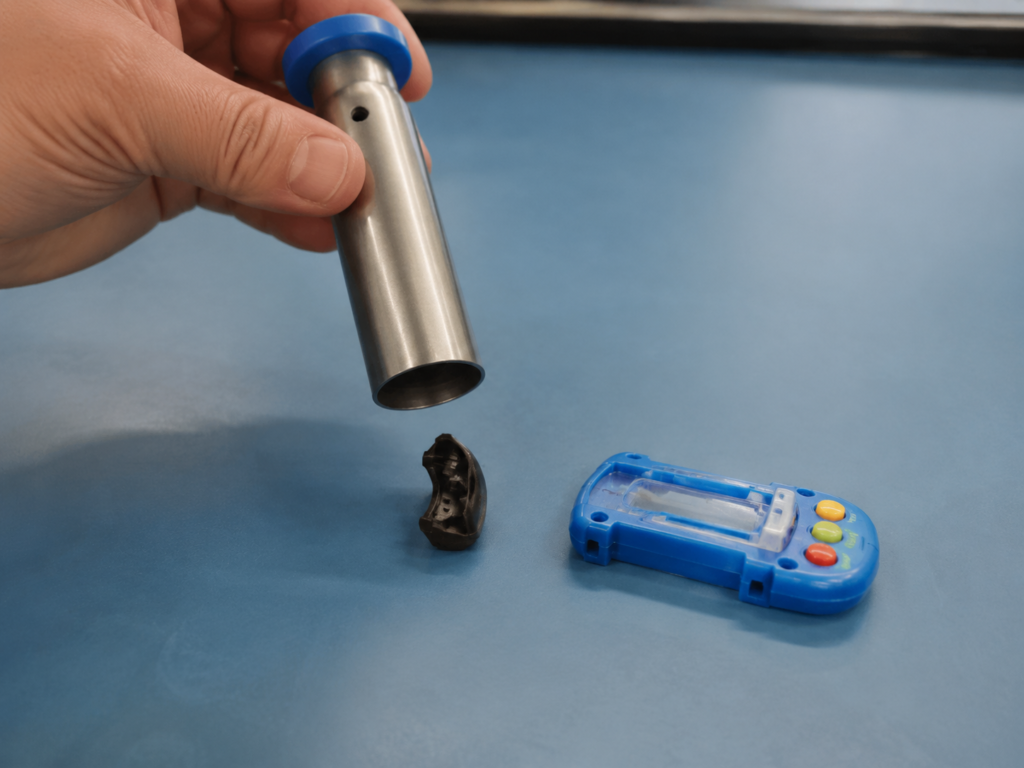
Portable Power Supplies (Power Banks, Wireless Chargers, Headset Charging Cases)
- Core control: lithium battery safety, shell flame retardancy
- Compliance requirements: For adult models, if subject to CPSC mandatory rules, a GCC must be issued and supported by a third-party safety test report; for those not yet included in specific mandatory standards, safety assessment and test records related to lithium battery safety and shell flame retardancy must also be retained. Children’s models require CPC + full CPSIA testing.
- Common violations: battery without protection circuit, shell flame retardant grade not up to standard.
Small Household Electronics (Electric Toothbrushes, Curling Irons, Desktop Small Fans)
- Core control: electrical insulation, mechanical safety, anti-scald design for heating products.
- Compliance requirements: For ordinary adult models, if subject to CPSC mandatory rules, a GCC must be issued; for those with high risks such as heating, third-party test reports must be provided to support compliance.
- Common violations: curling iron without high temperature warning, fan protective mesh gap too large which easily pinches fingers.
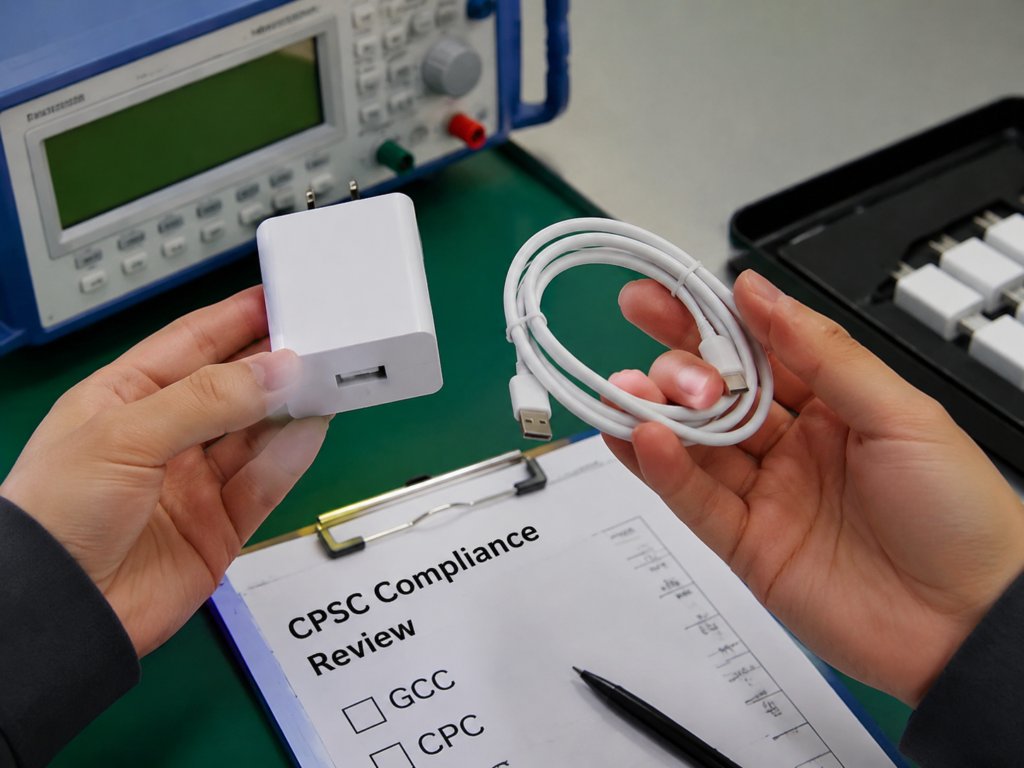
Mobile Phone/Computer Accessories (Chargers, Data Cables, Phone Cases)
- Core control: charger electrical safety, data cable flame retardancy, shell toxic substance content.
- Compliance requirements: For ordinary adult models, if subject to CPSC mandatory rules, a GCC must be issued; for children’s models, a CPC must be issued in accordance with CPSIA requirements.
- Common violations: charger without overcharge protection, phone case with excessive lead or plasticizer.
Children’s Consumer Electronics (Children’s Watches, Early Education Machines, Electronic Toys)
- Core control: lead/phthalate compliance, small part anti-detachment, battery anti-swallowing, permanent tracking label.
- Compliance requirements: Must be tested by a CPSC-recognized laboratory and a CPC must be issued.
- Common violations: watch strap with excessive plasticizer, battery easily detachable, no permanent tracking label.
Ordinary Electronics with Button Batteries (Remote Controls, Electronic Scales, Keychain Lights)
- Core control: child-resistant battery compartment, swallowing risk warning.
- Compliance requirements: Comply with the Button Battery Safety Act (Reese’s Law), adult models also need battery compartment safety design; if subject to CPSC mandatory rules, corresponding compliance documents and test records must be provided.
- Common violations: battery compartment buckle easily loosens, no swallowing risk warning label.
From Project Initiation to Listing: 5 Steps for Seller Compliance Practice
If you are a seller and need to do CPSC compliance for a consumer electronic product from scratch, following these 5 steps will not cause major mistakes:
Step 1: Product Positioning and Risk Sorting
First, clarify the target users of the product: adults, children, or shared by the family? Then list all high-risk components of the product, such as batteries, small parts, magnets, heating components, etc. It is best to form written records, so that you can explain clearly when encountering audits later.
Step 2: Match Applicable Compliance Requirements
According to the product positioning, match the corresponding compliance requirements:
- If it is a children’s product, follow the requirements of CPSIA, and prepare CPC, full testing, and permanent tracking label.
- If it is an adult high-risk product, such as those with batteries or heating functions, prepare a GCC according to applicable CPSC mandatory rules, and provide corresponding safety testing and compliance assessment records.
- If the product contains button batteries, the requirements for battery compartment safety design and warning labels must also be added.
Step 3: Testing and Document Preparation
Children’s products must be sent to a laboratory listed and recognized by CPSC for testing. For adult products, qualified laboratories or compliance solutions that can cover corresponding testing items can be selected according to their own risks and applicable standards — no matter what type of product, it is necessary to ensure that the sample model and materials used for testing are completely consistent with the bulk goods. You cannot use specially made samples for testing while cutting corners on bulk goods. After passing the test, a CPC is issued for children’s products based on the test, and for adult products that require a GCC, it is also necessary to ensure that the certificate information completely corresponds to the test report. Both electronic and paper copies of all documents must be stored properly for future random inspections.
Step 4: Label and Packaging Verification
During bulk production, all labels and packaging must be verified:
- The product itself must have manufacturer/importer information, model number, and batch number. Children’s products must also be printed with a permanent tracking label.
- The packaging and instructions must have English risk warnings, and children’s products must also have a clear age grading.
- For products containing button batteries, there must be swallowing risk warnings on the battery compartment, packaging, and instructions.
Step 5: Continuous Monitoring After Listing
Compliance is not done once the product is listed. There are several things that need to be done continuously afterwards:
- Collect user feedback, especially safety-related complaints. For example, if someone says the charger gets hot or the battery bulges, you must take it seriously and investigate in time.
- Track regulatory updates, such as new mandatory standards and recall announcements issued by CPSC, and adjust your products in time.
- Fulfill the accident reporting obligation: If it is found that the product does not comply with applicable mandatory rules, has defects that may constitute a substantial product hazard, or has unreasonable risks of causing serious injury or death (including cases of mass injuries), it must be reported to CPSC proactively and in time. The penalty for concealing known safety problems will be significantly increased.
- All test reports, certificates, and supplier records must be kept for at least 5 years, and must be available within 48 hours in case of random inspection.
Advanced Pitfall Avoidance: Don’t Step on These Boundaries and Minefields
After mastering the basic compliance process, you also need to pay attention to some easily overlooked boundary issues. Many sellers fail in these places where they “thought it was okay”.
5 Most Common Compliance Pitfalls
- Adult models marketed with children’s elements without CPSIA testing: For example, products printed with cartoon IP, promoted as “student models” or “liked by children”, are finally judged as children’s products by CPSC. Because there is no CPC and corresponding testing, they are fined heavily.
- Thinking that small batches, self-shipping, and free gifts do not need compliance: CPSC regulation does not distinguish between sales channels or quantities. Even if you only sell 1 item, or it is a free gift for buy-one-get-one-free, as long as it enters the U.S. consumer market, it must meet the requirements.
- CPC/GCC made with templates, without test report support: Just find a template and fill it in to use as a certificate. It will be exposed as soon as it is checked, which is equivalent to no compliance.
- Tracking labels for children’s products only attached to packaging: Many sellers, for convenience, only attach traceability labels to the outer packaging, which is directly judged as non-compliant — the requirement is that the product itself must have a permanent label that cannot be torn off or worn off.
- Thinking that passing FCC certification means meeting CPSC requirements: There was a seller who shipped goods only after doing electromagnetic compatibility testing, and was detained and fined because the lithium battery fire risk did not meet the standard — the two regulate completely different directions and cannot replace each other.
3 Easily Confused Compliance Boundaries
- Voluntary standards vs mandatory requirements: Standards such as UL and ASTM are voluntary in themselves, but if CPSC adopts a certain standard, or uses this standard to determine whether a product is defective, then you must comply, otherwise it is a violation.
- Second-hand/refurbished/promotional products: As long as a product enters the U.S. consumer market, whether it is brand new, second-hand, refurbished, or a promotional free gift, it must meet CPSC requirements. Second-hand products with safety hazards will still be recalled.
- Multi-purpose products: If a product has the possibility of being intended for children, it may be regulated as a children’s product. For example, a night light that you say is an adult model may be judged as a children’s product if it is sold in a maternity and baby store, or if there are cartoon patterns on the packaging.
What Are the Consequences of Violations?
Many people want to know the cost of violations. We have compiled the common consequences:
First are trigger scenarios: random customs inspections, platform random inspections, consumer complaints of injury, and exposure of mass accidents may all trigger violation investigations.
Specific consequences include:
- Goods detention/return: Detained by customs during import, unable to clear customs, and in serious cases, forcibly destroyed.
- Fines: The maximum fine for a single violation is about $120,000, and series violations can accumulate to millions or even higher. The specific amount is subject to CPSC’s current inflation-adjusted civil penalty cap and the actual circumstances of the case. Concealing known safety problems will further increase the penalty.
- Recall/removal: You are required to provide free return, exchange, or repair for consumers. The platform will directly remove the product, and in serious cases, even freeze the entire store.
What to Do If You Violate the Rules? Basic Response Logic
If you really encounter a violation investigation, don’t panic. Follow these steps:
Immediately stop selling the relevant products to prevent more consumers from buying risky products and prevent the risk from expanding.
Then proactively cooperate with the investigation of CPSC or the platform, and do not conceal known safety problems — the penalty for concealment is much heavier than the violation itself.
If it is confirmed that the product does have risks, initiating a recall proactively can reduce the penalty. Don’t wait for CPSC to force a recall.
Finally, make up for the testing, improve all compliance documents, and after confirming that there are no problems, apply for re-listing or customs clearance.
Final Summary
At this point, you should have a comprehensive understanding of CPSC compliance for consumer electronics: you can quickly determine the regulatory attribution of a product and whether it is a children’s product, distinguish the different roles of CPSC, FCC, and UL, complete basic compliance preparations according to category requirements and practical processes, verify the validity of certificates and test reports to avoid common pitfalls, and also understand the consequences of violations and basic response methods.
Whether you are a seller or a consumer, the core of CPSC compliance is “safety” — for sellers, compliance is not an extra cost, but a guarantee to avoid greater losses; for consumers, knowing a little about compliance can help you avoid many invisible safety hazards.