
If you are a cross-border e-commerce seller or a newcomer just expanding into the UK market, you may have been confused by the three marks: CE, UKCA, and UKNI. It is clearly stated that the UK market requires the UKCA mark, so why is CE still recognized in Northern Ireland, and why does the UKNI requirement occasionally pop up? How exactly are these three marks distinguished? What is UKNI anyway?
In fact, the logic of UKNI is not complicated at all. It is a special rule specifically for the Northern Ireland market. As long as you clarify its positioning, applicable conditions, and differences from the other two marks, you can quickly judge whether your product needs to bear it, and avoid most compliance pitfalls.
Introduction to the UKNI Mark: What It Is and Why It Exists
First, a plain-language definition of UKNI: it can be popularly understood as an “additional information sticker” for the Northern Ireland market. It is not itself an “entry ticket” to Northern Ireland; it only serves to inform the regulatory authority that the third-party conformity assessment of this product was carried out by a body authorized by the UK government. Its official name is the UK(NI) conformity mark, commonly abbreviated as the UKNI mark in the industry. It is a new compliance mark introduced after Brexit, with the sole function of indicating the origin of the assessment body, and it is only valid when used together with the CE mark.
Its existence is entirely due to the special status of Northern Ireland. After Brexit, in order to avoid a “hard border” between Northern Ireland and Ireland (an EU member state), the two sides signed the Northern Ireland Protocol: Northern Ireland is part of the UK customs territory, but its goods rules still follow the EU Single Market, while aligning with both the UK customs territory rules and the EU Single Market goods rules. On the other hand, Great Britain (i.e., the three regions of England, Scotland, and Wales, abbreviated as GB) uses its own UKCA mark, while Northern Ireland needs to align with both the UK and EU assessment systems at the same time. UKNI was designed for this alignment — it is neither the “Northern Ireland version” of UKCA nor a substitute for CE, but only a supplementary mark to CE.
Before moving on to the specific rules, let’s clarify several frequently appearing terms in plain language to avoid confusion later:
• Conformity assessment: In common terms, it is a “compliance checkup” for products, verifying whether they meet the requirements of relevant regulations such as safety and environmental protection, which is also the commonly referred to compliance testing and certification process.
• UK Approved Body: Refers to a body officially authorized by the UK government to carry out statutory third-party conformity assessment; not any random testing laboratory in the UK counts.
• EU Notified Body (abbreviated as NB): Equivalent to the EU version of an “approved body”, it is a third-party body authorized by the government of an EU member state to issue CE-related certificates.
• Northern Ireland market: Refers to the market where products are ultimately sold, given away free of charge, or used for commercial purposes within Northern Ireland. If products only pass through Northern Ireland as transit to other regions, they are not considered placed on the Northern Ireland market.
To start with, let’s clarify 4 core boundaries to avoid basic cognitive deviations:
First, UKNI is not a UK-wide mark; it is only valid in Northern Ireland and is not recognized in Great Britain.
Second, UKNI cannot be used alone; it must be affixed together with the CE mark, and affixing it alone has no compliance effect.
Third, not all products entering Northern Ireland need to bear the UKNI mark; in most cases, CE alone is sufficient, and it only needs to be affixed in specific scenarios.
Fourth, UKNI is not the Northern Ireland version of UKCA; the two have completely different regulatory bases and application rules.
Applicability Judgment: Core Conditions and Scenario Boundaries
After clarifying the basic concepts, the most critical question is: does my product need to bear the UKNI mark? In fact, the judgment criteria are very clear: four conditions must be met simultaneously, and if any one is missing, there is no need to affix it:
The first is the territorial condition: the product is indeed to be placed on the Northern Ireland market, whether for sale, free giveaway, or commercial use; transit only does not count.
The second is the product condition: the product falls under a regulated category that requires mandatory third-party conformity assessment, not a low-risk product for which the manufacturer can declare compliance on its own.
The third is the body condition: the third-party conformity assessment of the product is completed by a UK Approved Body, not an EU Notified Body, nor an ordinary testing body.
The fourth is the rule condition: the product meets the requirements of EU regulations adopted by Northern Ireland.
As long as one condition is not met, there is no need to affix the UKNI mark. Common scenarios where it is not required include the following:
If your target market is not Northern Ireland, for example, you only sell to Great Britain (using UKCA, or CE during the transition period) or only sell to the EU (using CE), this has nothing to do with UKNI.
If the third-party assessment of the product is completed by an EU Notified Body and the CE mark has already been affixed, the product can directly enter Northern Ireland without additional UKNI.
If the product is a low-risk self-declaration category that does not require assessment by a third-party body, CE alone is sufficient, and UKNI is not needed.
There are also categories explicitly exempted by regulations, such as small quantities of cross-border online purchases for personal use, non-commercial private second-hand transfers, custom-made medical devices, etc. The specific list shall be subject to the official inventory.
Many people ask: which products are regulated categories? Among common ordinary consumer goods, consumer electronics (such as mobile phone chargers, Bluetooth speakers, data cables), toys and baby products (such as children’s building blocks, plush toys, baby strollers), small household appliances (such as hair dryers, electric kettles, rice cookers), and protective products (such as safety helmets, goggles, disposable protective masks) are common categories that may fall under the regulatory scope of EU regulations applicable to Northern Ireland, but this does not mean that these categories must bear the UKNI mark. Whether UKNI is required requires further judgment on whether the product falls under the scope of mandatory third-party conformity assessment and whether the assessment body is a UK Approved Body — most low-risk electrical and electronic products and daily necessities can follow the manufacturer’s self-declaration route, requiring only the CE mark and no UKNI. In addition, there is no general full-category list; the specific judgment must be made in accordance with the regulations applicable to Northern Ireland. For special categories such as medical devices and construction products, the rules are independent and cannot be applied by the rules for ordinary consumer goods.
Conversely, there are several situations where the UKNI mark must absolutely not be used: if the product is only placed on the Great Britain or EU market, if the product has not passed third-party conformity assessment by a UK Approved Body, or if the product does not bear the CE mark. Affixing UKNI in these situations would instead be a violation.
Core Differences and Combination Rules with CE and UKCA Marks
Many people mix up the three marks mostly because they compare them indiscriminately. Let’s first clarify the premise of the comparison: the following comparisons are all for ordinary consumer goods that require mandatory conformity assessment, and all three are statutory marks. The rules for special categories do not apply to this comparison.
To facilitate quick differentiation, the core differences between the three marks are organized as follows:
| Comparison Dimension | CE Mark | UKNI Mark | UKCA Mark |
| Applicable Regions | EU + Northern Ireland | Northern Ireland only | Great Britain only (England/Scotland/Wales) |
| Core Positioning | Basic conformity mark (entry ticket) | Additional mark indicating the origin of the assessment body | Basic conformity mark (entry ticket) |
| Assessment Body Requirements | EU Notified Body or manufacturer’s self-declaration | UK Approved Body only (only for products requiring third-party assessment) | Judged in accordance with applicable GB regulations; products eligible for self-declaration are declared by the manufacturer, products requiring third-party assessment usually use a UK Approved Body, and special categories require separate rule checks |
| Can Be Used Alone | Yes | No, must be used with CE | Yes |
| Regulatory Basis | EU unified regulations | EU regulations adopted by Northern Ireland + UK supplementary rules | UK independent regulations applicable to Great Britain (GB) |
Next, let’s break them down. First, look at the relationship between UKNI and CE, specifically for scenarios in the Northern Ireland market:
Their positioning is completely different: CE is the basic conformity mark for the Northern Ireland market, equivalent to an entry ticket; UKNI is only an additional mark, used solely to indicate that the assessment body is from the UK.
Assessment body requirements differ: CE assessment can be carried out by an EU Notified Body or through the manufacturer’s self-declaration (for low-risk products); UKNI only corresponds to third-party assessment carried out by a UK Approved Body.
Market coverage differs: CE can be used throughout the EU and Northern Ireland; UKNI can only be used in Northern Ireland and cannot be used in the EU market.
Usage rules differ: CE can be used alone; UKNI must be affixed together with CE and cannot appear alone.
Now look at the differences between UKNI and UKCA. These two are the most easily confused, but in fact they are very different:
Applicable regions are completely different: UKNI is only valid in Northern Ireland, and UKCA is only valid in Great Britain. Northern Ireland does not recognize UKCA, and Great Britain does not recognize UKNI.
Regulatory bases differ: UKNI is based on EU regulations adopted by Northern Ireland plus UK supplementary rules; UKCA is based on independent regulations of the UK’s Great Britain (GB) region.
The only point of overlap is the assessment body: both recognize the assessment results of UK Approved Bodies — but this does not mean that the same assessment report can be directly used for both marks at the same time: the premise is that the UK Approved Body has the authorization qualification for the corresponding product regulations and category, and the technical requirements, test items, and document requirements applicable to Great Britain and Northern Ireland can be aligned; otherwise, separate assessment or supplementary documents are required.
Usage rules differ: UKNI must be used with CE; UKCA can be used alone.
After clarifying the differences between individual marks, the common mark combinations and applicable scenarios become very clear:
If only CE is affixed, it applies to the EU and Northern Ireland markets, provided that the assessment is completed by an EU Notified Body, or the product is a low-risk self-declaration category.
The combination of CE + UKNI only applies to the Northern Ireland market, provided that the third-party assessment is completed by a UK Approved Body.
If only UKCA is affixed, it only applies to the Great Britain market.
The combination of CE + UKCA applies to products placed on both the EU and Great Britain markets. Of course, during the CE recognition transition period in Great Britain, only CE can also be used.
You already know the entry-level judgment. Let’s talk about some semi-proficient judgment logic: how should the conclusion be adjusted if conditions change?
For example, if the assessment body is changed from a UK Approved Body to an EU Notified Body, then there is no need to affix additional UKNI for the Northern Ireland market, and CE alone is sufficient.
For example, if the target market is changed from Northern Ireland to Great Britain, then UKCA should be used instead (or CE during the transition period), and UKNI cannot be used.
For example, if the target market is changed from Northern Ireland to the EU, then only CE can be used, and UKNI must absolutely not be affixed, otherwise it may instead be judged as non-compliant.
For example, if the product is changed from a mandatory third-party assessment category to a self-declaration category, then UKNI is also not needed, and CE alone is sufficient.
Correct Usage Specifications: How to Affix and What to Prepare
If it is determined that UKNI needs to be affixed, it must be done in accordance with the specifications; incorrect affixation is also considered a violation.
First is the style and size of the mark: UKNI has an official fixed proportion and cannot be stretched or deformed arbitrarily. The standard template can be downloaded from the UK government’s official GOV.UK website. For regular products, the minimum height of the UKNI mark must not be less than 5 mm, must be clearly visible and not easily worn, and stickers that peel off easily cannot be used. For products with particularly small sizes, such as earphones and small electronic components, the minimum size requirement can be exempted, but the mark must still be clearly distinguishable.
Next is the affixation position: priority is given to affixing it on a clearly visible position on the product itself, such as the bottom or back of the product, and it cannot be affixed in a place that can only be seen after disassembly. If the product is too small or its surface cannot be labeled, it can be affixed to the smallest sales package. It should be noted that UKNI must be placed adjacent to the CE mark; they cannot be affixed one on the product and one on the package, nor can they be affixed separately on different positions of the product. Some special categories also require the mark to be printed on the instruction manual at the same time, which shall be subject to the regulations of the corresponding product.
There are several statutory prerequisites for affixing UKNI, and it must never be affixed randomly:
First, the product has completed conformity assessment, meets all requirements of the corresponding regulations in Northern Ireland, and products requiring mandatory third-party assessment have obtained the assessment report from a UK Approved Body.

Second, compliance documents are complete, including technical documentation (test reports, design drawings, instruction manuals, etc.) and a Declaration of Conformity that meets the requirements of the corresponding regulations. There is no separate “UKNI Declaration of Conformity” or “UKNI certificate”. The declaration document must clearly state the applicable regulations, manufacturer information, product identification information, and relevant content of the UK Approved Body’s participation in the assessment. All documents are prepared around the applicable regulations of the corresponding product.
Third, the responsible entity in the market chain must be clarified: the manufacturer within the UK is the primary responsible person; overseas manufacturers should, in accordance with the requirements of the corresponding product regulations, confirm the relevant obligations of importers, authorized representatives, or other economic operators, to ensure that when regulatory authorities conduct random inspections, they can connect with the responsible entity that can provide compliance documents. Whether a separate compliance responsible person needs to be designated shall be subject to the specific product regulations and sales model.
These compliance documents must be kept for at least 10 years, and the specific duration shall be subject to the regulations of the corresponding product. They must be provided in a timely manner when regulatory authorities conduct random inspections, otherwise the product may be directly judged as non-compliant.
Practical Operation for Overseas Sellers: Full Process from Sales Plan to Mark Selection
Having talked about so many rules, how should we proceed step by step in actual operation? The following is a set of processes from judgment to implementation, which can be used as a standard process for preliminary judgment.
Step 1: First, quickly self-test whether UKNI needs to be affixed by asking yourself four questions in order. If any answer is no, you don’t need to consider UKNI:
First question: Is the product to be placed on the Northern Ireland market? If not, you don’t need it at all.
Second question: Does the product fall under a regulated category that requires mandatory third-party conformity assessment? If not, you don’t need it.
Third question: Is the third-party assessment completed by a UK Approved Body? If not, you don’t need it.
Fourth question: Does the product already meet the requirements of EU regulations adopted by Northern Ireland? If yes, then it is necessary to affix both CE and UKNI.
Step 2: If it is determined that affixation is required, complete the following basic preparations:
First, organize the product’s technical materials, including instruction manuals, design drawings, test reports, etc., to ensure compliance with the regulatory requirements applicable to Northern Ireland.
Then complete the conformity assessment. For products requiring mandatory third-party assessment, you must find a UK Approved Body with qualifications for the corresponding category to conduct it; if it is a self-declaration product, UKNI is not needed in the first place, to avoid unnecessary cost expenditure.
Finally, prepare the compliance documents, sign the Declaration of Conformity required by the corresponding regulations, and clarify the responsible entity in the market chain.
If you operate in more than just the Northern Ireland market, choosing the right assessment body route can save a lot of certification costs. Here is the mark decision logic for multi-market sales:
If you only sell to Northern Ireland: if you use an EU Notified Body for assessment, CE alone is sufficient; if you use a UK Approved Body for assessment, you need to affix both CE and UKNI.
If you sell to both Northern Ireland and the EU: prioritize choosing an EU Notified Body for assessment, as CE alone can cover both markets, avoiding the cost of duplicate certification.
If you sell to both Northern Ireland and Great Britain: if you use a UK Approved Body for assessment, affix UKCA for Great Britain and CE + UKNI for Northern Ireland; if you use an EU Notified Body for assessment, during the CE recognition transition period in Great Britain, CE can cover both regions, which is more convenient.
If you operate in all three markets: EU, Northern Ireland, and Great Britain: first compare the assessment costs of EU Notified Bodies and UK Approved Bodies. Usually, choosing the CE route with an EU Notified Body can cover the EU and Northern Ireland markets; the access requirements for the Great Britain market shall be subject to the latest announcements on GOV.UK and corresponding product regulations. If the CE recognition policy is adjusted, then supplement UKCA-related assessments or documents as required, to minimize duplicate certification costs as much as possible.
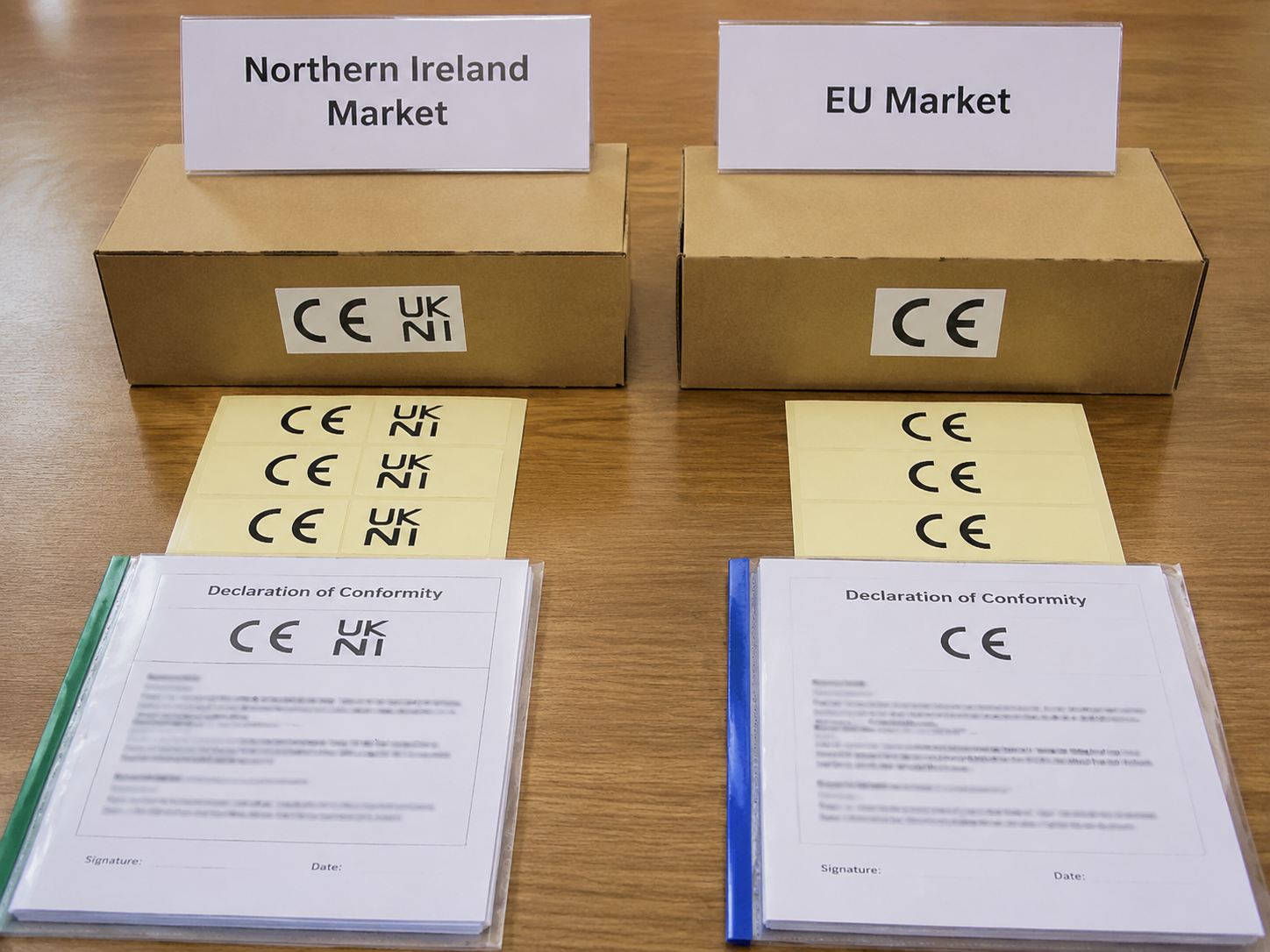
In actual operation, special attention should be paid: products bearing the UKNI mark may only be sold in the Northern Ireland market and must not be directly shipped as inventory for the EU market. If operating multiple markets at the same time, it is recommended to manage labels, packaging, and compliance documents separately by sales region, to avoid goods affixed with CE + UKNI flowing into the EU and causing compliance risks.
Cross-border e-commerce sellers should also pay attention to two special points:
One is platform rules. For example, the Northern Ireland site of Amazon UK has separate compliance requirements, which shall be subject to the latest platform rules; do not only look at general regulations.
The other is customs clearance requirements. When clearing customs in Northern Ireland, documents such as Declaration of Conformity and assessment reports may be required. It is recommended to prepare both electronic and paper versions in advance to avoid customs delays.
Before official labeling, quickly go through the checklist again: whether the target market includes Northern Ireland, whether the product is a mandatory third-party assessment category, whether the assessment body is a UK Approved Body for the corresponding category, whether the CE mark is also affixed and the size and position of both marks meet the requirements, whether the compliance documents are complete and the responsible entity is clear, and whether inventory and label segregation has been done if operating multiple markets. After confirming that all conditions are met, you can affix the marks. The final compliance shall still be subject to the corresponding product regulations and the latest official guidelines.
Common Misconceptions and Compliance Risk Avoidance
The following are the deep-seated misconceptions that are most easily overlooked or misjudged in practice:
The first category is applicability scenario misconceptions:
• Misconception: The CE mark has a recognition deadline in Northern Ireland
Correct explanation: Currently, the Northern Ireland market does not set a unified recognition deadline for compliant CE marks similar to that in GB; if the Windsor Framework or special product regulations are adjusted, the latest guidelines on GOV.UK shall prevail. Only the Great Britain region has a CE mark recognition transition period, and the relevant period and scope of application shall be subject to UK government announcements. The two must not be confused.
• Misconception: For simultaneous sales to Great Britain and Northern Ireland, only UKCA needs to be affixed
Correct explanation: Northern Ireland does not recognize the UKCA mark. Products entering the Northern Ireland market need to bear CE (or CE + UKNI), and UKCA alone cannot cover the entire UK market.
The second category is conformity assessment misconceptions:
• Misconception: As long as a UK testing body conducts the test, UKNI can be affixed
Correct explanation: Statutory conformity assessment results issued by a UK Approved Body for the corresponding product category are valid; test reports from ordinary commercial testing bodies cannot be used as the basis for affixing UKNI.
• Misconception: The UKNI mark requires UK government approval before use
Correct explanation: UKNI does not require prior case-by-case government approval. Manufacturers or responsible entities can affix it on their own after completing all conformity assessments required by applicable regulations (including third-party assessment with the participation of a UK Approved Body). However, the completion of third-party assessment for the corresponding category by a UK Approved Body is the core prerequisite for using UKNI; enterprises cannot affix it arbitrarily solely based on self-declaration.
• Misconception: Products affixed with UKNI can be directly sold to the EU
Correct explanation: The EU does not recognize conformity assessment results issued by UK Approved Bodies. Products bearing the UKNI mark cannot directly enter the EU market and may only be sold in the Northern Ireland region.
What are the consequences of violation? Common ones include customs seizure of products, platform delisting, fines, and mandatory recalls. In serious cases, legal liability may also be borne. If you want to check the latest rules, you must take the announcements on the UK government’s official GOV.UK website and the Northern Ireland Office as the standard, and do not readily believe unofficial scattered information online.
Notes on Special Fields and Policy Developments
The foregoing are all general rules for ordinary consumer goods. Several types of special products have independent regulatory systems and conformity assessment pathways, so the general mark rules cannot be directly applied. You must first check the corresponding special regulations, and do not apply them mechanically:
• Medical devices and in vitro diagnostic products: Northern Ireland mainly follows the EU MDR/IVDR regulations and usually uses the CE mark. The applicable rules for UKNI need to be checked separately, and priority can be given to the special Northern Ireland guidelines issued by the UK MHRA.
• Construction products: Northern Ireland applies EU Construction Products Regulations and usually uses CE. UKNI does not apply to the general pathway. You need to check the construction products regulations applicable to Northern Ireland to confirm whether UKNI applies to the corresponding conformity assessment scenario.
• Chemicals: Must comply with special regulations such as EU REACH/CLP and the UK’s supporting rules for Northern Ireland, and do not follow the general mark pathway of UKCA/CE/UKNI.
• Vehicles: Must meet the vehicle type approval requirements of the EU and the UK, and have an independent access mark system.
• Food and pharmaceuticals: Managed by the local Northern Ireland food and drug regulatory authority in accordance with special regulations, and there is no general mark application logic.
The judgment method is very simple: if your product belongs to a special industry, first check the special regulations for the corresponding category, and do not directly apply the general rules.
There is also the often confused issue of transition periods: UKNI has been officially implemented since January 1, 2021, and there is no transition period where “you don’t need to affix it first”. Only the Great Britain region has a CE mark recognition transition period; Northern Ireland has no such transition period. The CE recognition period in Great Britain shall be subject to the latest UK government announcement, and do not directly apply it to Northern Ireland.
Finally, let’s talk about the response methods for policy changes. Major policy adjustments such as the Windsor Framework may affect the compliance rules in Northern Ireland, so you should pay attention to official announcements in a timely manner. Product regulations and the list of regulated categories may also be updated. It is recommended to check the latest official guidelines before affixing marks to avoid falling into new pitfalls due to using old rules.
In general, to judge whether a product needs to use UKNI, you only need to closely follow the four core conditions: whether the target market is Northern Ireland, whether it is a mandatory third-party conformity assessment category, whether the assessment body is a UK Approved Body for the corresponding category, and whether it meets the EU regulations applicable to Northern Ireland. If special categories are involved or you have doubts about the rules, be sure to follow the latest guidelines on the UK government’s official GOV.UK website to avoid making wrong decisions based on outdated or unofficial information.