
If you plan to sell electrical products in Australia, or are just getting started with the compliance requirements of the Australian and New Zealand markets, you will most likely encounter the two concepts of RCM and EESS at the same time. Many practitioners tend to confuse the two in the early stages: either mistakenly believing that RCM is an “Australian quality certification”, or thinking that EESS is the entire content of RCM, which leads to many unnecessary compliance errors. This article will explain step by step from basic concepts, scope judgment, compliance processes to risk avoidance, covering all core content needed from entry level to independently completing basic judgments.
First, Understand the Basics: Core Relationship Between the RCM Mark and EESS
Many people’s first impression of RCM is “Australian certification”, but this statement is inaccurate. The full name of RCM is Regulatory Compliance Mark, which literally translates to “compliance mark”. It can be understood as the “market access stamp” legally required by Australia and New Zealand — it is not a quality rating, nor a separate certificate, but just a mark printed on the product. The most critical logic is: Only when all applicable compliance certificates are collected and a complete evidence chain is formed are you eligible to print this mark; printing it randomly does not count as compliance.
Different from the “unified certification issuance” model that many people understand, RCM itself does not have a single “certification issuing body”, nor does there exist an “RCM certificate” that covers all requirements. Compliance responsibility is led by the local responsible supplier in Australia: the supplier needs to complete all applicable regulatory requirements separately according to the actual functions of the product and the sales market, and after collecting a complete compliance evidence chain, is responsible for the legality of marking the RCM mark on the product by itself.
Then what is EESS? The full name of EESS is Electrical Equipment Safety System, which is the national unified electrical product safety management rule in Australia, specifically responsible for the “electrical physical safety” part of RCM compliance — simply put, it manages direct safety risks such as electric shock, fire, and overheating injury of products. It does not manage electromagnetic interference, energy efficiency level, or whether wireless functions are compliant; these belong to other applicable requirements under RCM.
From the perspective of regulatory segments, the mandatory requirements for RCM compliance are mainly divided into three categories: first, electrical safety (that is, the jurisdiction of EESS), second, electromagnetic compatibility (EMC), and third, radio requirements — as long as the product has the corresponding function, it must meet the requirements of the corresponding segment, and there is no such thing as an “additional item”. Only when all applicable requirements are fully met are you eligible to use the RCM mark.
People who are new to this are most likely to fall into three cognitive misunderstandings, which are clarified here in advance to avoid going astray later:
First, do not treat RCM as a quality certification. It is only the statutory minimum compliance threshold, just like you need a ticket to enter a cinema; the ticket only proves access qualification, and does not represent the service level.
Second, do not think that EESS is the entire RCM. It is only the electrical safety part of the three mandatory segments. Smart products with wireless functions, home appliances, etc., often also need to meet other applicable requirements such as EMC and radio, and all must meet the standards before the RCM mark can be affixed.
Third, do not think that EESS is a local regulation of a certain state. It is a unified national framework in Australia, but each state is responsible for the implementation of supervision, and the core logic is basically consistent across the country.
Quick Judgment: Whether Your Product Needs to Comply with EESS Requirements
The following three conditions are only for preliminary screening. Finally, it is necessary to confirm whether it falls within the jurisdiction of EESS in combination with the product category, use, power supply method, exclusion clauses and the current classification of the AS/NZS 4417 series:
First, it is electrical equipment, that is, products that rely on electrical energy to work; purely mechanical and purely manual products are not included.
Second, the voltage is within the conventional jurisdiction range: between 50V and 1000V alternating current, or between 120V and 1500V direct current. Products whose body voltage is lower than this range usually do not directly fall within the scope of general EESS jurisdiction, but accessories such as accompanying mains adapters, power cords, and charging docks still need to be individually judged whether they meet the requirements; products whose voltage exceeds this range may fall into the category of high-voltage or other special regulatory rules, and the jurisdiction ownership needs to be confirmed separately, and the general EESS rules cannot be directly applied.
Third, the product is intended for the Australian market, including sale, lease, and public use; even cross-border e-commerce direct mail to individual consumers is within the scope of jurisdiction.
Here are some common examples of products under jurisdiction: commonly used electric kettles, microwave ovens, desk lamps, mobile phone chargers, power strips, extension cords, as well as computer monitors, LED lamps, and smart home devices with plug-in charging, all belong to the common jurisdiction scope.
There are also some products that are usually not included in the general EESS jurisdiction, or are under the special management of other departments, but they cannot be directly excluded based solely on industry attributes, and need to be verified in combination with specific product definitions:
For example, low-voltage products powered purely by batteries (such as a small alarm clock using AA batteries, whose own working voltage is far below the threshold and does not need to be connected to the mains for charging) are usually not included in the general EESS jurisdiction;
Medical devices are mainly regulated by the Australian Therapeutic Goods Administration (TGA) under special medical device rules, but this does not mean that their electrical safety requirements automatically exclude EESS jurisdiction, which needs to be comprehensively judged in combination with product classification, supporting accessories and the rules of the target state/territory; their supporting general power adapters, chargers, plug power cords and other electrical accessories still need to be individually confirmed whether they are subject to EESS requirements;
Original electrical components of vehicles such as cars, ships, and aircraft are usually subject to the special regulations of the corresponding means of transport, but separately sold replacement parts and retrofitted electrical equipment still need to be judged for jurisdiction according to general EESS rules, and cannot be directly excluded based solely on the “for vehicle/ship use” label;
Professional industrial custom equipment needs to be judged whether it applies to the exclusion clauses of EESS in combination with the use scenario, operator qualification, and product-specific standards. Not all industrial equipment is automatically exempted, and it needs to be verified one by one against the official classification list.
There are two special situations that are particularly easy to miss in judgment, so extra attention is required:
The first is the power adapter, power cord, and charging dock included in the set. Even if the main product is a headset, as long as the set comes with a charger, this charger must individually meet the EESS requirements, and cannot be mixed with the main product to pass.
The second is battery products with mains charging function, such as power banks that can be directly plugged into wall sockets for charging, which are within the scope of jurisdiction because they involve mains access; if it is a pure low-voltage power bank that can only input through the USB port and its own maximum voltage is only 5V, it is usually not within the scope of EESS jurisdiction. It should be noted that even if the main product itself is not within the scope of EESS jurisdiction, the accompanying or separately sold mains adapters, chargers, Australian standard plugs and power cords still need to be individually judged whether they meet the EESS requirements according to their respective product categories, which is consistent with the principle of separate judgment of set accessories mentioned above.
If you are not sure whether your product counts, there are two reliable judgment methods: first, check the official EESS AS/NZS 4417 series product classification list, which has clear provisions on the ownership of various products; second, find an EESS-recognized body to do a pre-judgment, and use professional conclusions to avoid big pitfalls later.
Risk Level Classification: Level 1/2/3 Directly Determines Compliance Difficulty
After confirming that the product is within the jurisdiction of EESS, the next step is to judge the risk level — this level is not determined by product size, price or industry experience, but is clearly stipulated by the official classification list according to the risk of electric shock, fire, and misuse. You must not downgrade the declaration by yourself based on feeling.
Australia divides electrical products into three risk levels, with requirements from low to high. For easy comparison, they are organized as follows:
| Risk Level | Risk Degree | Core Compliance Requirements | Typical Products |
|---|---|---|---|
| Level 1 | Low | The responsible supplier keeps the test report + compliance statement on its own, no official registration required | Ordinary decorative LED light strings, small desktop fans, low-risk electrical accessories |
| Level 2 | Medium | Test report issued by a laboratory with ISO/IEC 17025 qualification + Australian local responsible party submits a declaration of conformity and completes official registration | Major home appliances, IT/audio-visual equipment, ordinary power tools |
| Level 3 | High | Compliance certificate issued by an EESS-approved certification body + official registration; some products require initial factory inspection or subsequent supervision | Power plugs, power strips, electric water heaters, residual current devices |
A special reminder here: many people think that power strips are small in size and belong to low risk, but in fact, because they are directly connected to the mains and used frequently, they can easily cause fires, so they belong to the highest Level 3. Many sellers save the registration fee by misjudging the level, and end up being fined more heavily.
It should be added that the specific evidence form and technical document scope of Level 1 low-risk products shall be determined according to the applicable product safety standards and the compliance judgment of the responsible supplier. The core is to be able to fully prove that the product meets the corresponding Australian and New Zealand safety requirements; the test report of Level 2 medium-risk products needs to cover the actual sold product models, key configurations and Australian and New Zealand national differences. A report that only has ISO/IEC 17025 qualification for the laboratory but does not match the content cannot be used as valid compliance evidence. Whether factory inspection is required shall be subject to the specific product category and the requirements of the certification body.
There are also three situations that will lead to changes in the risk level, which require re-evaluation:
First, the core parameters of the product have changed, such as changes in power, plug type, internal power supply structure, which may directly increase the risk level;
Second, the sales scenario has changed, for example, industrial equipment originally only sold to professional factories is now sold to ordinary consumers, the requirements will be stricter;
Third, when the official classification list or safety standards are updated, it is also necessary to check in time to avoid using old rules for new compliance.
Core Compliance Requirements: 4 Conditions That Must Be Met to Comply Under EESS
No matter which risk level the product is, to meet the EESS requirements, it must meet four core conditions, but the strictness of different levels is different.
First, the product complies with the unified Australian and New Zealand electrical safety standards
When judging whether a product meets the electrical safety requirements, priority should be given to matching the corresponding category-specific Australian and New Zealand standards recognized by EESS (for example, AS/NZS 60335 series for home appliances, AS/NZS 62368-1 for IT and audio-visual equipment); if there is no dedicated standard, or when the rules clearly require it, then refer to the general safety principle standard AS/NZS 3820, whose core requirements include dimensions such as electric shock protection, fire and overheating protection, mechanical safety, and clear marking. The requirements for mechanical safety, marking and labeling of specific products are usually subject to the provisions of the corresponding special standards.
Here is the most common cognitive misunderstanding: many people think that having a CE or CB report is equivalent to meeting the requirements, but that is not the case. Australia and New Zealand have their own plug standards (figure-8 shaped Australian standard plugs), rated voltage (230V), and some differences in safety details. Complying with Chinese and EU standards does not mean automatically complying with Australian and New Zealand standards, and difference verification must be completed according to the corresponding rules.
Second, complete compliance verification according to risk level
The verification requirements for different risk levels vary greatly:
For Level 1 low-risk products, the responsible supplier issues a compliance statement on its own, and keeps a full set of test reports and technical documents. There is no need to find a third-party body for review, nor official registration.
For Level 2 medium-risk products, there must be a test report issued by a laboratory with ISO/IEC 17025 qualification — note that the laboratory’s qualification scope must cover the test items of the corresponding product, and you cannot default that the report is valid just because the laboratory as a whole has 17025 qualification.
For Level 3 high-risk products, the requirements are the strictest. You must find an EESS-approved third-party certification body (Approved Certification Body, referred to as ACB) to issue a compliance certificate — note that ACB is a body with the qualification to issue compliance certificates, which is not the same concept as an ISO 17025 laboratory that can only issue test reports, and the responsibilities of the two cannot be confused. Some high-risk products also require factory inspections to confirm that the quality system in the production link can ensure that batch products meet the requirements, and regular supervision inspections may be required later.
Third, medium and high-risk products must complete EESS official registration
For Level 2 and Level 3 products, just having a test report is not enough. They must be registered in the EESS official system. This step is a big pitfall for many cross-border sellers: The registration subject must be a legally registered entity in Australia, that is, the “Responsible Supplier” defined in the EESS rules, which can be an importer, agent, or local Australian brand owner. Overseas companies or individuals cannot directly serve as responsible suppliers, nor can they directly submit registration applications. Many sellers submit registration applications domestically in China, and the result is directly rejected, wasting time.
After passing the registration, a unique registration number will be generated, and anyone can check the registration status of the product on the EESS official website. Registration is not once and for all. Product information changes must be updated in time according to the rules, and fees must be renewed on schedule, otherwise the registration will become invalid.
Fourth, mark the RCM mark and product information in accordance with specifications
All compliant products must be marked with the RCM mark and related product information as required, and cannot be printed randomly. The mark must use the official unified graphic, cannot change the proportion or color, nor can misleading words such as “Australian quality certification” be added next to it. Medium and high-risk products must complete EESS official registration before they can be marked with the RCM mark; marking in advance without registration is a violation.
The marking position is preferably on the product body or a permanently fixed nameplate; only when the product is too small to be clearly marked on the body can part of the information be moved to the packaging or manual according to the corresponding rules, and the marking requirements cannot be lowered at will.
In addition to the RCM mark, it is also necessary to mark the responsible supplier identification information (name or trademark), product model, rated electrical parameters, and traceable production identification (such as batch number or serial number) in accordance with the applicable EESS rules and specific product standard requirements; the marking requirements for different categories of products may vary, and shall be subject to the corresponding standards.
There are three common mistakes: only affixing the CE mark but not the RCM, the mark is too small to see clearly, and medium and high-risk products have printed the RCM mark before completing the registration — all these are violations and will be punished if found.
Practical Handling Process: 5 Steps from Product Preparation to Compliant Launch
After talking about the requirements, let’s sort out the complete process of actual handling. Following the steps will basically not cause big mistakes.
Step 1: Determine the product risk level
Against the official EESS AS/NZS 4417 classification list, find the risk level corresponding to your product. It must be strictly based on the official list, and the risk level must not be deliberately lowered for declaration; if you are not sure, you can find an EESS-recognized body to do a pre-judgment.
Step 2: Prepare technical documents and compliance testing
First sort out the basic technical documents, including product manuals, circuit schematics, parts lists, nameplate drafts, etc. Then find a qualified laboratory to do the testing, according to the Australian and New Zealand standards corresponding to the product.
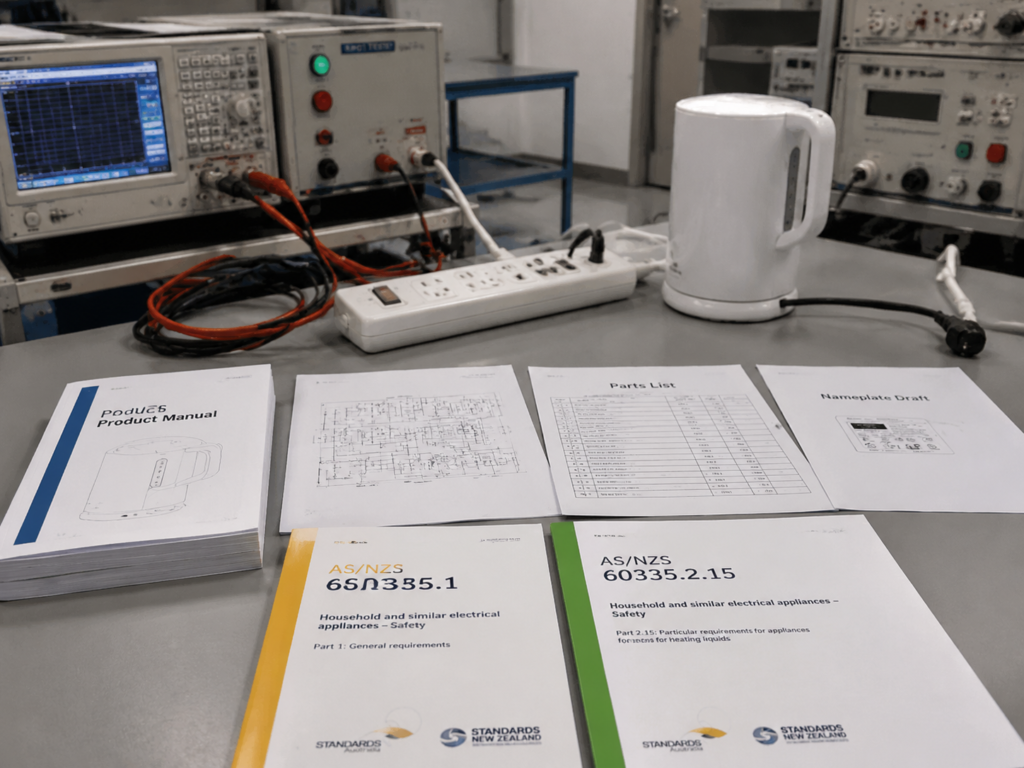
If you already have a CB test report under the International Electrotechnical Commission (IECEE) system, you can submit it to a qualified body to evaluate the possibility of reuse: whether it can be accepted, whether it is necessary to make up the Australian and New Zealand national difference test, whether it is necessary to supplement documents or retest, depends on the version of the CB report, the corresponding product standard, the difference list, the laboratory accreditation scope and the consistency between the product and the report. Not all CB reports can be directly reused; after passing the evaluation, only the difference part can be supplemented to save cost and cycle.
A special note here: The test sample must be exactly the same as the final mass-produced product. You cannot take a prototype with a modified structure for testing, and then change it back during mass production. In that case, the report is invalid, and it is equivalent to not doing it if found.
Step 3: Obtain third-party compliance certification (applicable to medium and high risk)
The third-party compliance requirements for different risk levels vary greatly, and shall be implemented in accordance with the current EESS rules for the corresponding product categories:
For Level 2 medium-risk products, the core compliance evidence is the test report that meets the requirements, a full set of technical documents, and the compliance statement issued by the responsible supplier. There is no need to forcibly obtain a compliance certificate issued by the ACB to submit registration. The specific requirements are subject to the EESS registration system and the corresponding product classification rules.
For Level 3 high-risk products, you must submit an application to an ACB that is officially recognized by EESS and has the authority to handle the corresponding product category. The ACB will review the completeness and compliance of the test report and technical documents, and issue a compliance certificate after passing; some products need to cooperate with the initial factory inspection, and regular supervision audits may be required later according to the rules.
Before submitting the application, be sure to confirm that the qualification scope of the body covers your product category, otherwise the money is spent, the certificate is useless at all, and the registration cannot pass.
Step 4: EESS system registration (applicable to medium and high risk)
After obtaining the compliance certificate that meets the requirements, the local Australian responsible supplier logs into the EESS official system, uploads materials, pays the registration fee, and completes the registration. After getting the registration number, you need to verify that the product status is “valid” in the EESS public database, and confirm that the brand, model, parameters and other information are completely consistent with the actual sold products, to avoid registration invalidation due to incorrect information filling or system delay.
After the registration is completed, if the product information changes, it shall be handled according to the degree of change:
- If it is only a non-substantial information change (such as a slight adjustment of the contact address), you can directly update the registration record in the system;
- If it involves changes that may affect compliance, such as model expansion, rated parameter adjustment, replacement of key parts, etc., you need to first evaluate whether it is necessary to make up tests, revise certification documents, and then confirm whether it is necessary to update the registration information;
- If the change affects the product risk level classification or core compliance conclusion, you need to re-handle testing, certification and registration.
The specific change requirements are subject to the EESS system rules and the compliance judgment of the responsible supplier, and untested models shall not be arbitrarily included in the existing registration scope.
Step 5: Marking for launch and file retention
After confirming that the registration is valid, you can mark the RCM mark and necessary information on the product in accordance with the specifications. All compliance documents, including test reports, technical documents, compliance statements, certification certificates, registration records, etc., shall be properly kept in accordance with the regulatory requirements of EESS and applicable states/territories, and the longer applicable period shall prevail; the responsible supplier must ensure that complete traceable records can be retrieved at any time during regulatory spot checks, and do not throw them away after completion. Before going on the market, reconfirm that the registration status is still valid, to avoid registration invalidation due to untimely renewal and other issues.
Advanced Pit Avoidance: Compliance Verification and Common Risk Avoidance
3 Steps to Quickly Verify Product EESS Compliance
Whether it is the purchaser checking the supplier’s qualification, or the seller self-checking, you can use these three steps to quickly judge:
First, check whether there is a clear RCM mark on the product body or nameplate, as well as the necessary information such as responsible supplier information, model, electrical parameters, and production traceability identification. Any missing one may be problematic.
Second, if it is a medium or high-risk product, go to the EESS official website to enter the model or registration number, check whether the registration status is valid, whether it has been cancelled or suspended, and at the same time check whether the registration information is consistent with the actual product.
Third, if it is a low-risk product, you can require the supplier to provide the self-declaration issued by the responsible supplier, the corresponding test report and technical documents. When verifying, you need to focus on: whether the standard and version applicable to the report match the product, whether the report covers all sales models and variants, whether the 17025 qualification scope of the issuing laboratory covers the corresponding test items, and whether the key configuration of the report sample and the mass-produced product is consistent.
For medium and high-risk products, in addition to verifying EESS-related qualifications, it is also necessary to simultaneously confirm whether other applicable RCM-related requirements such as EMC, radio, and energy efficiency have been met, to avoid thinking that all compliance is done only after completing electrical safety.
The 6 Most Common Types of Compliance Risks
In practice, the following 6 types of problems occur most frequently and need to be focused on avoiding:
First, go on the market directly with a CB or CE report, without making up the Australian and New Zealand national differences and completing the corresponding compliance process.
Second, find a body without EESS recognition qualification to do certification, the certificate is completely invalid and cannot pass the registration.
Third, overseas sellers submit registration applications on their own, without a local Australian responsible party, and the registration is rejected.
Fourth, products of the same series randomly share certificates. Models with different power, plugs, and power boards cannot share certificates. It must be ensured that the report covers all sales models.
Fifth, medium and high-risk products only have the RCM mark, and have not done EESS official registration.
Sixth, after the standard is updated, no re-evaluation is done, and the old version of the report/certificate becomes invalid after the transition period.
Compliance Differences in Different Sales Scenarios
Different sales channels have different regulatory priorities:
For offline physical sales, the regulatory department will conduct on-site spot checks. The product must be fully marked, and there must be a local responsible party. If non-compliance is found, the goods may be detained on the spot.
In the cross-border e-commerce platform scenario, the platform may require sellers to upload EESS registration certificates. Products that do not meet the platform policy may be removed from the shelves, and in serious cases, it will also affect store permissions.
The compliance requirements for second-hand electrical products need to be judged in combination with the actual situation: if the product has not been modified, the key safety structure has not been changed, and the original compliance mark and traceable information are still clearly identifiable, it is usually not necessary to re-apply for the same registration; but the reseller still needs to confirm the current safety status of the product, the validity of the original registration, the second-hand product regulatory rules of the state/territory where it is located, and the safety responsibility it needs to bear. If the product has been repaired, modified or key safety parts replaced, the compliance must be re-evaluated, and if necessary, re-testing or registration is required.
Actual Consequences of Non-Compliance
EESS supervision is jointly implemented by multiple entities, and non-compliance may face risks in multiple links:
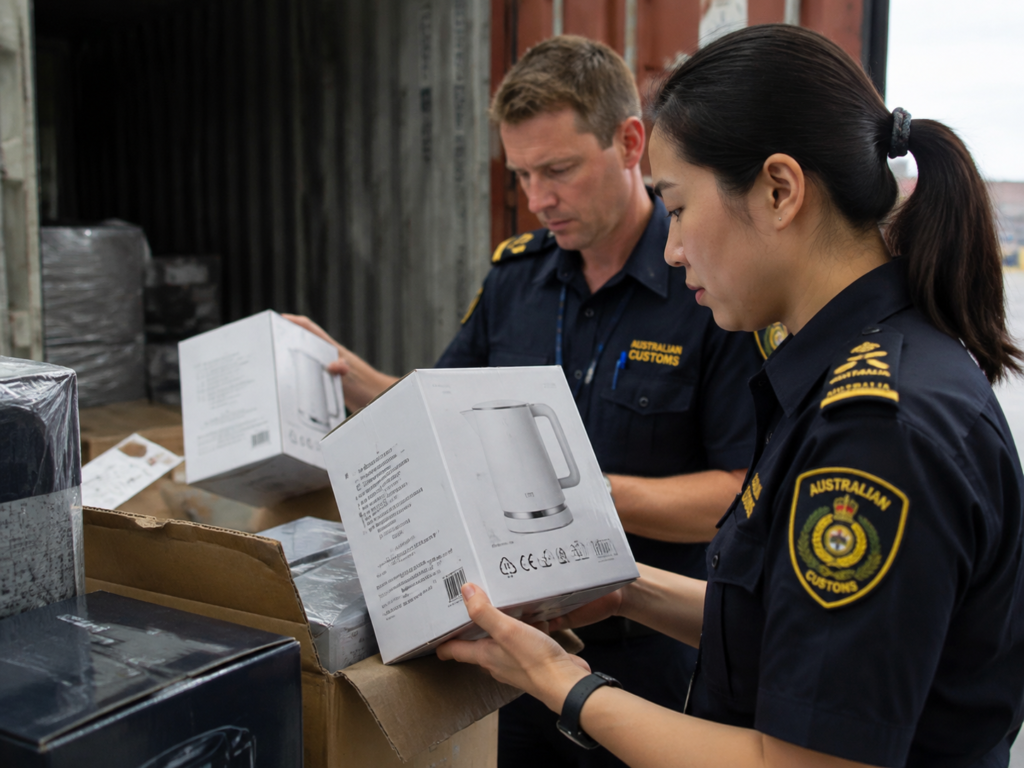
Import customs clearance link: Customs or border management departments may inspect electrical products. If obvious non-compliance is found (such as no RCM mark, no local responsible party information, high risk but no registration record, etc.), they may be detained, required to rectify or returned, and the relevant freight and cargo damage shall be borne by the importer.
Platform sales link: Cross-border e-commerce platforms usually review the compliance qualifications of sellers in accordance with Australian regulatory requirements. If valid EESS registration certificates or compliance documents cannot be provided, products may be removed from the shelves, and in serious cases, it will affect store operation permissions.
Market supervision link: The regulatory agencies of each state/territory are responsible for spot check and law enforcement in the local market. If the product is confirmed to be non-compliant, measures such as ordering rectification, recall, and sales ban may be taken. The amount of fines shall be verified in accordance with the current laws of the corresponding state/territory, and the punishment standards for different risk levels, number of violations, and violation circumstances vary greatly; if accidents such as electric shock and fire are caused by product safety problems, the responsible party also needs to bear civil compensation, and in serious cases, may involve criminal responsibility, and at the same time bear all recall costs, which may be a devastating blow to small businesses.
Boundary Clarification: Differences Between EESS and Other Related Requirements
Many people mix EESS with other compliance requirements. Here are a few common adjacent requirements explained clearly to avoid confusion.
Differences from EMC, Radio, and Energy Efficiency Requirements
EESS only manages electrical physical safety, that is, direct personal injury risks such as electric shock, fire, and overheating.
EMC (Electromagnetic Compatibility) manages whether the product will interfere with other electrical appliances or be interfered by other electrical appliances. For example, whether a microwave oven will affect WiFi signals is a matter of EMC, which EESS does not manage.
Radio requirements are for products with wireless functions such as WiFi, Bluetooth, cellular, etc., to ensure that wireless signals comply with specifications and do not interfere with public communications. Products such as smart speakers and Bluetooth headsets need to be additionally met.
Energy efficiency requirements are for products such as power supplies, lighting, and home appliances, requiring energy efficiency labels, such as the energy consumption star rating of refrigerators, which is also a separate rule.
It should be noted that complete RCM compliance requires meeting all applicable requirements at the same time, not just EESS is enough. For example, a smart desk lamp with WiFi needs to meet EESS (electrical safety), EMC (electromagnetic compatibility), and radio requirements at the same time. Only when all three meet the standards can the RCM mark be affixed.
Relationship with New Zealand Electrical Safety
RCM is a compliance mark jointly recognized by Australia and New Zealand. Products that have completed electrical safety compliance evidence retention, official registration and standardized marking in accordance with Australian EESS can usually reuse most of the electrical safety compliance materials when entering the New Zealand market, but this does not mean that they automatically meet all electrical safety obligations of New Zealand. New Zealand has supplementary rules for some product categories, local responsible supplier requirements, safety declarations, and labeling. Specific products may also have additional testing requirements. Before going on the market, you need to check the local rules one by one, and you cannot directly default that all are applicable.
Relationship with Australian State Rules
The vast majority of Australian states and territories adopt the unified EESS framework, and the core framework and judgment logic are basically the same, but there may be differences in regulatory details, law enforcement scales and supplementary requirements. For example, a few states/territories such as New South Wales have a small number of supplementary regulatory requirements. If products are mainly sold to the corresponding regions, it is best to check the local supplementary rules in advance to avoid omissions.
Final Summary
Overall, EESS is the core safety threshold for Australian electrical product market access, and it is also the most basic item among the three components of RCM compliance. For entry-level practitioners, you can proceed step by step according to clear steps: first do a preliminary screening through three basic conditions, then judge the product risk level against the AS/NZS 4417 official list, then complete the four core compliance requirements of standard matching, compliance verification, official registration, and standardized marking according to the level, and complete the 5-step practical process from level judgment to file retention; before going on the market or purchasing, you can use the 3-step verification method to quickly check compliance, and focus on avoiding 6 types of high-frequency compliance pitfalls. It should be noted that compliance is not a one-time work — when the product structure, standard version, and sales scenario change, the compliance status must be re-evaluated to ensure that it always meets EESS and other applicable RCM-related requirements. All judgments must be based on official rules and formal conclusions of professional bodies. Do not downgrade or simplify the process by yourself based on experience just to save costs, so as not to cause higher compliance risks.