
Many sellers engaged in UK cross-border business or manufacturers who are just preparing to export to the UK, when first exposed to UKCA-related requirements, most easily make the mistake of treating “UKCA certification” and “UKCA customs clearance documents” as the same thing — either they spend money on compliance assessment but have their goods detained because the customs clearance documents do not match; or they prepare a pile of useless documents, wasting time for nothing. In fact, UKCA certification is the entire process of a product from testing, assessment to confirming compliance with UK regulations, equivalent to “exam preparation + taking the exam”; while UKCA customs clearance documents are a collection of written proofs formed after the completion of the compliance assessment, used for UK mainland customs clearance and market supervision. The core is divided into two categories: one is the basic declaration documents required for customs release, which solves the problem of “whether the goods can enter customs”; the other is product compliance certification documents, which solves the problem of “whether the goods can be sold legally”. The latter usually do not need to be actively submitted with each shipment; whether they need to be provided depends on the random inspection requirements of customs, border enforcement or market supervision departments, as well as the regulations of specific products.
First Step for Beginners: Determine Whether Your Goods Need UKCA-Related Customs Clearance Documents
Before starting to prepare documents, first make a basic judgment from three dimensions, which can save you a lot of useless work: first, the entry destination of the goods; second, whether the product is subject to UKCA-related regulations; third, whether the goods will be placed on the UK market for sale.
Applicable Basic Scenarios
If the following three conditions are met at the same time, you need to prepare corresponding UKCA compliance-related customs clearance documents:
First, the entry area is the UK mainland (referred to as GB, including England, Scotland, Wales); Northern Ireland has separate compliance rules, which will be explained later;
Second, the product belongs to categories regulated by UKCA-related regulations, such as common electronic and electrical products, toys, machinery, personal protective equipment, etc. The specific scope needs to be confirmed against the list of regulated products published by the UK government;
Third, the goods are for commercial sale, that is, they will be put into circulation in the UK market. Whether you are an overseas manufacturer, a local UK importer, or a cross-border e-commerce seller using FBA or overseas warehouses, as long as you are the responsible party for compliance of the corresponding products, you need to ensure that the documents are complete.
Exempt/Inapplicable Situations
There are two types of situations that do not require preparation of UKCA compliance documents, but this does not mean that no customs clearance documents are needed:
The first type is exemption category, that is, goods that enter the UK mainland but are not for commercial sale and not placed on the market: such as personal use, reasonable quantity of non-commercial items; non-sale goods temporarily entering the country, such as exhibition exhibits, test samples, repaired old parts, as long as they meet the purpose requirements of customs declaration, no UKCA documents are needed; also goods that only transit and are not sold in the UK mainland, such as goods sent from China to Ireland transiting through UK ports, also do not need them.
The second type is products not applicable to the UKCA system, these products have their own special regulatory regulations, preparing UKCA documents is meaningless: such as food, pharmaceuticals, cosmetics, chemicals, etc. It is not that they do not need compliance, but that they need to prepare documents according to the special regulations of the corresponding category.
Common Cognitive Misconceptions for Beginners
Newbies who are just getting started are most likely to step into three basic cognitive misconceptions, which are specifically clarified here in advance:
The first misconception is “if the product has a UKCA mark, there is no need to prepare compliance documents” — wrong, the UKCA mark is only an external identifier of compliance, regulatory authorities have the right to verify the complete written document chain behind it, to confirm that the mark is not affixed randomly. Having only the mark without documents is still considered non-compliant.
The second misconception is “all products exported to the UK need UKCA documents” — wrong, it depends on the entry area, product category, and purpose of the goods. For example, personal use goods, goods sent to Northern Ireland, food and pharmaceutical categories, do not need UKCA compliance documents.
The third misconception is “UKCA documents must be actively submitted to customs during clearance” — wrong, during regular customs clearance, only basic customs declaration documents need to be submitted, UKCA compliance documents do not need to be submitted actively, but you must have the documents ready. Once there is a random inspection, you must be able to produce them within the specified time; if you cannot produce them, you will still be fined.
Core Framework: Two Types of Customs Clearance Documents and Consistency Requirements
UKCA-related customs clearance documents seem miscellaneous, but in fact the core is two completely different types. Many people confuse them, which leads to missing documents or preparing in the wrong direction. You can quickly distinguish them against the table below:
| Document Type | Core Purpose | Submission Requirement | Consequences of Errors/Omissions |
| Type 1: Basic Documents for Customs Release | Complete import declaration, customs verifies goods identity, value, tax rate | Must be actively provided during customs clearance | Errors or omissions in information will directly delay release, even lead to goods detention |
| Type 2: UKCA Compliance Certification Documents | Prove that products comply with UK safety/compliance regulations, respond to regulatory random inspections | No need to actively submit with each shipment, the responsible party must be able to retrieve them at any time | Failure to provide during random inspection may result in fines, return of goods, or prohibition of sale |
The two types of documents have different purposes and cannot replace each other: no matter how complete your compliance certificates are, you cannot clear customs without a commercial invoice; conversely, even if you have a full set of customs clearance documents, without compliance documents, you cannot sell legally if inspected.
In addition, there is a general core requirement: the product model, brand, manufacturer/responsible party information in all documents must be completely consistent. You cannot write “Fast Charger Pro” on the invoice and “Power Adapter A1” on the compliance document. Even if all documents are complete, this will be judged as non-compliant. When checking, three dimensions must be covered: the identification on the actual goods, commercial customs clearance documents, and UKCA compliance documents. The information that must be matched includes product model and brand, production batch, name and address of manufacturer/responsible party. The most common mistakes are inconsistency between sales name and technical model, and mixing products of different SKUs or batches in the same document.
Type 1 Documents: Requirements for Basic Documents Required for Customs Release
Basic documents must be actively submitted during customs clearance, none can be missing, and errors or omissions in information will directly affect the release speed. Specific requirements may vary slightly depending on the transportation channel, goods value, origin preferential policies and customs broker arrangements. The following are the general core contents.
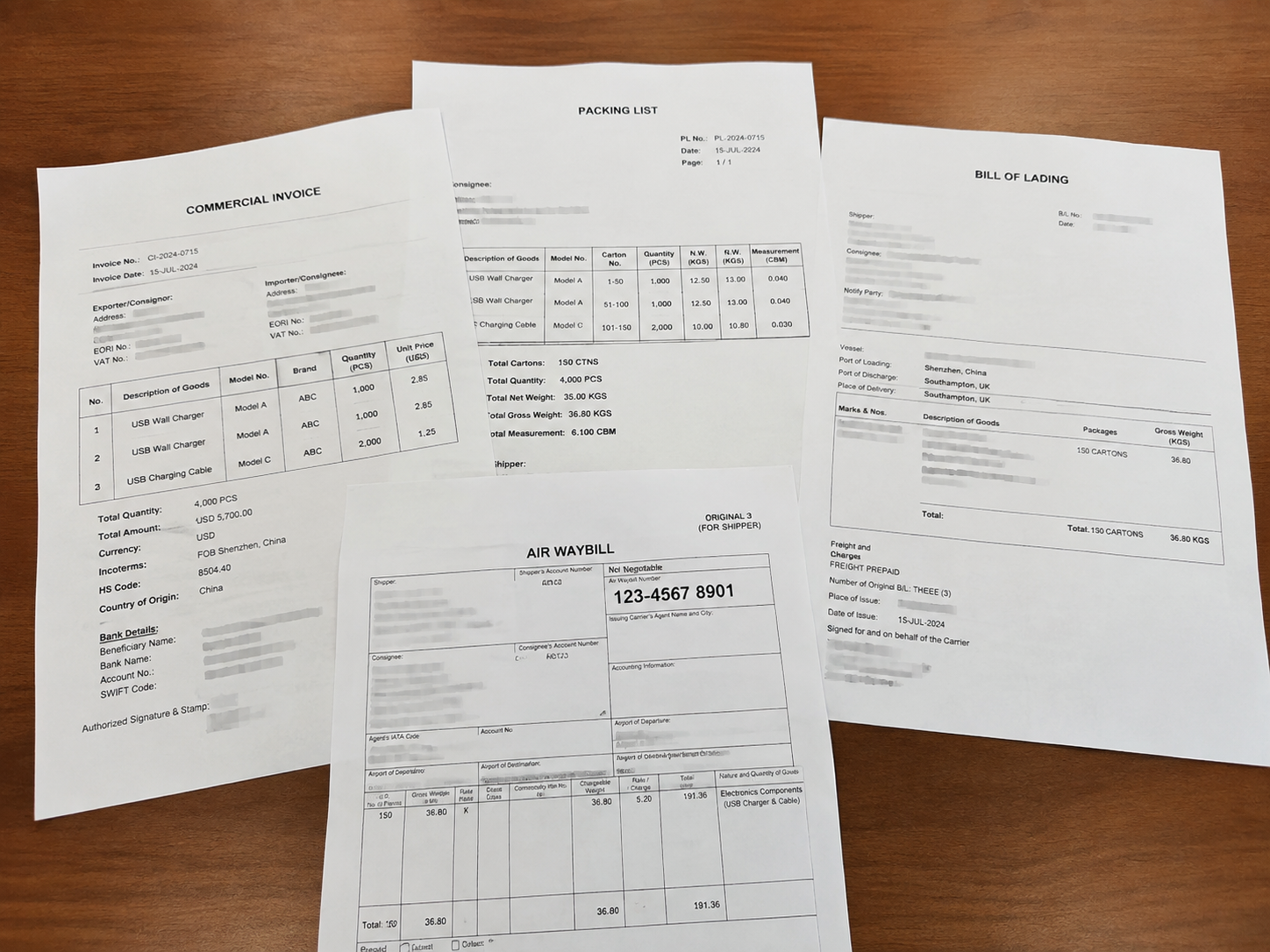
EORI Number
EORI, short for Economic Operators Registration and Identification number, is simply the “identification number” of operators in the customs system. The specific prefix of EORI required is determined by the actual import declaration entity, customs declaration arrangement and goods flow direction: EORI starting with GB is used for import declaration in the UK mainland, and EORI starting with XI is applicable to scenarios involving Northern Ireland, and the two cannot be mixed. A mistake many newbies make is using the overseas warehouse address or the name of the e-commerce platform to replace the compliant declaration entity. Without a corresponding valid EORI, it may lead to non-compliant declaration entities and affect customs clearance.
Commercial Invoice
The commercial invoice is one of the core documents for customs clearance. The invoice must have complete information: consignor and consignee information, specific product name, model, brand, quantity, goods value, currency, HS code, material, purpose. Absolutely cannot write vague descriptions such as “electronic products” or “household items”. Moreover, all product information on the invoice must be consistent with the corresponding information in the UKCA compliance documents.
Packing List and Transport Documents
The packing list must correspond to the quantity, gross weight/net weight, volume, batch, and total number of pieces of each box. All information must be completely consistent with the commercial invoice, no discrepancies. Transport documents are documents such as bills of lading and air waybills, used to confirm the transportation route and arrival information, usually provided by the carrier.
Import Declaration and Tax Arrangements
Import declaration is the declaration form submitted in the UK customs’ CHIEF or CDS system. If you use express or postal channels, the carrier will usually handle it for you, no need to operate it yourself.
In terms of taxes, it mainly involves customs duty and import VAT. There are various payment methods: it can be paid directly by the sender or the consignee, or paid by an agent on behalf. Some eligible entities can also apply for VAT deferred accounting. For commonly used trade terms such as DAP (Delivered at Place), the party responsible for tax payment and the payment method must be clarified in advance. Import VAT vouchers (such as C79 documents, only applicable to eligible VAT-registered import arrangements) can be used as vouchers for VAT input deduction, not all import scenarios involve them, and the specific shall be subject to the actual declared tax calculation method.
Certificate of Origin
The certificate of origin only needs to be provided when you want to apply for tariff preferences. For example, if you meet the free trade agreement tax rate between the UK and the country of origin, you need a certificate of origin to apply. But note that the certificate of origin can only be used to apply for tariff preferences, and absolutely cannot replace UKCA compliance documents, don’t confuse them.
Type 2 Documents: Basic Composition of UKCA Compliance Document Chain
UKCA compliance documents are not a single certificate, but a complete set of mutually verifying documents formed according to the applicable regulations of the product. The specific composition and requirements vary by category. The following are common core components, and the actual shall be subject to the requirements of the UK special regulations corresponding to the product.
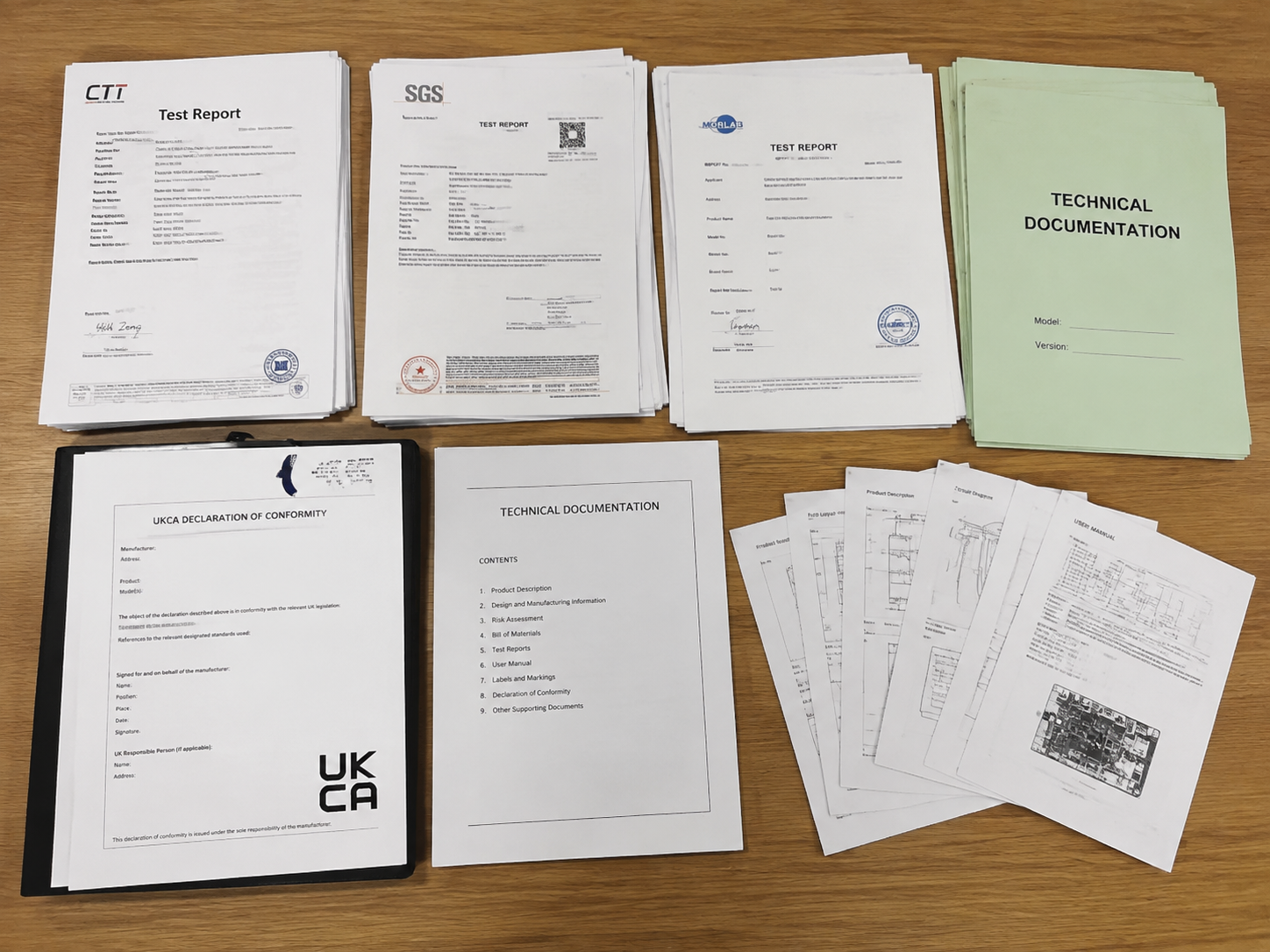
UKCA Declaration of Conformity (UK DoC)
In plain terms, it is a self-guarantee document issued by the manufacturer itself that “the product complies with UK regulations”, not issued by a third-party institution, but a document for which the manufacturer is responsible.
The specific content, signing method, and responsible party information that need to be listed in this declaration shall be subject to the regulations applicable to the product. General practical requirements include: it must be in English, cover the corresponding product models and batches, and the importer must be able to retrieve it at any time and provide it immediately during random inspection. Common mistakes include: wrong applicable regulations, no valid signature or date, incomplete coverage of product models.
Proof Related to UK Local Responsible Entity
The regulations of some regulated products require that manufacturers not located in the UK need to designate a UK local compliance responsible entity (commonly known as UK Responsible Person, referred to as UKRP), which is equivalent to a “compliance contact person” in the UK, so that if the regulatory authorities have questions, they can find a contact person.
Whether it is mandatory to designate a UKRP depends entirely on the requirements of the special regulations corresponding to the product, and there is no unified requirement for all products regulated by UKCA. If the regulations clearly require the designation of a UKRP, you need to prepare three types of core documents: first, the UKRP authorization letter, proving that the manufacturer has officially entrusted the entity to undertake compliance liaison responsibilities; second, the valid local UK address and contact information of the UKRP, which cannot be an email or virtual address.
For categories that require UKRP, there are also two mandatory marking requirements: the name and address of the UKRP must be marked on the UK DoC simultaneously, as well as on the product label or the minimum sales package, and the information in the three places must be completely consistent. If the manufacturer is already located in the UK and exports products on its own, usually no additional UKRP is required.
Test Reports and Third-Party Conformity Assessment Certificates
Whether a product requires third-party conformity assessment, and whether it must be participated by a UK officially authorized conformity assessment body (UK Approved Body), depends on the applicable regulations of the product, product category and the selected conformity assessment path, and cannot be judged solely by “low risk/medium-high risk”.
A special distinction should be made here: test reports issued by Chinese laboratories with corresponding accreditation qualifications are technical supporting documents for product compliance, but they are not equivalent to statutory conformity assessment certificates issued by UK Approved Bodies; only institutions with the authorization scope of corresponding product regulations can undertake the third-party assessment functions required by the regulations.
No matter what kind of report or certificate it is, there are two general requirements: first, it must cover the product model you are currently shipping, and you cannot use reports of other models to make up the number; second, the applicable standard version must be valid, and you cannot use expired old standards. Common mistakes include: the model in the report is different from the actual shipped product, the standard used has expired, and the issuing institution does not have the corresponding qualification.
Technical Documentation
Technical documentation is the complete set of technical files of the product, which usually includes product descriptions, design drawings, risk assessment reports, bill of materials, all test records, etc. Technical documentation does not need to be shown to customs, nor does it need to be carried with the goods, but you must keep it properly.
The retention period and starting point shall be implemented in accordance with the provisions of specific product regulations. Different categories may have different retention requirements for DoC, technical documentation, test records, and batch traceability records. The common starting point is the date when the product is first placed on the market or the last batch of products is placed on the market. If the regulatory authorities require provision, you must produce it within the specified time limit, otherwise it is also considered non-compliant.
Product Identification and Labeling
Product identification is the first thing that regulatory inspectors will look at during random inspections. The specific information to be marked, mark size, and marking position must be confirmed according to the regulations applicable to the product, and requirements vary for different categories.
The general requirements for most common regulated categories include: UKCA mark, product model, name and address of manufacturer/responsible party, English safety warnings and user manual; the UKCA mark must be clear and legible, with correct proportion, usually not less than 5mm in height, except for products with extremely small sizes; it is preferred to be affixed to the product body. If the product is too small to be affixed, it can also be affixed to the package or accompanying documents as required by regulations. Common mistakes include: insufficient mark size, blurring or deformation, non-compliant affixing position, and missing necessary information.
Reference for Category-Specific Compliance Requirements
The above is the general composition of compliance documents. Products of different categories may have additional requirements due to different applicable regulations. The following are reference descriptions for common categories, and the specific shall be subject to the UK special regulations corresponding to the product.
Electronic and Electrical Products
Common small household appliances, chargers, digital accessories, wireless products, etc. all belong to this category, but the specific applicable regulations shall be judged according to product parameters and functions: Low Voltage (LVD) related requirements only apply to electrical products with working voltage within the range of 50-1000V AC and 75-1500V DC; Electromagnetic Compatibility (EMC) requirements apply to equipment that may generate electromagnetic interference or is susceptible to electromagnetic interference; wireless products (such as Bluetooth headsets, WiFi routers) also need to comply with the requirements of UK radio equipment regulations.
In addition to general documents, such products usually need test reports corresponding to the regulations, and wireless products also need to supplement radio frequency compliance certificates. In addition, note: only for products directly connected to the mains power supply that need to comply with UK plug and voltage specifications, the power plug and voltage marking must comply with UK local standards (UK standard three-pin plug, 230V voltage marking); products powered by batteries, low voltage, etc. that do not involve mains connection do not need to apply this requirement, just prepare compliance documents according to the corresponding regulations.
Toys and Children’s Products
First of all, it should be clarified that toy regulations only apply to “products designed or intended for play by children under 14 years old”. Many products for children under 14 years old (such as children’s clothing, children’s furniture) may be subject to other special regulations and do not belong to the category of toys.
Products subject to toy regulations, in addition to general documents, also need to additionally provide toy safety test reports (including chemical safety testing), as well as sample drawings of age warning labels, such as the label of “not suitable for children under 3 years old”, to ensure that consumers can clearly see them.
Personal Protective Equipment (PPE)
To judge whether a product is subject to PPE regulations, the core depends on whether its intended use is “to protect human health or safety”, not the attribute of the product itself. For example, if ordinary cotton gloves are sold with the selling point of “keeping warm”, they do not belong to PPE; if they are sold with the selling point of “cut resistance”, they belong to the category of PPE.
PPE is divided into different categories according to risk levels, and the corresponding conformity assessment paths are different: some low-risk categories can be completed by the manufacturer itself for compliance assessment, while medium and high-risk categories may require the participation of UK Approved Bodies. Specific requirements shall be confirmed against UK PPE regulations and the intended use of the product.
Machinery Products
Whether electric tools, industrial machinery, stamping equipment, etc. are subject to machinery regulations needs to be confirmed first against the scope of application of the regulations. For products within the scope of machinery regulations, ordinary machinery usually needs to additionally supplement English safety operation manuals and risk assessment reports; if it is dangerous machinery listed in the regulations, it is also necessary to provide a conformity certificate issued by a UK Approved Body as required. The specific shall be judged against the classification list of the regulations, and cannot be determined solely by “looking dangerous”.
Construction Products and Medical Devices
These two categories are special categories with stricter supervision, and cannot directly apply the general UKCA rules.
Construction products need to comply with UK construction product regulations, corresponding to different conformity assessment requirements according to product categories. The DoC format and labeling rules are also different from ordinary products, and some categories require UK Approved Bodies to participate in the assessment.
The requirements for medical devices are even stricter. First, you must register with the UK Medicines and Healthcare products Regulatory Agency (MHRA), and then provide corresponding certification documents according to the risk level of the product. The compliance paths for different risk levels vary greatly.
Other Ordinary Products
Many people ask “do manual tools, ordinary plastic products, home decorations need UKCA documents”. Newbies can first make a simple preliminary judgment: products that are non-electric, have no sharp dangerous parts, have no protective function, and usually do not come into contact with food or the human body, mostly belong to low-risk ordinary products, and may only need to comply with general product safety requirements.
But this is only a reference for preliminary judgment. The final core judgment standard for whether UKCA special compliance documents are needed is still the intended use, function, and target user of the product, which needs to be confirmed against the list of regulated products and corresponding regulations published by the UK government, and compliance decisions cannot be made solely based on the preliminary judgment results. Some ordinary products may be subject to general product safety regulations rather than specific UKCA special regulations, and the corresponding document requirements will also be different.
Common Products Not Applicable to the UKCA System
These products have their own special regulations, don’t waste time preparing UKCA documents: cosmetics need to complete SCPN notification as required, prepare ingredient labels, etc.; food and pharmaceuticals need health certificates, importer registration, etc.; chemicals need documents complying with UK REACH regulations. Specific requirements shall be verified according to product type and import role, and have no direct relationship with the UKCA system.
Practical Self-Inspection and Response to Random Inspections
Many people have all the documents prepared, but are still judged as non-compliant because the information does not match, so self-inspection before shipment is very important.
3-Step Quick Self-Inspection Method for Newbies
Newbies can directly apply this simple self-inspection logic:
Step 1, first confirm whether the goods entry area is GB or Northern Ireland, then compare the intended use of the product and applicable regulations to judge whether UKCA compliance documents need to be prepared, don’t work in vain;
Step 2, against the above content, check whether the basic customs clearance documents, general compliance documents, and additional materials for the corresponding category are all complete, whether there are missing items;
Step 3, check whether the information of all documents is consistent, and whether the product identification meets the requirements of the corresponding regulations.
Practical Suggestions for Document Preparation
Whether electronic or paper versions need to be submitted during customs clearance is mostly a practical requirement of the customs broker or transportation channel, not a unified statutory requirement. It is recommended to confirm the submission format with the customs broker in advance, and it is best to attach a paper version with the goods for backup, which is convenient in case customs wants to check.
All compliance documents must be traceable, and the retention period must meet the requirements of the corresponding product regulations. A special reminder here: don’t just upload the documents to the e-commerce platform and be done with it. You must synchronize them to your customs broker and importer for filing. Otherwise, if customs asks the customs broker for documents and the broker cannot produce them, the goods will still be detained.
Key Points for Response When Subject to Regulatory Random Inspection
If you are really subject to a regulatory random inspection, don’t panic: first, submit the corresponding compliance documents according to the time limit, submission channel and document scope specified in the notice of the regulatory authority, don’t delay, the longer you delay, the more serious the consequences; it is best to agree on the response process with the UK importer and local responsible party in advance, who is in charge of finding documents and who liaises with the regulator, to ensure quick retrieval; if the documents are incomplete, quickly supplement the documents that meet the requirements. As long as the supplement is timely, in many cases, return of goods or fines can be avoided.
Special Scenarios and Advanced Pitfall Avoidance
After mastering the basic rules, you also need to understand the rules of some special scenarios to avoid unpopular pitfalls. This part is advanced content that can help you deal with more complex situations.
Applicable Rules of CE Compliance Documents
Many people care about whether CE mark documents can be used for UK mainland customs clearance. According to the current rules of the UK Department for Business and Trade (DBT), before December 31, 2027, CE compliance documents for most ordinary consumer goods can replace UKCA compliance documents for UK mainland (GB) customs clearance and market placement.
The application of this replacement rule requires three prerequisites to be met at the same time: first, the product complies with the corresponding EU regulations and standard requirements, and the CE mark is affixed compliantly; second, the product belongs to the category scope covered by CE recognition; third, the goods enter GB within the transition period.
The following categories are not applicable to the CE replacement rule and need to prepare UKCA compliance documents as required: products that only meet UK-specific standards, medical devices, construction products and other special regulatory categories. The specific list is subject to the latest publication on the DBT official website.
Also note: CE recognition is a rule at the market compliance level and cannot replace basic customs declaration documents such as invoices, EORI, and transport documents. Since the transition period policy may be adjusted, be sure to check the latest notice on the DBT official website before shipment, and subject to the valid rules at the time of shipment.
Differences in Customs Clearance Documents Between GB and NI
Many people confuse regions, leading to wasted preparation of documents. The UK mainland (GB) and Northern Ireland (NI) apply completely different compliance systems. You can make a basic distinction against the table below, and specific requirements still need to be confirmed according to the regulations corresponding to the product:
| Region | Applicable Compliance System | Core Notes |
| GB (England, Scotland, Wales) | UKCA system as the main, CE recognition implemented according to specific regulations | The scope and conditions of CE recognition need to be checked against the latest official list, and do not replace basic customs clearance documents |
| NI (Northern Ireland) | Follows the Windsor Framework, applies CE/CE+UKNI marks | UKCA mark is usually not applicable; most products can use CE, and some scenarios involving third-party assessment by EU notified bodies need to be affixed with UKNI, which shall be checked according to product regulations |
A common pitfall is preparing documents according to UKCA for goods sent to Northern Ireland, which is not only useless, but may also lead to customs clearance delays due to non-compliance with Northern Ireland’s rules. Therefore, before shipment, be sure to confirm the entry area and the compliance requirements of the corresponding products.
Special Scenarios for Cross-Border E-Commerce (FBA/Overseas Warehouse/Dropshipping)
In cross-border e-commerce scenarios, the sender, importer, and consignee are often not the same — for example, the sender is a Chinese seller, the importer is the tax agent you found, and the consignee is an Amazon FBA warehouse — it is easy to have the problem of unclear compliance responsibility chain.
It is recommended that in addition to conventional documents, submit UKCA compliance documents to the customs broker in advance, and it is best to attach a paper version with the goods; if multiple entities are involved, supplement the description of the authorization chain, clarify the compliance responsible party, and at the same time ensure that the inventory labels and batch records are traceable, and the compliance documents corresponding to each batch of goods can be found. There are two common pitfalls: first, there is no clear authorization relationship between each entity, and no one knows who is responsible when the regulator comes; second, only uploading documents to the e-commerce platform without synchronizing to the customs broker, so the broker cannot produce them when customs inspects.
Rules for Samples, Small Batches, and Components
Many people ask “do I need UKCA documents if I only send a few samples”. Here is the clear judgment logic: whether to be exempted from UKCA compliance requirements needs to be comprehensively judged in combination with product regulations, purpose of goods, nature of import declaration, and whether they are placed on the UK market. Non-sale goods only for display, testing, or repair purposes and not entering the sales link may be exempted under the premise of meeting customs declaration requirements. The quantity must comply with the principle of “reasonable non-sale”, and the specific shall be subject to the judgment of customs and regulatory authorities.
As long as the goods are for commercial sale, no matter how small the batch is, even if only 1 piece is sent, it must comply with the compliance requirements of the corresponding product. In addition, if it is a component or kit, it is necessary to judge whether it is sold as an independent product and whether it constitutes a part of the complete machine. The coverage of compliance documents must be consistent with the actual product combination you ship, you can’t just say that the finished product has a certificate and be done with it.
Advanced Pitfall Avoidance Misconceptions
In addition to the basic cognitive misconceptions mentioned above, there are several high-frequency advanced pitfalls to note:
First, don’t think that UKCA is a separate certificate — UKCA is a compliance mark, and what proves compliance is a complete set of mutually verifying document chain, not a single separate certificate. Don’t be misled by bad service providers saying “just buy a UKCA certificate”.
Second, don’t confuse laboratory test reports with statutory conformity assessment certificates — test reports issued by Chinese laboratories with corresponding accreditation qualifications can be used as technical supporting documents for compliance, but this is not equivalent to statutory conformity assessment certificates issued by UK Approved Bodies. They can only be used directly in categories where regulations allow manufacturers to conduct self-assessment. For medium and high-risk categories that require third-party assessment, certificates must be issued by UK Approved Bodies with corresponding authorizations.
Third, don’t think that all products need to designate a UKRP — whether a UK local responsible party is needed and whether it needs to be marked on the package and DoC shall be based on the regulations of specific products. There is no unified requirement, and categories that do not need it do not need to force it.
Fourth, don’t think that HS codes can be filled in casually — the HS code determines the tariff rate and regulatory conditions. Filling it wrong may not only lead to overpayment or underpayment of taxes and be inspected, but also trigger wrong regulatory inspections, even detention of goods. Be sure to fill it in truthfully.
Fifth, don’t think that the CE transition period applies to all categories — the current transition period of December 31, 2027 only covers most ordinary consumer goods, and special categories such as medical devices and construction products are not applicable. Moreover, the policy may be adjusted, and shall be subject to the latest DBT rules at the time of shipment.
Summary: Action List and Help Channels
If you are about to prepare UKCA-related customs clearance documents now, you can quickly implement them in these 5 steps:
Step 1, confirm the entry area (GB or NI), product category and intended use, and clarify whether UKCA compliance documents need to be prepared;
Step 2, against the regulations applicable to the product, confirm whether a UK local responsible party needs to be designated. If needed, complete the authorization and prepare relevant certificates;
Step 3, prepare basic customs clearance documents, including corresponding valid EORI, commercial invoice, packing list, transport documents, etc.;
Step 4, prepare UKCA general compliance documents, plus additional materials for the corresponding category;
Step 5, use the 3-step self-inspection method to check the consistency and compliance of all documents.
If you encounter uncertain situations, you can seek help through formal channels: the most authoritative is the official website of the UK Department for Business and Trade (DBT), which has the latest rules and lists; secondly, compliance service institutions with UK corresponding regulation accreditation qualifications can help you with product assessment and document preparation; there are also formal customs brokers, who have rich practical experience and can help you avoid many common pitfalls.