
If you do cross-border e-commerce in Australia and New Zealand, or often buy electronic products in these two countries, you must have seen the RCM mark on products. Many people call it “RCM certification” and think it is an official certificate of conformity—but this is precisely the most common misunderstanding about RCM.
The full name of RCM is Regulatory Compliance Mark, which is called the regulatory compliance mark in Chinese. It is a statutory market access mark for electrical and wireless products in Australia and New Zealand. Its essence is not “official issuance of a certificate to prove conformity”, but “enterprise self-declaration + local responsible party taking ultimate responsibility”—a product affixed with the RCM mark means that the corresponding responsible party confirms that the product meets local statutory requirements such as electrical safety, electromagnetic compatibility, and radio spectrum, and the responsible party shall bear legal liability if problems occur. Simply put, there is no such thing as an “RCM certification certificate” issued by the authorities at all. The term “doing RCM certification” in the industry is actually a common name for “completing all compliance processes + affixing the RCM mark”. Clarifying this terminology difference can help you avoid a lot of false publicity about “official certificate issuance”.
This unified compliance mark is jointly implemented by the Australian Communications and Media Authority (ACMA, the local official agency responsible for communications, media and related market supervision) and the New Zealand Ministry of Business, Innovation and Employment (MBIE, the corresponding department responsible for market compliance in New Zealand). Before 2013, compliance marks in Australia and New Zealand were fragmented: for example, the C-Tick for electromagnetic compatibility and the A-Tick for telecommunications products, which made it troublesome for enterprises to apply for multiple marks. Since 2013, RCM has gradually replaced these scattered marks, unifying the requirements of electrical safety, electromagnetic compatibility and radio spectrum under one mark. It should be noted that the regulation of electrical safety differs slightly between the two countries: in Australia, it is jointly responsible by the electrical safety regulatory agencies of each state and the National Electrical Safety System (EESS); New Zealand fully recognizes RCM in the fields of electromagnetic compatibility and radio, and only has a very small number of local exclusive rules for electrical safety registration, so most products can enter both markets as long as they meet RCM requirements.
For different groups of people, the value of RCM is also clear: for consumers, RCM can help initially identify that a product has been declared by a local responsible party to meet statutory requirements, and the responsible party can be traced when safety problems occur; if you need to confirm the validity of compliance, you can also ask the merchant to provide a compliance declaration and responsible party information for verification. For cross-border sellers and brand owners, one compliance process allows access to both the Australian and New Zealand markets at the same time, eliminating the need for two sets of marks and two sets of processes, which saves a lot of trouble; for regulators, the unified mark reduces the cost of market spot checks, and also forces enterprises to actively implement their compliance obligations.
Which Products Require RCM? Quick Judgment in 3 Steps
To determine whether a product requires RCM compliance, first clarify three categories of core products that must be covered:
The first category is electrical safety products, that is, finished electrical products with a rated voltage between 50V and 1000V AC, or between 120V and 1500V DC. For example, commonly used mobile phone chargers, hair dryers, desk lamps, and power banks all fall into this category.
The second category is electromagnetic compatibility products, that is, electronic devices that generate electromagnetic interference or are susceptible to electromagnetic interference—simply put, two things: whether they will interfere with other electrical appliances, and whether they will be unable to function due to interference from other electrical appliances. For example, computers, switching power supplies, and small household appliances with motors all fall into this category.
The third category is wireless communication products, that is, products with wireless transmission functions such as Bluetooth, WiFi, cellular networks, and radio frequency remote control. For example, Bluetooth headsets, smart watches, routers, and remote control toys are all within this scope.
In actual scenarios, attention should be paid to several easily confused product boundaries:
First is the difference between finished products and components: only finished products sold to end consumers need to be affixed with the RCM mark. Internal components produced by factories and used in finished products, such as circuit boards and battery cells, do not need to be labeled separately.
Then is the difference between sets and individual items: if a product is sold as a set, such as a set of Bluetooth headsets with a charging head, only the entire set needs to be compliant as a whole, and the charging head and headset inside do not need to be separately compliant; but if the charging head is sold separately, it needs to undergo separate RCM compliance.
There are also industrial customized products: many people think that industrial products do not need to be compliant, but this is not the case—as long as they are finished electrical products sold for industrial scenarios, they also need to meet RCM requirements. Only those non-sale, specially customized test samples may be exempted.
The following categories of common products are exempt from RCM requirements:
The first category is purely mechanical, passive products, that is, products that are not electrified and have no wireless transmission function, such as manual screwdrivers, wooden furniture, and ordinary water cups. These definitely do not need RCM.
The second category is products for non-sale purposes, such as second-hand items for personal use, and display or test samples that enter the country temporarily, which do not need to be compliant.
The third category is low-risk products explicitly exempted by the authorities. The specific list shall be subject to the latest public exemption list announced by ACMA and EESS, as the list is updated from time to time, so do not judge based on experience.
You can quickly determine whether a product requires RCM in 3 steps:
Step 1: Look at the product itself: Is it electrified (whether AC or DC), or does it have wireless transmission function? If neither, there is basically no need to consider it.
Step 2: Look at the sales scenario: Is it a finished end product sold to the Australian and New Zealand markets? If it is an internal component or a non-sale sample, it is not required.
Step 3: Check the official exemption list: For wireless/EMC products, first check the exemption catalog published by ACMA; for electrical safety products, first check the EESS equipment classification and registration requirements, subject to the latest official rules.
Advanced Understanding: Impact of Risk Levels on Compliance Requirements
If you have already understood the basic judgment and want to further estimate the cost and difficulty of compliance, you can learn more about the risk level classification of electrical safety products—the Australian National Electrical Safety System (EESS) divides electrical products into 3 risk levels. The higher the level, the stricter the compliance requirements:
| EESS Electrical Safety Risk Level | Core Compliance Requirements |
|---|---|
| Level 1 (Low Risk) | Usually can be self-declared by the responsible party. Regulations do not mandate testing by third-party laboratories, but evidence that proves compliance with applicable standards (such as internal test records, supplier technical documents, etc.) must be retained |
| Level 2/3 (Medium-High Risk) | Test reports must be issued by third-party laboratories recognized by Australia and New Zealand |
As for wireless products, because they involve the use of spectrum resources, they generally require third-party testing to verify spectrum compliance before they can be marketed and sold.
Don’t Think Affixing a Mark is Enough: Core RCM Compliance Requirements
RCM compliance is by no means just affixing a mark; it needs to meet various core requirements. First, there are three categories of basic technical requirements:
The first is electrical safety requirements. In plain terms, products must not have risks such as electric leakage, fire, and scalding, and their shell design and circuit structure must meet the safety standards of Australia and New Zealand.
The second is electromagnetic compatibility (EMC) requirements, which we mentioned earlier: they must not randomly emit electromagnetic signals that interfere with other electrical appliances, and must also withstand daily electromagnetic interference without malfunctioning arbitrarily.
The third is radio spectrum compliance requirements, which only products with wireless functions need to meet—simply put, the signal frequency and transmission power used by your product must comply with the radio management regulations of Australia and New Zealand. You cannot occupy public frequency bands arbitrarily, nor can you have too high a power that interferes with other devices.
In addition to technical requirements, RCM also has a mandatory prerequisite: there must be a local responsible supplier in Australia or New Zealand (Responsible Supplier).
This responsible party cannot be an overseas seller or factory; it must be an individual residing in Australia or New Zealand, or a company formally registered locally. It has three core obligations: first, to be responsible for liaising with local regulatory authorities; second, to retain all compliance documents; third, to bear legal liability for product compliance—simply put, if there is a problem with the product, the regulator will first contact this local responsible party.
In addition, the responsible party also needs to apply for an exclusive Supplier Code from ACMA. For electrical safety products, product registration must also be completed in the EESS database before the compliance process is considered complete.
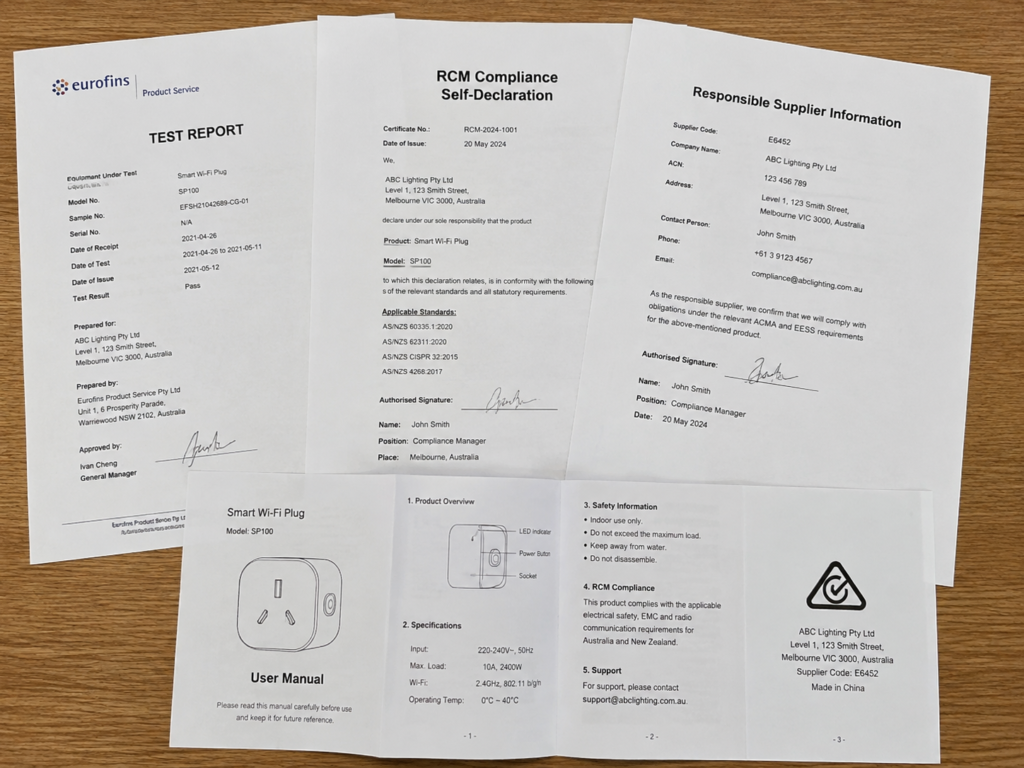
Many people think that compliance documents need to be submitted to the authorities for approval, but this is not the case—all compliance documents are retained by the responsible party themselves, and must be kept for at least 5 years (there may be slight differences in different states of Australia). Core documents include: test reports for products that require third-party testing, compliance self-declarations, local responsible party information, and product manuals. You do not need to actively submit them to the authorities on a regular basis, but if the regulatory department conducts a spot check, you must provide the full set of documents within the specified time, otherwise it will be directly judged as non-compliant.
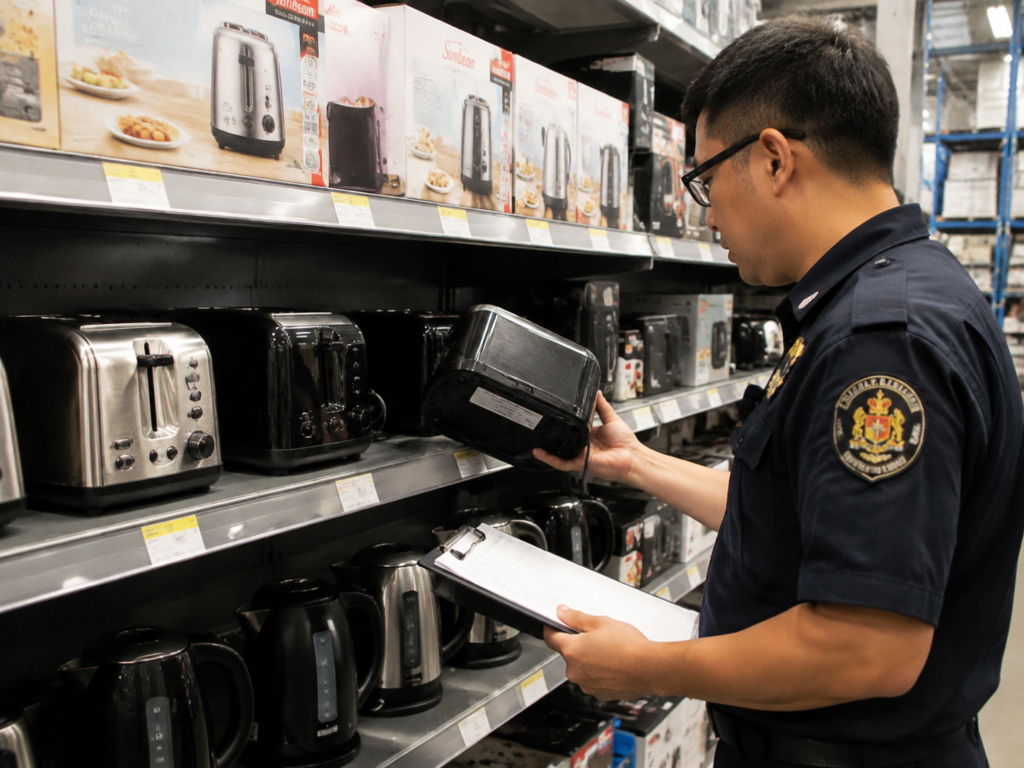
RCM adopts the regulatory logic of “post-market spot checks as the main method, no pre-issuance of certificates”: products do not need to apply for official certification certificates in advance, but before going on the market, applicable testing and verification, compliance self-declaration, local responsible party registration, EESS product registration (if applicable) must be completed, and a full set of compliance documents must be retained and the mark must be correctly affixed before entering the Australian and New Zealand markets. But this does not mean no one is in charge: Australian and New Zealand regulatory authorities will conduct random spot checks on the market, for example, placing orders from e-commerce platforms, buying goods from supermarkets, and taking them for testing; in addition, customs, e-commerce platforms, and large retailers may also require you to provide compliance certificates in advance before allowing you to enter the country or put products on shelves. If found to be non-compliant, the penalties are not light: in minor cases, fines and forced removal from shelves; in serious cases, all sold products must be recalled, and in severe cases, the legal liability of the responsible party will be pursued.
Can Existing CE/FCC Reports Be Used Directly for RCM?
Products with existing CE (EU) or FCC (US) test reports can be evaluated for reusability to reduce compliance costs. Before the comparison, let’s first unify three premises: first, we compare the core dimensions of applicable markets, coverage requirements, responsible entities, and report universality; second, the comparison is for finished electrical and wireless products sold to end users; third, the following are general situations, and specific products need to be evaluated separately, and cannot be generalized.
Let’s first take a quick look at the core differences between RCM, CE and FCC through a table:
| Comparison Dimension | RCM (Australia and New Zealand) | CE (EU/EEA) | FCC (US) |
|---|---|---|---|
| Applicable Market | Australia, New Zealand | EU and European Economic Area | United States |
| Coverage Requirements | Electrical safety + electromagnetic compatibility + radio spectrum (if applicable) | Electrical safety + electromagnetic compatibility + radio spectrum (if applicable) | Only electromagnetic compatibility + radio spectrum |
| Local Responsible Party Requirement | Must have a local responsible party in Australia or New Zealand | Can be self-declared by overseas manufacturers | Must have a local responsible party in the US |
| Report Universality | Need to supplement Australia-New Zealand exclusive difference tests + local responsible party registration | / | Wireless/EMC reports can be partially referenced; need to supplement electrical safety (if applicable) + Australia-New Zealand differences + local responsible party |
First, let’s look at the difference from CE: CE is the EU’s access mark, which, like RCM, covers electrical safety, electromagnetic compatibility and wireless requirements. Most of the standards of the two overlap, but Australia and New Zealand have some exclusive difference items, such as plug standards and voltage-related requirements, which are not included in CE reports. In addition, CE can be self-declared by overseas manufacturers, but RCM must have a local responsible party in Australia or New Zealand. Therefore, if you have a CE report, it can be used as a reference, but you must supplement the tests for Australia-New Zealand difference items, plus the registration of the local responsible party, and it cannot directly replace RCM.
Then look at the difference from FCC: FCC is the mark of the US Federal Communications Commission. It only manages electromagnetic compatibility and radio spectrum, not electrical safety—electrical safety in the US is a voluntary certification, such as UL and ETL, which the FCC is not responsible for. In addition, FCC requires a local responsible party in the US, which cannot be shared with the RCM’s local responsible party in Australia and New Zealand. Therefore, if you have an FCC report, the wireless and electromagnetic compatibility parts can be partially referenced, but you need to supplement the Australia-New Zealand difference tests. If the product belongs to the electrical safety category, you also need to make up the electrical safety test, plus the local responsible party registration, to meet the RCM requirements.
Of course, there are some situations where the reuse rate of existing reports will be higher, and not too many additional tests are needed:
If it is a purely wireless product with no electrical safety risk, then the CE or FCC wireless test report will have higher reference value, and fewer test items need to be supplemented.
If your product has been tested according to Australian and New Zealand standards before, the report can be reused directly without retesting.
If it is a very low-risk product, even third-party testing is not required; you only need to complete the registration of the local responsible party and make a self-declaration.
How to Handle RCM Compliance? Full Process from Evaluation to Listing
RCM compliance handling can be promoted according to the following steps:
Step 1: Product classification and risk determination. First confirm which types of compliance requirements your product involves—only electrical safety, or both electromagnetic compatibility and wireless requirements? Many products cover multiple categories at the same time. For example, a smart desk lamp with WiFi involves all three types of requirements. Then, against the classification standards of EESS and ACMA, confirm the risk level of the product, and also check first whether it is within the exemption scope to avoid doing useless work.
Step 2: Standard confirmation and test evaluation. First find the current Australian and New Zealand standards for the corresponding product category. If you can’t figure it out yourself, you can find a formal third-party agency to assist with confirmation. For low-risk products, usually you can directly make a self-declaration, no mandatory third-party testing is required, but proof of compliance with the standards must be retained; for medium and high-risk products, you can first evaluate how much of the existing CE and FCC reports you have can be reused, and determine the test items that need to be supplemented, which can save a lot of costs.
Step 3: Local responsible party registration. You need to find a qualified local responsible party in Australia or New Zealand, which can be a specialized agency or a local importer. After finding one, the responsible party will apply for an exclusive supplier code from ACMA. For electrical safety products, product registration must also be completed in the EESS database.
Step 4: Mark affixing and pre-listing inspection. Make a standard RCM mark according to official requirements, confirm that the affixing position complies with the regulations, then organize the full set of compliance documents and file them for retention as required. Finally, check whether the marks on the product, packaging, and manual, as well as the responsible party information, are consistent. Do not have a situation where the mark is correct but the responsible party information is wrong.
Step 5: Post-listing maintenance and change evaluation. Compliance documents must be kept for at least 5 years, ready to respond to regulatory spot checks at any time. In addition, if the product is revised, such as changing the shell, power supply, antenna, or replacing key chips, compliance must be re-evaluated. You cannot think that one completion is a once-and-for-all solution. If regulations or standards are updated, you must also confirm whether the products on sale still meet the new requirements.
Many people care about the cost and cycle of handling. In fact, there is no unified standard, and it all depends on the product situation:
In terms of cost, it is mainly determined by the risk level of the product, functional complexity, and whether additional testing is required. For low-risk products, you only need to pay the service fee and document fee of the local responsible party, and the cost is very low; for medium and high-risk products with complex functions, more supplementary tests are required, and the cost will be much higher. It should be noted that RCM does not have an official unified certification fee standard. Common expenses mainly come from local responsible party services, document organization, test evaluation, and possible registration/platform requirements. The specific amount depends on the product category and handling path.
In terms of cycle, low-risk products can generally be done in 1-2 weeks, and products that require testing take about 4-8 weeks. The specific time depends on the laboratory’s scheduling situation.
Don’t Affix the RCM Mark Randomly: You Will Be Fined for Getting These Specifications Wrong
Many people think that the mark can be affixed casually, but this is not the case. The use of RCM has clear specifications, and you will be fined if you affix it incorrectly. First, let’s talk about the style requirements of the mark:
First, the standard vector graphics released by ACMA and MBIE must be used. You cannot draw them by yourself, nor can you modify the shape and proportion at will. For example, stretching, flattening the mark, or changing the lines inside are all non-compliant.
Second, there is no mandatory general value for the size, but it must be clearly distinguishable to the naked eye. Very small products can be appropriately reduced, but not so small that they cannot be seen clearly.
Third, there is no mandatory requirement for color, as long as it forms a clear contrast with the background of the product or packaging. For example, a black mark on a white product and a white mark on a black product are both acceptable.
Fourth, the mark can be used with the Supplier Code. This marking is not mandatory, but it is recommended to add it to facilitate regulatory traceability.
The RCM graphic itself does not require mandatory labeling of certification or certificate numbers. Product traceability is achieved through model and responsible party information.
Then let’s talk about the affixing position of the mark, which is also particular:
For conventional products, the mark must be affixed to the product body, not only on the outer packaging or manual—for example, a hair dryer must have the mark on the body or handle, and printing it only on the packaging box is not acceptable.
If it is a very small product, such as the earbud body of true wireless Bluetooth headsets or smart bracelets, if the mark really cannot be affixed, it can be affixed to the minimum sales package, that is, the smallest packaging box that consumers receive.
Products with electronic display interfaces that comply with official electronic label application rules can display the RCM mark on the operation interface. They still need to meet the official requirements for the accessibility and clarity of electronic labels, and no physical mark needs to be affixed.
Here are some of the most common mark usage errors that you must avoid:
The first is drawing or modifying the mark style by yourself, without using the official standard vector graphics. In this case, even if the product itself is compliant, you will be fined if the mark is incorrect.
The second is only putting the RCM mark on the e-commerce product detail page, with no mark on the product body or minimum sales package at all. This is also non-compliant.
The third is affixing the RCM mark in advance before completing all compliance processes. This is a false declaration, and the penalty will be heavier if found out.
The fourth is affixing other certification marks together, but in fact, the corresponding compliance requirements have not been completed at all. For example, affixing the CE mark but not completing CE compliance will also cause problems.
Common RCM Misconceptions for Beginners to Avoid Pitfalls
The following are common RCM misconceptions for beginners, which can help avoid most false publicity and operational errors.
Cognitive Misconceptions: Basic Concepts That Are Most Easily Misunderstood
Misconception 1: Thinking that RCM is an “official certification certificate” → Truth: RCM is a compliance mark of self-declaration nature. There is no official certification certificate, and publicity of “official certificate issuance” is misleading.
Misconception 2: Thinking that RCM is a quality certification → Truth: RCM only verifies that products meet the three types of statutory minimum requirements of safety, electromagnetic compatibility, and radio spectrum. It does not involve quality indicators such as performance and durability. Having the mark does not represent good or bad quality.
Misconception 3: Thinking that RCM only applies to Australia → Truth: RCM is a mutually recognized mark between Australia and New Zealand. After compliance, you can enter both markets at the same time. Only New Zealand has a very small number of exclusive rules for electrical safety registration, and most products do not require additional operations.
Practical Misconceptions: Pitfalls Most Easily Encountered During Handling
Misconception 1: Having a test report means you can directly affix the RCM mark → Truth: A test report is only one of the compliance bases. It is only valid when the local responsible party in Australia and New Zealand is in place, corresponding registrations are completed, and a full set of compliance documents is prepared.
Misconception 2: Overseas factories or sellers can directly apply for RCM → Truth: RCM requires that registration and compliance declarations must be completed by a local responsible party in Australia or New Zealand, and overseas entities cannot apply directly.
Misconception 3: The RCM handling cost is the same for all products → Truth: The cost is affected by factors such as product risk level, functional complexity, and whether testing is required, and the difference is large.
Misconception 4: One RCM completion is valid for life → Truth: When products are revised, or regulations or standards are updated, compliance must be re-evaluated. There is no lifetime validity.
Quickly Identify False Compliance Services
Finally, we have sorted out several methods to quickly identify false compliance services to avoid pitfalls:
Any service that claims “certificate issued on the same day” or “ultra-low price all-inclusive” has a high probability of fraud risk. It may only provide false marks or invalid certificates, without completing the full compliance process, and problems will be exposed as soon as checked.
Any service that claims “no local responsible party is needed” can basically be judged as non-compliant publicity—the local responsible party is a mandatory requirement of RCM, and its absence is absolutely non-compliant.
When choosing an agency, be sure to ask the other party to provide a complete compliance evidence chain, such as local responsible party registration information, corresponding test reports, compliance declarations, etc. Pay only after confirmation, and it is not recommended to pay the full amount in advance.
Practical Tools: Judgment Methods You Can Use Directly After Reading
Finally, we have sorted out several practical methods that you can use directly after reading, whether you are a consumer or a seller.
Consumers: Judge Whether Products Purchased in Australia and New Zealand Are Compliant
If you are a consumer and want to judge whether a product purchased in Australia and New Zealand is compliant, follow these 3 steps:
Step 1: First check the product body or the minimum sales package to see if there is a standard RCM mark.
Step 2: If you can’t find it, or are not sure, you can ask the seller to provide a compliance self-declaration and local responsible party information. Regular sellers will provide them.
Step 3: If there is neither a mark nor any compliance documents that can be provided, it is most likely a non-compliant product. You should purchase cautiously or ask the merchant to supplement the compliance certificate. Otherwise, it may be difficult to trace responsibility when problems occur.
Small Sellers: Quickly Evaluate the Feasibility of RCM Handling
If you are a small seller who has just entered the Australian and New Zealand markets and want to quickly evaluate whether your product needs RCM and the approximate cost, you can follow this idea:
First, use the 3-step judgment method mentioned earlier to confirm whether the product is within the scope of RCM requirements.
Then, against the risk level, roughly estimate the cost and cycle—low-risk products have low cost and fast speed, and medium and high-risk products need to include testing fees.
When looking for an agency, prioritize formal institutions with local qualifications in Australia and New Zealand that can provide responsible party services. Don’t believe in publicity such as “guaranteed pass” or “buy a certificate”. In the end, you will be the one responsible if something goes wrong.
Basic Response Logic for Regulatory Spot Checks
If you really encounter a regulatory spot check, don’t panic. Remember these basic response logics:
Provide complete compliance documents as soon as possible, do not delay, let alone conceal.
Never forge test reports or responsible party information. Once discovered, the penalty will be much heavier.
If your product is indeed non-compliant, actively removing it from shelves and recalling sold products can greatly reduce the penalty.
After reading this article, you will master four core abilities: accurately identify that RCM is a mandatory compliance mark for electrical/wireless products in Australia and New Zealand, not an official certification certificate; quickly judge whether a product requires RCM, the corresponding risk level and approximate cost range; avoid common cognitive and practical misconceptions, and identify false compliance services; evaluate the reuse space of existing CE/FCC reports to reduce unnecessary compliance costs.