
This article is intended for consumer electronics practitioners. It systematically breaks down the enforcement logic and litigation risks of California Proposition 65 (referred to as Prop 65 or California 65) from basic concepts to practical risk-avoidance methods, helping you quickly distinguish it from conventional electronic compliance requirements such as RoHS, FCC, and CE, and master basic self-inspection and risk response methods.
I. Basic Introduction: Core Positioning and Applicable Scope of California Prop 65
1. Core Positioning: A Right-to-Know Act, Not a Product Quality Standard
The essence of California Prop 65 is a consumer right-to-know act, not a product quality or safety standard. It does not prohibit the presence of hazardous substances in products. It only requires that when a product contains carcinogenic or reproductive toxic substances listed by California, and the exposure level under normal use exceeds the safety threshold, a clear warning must be provided to California consumers. In other words, the presence of listed substances in a product does not mean it is “unqualified”. As long as the exposure level is below the safe harbor level, or a warning is affixed as required, it complies with the rules.
It cannot replace compliance requirements such as RoHS, FCC, and CE at all: RoHS focuses on restricting the total content of hazardous substances in electronic products; FCC regulates electromagnetic compatibility and communication safety; CE is the EU market access requirement; while California Prop 65 only targets the consumer right to know in the California market, examining the obligation to inform in exposure scenarios, and has no direct connection with the product’s own quality and safety standards.
2. Applicable Scope: Which Entities and Products Are Subject to Jurisdiction
From the perspective of applicable entities, California Prop 65 usually covers manufacturers, importers, brand owners, distributors, and e-commerce sellers with 10 or more employees. Small businesses with fewer than 10 employees may be eligible for exemption themselves, but if brand owners, importers, or distributors in the supply chain meet the entity requirements, relevant liabilities may still be traced back to the corresponding links. You cannot completely ignore compliance just because you are a small business.
The triggering of jurisdiction has nothing to do with the place of business registration of the enterprise. It applies as long as the product is foreseeably likely to enter the California market — including cross-border direct mail to California addresses, resale by third-party distributors to California, shipping from FBA warehouses in California, and even cases where the store does not restrict orders from California addresses, all of which may be deemed as foreseeable entry into the market.
This article focuses on the scenario of consumer electronic products. Industrial or medical-specific electronics, if sold only to professional customers and without foreseeable exposure paths for ordinary California consumers, are usually not judged by consumer product rules. However, jurisdiction cannot be directly excluded solely based on category names such as “industrial grade” or “medical grade”; the core still depends on whether they will be accessed by ordinary consumers.
3. Plain-Language Explanations of Must-Know Core Terms
When you first come into contact with California Prop 65, you will encounter many professional terms. Here are clear explanations in plain language first:
- OEHHA (California Office of Environmental Health Hazard Assessment): The rulemaker, responsible for maintaining the list of listed substances and safety thresholds. It does not directly participate in enforcement, nor will it proactively send violation notices to enterprises.
- List of Listed Substances: A list updated annually by OEHHA, which includes all substances confirmed to be carcinogenic or reproductively toxic. Currently, nearly 1,000 substances are on the list.
- Safe Harbor Level: It can be understood as the “safety line”. As long as the exposure level of hazardous substances in the product is below this threshold, no warning is required. The safety line for carcinogenic substances is called NSRL (No Significant Risk Level), and the one for reproductive toxic substances is called MADL (Maximum Allowable Dose Level). For enterprises, you only need to remember that “no warning is required if it is below the corresponding safe harbor level”.
- Private Attorney General: A special role authorized by California law, which can be held by individuals, environmental organizations, or professional institutions. They have the right to file lawsuits against entities that violate California Prop 65 on behalf of the government. After winning the lawsuit or reaching a settlement, they can obtain part of the fines and attorney’s fee compensation.
- 60-Day Advance Notice: A mandatory pre-litigation procedure that must be completed before filing a lawsuit. The plaintiff cannot directly sue the enterprise, but must first send a notice to the enterprise and government departments, leaving a 60-day period for negotiation and verification.
4. Why Electronic Products Are a High-Enforcement Category
Electronic products have become a category with high enforcement frequency of California Prop 65, which is mainly related to four industry characteristics:
First, complex material composition. Electronic products involve various components such as plastic housings, solder, batteries, surface coatings, and cables. Many commonly used materials may contain listed substances, making investigation difficult.
Second, diverse contact scenarios. Consumer electronics often have multiple usage scenarios such as hand-held use, wearing, and children’s play. Exposure paths such as skin contact and oral contact are clear, making it easier to meet the enforcement premise of “foreseeable exposure”.
Third, long supply chain hierarchy. The supply chain of the electronics industry usually involves multiple links such as raw material factories, processing factories, brand owners, and distributors. Material responsibility, test reports, and warning obligations are prone to gaps in the circulation process, leaving room for the plaintiff to pursue liability.
Fourth, high proportion of online sales. Consumer electronics have a high proportion of online sales, while warning content on e-commerce pages, product packaging, and the product itself is prone to inconsistency or even absence. Plaintiffs can easily find evidence from public e-commerce pages.
II. Sources of Enforcement: Who Initiates Lawsuits and How Enterprises Are Targeted
1. Division of Labor and Proportion of Three Types of Enforcement Entities
In the enforcement system of California Prop 65, the powers and responsibilities of the three core roles are very different:
- California Attorney General / District Attorney: Only handle cases involving major public interests, such as large-scale violations by big brands and serious issues involving children’s health, accounting for less than 10% of all cases.
- Private Plaintiffs: Including environmental organizations, professional litigation institutions, and individuals, accounting for more than 90% of all enforcement cases. Such entities can obtain part of the fines and attorney’s fee compensation after winning a lawsuit or reaching a settlement, and are the most important enforcement promoters in practice.
- OEHHA: Only responsible for updating rules, the listed substances list, and safe harbor thresholds, and does not participate in enforcement or initiate lawsuits at all.
2. Four Common Paths of Being Enforced (Ranked from Highest to Lowest Probability)
The vast majority of electronic sellers are sued not because of government random inspections, but because of the following situations:
- Third-party anonymous purchase and sampling inspection: This is the most common triggering method, especially for hot-selling e-commerce and high-contact electronic products. The plaintiff will purchase products on platforms such as Amazon and independent websites, and if the exposure level is found to exceed the standard after testing, subsequent procedures will be initiated.
- Batch investigation after OEHHA adds new listed substances: Whenever OEHHA adds new substances to the listed list, the plaintiff will conduct batch investigations on all categories that may contain the substance based on material clues — for example, when new substances related to plastics, flame retardants, and battery materials are added, a large number of electronic products with plastic housings and batteries may be included in the investigation scope.
- Reports from consumers or peers: This situation is relatively rare, and generally targets products with no warnings at all and high risks.
- California border or market random inspections: The proportion is extremely low, basically only targeting batch violations of well-known brands, and small and medium-sized sellers rarely encounter them.
3. High-Risk Electronic Product Categories Subject to Lawsuits
The lawsuit risks of different electronic products vary significantly, and the plaintiffs mainly focus on the following categories:
- High-contact accessories: Charging cables, earphones, phone cases, keyboards, game controllers, etc. Users have repeated daily contact with them, the exposure path is clear, and tests are prone to positive results. This is the category with the highest incidence of lawsuits.
- Wearable devices: Smart watches, wristbands, head-mounted devices, etc. They are in contact with the skin for a long time, the risk of migration exposure is higher, and the plaintiff’s probability of winning the lawsuit is relatively greater.
- Children’s electronics: Children’s watches, early education machines, electronic toys, etc. Due to scenarios such as children’s accidental biting, hand-to-mouth contact, and long-term wearing, exposure assessment is stricter, and sensitivity is higher in enforcement and settlement negotiations. They are the key focus of plaintiffs.
- Hot-selling products of cross-border small and medium-sized brands: They do not have a dedicated compliance team, and their sales volume is sufficient to cover litigation costs, making them more likely to be included in the batch investigation scope by plaintiffs.
III. Full Enforcement Process: Complete Links from 60-Day Notice to Case Closure
The enforcement of California Prop 65 has clear statutory procedures, and each link from evidence collection to case closure has statutory time windows and operational requirements.
1. Step 1: Pre-litigation Evidence Collection by the Plaintiff (Rules Specific to Electronic Products)
Before sending the notice, the plaintiff needs to complete legal evidence collection first, and there are special testing rules for electronic products:
In practice, the plaintiff usually purchases the involved products anonymously from formal sales channels. Unclear sample sources will greatly weaken the credibility of the evidence.
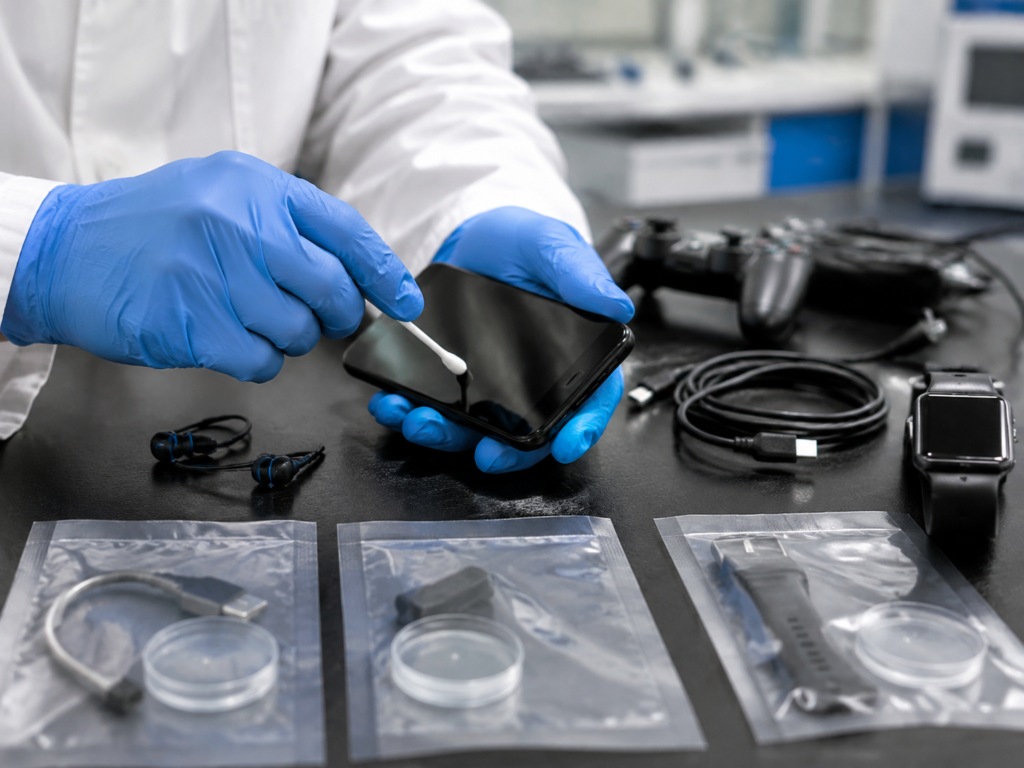
The core of the test is the migration level of accessible components under normal use, not the total content of the substance — simply put, it measures “how much hazardous substances will migrate out of the product’s contact surface during normal use”, such as whether it will rub off on hands when touched, or dissolve into the mouth when bitten. Even if the total content of substances inside the product is very high, as long as they are sealed inside and cannot be touched, or will not migrate out even if contacted, it is not a violation. This is also the core reason why RoHS total content reports cannot be directly used for California Prop 65 defense: the two examine completely different indicators.
The plaintiff usually entrusts a third-party laboratory recognized by California or acceptable in California Prop 65 litigation/settlement to issue a report; before the enterprise conducts self-retesting, it should confirm that the laboratory qualification, testing method, sample chain record, and report format can be used in California Prop 65 cases to ensure the admissibility of evidence.
2. Step 2: Sending the 60-Day Advance Notice (Mandatory Statutory Procedure)
After the evidence collection is completed, the plaintiff cannot directly file a lawsuit, but must first send a 60-day advance notice. This is a mandatory statutory procedure, and lawsuits lacking this procedure will not be accepted by the court.
A formal advance notice must include the following core information: the model/batch of the involved product, the name and migration level of the detected substance, the corresponding safe harbor value, and the specific exposure path (such as skin contact, oral contact).
The notice needs to be served to three parties simultaneously: the involved enterprise, the California Attorney General’s Office, and OEHHA, which is equivalent to completing government filing.
This 60-day window period is very critical: the government will first decide whether to take over the case (usually only major public interest cases will be taken over), and the enterprise can use this period to prove its compliance, negotiate a settlement with the plaintiff, or prepare litigation response materials.
3. Step 3: Case Diversion After the 60-Day Window Expires
After the 60-day window period ends, the case will go in three directions:
- Taken over by the Attorney General: Only for cases involving major public interests, with an extremely low proportion, and small and medium-sized sellers basically will not encounter this.
- Formal lawsuit by private plaintiff: If the government does not take over the case and the two parties do not reach a settlement within the window period, the plaintiff will formally file a lawsuit with the court.
- Settlement reached by both parties: This is the most common situation, accounting for the vast majority of all cases. Many cases even have settlement terms negotiated within the 60-day window period, and will not proceed to the formal lawsuit step.
4. Step 4: Enforcement Requirements After Case Closure
California Prop 65 cases rarely go to trial and judgment, and more than 90% end in settlement. There are three common forms of case closure: first, a settlement agreement signed by both parties; second, a consent order issued by the court, which is enforceable, and non-compliance will be punished as contempt of court; third, a trial judgment, with an extremely low proportion, because both parties have high litigation costs and low cost-effectiveness.
Regardless of the form of case closure, the core rectification requirements generally include three categories: affixing compliant warnings, adjusting material formulas to reduce exposure levels, and removing violating products from shelves.
Regarding cost allocation, roughly 75% of the settlement amount or fine will go to the California Toxic Substances Control Fund for public environmental protection and health projects, and the remaining 25% or so will go to the plaintiff. The specific proportion will vary with the case situation, and the plaintiff’s attorney’s fees are usually borne separately by the defendant.
The fine standard shall be subject to the current rules at the time of the violation. In 2024, the statutory maximum is $2,750 per violation per day, and this figure will be adjusted annually with inflation; the actual amount is usually not mechanically calculated based on the maximum, but will fluctuate in combination with the duration of the violation, sales volume, subjective fault, rectification attitude, and settlement negotiation situation.
IV. Risk Breakdown: Costs and Common Pitfalls of Electronic Product Litigation
1. Direct Economic Risks
For enterprises of different sizes, the gap in settlement amounts or fines is very large: the common settlement range for cross-border small and medium-sized sellers is between $5,000 and $50,000, depending on factors such as product sales volume, type of violation, and whether it involves children’s usage scenarios; for cases of high-volume brands, the total cost of settlement and rectification can often reach hundreds of thousands to millions of dollars.
In addition to settlement amounts or fines, there are many hard costs: attorney’s fees, retesting fees, product rectification fees, inventory destruction or rework fees. The sum of these costs is sometimes no less than the settlement amount.
Two common issues need to be noted: First, most ordinary product liability insurance does not cover the litigation costs of California Prop 65. When purchasing insurance, be sure to check the terms separately, and do not assume that claims can be made by default; second, even if the enterprise wins the lawsuit, it may not be able to make the plaintiff bear the attorney’s fees — only when the court determines that the plaintiff’s lawsuit is malicious will the plaintiff be ordered to bear the attorney’s fees. Otherwise, even if you win the lawsuit, you still have to bear your own attorney’s fees.
2. Implicit Long-Term Risks
In addition to direct economic expenses, there are some long-term impacts that are easily overlooked:
- E-commerce platform penalties: If platforms such as Amazon receive a litigation notice, they may directly remove the California station link of the involved product, and even restrict traffic to the entire store or ban the account, affecting more than just a single product.
- Risk of serial litigation: The settlement agreement is only valid for the plaintiff who initiated the lawsuit, and other private plaintiffs may still file separate lawsuits for the same violation.
- Impact on brand reputation: Court judgments, consent orders, and some filed settlement information may be publicly available. If consumers or partners find relevant records, it will affect brand trust. Sellers who do their own brands need to pay special attention to this.
3. Unique High-Risk Points of Electronic Products
Violations of electronic products are basically concentrated in several common substances and easily overlooked components, which can be quickly matched through the following table:
| Common Listed Substances | Common Components in Electronic Products |
|---|---|
| Lead | Solder, metal contacts, surface coatings |
| Phthalates | PVC cables, soft plastic housings, keyboard rubber pads |
| Cadmium | Rechargeable batteries, metal plating, pigments |
| Flame retardants | Circuit boards, cable sheaths, plastic housings |
Many sellers easily overlook some inconspicuous accessible components: such as the metal mesh of earphones, the metal pieces of charging ports, the surface coating of keys, and even the contact parts of the inner tray of product packaging. These are all parts covered during testing. Don’t think that only large housings count as accessible components.
If the product is sold to children, or there are foreseeable scenarios of children’s accidental biting, hand-to-mouth contact, and long-term wearing, due to the more sensitive assumptions about children’s weight and exposure, the safe harbor judgment threshold is lower, and higher fine weights are often given in enforcement or settlement. The overall risk is significantly higher than that of ordinary consumer electronics.
4. Most Common Cognitive Misconceptions
We have sorted out several types of cognitive misconceptions that practitioners are most likely to fall into. Avoiding them in advance can effectively reduce unnecessary compliance costs:
- “We only sell to other U.S. states and don’t ship to California, so there’s no risk”: Wrong. As long as the product is foreseeably likely to enter California (such as not restricting orders from California addresses, third-party distribution to California, FBA warehouses located in California), it is under jurisdiction, regardless of which state is the main sales market.
- “If the total content of hazardous substances meets the standard, it is compliant”: Wrong. California Prop 65 examines the migration level of accessible components. If the total content is high but cannot migrate, there is no problem; if the total content is low but the migration level exceeds the standard, it is also a violation. RoHS total content reports cannot be directly used for defense.
- “Affixing a warning label means absolute exemption from liability”: Wrong. If the format, position, and content of the warning do not meet the requirements, it is equivalent to not affixing it. For example, if the text is too small, it is only placed in the manual, or specific substances are not listed, consumers cannot see it before purchase, and you will still be sued.
- “Overseas registered enterprises will not be sued”: Wrong. Jurisdiction follows the product. As long as the product enters the California market, liability may be pursued. Cross-border sellers will also be sued, and platforms will cooperate in implementing operations such as removing products from shelves and freezing funds.
- “If the supplier says it is environmentally friendly, there is no problem”: Wrong. Oral statements from suppliers have no legal effect. If you cannot produce test reports or written liability statements when sued, you cannot defend yourself, and you still have to bear the responsibility yourself.
V. Semi-Proficient Skills: Quick Judgment Method for Litigation Risks
After understanding the basic rules and risks, you can use the following steps to quickly judge the litigation risk of your own products.
1. Step 1: Determine Whether the Product Is Within the Jurisdiction Scope
Judging jurisdiction requires considering both product attributes and responsible entities:
On the product side, three conditions must be met: First, the product may enter California, including cross-border direct mail, shipping from FBA California warehouses, third-party distribution, and stores not restricting orders from California addresses; second, it belongs to the category of consumer electronic products. Industrial or medical-specific electronics, if sold only to professional customers and without foreseeable exposure paths for ordinary consumers, are usually not judged by consumer product rules, but cannot be directly excluded solely based on category names; third, there are accessible components during normal use. Components that are completely sealed inside and cannot be touched by users during normal use are not within the scope of investigation.
On the entity side, it is necessary to confirm: whether the responsible entity is a manufacturer, importer, brand owner, distributor, or e-commerce seller with 10 or more employees; if you are a small business with fewer than 10 employees, although you may be eligible for self-exemption, eligible entities upstream and downstream of the supply chain may still be held liable, so you cannot directly determine that there is no risk.
2. Step 2: Determine the Probability of Violation
If it is confirmed that it is within the jurisdiction scope, further judge the probability of violation:
- First check the latest listed list of OEHHA to confirm whether the product materials contain the corresponding listed substances;
- Obtain the migration test report of accessible components and compare it with the corresponding safe harbor value; usually, no warning is required only when the exposure level under the listed substance, the accessible component, and the exposure path is below the safe harbor level;
- If there is no test report for the time being, you can refer to the risk level of the same category: high-contact soft plastic components and metal-plated components have higher risks, and fully sealed internal components have very low risks;
- It should also be judged in combination with the usage method: products that are hand-held, worn, used by children, heated during use, or prone to wear have higher exposure risks — for example, game controllers that are often held in the hand will have higher migration levels after wear than new products.
It should be noted that each SKU, batch, and material change must be reviewed one by one, and all listed substances and all accessible components must be confirmed to meet the requirements before overall compliance can be determined.
3. Step 3: Determine Whether the Received 60-Day Notice Is a Fraud
Nowadays, many scammers impersonate plaintiffs to send 60-day notices to defraud money. You can quickly identify them by checking four core points:
First, check if there is a filing number from the California Attorney General. You can directly use the number, plaintiff’s name, and product information to verify the filing record in the California Attorney General’s public database;
Second, check if the test report is complete, including the test method, sample source, and specific migration value. It cannot only have a vague “exceeds the standard” conclusion;
Third, check if the laboratory issuing the report is a third-party institution recognized by California or acceptable in California Prop 65 litigation/settlement. Enterprises can require the other party to provide laboratory qualification certificates and testing method basis; otherwise, the test results have no evidentiary effect;
Fourth, check if there is a request for private transfer to a personal account — the settlement amount of formal litigation will go through a public account and require the signing of a formal agreement, and will never require transfer to a personal account.
If you have doubts about the authenticity of the notice, you can consult a California compliance lawyer or a professional testing institution for confirmation when necessary.
4. Step 4: Quickly Determine Whether the Warning Is Compliant
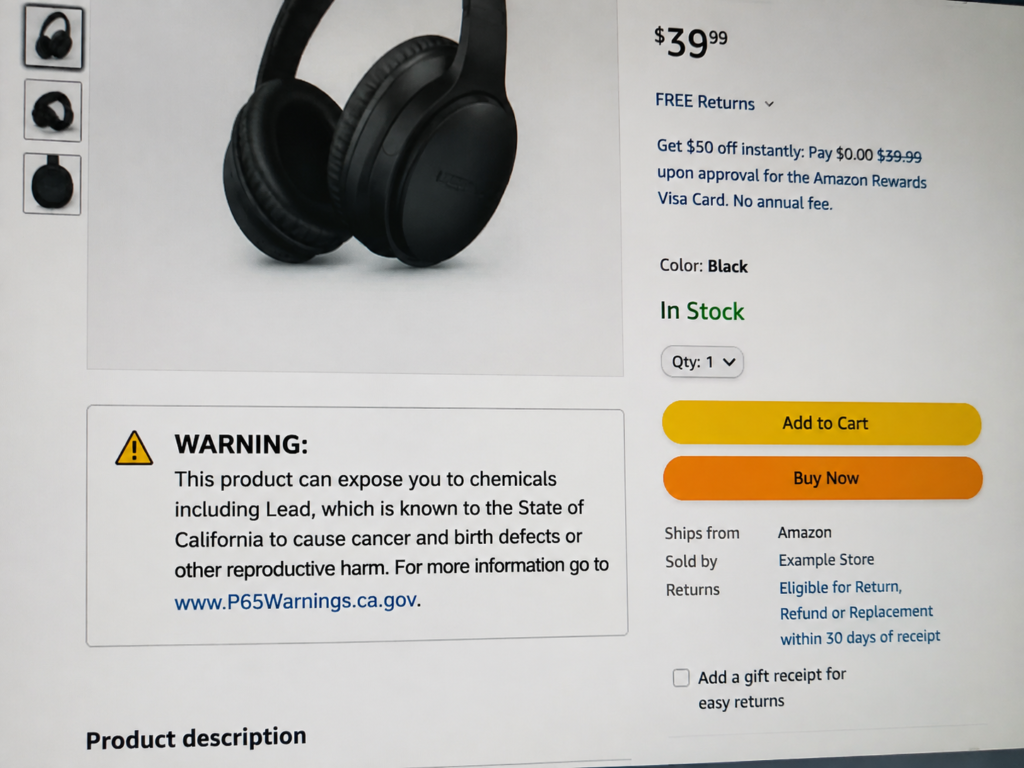
Many sellers’ warnings are useless even if they are affixed. As long as they meet these basic requirements, they are considered qualified safe harbor warnings:
- Format requirements: Warnings should usually include a warning symbol and the capitalized word “WARNING”; the triangular warning symbol on color labels should be yellow, and the warning symbol cannot be omitted on black and white labels; at the same time, at least one listed substance related to the product should be listed, and it should be clearly stated whether it is a carcinogenic risk or reproductive toxicity risk. Vague expressions such as “this product contains hazardous substances” cannot be used alone.
- Position requirements: For online sales, the warning must be visible to consumers before they complete the purchase, and should usually be placed in a prominent position on the e-commerce product detail page or in the purchase process; for offline sales, it must also be marked on the packaging, product label, or the product itself; it must never be placed only in the after-sales manual.
- Language requirements: If non-English languages (such as Spanish, Chinese) are used in product labels and advertisements, the warning must also use the corresponding language simultaneously.
5. Applicable Conditions of Common Defense Ideas
If you are really sued, you don’t have to just accept the loss. As long as there is sufficient evidence for these defense ideas, you can have a high probability of winning the lawsuit or reducing the settlement amount:
- Claiming that the exposure level is below the safe harbor level: A migration test report issued by a third-party laboratory that meets California litigation requirements must be provided. Oral claims are invalid.
- Claiming that the substance is sealed inside and inaccessible during normal use: Evidence such as product structure design drawings and disassembly certificates must be provided to prove that users cannot touch the corresponding substance at all during normal use.
- Claiming that a compliant warning has been provided: Evidence of warning retention across all channels must be provided, such as screenshots of e-commerce pages, photos of packaging, and actual photos of the product, to prove that consumers can see the compliant warning before purchase.
- Claiming that upstream suppliers or other sellers have already assumed the warning obligation: A written liability division agreement must be provided to prove that the other party is responsible for the warning obligation as agreed. Oral agreements are invalid.
VI. Practical Entry-Level Actions: List of Pitfall-Avoidance Actions for Electronic Products
1. Three Basic Compliance Actions Before Product Launch
Before the product is launched, complete these three basic compliance actions first:
- Implement testing at the supply chain end: Require suppliers to provide migration test reports for accessible components. At the same time, stipulate in the procurement contract that suppliers must notify in advance if they change materials, to avoid violations caused by secret material changes.
- Standardize the setting of warnings: If the test confirms that the exposure level exceeds the safe harbor, make warnings strictly in accordance with OEHHA’s safe harbor format, and simultaneously cover all channels that consumers may access, such as products, packaging, e-commerce product detail pages, and manuals; but do not affix warnings randomly for “insurance” — unfounded excessive warnings will instead affect consumer trust and do not meet the requirements of the rules.
- Standardize evidence retention: All test reports and compliance records must correspond to specific SKUs, batches, and sales times, and be stored in categories. If you are really sued, you can quickly take them out for proof, which is much more effective than looking for evidence temporarily.
2. Correct Response Steps After Receiving a 60-Day Notice
If you really receive a 60-day advance notice, follow these four steps to avoid chaos:
- First verify the authenticity: Within 24 hours of receiving the notice, check the authenticity against the fraud identification points mentioned above. Do not directly contact the plaintiff, nor admit the violation at the beginning, otherwise you will be in a very passive position.
- Arrange retesting as soon as possible: Send products of the same batch to a third-party laboratory recognized by California or acceptable in California Prop 65 litigation/settlement to retest the migration level of accessible components — the plaintiff’s test may have errors, and the retest result is the core basis for response.
- Collect all relevant materials: Including sales records of the involved products, existing warning evidence, supply chain compliance materials, test reports, etc., organize them for subsequent negotiations or litigation response.
- Choose an appropriate response method: Combined with the retest results and defense conditions, choose to prove compliance, negotiate a settlement, or respond to the lawsuit. If the case involves a high amount, children’s products, multiple SKUs, high sales volume, platform freezing, or cross-state sales chains, it is recommended to consult a California-licensed compliance lawyer as soon as possible, and do not negotiate blindly on your own.
3. Three Things You Must Never Do
During the response process, you must never do these three things, otherwise the risk will increase exponentially:
- Don’t just ignore the notice: If you ignore it, the plaintiff will directly file a lawsuit. If the enterprise does not appear in court, a default judgment will be made, the fine amount will be much higher than the settlement, and it may also be enforced by the platform.
- Don’t transfer money privately without signing a formal settlement agreement: Even if the other party says “transfer the money and we will withdraw the lawsuit”, you must sign a formal settlement agreement, preferably filed with the court. Otherwise, after paying the money this time, other plaintiffs can still sue for the same problem next time, which means you spend money for nothing.
- Don’t affix generic warnings casually: Just find a “WARNING” picture and paste it, without listing specific substances, wrong position, wrong format, it is equivalent to no compliance, and you will still be sued, which is a waste of effort.
4. Optional Directions for Long-Term Risk Reduction
If you are a seller building a long-term brand, you can gradually promote these things to reduce risks from the root:
- Gradually replace high-risk materials for high-volume SKUs, such as using lead-free solder, non-PVC cables, and halogen-free flame retardants, to solve the exposure problem at the material level.
- Establish a regular review mechanism for high-risk categories (such as wearables, children’s electronics), do not only test the first batch of samples, to avoid violations caused by mid-stream material changes in the supply chain.
- Clarify the liability division of California Prop 65 with upstream suppliers and write it into the procurement contract. For example, if the violation is caused by the supplier’s materials, the supplier shall bear the litigation and rectification costs, so as to front-load the risk.
Core Summary
After reading this article, you should be able to do the following things: distinguish the core differences between California Prop 65 and electronic compliance requirements such as RoHS, FCC, and CE; quickly judge whether your electronic products are within the jurisdiction scope of California Prop 65 and whether the probability of violation is high; identify fraudulent 60-day notices; know what to do first after receiving a formal notice; avoid common cognitive misconceptions; and independently complete basic compliance self-inspection before product launch.
Finally, it should be reminded that California Prop 65 has many detailed rules, and they will be dynamically adjusted with the update of OEHHA’s list. This article is popular science content for entry-level practitioners and does not constitute legal advice. If you encounter high-value litigation or major compliance decisions, be sure to consult a California-licensed compliance lawyer.