
If you live in Japan, you have most likely heard the saying that “you have to pay to throw away large home appliances”. Japan has special mandatory recycling rules for specified categories of large home appliances, which cannot be discarded at will like ordinary garbage. Serious illegal dumping may even face legal penalties. The core law behind this is the , commonly known as the “Home Appliance Recycling Law”. This article will help you quickly understand this set of rules from the scope of application, practical operation process, fee judgment, to key points for avoiding pitfalls.
1. Basic Understanding: What is Japan’s Home Appliance Recycling Law
You may have seen signs for (Home Appliance Recycling Law) in electronics stores. Its official name is the , a mandatory recycling system established by Japan for several types of large home appliances. It clearly stipulates that these home appliances cannot be discarded casually as ordinary household waste or even bulky waste, and must go through a special recycling process.
The core logic of this set of rules, in plain terms, is: manufacturers shall bear the main responsibility for the recycling and treatment of their products after they are scrapped. The corresponding professional concept is Extended Producer Responsibility (EPR for short). However, the responsibility is not entirely borne by manufacturers: sellers shall bear the obligation to accept recycling in specific scenarios, and consumers shall also follow formal channels and pay corresponding fees in accordance with regulations, with all three parties assuming their respective responsibilities.
This law was introduced with a clear historical background: in the 1990s, the number of scrapped home appliances in Japan surged, landfill capacity was tight, illegal dumping was frequent, and harmful substances such as refrigerants and phosphors in home appliances would pollute soil and water sources. Therefore, Japan officially enacted the law in 1998 and fully implemented it in 2001. From the perspective of environmental protection positioning, it manages the resource recycling and hazardous substance treatment of home appliances “after disposal”, and together with the energy efficiency policy that manages power consumption “during use”, it forms Japan’s environmental protection management system for home appliances.
Here we first correct a most common beginner misconception: not all home appliances of Japanese brands are subject to this law. Only household specified-category home appliances that are discarded within Japan and meet the statutory items need to comply with its provisions — for example, if you throw away a Panasonic TV in China, you only need to comply with local Chinese waste disposal rules, which has nothing to do with Japan’s Home Appliance Recycling Law.
2. Scope of Application: Quickly Determine Whether It Is Subject to Regulation
To judge whether an old home appliance needs to be disposed of in accordance with the Home Appliance Recycling Law, the core is to look at three conditions, starting with the 4 categories of household large home appliances covered by the law.
4 Categories of Statutorily Covered Household Large Home Appliances
The law clearly specifies four categories of large home appliances that must be mandatorily recycled, each with a clear scope:
1. Household air conditioners
Including wall-mounted, floor-standing, household central air conditioners (including outdoor units), excluding large commercial units used in supermarkets, offices and other places. As long as the air conditioner is designed for daily household use, it falls within the scope of application regardless of installation method.
2. Household televisions
Whether they are statutory objects is determined by product category and the items in the manufacturer/recycling voucher fee schedule; not all devices with display screens are within the scope of regulation. Screen size usually affects the tier of the re-commercialization fee, and is not a criterion for determining whether the law applies; special models such as portable, in-vehicle, and bathroom-specific ones need to be confirmed in combination with the manufacturer’s item classification. If you are unsure, you can consult the manufacturer or your local municipality (city/town/village).
3. Household refrigerators/freezers
Including freestanding household refrigeration, freezing, or combined refrigeration-freezing equipment, excluding commercial built-in refrigerators and commercial ice makers. All upright/chest freezers for independent household use count, and there is no direct relationship with capacity size.
4. Household washing machines/dryers
Including household washing machines, dryers, washer-dryer combos, excluding large industrial laundry equipment for commercial laundries. Small mini washing machines for household use also fall within the scope of application.
Common Categories and Scenarios That Are Clearly Not Applicable
There are several common items that are easily confused, but actually do not fall under the jurisdiction of the Home Appliance Recycling Law:
• Small home appliances: small electronic appliances such as rice cookers, microwave ovens, hair dryers, vacuum cleaners, etc., are managed under the small home appliance recycling system, but the actual recyclable items, disposal methods, and fee standards vary by local municipality, so please refer to the local official list.
• Computers and monitors: household desktop computers, laptop computers, and monitors are managed under the personal computer recycling system established based on the . The specific rules need to be determined based on whether the product has a PC recycling mark and whether the original manufacturer still exists; monitors usually apply to corresponding standards separately.
• Commercial/business-use home appliances: commercial equipment such as supermarket freezers and company central air conditioners are subject to relevant rules for industrial waste.
• Home appliances discarded outside Japan: Japanese-made home appliances discarded outside Japan are not subject to this law, just comply with local regulations.
Special Boundaries and 3-Step Quick Judgment Method
There are some special situations that are easy to be unsure about, such as home appliances brought into Japan from overseas, built-in embedded home appliances, ultra-large special models, second-hand or old home appliances. The core logic of judgment is that the Home Appliance Recycling Law applies only if three conditions are met at the same time. Here, “household use” is determined based on product specifications, design purpose, and statutory item classification, not based on the identity of the owner: if the equipment is designed for commercial use, even if it is used at home, it is not a statutory object; conversely, for household models even if temporarily used for small office work, for borderline cases it is recommended to confirm with the manufacturer or municipality first.
You can use 3 steps to make a quick judgment:
Step 1: Check whether it belongs to the statutory 4 categories of large home appliance items;
Step 2: Confirm that the product is a household device, not a commercial/business-use device;
Step 3: Confirm that the disposal act takes place within Japan.
If all three conditions are met, you need to follow the formal recycling process stipulated by the Home Appliance Recycling Law.
3. Division of Responsibilities of All Parties: Who to Contact for Recycling and What Each Party Does
Many people panic when disposing of old home appliances for the first time, not knowing who to contact. In fact, the Home Appliance Recycling Law clearly stipulates the responsibilities of all parties, and you can find the corresponding entity according to your identity.
Responsibilities of Ordinary Consumers
As an ordinary consumer, you first need to be clear: you must not discard specified home appliances at will, and must deliver them for recycling through formal channels, which is a statutory requirement.
In terms of fees, you usually need to pay two parts of the cost: first, the statutory re-commercialization fee, which covers the statutory costs of disassembly, hazardous substance treatment, and resource recovery; second, the collection and transportation fee, which covers service costs such as door-to-door pickup, transportation, and manual handling, and is priced by the entity providing the service.
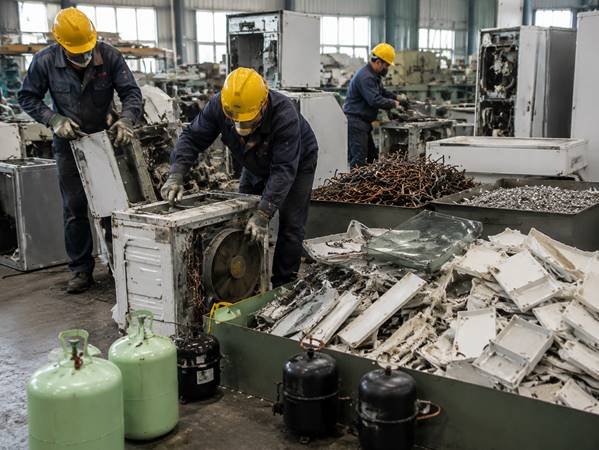
In addition, we strongly recommend that you keep recycling vouchers after delivering the home appliances (such as the consumer stub of the home appliance recycling voucher, called in Japanese, formal recycling acceptance certificate, etc.). The number on these vouchers can be used to check the recycling progress, and is also the core evidence that you have delivered them legally. It is recommended to keep them until you can confirm that the recycling is completed and there are no related disputes, and it is best to take photos to back up electronic copies at the same time.
Statutory Obligations of Home Appliance Sellers
The statutory obligations of home appliance sellers are divided into two scenarios:
The first is “buy new, collect old”: when a consumer buys a new home appliance of the same category and requests the seller to recycle the old one, the seller shall not refuse, provided that the statutory acceptance conditions are met (e.g., the old appliance is a specified household category, the delivery location is within the service area, etc.);
The second is “original store recycling”: when a consumer requests the original store where they purchased the appliance to handle the old specified category home appliance sold by the store, the seller must also accept it in accordance with regulations.
In addition, sellers must clearly publicize the recycling fee standard and handling process, collect the statutory re-commercialization fee on behalf of the relevant parties, and all collected old home appliances must be handed over to the statutory designated collection sites (old appliance receiving and transfer nodes established by manufacturers, etc.), and must not disassemble, discard, or resell them to unqualified parties without permission.
Statutory Obligations of Manufacturers/Importers
Manufacturers and importers shall bear the re-commercialization obligation in accordance with the law. In practice, most brands handle it through two major joint recycling systems (commonly known as Group A and Group B in the industry), and may also adopt other compliance methods that meet legal requirements. This is the division of labor within the industry, and ordinary consumers do not need to choose by themselves; formal recycling channels will automatically correspond to the corresponding processing system according to the brand.
Manufacturers’ statutory obligations include: being responsible for the disassembly, hazardous substance treatment, and resource reuse of recycled home appliances, meeting the statutory minimum re-commercialization rate; disclosing the re-commercialization fee standards for home appliances of each category and specification, as well as the annual actual re-utilization rate.
Here we also correct a common misconception: many people think “when I buy a new home appliance, the merchant collects the old one for free”. In fact, the statutory recycling fee should originally be borne by the consumer. The “free old appliance collection” mentioned by merchants is just their promotional benefit, not a statutory obligation.
4. Practical Process: Formal Recycling Steps in Different Scenarios
When actually disposing of old home appliances, there are three common formal channels depending on your situation, and the first one is the most hassle-free to prioritize.
Scenario 1: Buy new, collect old (most hassle-free, prioritize)
If you were already planning to buy a new home appliance of the same category, just apply for old appliance recycling from the store when purchasing, which is the most trouble-free way.
You only need to clearly inform the store staff of the category, brand, and size of the old appliance in advance, check the fee details, and after paying the fee, the seller will complete the home appliance recycling voucher procedures in accordance with regulations. You only need to keep the consumer stub, you don’t need to stick the voucher yourself, and the delivery staff will handle the old appliance marking in accordance with specifications. When the new home appliance is delivered to your door, the delivery staff will take away the old one at the same time. Remember to confirm that the voucher information is correct before keeping it. The handling fee for this method is usually combined with the new appliance delivery fee, and is often cheaper than finding recycling separately.
Scenario 2: Recycle through the original purchase store (not buying a new appliance)
If you don’t plan to buy a new appliance, but you still remember which store you bought the old home appliance from, you can directly contact the original purchase store to apply for recycling.
First confirm that the old appliance was indeed sold by that store, then explain the category, brand, model of the appliance and your address to the store staff, make an appointment for door-to-door pickup time, or deliver the appliance to the location designated by the store yourself. After paying the fee, receive the recycling voucher and keep it properly.
Scenario 3: Can’t find the original purchase store (general solution)
If you can’t find the original purchase store, or the original store has closed down, you can use the general solution: first check the official website of your local municipality, find the home appliance recycling section, make an appointment for collection and transportation services through the officially announced channels, or deliver it to the designated collection site by yourself when the acceptance conditions are met.
It should be noted that if you choose to deliver it yourself, you need to go to the post office first to buy a home appliance recycling voucher corresponding to the category and specification, fill in the relevant information, stick the voucher on the old appliance, then send it to the designated place, and keep the consumer stub of the recycling voucher at the same time. The available recycling channels may vary by local government, so it is recommended to confirm in advance.
Full processing chain after recycling
Many people are curious about where old home appliances go after being collected. In fact, the entire process is completely transparent:
First is collection and distribution: the entity responsible for collection and transportation concentrates the old appliances at the designated collection site, confirms the items and brands through the recycling voucher system, and then distributes them to the manufacturers of the corresponding recycling processing system;
Then is disassembly processing: workers will first recycle or conduct harmless treatment of regulated substances such as refrigerants, mercury-containing components, and waste oil according to category, then disassemble the body and sort it into recyclable raw materials such as metal, plastic, and glass;
Finally is resource utilization: these raw materials will be supplied to downstream production enterprises to be made into new products again. Only a very small number of home appliances that are in particularly good condition and meet safety standards will enter the second-hand market after compliance testing.
According to legal requirements, the statutory minimum re-commercialization rate for each category of home appliances is calculated based on weight, and the specific value varies by category, subject to the latest official standards announced by Japan’s Ministry of Economy, Trade and Industry (METI).
5. Fee Judgment: What Is Reasonable and How to Prevent Overcharging
Recycling fees are the issue that everyone is most concerned about, and also the place where it is easiest to be scammed. As long as you understand the composition of the fees, you can quickly judge whether the charge is reasonable.
Fee composition breakdown (two parts, don’t mix them up)
Home appliance recycling fees are divided into two parts with completely different natures, don’t confuse them:
The first part is statutory re-commercialization fee, which is used to pay the statutory costs of disassembly, harmless treatment of hazardous substances, and resource reuse. It is set by each manufacturer according to category and specification as a public standard. For products of the same category and specification from the same manufacturer, the fee standard is usually uniform nationwide.
The second part is collection and transportation fee, which is used to pay service costs such as door-to-door pickup, transportation, and manual handling. It is priced by the entity providing recycling services (sellers, recycling points, etc.), and varies greatly between different regions, different channels, and different handling conditions.
Key factors affecting fees
The core factors affecting the re-commercialization fee are the category, specification (such as TV size, refrigerator capacity) and brand of the home appliance. Pricing varies slightly between different brands, and products with higher specifications under the same brand usually have higher fees.
Factors affecting the collection and transportation fee mainly include: location, recycling channel, weight/volume of the home appliance, handling conditions (such as whether there is an elevator, floor height), whether additional work is required (such as air conditioner disassembly, difficulty in moving out the old appliance), etc.
In addition, some local governments have fee reduction policies for low-income families. Those who meet the conditions can consult and apply with their local municipality in advance.
Official price inquiry channels
If you want to confirm the official standard of the re-commercialization fee, there are four reliable channels:
1. Official page of the Japan Home Appliance Recycling Association (Home Appliance Recycling Voucher Center): you can check the re-commercialization fee standards of each brand, recycling voucher purchase methods, and designated collection site information;
2. Recycling section on the official website of each brand manufacturer: you can check the latest fees for products of each specification of the corresponding brand;
3. Home appliance recycling special page of Japan’s Ministry of Economy, Trade and Industry: you can check statutory standards and policy updates;
4. Official waste guide of your local municipality: you can check local recycling channels and corresponding fee references.
Common overcharging traps and ways to avoid them
There are three common types of overcharging traps, and the corresponding avoidance methods are also very clear:
First trap: passing off handling fees as statutory re-commercialization fees, claiming “this is the price uniformly stipulated by the state”, but actually overcharging. How to avoid it: ask the other party to break down the details of “re-commercialization fee” and “collection and transportation fee”, then compare the amount of the re-commercialization fee with the official standard of the manufacturer. If they are inconsistent, it is overcharging.
Second trap: repeatedly charging fees within the statutory scope, such as additionally charging “disassembly fee” and “hazardous substance treatment fee” — these fees are already included in the statutory re-commercialization fee and should not be charged separately repeatedly. But note: if it is additional services such as air conditioner disassembly, handling on high floors without elevators, or moving out through special routes, these are value-added services in the collection and transportation link. The recycling party must clearly inform and quote separately in advance, and can only charge after both parties confirm, which is not overcharging.
Third trap: first attract appointments with ultra-low prices, then temporarily increase the price after coming to the door on the grounds that “the home appliance is too old”, “the floor is too high”, etc. How to avoid it: confirm all fee details and the total price in advance, write the agreed content into the appointment voucher (email, chat records, paper documents are all acceptable), verbal agreements are not valid.
6. Risks and Misconceptions: Avoiding Pitfalls and Determining Illegality
Common cognitive misconceptions
• Misconception 1: You can discard specified large home appliances just by sticking a bulky waste voucher
Correct answer: The 4 categories of specified large home appliances are not applicable to the ordinary bulky waste system. Even if you stick a bulky waste voucher and leave it at the garbage station, it is still illegal dumping.
• Misconception 2: Free or ultra-low-price recycling is more cost-effective
Correct answer: Formal recycling has clear processing costs. You should be vigilant about services that cannot explain the final delivery channel, cannot provide recycling vouchers or formal acceptance records, and refuse to break down fee details. If the old appliance is illegally dumped after entrusting such a service, the original owner may be included in the investigation, and responsibility shall be determined based on the specific facts.
• Misconception 3: Moving companies will automatically handle old home appliances
Correct answer: Most moving companies are only responsible for transportation. If you entrust a moving company to handle recycling on your behalf, you should confirm in advance the formal recycling channel it connects with, and obtain the (consumer stub) or equivalent acceptance voucher.
• Misconception 4: There is no responsibility at all after reselling or giving away home appliances
Correct answer: The recycling responsibility for second-hand home appliances is, in principle, borne by the current owner at the time of disposal. When selling to a formal second-hand store with a second-hand goods dealer license (), you need to keep the transaction voucher. However, a second-hand goods dealer license only means that the business entity has the qualification to operate second-hand goods, and does not mean that it automatically exempts you from responsibility for subsequent disposal results; for private transactions or free gifts, it is recommended to keep complete transaction records (including the other party’s identity information, delivery time, chat/transfer records, etc.), which can be used to deal with possible subsequent disputes, but does not mean that all potential responsibilities are completely exempted. The specific situation still needs to be determined based on the facts of subsequent illegal dumping.
Illegal acts and legal liabilities
Up to 5 years of imprisonment or a fine of up to 10 million yen is the maximum statutory penalty stipulated in the for serious illegal acts such as illegal dumping. Whether it constitutes an illegal act and what penalty applies shall be determined based on the specific act, circumstances, and subject, and it is not that failure to recycle through formal channels will automatically apply the maximum penalty.
Common illegal scenarios include: individuals randomly discarding specified home appliances in public areas such as roadsides, parks, and garbage stations; unqualified entities illegally collecting and discarding waste home appliances, etc.
For foreign nationals residing in Japan, if they receive criminal punishment for acts such as illegal dumping, it may affect immigration examinations such as visa renewal and permanent residence applications. For specific details, please consult a professional lawyer or the Immigration Services Agency.
Special scenario risk warnings
• In areas with inconvenient transportation such as remote islands and mountainous areas, there may be no door-to-door recycling service, and you need to deliver the home appliances to the designated collection site by yourself. It is recommended to consult your local government in advance to confirm.
• For home appliances that are severely damaged, missing parts, cannot be handled safely, or for which it is difficult to confirm whether they belong to statutory items, you need to explain the specific situation to the recycling party in advance when making an appointment. You may be charged an additional special operation fee, or guided to the corresponding formal channel for handling.
7. Distinguishing Easily Confused Regulations: Don’t Get the Scope of Jurisdiction Wrong
There are several laws and regulations related to home appliance recycling in Japan, and many people are easy to confuse them. We list the core differences in a table, so you won’t go to the wrong channel by checking against it:
| Regulation/System | Applicable Objects | Main Responsible Party | Core Rule Features |
| Home Appliance Recycling Law | 4 categories of household large home appliances (air conditioners, household televisions, refrigerators/freezers, washing machines/dryers) | Mainly manufacturers | Mandatory to follow special recycling process; re-commercialization fee is publicly priced by manufacturers according to specifications; collection and transportation fee is charged separately by the recycling party |
| Small Home Appliance Recycling System | Multiple types of small electronic appliances (such as rice cookers, microwave ovens, vacuum cleaners, etc., actual collected items are subject to the local municipality’s list) | Mainly local governments, manufacturers bear part of the responsibility | Disposal methods and fee standards are determined by local governments themselves, with large differences between regions |
| Personal Computer Recycling System (under the framework of the ) | Household desktop/laptop computers, monitors | Mainly manufacturers | Specific processes need to be determined based on whether the product has a PC recycling mark and whether the original manufacturer still exists; fees can be prepaid at the time of purchase, or paid at the time of disposal; monitors usually apply to corresponding rules separately |
| Bulky Waste System | Large household waste that is not specified home appliances, such as furniture and bicycles | Local governments | Responsible for recycling by local governments, fees are generally lower than those for large home appliance recycling, need to make an appointment in advance and stick a bulky waste voucher |
Simply put, when judging, first check whether it is one of the 4 categories of large home appliances; if yes, follow the Home Appliance Recycling Law; if not, then check whether it is a small home appliance, a computer, or ordinary large items, and find the corresponding channel.
8. Practical Tools and Quick Checklist
Quick checklist before recycling
Before disposing of old home appliances, first check these 6 things:
□ Confirm that the home appliance to be disposed of belongs to the 4 categories of specified large home appliances; if not, find the corresponding recycling channel
□ Prioritize the “buy new, collect old” method, which has the most hassle-free process
□ Prepare basic information of the home appliance in advance: category, brand, model, TV size/refrigerator capacity, whether additional work such as disassembly is required
□ Ask clearly about the fee details in advance, and compare the re-commercialization fee with the official price to avoid overcharging
□ Choose a service provider that can provide formal recycling vouchers, and refuse low-price recycling without vouchers
□ Be sure to ask for a recycling voucher after handing over the home appliance. It is recommended to keep it until the recycling is completed and there are no disputes, and take a photo as a backup.
Special notes for overseas users
• If you don’t speak Japanese, prioritize consulting the multilingual counter of large electronics stores, or contact the international exchange section of your local municipality, and ask the staff to assist with guidance.
• When moving out of a rental property, the recycling responsibility for old home appliances shall be determined based on the rental contract and equipment ownership: for home appliances provided by the landlord or management company and listed in the housing equipment list, first contact the landlord or management company to confirm the disposal method; for home appliances purchased by the tenant themselves, the tenant is responsible for recycling in principle; if the contract requires restoration to the original state when moving out, the home appliance is damaged by the tenant, or the tenant leaves the home appliance without permission, the relevant fees may be borne by the tenant.
• Even for short-term travel or business trips, as long as you discard specified categories of large home appliances within Japan, you need to comply with the provisions of this law and must not discard them at will.
• If you plan to export second-hand home appliances that can still be used normally, you should confirm the import, electrical safety, and environmental protection requirements of the destination country in advance; if the equipment has become waste, or contains substances subject to cross-border transfer control, it may be subject to relevant Japanese and international rules on cross-border transfer of waste (such as the Basel Convention). You should confirm the compliance requirements with a professional customs broker or competent authority before shipment, and must not disguise waste home appliances as second-hand goods for export.
Overall, as long as you master the method of judging the scope of application, choose the right formal recycling channel, check the fee details, and keep the recycling voucher, you can easily and compliantly dispose of old home appliances and avoid unnecessary legal risks.