
If you have ever shopped for small electronics online while living in Europe, or sold products like USB fans and Bluetooth headsets via cross-border e-commerce, you have most likely heard of the term “GPSD compliance” — either you were asked to provide certification when receiving goods, or your products were removed from platforms or detained at customs, but you cannot figure out what GPSD is and whether your products fall within its scope. This article starts from the most basic concepts and covers judgment of complex cases with blurred boundaries, to help you thoroughly understand the scope of application of GPSD for electronic products. It is useful for both individual overseas shoppers and small sellers seeking compliance.
Prerequisites for Beginners: First Understand the Relationship Between GPSD and Electronic Products
Plain-Language Explanation of GPSD
You can think of GPSD (General Product Safety Directive) as the “minimum safety baseline” set by the EU for all consumer goods sold in the EU. It is a typical “catch-all” regulation: if a certain category of products is already covered by special safety regulations, the special regulations shall take precedence; if there are no special rules, the requirements of GPSD shall apply. Its core logic is simple: products must not cause harm to people under normal use or under reasonably foreseeable misuse by consumers.
Practical Significance of Understanding the Scope of Application
For ordinary consumers (including overseas shoppers), being able to quickly judge whether an electronic product is subject to GPSD means knowing whether it meets the most basic safety baseline, and they can reasonably require merchants to provide certification when encountering non-compliant products.
For small cross-border sellers, the cost of getting the scope of application wrong is straightforward: at best, products are removed from platforms or detained at customs; at worst, they face fines or even market access bans. Many small sellers fall into the trap because they mistakenly believe that low-voltage small electronics that should be regulated by GPSD do not need safety compliance.
Important Version Reminder: Transition Between GPSD and GPSR
Here is a version note first: this article explains the judgment logic of the scope of application based on the historical framework of GPSD (2001/95/EC). The current general product safety rules in the EU have been taken over by the General Product Safety Regulation (GPSR, EU 2023/988), and GPSD was officially fully replaced on December 13, 2024. The judgment logic for the scope of application of the two is basically the same, except that the new regulation adds some compliance obligations. The judgment methods learned now can be directly applied to the current GPSR rules, and there is no need to worry about landmark changes.
Core for Beginners: 3-Step Quick Judgment Method for Electronic Products Subject to GPSD
After understanding the basic concepts, ordinary people can quickly draw a preliminary conclusion about an electronic product in 3 steps, without memorizing complex regulatory provisions.
Step 1: Confirm Whether It Is an Electronic Product for Ordinary Consumers
The core judgment standard here is not the product labeling, but “whether ordinary consumers can reasonably purchase and use it in daily life”: as long as it is a product sold for individual daily use and powered by electricity (including plug-in, battery-powered, and rechargeable models), it is a consumer-grade electronic product.
Counterexamples are products sold only to factories and professionals, such as factory-specific industrial control motherboards and communication base station equipment. Ordinary people can hardly buy them and will not use them in daily life, so they do not belong to consumer-grade products.
Special attention should be paid: even if a product is labeled “industrial grade”, as long as ordinary consumers can easily buy it on e-commerce platforms and use it normally at home, it will still be judged as a consumer-grade product.
Step 2: Check Whether All Core Risks Are Covered by Special EU Safety Regulations
The EU has separate safety regulations for many categories. For example, the Low Voltage Directive (LVD) applies to the electrical safety of electrical equipment within a specific voltage range, the Toy Safety Directive governs the overall safety of children’s toys, and the Medical Device Regulation governs the safety requirements of medical devices. If the core safety risks of a product are already fully covered by special regulations, the special regulations shall take precedence, and GPSD shall not directly govern.
If no special regulation can cover all core risks, proceed to the third step of judgment.
Step 3: Check Whether It Is on the Clear Exclusion List of GPSD
If the product is not on the exclusion list clearly specified in the GPSD regulation, it is subject to GPSD.
You can remember a simple conclusion formula: Consumer-grade electronic product + no special regulation fully covering core risks + not on the GPSD exclusion list = subject to GPSD. Conversely, as long as any one of the conditions is not met, GPSD does not apply directly (or only applies to part of the risks, which will be explained in detail in the advanced section).
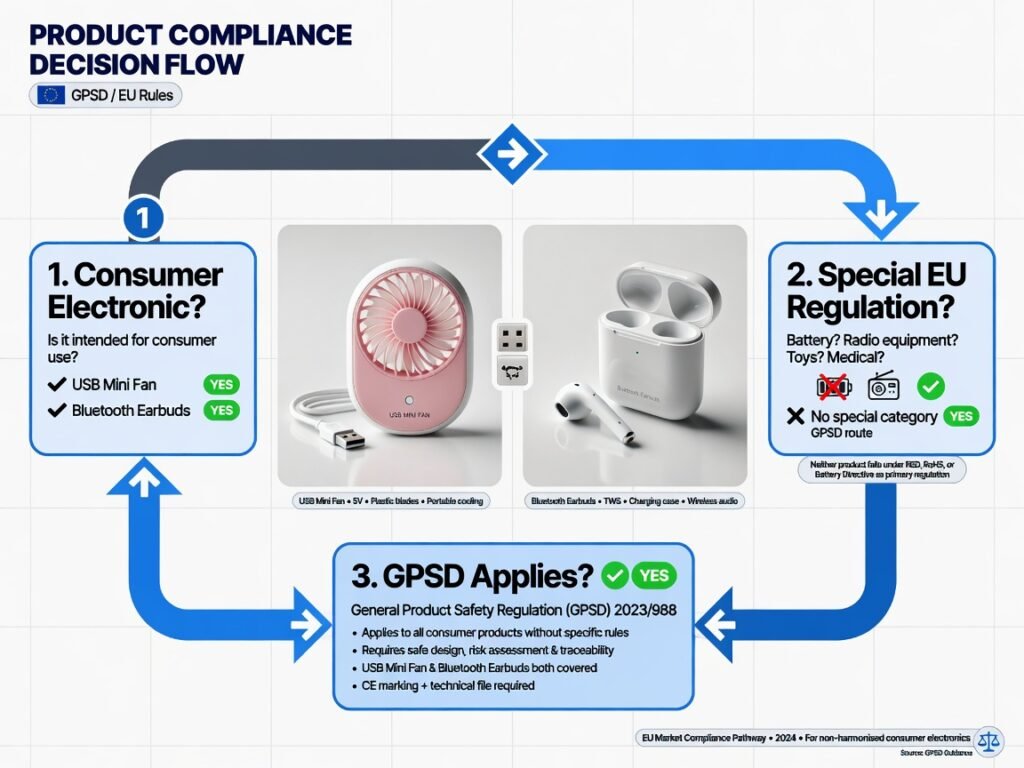
Common Categories of Consumer Electronics Whose Safety Risks Are Covered by GPSD as a Catch-All
The above judgment method may still be a bit abstract. We have sorted out 3 of the most common categories of consumer electronics whose safety risks are usually covered by GPSD as a catch-all, for your reference — note that what is mentioned here is the catch-all scope of GPSD, and many products may also be subject to other special regulations at the same time.
Low-Voltage Consumer Small Electronics Below LVD Voltage (Most Typical)
The core judgment standard for this type of product is that the operating voltage is below 50V AC or 75V DC, which is usually not covered by the Low Voltage Directive (LVD), so the electrical safety is mainly covered by GPSD as a catch-all. It should be specially noted that this does not mean that such products are only regulated by GPSD: if the product has wireless communication functions such as Bluetooth, Wi-Fi, or cellular, it must also meet the relevant requirements of the Radio Equipment Directive (RED) — RED covers wireless spectrum, wireless-related health and safety, and some cybersecurity requirements. For example, for wireless Bluetooth headsets, RED governs wireless-related risks, while GPSD covers remaining risks such as battery overheating and accidental ingestion of small parts.
Common examples include: USB small fans/desk lamps, 5V power banks, wireless Bluetooth headsets, ordinary mice and keyboards, etc.
Also note: if similar products are specially designed for children, such as early education Bluetooth headsets for 3-year-old toddlers, they may be governed by the Toy Safety Directive and are not subject to GPSD.
New/Cross-Border Consumer Electronics Without Special Regulations
This type of product belongs to niche or cross-border categories that have emerged in recent years, and there is no corresponding special EU safety regulation, so the overall safety risks are governed by GPSD.
Common examples include: smart luminous clothing, electronic counting jump ropes, smart water cups with temperature display, battery-powered electronic aromatherapy devices, etc. Simply put, daily necessities with simple electronic functions fall into this category as long as they are not covered by special safety rules.
Low-Voltage Electronic Accessories
This type of product is a supporting accessory for electronic products, powered by low voltage, and is not covered by special safety regulations, so safety risks are usually covered by GPSD as a catch-all.
Common examples include: USB data cables, mobile phone wireless charging receiver pads, USB adapters, mobile phone USB coolers, etc.
Special attention should be paid: wall chargers and power adapters do not belong to this category — because their mains input usually falls within the voltage jurisdiction of LVD, the core electrical safety is governed by LVD. This is the boundary that most people easily confuse.
Situations Where Electronic Products Do Not Directly Apply to GPSD or Do Not Take GPSD as the Main Basis
In addition to the above categories covered by GPSD as a catch-all, there are several types of products that either do not directly apply to GPSD or do not take GPSD as the main compliance basis. You can first check accordingly to avoid getting the compliance priority wrong.
Electronic Products Whose Core Risks Are Covered by Special Safety Regulations
If the core safety risks of a product are fully covered by special regulations, the corresponding special regulations shall take precedence. GPSD does not directly govern core risks, and only serves as a catch-all for remaining safety risks not covered by special regulations:
- Wall-plug appliances with operating voltage within the LVD range (such as refrigerators, hair dryers, wall chargers) → core electrical safety is governed by the Low Voltage Directive (LVD); if the product also falls within the scope of other special regulations (such as massage devices with medical effects), the core risks must first be judged according to the corresponding special regulations;
- Children’s electronic toys (remote control cars, children’s story machines) → governed by the Toy Safety Directive;
- Medical-grade electronic products (electronic blood pressure monitors, physiotherapy devices claiming therapeutic effects) → governed by the Medical Device Regulation (MDR);
- Electronic protective equipment (noise-canceling electronic earmuffs) → governed by the Personal Protective Equipment (PPE) Regulation.
Purely Non-Consumer-Grade Electronic Products
If a product is sold only to enterprises and professionals, and ordinary consumers cannot reasonably purchase and use it, it does not fall within the jurisdiction of GPSD. For example, factory-specific industrial control motherboards, communication base station equipment, professional electronic instruments for hospitals, etc.
But there is an exception: if the same product is also sold to ordinary consumers, it must still be judged as a consumer-grade product and may be subject to GPSD.
Electronic Products Clearly Excluded by GPSD Regulations
There are also several categories of exclusions clearly listed in the GPSD regulation, which do not need to comply with the GPSD compliance requirements:
- Electronic products for military/defense purposes;
- Products intended only for export to markets outside the EU;
- Electronic components sold only to manufacturing enterprises and not directly to consumers (such as resistors, capacitors, chips and other parts that ordinary people will not use directly);
- Second-hand electronic products marked as antique/collection use and clearly informed that they cannot be used normally.
Note: As long as ordinary second-hand, refurbished, and rental electronic products are circulated to EU consumers and do not fall into the above exclusion situations, they still need to be judged whether they are applicable according to the rules of GPSD/GPSR.
Advanced (Semi-Proficient): Judgment Method for Boundary Cases
What is mentioned above are all clear situations. In practice, products with blurred boundaries are often encountered. For example, who is responsible for Bluetooth headsets? Do small accessories given in sets count? This part is suitable for cross-border sellers who need accurate judgment, or readers who want to thoroughly understand the rules.
Judgment of Products Whose Partial Risks Are Covered by Special Regulations
The risks of many products are not single. A certain type of risk may be covered by special regulations, and the remaining risks are not regulated — at this time, the remaining uncovered risks are still governed by GPSD.
For example, for low-voltage headsets with Bluetooth, the Radio Equipment Directive (RED) covers wireless risks such as wireless spectrum compliance, wireless-related health and safety, and some cybersecurity. However, electrical, mechanical, and misuse risks of the headset, such as battery overheating risk, scratch risk from sharp edges of the casing, and accidental ingestion of small parts, which are not covered by RED, are covered by GPSD as a catch-all.
The judgment method is very straightforward: list all foreseeable safety risks of the product, check one by one whether there are special regulations covering them, and the uncovered parts are subject to GPSD.
Judgment of Cross-Border Multi-Functional Electronic Products
The core of judging cross-border products is to look at the main purpose of the product and the core functions claimed by the merchant, not how many additional functions it has.
Take two examples: for a children’s water cup with electronic display, if the merchant promotes it as an “educational early education toy” and the core function is a toy, it is governed by the Toy Safety Directive; if the merchant promotes it as a “smart temperature-measuring children’s water cup” and the core function is a container for drinking water, it is governed by GPSD. Another example: a massage device with heating function, if it is advertised as “able to treat cervical spondylosis and lumbar spondylosis”, it is a medical-grade product and governed by MDR; if it is only advertised as “muscle relaxation massage” for ordinary home use, its attribution is judged according to the operating voltage, and low-voltage ones are governed by GPSD.
Judgment of Electronic Accessories in Sets
Whether electronic accessories in a set are separately subject to GPSD depends on whether the accessories can be used and sold independently: if yes, they are judged as independent products; if they can only be used with the main product, they follow the regulations applicable to the main product.
For example, a USB small fan given as a gift when buying a laptop can be used by plugging into any USB port alone. As long as this small fan meets the conditions, it is separately subject to GPSD. Another example: an electronic remote control in a toy set can only control this set of toys and cannot be used alone, so it follows the main product and is governed by the Toy Safety Directive, and is not separately subject to GPSD.
Judgment of Products in Special Circulation Scenarios
Many people think that only officially sold products count as “placing on the market” in EU regulations. Here is a plain-language explanation first: as long as products are provided to EU consumers in any commercial form such as sale, gift, rental, or trial use, it counts as placing on the market, regardless of whether there is a charge or the value of the package. In practice, many scenarios belong to placing on the market:
- Small-value cross-border e-commerce parcels and gifts: as long as they are provided to EU consumers, whether sold or given, regardless of the parcel value, they count as placing on the market and are subject to GPSD;
- Second-hand/refurbished/rental electronic products: as long as they are circulated to consumers, and are not antique collection-grade or faulty and pending repair, they are subject to GPSD;
- Exhibition samples/test products: only used for display and not sold or given to consumers, not applicable.
Advanced (Semi-Proficient): Scope Boundaries Between GPSD and Common EU Electronic Regulations
Many people easily confuse the relationship between GPSD and other EU electronic regulations. We break down the most common categories one by one to help you clearly sort out the boundaries:
Scope Boundary Between GPSD and CE Marking
First of all, it should be clear that the CE mark is not a unified safety certification, but a self-declaration mark that the product meets the requirements of a certain type of EU special regulation. Common CE-corresponding regulations include LVD for electrical safety, RED for wireless, and EMC (Electromagnetic Compatibility) — simply put, rules to ensure that equipment does not randomly emit electromagnetic waves to interfere with other equipment, nor will it malfunction due to electromagnetic interference.
GPSD itself is not the basis for issuing the CE mark, so having a CE mark ≠ automatically meeting all GPSD requirements (CE only covers the jurisdiction scope of the corresponding special regulation); conversely, no CE mark ≠ necessarily subject to GPSD, it is still necessary to first judge whether the product falls within the jurisdiction scope of a special regulation.
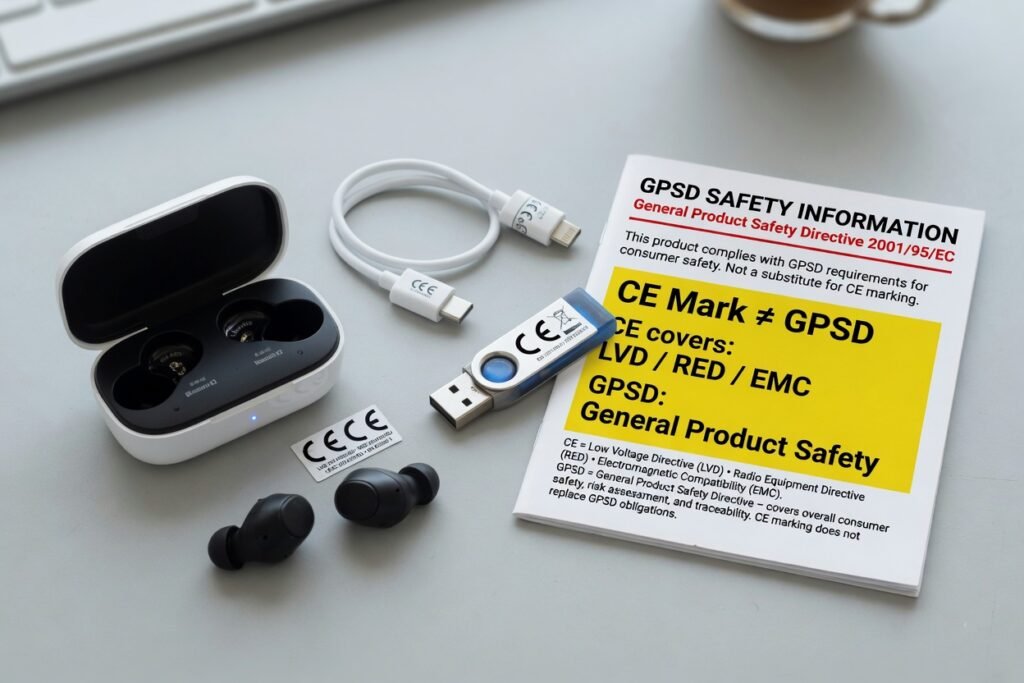
Scope Boundary Between GPSD and the Low Voltage Directive (LVD)
The core jurisdiction scope of LVD is the electrical safety of electrical equipment with operating voltage between 50-1000V AC and 75-1500V DC.
If the operating voltage of the product falls within the LVD range, LVD takes precedence in governing core electrical safety; for products below the LVD voltage range, electrical safety is covered by GPSD as a catch-all, such as various USB-powered small devices and battery-powered small electronics.
Scope Boundary Between GPSD and the Radio Equipment Directive (RED)
RED governs the wireless spectrum compliance, wireless-related health and safety, and some cybersecurity requirements of devices with wireless communication functions such as Bluetooth, Wi-Fi, and cellular.
For products with wireless functions, RED is only responsible for wireless-related risks, and non-wireless safety risks such as physical injury, children’s misuse, and instructions and warnings are still supplementarily governed by GPSD. Typical boundary products such as smart watches and wireless headsets are all subject to RED for the wireless part and GPSD for the remaining use safety risks.
Scope Boundary Between GPSD and RoHS/REACH
RoHS governs the restriction of specific hazardous substances in electrical and electronic products, and REACH governs chemical safety in a broad sense.
The jurisdiction scopes of these two types of regulations and GPSD are completely different: GPSD governs the overall use safety of products (including electrical, mechanical, thermal, misuse and other risks). Chemical compliance cannot replace use safety judgment. The three types of regulations can apply at the same time, and there is no situation where “complying with one means you don’t need to care about the other”.
Practical Self-Check List and Common Misconception Avoidance
3-Step Self-Check List for Individual Overseas Shoppers
- Confirm that the product is a consumer-grade electronic product for daily use by yourself or your family, not for industrial or professional use;
- Judge whether it belongs to categories with special safety regulations such as home appliances, toys, and medical devices;
- If it does not belong to a special category and is not on the exclusion list, it is subject to GPSD, and you can require the merchant to provide compliance certification.
5-Step Self-Check List for Small Cross-Border Sellers
- Confirm whether the product is sold to ordinary EU consumers;
- Clarify the core functions and main usage scenarios of the product, and do not be disturbed by additional functions;
- Check whether there is a corresponding EU special safety regulation covering the core risks;
- Check whether it is on the clear exclusion list of GPSD;
- If no special regulation fully covers it and it is not on the exclusion list, compliance must be completed in accordance with GPSD requirements.
6 Most Common Misconceptions About the Scope of Application
- Misconception 1: All electronic products are governed by LVD. Wrong. LVD only governs electrical safety within a specific voltage range. For small electronics below 50V AC or 75V DC, electrical safety is covered by GPSD as a catch-all, such as USB small fans and Bluetooth headsets.
- Misconception 2: With a CE mark, you don’t need to care about GPSD. Wrong. CE only covers the requirements of the corresponding special regulation. For example, Bluetooth headsets have CE-RED, but parts not regulated by RED, such as battery safety and mechanical safety, still need to comply with GPSD.
- Misconception 3: If subject to GPSD, you don’t need to comply with EMC/RoHS. Wrong. GPSD is a catch-all rule for use safety. As long as the product falls within the jurisdiction of other regulations (for example, the vast majority of electrical and electronic products must comply with RoHS), it still needs to be observed. Multiple regulations can apply at the same time.
- Misconception 4: Labeled “industrial grade” means no need to comply with GPSD. Wrong. The standard for judging consumer grade is whether ordinary consumers can reasonably purchase and use it, not the product labeling. Products that ordinary people can buy on e-commerce platforms and use in daily life are considered consumer grade even if labeled industrial grade.
- Misconception 5: Low voltage/low power means no safety obligations. Wrong. Low-voltage products may also have risks such as overheating and fire, battery explosion, accidental ingestion of small parts, and scratches from sharp edges, all of which fall within the jurisdiction of GPSD.
- Misconception 6: Cross-border small-value parcels/gifts do not need to comply with GPSD. Wrong. As long as they are provided to EU consumers, regardless of whether there is a charge or the parcel value, they belong to “placing on the market” as defined by EU regulations (for specific explanations, please refer to the previous section “Judgment of Products in Special Circulation Scenarios”), and must meet GPSD requirements.
Conclusion
So far, the content about the scope of electronic products subject to GPSD has been covered. You don’t need to memorize all regulatory provisions by rote. As long as you grasp the core attribute of “catch-all” and combine the basic judgment logic and boundary judgment methods, you can quickly sort out the compliance attribution of the vast majority of consumer electronics and avoid common cognitive misconceptions. The scope judgment logic explained in this article based on the GPSD framework can be directly applied to the current GPSR rules; if you encounter particularly complex cross-border products, you can also consult a professional compliance institution for final confirmation.