
The core legal basis for UKCA low voltage safety requirements is the UK’s — this is the safety rule for electrical product market access in Great Britain, belonging to the electrical safety branch of the UKCA compliance system, rather than a quality grade certification or institution-issued marketing certification. Its safety objectives are close to the EU’s original Low Voltage Directive (LVD), with the core of preventing personal and property risks such as electric shock, overheating fire, and mechanical injury, but the applicable jurisdiction, document requirements and responsible entity rules differ from the EU system. If a product is non-compliant, it may face customs seizure, market withdrawal, recall, and fines; in serious cases, it may involve criminal liability, and e-commerce platforms can also directly require compliance proof or remove the product.
You can determine whether the UK’s apply to your product through 5 steps; if any step is not met, you should record the reason for non-applicability and confirm whether it is regulated by other special regulations, general product safety rules, or EU rules for Northern Ireland.
1. 5-Step Judgment: Whether Your Product Is Subject to These Regulations
Step 1: Check the Rated Voltage Range
This is the most basic judgment criterion; only products with rated voltage falling within the corresponding range are subject to these regulations:
• Alternating current (AC): rated voltage between 50V and 1000V
• Direct current (DC): rated voltage between 75V and 1500V
Special attention should be paid here: the judgment basis is the rated working voltage marked on the product nameplate, not the actual connected voltage, instantaneous fluctuation voltage, nor the voltage during failure. For example, a desk lamp marked 220V AC still falls within the applicable scope even if you use a transformer to step it down to 12V for use.
If the voltage exceeds this range, such as high-voltage power distribution cabinets, or small toys powered by 3V button batteries, they are not regulated by these regulations, but this does not mean there are no safety requirements; they just need to comply with other corresponding high-voltage equipment, occupational safety, or product safety regulations.
Step 2: Confirm Product Categories and Exclusion Scenarios
Even if the voltage meets the requirements, some products or scenarios are not subject to these regulations. The core of judgment is whether the product is special equipment listed in the regulations and whether it is supplied to the market as an independent device:
Common products requiring compliance: small household appliances, chargers/power adapters, lamps, IT/audio-visual equipment (such as computers, speakers), ordinary low-voltage industrial electrical equipment.
Excluded categories listed in the regulations: medical devices, aviation/military/ship/railway special equipment, electrical equipment for explosive atmospheres, domestic plugs and sockets, electricity meters, elevator components, etc., usually have a special safety supervision system and are not subject to these low voltage regulations; however, if they are general electrical components rather than special equipment for the above fields, they still need to be judged separately based on intended use and power supply method, and cannot be excluded solely based on the industry name.
There are also several types of scenarios that do not require separate compliance under these regulations:
• Internal components not sold separately: such as built-in circuit boards, modules, etc. that are not sold separately to the outside world, do not require separate compliance, but the safety performance of the components must be included in the whole machine compliance assessment.
• Custom test kits for R&D use: special test equipment limited to internal R&D use and not entering the circulation market, do not require compliance.
• Second-hand items for personal use: personal non-commercial resale of idle personal items usually does not require re-compliance under these regulations; commercial second-hand, refurbished resale, or first-time placement of imported second-hand goods still requires assessment.
Step 3: Judge Product Status and Placement Purpose
These regulations focus on controlling electrical equipment placed on the Great Britain market. New products placed on the market for the first time usually require compliance; situations such as refurbishment, rebranding, major modification, and first-time placement of commercial second-hand imports may also be regarded as new market placement actions, requiring re-evaluation. The following are several common special status judgments:
• Refurbished/rebranded/majorly modified products: products that have been refurbished, rebranded, or majorly modified (such as changing rated power, replacing core safety components, changing power supply methods) are regarded as new products, and the entity implementing the modification shall bear the manufacturer’s responsibility and needs to complete compliance again.
• Non-sale samples / R&D test kits: limited to controlled display, internal R&D evaluation, or customer test verification, and must not enter the terminal circulation market, nor be used for commercial supply activities such as sale or gifting; once provided to end users in any form, it is deemed to be placed on the market and compliance must be completed.
• Supporting components for internal enterprise use: only refers to non-independently supplied components matching the enterprise’s own production equipment and not sold to the outside world, do not require separate compliance; if they are subsequently sold separately to the outside world, supplementary compliance is required.
• Second-hand goods: the exemption rule for personal non-commercial resale of personal use items has been explained in Step 2; if it is commercial second-hand resale, refurbished resale, or first-time placement of second-hand products imported from abroad into the Great Britain market, the corresponding responsible entity still needs to complete the compliance assessment.
Step 4: Clarify the Applicable Rules for the Sales Region
Different regions of the UK have different applicable rules, and many people make mistakes here:
• Great Britain (England, Scotland, Wales): These low voltage safety requirements apply, and the CE marking is recognised indefinitely at present; there is no mandatory requirement to switch to UKCA, which means compliance via the CE pathway is also legal for sale.
• Northern Ireland: Due to the arrangement of the Northern Ireland Protocol, EU low voltage rules apply here, and the CE marking is usually used; UKNI cannot be used alone, and is only used together with CE when the regulations require third-party conformity assessment and a UK accredited body is used. Sales to Northern Ireland still require completion of EU LVD technical documentation and EU DoC, which does not exempt low voltage safety obligations, but only applies different rules.
If you sell to both the UK and the EU, you don’t need to do two tests — the core safety requirements are similar, and the same test data can be shared, as long as you prepare the corresponding documents and marks for each jurisdiction separately.
Step 5: Check Boundary Situations That Are Easily Misjudged
Some special situations are easy to judge incorrectly, so they are listed separately:
• Kits and accessories: If sold as a complete set (such as a monitor with power supply), evaluate as a complete set of products; if accessories are sold separately (such as a separately sold power adapter), they need separate compliance.
• Battery-only powered products: If the rated voltage of the battery is lower than 75V DC and there is no higher voltage power input, these regulations usually do not apply, such as ordinary single-string lithium battery small fans, and Bluetooth headsets powered by 3.7V.
• Safety Extra-Low Voltage (SELV) products: Don’t think that compliance is unnecessary just because the output is SELV — judgment should be based on the rated power supply voltage and designed use of the device as a whole. Take a mains-input mobile phone charger as an example: even if the output is 5V SELV, the device still falls within the rated input range of 50V to 1000V AC, so compliance is required; devices only powered by a power supply lower than 75V DC and containing no rated power supply part within the range are usually not subject to these regulations.
• Parallel regulations: Low voltage regulations only cover electrical safety, not EMC, RoHS, energy efficiency, etc. For example, a speaker with Bluetooth, in addition to low voltage requirements, must also comply with radio regulations; if it is a children’s toy, it must additionally comply with toy safety regulations.
2. Core Safety Requirements: Underlying Rules That Products Must Meet
Many people think that compliance is just finding a standard to test, but in fact all test items come from the clear safety objectives of the regulations, centering on “protecting personal and property safety”, which can be specifically divided into 5 categories of core requirements.
2.1 Overarching Safety Objectives of the Regulations
All safety requirements ultimately serve three objectives:
First, to protect persons and domestic animals from injuries such as electric shock, mechanical damage, thermal burns, harmful radiation, or chemical exposure;
Second, to protect property from losses such as overheating fire, and equipment failure damage;
Third, to ensure installation and use safety, through clear markings and instructions, to ensure that products do not pose risks when correctly installed and used for intended purposes.
2.2 Protection Against Electric Shock (The Most Core Requirement)
Electric shock is the most common safety risk of electrical products, so protection against electric shock is the core of all requirements:
• During normal use, plugging and unplugging, and even reasonably foreseeable misoperation (such as accidentally knocking off the casing, plugging/unplugging with wet hands), users must not be able to touch live parts;
• Insulation performance must still be maintained after moisture or water ingress, and there must be no risk of electric leakage;
• Insulation thickness, creepage distance, and clearance distance must match the rated voltage level — creepage distance here refers to the shortest distance between live parts along the surface of insulating material, and clearance distance refers to the shortest distance of air between two live parts; insufficient values of both are prone to insulation breakdown, causing electric leakage;
• Products with earthing function must ensure that the earthing connection is continuous and reliable, not easy to disconnect, so that in case of internal electric leakage, the electricity can be conducted away in time to avoid injury.
2.3 Thermal and Fire Safety Requirements
Overheating fire is another high-incidence risk of electrical products, and related requirements cover both normal and abnormal scenarios:
• During normal operation, the temperature of surfaces accessible to users must not exceed the safety threshold of the corresponding product to avoid scalding;
• In abnormal states such as overload, short circuit, or blocked ventilation openings, the product must not catch open flame, nor allow the fire to spread to the outside;
• Casings, internal insulating materials, etc. must have corresponding levels of flame retardant performance, and flammable materials must not be used for key structural parts.
2.4 Mechanical and Structural Safety Requirements
In addition to electrical risks, structural defects of the product itself may also cause injury:
• The structure must be stable, and will not loosen or shatter to expose internal dangerous parts after normal use, transportation, or minor drops;
• Sharp edges and moving parts (such as fan blades, transmission gears) must be protected to avoid scratching or pinching users;
• The connection of power cords and plugs must be firm, and will not loosen to expose internal wires after a specified number of pulls.
2.5 Labelling and Instruction for Use Requirements
Clear labelling and instructions are the key to avoiding user misuse, and are legally mandatory requirements:
• The product body must be clearly marked with rated voltage, power, frequency, brand, and model, to facilitate users to judge the applicable scenario;
• The product or its packaging, accompanying documents shall also provide the manufacturer’s name and contact address in accordance with regulations; when products are supplied by overseas manufacturers and placed on the Great Britain market by UK-based importers, the name and address of the UK importer must also be provided. An authorised representative may be entrusted by the manufacturer in writing to undertake part of the liaison duties, but does not by default replace the importer’s legal liability, nor is it a required role in all scenarios;
• English safety instructions for use and risk warning statements must be included, clarifying the applicable environment, installation method, and prohibited operations of the product;
• All markings must be firm and durable, not easy to erase or wear, and temporary stickers or easily faded printing must not be used.
2.6 Variable Conditions of Safety Requirements
These requirements are not static and will be adjusted according to the use scenario and product design:
• Different use scenarios have different requirements: the temperature thresholds for household and commercial use are different, the waterproof and insulation requirements for dry indoor, humid bathroom, and outdoor environments vary greatly, and the heat dissipation requirements for enclosed and ventilated environments are also different;
• Design changes will affect compliance: replacing casing materials, power cords, core circuits, or increasing rated power may break the original safety balance, requiring re-evaluation (for specific change re-evaluation requirements, see the compliance implementation and pitfall avoidance chapter).
3. Compliance Implementation: Full Process Operation of Self-Declaration
Many people think that UKCA low voltage compliance must require a third-party institution to issue a certificate and cost a lot of money, but that’s not the case at all.
3.1 Path Clarification: Default Self-Declaration, No Mandatory Third-Party Certification
The legal compliance pathway for UK low voltage regulations is manufacturer’s self-declaration, and there is no mandatory requirement for certification by UKAB (UK government-approved third-party compliance bodies).
As far as the are concerned, manufacturers can adopt internal production control and sign a declaration of conformity; test reports issued by third-party laboratories (including UKAS-accredited authoritative laboratories) are only evidence to prove that the product meets the requirements, not a “mandatory certification certificate”. Some customers or e-commerce platforms may require third-party reports, which is a commercial requirement, not a legal obligation.
As far as the low voltage safety regulations themselves are concerned, ordinary products usually complete compliance through internal production control and manufacturer’s self-declaration; if the product also falls under other regulations or special regulatory categories, third-party assessment requirements may be triggered by other regulations. Do not mistake customer-specified laboratory reports or platform certificate requirements for the legal UKAB certification obligation.
3.2 6 Operational Steps for Self-Declaration
For self-compliance of ordinary low voltage products, just follow these 6 steps:
1. Confirm the scope of application: First check according to the 5 steps mentioned above to confirm that the product falls within the scope of application of the low voltage regulations, and exclude special regulatory categories.
2. Match corresponding standards: Find the corresponding product standards officially designated by the UK, that is, BS or BS EN series standards. Adopting the relevant clauses of applicable UK designated standards can obtain a presumption of conformity for the regulatory safety objectives covered by the standard; however, it is still necessary to confirm that the product type and version meet the scope of application of the standard, and there are no risks not covered by the standard, and at the same time check the transition arrangement of the standard. Whether a standard is a UK designated version shall be subject to the designated standard announcement issued by the UK government, and cannot be judged solely by the “latest version” marked by the laboratory or standard website.
Here are the corresponding standards for several common products: BS EN 62368-1 for IT and audio-visual equipment, BS EN 60335 series for household appliances, BS EN 60598 series for lamps. If there is no corresponding designated standard, you have to prove by yourself that the product meets the safety objectives of the regulations. Novices and small sellers should try to avoid this situation, as the risk is very high.
3. Complete safety testing: You can test in your own laboratory, or entrust a third-party laboratory to test. Either way, you must keep complete original test records, not just get a result.
4. Carry out risk assessment and prepare technical documentation: Identify all possible safety risks, correspond to the requirements in the standard, explain risk control measures, and verify the effectiveness of the control measures. Finally, organise all materials into complete technical documentation.
5. Sign the Declaration of Conformity (DoC): This is an official document signed by the responsible entity, declaring that the product meets the requirements of the UK’s .
6. Affix the compliance mark: According to the path you choose, affix the UKCA or CE marking, which must comply with the specifications.
3.3 Core Content and Management Requirements of Technical Documentation
Technical documentation is the core evidence of compliance, and it is the first thing to be checked during regulatory spot checks. It must include the following content:
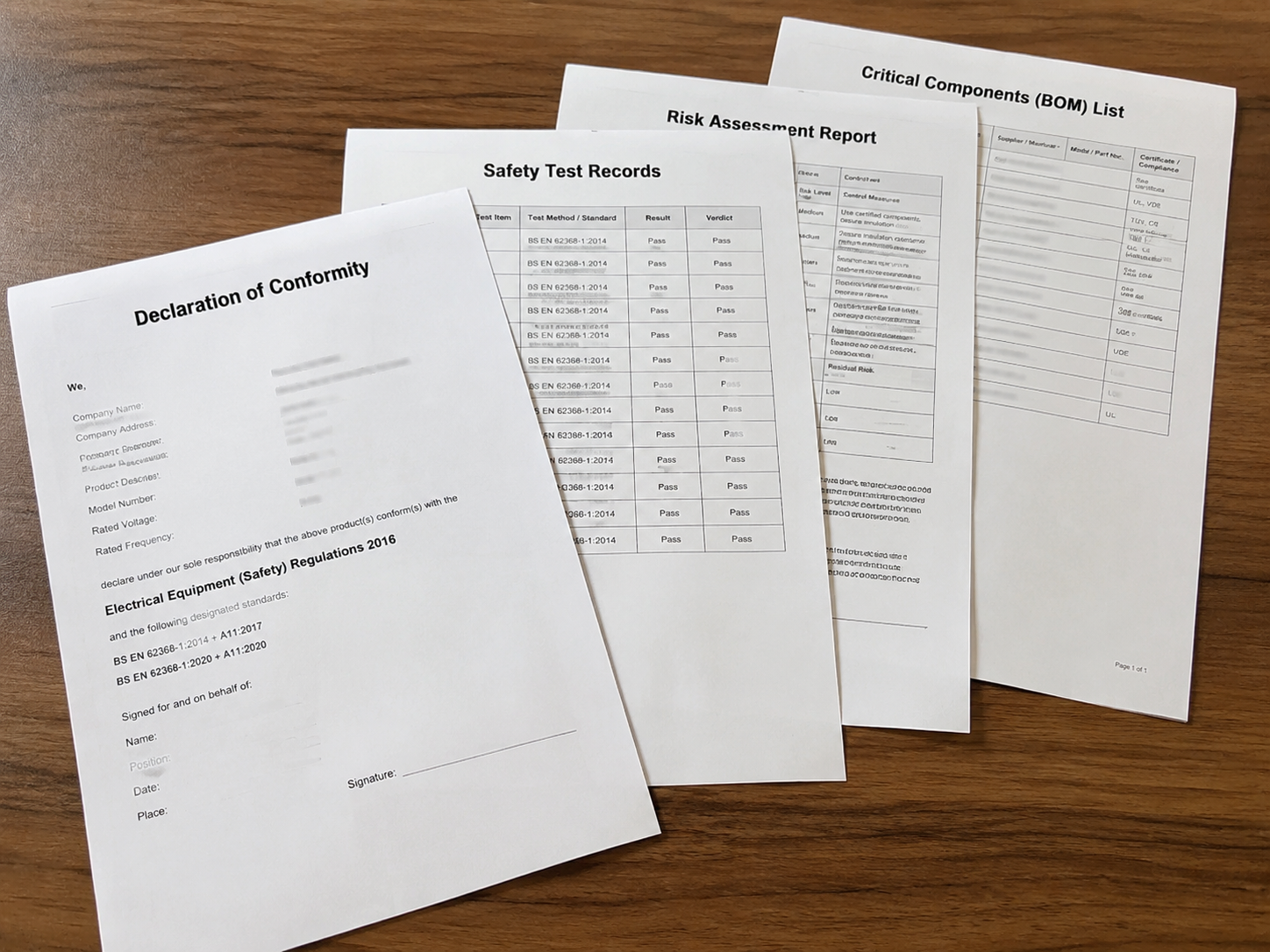
• Basic product description, model specification
• Circuit diagrams, schematic diagrams
• List of critical components (BOM), such as plugs, fuses, insulating materials and other key parts, must have compliance certificates and be consistent with the components of the test sample
• Risk assessment report
• Safety test records or test reports
• Samples of product labelling and instructions
• Declaration of Conformity (DoC)
In addition to complete documentation, there are several management requirements:
• Production consistency: You must have a mass production inspection process to ensure that the structure, materials, and parameters of mass-produced products are the same as those of the test sample. You cannot have good samples but cut corners on bulk goods.
• Re-evaluation after changes: If the product’s design, key components, power, or materials are changed, compliance must be re-evaluated and the technical documentation updated simultaneously.
• Retention period: Manufacturers and, where applicable, importers shall keep technical documentation, DoC and traceable materials for at least 10 years in accordance with their respective legal obligations; the specific starting event, data holder and scope of data to be retained shall be confirmed in accordance with the applicable regulatory provisions and their role in the supply chain. All materials must be traceable to specific models and batches, and can be provided immediately when required by regulators.
3.4 Specifications for Declaration of Conformity (DoC) and Mark Affixing
The DoC cannot be written casually, and legal requirements include the following content: a clear declaration of conformity with the , a list of all applicable UK designated standards (or other technical basis for proving conformity with safety objectives), product identification information, complete manufacturer information, and the name, position and date of the signatory. The manufacturer’s information must be clear; if a UK importer is involved, it shall also be ensured that the importer’s information is consistently reflected in the traceable materials required by regulations, product/packaging/accompanying documents, to avoid contradictions between DoC, nameplate and supply chain records.
The DoC must at least be traceable with the product model, batch and technical documentation, and must be provided in a timely manner when required by regulatory authorities, importers, platforms or customers; do not only save the DoC as an internal draft that cannot be matched to specific products externally. Whether to provide a paper version with the box, list a download link in the manual, or retain it by the supply chain responsible entity can be determined according to one’s own regulatory role and customer/platform requirements.
The requirements for the UKCA marking are also very clear:
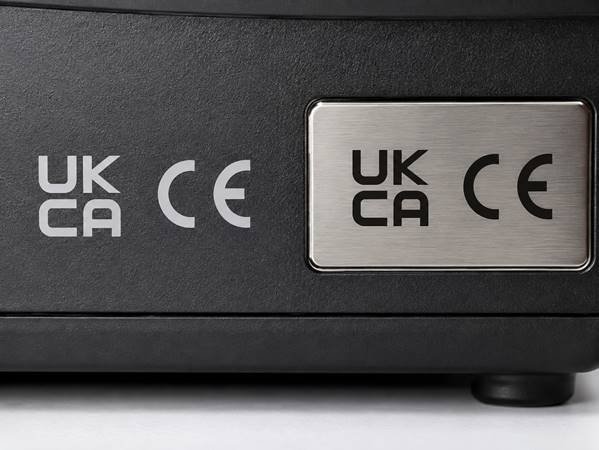
• It must be drawn in accordance with the officially specified proportion, and must not be deformed or stretched
• For conventional products, the minimum height of the mark must not be less than 5mm
• It is preferred to affix it on the product body or nameplate, which must be clear and durable, not easy to erase
• It can be affixed together with the CE marking, but the two marks must comply with their respective regulatory requirements and cannot replace each other
3.5 Special Requirements for UK Standard Plugs, Power Cords and Adapters
This part is easily missed by many people, so it is explained separately:
• If the product is accompanied by a plug intended to be connected to a UK standard socket, it shall be configured in accordance with the applicable plug and socket safety regulations and BS 1363 requirements, and use a fuse matching the rated parameters of the equipment; products with fixed wiring, equipment connectors, or no accompanying plug shall be evaluated according to their actual power supply method.
• Separately sold domestic plugs and sockets are not regulated by these low voltage regulations, but are specifically governed by the . Do not comply according to low voltage requirements.
• If external power adapters are sold separately, they need to separately meet the low voltage regulation requirements; if they are sold as a set with the host device, they must be included in the whole machine compliance assessment and cannot be omitted.
• All power supply accessories such as power cords, plugs, adapters, charging bases, etc. sold with the whole machine shall be included in the whole machine’s risk assessment and test sample consistency management, and must not be omitted; when accessories are sold separately, they shall complete compliance separately according to their own product category.
3.6 Division of Responsibilities of Different Market Entities
Compliance is not just the manufacturer’s business. The responsibilities of different supply chain roles depend on their role in the process of placing products on the Great Britain market, and cannot be judged solely by the place of registration:
• Manufacturer: Responsible for product design, testing and conformity, bears primary responsibility for product safety, and needs to prepare and retain technical documentation and sign the DoC.
• UK-based importer: Refers to the entity that first places products manufactured overseas on the market within Great Britain. Its legal obligations include: verifying that the manufacturer has completed the applicable compliance procedures, that the technical documentation and DoC are complete and valid, ensuring that the product bears the required traceable markings (including its own name and address, etc.), and cooperating with regulatory traceability. The identity of the importer shall be confirmed according to the actual supply chain — the determination of the responsible entity may be different under different modes such as direct cross-border sales, platform fulfilment, and UK warehouse storage, and it cannot be judged solely by the seller’s registered place whether a UK importer needs to be designated.
• Authorised representative: May be entrusted by the manufacturer in writing to undertake part of the compliance-related liaison or document retention responsibilities, but cannot replace the importer’s legal obligations, nor is it a required role in all scenarios.
• Distributor: Must ensure that the appearance and labelling of the products sold meet the requirements, must not sell obviously non-compliant products, and cooperate with the traceability investigation of regulatory authorities.
4. Common Pitfall Avoidance: Misconceptions and Core Differences Between UKCA and CE
Many people make mistakes not because they intentionally do not comply, but because they are misled by wrong information. Here we sort out the most common misconceptions and core differences.
4.1 Common Cognitive Misconceptions About the Scope of Application
• Not all live products are subject to these regulations: they must simultaneously meet four conditions: rated voltage range, product category/exclusion list, sales region and product status. For example, pure battery small devices with DC voltage lower than 75V and no mains input usually do not apply; sales to Northern Ireland follow the EU LVD compliance pathway, not the UKCA pathway under these regulations.
• Do not equate “low voltage” with “low safety requirements”: the low voltage here is only the voltage range defined by the regulations, and the strictness of the core safety requirements is essentially no different from the electrical safety requirements of high-voltage products; requirements such as electric shock protection, fire protection, and mechanical safety are all indispensable.
• Do not equate “not subject to these regulations” with “no safety responsibility”: it just means that it is not regulated by these low voltage regulations, and still needs to comply with other corresponding safety regulations (such as high-voltage equipment regulations, general product safety regulations, etc.), and cannot be placed on the market at will.
4.2 Core Differences Between UKCA and CE Low Voltage Requirements
Many people are confused about the relationship between the two. In fact, the core safety requirements are almost the same, only the applicable places and document requirements are different. It is clearer to list them in a table:
| Comparison Item | UKCA Low Voltage Requirements | CE Low Voltage Requirements |
| Applicable Jurisdiction | Great Britain, UK (England, Scotland, Wales) | EU Member States + Northern Ireland, UK |
| Regulatory Basis | UK | EU Low Voltage Directive (LVD 2014/35/EU) |
| DoC Document Requirements | Cite UK designated standards (BS/BS EN) or equivalent technical basis, declare conformity with UK regulations | Cite EU harmonised standards (EN) or equivalent technical basis, declare conformity with EU LVD |
| DoC Signing Requirements | Signed by the responsible entity specified in the regulations; whether an authorised representative can sign on behalf shall be subject to written authorisation and applicable rules | Signed by the responsible entity specified in the regulations; whether an authorised representative can sign on behalf shall be subject to written authorisation and applicable rules |
| Traceable Marking Requirements | Traceable information of the manufacturer and UK-based importer shall be marked on the product or packaging in accordance with regulations, and the specific carrier shall be subject to current rules | Traceable information of the manufacturer and EU-based importer shall be marked on the product or packaging in accordance with regulations, and the specific carrier shall be subject to current rules |
| Mark Validity | Only valid in Great Britain; Great Britain also recognises the CE marking indefinitely | Valid in the EU and Northern Ireland; recognised indefinitely in Great Britain |
| Test Data | The same core test data can be shared with CE | The same core test data can be shared with UKCA |
It should be noted that Great Britain’s recognition of the CE low voltage pathway does not mean that CE can replace the obligations of all UKCA regulations; if the product is also subject to other regulations such as EMC, RoHS, radio, toys, machinery, etc., it is still necessary to separately confirm the marking and document requirements of the corresponding regulations in Great Britain.
4.3 Common Pitfalls in Compliance Processes
• Self-declaration does not mean “write casually without responsibility”: the premise of self-declaration is that the product actually meets the regulatory requirements, and the technical documentation and test records must be able to support the declaration content. The penalty for confirmed fraud will be more serious than ordinary non-compliance.
• Having a test report does not equal compliance: the report must correspond to the mass production version, the applicable standard is correct and within the validity period, the test items cover all key safety items, and the mass-produced product is consistent with the test sample; otherwise, the report has no compliance proof effect.
• Do not believe the statement that “you must find a third-party institution to issue a certificate”: low voltage regulations have no mandatory third-party certification requirements, and ordinary products can complete compliance by themselves; third-party reports are only compliance evidence, and still need to match the mass production version and complete test items, and cannot replace one’s own compliance responsibility.
4.4 Common Errors in Documents and Marks
• The DoC cites the EU directive, not the UK’s
• The standard used is not the UK designated version applicable when the product is placed on the market, or the scope of application of the standard does not match
• Failure to provide traceable information of the UK-based importer as required by regulations
• The UKCA marking is less than 5mm in size, or deformed, stretched, and affixed in a blurry position
4.5 Common Omissions in Products and Changes
• Only check the host device, forgetting accessories such as external power supplies and power cords; accessories sold separately or included in the set must be compliant
• Think that small changes do not require re-evaluation: “small changes” such as replacing key components, changing materials, and adjusting power may affect safety, and must be re-verified
• Only look at laboratory tests, regardless of actual use scenarios: for example, the product is originally for indoor use, but you sell it for outdoor use, the waterproof and temperature resistance are not up to standard, even if it has passed the test, it is non-compliant, and the use restrictions in the manual must be consistent with the sales scenario
4.6 Key Points for Responding to Regulatory Investigations
If you are actually spot-checked by the market regulatory authority, you can handle it according to the following steps:
1. First check the specific information in the regulatory notice: including the involved product model, batch, applicable jurisdiction, scope of materials required to be provided, and reply time limit, to avoid giving irrelevant answers.
2. Retrieve the materials of the corresponding version: find the technical documentation, DoC, test report and supply chain related records of this model of product, and confirm that the materials are consistent with the batch of the involved product.
3. Make a written reply after clarifying the compliance pathway: clearly explain the compliance pathway (UKCA or CE) adopted by the product and the corresponding regulatory basis, and submit the materials as required; if you are not familiar with the regulatory requirements, you can entrust a local UK compliance consultant to assist in responding to avoid expression errors.
5. Quick Self-Inspection and Decision-Making Methods
If you already have products to place on the UK market, you can use the following methods to quickly check risks and make decisions.
5.1 10-Minute Pre-Placement Self-Inspection Checklist
This is a quick check for common obvious omissions, which must be done before placing products on the market:
1. Judge the scope: Check the product’s rated voltage, category, sales region, and product status to confirm that it falls within the scope of application of the low voltage regulations; at the same time, confirm whether the sales pathways for Great Britain, Northern Ireland, and the EU need to apply different rules respectively.
2. Check appearance: No exposed live parts, intact insulation layer, no sharp edges, stable and firm structure, basic markings on the product are clear and will not come off when wiped.
3. Verify documents: There are safety test records corresponding to applicable UK designated standards or CE harmonised standards; sign UKCA DoC or EU DoC according to the selected compliance pathway; technical documentation can be traced to the currently sold models and batches.
4. Check marks: The UKCA or CE marking is clear and durable, with a height of at least 5mm, in the official standard style, without deformation.
5.2 Key Variables That Will Change Compliance Conclusions
If you have mastered the basic judgment methods, you also need to note that the following situations will change the compliance conclusion, and you cannot directly apply the original results:
• Voltage change: If the rated voltage is adjusted beyond the range of 50-1000V AC or 75-1500V DC, these regulations will no longer apply, and other corresponding safety requirements need to be met.
• Region change: If the sales scope is expanded from Great Britain to Northern Ireland, the EU LVD compliance pathway must be used instead of only UKCA.
• Scenario change: If the product use scenario is changed from indoor to outdoor, or from dry environment to humid environment, the waterproof, temperature resistance and other requirements need to be re-evaluated, and the design should be adjusted or warnings should be added.
• Design change: If core safety components are replaced, rated power is adjusted, or casing or insulating materials are changed, compliance must be re-verified and technical documentation updated (for details, refer to the change omission reminder in Chapter 4).
5.3 4-Step Judgment Method for Test Report Validity
If you get a test report and don’t know if it can be used, you can check it from 4 aspects:
• Check the model: Is the product model covered in the report the version you are going to sell now, and is there a description of multi-model coverage?
• Check the standard: Is the standard used for testing the UK designated version applicable when the product is placed on the market, and can it be used to establish a presumption of conformity?
• Check the sample: Are the structure, power, materials, and key component suppliers of the test sample consistent with your mass-produced products?
• Check items: Do the test items cover all key safety items such as electric shock protection, temperature rise, insulation, and mechanical safety, and are there any missing items?
Final Summary
In general, the core logic of UKCA low voltage compliance is not complicated: first, clarify whether the product is subject to these regulations through 5-step judgment, then complete product design verification against the safety objectives, retain complete technical documentation and declaration of conformity as traceable evidence, select the corresponding compliance pathway according to the sales region, and re-evaluate in time when the product design, use scenario or sales region changes. As long as you do a solid job of safety verification based on regulatory requirements and keep good traceable evidence, you can effectively avoid most compliance risks.