
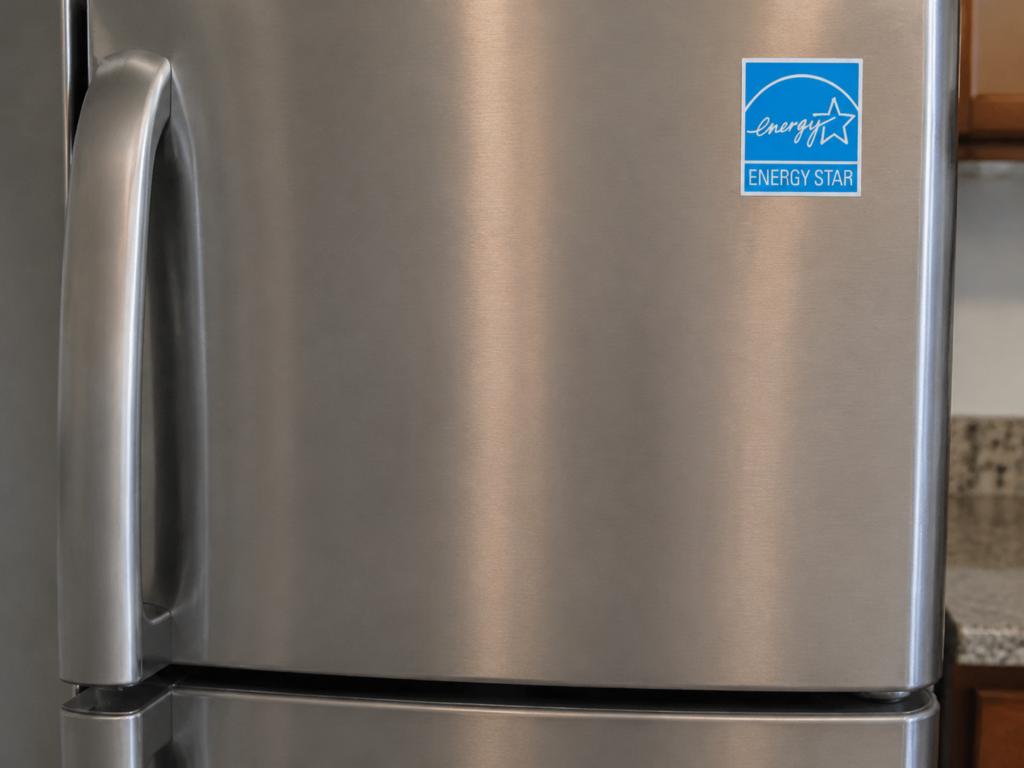
If you sell products in the U.S. market, work on construction projects in the U.S., or have bought home appliances while living in the U.S., you must have seen the ENERGY STAR label with a white house and a star on a blue background. It is a voluntary energy-saving certification label launched by the U.S. Environmental Protection Agency (EPA) in partnership with the Department of Energy (DOE). Its core function is to help consumers quickly identify products or buildings with energy efficiency higher than the general industry standard — simply put, only the batch of products that are more power-efficient and energy-saving among similar products are eligible to bear this label. It is not an ordinary environmental pattern designed by enterprises themselves, but a certification mark strictly bound by official rules. Violations of usage may result in product removal from shelves at best, and official fines at worst.
It should be clarified that ENERGY STAR is a voluntary energy-saving certification, not a mandatory safety certification like UL — enterprises can choose not to participate in the certification, but as long as they pass the certification and use the label, they must comply with official rules. The entire program is uniformly managed by the EPA, all usage requirements are subject to the officially released brand guidelines, and the rules will be adjusted with category updates and standard iterations, so old requirements from many years ago cannot be applied to current products.
The usage rules of the ENERGY STAR label cover multiple types of entities: certified manufacturers, brand owners, importers or OEMs are the core users; authorized distributors, retailers, and e-commerce sellers can also use it within the specified scope; building operators and project parties can use it in corresponding construction projects; ordinary consumers also need to understand the rules to identify the authenticity of products and avoid false advertising traps.
People who are new to this are prone to three cognitive misconceptions, so let’s clearly draw the boundaries here:
First, it is not the case that “a product can bear the label as long as it is energy-saving”. Even if the actual energy efficiency of a product is higher than the industry standard, as long as it has not gone through the officially designated certification process and been included in the official public list, the label cannot be used, otherwise it will directly constitute a violation.
Second, it is not an “enterprise-level certification”. Certification is only for specific product models, or individual buildings and projects. There is no such thing as “a company has obtained ENERGY STAR certification”, let alone using the label on all products of the entire brand or entire series.
Third, it is not a “mandatory requirement”. ENERGY STAR is a voluntary participation program. Products that have not passed the certification can be sold normally, except that they cannot use this label; even if they have passed the certification, enterprises can choose not to affix the label, but as long as they use it, they must fully comply with the rules.
Want to Use the Label? First Meet These 3 Preconditions
To use the ENERGY STAR label legally, it is not enough to just download a picture. Three core conditions must be met at the same time, and none is dispensable.
First, the Product/Project Must Have Valid Certification
First, the product or construction project for which you want to use the label must have passed the ENERGY STAR certification of the corresponding category and completed official listing — that is, it has been entered into the ENERGY STAR public database, which can be checked by anyone. Among them, product certification needs to meet the energy efficiency requirements of the corresponding category, and be tested by EPA-recognized third-party laboratories and audited by certification bodies; construction/project categories must also first be entered into the official public database with valid status, and the specific certification process is subject to the official rules of the corresponding project.
Here are a few easily overlooked details: only the official U.S. ENERGY STAR certification is valid; energy-saving certifications from other countries or regions (such as EU energy labels, China energy labels) cannot be mixed, nor can they be used as a basis for using the ENERGY STAR label; the certification status must be “valid”, and if it has expired, been officially revoked, or the corresponding model has been discontinued, the label can no longer be used.
Second, the User Entity Must Have Legal Qualification
It is not that anyone can use this label for promotion as long as the product has certification. The user entity must have legal qualification:
If it is a certified brand owner or manufacturer, it must have signed a partnership agreement with the EPA, which is the most basic qualification; if it is a distributor, retailer or e-commerce seller, it must obtain written permission from the certified party, and can only promote specific certified models within the authorized scope, and cannot expand the scope arbitrarily; third parties without direct authorization, such as advertising agencies and foundries, must not use the label for promotion without permission; ordinary consumers can only use the label to identify authenticity, and cannot use it for commercial promotion.
Third, the Certification Scope Cannot Be Expanded Arbitrarily
Even with certification and authorization, the label cannot be used arbitrarily on uncertified items:
The label can only be used on specific models or individual projects clearly listed on the certification certificate, and cannot be expanded to other models of the same series, the entire brand or the entire project scope; if the product is redesigned and key energy efficiency parameters change, certification must be reapplied for, and the label of the original certified model cannot be directly applied to the redesigned product; in addition, the certification of the main product does not mean that supporting accessories (such as chargers, filter elements, remote controls) and gifts can also use the label, which all require separate certification.
Semi-Proficient Judgment: How to Check Whether the Certification Is Valid
If you want to confirm the certification status of a product or a project, the most authoritative method is to log in to the public database on the official ENERGY STAR website and enter the product model or project name to query. When checking, pay attention to three points: first, the brand, model, and key parameters must be completely consistent with the actually sold product, to avoid confusion between different models of the same series; second, confirm that the status is “valid” and there are no marks such as expired, revoked, or suspended; third, if you are a distributor, you must also confirm that your authorization corresponds to the certified model, and you cannot use it beyond the scope.
The Label Itself Cannot Be Modified Arbitrarily: These Visual Red Lines Must Not Be Crossed
Many violations start with modifying the label style. ENERGY STAR has very strict visual requirements for the label itself, and the core principle is “the official original version must be used, and no elements can be altered”.
First, the official original materials must be used: all label source files must be downloaded from the EPA’s ENERGY STAR Brand Center, and you must never draw them yourself or take screenshots from web pages to make do. The core elements of the label — the blue hemispherical background, the white house with a star pattern, and the all-uppercase standard “ENERGY STAR” font — none of them can be modified. Moreover, different categories have exclusive label versions: those for products, residential use, and commercial buildings each have their own styles and cannot be mixed; for example, product labels cannot be affixed to buildings.
Explicitly prohibited visual modifications include: the label cannot be stretched, flattened, or rotated; the color, font, and element proportions cannot be changed; shadows, glows, strokes, 3D effects cannot be added, nor can any additional decorative patterns be added; the elements of the label cannot be disassembled and reassembled, let alone the label be repeatedly arranged as a background image.
Regarding size, clarity, and white space, the minimum size requirements for different scenarios (such as product surfaces, outer packaging, promotional flyers, digital advertisements) are different, and the specifics are subject to official guidelines, but the core requirement is to ensure that the label is clear and recognizable: the digital version cannot be stretched and blurred, and the printed version cannot have ghosting or misregistration. Sufficient safe blank area must be left around the label, and it cannot be blocked or squeezed by other text or patterns, to ensure the independence of the label.
There are also special versions and matching rules: special labels such as black and white version, monochrome version, and reverse white version can only be used in officially permitted scenarios, such as monochrome printing or dark backgrounds, and cannot be used arbitrarily on ordinary light-colored backgrounds; if placed side by side with other certification labels or brand logos, they must remain independent of each other, and cannot be placed too close so that consumers mistakenly think it is a “joint certification”; the ENERGY STAR label must not be deliberately shrunk to a very small size, or placed in easily overlooked positions such as the corner of a page or the back of a product.
How to Use in Different Scenarios: Products, E-commerce, Offline, and Construction Each Have Their Own Rules
In addition to the style requirements of the label itself, different usage scenarios also have corresponding rules, and the core is “not to mislead consumers”.
Product Body and Packaging Scenarios
The label on the product body must be affixed to a conspicuous position on the appearance that is not easy to wear, and cannot be hidden in places that consumers cannot see, such as the battery compartment or the instruction manual. The label on the outer packaging must be placed on the same visible surface as the product model and brand information, and must not make consumers mistakenly think that the entire box of products or uncertified accessories in the package also meet ENERGY STAR requirements. Labels on supporting materials such as product manuals and warranty cards must correspond one-to-one with the corresponding certified models, and ENERGY STAR labels cannot be printed on the manuals of all models.
Online E-commerce and Digital Promotion Scenarios
E-commerce sellers should pay special attention: the label can only be used on the main image and detail page of the corresponding certified model, and cannot be placed in areas where uncertified products are displayed, such as the store homepage or related recommendation positions. The digital label must meet the size and proportion requirements; even small-sized labels in thumbnails and carousel images must be clearly recognizable, and the style cannot be modified by photo editing. When using the label in social media or video advertisements, it must appear together with the specific certified model, and the label cannot be used alone as a general environmental symbol, to avoid consumers mistakenly thinking that the entire brand has passed the certification.
Offline Promotion and Retail Display Scenarios
If the ENERGY STAR label is used on offline posters, display stands, or leaflets, it must correspond to specific certified products, and the label cannot be placed alone as an “environmental endorsement” without the product. When displaying on retail shelves, certified products and uncertified products must be placed separately to avoid mixed placement that makes consumers mistakenly think that the adjacent uncertified products are also certified. Only when all products involved in this promotion have been certified can the label be used for related overall promotion; the label must not be used alone as an endorsement for the enterprise’s general environmental image without specific certified products.
Construction/Project Scenarios
For residential projects (such as apartments and single-family homes), the ENERGY STAR label must be affixed to a conspicuous public position at the entrance or next to the electricity meter box, for the convenience of residents or home buyers to check. For commercial buildings, the exclusive building label must be displayed in the lobby or public area in accordance with official certificates or corresponding project requirements; if information such as grades and scores is involved, it shall be subject to the clear requirements of official materials, and grades or scores shall not be created independently. The exclusive version of the label is used for construction categories, which cannot be mixed with product labels; moreover, just because the entire building has passed the certification, ENERGY STAR labels cannot be affixed to uncertified individual home appliances and equipment in the building.
What to Say in Promotion: The Boundary Between Compliance and Violation
In addition to the label itself, the supporting promotional text also has strict requirements, and the scope cannot be arbitrarily exaggerated or blurred.
First are the recommended compliant expressions: in Chinese, you can say “能源之星认证” (ENERGY STAR certified), “符合能源之星能效要求” (meets ENERGY STAR energy efficiency requirements), “本型号已获能源之星认证” (this model has obtained ENERGY STAR certification); in English, the official standard expression “ENERGY STAR certified” is uniformly used. All expressions must clearly point to specific certified models or projects, and the scope cannot be blurred.
Prohibited violation expressions are mainly divided into three categories:
The first category is absolute rhetoric, such as exaggerated statements like “most energy-saving”, “top-level power saving”, “government-recommended best energy saving”. ENERGY STAR only means that energy efficiency is higher than the general standard, and does not mean “the best” or “top-level”.
The second category is expanded rhetoric, such as statements beyond the certification scope like “all series are certified”, “ENERGY STAR designated brand”, “all products of the company meet the standards”.
The third category is borderline expressions, such as unofficial terms like “节能之星” (energy-saving star) and “Energy Star level”. The official names “能源之星” and “ENERGY STAR” must be used strictly.
If the promotion involves specific data such as energy saving percentages and efficiency indicators, the test conditions and test caliber must be clearly marked. Test results of different categories and different versions of standards cannot be directly compared, and data without official test basis must never be marked arbitrarily.
Semi-Proficient Judgment: Core Standards for Compliant Rhetoric
To judge whether a piece of promotional rhetoric is compliant, in fact, you only need to look at three points: first, whether it clearly points to a specific certified model or project, and whether the scope is blurred; second, whether there are exaggerated or absolute expressions; third, if specific data is involved, whether there is official test basis to support it. As long as these three points are met, you will basically not fall into the trap of rhetoric violations.
What Happens If You Violate the Rules: Common Violations and Consequences
Many people think “it’s just a label, no one will check if I use it”. In fact, the EPA will verify compliance through various channels such as regular spot checks and consumer reports, and the consequences of violations are far more serious than imagined.
Two Most Common Types of Violations
The most core red line is qualification violations, which also carry the heaviest penalties: for example, affixing the label without passing certification, or continuing to newly use it after the certification has expired or been revoked; using beyond the certification scope, for example, only refrigerators are certified, but labels are affixed to freezers and accessories; there is also illegal authorization, where the certified party lends the label to an unqualified third party, or a third party uses it without obtaining authorization.
The second category is visual and scenario violations, which are also the most likely to be accidentally committed: for example, tampering with the label style, changing colors, proportions, fonts, or adding additional effects; using old versions of labels that have been discontinued, or using screenshots or self-drawn versions; there is also scenario abuse, for example, promoting that the entire brand and store are certified with only a single product certified, or using product labels instead of building labels.
Common Consequences of Violations
If a violation is found, you will first face official penalties from the EPA: the EPA has the right to require immediate rectification. The amount of fines for violations will vary with applicable regulations, annual adjustments, and specific circumstances. The maximum fine for a single violation can reach tens of thousands of dollars, and the specifics are subject to the EPA’s official enforcement announcements, partnership agreements, and current effective penalties. In serious cases, product certification will be revoked, partnership agreements will be terminated, and even future participation in the ENERGY STAR program will be prohibited.
In addition to official penalties, there are also many commercial risks: for example, e-commerce platforms will directly remove violating products, affecting store weight; consumers’ trust will decline after discovering false advertising, and they may even be sued for false advertising or trademark infringement.
Inventory Handling Rules After Certification Expires
Many people will ask: if the certification expires, can the previously produced inventory still be sold? This depends on the situation: if the original certification expires because ENERGY STAR has updated the category standards, then the compliant inventory that has been produced can continue to be sold with the label within the officially stipulated transition period; if the certification is revoked by the EPA due to violations, then all inventory can no longer be sold with the label, and all labels must be removed immediately. The specific length of the transition period is subject to the official notice issued by ENERGY STAR for that category, and there is no general unified period.
Practical Guide: Compliance Self-Inspection and Authenticity Identification
At the practical level, merchants and consumers can quickly check according to the following methods:
3-Step Compliance Self-Inspection Method for Merchants
If you are a merchant or operator using the label, as long as you follow three steps, you can cover most common violation risks:
Step 1: Check qualifications. Confirm that the corresponding product or project is valid in the official database, that you have legal authorization to use (such as partnership agreements, written authorization letters from the certified party), and that the authorization scope matches the products/scenarios used.
Step 2: Check materials. Confirm that the label used is the latest version downloaded from the official Brand Center, with no modification, deformation, or blurring, and the white space also meets the requirements.
Step 3: Check scenarios. Confirm that the label is only used on products or projects within the certification scope, the supporting promotional text is not exaggerated or misleading, and the expressions across all channels (such as Amazon, independent websites, offline posters) and multiple languages are consistent.
In addition, pay attention to regular review. It is recommended to check the certification status and official rules for updates every quarter, and all certification documents and authorization documents must be kept properly for EPA spot checks.
Methods for Ordinary Consumers to Identify Authenticity
If you are an ordinary consumer who wants to confirm whether the ENERGY STAR label on a product is real, you can check from three aspects:
First, check the model. Enter the product model into the public database on the official ENERGY STAR website to see if there is a corresponding valid certification, and whether the brand and parameters match.
Second, look at the label. Check whether the color, pattern, and font of the label are standard, and whether there is deformation, blurring, or additional decoration. For example, if the blue label is changed to green, or a leaf is added, it must be fake.
Third, distinguish the rhetoric. If there are exaggerated statements in the promotion such as “most energy-saving” or “government recommended”, or borderline names such as “节能之星” (energy-saving star), you should be vigilant. If you find a suspicious violating label, you can report it through the reporting portal on the EPA official website or the reporting channel of the corresponding e-commerce platform.
Rectification Priority After Discovering Violations
If you accidentally find that you have a violation, do not delay with a fluke mentality. Handling according to the following priorities can minimize risks: immediately remove the violating label content from all channels to avoid continued violations; then carefully check the certification qualifications and authorization scope, and re-use the compliant label after clarifying the compliance boundaries; if the scope of the violation is relatively large, you can proactively report the situation to the EPA to seek lenient treatment; all rectification records, certification and authorization documents must be kept properly for subsequent spot checks.
Don’t Confuse: Several Groups of Easily Misidentified Concepts
In the rules of ENERGY STAR, there are several groups of concepts that are often confused, so we will specifically distinguish them clearly here.
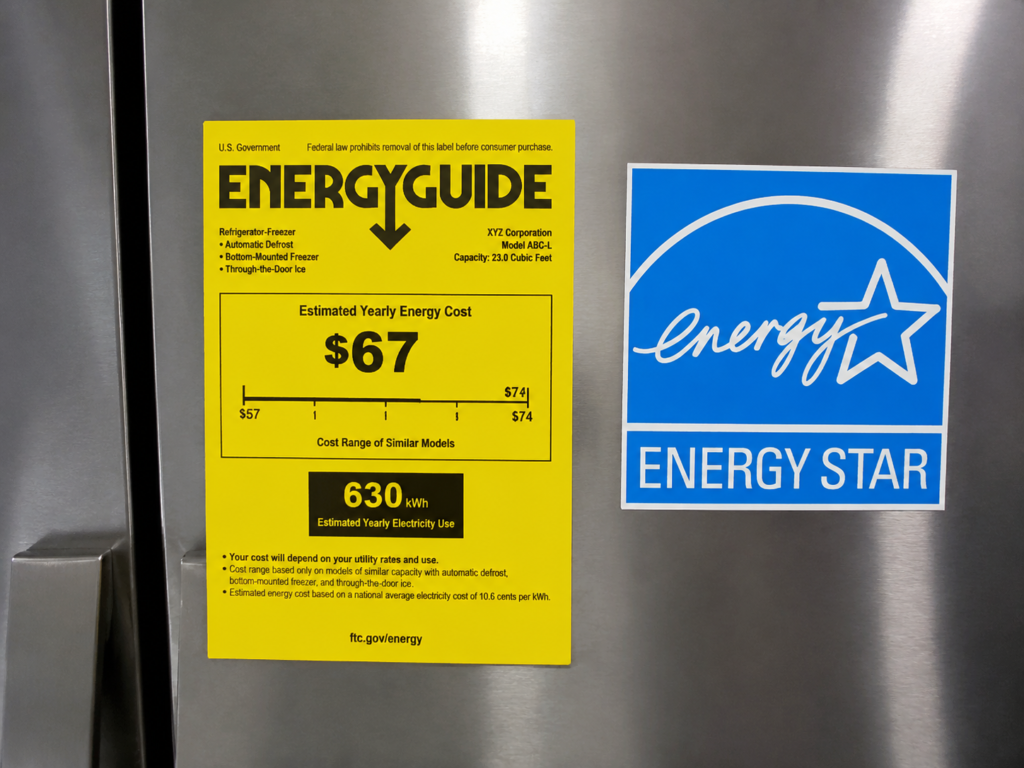
ENERGY STAR Label vs. U.S. Mandatory Energy Label (EnergyGuide)
Many people confuse ENERGY STAR with EnergyGuide (also called the yellow label). In fact, the two are completely different, and a table comparison is clearer:
| Comparison Dimension | ENERGY STAR Label | EnergyGuide Mandatory Energy Label |
|---|---|---|
| Nature | Voluntary certification | Federal mandatory requirement |
| Core Function | Marks top products with energy efficiency higher than general standards | Displays product energy consumption range and ranking among similar products |
| Scope of Application | Only specific certified models/projects; energy efficiency thresholds and certification rates are adjusted with categories and specification versions | Products for sale in relevant categories covered by FTC rules |
| Administrator | EPA + DOE | U.S. Federal Trade Commission (FTC) |
Simply put, EnergyGuide must be affixed to all products in relevant categories covered by FTC rules, to tell consumers what level the energy consumption of this product is among similar products; while ENERGY STAR is voluntary, and only products with energy efficiency ranking at the forefront of similar products can obtain it (specific thresholds and certification rates vary with categories and specification versions, no fixed standard), which is equivalent to a mark of “selecting the best from the best”. The two can appear on the same product at the same time, but they cannot replace each other.
ENERGY STAR Label vs. Ordinary Environmental Patterns
There are also people who regard environmental patterns made by enterprises themselves as ENERGY STAR, such as green leaves, blue stars, etc. Note: ENERGY STAR is an official certification mark with strict certification processes and usage rules, and cannot be used just by drawing a similar pattern casually; ordinary environmental patterns are created by enterprises themselves, which only represent the enterprise’s own environmental claims, and do not represent official energy-saving certification. Using patterns similar to ENERGY STAR to mislead consumers is a violation, and in serious cases, it will constitute trademark infringement.
“Searchable in Database” vs. “Qualified to Use”
Many people think “if the product can be found in the ENERGY STAR database, I can use this label for promotion”. In fact, these are two different things: being searchable in the database only means that this model of product has passed ENERGY STAR certification; but only the certified party, or the entity authorized by the certified party, is qualified to use this label for commercial promotion. Even if you download the genuine label file from the official website, as long as there is no legal authorization, unauthorized use is a violation.
Summary of Core Judgment Standards
All rules can be condensed into four core judgment standards, applicable to quick checks in all scenarios:
First is qualification judgment: the corresponding product or project has valid certification, and the user entity has legal authorization;
Second is style judgment: the label is the latest official original version, with no modification, deformation, or blurring, and the white space meets the requirements;
Third is scenario judgment: it is only used within the certification scope, and the supporting text is not exaggerated or misleading;
Fourth is dynamic judgment: regularly check the certification status and official rules, and immediately stop using once the certification expires or the authorization changes.
Adhering to these four points can avoid the vast majority of violation risks.