
In the U.S. energy efficiency system, the three most frequently mentioned concepts—DOE energy efficiency requirements, the Energy Star label, and the EnergyGuide yellow label—are also very easily confused: some people think products without Energy Star are unqualified, some equate DOE energy efficiency with a low-end energy efficiency line, and others mistake the yellow label for a certification. In reality, the three have clearly defined roles, and the connections and differences between Energy Star and DOE energy efficiency are the most prone to misunderstanding. This article will break down the relationship between the two from five dimensions: regulatory division of labor, system connections, core differences, practical applications, and common misconceptions, to help readers establish a clear judgment logic.
First, Get the Basics Straight: Division of Labor of the Three Core Roles
The prerequisite for understanding the relationship between the two is to first clarify the positioning and division of labor of the three core roles in the U.S. energy efficiency system. Each of the three has its own area of responsibility and cannot replace the others.
The first role is DOE energy efficiency, which refers to the energy efficiency rules formulated by the U.S. Department of Energy (DOE for short). You can think of it as the “entry passing line” for the U.S. market: it is a mandatory federal legal requirement, and regulated products that do not meet it cannot be legally sold in the United States at all. It mainly covers civilian and commercial equipment with high power consumption and high sales volume, such as refrigerators, air conditioners, washing machines, and LED lights. Many people mistakenly believe that DOE is a “high energy efficiency label”, but that is not the case at all—it is just the minimum threshold. Meeting the threshold only means that products of the corresponding category can be sold legally, and does not represent a high level of energy efficiency.
The second role is Energy Star, a high energy efficiency label launched by the U.S. Environmental Protection Agency (EPA for short) in collaboration with the DOE, equivalent to a “top student medal”. It is applied for voluntarily: manufacturers can apply if they want the label, and it is fine if they do not, as long as the product meets the mandatory access requirements for the corresponding category, it can be sold normally. Its function is to help consumers quickly identify more energy-saving products, and its coverage is much wider than that of DOE: in addition to the high-energy-consumption products regulated by DOE, it also includes products such as computers, monitors, and office equipment that have low per-unit power consumption but high total usage. Even residential buildings, commercial buildings, and industrial facilities can obtain Energy Star certification.

The third role is the EnergyGuide yellow label. Many people mistake it for a certification, but in fact it is just an “energy consumption report card” that the U.S. Federal Trade Commission (FTC for short) mandates to be posted. It is not a certification of any kind: it neither proves that the product has passed DOE requirements nor that it has Energy Star. It simply clearly states the product’s annual electricity consumption, estimated annual electricity cost, and the energy consumption range of similar products, to facilitate horizontal comparison by consumers.
For easy memorization, you can refer to the quick reference table below:
| Name | Core Positioning | Nature | Regulatory Agency |
|---|---|---|---|
| DOE Energy Efficiency | Legal access threshold for regulated products | Federal mandatory | U.S. Department of Energy (DOE) |
| Energy Star | Identification label for high energy efficiency products/facilities | Voluntary application | U.S. Environmental Protection Agency (EPA) in collaboration with DOE |
| EnergyGuide Yellow Label | Horizontal comparison tool for energy consumption information | Mandatory disclosure | U.S. Federal Trade Commission (FTC) |
The specific responsibilities of the three agencies have their own focuses: the DOE is responsible for formulating mandatory energy efficiency thresholds, issuing unified testing methods, and carrying out compliance enforcement; the EPA takes the lead in formulating Energy Star product specifications, managing third-party certifications, and investigating and punishing label abuse; the FTC is responsible for formulating EnergyGuide information disclosure rules and cracking down on false energy consumption publicity.
Core Connections: Overlap and Linkage of the Two Systems
The two are not completely independent systems. Their core connections are reflected in three aspects: testing methods, energy efficiency levels, and management coordination.
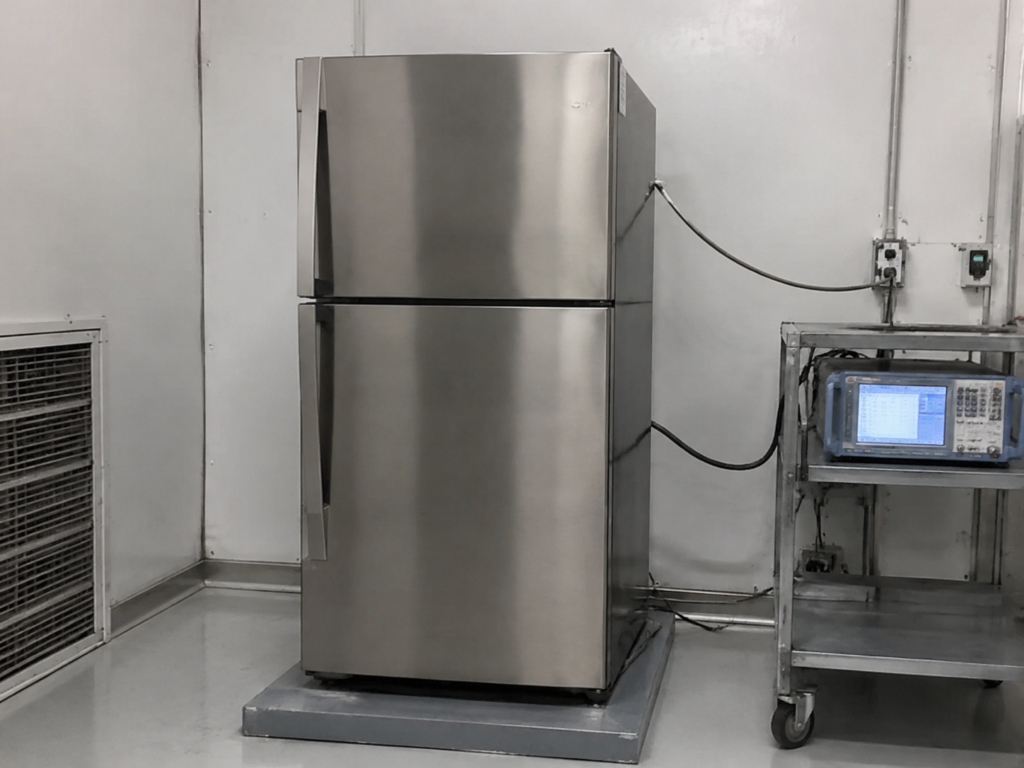
First is the compatibility and differences in testing methods. For overlapping covered categories for which the DOE already has unified testing procedures, Energy Star usually directly references DOE testing methods, eliminating the need for manufacturers to redo basic tests, and core data can be directly reused. For example, for the basic energy consumption test of refrigerators, the DOE has already set the test environment and test steps, so Energy Star directly uses this result, and only requires additional testing of items not required by the DOE—such as more detailed indicators like standby power consumption, networked mode power consumption, and sleep mode energy consumption. After all, to evaluate “top students”, the requirements are naturally more detailed. The test data from both sides are stored in the DOE Compliance Database and the EPA Energy Star Qualified List respectively, and can be used for cross-verification.
Second is the hierarchical relationship of energy efficiency thresholds. From a hierarchical perspective, among the categories covered by both, the DOE is the legal mandatory access bottom line, while Energy Star is a voluntary high energy efficiency line, whose requirements are usually higher than the DOE bottom line. There is no unified figure for how much higher; the gap varies by category and standard version, and the specific shall be subject to the officially released product specifications. For some categories, Energy Star also adds sub-indicators not covered by the DOE, such as standby power consumption, sleep mode power consumption, etc. The standards of the two are adjusted in linkage: the DOE usually regularly evaluates whether energy efficiency standards need to be revised in accordance with statutory mechanisms, with a common evaluation cycle of about 3 to 5 years, and dynamically adjusts the access threshold with technological progress. However, the rule formulation and effective time for specific categories vary depending on policy processes and the pace of technological iteration. Energy Star also usually adjusts its own requirements synchronously or with a slight lag to maintain its high energy efficiency positioning above the DOE bottom line; if DOE standards approach or exceed the existing Energy Star threshold, the EPA usually restores differentiation by revising specifications, setting transition periods, or adjusting eligibility requirements, subject to the official specifications and effective dates of the corresponding products.
Finally, there is management coordination and data interoperability. The DOE provides technical support for Energy Star, such as the formulation of testing methods and the calculation of energy efficiency baselines; after all, the DOE has more comprehensive technical data accumulated in the field of energy efficiency testing. The DOE, EPA, and FTC may share or reference part of the testing and certification information within their respective terms of reference to facilitate cross-verification and coordinated law enforcement, but the three agencies still have clear responsibility boundaries and carry out work within their respective jurisdictions.
Key Differences: Core Differences in Positioning, Scope, and Verification
Despite their close connections, the two have core differences in positioning and nature, coverage scope, and verification rules. They are rules at different levels in the U.S. energy efficiency system, and getting them wrong may lead to pitfalls in product selection or compliance.
The first and most core difference is that the nature and consequences of violations are different. DOE energy efficiency is a mandatory access requirement for regulated categories. Selling products that do not meet the standards is a clear violation of the law, the products will be prohibited from being marketed, and may also face high fines. Energy Star, on the other hand, is applied for voluntarily. Even if it is found to be unqualified after application, the worst result is the revocation of the right to use the label. As long as the product meets the mandatory access requirements for the corresponding category, it can still be sold normally, and basic compliance will not be affected. There is a very important logic to remember here: only in overlapping covered categories where the DOE has corresponding mandatory standards, Energy Star certification is usually based on DOE compliance (after all, the Energy Star threshold for such categories is usually higher than the DOE bottom line); for categories only covered by Energy Star, such as computers and buildings, it is impossible to infer whether the product meets DOE requirements from the Energy Star label—most of these categories themselves do not have corresponding DOE mandatory standards.
The second difference is different coverage scope. The overlapping part of the two is those civilian and commercial equipment with high energy consumption and large sales volume, such as refrigerators, washing machines, household air conditioners, and LED lights. The DOE has mandatory requirements for these, and Energy Star also has corresponding high energy efficiency standards. But Energy Star’s coverage is much wider: for office equipment with low energy consumption but high usage such as computers, monitors, and printers, as well as residential buildings, commercial buildings, and industrial facilities, the DOE does not have unified mandatory energy efficiency standards, but Energy Star has corresponding certifications. Conversely, there are also some special commercial or industrial equipment for which the DOE has mandatory energy efficiency requirements, but there is no corresponding Energy Star certification because the audience is too small.
The third difference is different verification rules and official query channels. DOE compliance adopts the “manufacturer self-test + data submission + random spot check” model: after the manufacturer completes the test in accordance with the standards, it must submit the data to the DOE Compliance Certification Database (CCMS for short, the official DOE compliance certification database), and the DOE conducts regular random spot checks. Regulated products do not have an exclusive DOE label, and compliance status can be verified by searching the model in the above-mentioned database.
Energy Star certification must be reviewed and approved by a third-party organization recognized by the EPA. Products can only use the blue star label after being included in the EPA’s official qualified list, and certification status can be verified through the ENERGY STAR Product Finder (the official Energy Star qualified product query tool).
The EnergyGuide yellow label is an information disclosure document mandated by the FTC to be posted. It can be verified through the FTC EnergyGuide/Appliance Energy Database (only applicable to categories with yellow label requirements), and is only for energy consumption information disclosure, not representing compliance or certification.
The above public databases are only used for energy efficiency information verification, and do not replace the full-process compliance judgment for products entering the U.S. market.
How to Use in Practical Scenarios: Practical Methods for Product Selection and Compliance
After clarifying the connections and differences between the two, the following methods can be applied to daily product selection and compliance judgment scenarios.
Four Steps for Ordinary Consumers to Select Products
First step: Check compliance: If the product belongs to a DOE-regulated category (such as major home appliances, air conditioners, LED lights), first confirm that it meets DOE mandatory requirements to avoid buying products from non-compliant channels that do not meet the requirements. You can ask the merchant to provide a compliance certificate, or search for the product model in the official DOE compliance certification database by yourself; if the product is not within the scope of DOE regulation (such as computers, monitors), you can refer to Energy Star official specifications or other applicable energy efficiency rules to verify basic information.
Second step: Filter for energy savings: If you want to save on electricity bills, for categories with DOE mandatory standards, prioritize products with Energy Star under the same specification—for example, for 1.5-horsepower air conditioners of the same specification, those with the star label are usually more energy-efficient than ordinary models that just barely meet the DOE line; for categories without DOE standards, you can also prioritize products with Energy Star, as there is at least a unified reference standard for energy efficiency.
Third step: Compare details: If several products all have Energy Star, compare their EnergyGuide yellow labels (only applicable to categories with yellow label requirements) and look at the estimated annual electricity cost marked on them; the lower the value, the more energy-efficient. After all, even if they all meet Energy Star requirements, there are still differences in energy efficiency among different products.
Fourth step: Calculate the total cost: Don’t just look at the label; calculate the total cost over 3 to 5 years—that is, the sum of “purchase price + electricity cost + maintenance cost”. Some Energy Star products have a much higher selling price than ordinary models. If it takes more than ten years to recoup the cost from the saved electricity bills, and you plan to replace the appliance in three to five years, then it may not be necessary to spend the extra money.
Judgment Logic Varies by Category
Not all categories of Energy Star have the same gold content. For categories with DOE mandatory standards (such as major home appliances, air conditioners, LED lights), Energy Star is a real high energy efficiency bonus, because there is a unified bottom line for reference, and products with the star label usually have higher energy efficiency than ordinary qualified products.
But for categories without federal DOE mandatory standards, the judgment logic is divided into two types: for tangible products such as home appliances and electronic equipment, you can only compare products that also have the Energy Star label, of the same category and specification. You cannot say “those with the star are definitely better than those without”—some products that have not applied for certification may also have high energy efficiency, but the manufacturer just thinks the certification cost is not cost-effective and did not apply; for facility-type objects such as residential buildings and commercial buildings, comparisons must be made based on the same building type and similar area/usage scenarios, and cross-category judgment cannot be made directly. Also note that for these categories without federal DOE standards, individual states may have their own requirements, or government procurement and energy subsidy programs may require Energy Star, which should be judged in combination with the specific scenario.
Don’t Ignore the Iteration of Standard Versions
Many people don’t know that neither DOE nor Energy Star standards are static; they are regularly updated with technological progress, and certifications are not valid for life. For example, a refrigerator that met Energy Star standards in 2019 may no longer meet the new requirements after the standard was updated in 2023. So when buying products or making bulk purchases, be sure to check the currently valid standard version, and don’t assume that a star label means the latest high energy efficiency. The official database will mark the standard version and effective date corresponding to each product, which is clear with a single check.
Precautions for Overseas Users Purchasing U.S.-Standard Products
If you buy U.S.-standard products outside the United States, or buy appliances from the United States and bring them back to your own country for use, pay attention to two points: First, U.S. energy efficiency tests are carried out in accordance with the rated voltage, test environment, and usage assumptions specified in the corresponding product specifications; some categories such as home appliances and air conditioners also involve test conditions such as climate zones, seasonal energy efficiency, or specific operation modes, which may differ from the test benchmarks of other countries, and actual power consumption during use will vary. Second, U.S. DOE and Energy Star standards only apply to the U.S. market and cannot be used as compliance certificates for other countries. Products imported or exported to other countries must meet local energy efficiency requirements.
Avoiding Common Misconceptions: 5 Most Easily Misunderstood Concepts
The following are 5 common cognitive misconceptions about the relationship between the two, which need to be distinguished carefully.
Misconception 1: Energy Star is a mandatory requirement, and no label means unqualified
This is the most common misunderstanding. Only DOE energy efficiency is a mandatory access requirement at the U.S. federal level for regulated categories. Energy Star is completely voluntary; manufacturers can choose to apply or not, and as long as the product meets the mandatory requirements of the corresponding category, it can be sold legally. Of course, there are exceptions: for example, some state government procurement or energy subsidy programs require products to have Energy Star to participate, but this is only a requirement for specific scenarios, not a mandatory rule for the entire retail market.
Misconception 2: Products with Energy Star are definitely more energy-efficient than ordinary products
This statement is only valid under the premise of “same category, same specification, same function, same usage scenario”; there is no comparability at all across categories, capacities, or scenarios. For illustrative purposes only, the annual absolute power consumption of a large-capacity high-efficiency refrigerator may be higher than that of a small-capacity ordinary qualified refrigerator. The specific value shall be subject to the product’s EnergyGuide yellow label or the information published in the official database. So when comparing, be sure to align the specifications and scenarios first.
Misconception 3: DOE energy efficiency is a “low-end line”, and products that pass DOE have poor energy efficiency
This is a complete misunderstanding. DOE is just the minimum compliance threshold required by law, not an energy efficiency grade classification. It only proves that “this regulated product can be sold legally”, and does not represent good or bad energy efficiency. Moreover, DOE standards are regularly raised with technological progress. For example, today’s passing line may have been a top-level high energy efficiency level 10 years ago, so “passing DOE” cannot be taken as a sign of poor energy efficiency.
Misconception 4: The two are completely independent sets of standards
That’s not actually the case. For overlapping categories covered by both, Energy Star mostly directly uses DOE testing methods, only raising the energy efficiency threshold on the basis, and may also add some detailed requirements that DOE does not have. When manufacturers apply for Energy Star, the basic test data can directly use the results of DOE compliance tests, without having to retest everything. So the two are not completely separated, but have a deep connection. However, for categories only covered by Energy Star, there is no direct corresponding relationship between the two, and they cannot be confused.
Misconception 5: Products with Energy Star definitely have lower total usage costs
Many people think that high energy efficiency equals saving money, but that’s not necessarily the case. Total usage cost is the sum of purchase price, electricity cost, and maintenance cost. Because Energy Star products have higher technical requirements, their selling prices are usually more expensive than ordinary models, and some with smart functions also have higher maintenance costs. If you use it very rarely, for example, an air conditioner that is only turned on 10 days a year, the extra money may not be saved even until the product is scrapped. Generally speaking, the higher the frequency of use of a product (such as a refrigerator that is plugged in every day, an air conditioner that is often turned on in summer), the more cost-effective it is to buy Energy Star; for low-frequency use products, you can calculate the cost yourself before deciding.
Summary
At the end of the day, the three core roles of the U.S. energy efficiency system each have clearly defined responsibilities: the DOE is in charge of mandatory access, which is the legal bottom line for regulated energy-consuming products to be sold legally in the United States; Energy Star is in charge of higher energy efficiency, a voluntary high energy efficiency label with a wider range of covered categories, and only in overlapping covered categories is it usually upgraded based on DOE standards; the EnergyGuide yellow label is in charge of information disclosure, a public tool to help consumers compare energy consumption horizontally.
By clarifying these three layers of relationships, when purchasing U.S.-standard home appliances or selecting products for the U.S. market, you can not only quickly judge the basic compliance of products, but also select more suitable high-energy-efficiency products under the same specifications and scenarios, without equating “no Energy Star” with “product unqualified”, nor blindly paying a premium for the label. When in doubt, you can directly query through the corresponding official database, and all public information related to energy efficiency is available for free.