
International students who have just arrived in Japan and want to throw away an old phone may search the waste disposal guide for a long time without finding the corresponding category; small cross-border e-commerce sellers selling Bluetooth earphones to Japan may suddenly be notified that they bear recycling responsibility — many overseas users encounter pitfalls in electronics recycling when entering the Japanese market. Japan’s recycling rules may seem detailed and complicated, but as long as you understand the liability logic behind them and verify step by step by product category, identity, and location, it is actually not difficult to make a judgment.
I. Basic Understanding: Jurisdiction Scope and Core Logic
Plain-Language Essence and Core Rules
The essence of Japan’s electronics recycling is to assign clear responsibilities for the entire chain of e-waste from production to end-of-life, to avoid gray areas where no one is in charge. The core logic of this set of rules is called Extended Producer Responsibility (EPR). In plain terms: enterprises that produce or import products shall bear the main responsibility for the recycling and utilization of products after they are scrapped, and cannot walk away after selling the products.
The purposes of formulating these rules are also very clear: first, to reduce soil and water pollution caused by heavy metals in e-waste; second, to recycle rare resources such as gold, silver, and rare earths in mobile phones and computers for circular use; third, to clarify the principle that “producers/importers bear primary responsibility, and discarders cooperate”, so that the corresponding responsible person can be found when problems arise.
Applicable Boundaries: Preliminary Screening Method and Common Exceptions
To determine whether a product is subject to the special civil recycling system, three core dimensions are examined: product category attribute, waste status, and distribution scenario. Only when the three prerequisites of “circulating within Japan, for civil use, and for the purpose of discarding” are met at the same time will the corresponding special recycling rules apply.
Several common situations are not subject to the special civil recycling system:
1. Electronic equipment in professional fields such as industrial production, automotive, and medical care follow separate industrial waste rules;
2. Old products that can still be used normally are resold, given to others, or individuals disassemble usable parts for their own use, and no waste that needs to be discarded is generated, so there is no need to go through the special recycling process;
3. Ordinary small electronic items that do not belong to the specific recycling system may be treated as general waste according to the rules of municipalities, and are not required to go through special recycling channels uniformly.
It should be specially noted that whether a product constitutes waste shall be comprehensively judged in combination with its actual state and disposal purpose — for example, equipment that is damaged and cannot be repaired is still essentially waste even if it is listed for sale on a second-hand platform, and must be handled in accordance with recycling rules.
Division of Responsibilities in the Core Legal Framework
Japan’s e-waste recycling does not use one set of rules for all products, but has different systems by product category, plus a catch-all penalty provision, with a clear division of responsibilities:
| Product Category Scope | Corresponding Law/System | Core Management Method |
| Four types of large home appliances: air conditioners, televisions, refrigerators/freezers, washing machines/dryers | (commonly known as the ) | A unified mandatory system nationwide, where manufacturers, importers, and retailers perform their obligations in accordance with regulations |
| Small electronics such as mobile phones, cameras, game consoles, small home appliances, tablets, etc. | (commonly known as the ) | Centered on voluntary collection participation by municipalities and treatment by state-certified operators, with large differences in rules across regions |
| Home computers and monitors | PC recycling rules under the + supplementary small home appliance recycling channels | Brand-led recycling arrangements, with local channels providing supplementary coverage |
| Penalties for violations of all e-waste rules | Catch-all penalty provision, punishing acts such as illegal discarding and unqualified treatment |
4 Most Common Misconceptions for Beginners
People who are new to this are most prone to 4 cognitive biases. Here we correct them in advance, and specific rules will be explained in detail later:
First, the recycling rules are not the same for all electronic products — Japan has different systems for large home appliances, home PCs, and small home appliances. Some products may be treated as local general waste, and the requirements for discarding a refrigerator are completely different from those for discarding earphones;
Second, recycling responsibility is not entirely borne by consumers — producers, importers, and sellers bear the main treatment or collection responsibilities under the corresponding systems, and consumers only need to cooperate with disposal;
Third, products subject to special recycling systems cannot be thrown away as ordinary waste or oversized waste — regulated products such as the four types of large home appliances and home PCs must go through formal channels, and mixed discarding may be suspected of violating the law;
Fourth, there is no unified national price for recycling fees — they vary by product category, brand, size, recycling channel, and region.
II. Obligation Division of Responsible Entities in the Entire Chain
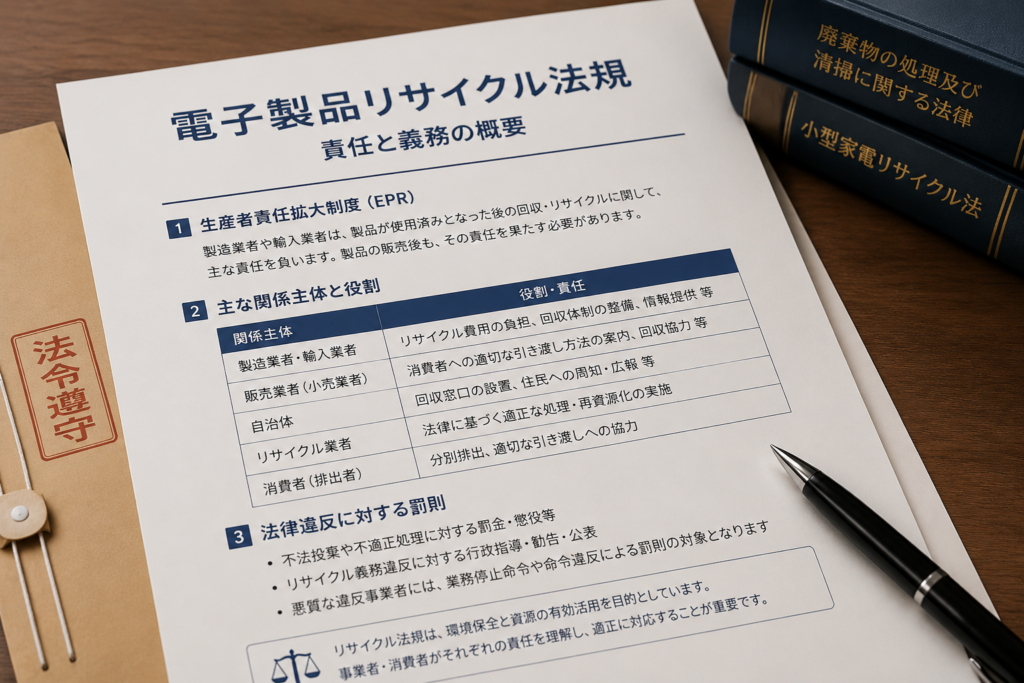
The reason why Japan’s e-waste recycling rules can be implemented is that the responsibilities of each link are clearly divided according to different systems, and there are corresponding requirements for what each party should do. It should be noted that EPR is a general understanding framework, which does not mean that producers of all electronic products bear the same obligations in terms of design, recycling rate, fee disclosure, or recycling. The responsible entities and the content of their obligations vary greatly under different systems.
Core Responsibilities of Producers/Importers
Under different systems, the obligations of producers and importers are not exactly the same, and need to be judged according to the system to which the product belongs:
• Four types of large home appliances (*Home Appliance Recycling Act*): Manufacturers and importers bear the recycling obligation, and must meet the statutory recycling benchmarks for the corresponding product categories. Product design must meet the statutory requirements of being easy to dismantle and recyclable. At the same time, information such as product recycling channels, treatment methods, and recycling fees must be disclosed;
• Home PCs (PC recycling rules under the *Act on Promotion of Effective Utilization of Resources*): Manufacturers must perform recycling obligations in accordance with the system requirements. The specific service scope and fee standards shall be subject to the rules of the brand and the PC 3R Promotion Association;
• Small electronics (*Small Home Appliance Recycling Act*): The system is centered on voluntary collection participation by municipalities and treatment by state-certified operators. Relevant entities such as manufacturers and importers shall bear cooperative obligations as required, and the specific participation method depends on the product category and distribution model.
Regarding the determination of importers’ responsibilities, the default rule is: the entity that imports foreign brand products and puts them on the Japanese market is usually the statutory responsible entity under the corresponding recycling system, and bears the same obligations as domestic producers. If there are brand authorization entrustments, special distribution arrangements, etc., the responsible entity shall be comprehensively judged in combination with the actual import process, authorization relationship, etc.
Core Responsibilities of Sellers (Including Online/Cross-Border Sellers)
Responsibilities in the sales link are mainly focused on collection and take-back, fee transfer, and information notification. Specific requirements depend on the product category and sales scenario:
For the four types of large home appliances covered by the , retailers have take-back obligations under statutory circumstances, such as selling new replacement products of the same category to consumers, or the old appliance was originally sold by the retailer. The recycling fees and collection/transportation fees paid by consumers shall be collected by the seller in accordance with regulations, and the corresponding recycling fees shall be fully transferred to the compliant recycling system. At the same time, the seller shall issue a home appliance recycling voucher or a formal certificate with an acceptance number to the consumer as proof of payment and recycling acceptance. Sellers shall also inform consumers of recycling rules, fee standards, and acceptance scope in accordance with the requirements of corresponding laws and regulations.
In the cross-border e-commerce scenario, the attribution of responsibility shall be judged in combination with the actual distribution chain: first clarify who is the manufacturer, importer, or retailer under Japanese law. Different identities bear different obligations, and overseas sellers cannot be exempted from responsibility solely by virtue of their “cross-border” identity. If an overseas seller sells directly to Japanese consumers and there is no clear importer, manufacturer’s representative, or authorized retailer in Japan to bear the statutory recycling obligation, the overseas seller must first designate a responsible entity or compliant service provider in Japan to perform the corresponding obligations on its behalf, and shall not evade compliance requirements solely on the grounds of cross-border sales. The specific division of responsibilities can be confirmed by entrusting a compliance lawyer or the competent authority in combination with the actual situation of the supply chain.
Core Responsibilities of Consumers
The responsibility of ordinary consumers is mainly to cooperate with disposal, and there is no need to bear the pressure of treatment: first, for products subject to special recycling systems, they cannot be mixed with household waste or discarded randomly on the roadside or at the entrance of unattended recycling points, but must go through the corresponding formal channels; second, pay recycling fees in accordance with the requirements of the corresponding category and channel; third, delete personal data in the device before disposal, remove the SIM card and memory card, and separate the battery as required by the local authority or channel; fourth, properly keep the recycling voucher as proof of having performed the obligation.
Core Responsibilities of the Government and Public Institutions
The government and public institutions are mainly responsible for rule-making and convenient services: at the central level, the Ministry of Economy, Trade and Industry (METI) and the Ministry of the Environment jointly administer relevant systems, with respective focuses: METI focuses on product recycling, manufacturer systems, and resource circulation policies, while the Ministry of the Environment focuses on waste treatment, illegal dumping supervision, and local general waste systems; at the local level, municipalities are responsible. They are local autonomous bodies at the city, town, and village levels in Japan, and are also the main official entry point for ordinary residents to inquire about waste and recycling rules. They can voluntarily participate in the small home appliance collection system, set up public recycling points, formulate local disposal rules, and provide convenient recycling services; designated recycling corporations for large home appliances are responsible for the unified transportation and compliance supervision of large home appliances, and report recycling data as required.
III. Differences in Recycling Rules by Product Category
The system divided by product category is the core feature of Japan’s e-waste recycling. The requirements for different categories vary greatly, which are explained separately below.
Large Home Appliances (Air Conditioners/Televisions/Refrigerators/Freezers/Washing Machines/Dryers)
The four types of large home appliances are the most strictly regulated category. For corresponding products circulating in Japan, entities such as manufacturers, importers, and retailers must perform their obligations in accordance with the . This law sets statutory recycling benchmarks for the four types of large home appliances by category, and the specific values shall be subject to the latest standards announced by METI.
Recycling fees for large home appliances are divided into two parts, charged separately:
1. Manufacturer’s recycling and related fees: Priced by the manufacturer according to category and specification, specially used for disassembly and resource reuse. The fee standard must be reported to the competent authority for the record;
2. Collection and transportation fee: Priced by the actual accepting recycling channel (retailer, designated take-back location, etc.), used for services such as transportation and door-to-door collection.
Taking the common total fees (including recycling fee + basic collection and transportation fee) in the Japanese market in 2024 as a reference: washing machines are usually 2,500-3,500 yen, refrigerators/freezers 4,500-6,500 yen, televisions 2,700-4,800 yen, and air conditioners 3,000-4,500 yen. The specific amount will vary by brand, size, capacity, and recycling channel. The above is only a rough reference, and the final price shall be subject to the latest quotation officially announced by the Home Appliance Recycling Voucher Center or the brand.
When calculating the specific fee, you can inquire in two steps: first, check the recycling and related fees on the Home Appliance Recycling Voucher Center or the brand’s official page according to the brand and product type (such as TV display technology, refrigerator capacity, air conditioner capacity); second, confirm the collection and transportation fee with the acceptance channel you choose (such as the retailer selling new machines, the local designated take-back location). The sum of the two is the total fee.
There are three types of statutory main channels for large home appliances: first, apply for take-back from a retailer that sells new replacement products of the same category; second, apply for take-back from the retailer that originally sold the product; third, deliver it to the official designated take-back location by yourself. Door-to-door collection by municipalities and collection at convenience stores are optional services provided by some regions or some service providers. Whether they are available and the fee standards need to be checked in advance with the official announcement of the local area.
Small Electronics (Mobile Phones/Cameras/Game Consoles/Small Home Appliances/Tablets, etc.)
Small electronics are subject to the . The core mechanism of this system is voluntary collection participation by municipalities and recycling treatment by state-certified operators. Relevant entities such as manufacturers and sellers bear cooperative obligations in accordance with the system requirements. The rules on collectible categories and channels vary greatly across regions.
In terms of fee bearing, civil small electronics recycling in most regions is free for consumers. The recycling treatment cost is jointly borne by producers participating in the system and local governments. Only a few special categories or door-to-door services may charge a small fee, and the specific amount shall be subject to local announcements.
Recycling channels usually include community public recycling bins, recycling points at convenience stores/post offices, brand trade-in activities, municipal temporary collection days, etc. The specific channels are set by each region according to the actual situation, and there is no unified national standard. Before disposal, please check the local official announcement to confirm the recyclable categories and requirements. Devices with batteries must have the batteries separated in advance as required by the local authority to avoid safety hazards.
Computers/Monitors
For the recycling of home computers and monitors, priority is given to official brand channels. The judgment rules can be followed in two steps:
First step, confirm product attributes: first check whether the device is a home PC or monitor covered by the system, whether the device body has a PC recycling mark, and whether the corresponding manufacturer is still in normal operation — products with the mark and whose manufacturer is in operation usually have recycling services provided by the manufacturer in accordance with the PC recycling rules under the , most of which are free;
Second step, confirm the acceptance scope and fees: for products without a PC recycling mark, whose manufacturer has ceased operations, or that are not covered by the system, you can check the local small home appliance collection list. If they are on the list, dispose of them according to local rules; computer equipment discharged by enterprises must be entrusted to a qualified institution for treatment in accordance with industrial waste rules, and cannot be put into civil recycling bins just because of their small size.
In addition, the rules on whether monitors and main units can be recycled together vary by brand or channel. It is best to confirm in advance before disposal to avoid a wasted trip.
Special Components and Exception Categories
Several special situations require separate attention. Among them, batteries are subject to separate battery recycling regulations, and producers bear the main recycling responsibility. The treatment methods are specifically distinguished by type:
• Removable rechargeable batteries: such as mobile phone lithium batteries, camera batteries, power bank batteries, etc., must be separately disposed of at dedicated battery recycling points in convenience stores and supermarkets, or handled through brand recycling channels. Do not discard them with the whole device;
• Disposable dry batteries: such as AA and AAA alkaline batteries, etc., are general waste. Dispose of them according to the ordinary waste rules of the local municipality, and do not mix them into rechargeable battery recycling channels;
• Built-in device batteries: such as mobile phones and wireless earphones with built-in lithium batteries, etc., consumers do not need to disassemble them by themselves. Just dispose of them directly according to the recycling rules of the category to which the whole device belongs. Self-disassembly may cause safety risks such as short circuit and fire;
• Abnormal batteries/devices containing abnormal batteries: if the battery or device has abnormal conditions such as bulging, leakage, or overheating, absolutely do not put it into ordinary recycling bins, and do not disassemble it by yourself. You should first contact the local municipality or brand customer service to confirm the special safe collection method.
• Chargers: Chargers are small electronic devices, not subject to battery recycling rules. They must be disposed of according to local small home appliance recycling rules or brand recycling channels, and should not be thrown directly into battery recycling points.
• Electronic equipment in commercial, industrial, automotive, and medical fields: not subject to civil recycling rules, and all are handled in accordance with relevant regulations on industrial waste.
IV. Standard Recycling Process and Compliance Judgment Method
After understanding the rules, there are clear steps and general standards for how to operate and how to judge compliance.
Standard Recycling Process for Large Home Appliances
The process for large home appliances is the most standardized, and you can operate according to the following steps:
First step, first confirm that the product belongs to the four major categories specified in the , and is a household civil model, excluding products that do not apply to civil rules such as commercial and special custom-made products;
Second step, select a compliant recycling channel, giving priority to retailers selling new replacement products, the original selling retailer, or check the official designated take-back locations; if the local municipality provides services such as door-to-door collection, you can confirm in advance before choosing;
Third step, complete payment and voucher processing according to the selected channel:
• Retailer take-back route: the retailer collects the corresponding fee (including recycling fee and possible collection and transportation fee), and issues a home appliance recycling voucher or a formal document with an acceptance number. You need to check whether the information such as item category and manufacturer is accurate;
• Self-delivery to designated take-back location route: you need to first confirm the brand and category of the product, complete payment and apply for a recycling voucher through designated channels (such as post offices, official online platforms) in accordance with the requirements of the home appliance recycling voucher system, then bring the voucher to the designated take-back location;
Fourth step, deliver the old appliance and confirm that the accepting party has completed the receipt procedures;
Fifth step, the old appliance is transported by a compliant entity to a disassembly factory for treatment, and relevant recycling data is reported in accordance with legal requirements.
Standard Recycling Process for Small Electronics/Home Computers
The process for small electronics and home computers is relatively simple:
First step, confirm the product category, check the corresponding recycling rules, and confirm the applicable disposal channel;
Second step, make preparations before disposal: delete personal data, remove SIM card/memory card, and separate the battery as required by the channel; if the device has abnormalities such as bulging or leakage, first contact the relevant party to confirm the treatment method;
Third step, select the corresponding compliant channel for disposal;
Fourth step, if a voucher is needed, ask the accepting party for a formal document.
3 Core Judgment Standards for Compliance
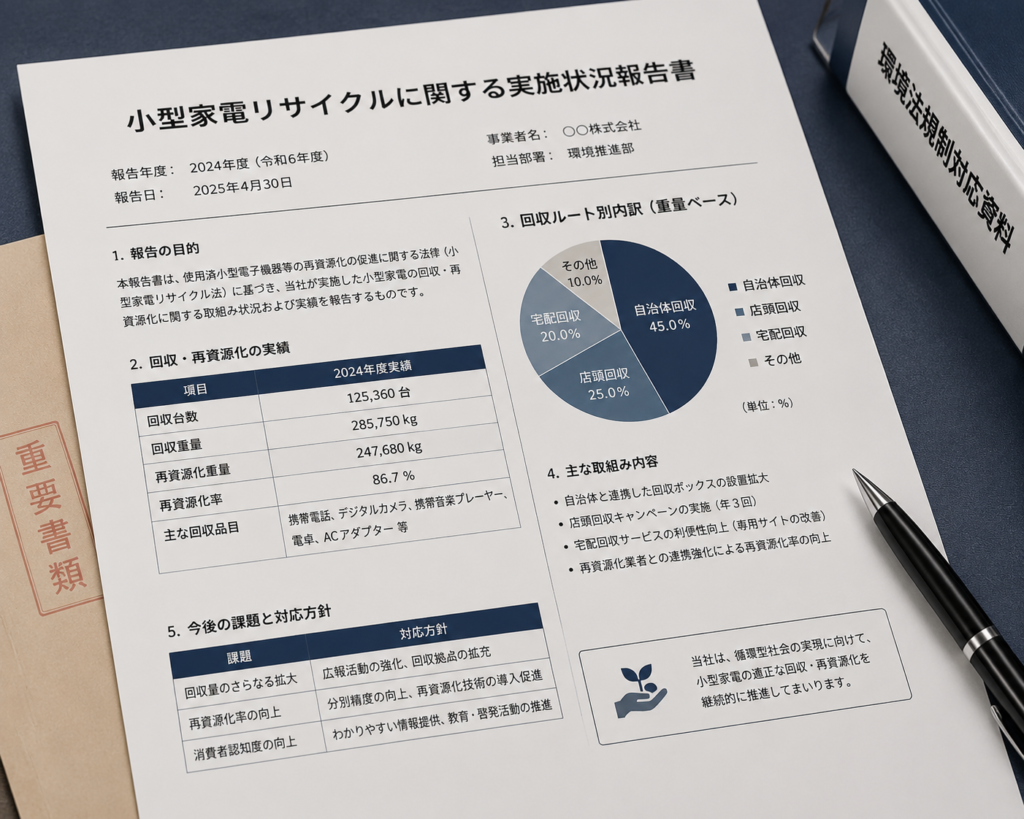
You don’t need to memorize thick legal provisions. As long as three conditions are met, it is basically compliant:
First, the product is disposed of through a formal recycling channel applicable to the corresponding category, and is not randomly discarded or handed over to unidentified individuals;
Second, the responsible entities of the corresponding links (producers/sellers/consumers, etc.) have performed their own obligations in accordance with legal requirements;
Third, the entities responsible for collection, transportation, and treatment are compliant entities permitted by the corresponding system, such as statutory retailers, designated take-back locations, local government collection systems, official brand channels, or treatment institutions that have obtained the required licenses in accordance with the law.
Common Consequences of Violations
The punishment basis for e-waste violations in Japan is mainly the and special laws and regulations for corresponding categories. The specific punishment depends on the circumstances of the violation, the identity of the subject, and the applicable provisions. Not all minor violations will directly apply the maximum penalty. Common types of violations and corresponding maximum penalties include:
1. Illegal dumping of e-waste by individuals: According to the , the maximum penalty is 5 years of imprisonment or a fine of 10 million yen;
2. Unlicensed collection, transportation, or treatment of e-waste: Whether individuals or enterprises, those engaged in relevant activities without obtaining corresponding qualifications may be sentenced to imprisonment or fined in accordance with the , and the specific amount depends on the circumstances;
3. Legal persons committing relevant violations: The dual punishment system for legal persons applies. In addition to punishing the directly responsible persons, the legal person may be fined up to 300 million yen, and in serious cases, may face measures such as business rectification and public announcement of the violation list.
It should be noted that cross-border entities will not automatically have their goods detained by customs or be held accountable solely because of their identity as “cross-border sellers”. They usually bear corresponding consequences only under specific circumstances such as violations in the import link, products not meeting Japanese compliance requirements, or illegal acts by their responsible entities in Japan. In serious cases, product entry may be restricted.
V. Exclusive Pitfall Avoidance Guide for Overseas Users
Because they are not familiar with Japanese rules, overseas users are prone to encounter some pitfalls that locals will not encounter. Here we explain for two types of users.
Pitfall Avoidance for Individuals Living/Studying in Japan
People who have just arrived in Japan, because they are not familiar with the rules, are prone to several operational pitfalls that locals rarely encounter:
First pitfall: violations caused by incorrect disposal — mixing regulated old electronics into household waste or oversized waste, or piling them at the entrance of unattended recycling points, this is an illegal discarding act. Once verified, it may trigger punishment under the ; if the device has abnormalities such as bulging or leakage, it is even more unacceptable to put it directly into public recycling bins. You need to first contact the municipal authority or the brand to confirm the special treatment method.
Second pitfall: thinking that merchants must take back all old home appliances when buying new ones — in fact, the only requires retailers to take back the four types of large home appliances under statutory circumstances such as selling new replacement products of the same category or having sold the old appliance. Merchants can refuse requests beyond the scope (such as different categories, small electronics not sold by the store);
Third pitfall: credulously believing unqualified “free door-to-door recycling” advertisements — handing waste to unidentified collectors may lead to risks such as illegal discarding of old devices (which may eventually be traced back to the discarder), extra charges, and personal information leakage; to judge whether a channel is formal, you can verify whether the other party is an official designated take-back location, a brand-authorized service provider, or a municipal cooperative institution. After recycling, be sure to ask for a formal voucher with an acceptance number;
Fourth pitfall: not being able to distinguish which recycling is free and which is charged — the four types of large home appliances usually require payment of recycling fees, while small electronics and home computers with PC recycling marks in most regions are free for consumers. Confirm the rules before disposal to avoid spending unnecessary money.
The safest way is to prioritize checking the recycling guide on the official website of the local municipality, or use the official brand trade-in channel, which is both worry-free and compliant.
Pitfall Avoidance for Cross-Border Electronics Sellers
Cross-border sellers operating in the Japanese market are most prone to pitfalls due to unclear judgment of responsible entities. Do not assume that all sellers must bear the same recycling obligations. You can clarify your own responsibilities and implement them according to the following steps:
1. Clarify the distribution chain and your own identity: first confirm who puts the product on the market as a manufacturer or importer in Japan (this is the core entity bearing EPR responsibility), then confirm who bears the retailer’s collection, take-back, and information notification responsibilities, and correspond obligations to your own role;
2. Implement the domestic responsible entity: if there is no clear importer, manufacturer’s representative, or authorized retailer in Japan to bear the statutory recycling obligation, you must first designate a responsible entity or compliant service provider in Japan to perform the corresponding obligations on your behalf before starting sales;
3. Confirm the product regulation scope: confirm whether the product belongs to the four types of large home appliances, home PCs/monitors, or may only be handled through municipal small home appliance channels. The systems applicable to different categories are completely different;
4. Connect with compliant channels and complete public disclosure: according to your own identity and product category, connect with compliant recycling cooperation channels to implement obligations; if the corresponding system requires information disclosure, you must clarify the recycling rules and fee standards to consumers on the product page or official channels.
It is specially reminded that finding a local agent does not mean that you are completely free of responsibility. Local agents usually only assist in performing relevant obligations, and the statutory responsibility still needs to be borne by the corresponding responsible entity (such as importer, manufacturer), and cannot be completely transferred through the agent. It is recommended that before entering the Japanese market, sellers entrust local compliance lawyers or professional institutions to confirm specific requirements in combination with their own supply chain situation, and do not blindly apply general rules.
Clarification of Common Responsibility Confusion Points
There are several responsibility-related issues that many people confuse, here we clarify them all at once:
First, seller recycling ≠ seller responsible for treatment: sellers mainly bear the obligation of collection and take-back, and the subsequent treatment responsibilities such as disassembly and resource reuse are borne by entities such as producers under the corresponding system;
Second, the recycling rules for home electronics and commercial electronics are different: home electronics are subject to civil recycling related systems, while electronic equipment discharged by commercial/enterprises must be handled in accordance with relevant industrial waste rules. The requirements, channels, and fees of the two are different;
Third, recycling treatment fee ≠ ordinary waste fee: recycling-related fees are mainly used for links such as disassembly of e-waste and resource reuse, which are different from municipal ordinary waste treatment fees in terms of purpose and management entity;
Fourth, electronics bought in Japan ≠ must be recycled in Japan: if it is a product carried out of the country by an individual, it can be handled according to the local recycling rules when scrapped, and there is no need to specially send it back to Japan.
VI. Practical Judgment Tools and Official Inquiry Channels
When you encounter uncertain situations, you don’t need to ask around. You can judge by yourself using the following methods.
3-Step Quick Judgment of Product Recycling Rules
For any electronic product, you can quickly correspond to the applicable rules in three steps, without rote memorization:
First step: Look at the category — first confirm which category the product belongs to: four types of large home appliances, home PCs/monitors, small electronics, batteries/chargers; if it is professional electronics such as industrial, automotive, or medical, directly follow industrial waste rules, and the civil recycling system does not apply.
Second step: Look at the scenario — confirm whether the product has been discharged as waste: second-hand transfer, gifting, or personal disassembly of usable parts for own use of products that can still be used normally do not fall under the jurisdiction of recycling; products that are damaged and cannot be repaired, and are clearly for the purpose of discarding (including damaged devices listed on second-hand platforms), fall under the jurisdiction of recycling.
Third step: Look at identity and location — if it is civil waste, then combine your identity as a consumer/seller/producer and the specific rules of your location to select the corresponding compliant channel.
Official Authoritative Inquiry Channels
All information is subject to official release. These channels are the most reliable and can be selected according to the content you want to check:
• Japan Ministry of Economy, Trade and Industry (METI) Environmental Recycling Column: To inquire about the latest laws and regulations, statutory recycling benchmarks, and information related to compliant entities. It is the most authoritative national-level information source for resource circulation policies;
• Japan Ministry of the Environment Waste Management Column: To inquire about waste treatment rules, illegal dumping penalty standards, and relevant requirements of local general waste systems;
• Official waste website of the local municipality: To inquire about the most practical on-site information such as local recycling point locations, recyclable categories, disposal requirements, and fee standards. It is the most commonly used inquiry channel for ordinary users;
• Official website of the Home Appliance Recycling Voucher Center: To inquire about the recycling fee standards for large home appliances, the list of designated take-back locations, and reference to recycling rules of various brands;
• Official website of the PC 3R Promotion Association: To inquire about recycling rules for home computers, the list of participating brands, and explanations related to PC recycling marks.
Compliance Self-Check Lists for Two Types of Users
Individuals going to Japan can self-check against the following 4 items before disposal:
1. Have you confirmed the product category and checked the corresponding recycling rules?
2. Have you distinguished the fee/free requirements for the corresponding category, and prepared the corresponding fee (if needed)?
3. Have you completed personal data deletion, removed the SIM card/memory card, and separated the battery as required?
4. Have you selected a formal channel and prepared to request/keep the formal recycling voucher?
Cross-border sellers can self-check against the following 4 items:
1. Have you sorted out the product distribution chain and clarified your identity as a responsible entity under Japanese law?
2. Have you confirmed the recycling laws and compliance requirements corresponding to the product category?
3. Have you connected with compliant recycling cooperation channels to implement recycling obligations?
4. Have you publicly disclosed recycling-related rules and information to consumers in accordance with the requirements of the applicable system?
Core Summary
The core of Japan’s electronic product recycling rules is “systems divided by category, clear responsibilities for each link”: the four types of large home appliances are strictly regulated by the , with unified national statutory requirements; home PCs are mainly recycled by brands, with local channels as supplements; small electronics recycling is based on voluntary collection by municipalities, with relevant entities cooperating in accordance with the system, and it is free for consumers in most regions.
Whether it is individuals living in Japan or cross-border sellers expanding into the Japanese market, as long as you first quickly frame the applicable rules in three steps of “category-scenario-identity”, and then confirm the local specific requirements through official channels, you can accurately perform your obligations and avoid violation risks.