
Practitioners engaged in the electrical and electronic product industry targeting the Japanese market have mostly heard of the concept of “J-MOSS”, and common questions focus on three points: Is it the Japanese version of RoHS? Is it a mandatory certification like PSE? Can products that exceed the limits not be sold? This article systematically sorts out the scope of application, judgment rules, and compliance processes of J-MOSS from introductory concepts to advanced boundary judgment, to help you clarify the core requirements.
1. Basic Understanding of J-MOSS: It Is Not a Certification, but a Mandatory Information Disclosure System
When first exposed to J-MOSS, it is easiest to confuse it with various certifications and bans. We will start with the basic definition and core logic to clarify the institutional boundary.
Vernacular Definition and Official Basis
You can understand J-MOSS as Japan’s “hazardous substance content publicity rule” for specified electrical and electronic products. Its full English name is Japanese Marking of Specific Chemical Substances, which is the labeling system for the content of specific chemical substances.
The official basis of this system is Japan’s , the supporting technical standard is JIS C 0950, and the competent authority is the Ministry of Economy, Trade and Industry of Japan (abbreviated as METI). It should be clarified that: J-MOSS is a mandatory information disclosure requirement, not within the scope of electrical safety certification, and there is no unified “J-MOSS certification certificate”. The “J-MOSS agency services” on the market essentially provide conformity judgment and labeling guidance, rather than issuing official unified certificates.
Core Logic: Information Disclosure Does Not Equal Unified Sales Ban
Many people equate J-MOSS with EU RoHS, believing that “products with excessive hazardous substances cannot be sold in Japan”. In fact, the core logic of the two is completely different:
• EU RoHS is a “restriction of use system”: as long as the hazardous substances in homogeneous materials exceed the limit values, the product cannot be placed on the EU market, which is a prohibition-type rule;
• J-MOSS is an “information disclosure system”: its core obligation is to require enterprises to disclose the situation of hazardous substances in products in accordance with the rules, and there is no unified sales ban rule itself — completing labeling and information disclosure only means meeting the information disclosure requirements of J-MOSS. Whether a product can be imported, sold in Japan, or enter specific channels also needs to comply with other applicable laws and regulations, transaction contracts, and platform rules at the same time.
Japan has three main purposes for introducing this system: first, to let consumers and recycling enterprises clarify the situation of hazardous substances in products, and reduce the pollution risk of electronic waste dismantling; second, to force enterprises to reduce the use of high-risk chemical substances; third, to support Japan’s green procurement system, and provide a reference for the environmental protection procurement of the government and large enterprises.
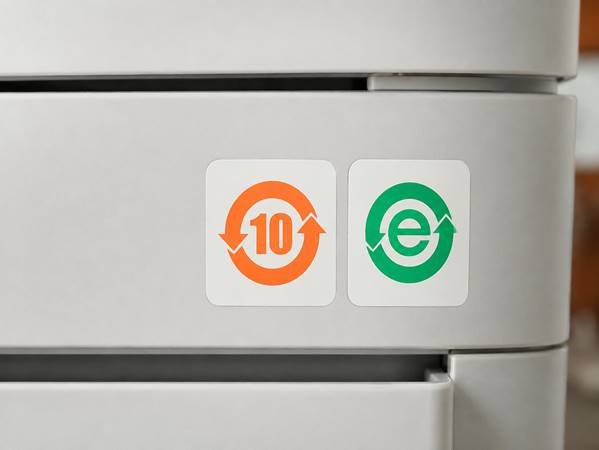
4 Basic Misconceptions Most Easily Made by Beginners
Practitioners who are new to J-MOSS often fall into the following cognitive misconceptions, which are clarified one by one here:
1. Orange label = unqualified product / cannot be sold? Wrong. The orange label is “publicity of exceeding the limit”, which only indicates that there are hazardous substances exceeding the limit value in the product, does not mean that the product quality is unqualified, nor is it a sign that J-MOSS prohibits sales. Whether the product can be circulated needs to be judged in combination with other rules.
2. J-MOSS = Japanese RoHS? Wrong. RoHS is a restriction of use system, and J-MOSS is a mandatory information disclosure system. The two have different substance lists, exception clauses, and rule logic, and cannot be directly equated.
3. All electronic products need to comply with J-MOSS? Wrong. Only categories specified by METI need to perform statutory labeling obligations, and not all electrical and electronic products are within the scope of control.
4. Does J-MOSS have an environmentally friendly use period? Wrong. The “Environmentally Friendly Use Period (EFUP)” with a circled number is a requirement of China RoHS. J-MOSS has no relevant regulations, and labels shall not be mixed.
2. Scope of Application Judgment: Specified Products, Responsible Subjects and Trigger Scenarios
After understanding the basic logic, the first step to judge is: whether your products and business need to meet J-MOSS requirements, which needs to be checked from three dimensions: product scope, responsible subject, and trigger scenario.
Scope of Application of Statutory Mandatory Labeling Obligations
The statutory mandatory scope of application of J-MOSS is subject to the list of specified products announced by METI in accordance with the . Product classification needs to be checked against official definitions, sales forms, and applicable conditions, and cannot be judged only by the common name of the product. At present, there are 7 categories of products under statutory mandatory control, namely: personal computers, air conditioners, televisions, refrigerators, washing machines, clothes dryers, and microwave ovens.
For multi-functional composite products (such as ovens with microwave oven function, smart refrigerators with display screens), preliminary classification can be made first according to the main purpose or the sales form of the whole machine, and the final conclusion shall be subject to METI’s official product definition.
Products not included in the METI specified list (such as medical equipment, military/aerospace products, large industrial equipment, etc.) are usually not subject to the statutory labeling requirements of J-MOSS, but it is necessary to check other Japanese environmental protection regulations (such as the Chemical Substance Control Law) and customer requirements in combination with product attributes.
Common Scenarios for Commercial Conformity Document Requirements
In addition to statutory mandatory labeling obligations, there is another type of common non-statutory requirement in practice: for products not included in the statutory list such as small home appliances, lighting equipment, and IT accessories, Japanese local brands, purchasers, or e-commerce platforms often require suppliers to provide J-MOSS conformity documents as a condition for cooperation access. Such requirements fall within the scope of contract or platform rules, and are not statutory obligations of J-MOSS. However, if you want to undertake the corresponding business, you usually need to provide relevant documents as agreed.
Rules for Determining Responsible Subjects
The statutory responsible subject of J-MOSS needs to be determined in combination with the business model, and the core rules are as follows:
• Products produced and sold in Japan: the manufacturer is the statutory primary responsible person;
• Products produced overseas and imported to Japan for sale: the importer within Japan is the statutory primary responsible person;
• OEM/ODM foundry mode: the foundry party shall assume the obligation to provide substance information in accordance with the contract, and the statutory labeling responsibility shall be borne by the brand owner/importer; the contract can allocate specific execution work, but cannot change the determination of the statutory responsible subject.
Basic Scenarios That Trigger Compliance Obligations
To judge whether J-MOSS compliance needs to be implemented, you can first compare the three most common trigger scenarios to quickly narrow the scope of judgment:
The first category is statutory mandatory scenarios: products that belong to the control categories specified by METI and are sold online or offline to ordinary Japanese consumers must perform statutory labeling and information disclosure obligations.
The second category is commercial cooperation scenarios: for B2B supply (including OEM production) to Japanese brand owners, even if the product is not in the statutory mandatory list, it may be required to provide J-MOSS conformity documents due to customer contracts or procurement requirements, which shall be subject to the agreement of both parties.
The third category is cross-border e-commerce scenarios: it is necessary to comprehensively judge whether compliance obligations are triggered based on the location of inventory, the subject of import declaration, whether it constitutes import sales within Japan, and whether the product belongs to the specified category, and cannot be directly judged only by the sales channel.
Preliminary Judgment of Common Boundary Situations
In actual business, ambiguous scenarios are often encountered. Preliminary judgment can be made first according to the following standards, and the final conclusion shall be subject to official rules:
• Parts/raw materials: The statutory labeling objects are specified finished products. Parts generally do not need to be labeled with J-MOSS separately, but need to provide complete substance information to the finished product manufacturer. If the parts are independent commodities sold directly to consumers, it is necessary to separately judge whether they belong to the control category against the METI specified list.
• Small batch/samples: J-MOSS has no statutory “batch exemption” rule. As long as it is a specified product and enters the Japanese circulation link, even a single sample needs to meet the corresponding requirements.
• Multi-functional composite products: Preliminary classification is based on the main purpose or the sales form of the whole machine, and the final decision is subject to METI’s official definition.
3. Exceeding Limit Judgment Rules: Focus on 6 Controlled Substances in Homogeneous Materials
J-MOSS currently controls 6 hazardous substances, and the core standard for judging whether the limit is exceeded is “homogeneous material” — if this concept is misunderstood, subsequent judgments will be wrong.
6 Controlled Substances and Limit Values
For easy comparison, we have sorted out the controlled substances, limit values, and common existing parts into the following table:
| Controlled Substance | Limit Value (by weight proportion of homogeneous material) | Common Existing Parts |
| Cadmium (Cd) | ≤0.01% (i.e. 100ppm) | Batteries, electroplated layers, plastic stabilizers |
| Lead (Pb) | ≤0.1% (i.e. 1000ppm) | Solder, batteries, coatings, metal alloys |
| Mercury (Hg) | ≤0.1% (i.e. 1000ppm) | Fluorescent lamps, switches, sensors |
| Hexavalent Chromium (Cr(VI)) | ≤0.1% (i.e. 1000ppm) | Electroplated anti-rust layers, pigments |
| Polybrominated Biphenyls (PBB) | ≤0.1% (i.e. 1000ppm) | Plastic flame retardants |
| Polybrominated Diphenyl Ethers (PBDE) | ≤0.1% (i.e. 1000ppm) | Cables, circuit board flame retardants |
What is “Homogeneous Material”? Why Is It So Important?
Many people think that “as long as the total content of hazardous substances in the whole product does not exceed the limit, it is fine”, which is completely wrong. The limit values of J-MOSS are calculated separately for homogeneous materials, and the total weight of the whole machine cannot be used to dilute the content of parts that exceed the limit.
The so-called homogeneous material, in vernacular terms, is: a single material that can no longer be split into different materials by ordinary mechanical methods such as screwdrivers, pliers, and scissors. For example, for a laptop, the aluminum alloy shell is a homogeneous unit, the anodized coating on the surface of the shell is another, a single solder joint on the motherboard is one, and the plastic sheath of the wire is also one — these units need to be individually judged whether they exceed the limit, and the entire motherboard or the entire computer cannot be mixed together for calculation.

Take a practical example: if the lead content of the solder joints on the laptop motherboard is 0.2% (exceeding the 0.1% limit), even if the total weight proportion of lead in the whole computer is only 0.01%, it is still considered to exceed the limit, and the labeling obligation must be performed in accordance with the rules.
Statutory Exception Scenarios: EU RoHS Exemptions Shall Not Be Directly Applied
Many practitioners will ask “EU RoHS has high-temperature solder exemption, does J-MOSS also have it?” Here is a special reminder: The statutory exception scenarios of J-MOSS must be subject to the provisions of Japan’s current laws and regulations, government ordinances, and JIS C 0950, and the exemption clauses of EU RoHS must never be directly applied — the scope of application and applicable conditions of the two are different, and direct application is prone to compliance deviations.
In addition, if it is an unavoidable residual impurity in the production process, as long as the content is lower than the limit value, it does not need to be treated as exceeding the limit.
Regulation Version and Authoritative Query Channels
The substance list, limit values, and exception scenarios of J-MOSS may be adjusted with technological development, and the latest official requirements need to be checked before the product is launched.
Before the product is launched, it shall be subject to the J-MOSS related system instructions published on the METI official website, the current legal texts published on e-Gov, and the current valid version of the JIS C 0950 standard text; if you need to quote a specific JIS version or supplementary content, you should first check whether the standard text used is the current valid version. According to publicly available official documents, the 4 new phthalates added to EU RoHS are not included in the scope of J-MOSS control; it is still necessary to review the latest official announcement before the product is launched to confirm whether there are adjustments.
There are three main official authoritative query channels:
1. Official website of the Ministry of Economy, Trade and Industry (METI) of Japan;
2. Japan e-Gov Law Search System;
3. Current version of the JIS C 0950 standard text.
4. Core Compliance Requirements: Labeling Rules and Evidence Chain Management
After completing the exceeding limit judgment, two core compliance tasks need to be implemented: correctly use labels, and retain a complete compliance evidence chain.
Usage Rules of Two Types of Labels
J-MOSS has two types of labels: orange content label and green conformity label, with completely different usage rules, which shall not be confused:
• Orange content label: As long as any controlled substance in any homogeneous material of the product exceeds the limit, this label must be used. Its function is to remind consumers and recyclers that the product contains hazardous substances exceeding the limit value.
• Green conformity label: It can be used voluntarily only when the 6 controlled substances in all homogeneous materials of the product are below the limit values. It is mainly used for environmental protection publicity and is not a mandatory requirement.
The formats of both types of labels must comply with the JIS C 0950 standard, and the color, shape, or meaning shall not be changed without authorization; at the same time, it should be noted that J-MOSS does not have the “environmentally friendly use period” label with a circled number like China RoHS, and labels shall not be mixed.
Key Points for Checking Labeling and Information Disclosure
Details such as the position, size, and disclosure method of the label shall be subject to JIS C 0950 and METI official guidelines, and can be checked in the following order during implementation:
1. Trigger condition check: First, judge whether there are substances exceeding the limit according to homogeneous materials, and confirm whether the orange label obligation is triggered; if a compliant product needs to use a green label, it is necessary to first verify that all homogeneous materials meet the limit requirements.
2. Label body check: Check the pattern, color, and size ratio of the label according to the current JIS standard to ensure compliance with the specification.
3. Carrier and position check: Confirm that the label position and visibility on the product body, packaging, or accompanying documents meet the requirements; for special cases such as small products, alternative disclosure methods such as official websites and product catalogs can be used in accordance with regulations.
4. Public information check: If supplementary information is disclosed online or through catalogs, it is necessary to confirm the applicable conditions of this method, and ensure that the disclosed content corresponds to the product model one by one; the disclosed fields shall at least include the name of the substance exceeding the limit, the product part where it is located, and other content required by the official.
5. Language check: Public materials for the Japanese market shall provide accurate Japanese information in accordance with applicable rules, and the specific requirements shall be subject to METI/JIS related guidelines.
Compliance Evidence Chain Management
Although J-MOSS does not have a unified certification certificate, it is necessary to retain complete compliance evidence to respond to official or customer inspections. The core evidence includes five categories: bill of materials (BOM), homogeneous material split table, supplier substance declaration, relevant test reports, and judgment basis for label use.
Special attention should be paid to change management: if the supply chain changes materials or the product is redesigned, the conformity must be re-judged and the corresponding evidence chain updated.
Regarding the evidence retention period, the J-MOSS related rules do not set a unified mandatory period. Enterprises shall formulate their own file retention rules in combination with applicable legal requirements, JIS/official guidelines, customer contract agreements, product life cycle, dispute limitation period, and internal change management cycle, and retain version association records when materials, products, or regulations change, to ensure full-process traceability.
5. Introductory Practical Process: 5 Steps from Design to Launch
If your product needs to meet J-MOSS requirements, you can complete basic compliance in the following 5 steps to avoid missing key links.
Step 1: Scope Judgment (First Confirm Whether Compliance Is Required)
Do not arrange testing as soon as you start. First clarify the compliance obligation level of products and business:
1. Check against METI’s latest list of specified products and official definitions to confirm whether the product belongs to the statutory mandatory control category;
2. Confirm the sales scenario: is it retail for Japanese consumers, or B2B supply? Do customers or platforms require J-MOSS documents?
3. Preliminary judgment of compliance type: whether it is necessary to perform statutory labeling obligations, or only need to provide a commercial conformity declaration.
Step 2: Supply Chain Information Collection and Review
After confirming that compliance is required, first sort out the complete bill of materials (BOM) of the product, split it into the smallest units according to the requirements of homogeneous materials, and then request supporting documents such as substance declarations and test reports from suppliers.
When reviewing supplier documents, you cannot just look at the general statement of “RoHS compliant”, and need to focus on checking the following content:
• Whether the report covers the 6 controlled substances of J-MOSS;
• Whether the testing is carried out on homogeneous materials, rather than whole machine or whole component testing;
• Whether the test date and material model are consistent with the currently used materials;
• Whether the testing method meets the requirements, whether exception clauses apply, and what the basis is;
• Whether there is a mechanism for advance notification when suppliers change materials.
High-risk materials such as solder, electroplated layers, plastics (including flame retardants, pigments, stabilizers), fluorescent tubes, and batteries can be prioritized for inspection to improve efficiency.
Step 3: Exceeding Limit Judgment and Verification
After obtaining the supplier’s documents, check the content of the 6 substances one by one according to the homogeneous material rules and limit requirements. If the documents provided by the supplier cannot cover the corresponding product model, homogeneous material scope, 6 controlled substances, testing methods, exception application basis, or latest material status, you can entrust a laboratory with corresponding testing capabilities and traceable reports to conduct supplementary testing according to customer requirements, contract agreements, or internal risk control rules. For scenarios facing Japanese brands, platforms, or official inspections, the supplementary testing institution should prioritize third-party institutions that are recognized by customers, whose testing scope covers relevant materials and 6 controlled substances, whose reports are traceable and acceptable to the Japanese market; whether it is necessary to use Japanese local or designated institutions shall be subject to customer/platform rules and applicable requirements.

It should be noted that the test report is only one of the judgment evidences, and cannot replace BOM sorting, homogeneous material splitting, and statutory exception scenario checking. Finally, it is necessary to check whether it meets the official statutory exception scenarios to avoid unnecessary rectification.
Step 4: Production of Labels and Public Content
Select the corresponding label according to the judgment result: products exceeding the limit shall use the orange label as required, and compliant products may voluntarily choose whether to use the green label. Products not included in the statutory specified list are usually not subject to statutory J-MOSS labeling obligations; if customers or platforms require J-MOSS related conformity documents, declarations or test documents shall be provided in accordance with contract or platform rules, and the use of labels still needs to be checked against JIS C 0950 and official guidelines to avoid packaging commercial conformity publicity as official mandatory certification.
Then, in accordance with the requirements of JIS C 0950 and METI official guidelines, prepare the Japanese version of the public information, and confirm that the format, position, and disclosure method of the label meet the requirements.
Step 5: Post-Launch Continuous Maintenance
Compliance is not a one-time thing, and continuous maintenance needs to be done after the product is launched:
• When the supply chain changes materials or the product is redesigned, re-judge the conformity and update the evidence chain;
• Regularly pay attention to METI’s regulatory updates and adjust compliance plans in a timely manner;
• Retain compliance documents in accordance with internal file management rules, and respond to official or customer inspections at any time.
6. Advanced Judgment: Regulation Comparison and Complex Boundary Handling
After completing basic compliance, you can further understand the differences in regulations and judgment methods for complex boundaries, avoid hidden risks, and reasonably control compliance costs.
Core Differences with Common Regulations (Cannot Be Directly Replaced)
J-MOSS overlaps with the control scope of many environmental protection and safety regulations, but the rule logic is completely different, and they cannot replace each other:
• With EU RoHS: The two have different core logic, substance lists, and exception clauses. EU RoHS is a restriction of use system, and J-MOSS is a mandatory information disclosure system; RoHS test reports can be used as auxiliary evidence of substance content, but cannot directly replace J-MOSS compliance judgment and labeling obligations.
• With PSE certification: PSE is for electrical safety control, and J-MOSS is for chemical substance labeling. The two are independent compliance lines and do not cover each other. Passing PSE certification does not mean J-MOSS compliance, and vice versa.
• With Japan’s Recycling Law and Chemical Substance Control Law: The Recycling Law regulates the recycling and treatment of products after disposal, the Chemical Substance Control Law regulates the production/import approval of new chemical substances, and J-MOSS regulates the disclosure of hazardous substance information before listing. The applicable scenarios and responsibility requirements are different.
3 High-Frequency Advanced Misconceptions
In addition to the previous basic cognitive misconceptions, the following easily overlooked cognitive deviations are often encountered in compliance practice:
1. Judgment caliber misconception: In addition to needing to judge separately by homogeneous materials and not using the total weight of the whole machine to dilute the exceeding content, it should also be noted that J-MOSS judgment does not distinguish between “intentional addition” and “residual impurities”. Even if it is an unavoidable residue in the production process, as long as the content in the homogeneous material exceeds the limit value, it is necessary to judge whether labeling is required according to the rules.
2. Document replacement misconception: RoHS reports and chemical substance compliance declarations from other regions can only be used as auxiliary references for substance content, and cannot be directly equated with J-MOSS compliance — it is also necessary to confirm whether the product scope of application, statutory exception clauses, labeling and information disclosure requirements meet Japanese rules, and cannot be directly used universally.
3. Continuous validity misconception: Compliance is not a one-time thing. Supply chain material changes, product redesigns, and regulatory updates all require re-judgment of conformity, and there is no such thing as “one test, lifetime validity”.
Four-Element Judgment Method for Complex Boundary Scenarios
When encountering ambiguous scenarios, you can check one by one according to the four elements of “factual conditions – preliminary treatment suggestions – legal/rule basis – evidence to be retained” to avoid subjective judgment. The following is the check framework for common scenarios:
1. Importer Responsibility Scenario
• Facts to be checked: whether the overseas brand has a clear importer within Japan; who are the import declaration subject, cargo right ownership, and sales subject respectively; whether the platform, customs clearance company, or purchaser only provides services, or assumes the role of importer.
• Preliminary treatment suggestions: first confirm the statutory importer subject, then implement labeling and document preparation work according to the division of responsibilities; the contract can agree on the specific execution division of labor, but cannot replace the determination of statutory responsibility.
• Basis: Provisions on importer responsibilities in the .
• Evidence to be retained: importer qualification documents, clauses on responsibility division in the contract, and import declaration related records.
2. Cross-Border Sales Scenario
• Facts to be checked: the registered place of the seller; the location of inventory (whether it enters Japan in advance); the subject of import declaration; whether it constitutes a continuous sales behavior within Japan; whether the product belongs to the specified category.
• Preliminary treatment suggestions: comprehensively judge whether it belongs to the import sales scenario applicable to J-MOSS based on the above facts. If not, it is necessary to confirm the obligations in combination with other regulations or platform requirements.
• Basis: METI’s instructions on the applicable scenarios of specified products, and relevant Japanese import and circulation regulations.
• Evidence to be retained: sales model description, inventory and logistics records, import subject certificate, and corresponding clauses of platform rules.
3. OEM/ODM Foundry Scenario
• Facts to be checked: whether the foundry party is only responsible for production; whether the brand owner/importer is the statutory responsible subject; the division of labor agreement in the contract on substance information provision and label production.
• Preliminary treatment suggestions: the foundry party shall provide complete material substance information in accordance with the contract, and the final compliance responsibility for labeling shall be borne by the brand owner/importer; the division of labor between the two parties shall be clarified in the contract to avoid unclear rights and responsibilities.
• Basis: J-MOSS provisions on responsible subjects, contract agreements.
• Evidence to be retained: clauses on compliance responsibilities in the foundry contract, material information delivery records, and brand owner confirmation documents.
4. Independent Sales of Parts Scenario
• Facts to be checked: whether parts are sold separately to Japanese consumers; whether they belong to the categories in the METI specified product list; whether there are additional requirements from customers or platforms.
• Preliminary treatment suggestions: judge whether it belongs to the mandatory control scope against METI’s official product definition; if it does not belong to the statutory scope, provide conformity documents according to contract or platform requirements.
• Basis: METI specified product list and product definition instructions.
• Evidence to be retained: product classification judgment records, written documents required by customers, and conformity declarations.
5. Second-Hand/Refurbished Product Scenario
• Facts to be checked: whether the product is a new product entering the Japanese circulation link for the first time; whether second-hand products are refurbished and sold under the name of new products; whether relevant regulations on second-hand goods apply.
• Preliminary treatment suggestions: J-MOSS labeling obligations apply to new products in circulation for the first time; second-hand resale products are usually not subject to new product labeling requirements, and those sold as new products after refurbishment need to comply with new product compliance.
• Basis: METI’s instructions on the applicable objects of J-MOSS.
• Evidence to be retained: product attribute certificate (new/second-hand/refurbished), circulation records.
Risk Stratification Control of Compliance Costs
Compliance costs can be promoted in layers according to risks to avoid unnecessary testing investment:
1. Risk identification: first sort out high-risk points by material type, including solder, electroplated layers, flame retardants/pigments/stabilizers in plastics, fluorescent tubes, batteries, etc. These parts have a higher probability of exceeding the limit.
2. Existing document verification: prioritize collecting existing substance declarations and test reports in the supply chain, check whether they correspond to specific product models, cover the 6 controlled substances of J-MOSS, adopt homogeneous material judgment caliber, clarify the basis for exception application, and confirm that the supplier has a mechanism for advance notification of material changes.
3. Supplementary testing for doubtful points: only arrange testing as needed for materials with gaps in documents, unverifiable information, or high risk levels, and there is no need to conduct full testing of all materials.
7. Quick Self-Inspection and Risk Response
If compliance work has been carried out, you can quickly self-inspect through the following list, and also rectify in time against common risks.
5-Minute Quick Self-Inspection Checklist
□ Does the product belong to the METI specified control category, or does the customer/platform explicitly require J-MOSS documents?
□ Has it been split to the homogeneous material level, and the content of the 6 controlled substances has been checked?
□ Is cadmium ≤0.01%, and the remaining 5 substances ≤0.1% (or meet the official statutory exception requirements)?
□ Do products exceeding the limit use the orange label as required by the official, and disclose the corresponding Japanese substance information?
□ Is the compliance evidence chain complete, and the retention period meets the requirements of regulations, contracts, and internal management?
Common Compliance Risks and Rectification Directions
If problems are found in self-inspection, rectification can be carried out in the following directions:
1. Missing label / false information: immediately supplement labels and public information that meet JIS requirements, carefully check the accuracy of Japanese expressions, and avoid translation deviations.
2. Compliance documents cannot be traced: complete the BOM table, supplier declarations, and test reports as soon as possible, sort out the homogeneous material split records, and ensure that the information of each material has a source basis.
3. Supply chain material changes not reviewed: establish a material change review mechanism, and re-judge substance conformity and update evidence every time the supplier changes materials or the product is redesigned.
4. Failure to meet customer/platform rules: supplement conformity declarations or test reports against customer or platform requirements, and clarify the boundary of responsibilities at the same time to avoid assuming obligations beyond the agreement.
Key Points for Responding to Official/Customer Inspections
When encountering official or customer compliance inspections, it can be handled according to the following principles:
1. Provide a complete compliance evidence chain as required, including bill of materials, homogeneous material split records, supplier declarations, test reports, label judgment basis, etc.
2. If you have objections to the inspection results, submit a review application and supporting documents in accordance with the corresponding rules.
3. If it is confirmed that it does not meet the requirements, submit a rectification plan on time and follow up on implementation.
4. The specific legal responsibilities and penalties shall be subject to the applicable legal provisions and official law enforcement decisions.
To master the compliance logic of J-MOSS, the core is to establish three levels of judgment ability: first, quickly judge whether it is necessary to perform statutory or commercial compliance obligations through product category, sales scenario, and responsible subject; second, complete substance judgment, label production, and evidence retention according to homogeneous material rules, and implement basic compliance requirements; third, when facing complex boundary scenarios, check facts and retain evidence through the four-element method, and control compliance costs combined with the risk stratification idea.