
Whether you are a cross-border seller looking to sell home appliances and lighting products to the U.S., or an ordinary consumer living in the U.S. shopping for electrical appliances, you have most likely heard the term “DOE energy efficiency”. But many people’s understanding of it either stops at “a U.S. certification”, or treats it as an honor for the highest energy efficiency, and some even think that having a paper certificate is all there is to it — in fact, none of these understandings are accurate. DOE energy efficiency is one of the most basic mandatory access rules in the U.S. market, and is directly related to whether you can sell products smoothly or buy formal products. Starting from the basic definition, this article systematically sorts out its coverage scope, core rules, query methods, and common pitfall avoidance points, to help the two types of readers quickly establish a clear and accurate understanding.
First, Understand the Essence: What Exactly is DOE Energy Efficiency Certification?
It is Not a Private Certification, but a Federal Mandatory Access Rule
Many people hear “certification” and think it is a certificate issued by a third-party organization. In fact, DOE energy efficiency is initiated by the U.S. Department of Energy (DOE for short), and is a federal-level official regulation, not a voluntary certification from a private institution.
Its core logic is very simple: set a statutory minimum energy efficiency passing line for commonly used power-consuming products, and products that fail to meet this line cannot be sold in the U.S. market. It is not about selecting “the most energy-efficient products”, but only ensuring that products on the market meet basic energy-saving requirements — a bit like the first subject of a driver’s license test: passing it gives you the qualification to drive on the road, it is not an award for a perfect score.
There is No Unified Paper Certificate; It is Essentially Filing in an Official Database
There is another common misconception: many people think that DOE will issue a “certification certificate” with a big seal, and getting the certificate means everything is done. In fact, DOE does not issue a unified certification certificate at all. The compliance process is that enterprises submit test data and compliance declarations to DOE’s Compliance Management System (CCMS for short, the official management system used by DOE for energy efficiency compliance filing). After passing the formal review, product information will be entered into a public database that everyone can query.
What is often referred to in the market as “DOE certification”, “DOE compliance”, and “meeting DOE standards” are essentially the same thing: the statutory filing process has been completed, and the product’s energy consumption meets the minimum requirements of the corresponding standard.
Who Bears Legal Responsibility?
The primary responsible parties for DOE compliance are U.S.-based manufacturers, importers, and private labelers (commonly referred to as brand owners). If a product is non-compliant, DOE will directly hold these responsible entities within the U.S. accountable.
As for overseas contract manufacturers, such as Chinese factories that make home appliances for U.S. brands, they only need to cooperate by providing test samples and technical materials, and are not directly responsible for DOE enforcement — of course, if non-compliance is caused by the contract manufacturer cutting corners, the brand owner will definitely hold the contract manufacturer accountable, but that is a matter between enterprises and has nothing to do with DOE enforcement.
The True Meanings of Common English Terms
When doing business in the U.S. market, you will often see various English expressions related to DOE, each with different focuses. Pay attention to the distinctions:
- DOE compliant / meets DOE standards: means the product meets DOE energy efficiency requirements, and is the most basic compliance expression.
- DOE certified: is a common colloquial term in the market. It does not mean that DOE officially issues a unified certification certificate, but only represents that the product has completed compliance filing.
- DOE approved: this expression is easily misleading. DOE does not proactively “approve” individual products, but only conducts formal review of submitted compliance materials and publicizes filing information; if a merchant only mentions this expression but cannot provide the specific filed model, it is recommended to verify through the official database.
Which Products Need It? Coverage Scope and Judgment Methods
Now that we have clarified what DOE is, the next most common question is: does my product need DOE compliance?
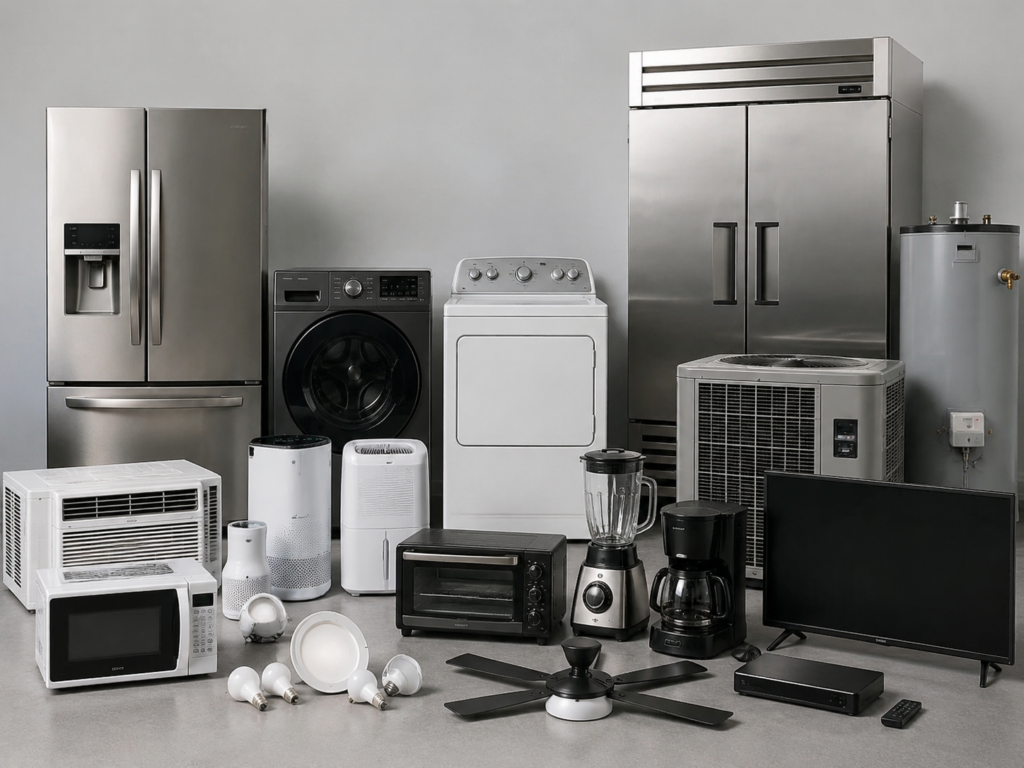
These Common Categories Are Within the Mandatory Control Scope
DOE’s control list covers most commonly used power-consuming products, mainly divided into four categories:
The first category is large home appliances, such as refrigerators, washing machines, dryers, air conditioners, heat pumps, water heaters, and dishwashers — almost all large home appliances you can think of are within the scope.
The second category is lighting and small home appliances, such as light bulbs, lighting fixtures, external chargers (the commonly used mobile phone chargers), microwave ovens, dehumidifiers, ceiling fans, etc.
The third category is commercial equipment, such as commercial freezers, central air conditioners, commercial water heaters, electric motors, transformers and other equipment commonly used in ordinary commercial scenarios.
The fourth category is some electronic products, such as televisions, set-top boxes, etc. It should be noted here that most portable consumer electronics (such as mobile phones and laptop computers themselves) are not within the control scope, but their external chargers need to be compliant.
These Situations Do Not Require DOE Compliance
Of course, not all power-consuming products need it. There are several clear exceptions, but all have strict preconditions, and the scope of exemption cannot be arbitrarily expanded:
The first is customized industrial-specific equipment, such as special motors customized for factory production lines, which are not general-purpose models for civilian or ordinary commercial use, and are not on DOE’s control list — they do not need to be done.
The second is used or refurbished products that are not marketed and sold as new controlled products: DOE’s control scope targets newly mass-produced products that enter the market for the first time as new products. Ordinary second-hand resale and personal idle circulation do not require re-filing; but if a product is refurbished and then re-marketed and sold as a brand-new product, it still needs to complete DOE compliance.
The third is non-sale samples that do not enter the sales process at all and are only used for internal testing or public display, such as display prototypes for exhibitions and laboratory test prototypes. As long as they are not officially sold to the public, they do not need to be compliant; if they are later converted into officially sold products, they still need to complete filing as required.
The fourth category is products with extremely low power or extremely small capacity, but exemption is not a general rule: whether the control threshold is met must be judged strictly in accordance with the statutory threshold of the specific category. For example, some particularly small mini-refrigerators and indicator lights with extremely low power may be exempted because they do not meet the control threshold, but it cannot be assumed that all low-power/small-capacity products meet the exemption conditions. The standards of the corresponding category must be checked one by one.
3 Steps to Quickly Determine If Your Product Needs It
If you are unsure whether your product needs to be compliant, you can judge according to these three steps, and you will basically not go wrong:
Step 1: First check the list of controlled products published on the official DOE website. Search by product category, and you can see the corresponding control instructions.
Step 2: Confirm the core usage scenarios of the product. If it is designed for civilian or ordinary commercial scenarios such as ordinary families, offices, and stores, it is most likely within the control scope; if it is a non-general-purpose equipment customized for special scenarios such as industry and scientific research, it is generally not within the scope.
Step 3: Check whether the product’s capacity, power, and launch status meet the control threshold. Even if the category matches, if the capacity or power is below the statutory threshold, it may still be within the exemption scope; if it involves an update of energy efficiency standards, different legal statuses need to be distinguished: after the new standard takes effect, newly manufactured and newly imported products usually must meet the new standard, while whether already produced or imported inventory can continue to be sold shall be subject to the implementation date and transition arrangements in the final rule of the corresponding category — for example, some categories will set a certain sales period for already produced inventory, while others have no transition period, so it cannot be generalized.
What Counts as Meeting the Standard? Core Rules and Common Indicators
Now that we know whether it needs to be done, let’s talk about DOE’s compliance logic, and what those energy efficiency parameters that people often see actually mean.
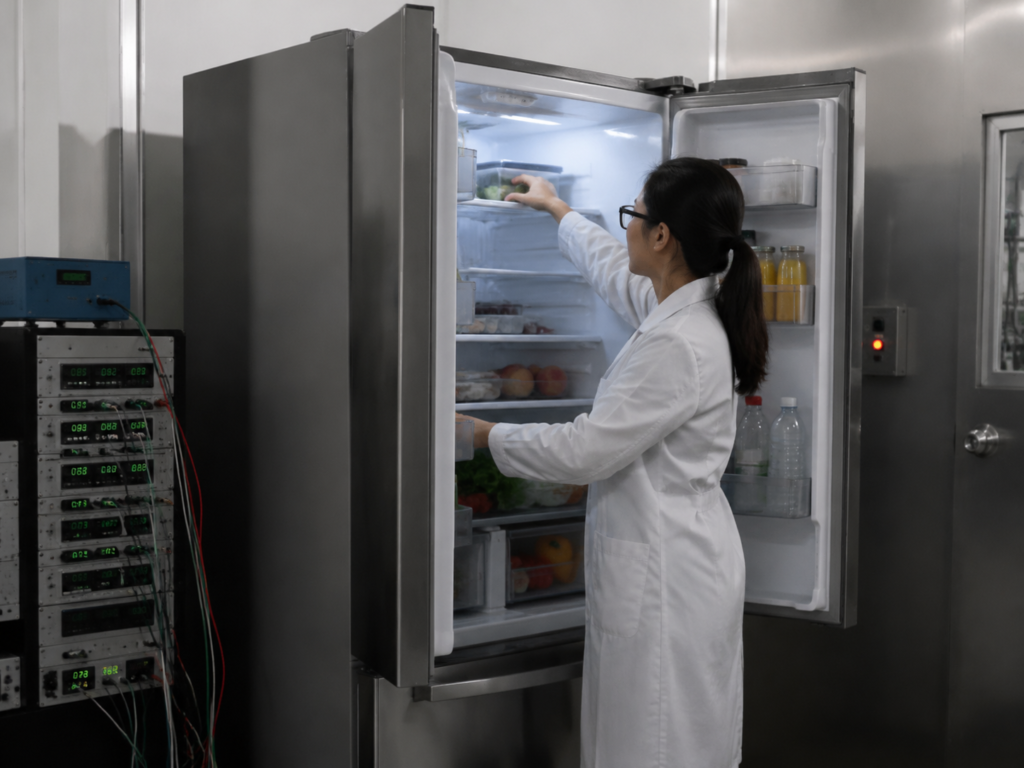
Compliance Logic: Unified Testing Rules, Passing the Statutory Threshold Means Qualification
Many people think that DOE tests the maximum power of the product, but that is not the case. What it tests is the comprehensive energy consumption or efficiency of the product under typical usage scenarios — for example, for a refrigerator, it does not test the power when the compressor is turned up to the maximum, but simulates the scenario of a normal family opening and closing the door and putting food in, to measure the total power consumption for a whole year.
Moreover, all brands in the same category must follow the same set of test procedures designated by DOE. The test environment and usage modes are uniformly standardized, so that the product parameters of different brands in the same category are comparable, and there will be no situation where “our test method is lenient, so it looks more energy-efficient”.
In addition, the energy efficiency passing line is not static. It is regularly updated with technological progress, and the requirements will become higher and higher. For example, the passing line for refrigerators ten years ago may have been 200 kWh per year, but now with better technology, 100 kWh may be required to pass.
Plain-Language Explanations of Common Energy Efficiency Indicators
Energy efficiency indicators vary by category. You don’t need to memorize them by rote, just know a few of the most common ones:
| Common Energy Efficiency Indicator | Main Applicable Categories | Plain-Language Explanation | Relationship Between Value and Energy Saving |
|---|---|---|---|
| Comprehensive annual power consumption (kWh/year) | Large home appliances such as refrigerators, washing machines, and dishwashers | Total power consumption under normal use for 1 year | The lower the value, the more energy-efficient |
| Energy efficiency ratio (SEER/EER) | Air conditioners, heat pumps | Amount of cooling/heating produced per 1 kWh of electricity | The higher the value, the more energy-efficient |
| Luminous efficacy (lm/W) | Light bulbs, lighting fixtures | Brightness corresponding to 1 watt of electricity | The higher the value, the more energy-efficient |
| Standby power consumption | Controlled categories explicitly covered by the corresponding energy efficiency standards | Power consumption in off/standby state | Must not exceed the statutory upper limit |
Let’s talk about standby power consumption separately here: many people don’t know that electrical appliances plugged in but not turned on may also consume several kWh of electricity a year. For categories to which this indicator applies, DOE has set a clear upper limit for standby/off power consumption, with the aim of reducing this unnecessary energy waste.
Core Testing Rules (Beginner Version)
To ensure fair and credible test results, DOE has strict requirements for testing. For the beginner stage, remembering these points is enough:
First, testing must strictly follow the unified test procedures designated by DOE to ensure that data is traceable and verifiable. In practice, third-party laboratories with ISO/IEC 17025 accreditation scope for the corresponding items are usually selected to conduct testing — this is an internationally recognized proof of laboratory testing capability, representing that the laboratory’s testing process and data accuracy meet unified standard requirements, which can effectively reduce the risk of filing rejection or non-acceptance in subsequent random inspections. The authenticity of compliance data and the consistency of testing methods are the sole responsibility of the product’s responsible entity.
Second, the test environment has unified standards. For example, temperature, voltage, and usage modes are all fixed, to prevent people from deliberately cheating by testing in a lenient environment.
Third, test samples must be regular mass-produced models. You cannot specially make a high-configured “special sample” for testing, while selling reduced-configuration ordinary models.
Fourth, sampling must meet DOE requirements. You cannot pick the best unit for testing; samples must be randomly selected to represent the true level of the entire series.
Intermediate Supplement: Standard Hierarchy and Update Logic
If you are a seller doing business in the U.S. market, you need to know a little more about the background of the standards: the legal basis of DOE energy efficiency is the U.S. Federal Energy Policy Act, and the specific implementation rules are written in federal regulations, not decided arbitrarily.
When standards are updated, DOE will issue final rules by category, set effective dates and transition periods, to give enterprises time to adjust product design and production arrangements. After the transition period ends, the old standard becomes invalid, and products tested according to the old standard can no longer be launched on the market.
Complete Process for Compliance Handling (Simplified Version)
Many people think the DOE compliance process is very complicated, but in fact, it can be broken down into four steps. For the beginner stage, you don’t need to dwell on the details, just know the general logic:
Step 1: First Clarify Which Category the Product Falls Into and Which Standard Applies
This is the most basic and most error-prone step. You must first clarify which specific category under DOE control your product belongs to, and match the corresponding energy efficiency standard. For example, even for water heaters, the standards for electric water heaters, gas water heaters, and heat pump water heaters are completely different, so you can’t mix them up.
At the same time, you must also confirm the latest test methods, compliance thresholds, and the effective time of the standard. Don’t use an old standard that has already expired, which will be a waste of effort.
Step 2: Send Samples to a Qualified Laboratory for Testing
After confirming the standard, you can prepare regular mass-produced samples and send them to a qualified laboratory for testing. The laboratory will conduct testing according to the unified test method, and issue an official test report after the test is completed. This report is the core basis for subsequent filing.
Step 3: Submit Official Filing and Make It Public
After getting the test report, you can submit the test data, product information, and the enterprise’s compliance declaration in DOE’s CCMS system. It should be noted here that DOE conducts formal review, that is, checking whether the submitted materials are complete and the format is correct. It will not verify the actual energy consumption of the product on the spot — verification will be carried out later through random inspections, so don’t think about getting away with fraud.
After the filing is approved, the product information will enter DOE’s public database, which everyone can query. This means the product has completed DOE compliance.
Step 4: Ongoing Compliance After Launch
Many people think that everything is fine after filing, but that’s not the case. There are ongoing compliance requirements after launch:
First, some categories need to be affixed with the FTC’s yellow EnergyGuide energy label. All data on the label must be completely consistent with the filed information, and cannot be changed arbitrarily.
Second, the actual energy consumption of mass-produced products must be consistent with the test data. You cannot secretly reduce configurations to cut costs, such as replacing a good compressor with a poor one, leading to increased energy consumption.
Third, if the energy efficiency standard is updated later, or your product is remodeled (for example, the compressor is replaced, or the capacity is changed), you need to re-test and update the filing, and you cannot keep selling with the old filing.
Finally, materials such as test reports and technical documents must be properly preserved, and must be provided in a timely manner when DOE conducts random inspections.
Practical Skills: How to Check Compliance and Read Energy Efficiency Parameters
Whether you are an ordinary consumer or a seller, learning to check compliance and understand energy efficiency parameters is a very practical skill.
For Ordinary Consumers: Quickly Check If a Product is Formal and Compliant
When buying home appliances and lighting products in the U.S., are you afraid of buying unfiled parallel imports? It’s very simple: just go directly to DOE’s public energy efficiency compliance database to check:
Open the database page, enter the product’s brand and full model number, and you can find the corresponding filing information. For complete sets of equipment such as air conditioners and heat pumps, pay attention to checking the combined model number of the indoor unit and outdoor unit, and don’t just check one of them.
After finding it, check whether the product’s model number and energy consumption parameters completely match what the merchant says. If you confirm that the product belongs to a DOE-controlled category, is a new mass-produced regular model on sale, and you still cannot find public information after entering the completely accurate brand and full model number, it is most likely an informal product that has not completed DOE compliance filing; if it is a newly launched product, it may also be that the filing is still in the public announcement process, and you can judge after checking the merchant’s compliance statement again.
The Correct Way to Compare Energy Efficiency Parameters
Many people tend to make silly mistakes when comparing energy efficiency. For example, comparing the annual power consumption of a 500-liter large refrigerator with a 200-liter small refrigerator and saying the large refrigerator uses more power — this is obviously unfair. The correct comparison method should pay attention to these points:
First, comparisons can only be made between products of the same category, same capacity, and same energy type. For example, only 500-liter refrigerators can be compared in terms of annual power consumption; an electric water heater and a gas water heater cannot be compared at all.
Second, the lower the annual power consumption, the more energy-efficient, but the total power consumption of large-capacity products is definitely higher than that of small-capacity ones. This is normal, and you can’t say that large-capacity products are not energy-saving.
Third, products with additional functions will have higher energy consumption. For example, a refrigerator with ice making, internet connection, and automatic door opening functions will definitely consume more power than a basic model, which is also reasonable.
Fourth, the values on the parameters are test values under unified laboratory conditions. In actual use, due to different climates and usage habits, energy consumption will vary — for example, if you live in hot Florida and open the refrigerator door frequently, the power consumption will definitely be higher than that measured in the laboratory.
Fifth, the energy-saving subsidy requirements in some regions are higher than the minimum DOE standard. Don’t think that passing DOE means you can get a subsidy; you have to check the local subsidy requirements separately.
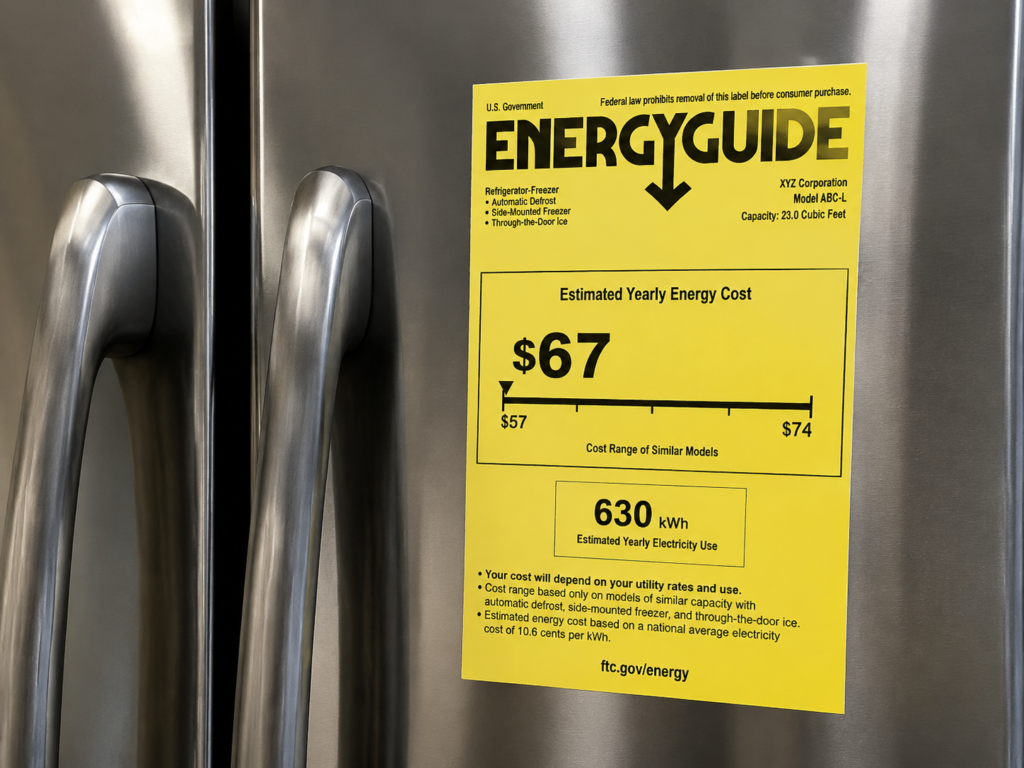
How to Correctly Read the Yellow EnergyGuide Label
When buying large home appliances, you will often see the yellow EnergyGuide label affixed to the product. Many people don’t know how to read it, and even think the ranking on it is a quality ranking, but that’s not the case:
First, confirm whether the product type, capacity, and main configuration on the label are the model you want to choose. Don’t use the label of model A to look at the parameters of model B.
Then look at two core data: estimated annual energy consumption, and estimated annual operating cost — this operating cost is calculated based on the U.S. reference electricity price. If the electricity price in your area is different, the actual cost will vary.
Finally, the energy consumption range on the label is the energy consumption range of similar products. The left side is the most energy-efficient, and the right side is the least energy-efficient. It is only a comparison of energy consumption, and has nothing to do with product quality or service life. Don’t think that products ranked on the left have better quality.
4 Key Points for Sellers/Importers to Verify Compliance
If you are a seller or importer, when verifying the DOE compliance information provided by the supplier, you should focus on these four points to avoid pitfalls:
First, first check whether the product category is really on DOE’s control list. Neither miss doing it (resulting in the product being unable to go on the market) nor do it unnecessarily (wasting money for nothing).
Second, compare the data on the test report with the latest energy efficiency threshold of the corresponding category to see if it really meets the standard. Don’t use a report that just meets the old standard line to cope with the new standard.
Third, pay attention to the effective time of the standard. Don’t use an outdated old standard report for filing, as it has long been invalid.
Fourth, check whether the product’s model number, configuration, and filing information are completely consistent. You cannot arbitrarily share filings across models: whether a filing can be shared depends on whether the model still falls within the same basic model category defined by DOE, and the configuration change does not affect energy efficiency; models that exceed the definition scope of the basic model, or whose capacity, power, core components, etc. changes will affect energy efficiency, need to complete filing separately.
Don’t Confuse Them: Differences from Similar Energy Efficiency/Safety Systems
Many people confuse DOE with several other common U.S. energy efficiency and safety systems. Here we will clarify the differences at once to avoid pitfalls.
Core Differences from ENERGY STAR
This is the pair that is most easily confused. There are three core differences:
First, the nature is different: DOE is a mandatory minimum passing line, and products that fail to meet it cannot be sold; ENERGY STAR is a voluntary higher energy efficiency standard, and only products whose energy efficiency level is significantly higher than the minimum DOE requirement can obtain certification.
Second, the logical relationship: products that can get ENERGY STAR must have met DOE’s energy efficiency requirements — after all, if you don’t even reach the passing line, you are not qualified to participate in the evaluation of a higher-level energy efficiency label. But conversely, products that pass DOE do not necessarily get ENERGY STAR.
Third, the supervisory bodies are different: DOE’s mandatory standards are managed by the U.S. Department of Energy, and ENERGY STAR is led by the U.S. Environmental Protection Agency (EPA).
Differences from the FTC Yellow Energy Label
Many people think the yellow EnergyGuide label is the official mark of DOE, but in fact the two belong to different systems:
DOE is responsible for formulating minimum energy efficiency standards and managing compliance filings, and is the core basis for market access; the FTC (Federal Trade Commission) is responsible for regulating the format and information disclosure requirements of the yellow energy label, with the aim of allowing consumers to intuitively compare the usage costs of different products.
According to regulations, for products affixed with the EnergyGuide label, the marked energy efficiency data must be completely consistent with the DOE filing information; if you need to verify the true compliance status of a product, you can query and confirm it through the DOE public database.
Differences from Safety Certifications Such as UL/ETL
Some people think that having safety certifications such as UL/ETL is equivalent to meeting DOE requirements, but these are completely different things:
DOE regulates energy efficiency, that is, whether the product uses a lot of power; safety certifications such as UL/ETL regulate safety, such as whether there is a risk of electric shock, fire, or fire hazards.
The two are completely independent systems and cannot replace each other — products with safety marks do not necessarily meet DOE energy efficiency requirements, and conversely, products that meet DOE energy efficiency do not necessarily pass safety certification. Both must be done.
Differences from State-Level Requirements Such as California’s CEC
DOE is a unified federal-level minimum requirement, and theoretically the entire U.S. market must comply with it, but some U.S. states can formulate stricter state-level energy efficiency standards, the most typical of which is California’s CEC (California Energy Commission) standard.
From the perspective of federal minimum energy efficiency access, DOE is the basic threshold applicable throughout the U.S.; but when actually entering the market for sale, it is also necessary to simultaneously check the FTC energy label requirements, supplementary energy efficiency rules of the target state, local energy-saving subsidy conditions, as well as other non-energy efficiency access requirements such as safety and electromagnetic compatibility. If the product is sold to regions with stricter state-level energy efficiency standards such as California, it must meet both federal and state rules. When the requirements of the two are inconsistent, the stricter one shall be implemented. In addition to state-level mandatory standards, some states also have additional energy efficiency conditions such as energy-saving subsidies and installation specifications, which also need to be checked separately in advance.
How Strict is the Supervision? Consequences of Violations and Common Pitfall Avoidance
Many people think that DOE is “just file it, no one checks”, but that’s not the case at all. DOE’s supervision is still very strict, and the cost of violations is also very high.
How Does DOE Investigate Violations?
DOE’s supervision mainly relies on two methods:
The first is regular market random inspections. DOE will directly purchase products on sale from the market and send them to laboratories for testing to verify whether the actual energy consumption is consistent with the filed data.
The second is public reporting. Whether it is consumers or peers, as long as they find that a product is in violation, they can report it to DOE, and DOE will launch a verification procedure after the report.
The 4 Most Common Violation Situations
In actual law enforcement, the most common violations are the following:
The first is the most basic: launching and selling directly without DOE filing. This is caught every time it is checked.
The second is false marking of energy consumption, that is, the actual energy consumption of the product is much higher than the filed data, which constitutes consumer fraud.
The third is “high-configuration samples for testing, reduced configuration for mass production”, that is, using specially modified high-configuration samples for testing, and after getting a qualified report, replacing them with lower-cost poor parts during mass production, resulting in actual energy consumption not meeting the standard.
The fourth is illegal sharing of filings among different models in the same series. For example, a series has multiple models with different capacities and different core configurations, but only one of the models has been filed, and other models that do not meet the sharing conditions directly apply the filing information. This is also a violation.
What Are the Consequences of Violations?
DOE’s penalties for violations are no trivial matter. The specific consequences depend on the circumstances and the number of products involved:
First, at the product level: goods may be directly detained by customs during import, products already on sale will be forcibly removed from shelves, and products already sold may even be required to be recalled.
Then there are fines: the amount of the fine is comprehensively determined based on factors such as the nature of the violation, its duration, and the number of products involved. For serious cases, the fine for a single product may reach the million-dollar level.
In addition, violation records will increase DOE’s subsequent law enforcement attention to the enterprise. The probability of random inspections of related categories and even all categories of products will increase significantly, and subsequent compliance costs will also increase accordingly.
Common Cognitive Misconceptions and Pitfall Avoidance Tips
Finally, let’s talk about a few of the most common cognitive misconceptions to help everyone avoid pitfalls:
First misconception: If you have ENERGY STAR, you don’t need to do DOE. This is completely wrong. ENERGY STAR is built on the basis of DOE compliance. Products that haven’t even done DOE are not qualified to apply for ENERGY STAR at all.
Second misconception: DOE certification is the highest energy efficiency proof. Wrong. DOE is just the statutory minimum passing line. Passing it only means you can sell it, it does not mean it is the most energy-efficient. Real high energy efficiency depends on ENERGY STAR or higher standards.
Third misconception: One certification is valid for life. Wrong. Energy efficiency standards are regularly updated. When products are remodeled or core components are replaced, they need to be re-tested and the filing updated. It cannot be done once and for all.
Fourth misconception: Certifications for overseas versions and U.S. versions are universal. Wrong. For example, products sold in China with 220V voltage, and U.S. 110V versions, or versions with different capacities and functions, all need to be re-tested. Overseas certifications cannot be used directly.
In fact, avoiding pitfalls is very simple. Whether you are a seller or a brand owner, regularly check the standard update announcements for the corresponding category on the official DOE website and adjust your products in advance, so you won’t be in a panic when the new standard takes effect.
Final Summary: 4 Things You Can Quickly Judge After Learning This
After learning this content, you can quickly handle 4 things related to DOE energy efficiency:
The first is a practical skill on the consumer side: when buying home appliances, lighting and other products sold in the U.S., you can check the filing information through the DOE public database, and judge whether the product is compliant based on the category, model, and launch time, to avoid buying informal parallel imports.
The second is basic judgment on the export side: if you want to sell products to the U.S., you can first check the control list to confirm whether the product needs DOE compliance, then proceed with testing and filing according to the process, so you won’t waste effort or miss access procedures.
The third is publicity discrimination: when you see publicity such as “high energy efficiency” or “DOE certification” again, you can distinguish whether it just meets the minimum DOE access line, or has obtained higher standard certifications such as ENERGY STAR, and won’t be fooled by false marking claims.
The fourth is energy efficiency comparison: when comparing the energy efficiency of different products, you will first align the category, capacity, energy type and configuration, then look at the parameters and the yellow EnergyGuide label, and won’t make silly mistakes like comparing the power consumption of a large refrigerator with a small refrigerator.