
Foreign trade practitioners and cross-border e-commerce sellers operating in the UK market will most likely hear the term “UKCA” when they first come into contact with compliance. Many people’s first reaction is: Does my product need UKCA? If you get it wrong, you may face goods detention, fines, platform removal, or waste money and time for nothing. In fact, judging the scope of UKCA is not that complicated. Once you understand the core rules, you can quickly draw conclusions for most products by yourself.
First, Understand: What Is UKCA and Why Scope Determination Is the First Step
UKCA stands for UK Conformity Assessed. You can think of it as the “entry ticket” for product compliance in the Great Britain (GB for short) market of the UK — only products that meet the corresponding safety standards can bear this mark and enter the GB market for sale.
However, two common misconceptions need to be clarified first: First, not all products require UKCA; only categories regulated by UK product safety regulations need it. Second, not all UKCA certifications need to be carried out by third-party bodies. For low-risk products, manufacturers can conduct testing on their own, retain compliance documents, and issue a self-declaration. Only medium and high-risk products require the participation of a UK-accredited third-party body for assessment.
Why is scope determination so important? Because the cost of both types of misjudgment is not small: If you think it’s not needed when it actually is, at best your goods will be detained or removed from e-commerce platforms, and at worst you will face fines. If you spend time and money on it when it’s not needed, it’s a pure waste of resources. Whether you are a local UK manufacturer, an overseas exporter, a UK importer or authorized representative, or a cross-border e-commerce seller, as long as you do business in the GB market, this is the first hurdle to pass.
Memorize 4 Key Terms First to Avoid Mistakes in Subsequent Determination
Before formally explaining the scope, let’s clarify 4 frequently occurring core terms first, so that you won’t be confused when reading the content later:
The first is Great Britain (GB): This is the applicable region of UKCA, specifically referring to the three regions of England, Scotland, and Wales, not the “entire UK” as we often say.
The second is placing on the market: This is a compliance term, which in plain language means that a product enters the target market for the first time for the purpose of commercial sale. Many time nodes and applicable conditions for judging whether UKCA is required are related to this concept.
The third is exempt products: Some products originally belong to regulated categories, but if they meet the special conditions stipulated by law, they do not need UKCA. Such products are called exempt products. Note that exemption is statutory; you cannot claim exemption status on your own.
The fourth is UK-based responsible entity: The names and specific obligations vary slightly under different regulations. Common ones include UK responsible person, importer, authorized representative, etc. The core is that when the manufacturer is not based in the UK, some categories require a local UK compliance liaison entity responsible for cooperating with supervision and retaining compliance documents. Whether it is required and what role it falls under must be confirmed according to the regulations of the corresponding category; it is not mandatory for all products.
If Any of the 3 Conditions Are Not Met, UKCA Is Not Required at All
You don’t have to go through the product list one by one right away. First go through three pre-screening conditions. As long as one is not met, it has nothing to do with UKCA directly, which can eliminate most unnecessary judgments.
First: Geographical Condition — Only Applicable to the UK Great Britain (GB) Market
The scope of UKCA is limited to the Great Britain (GB) market, that is, the three regions of England, Scotland, and Wales.
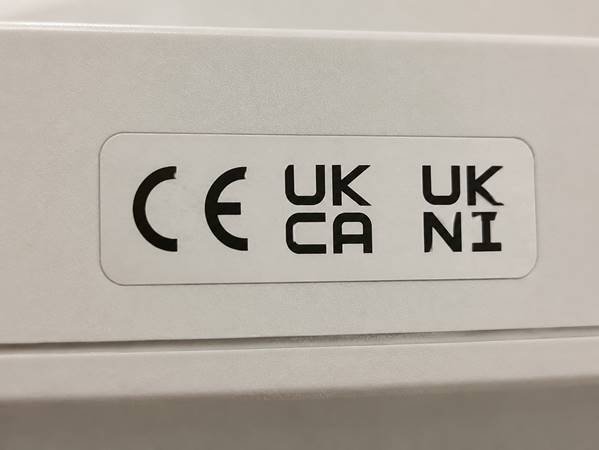
There are two types of non-GB regions that are often confused: One is Northern Ireland, where the UKCA mark is not applicable, and compliance can usually be achieved with the CE mark. If the product undergoes third-party assessment by a UK-accredited body, it may be necessary to affix both the CE and UKNI marks — the UKNI mark cannot be used alone as a compliance mark for entering the Northern Ireland market. The other type is British Overseas Territories or Crown Dependencies, such as the Isle of Man and Jersey, which have their own separate product safety rules and do not apply UKCA either.
If your products are sold to both GB and Northern Ireland, you must meet the requirements of both regions respectively; one certification cannot be used universally.
Second: Sales Nature Condition — Only for Products Commercially Placed on the GB Market for the First Time
Simply put, only products that you put up for sale and enter the GB market for the first time need to be considered for UKCA.
Specifically including: brand-new products produced locally in the UK, new/used/refurbished products imported from overseas (as long as they enter GB for sale for the first time); whether shipped via e-commerce platforms, overseas warehouses, or directly mailed to UK consumers, as long as it is for commercial sale purposes, it counts.
These situations do not count: personal items for personal use, non-sale samples for exhibition (must be taken out of GB after the exhibition), transit goods that only pass through the UK to other countries, used products or inventory that have been legally circulated in GB (for example, old inventory of local UK merchants put up for resale, as long as they were compliant before, no need to do it again).
Third: Time Condition — Must Correspond to the Mandatory UKCA Timeline for the Relevant Category
The mandatory implementation time of UKCA and the transition period for CE mark recognition vary by category, and there is no unified “cross-category transition rule”. Whether the UKCA mark must be used should be judged in combination with the specific regulations to which the product belongs, the time when it is first placed on the GB market, and whether the UK official still recognizes the CE mark at the current time. Most ordinary industrial and consumer goods have had or still have transition arrangements for CE recognition, but high-risk categories such as medical devices and construction products have separate transition and supervision rules. All shall be subject to the latest announcements on the UK government official website (gov.uk).
Special attention should be paid here: the time basis for judgment is the time when the product is first placed on the GB market, not the production date of the product. For example, if a product you produced in 2023 is first sold in the GB market in 2026, it shall follow the effective rules of that category in 2026, and has nothing to do with the production time.
Which Products Require UKCA? 6 Core Scope Categories
After passing the pre-screening, let’s see if your product belongs to a regulated category. The following are the most common frequently regulated categories in foreign trade and cross-border e-commerce scenarios, and are not the complete official list published on the UK government official website (gov.uk). If you encounter niche special categories such as marine equipment, railway equipment, measuring instruments, outdoor noise equipment, and non-automatic weighing instruments, you need to directly check the official classification for confirmation. Each category has been organized with easy-to-remember judgment characteristics and common examples, and most ordinary products can be directly matched.
1. Electronic, Electrical and Wireless Communication Products
This is the most common category, and it is also easy to judge: as long as the product is powered by plug-in or battery, or has wireless communication functions such as Bluetooth, WiFi, or cellular network, it is basically within the scope.
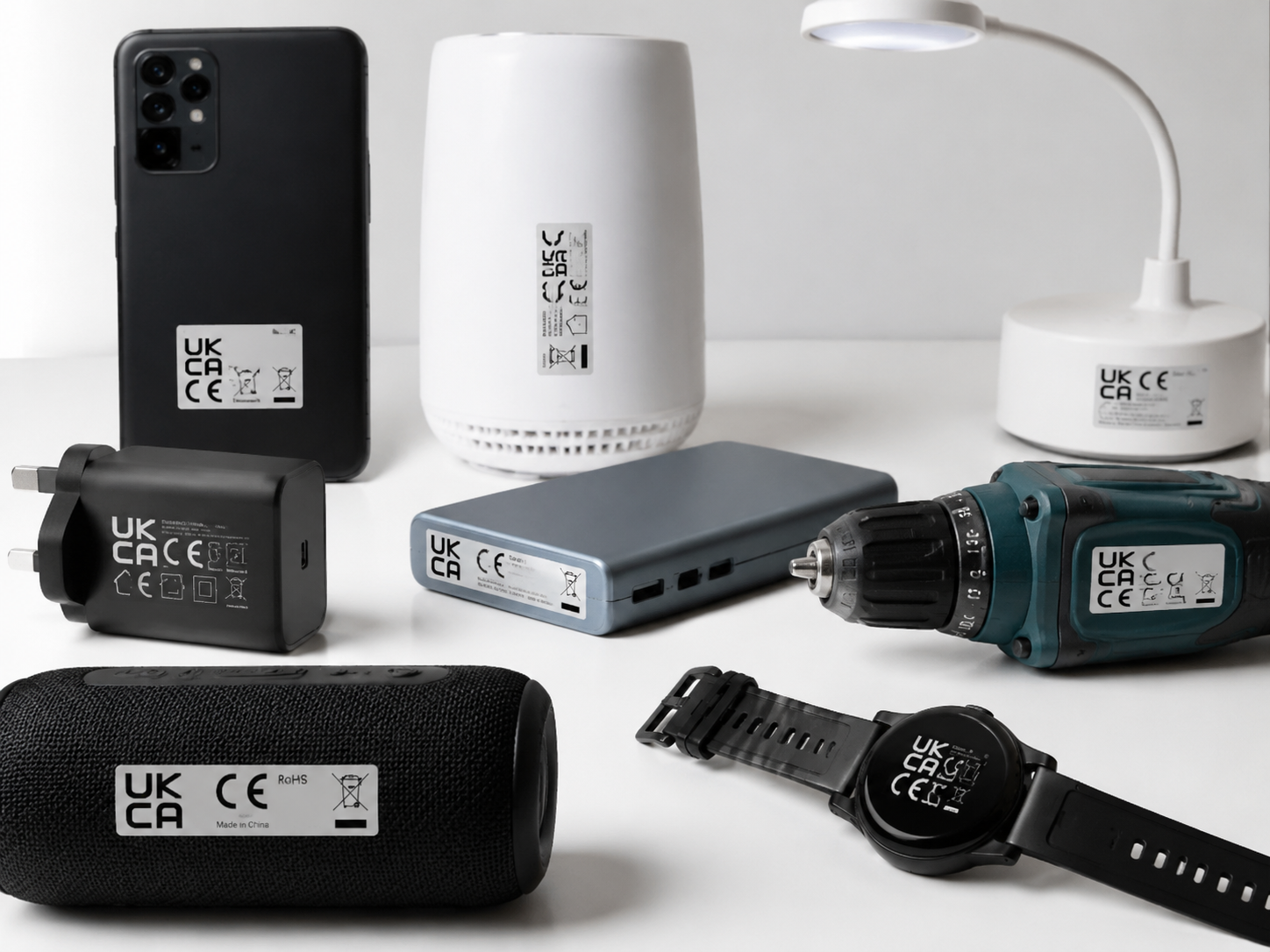
Common examples: mobile phones, chargers, home appliances, lamps, power banks, electric tools, Bluetooth speakers, smart watches.
This type of product is mainly regulated in three aspects: low-voltage safety (no electric leakage or fire), electromagnetic compatibility (will not interfere with other electrical appliances nor be interfered with), and compliance with radio spectrum use.
2. Machinery and Power Equipment
The core feature is that it has moving parts and is driven by power such as electricity or fuel. It ranges from household equipment to industrial machinery.
Common examples: household washing machines, industrial machine tools, electric bicycles, fitness equipment, elevators, agricultural machinery.
The focus of supervision is mechanical structure safety (such as whether there is a protective device, whether it will pinch hands) and supporting electrical safety.
3. Toys and Children’s Products
The core regulated scope is toy products specifically designed for children under 14 years old to play with, and the safety requirements for such products are much stricter than those for ordinary consumer goods. Some children’s products clearly covered by children’s product safety regulations are also within the UKCA system, but not all childcare products need to bear the UKCA mark — do not directly classify products into the toy UKCA category just because they are intended for children. Judgment must be made by matching the core function of the product with the corresponding special regulations: for example, baby strollers need to be checked against the special safety standards for childcare products, child safety seats need to be checked against the vehicle seat type approval rules, and pacifiers need to be checked against general product safety or food contact material related requirements. Whether the UKCA mark needs to be affixed shall be confirmed according to the corresponding specific regulations.
Common toy examples: children’s building blocks, plush toys, educational puzzles, remote control toys.
The requirements that toys need to meet include physical safety (such as whether small parts can be accidentally swallowed, whether there are sharp edges and corners), chemical safety (whether heavy metals and toxic substances exceed the standard), flammability performance (whether they are flammable), etc.
4. Personal Protective Equipment (PPE)
The core function of this type of product is to protect the user from safety and health risks, which in plain terms is something that “protects people from injury”.
Common examples: safety helmets, goggles, work gloves, protective masks, reflective vests, safety shoes.
The focus of supervision is whether the protective performance meets the standards (for example, whether cut-resistant gloves can really resist cutting) and the safety of the material itself.
5. Medical and Health-Related Products
Any product claimed to be used for medical diagnosis, treatment, care or disease prevention, whether for home or medical use, falls under the supervision of medical devices.
Common examples: thermometers, medical bandages, blood pressure monitors, medical masks, in vitro diagnostic test kits.
This type of product is regulated by the UK Medicines and Healthcare products Regulatory Agency (MHRA), with stricter rules and different procedures than ordinary consumer goods: you need to first determine the product class according to MHRA’s classification rules, then correspond to the requirements of registration, compliance assessment and transition period, and cannot directly apply the UKCA process for ordinary industrial products. It should be noted that if they are just ordinary household fitness and health care products that do not claim to have the functions of diagnosing, treating or preventing diseases, they do not fall into the category of medical devices, and need to be judged according to the rules of other categories corresponding to their actual functions.
6. High-Risk Industrial and Construction Products
Because this type of product involves a high risk level, there are special regulations for supervision, covering core areas such as pressure equipment, gas, explosion protection, and construction safety.
Common examples: gas appliances, pressure vessels, explosion-proof equipment, construction steel, doors and windows, thermal insulation materials.
The UKCA requirements for this type of product are usually more complex, and most require the participation of a UK-accredited third-party body for assessment.
3 Types of Situations That Clearly Do Not Require UKCA
In addition to the situations excluded by the pre-screening mentioned above, there are three types of products that clearly do not require UKCA, so don’t waste money.
1. Low-Risk Products Completely Outside the UKCA Supervision Scope
These are ordinary low-risk products that have no corresponding UKCA regulatory regulations. These products may be subject to other UK rules (for example, fresh food is regulated by food safety regulations), but do not need to bear the UKCA mark.
Common examples: ordinary clothing (not for protection, nor children’s special functional styles), paper books, handmade jewelry, ordinary stationery, fresh food.
2. Products That Meet Statutory Exemption Conditions
Some products originally belong to regulated categories, but if they meet the statutory special conditions, they do not need UKCA. There are three main types:
First, low-volume handmade custom low-risk products. Note that only some categories have this exemption, and it must meet the official clear definition. You cannot claim exemption just by saying it is handmade and custom; you must check the official rules of the corresponding category.
Second, prototypes or samples used only for R&D testing and not for sale to the public;
Third, products for special public purposes such as military and police use.
3. Pure Non-Physical Products/Services
Pure software, pure digital content (such as online courses, e-books, ordinary mobile phone apps), and pure services (such as consulting and maintenance services) do not require UKCA.
But note one exception: if the software is a core functional component of a hardware product, such as control software for medical equipment or operating software for industrial machine tools, it must be judged together with the hardware and cannot be exempted separately.
How to Judge Products with Ambiguous Boundaries? 4 Practical Rules
There are always some products in the gray area, such as those that look similar but have different uses, are sets or accessories, are second-hand, etc. At this time, use the following 4 rules to judge, and you can basically figure it out.
Rule 1: Same Appearance but Different Uses, Subject to Design/Promotional Purpose
Many products look similar, but their uses are different, and the regulatory categories are vastly different. When judging, don’t just look at the appearance; look at the design purpose of the product and the core use promoted by the merchant.
The most typical example is masks: ordinary decorative masks, which are only used to match clothes and block floating dust, are not within the scope of UKCA; but if they are protective masks used to prevent dust and viruses, they belong to personal protective equipment and must have UKCA. Another example is gloves: ordinary warm wool gloves do not need it, while work gloves that are cut-resistant and chemical corrosion-resistant belong to PPE and require certification.
Rule 2: Combined/Set/Multi-Functional Products, Cover All Requirements According to Final Functions
If a product has multiple functions, or is a set of combined products, it must cover the compliance requirements corresponding to all functions, not just one of them.
For example, a children’s toy with LED lights is both a toy and has electronic and electrical functions, so it must meet both the requirements of toys and the safety requirements of electronics and electrical equipment. Another example is an assembled electric toy set, which after assembly is an electric toy with moving parts, so it must meet the requirements of both toys and machinery.
The simplified judgment method is: first match the main category according to the core use function of the product, then check whether there are other functions that need to cover the corresponding requirements.
Rule 3: Accessories/Spare Parts/Consumables, Depends on Whether They Are Sold Separately as Finished Products
Many people are confused about whether accessories need UKCA. In fact, the core judgment standard is: whether it is sold separately as a finished product.
If the accessories are individually packaged and sold separately, and themselves belong to regulated categories, they need UKCA, such as separately sold chargers and separately sold protective masks. But if they are original replacement spare parts sold together with the original product, such as the original charger given with a mobile phone, or spare parts provided with a machine tool, they can usually be included in the overall compliance assessment and technical document management of the main product or set, which does not mean that the accessories themselves do not need to meet applicable safety regulations; only when such accessories are placed on the market separately, or are safety-critical components, do they need to be separately checked for UKCA or other special regulatory requirements.
However, it should be noted that special safety-related accessories, such as elevator safety components and wireless communication modules, have special rules, and this logic cannot be directly applied; you need to check the official requirements separately.
Rule 4: Used/Refurbished/Modified Products, Depends on Whether They Are First Placed in GB and Whether Their Attributes Are Changed
Whether used products need UKCA cannot be generalized, and there are three situations:
If they are used or refurbished products imported from overseas to GB, as long as they enter the GB market for sale for the first time, they fall within the scope of UKCA and require certification;
If the product has been legally circulated in GB, for example, a used mobile phone resold by a local UK consumer, or old inventory of a merchant put up for resale, there is no need to redo UKCA;
If the original use or safety performance of the product changes after refurbishment or modification, for example, converting an ordinary electric bicycle into a faster electric motorcycle, it is equivalent to a new product, which needs to be re-included in the UKCA scope and follow the requirements for new products.
Step-by-Step Guide to Quickly Determine Whether Your Product Requires UKCA
After talking so much, you may still feel a bit confused. Below is a set of practical steps. Follow them in order, and you can quickly get a conclusion for most products.
Step 1: 30-Second Pre-Screening (Eliminate 80% of Non-Applicable Cases)
First check the three most basic questions:
1. Is your product sold to the Great Britain region of the UK (England, Scotland, Wales)?
2. Is your product for commercial sale and entering the GB market for the first time?
3. When the product is first placed on the GB market, does the corresponding category already require UKCA, and there is no applicable CE recognition/transition arrangement?
As long as one answer is “no”, you don’t need to consider UKCA at all, saving you from wasting effort later.
Step 2: Initial Category Matching (Most Ordinary Products Get a Conclusion Directly)
If you pass the pre-screening, do two comparisons:
First compare with the 6 categories of products that require UKCA mentioned above to see which category your product belongs to;
Then compare with the 3 types of situations that do not require UKCA to see if it is an exclusion item.
For most ordinary consumer and industrial products, a clear conclusion can be drawn at this step. If it is a relatively niche special category, such as marine equipment, railway equipment, measuring instruments, which are not in the 6 categories mentioned above, then directly check the official list of the UK government.
Step 3: Check Boundary Situations (For Ambiguous Products)
If your product belongs to situations with relatively ambiguous boundaries such as combined sets, accessories, used products, or custom products, use the 4 boundary judgment rules mentioned above to check one by one. Never draw a conclusion just by looking at the product name; you must make a comprehensive judgment combined with the product’s function, use, and sales method.
Step 4: Official Verification Channels When You Are Unsure
If you are still not sure after judging by yourself, don’t guess blindly. It is safest to confirm through official channels:
• UK government official website (gov.uk): You can search for “UKCA marking guidance”, “product safety for businesses” and “sector-specific regulations” of the corresponding industry, and find official requirements by product category;
• Competent authorities of the corresponding industry: For example, MHRA for medical products, and the UK Office for Product Safety and Standards (OPSS) for ordinary consumer goods;
• Consult a qualified local UK compliance service provider.
Also note: Do not directly apply the CE product scope to judge UKCA; the rules issued by the UK official shall prevail.
For your quick check, here is a simple checklist. If all the first 4 items are met, it basically falls within the applicable scope of UKCA; as for whether the UKCA mark must be affixed currently and whether transition arrangements such as CE can still be used, you need to check the current official rules of the corresponding category:
□ Sales region is Great Britain, UK (England/Scotland/Wales)
□ Product is for commercial sale and is launched in GB for the first time
□ Product belongs to the core regulated categories that require UKCA
□ Does not meet any statutory exemption conditions
□ The corresponding category already requires UKCA when first placed on GB, and there are no available transition arrangements such as CE recognition
5 Most Common Scope Judgment Misconceptions to Avoid
Finally, we have sorted out 5 most common pitfalls that people easily fall into. Avoiding these can save you a lot of detours.
Misconception 1: All Products Exported to the UK Require UKCA
Many people who are new to UKCA think that as long as they sell to the UK, they need to do it, but that’s not the case. Only products that are regulated by UKCA and commercially placed on the GB market for the first time need it. Ordinary handmade jewelry, fresh food, pure services, and personal items are not within the scope. Don’t rush to find a certification agency right away; first screen according to the method above.
Misconception 2: The Product Scopes of UKCA and CE Are Exactly the Same
Because UKCA was launched after the UK left the EU, many rules refer to CE, so most categories do overlap, but they are not exactly the same. The UK has adjusted the scope of some categories. For example, the classification of some construction products and medical devices is different from that of the EU. Directly applying the CE scope to UKCA may lead to under-judgment (thinking it’s not needed when it actually is) or over-judgment (wasting money when it’s not needed).
Misconception 3: Small/Low-Value Products Sold Online Do Not Need UKCA
Some people think that since they only sell small, low-value chargers and toys on e-commerce platforms, no one will check, so UKCA is not needed. In fact, whether online or offline, regardless of the product’s size or how low the price is, as long as it falls within the UKCA scope, it must be compliant. Major UK e-commerce platforms conduct regular spot checks on non-compliant products. If found, products are immediately removed from shelves, and in severe cases, accounts are frozen.
Misconception 4: Northern Ireland Also Requires UKCA Certification
This is the most common geographical misconception: UKCA is not used uniformly across the entire UK. Northern Ireland applies the CE or CE+UKNI marks, and UKCA is not applicable there. If products are sold to both GB and Northern Ireland, they must meet the compliance requirements of both regions respectively.
Misconception 5: Scope Can Be Judged by Product Name Without Considering Use
Many people only search for product names when checking the scope, such as “do masks need UKCA”, but in fact, products with the same name but different uses may have completely different regulatory categories. Ordinary decorative masks do not need it, protective masks do, and medical masks also need to follow the medical category process. Therefore, when judging, you must consider the product’s designed use and promotional use comprehensively, not just the name.
The core logic of UKCA scope determination can be summarized as: first exclude non-applicable scenarios through three pre-screenings of region, sales nature, and time node, then match the category regulatory scope and exemption rules. When encountering boundary situations such as combined products, accessories, and used products, check one by one according to designed use, sales form, and whether it is the first placement on GB. When in doubt, prioritize verification through official channels, and there is no need to memorize all categories by rote.