
If you run a cross-border e-commerce business in the U.S., operate a physical offline store, or have simply bought plug-in small home appliances, you have most likely seen the small “ETL” mark printed on the bottom of products. Many people know it is a safety certification, but cannot clearly state which products should carry this mark and which situations constitute unauthorized use. Getting it wrong can, at best, lead to products being removed from e-commerce platforms or detained by customs, and at worst, create hidden electrical safety hazards. Today we will thoroughly explain the scope of application of ETL Listed: from a beginner-friendly category checklist for direct reference, to advanced judgment logic, and then to official authenticity verification methods. After reading this, you will be able to make a mostly accurate judgment on your own.
First, Get Clear: What Exactly Is ETL Listed?
In plain terms, ETL Listed is a third-party electrical safety compliance mark issued by the international testing institution Intertek (known as Tianxiang Group in Chinese). It represents that the product has passed tests for applicable electrical safety standards in the United States or Canada, is commonly seen on finished residential, commercial, and general industrial products, and meets local safety requirements.
Many people compare ETL with UL. In fact, the two have the same legal validity — both belong to the Nationally Recognized Testing Laboratory (NRTL) system administered by the U.S. Occupational Safety and Health Administration (OSHA). Simply put, this is a list of institutions officially recognized by the U.S. government that are qualified to issue electrical safety certifications. Only certifications issued by institutions on this list have legal effect in the U.S.
However, note that ETL Listed only verifies the electrical safety of end-use finished products. It does not cover other dimensions of compliance requirements such as radio frequency, energy efficiency, medical functions, or product performance. Do not assume that having this mark equals full compliance across all categories.
Why Is the Scope of Application So Important?
Clarifying which products are eligible for ETL Listed is not for passing exams, but for solving practical problems:
- For sellers: unauthorized use of the ETL Listed mark on products outside the scope will lead to customs detention, removal from e-commerce platforms, and in serious cases, fines.
- For merchants and engineering contractors: U.S. retail channels, commercial projects, and local electrical inspections often take ETL Listed as a basic safety access criterion. Products with incorrect scope cannot pass inspection.
- For ordinary consumers: you can also judge whether a product meets basic electrical safety requirements through the scope of application, and avoid inferior products with counterfeit marks.
Don’t Mix Them Up: Differences Between Several ETL Marks
ETL has several different marks under its umbrella, and many people easily confuse them. Let us first draw clear boundaries — the “ETL Listed” discussed today refers specifically to the safety certification for end-use finished products. The other types do not fall into this category:
| ETL Mark Type | Core Purpose | Is It Within the ETL Listed Scope Discussed in This Article? |
|---|---|---|
| ETL Listed | Electrical safety certification for ready-to-use end-use finished products | Yes |
| ETL Recognized | Component certification for parts and modules (e.g., bare power modules, battery cells) | No |
| ETL Verified | Performance verification (e.g., brightness, battery life, energy efficiency), unrelated to safety access | No |
| ETL Classified | Narrow-scope assessment only for specific risks or specific conditions, with far less coverage than Listed | No |
| ETL Listed with us/c/cETLus regional markings | Regional applicability labels on the nameplate: U.S. only / Canada only / valid for both U.S. and Canada | Yes (these are regional markings for ETL Listed, not independent certification types) |
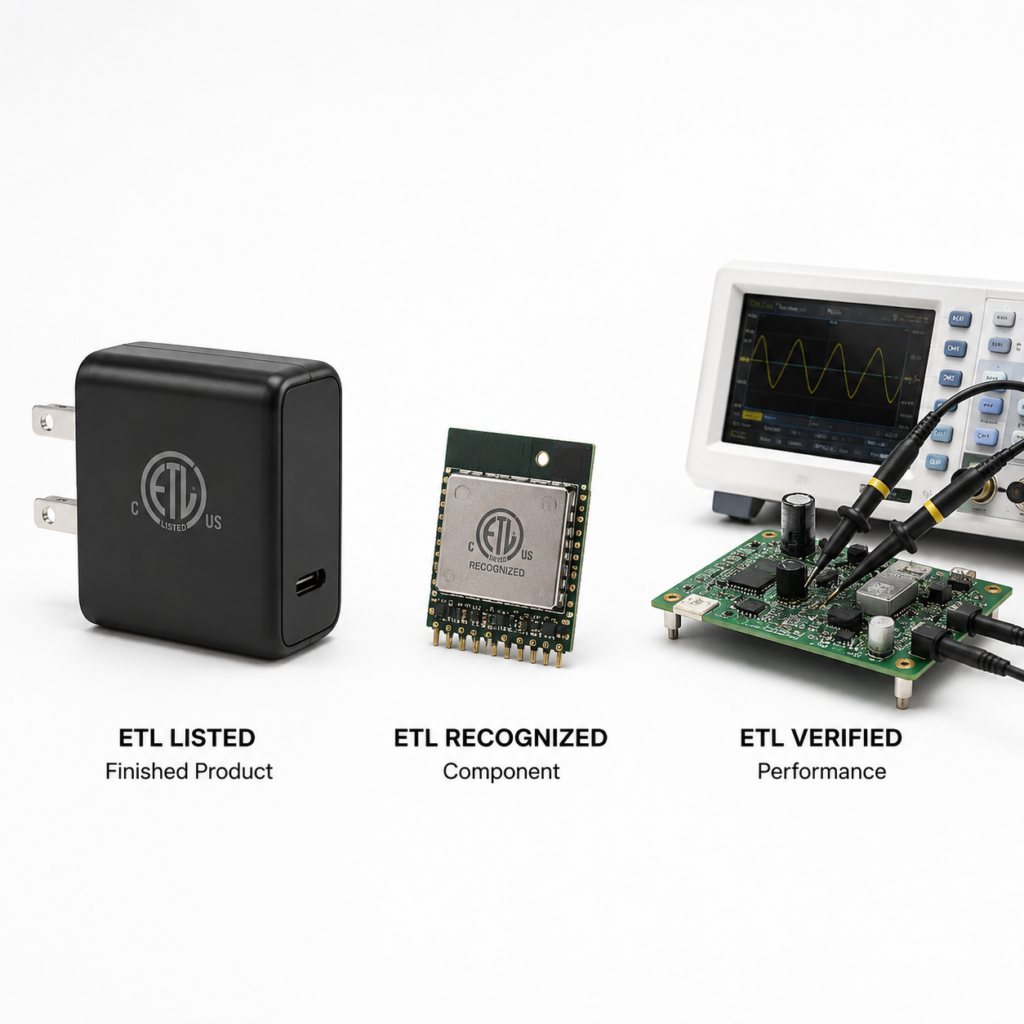
It should be noted that us, c, and cETLus are regional applicability marks for ETL Listed, not independent certification categories. The specific regions where a product is applicable are ultimately subject to the listing information in Intertek’s official directory.
A simple way to remember: only finished products intended for end users and ready to use out of the box carry the ETL Listed mark; components and performance verifications do not count.
Beginner’s Quick Reference: Common Electronic Products Eligible for ETL Listed
First, here is a beginner-level reference checklist. The vast majority of compliant electronic products encountered in daily life can be classified into the following categories:
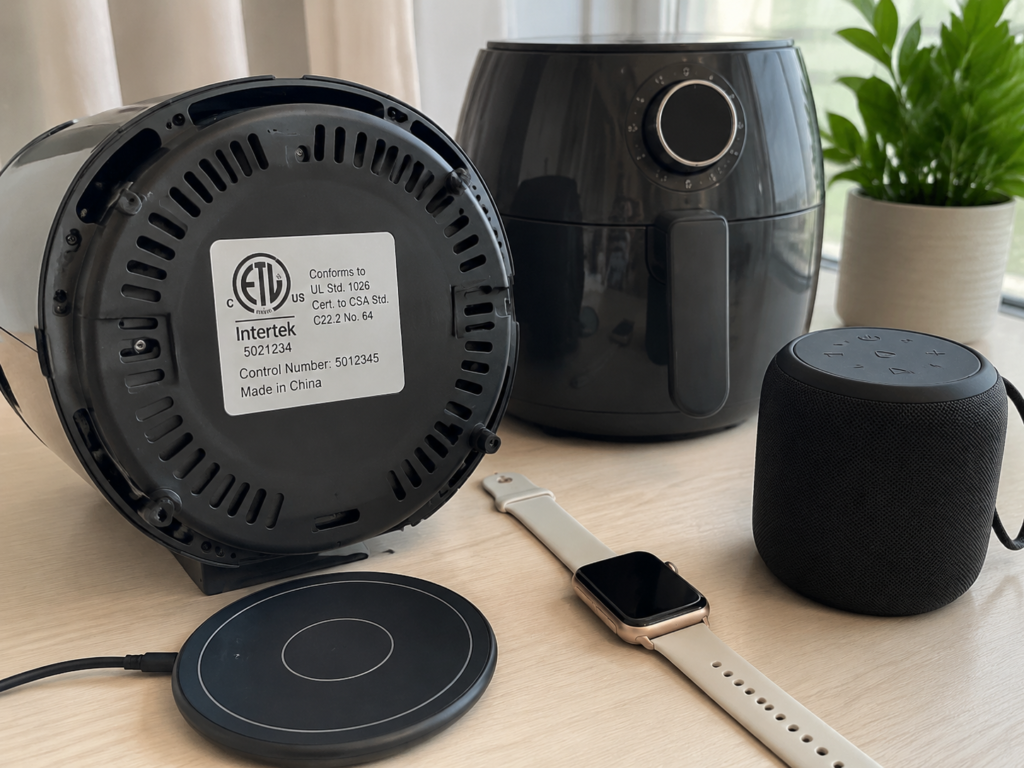
Home Consumer Electronics
These are finished products for daily home use, either plug-in or battery-powered, ready to use out of the box. Examples include audio-visual products such as TVs, speakers, projectors, set-top boxes, and game consoles; small home appliances such as coffee makers, air fryers, hair dryers, electric toothbrushes, and robot vacuums; as well as wearables and accessories such as smart watches, wireless charging pads, power banks, wired earphones, and Bluetooth earphones.
Quick judgment tip: intended for ordinary household users, no additional assembly or modification required, can be used directly after plugging in / installing batteries.
Office and Commercial Electronics
Finished equipment commonly used in offices and shops is also within the scope. Examples include IT equipment such as monitors, desktop computers, laptops, servers, routers, and switches; office peripherals such as printers, scanners, paper shredders, and external storage devices; as well as commercial terminals such as POS machines, barcode scanners, conference systems, and shop advertising screens.
Although these products are for commercial scenarios, they are also finished products directly intended for end users and require no additional modification, so they meet the requirements of Listed.
Lighting and Electrical Finished Products
This category is directly connected to the mains supply and is also a key focus of electrical safety inspections. Residential lighting includes LED bulbs, chandeliers, light strips, ceiling lights, and desk lamps; commercial lighting includes office LED panel lights, commercial ceiling lights, and track lights; electrical finished products include smart switches, wall sockets, finished extension cords with plugs, and dimmers.
Note that the core here is “finished product”: a finished extension cord with a plug counts, but if it’s just a bundle of wire and two plugs that you have to assemble yourself, it does not count.
Power Supply and Charging Finished Products
Examples include wall-plug power adapters, mobile phone chargers, USB charging docks, UPS (uninterruptible power supply) units, and finished power banks (portable chargers), all of which are within the scope.
A key point to emphasize here: they must be complete, ready-to-use power supply finished products. Bare power modules and individual battery cells are components and are not within the scope of Listed.
General Industrial Electronic Finished Products
Note that there are two prerequisites: “general” and “finished product”. Examples include complete industrial control cabinets, industrial switches sold as complete units; as well as general industrial lighting such as high bay lights and regular industrial lighting fixtures.
These products must be finished products sold as complete units and used in general industrial environments — if they are for special scenarios such as explosion-proof mines or underwater use, they do not fall within the scope of ordinary Listed.
Key Pitfalls to Avoid: These Products Are Not Eligible or Require Additional Assessment
After reading the applicable categories, you may think most electronic products can be certified? That is not the case. Many products are either completely outside the scope or cannot be directly applied for under ordinary ETL Listed, and a lot of people stumble here.
Categories Completely Outside the Scope of Application
The first category is pure electronic components, such as resistors, chips, bare circuit boards, battery cells, and bare power modules — these are all components of products, not end-use finished products. They can only obtain component-level Recognized certification and cannot bear the Listed mark.
The second category is non-mass-produced, non-commercial products, such as self-made laboratory test equipment, engineering prototypes, and custom tooling fixtures. These are not formal mass-produced products for market sale and are also outside the scope.
The third category is categories with exclusive regulatory systems, such as military/aerospace electronics, implantable medical devices, and original equipment manufacturer (OEM) in-vehicle electronics for complete vehicles (these products usually follow the exclusive regulatory system for complete automobiles, such as relevant U.S. FMVSS standards, and do not directly apply ordinary residential/commercial ETL Listed rules) — all of these have their own special safety regulatory rules and are not governed by ordinary residential/commercial ETL Listed.
Boundary Products Prone to Misjudgment
There are several other types of products that look like ordinary electronics but cannot be directly applied for under ordinary ETL Listed, and many sellers easily trip up here:
- Children’s toys with electronic functions: such as electric toy cars and early education machines, need to meet toy-specific safety standards. Electrical safety is only one part of them, and ordinary ETL Listed alone is not sufficient.
- Non-implantable small medical electronics: such as home blood pressure monitors and blood glucose meters, need to be tested according to exclusive medical electrical standards. Moreover, ETL is only a safety certification and cannot replace FDA medical approval.
- Industrial electronics for explosion-proof/mine scenarios: ordinary industrial-grade ETL certification does not cover explosion-proof requirements, and must additionally comply with exclusive explosion-proof standards.
- Electronics for outdoor/humid environments: such as outdoor street lights and bathroom heaters, ordinary indoor certification does not cover waterproof and weather resistance requirements, and corresponding additional tests are required.
- Electronic kits that require user self-assembly: such as DIY radio kits and circuit board sets that require soldering by the user, because they are not ready-to-use end-use finished products, they cannot obtain Listed certification.
Advanced Judgment: Four Core Logics for Unfamiliar Categories
If the product you encounter is not on the common list above, you do not need to memorize everything by rote. As long as you master the four core judgment dimensions, you can preliminarily determine whether it is within the scope of ETL Listed — this is also the key from beginner to semi-proficient.
Dimension 1: Is It an End-Use Finished Product?
This is the core judgment criterion: after the user receives it, no additional assembly or modification is required, and it can be used directly by plugging in power or installing batteries.
For example, a finished desk lamp lights up right out of the box when plugged in, so it is an end-use finished product; if you buy a desk lamp kit that requires you to connect the wires and install the lamp holder yourself, it is not. Counterexamples are also clear: DIY kits that require self-soldering, bare circuit boards, and individual power modules do not count.
There is a special case here: if it is a finished product set sold as a complete set with official installation instructions, such as a chandelier set with all accessories and installation guidelines, and the installation process only requires routine operations such as screwing and hanging, without electrical modification, it can be evaluated as a complete finished product set.
Dimension 2: Is There a Corresponding Current Safety Standard?
ETL Listed is not a casual test; it must be based on current safety testing standards issued by U.S. ANSI, UL, or Canadian CSA. Here are a few common corresponding examples: ordinary household desk lamps correspond to the UL 153 standard, and power adapters correspond to the UL 62368-1 standard — these are only examples of common standards for specific categories and do not cover all applicable standards for electronic products.
If it is a brand-new product category with no corresponding current standard, ETL Listed cannot be directly obtained, and it is necessary to first evaluate whether a special test plan can be developed. In addition, safety standards are regularly updated, and the scope of products covered may be adjusted after each update; they are not static.
Dimension 3: Electrical Risk Level
The core of ETL Listed is to control electrical safety risks, so the risk level of a product directly affects whether it can be certified and according to which standard. Generally speaking, the risk priority of power supply is: mains supply > built-in high-voltage circuit > low-voltage DC > low-power battery supply.
But special attention should be paid: low power does not mean exemption from assessment. Even a very small Bluetooth earphone has corresponding battery safety standards and must follow the rules. The core is to check for risk points such as accessible live parts, heating parts, and insulation structures, not just the power level.
Dimension 4: Intended Use Scenario and Region
First, safety standards for residential, commercial, and industrial use are different, and certifications cannot be used across scenarios — for example, the certification for a household desk lamp cannot be used for lighting in industrial mines, as industrial scenarios have stricter requirements.
Second, special scenarios such as explosion-proof, medical, children’s use, and outdoor humid environments all have exclusive safety standards and cannot be certified according to ordinary electronics standards.
Finally, there may be slight differences between the standards of the U.S. and Canada, so there are regional markings on the ETL mark: products with only the “us” mark can only be sold in the U.S., products with only the “c” mark can only be sold in Canada, and products with the “cETLus” mark are valid for both the U.S. and Canada. Products with single-region certification cannot be sold across regions.
Practical Methods: How to Self-Check and Verify the Certification Scope?
After explaining the judgment logic, you may ask: when you actually encounter a product with an ETL mark, how do you confirm that its certification is real and the scope is correct? Below are several actionable methods, from quick self-check to official verification.
3-Step Quick Self-Check Method
No need to look up any information, you can make a preliminary judgment in one minute:
Step 1: Check the product form — is it a finished product for end-user sales? Can it be used directly out of the box? If it requires self-assembly or modification, it is definitely not within the scope of ordinary Listed.
Step 2: Match with common categories — compare with the five categories of applicable products mentioned above to see if it belongs to the common eligible categories.
Step 3: Confirm the use scenario — is it an ordinary residential, commercial, or general industrial environment? Are there any special requirements such as explosion-proof, waterproof, medical, or children’s use?
If all three steps are met, it is most likely within the scope of application.
Preliminary Verification via Product Nameplate
For formal ETL Listed certification, the corresponding mark must be on the nameplate at the bottom or back of the product. You can check from the following points:
First, there must be the ETL Listed mark, as well as an exclusive Control Number — usually a character code of about 7 digits, which is the unique query voucher for the certification. If there is no control number, it is most likely fake.
Second, check the regional markings on the mark, whether it is us, c, or cETLus, to confirm whether the applicable region matches the region where you want to sell/use the product.
Third, if the nameplate does not additionally mark special use scenarios (such as waterproof, outdoor applicable, explosion-proof, etc.), it can be preliminarily inferred that its certification is based on the test requirements of ordinary indoor residential/commercial environments. However, the nameplate can only be used for preliminary screening and cannot be used alone as a basis for judging the coverage of special scenarios; for special uses such as outdoor, humid, and explosion-proof, you must go back to the official Directory and specific applicable standards to check and confirm whether the applicable scope in the official listing covers it.
Finally, you also need to check whether the parameters on the nameplate, such as model number and rated voltage/power, are consistent with the actual product. If the model number does not match, even if the mark is real, it does not cover this product.
Precise Verification via Intertek’s Official Database
The most accurate method is to query in Intertek’s official ETL Listed Directory database. You only need to enter the official query page and enter the control number, product model, or manufacturer name to search.
After finding the result, you should focus on checking three pieces of information: first, whether the product model is consistent with the one you have. Note that the same control number may include multiple models, so you need to check them one by one, not just confirm the control number is correct; second, whether the applicable safety standards and use scenarios match; third, whether the certification status is valid. If it cannot be found, or the status is invalid or revoked, the certification is invalid.
Common Tips for Identifying Fake Marks / Misuse
Be careful when you encounter the following situations, which are most likely fake marks or out-of-scope use:
- Incorrect mark style, or missing control number;
- The entered model or control number cannot be found in the official database, or the status has expired;
- Promoting ETL Recognized (component certification) or ETL Verified (performance verification) as ETL Listed safety certification;
- The model on the nameplate is inconsistent with the model in the official listing, for example, the official listing is Model A, but the product is printed with Model A Pro.
5 Most Common Cognitive Misconceptions
Finally, we sort out the 5 most common cognitive misconceptions. Even people who have been in e-commerce for several years can easily get them wrong.
Misconception 1: All Electronic Products Can Obtain ETL Listed
Correction: ETL Listed only applies to end-use finished products with corresponding safety standards. Pure components, non-commercial products, and categories with exclusive regulatory systems are all outside the scope.
Example: The battery cell in a mobile phone is a component and can only obtain ETL Recognized component certification, and cannot be regarded as an ETL Listed finished product alone; after being installed in an end product such as a mobile phone, whether it is included in the scope of the whole machine safety certification depends on the declared model of the whole machine, applicable standards, and official listing.
Misconception 2: With the ETL Listed Mark, It Is Universal for All Scenarios / Regions
Correction: Certification only covers the product model, use scenario, and region at the time of declaration; it is not a single mark that works everywhere.
Example: The ETL certification for a household desk lamp cannot be used for mine lighting. Products with only the us mark cannot be sold in Canada, otherwise it is a violation.
Misconception 3: ETL Listed Is Lower Grade Than UL Listed and Is Not Recognized
Correction: Both are NRTL safety certifications recognized by U.S. OSHA, with exactly the same legal validity, and both are officially recognized safety certifications.
Note: For a few very niche categories, different institutions may cover different standards, or some specific channels may specify the UL mark, but from a regulatory perspective, there is no difference in the validity of the two.
Misconception 4: Having Other Certifications Means Meeting the ETL Applicable Scope
Correction: Certifications such as CE, 3C, FCC, and FDA are in charge of different fields or markets and cannot directly replace ETL’s electrical safety certification.
Example: A WiFi-enabled router with an FCC ID only means that its radio frequency meets the requirements. It is still necessary to separately evaluate the applicable scope of ETL Listed and obtain electrical safety certification.
Misconception 5: Certification Passes Once and Is Valid for the Entire Series / Permanently
Correction: First of all, series certification has strict rules and must meet the series division requirements in the standard. After product remodeling or replacement of key parts such as power supplies and batteries, the certification scope needs to be re-evaluated. For example, if the original 5V1A power supply of a desk lamp of the same series is replaced with a 12V2A one, it is necessary to re-verify whether it is still within the original certification scope, and the original mark cannot be used directly.
Second, ETL certification is not a once-and-for-all matter. The issuing agency will regularly conduct follow-up inspections at the factory. When standards are updated or products are remodeled, re-testing may be required. It is not that everything is fine once you get the certificate.
Final Summary
At this point, you should have a relatively clear understanding of the scope of application of ETL Listed. After learning this content, you can master the following practical abilities:
You can quickly distinguish ETL Listed from other types of ETL marks and clarify the core boundaries of the certification;
You can use the 3-step self-check method to preliminarily judge whether common electronic products are within the applicable scope;
You can identify completely inapplicable and boundary categories and avoid the 5 core cognitive misconceptions;
You can verify the certification scope and authenticity of specific products through the product nameplate and official database;
You can accurately communicate the scope requirements of ETL Listed with suppliers and channel partners and will not be misled.
Whether you are engaged in cross-border e-commerce, local U.S. retail, or an ordinary consumer buying electrical appliances, this knowledge can help you avoid many electrical safety pitfalls.