
Friends who do business in the US market have most likely encountered confusion related to “UL”: a supplier says “we have a UL report”, but when you submit it for platform entry, it gets rejected directly; a customer asks “do you have UL certification”, and you hand over a test report, only to be told on the spot that it does not meet the requirements. Many people cannot tell the difference between a UL test report and a UL certificate, thinking both are “UL-related proofs”, only to end up wasting money, delaying delivery schedules, and even falling into major compliance pitfalls.
This article will explain this matter thoroughly: from the most basic definition of UL, to the core differences between the two, to how to verify the documents you receive, how to choose according to your own needs, and how to check authenticity. After reading it, you will be able to handle most daily UL compliance issues and no longer be misled.
First, Understand a Few Basic Concepts
Before talking about the differences, we need to clarify a few most easily confused basic concepts, otherwise it is easy to fall into the misunderstanding that “UL is an official US certification”.
What Exactly is UL
Many people think UL is an official agency of the US government, but it is not. UL’s full name is UL Solutions, a private safety science company in the US with a history of more than 100 years. It has two core tasks: one is to develop safety standards for various products, and the other is to conduct certification and testing.
Many standards developed by UL are recognized by the American National Standards Institute (ANSI), so they have high authority. But note: UL certification is essentially a market and commercial requirement, not a unified mandatory regulation across the US — only some local regulations reference UL standards, or require products to have NRTL certification, and in that case UL is required as a type of NRTL.
The common products that require UL-related certifications in daily life are mostly safety-related, such as powered consumer electronics, lighting, home appliances, building materials, fire protection products, etc.
The General Environment of US Safety Compliance: UL is Not the Only Option
To understand UL’s position, you first need to know several core roles in the entire US safety compliance system, which in plain terms are:
- OSHA (Occupational Safety and Health Administration, the federal government department responsible for workplace safety supervision): It authorizes a number of third-party institutions to carry out safety certification, and these institutions are collectively referred to as NRTLs.
- NRTL (Nationally Recognized Testing Laboratory): Third-party certification institutions authorized by OSHA. UL is just the most well-known one among them; ETL, CSA, etc. are also NRTLs, and in most scenarios, their listing certification has equivalent validity.
- NEC (National Electrical Code): A nationwide electrical safety standard in the US, and regulatory authorities in most places enforce according to this standard.
- AHJ (Authority Having Jurisdiction): Local regulatory agencies with law enforcement powers such as fire protection and construction departments. For example, if the lighting you sell is to be installed in a commercial building, the local fire department responsible for acceptance is the AHJ, and they have the final say on project compliance.
So the core conclusion is simple: UL is not the only safety certification in the US, nor is it directly issued by the government; it is one of the most widely recognized NRTL certifications in the market.
UL Test Report: The “Safety Test Report Card” of Samples
Let’s start with the UL test report. You can think of it as a student’s single exam report card: you send samples to the laboratory, the laboratory tests according to UL standards, and then issues a report telling you which items passed and which failed.
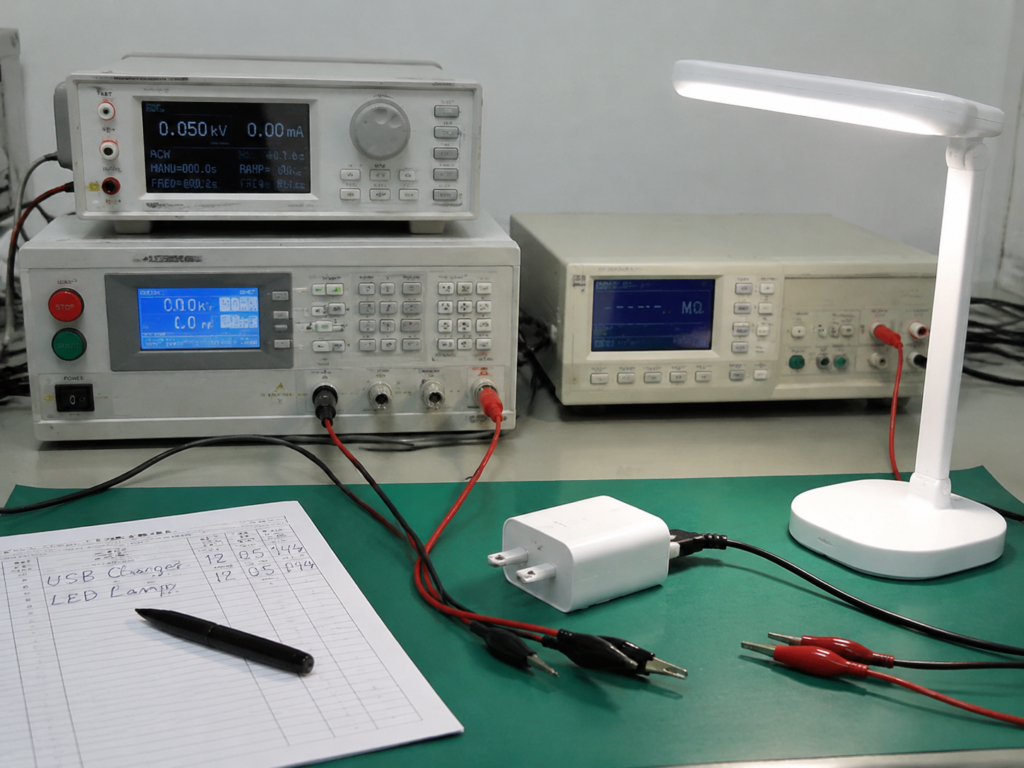
This report is only responsible for the few/batch of samples you sent, as well as the test items listed in the report. As for whether your mass-produced products in the future are the same as the samples, and whether they can always meet the standards, the laboratory does not take responsibility.
The purpose of the test report is also very clear: for example, to verify performance during the product R&D stage, to be used as application materials when applying for UL certification, for internal compliance archiving of the company, or when customers request to see the test results of samples.
Also note: it is not only UL’s own laboratories that can issue UL test reports. Any third-party laboratory with the testing capability for the corresponding UL standard can issue them, but the recognition of reports issued by different laboratories varies, which we will explain in detail later. Third-party laboratories can issue test reports according to UL standards, but whether they can be accepted by customers, platforms, or UL certification projects depends on the laboratory’s qualifications, the completeness of test items, the consistency between samples and mass-produced products, the adopted standard version, etc. Not all third-party reports have the same validity.
UL Certificate: The “Safety Compliance Pass” for Products
The UL certificate is completely different. It is equivalent to a graduation certificate issued by the school: you can’t get it by just taking one exam; you can only get it if the entire production and quality control process meets the requirements.
The UL certificate is an official proof issued by UL Solutions as a certification body, representing that your product has been included in UL’s certification system. It is not only responsible for the submitted samples, but also valid for mass-produced products of the same model listed on the certificate and the designated production factories — provided that you always comply with UL’s control requirements.
There are three common types of UL certificates, don’t confuse them:
- UL Listed: For complete end products, such as mobile phone chargers, small home appliances, and lighting — products that consumers can use directly after receiving them. Generally, these are listing certifications, which is also one of the common forms of the so-called “NRTL listing”.
- UL Recognized: For components or raw materials, such as capacitors, PCB boards, and plastic pellets. These parts are installed inside the whole machine, cannot be sold separately as end products, and cannot replace the listing certification of end products.
- UL Classified: For specific performance or specific scenarios of products, such as fire resistance rating and waterproof rating. It only proves that this one performance meets the requirements, and is not a full-item safety certification.
In addition to the certificate itself, UL also provides two supporting core documents: one is the Listing detail page, which is used to publicly confirm the certified model, category, and applicant/production entity information; the other is the Follow-Up Service Procedure (hereinafter referred to as Follow-Up Procedure), which is the official basis for factory inspection and mass production consistency control in UL’s subsequent Follow-Up (continuous follow-up supervision service after certification issuance). It usually specifies the list of recognized key components, product structure requirements, factory inspection frequency rules, and mark usage specifications. During mass production, factories cannot arbitrarily replace key materials or change product structure, otherwise it may lead to certification invalidation. These supporting documents are the official basis for subsequent mass production control, factory inspection, and mark use.
The greatest value of the UL certificate is that you can use the corresponding UL mark on products and packaging within the certification scope, and it can be queried in UL’s official system, with high recognition.
Remember the Core Difference in One Sentence
At this point, the core difference between the two is actually very clear, and can be remembered in one sentence:
A UL test report is a record of the test results of a single sample, while a UL certificate is a compliance qualification continuously recognized by the UL system; a qualified test report can be used to apply for a certificate, but it can never directly replace a certificate.
Core Differences Between UL Test Reports and Certificates
Below we compare the differences between the two in detail from 6 dimensions. First, a note: the following comparisons are all for ordinary consumer powered products and conventional UL safety requirements in the US market. For special categories such as medical, industrial, and fire protection, the requirements will be different, and specific analysis is needed on a case-by-case basis.
For your quick understanding, we have first compiled a comparison table:
| Comparison Dimension | UL Test Report | UL Certificate |
|---|---|---|
| Issuing Entity and Application Process | Can be issued by UL-affiliated laboratories or third-party laboratories with corresponding capabilities; the core process is sample submission → testing → report issuance, totaling 3 links | Can only be issued by UL Solutions as the certification body; the core process includes sample testing → engineering review → factory audit → certification issuance → annual follow-up, with at least 5 links |
| Coverage Objects and Scope of Responsibility | Only covers single/a small number of submitted samples and specific test items, does not guarantee mass production consistency | Covers the full series of models listed on the certificate, corresponding production factories, and the list of recognized key components, with requirements for mass production consistency |
| UL Mark Usage Right | No right to use any UL mark, can only prove the test results of samples | Allowed to use the corresponding category of UL mark within the certification scope |
| Cost and Cycle | For conventional consumer electronics, the cost is about several thousand to tens of thousands of RMB, and the cycle is 1-4 weeks | Including testing, factory audit, and first-year annual fee; for conventional consumer electronics, it is about tens of thousands to over 100,000 RMB, with a cycle of 4-12 weeks |
| Validity Period and Maintenance Requirements | No fixed validity period, only corresponds to the sample state and UL standard version at the time of testing, no subsequent maintenance required | Remains valid if annual factory inspection passes and the standard is not updated; requires annual fee payment and supervision acceptance |
| Recognition and Query Method | Only a technical proof, recognition depends on the requesting party, can only apply for verification from the issuing laboratory | Official certification proof of the UL system, widely used in various compliance scenarios; can be queried through the UL Product iQ system |
Next, we will explain the details dimension by dimension, as well as the question that many people care about: “under what circumstances will the differences change”.
Differences in Issuing Entity and Application Process
The process of a test report is very simple: you send the samples over, and the laboratory issues a report after testing. There are only 3 core links in the whole process. When the materials are complete and the samples do not need rectification, it may be faster, but this should not be regarded as a fixed promised cycle. Moreover, as long as the laboratory has the testing capability for the corresponding UL standard, whether it is UL-affiliated or third-party, it can issue the report.
The process of a UL certificate is much more complicated: first, you need to send samples for full-item testing. After passing the test, UL will also conduct an engineering review to audit your product design and list of key components. Then, it will conduct an initial factory audit at your production factory to confirm that the factory has the ability to mass-produce products that meet the requirements. Only after all these are passed will the certificate be issued. After certification issuance, it is not once and for all. UL will come to the factory for follow-up inspections every year to ensure that you always meet the requirements.
Many people will ask: I already have a qualified UL standard test report, can I directly skip the test when applying for a certificate? The answer is not necessarily. UL will comprehensively evaluate many factors: for example, whether the laboratory that issued the report has qualifications, whether the test data is complete, whether the submitted samples are consistent with the mass-produced models you want to certify, and whether the UL standard version used is the latest. Finally, it will decide whether to accept the data of this report, and will not default to directly skipping the testing link.
Differences in Coverage Objects and Scope of Responsibility
The coverage of a test report is very narrow: it is only responsible for the few samples you sent and the test items listed in the report. For example, if you send a 10W charger for testing, the report only proves that this 10W sample passed the test. If you sell a 20W one, or the mass-produced product is different from the sample, then the report is useless. Moreover, the test report does not guarantee that all mass-produced products meet the requirements, after all, it only tested the few that were sent.
The coverage of a UL certificate is much wider: it covers all models listed on the certificate’s Listing page, the corresponding production factories, and the list of key components recognized by UL. As long as it is within this scope, mass-produced products are considered to meet UL certification requirements, because UL has already audited your factory’s mass production control capability, and there are subsequent annual inspections as a guarantee.
Of course, there are exceptions to this difference: if it is a special test report for batch submission, the covered batches will be wider than single samples, but it is still not equivalent to a certificate — because it still does not audit the factory’s mass production capacity, nor does it have subsequent continuous supervision. In addition, if there is a small change to the product, such as replacing a key part, the test report may directly become invalid, but the UL certificate has an official change reporting process. As long as the report is approved, the certificate remains valid. This is also one of the core reasons why test reports cannot directly replace certificates.
Differences in UL Mark Usage Right
This is the most intuitive difference between the two: the UL mark is a registered trademark of UL. Only after obtaining an official UL certificate can you use the corresponding category of UL mark on products, packaging, and manuals within the certification scope. Test reports have no right to use the UL mark at all. Even if you pass all items in the test, you cannot affix the UL mark casually, otherwise it is a violation.
Of course, this does not mean that test reports are useless. For example, in the prototype stage of product R&D, you just want to know whether the sample can pass the UL standard test and do not need to use the UL mark at all. At this time, the practical value of the test report is higher than that of the certificate, as it is faster and cheaper.
Differences in Cost and Cycle and Influencing Factors
The following is only a reference for the RMB range of conventional consumer powered products and projects of ordinary complexity, and is not applicable to special categories such as medical, fire protection, and industrial control. For consumer electronic products of ordinary complexity, the cost of a UL test report is about several thousand to tens of thousands of RMB, with a cycle of 1-4 weeks; the cost of a UL certificate is about tens of thousands to over 100,000 RMB, with a cycle of 4-12 weeks, which includes testing fees, factory audit fees, and the first-year annual fee.
Note that this is only a conventional reference. The actual cost and cycle are affected by many factors: for example, the more complex the product and the more UL standards involved, the higher the cost; the more rectification times during testing, the longer the cycle; if there are several production factories, or many models in the same series, additional fees will be charged; if you need urgent processing, or the parts used are not UL recognized, the cost and cycle will also increase.
Differences in Validity Period and Maintenance Requirements
The test report has no fixed “validity period”. It only corresponds to the state of the sample at the time of your test and the UL standard version used at that time. As long as the product has not changed and the standard has not been updated, the reference value of this report will always exist, and you do not need any subsequent maintenance or pay any fees.
The UL certificate is different. It requires continuous maintenance: you have to pay an annual fee every year, and also accept UL’s factory follow-up inspections. As long as the annual inspection passes and the corresponding UL standard is not updated, the certificate remains valid. If you fail to pay the annual fee, fail the annual inspection, or change the product/factory without reporting, the certificate will be suspended or even cancelled.
It should be mentioned here: if the corresponding UL safety standard is updated, whether it is a test report or a certificate, it is necessary to re-evaluate whether the product meets the requirements of the new version, and the validity will be affected. This is consistent for both.
Differences in Recognition and Query Method
A test report is essentially just a technical proof, and its recognition depends entirely on the regulations of the requesting party: some customers accept it, some do not; some platforms accept it as auxiliary material, some require official certification. Moreover, there is no unified official query system for test reports. If you want to verify the authenticity, you can only check with the laboratory that issued the report.
The UL certificate is an official proof of the UL system, often used in scenarios such as channel access, AHJ acceptance, project procurement, insurance/contract review, etc., and its recognition is much higher than that of ordinary test reports. Also note: there is no universal mandatory UL requirement for US import customs clearance. Only a few high-risk categories may be required to supplement compliance materials. Most UL requirements come from channels, platforms, local regulations, or contractual agreements. You don’t need to worry too much about customs clearance issues, but you should also prepare for compliance in advance.
The official query channel for UL certificates is UL Product iQ (UL’s official product certification query system). You only need to register a free basic account and enter the certificate’s file number or company name to find the core certification information. Basic queries can usually be used to check the file number, company name, model, category, and current valid status; more complete historical status or detailed information may be restricted by account permissions. If the information is inconsistent or cannot be found, you should further verify with UL or the certificate holder.
Finally, a common question is added: is a test report issued by a UL-affiliated laboratory equal to a UL certificate? Of course not. Even a test report issued by UL’s own laboratory is just a test report. It has higher recognition than third-party ones and is more likely to be accepted when applying for certification, but it is still not an official UL certification and cannot be used as a certificate. Also, many people think that AHJ only accepts UL certificates, but that’s not true. AHJ usually requires NRTL listing, and certifications from other NRTLs such as ETL and CSA may also be accepted, depending on local regulations and project requirements.
How to Verify Documents After Receiving Them: Quickly Judge Whether They Can Be Used
Many people, after receiving a UL report or certificate from a supplier, don’t know how to check if it is real or usable. Below we will explain the key verification points respectively, just follow the checks.
4 Key Verification Points for UL Test Reports
After receiving a UL test report, checking according to these 4 steps can basically avoid most pitfalls:
- Verify sample identity: First check whether the product model, rated parameters (such as voltage, current, power), manufacturer name, and sample status are completely consistent with the product you want to purchase or sell. If it is an OEM/ODM product, you also need to check the applicant, manufacturer, brand authorization or model correspondence statement in the report to confirm that the supplier has the right to use the report. You can’t just look at the similar appearance or model.
- Verify test standards: The report must clearly mark the specific UL standard number and version number, such as “UL 62368-1:2018”. If it only says “compliant with UL standards” but has no specific number, it is most likely unreliable, because UL has hundreds of different standards corresponding to different products, and not writing the standard number is equivalent to saying nothing.
- Verify test coverage: Check whether the report covers all the test items you need. For example, if you want to do a full safety test of a power supply, but the report only tested the withstand voltage item, even if this item gets full marks, it does not mean that the overall product meets UL requirements.
- Verify the qualification of the issuing party: Does the laboratory that issued the report have the ability to test the corresponding UL standard? You can judge by referring to the “test report credibility hierarchy” we mentioned below. Reports of different levels have very different recognition.
Credibility Hierarchy of UL Test Reports
Also called UL test reports, the value of those issued by different institutions varies greatly. They can be roughly divided into four levels, and you can choose according to your own needs:
- Reports issued by UL Solutions-affiliated laboratories: Have the highest recognition. If you plan to apply for UL certification later, this type of report has the highest probability of being accepted, which can save a lot of trouble.
- UL Witness Test/Data Acceptance Program reports: That is, when a third-party laboratory conducts testing, a UL engineer is present to witness, or UL has recognized the laboratory’s test data in advance. This type of report also has relatively high acceptance, and can often be used when applying for UL certification.
- UL standard reports issued by CBTL/ISO 17025 laboratories: These laboratories have internationally recognized qualifications, and the standardization of reports is guaranteed. They can be used as general technical proofs, but whether they are specifically accepted depends on the regulations of the requesting party.
- Ordinary third-party pre-test reports: These are generally for internal R&D reference of enterprises, such as checking whether the product can roughly pass and correcting problems in advance. They do not have formal certification validity and cannot be used as compliance materials for customers or platforms.
6 Key Verification Points for UL Certificates
The verification of UL certificates needs to be more careful, because it involves formal compliance validity. There are 6 core points:
- Verify file number and category: The File Number of a UL certificate is the most direct and important query entry, and can also be searched in Product iQ combined with information such as company name and product category. It is usually in the upper left corner of the certificate. A “certificate” without a valid file number can be directly disbelieved. At the same time, confirm the certification type: is it Listed, Recognized, or Classified? Also check the corresponding CCN (UL’s code for distinguishing product certification categories). Different power supplies, lighting, and components correspond to different CCNs. You can’t just look at similar product names; you should take the category and usage description displayed on the Product iQ page as the standard.
- Verify entity information: Are the names and addresses of the Applicant, Manufacturer, and Factory on the certificate consistent with the actual supplying entity? Many suppliers will use other people’s certificates to impersonate, and this step can find out.
- Verify model coverage: Only the models clearly listed on the supporting Listing page of the certificate are valid. If the model you want only differs by one letter in the suffix, or the internal configuration or key materials have changed, it is likely not within the coverage and cannot be counted as valid certification.
- Verify follow-up status: The status of a UL certificate changes in real time. Be sure to confirm that the certificate’s Follow-Up service is in a valid state and has not been suspended or cancelled. A suspended or cancelled certificate is invalid, no matter how real the paper version is.
- Verify mark usage right: The certificate will clearly state the type, style, and scope of use of the authorized UL mark. You cannot casually change the appearance of the mark, nor use it on products that are not listed.
- Verify standard version: Is the UL standard version based on which the certification is issued still currently valid? If the standard has been updated, the old certificate may need supplementary testing to remain valid.
How to Choose: Compliance Solutions for Different Scenarios
What many people struggle with most is: should I do a test report or a certificate? Actually, there’s no need to struggle, just look at your scenario and needs.
Scenarios Where UL Test Reports Are Preferred
If the following situations are met, it is enough to prioritize the test report, which is more cost-effective:
- Product R&D stage: The prototype has just been made, and you want to verify whether it meets UL standards and find problems for rectification in advance. At this time, doing a targeted test report is much cheaper and faster than directly applying for certification and then being sent back for rectification.
- Small-batch trial production/trial sale: You plan to test the waters with a small batch first, and the target channel does not clearly require UL certification or NRTL listing. Then doing a test report for low-cost compliance verification, and upgrading to an official certificate after sales are stable, is a relatively safe solution — but you must confirm with the channel or buyer in advance, don’t wait until the goods are produced and they don’t accept it.
- Customer special technical review: Overseas buyers only require UL standard test proof of samples, and do not need official UL certification, then just do a report directly.
- Cross-border platform entry preliminary review: Some platform categories require submission of compliance test reports as auxiliary materials first. At this time, the report can also be used, but whether it can pass in the end depends on the specific rules of the platform.
Scenarios Where Official Certification Certificates/NRTL Listings Are Required (UL Certificates Are a Common Choice)
But if the following situations occur, you must have an official NRTL listing or certification certificate, which cannot be replaced by a test report. UL certificate is one of the most commonly used choices. If NRTL Listed is required, NRTL listing certificates recognized by OSHA such as ETL and CSA may also be accepted, subject to platform, AHJ, contract or insurance terms:
- Sold in large offline supermarkets/chain channels in the US: For example, large chains such as Walmart, Home Depot, and Best Buy almost all require products to have NRTL listing, and UL certificate is one of the most common access credentials.
- Mandatory certification categories on cross-border platforms: For example, power supplies, lighting, and children’s powered products. Mainstream platforms such as Amazon will require UL listing or equivalent NRTL certification certificates, otherwise they will be directly removed from the shelves.
- Government/public project procurement, insurance underwriting requirements: These scenarios have high compliance requirements, and official certification proof is required.
- Electrical/construction acceptance responsible by US local authorities (AHJ): For example, if you sell switches and lighting for decoration, and the local fire or construction department checks compliance, then usually an NRTL listing certificate is required.
- Scenarios where high-risk products need to meet NRTL listing requirements: For example, products with high voltage, heat-generating, for children, and related to fire protection. Even if the channel does not have mandatory requirements, in order to avoid risks, it is best to do an official UL or other NRTL listing certificate.
Compliance Solutions for Different Business Stages
In addition to scenarios, you can also choose the appropriate solution according to your business stage:
- Low-cost transition for start-ups/small sellers: If the budget is limited and you want to test the market reaction first, you can first do a UL test report to verify product quality, and then upgrade to an official certificate after confirming qualification and stable sales. The initial cost is low and the risk is small. But you must confirm in advance that the target channel accepts the report, don’t do it blindly.
- Long-term operation of mature sellers/brands: If you plan to do the US market for a long time, it is recommended to apply for a UL certificate directly to avoid subsequent removal or fines due to compliance issues. Moreover, before officially applying for certification, you can do a pre-test first to fix problems in advance, reduce the number of rectifications in the formal test, and actually save money. In addition, when there are changes to products or key components, you must report to UL in time, don’t change them privately, otherwise the certificate may be suspended.
- Optimization of multi-model/high-cost products: If your product has many models in the same series, or the cost per unit is very high, you can do series certification, putting multiple models on the same certificate to dilute the cost of each model. In addition, when selecting parts, prioritize those that already have UL Recognized component certification, so that some test items can be reduced during the whole machine test, which can also save money.
3-Step Method for Quick Judgment of Boundary Scenarios
If you encounter uncertain boundary situations, use these 3 steps to judge quickly, and you will basically not be wrong:
- Look at the requirement wording: If the other party writes “UL certification”, “UL listing”, “NRTL listing”, then it requires an official certification certificate; if it writes “UL test report”, “UL standard test”, then it requires a test report.
- Look at external mandatory requirements: If the platform, AHJ, contract, or insurance clearly states that certification is required, even if you only sell 10 units, you have to do a certificate, and cannot use a report to make do.
- Look at product risk: If the product is powered, heat-generating, for children, or related to fire protection, these high-risk products should be prioritized for official certification. Don’t save this little money, because if something goes wrong, you can’t afford to compensate.
Pitfall Avoidance Guide: Common Misconceptions and Authenticity Verification
Finally, let’s talk about the most common cognitive misconceptions and how to verify the authenticity of UL documents, to help you avoid 90% of the pitfalls.
Clarification of 7 Common Cognitive Misconceptions
- Misconception 1: A UL test report is UL certification
Clarification: The “UL certification” we usually talk about specifically refers to the official certificate issued by UL Solutions, which is a proof of the entire UL certification system. A test report is just a test record of a single sample, which is completely different. Some bad suppliers will deliberately confuse these two concepts and sell reports as certification. If you believe them, they will most likely be rejected when submitted to platforms or supermarkets. In serious cases, they will be deemed false publicity, and you will be held responsible for compensation. - Misconception 2: You can affix the UL mark if you have a UL test report
Clarification: The UL mark is a registered trademark of UL. Only after obtaining an official UL certificate can you use the corresponding category of UL mark on products, packaging, and manuals within the certification scope. Affixing the UL mark casually with only a test report is illegal use. In mild cases, products will be detained or removed from shelves; in severe cases, you will be fined or even face lawsuits. - Misconception 3: If components have UL certification, the whole machine can claim UL certification
Clarification: UL Recognized component certification only proves that the part meets safety requirements under limited conditions, such as the temperature cannot exceed a certain level, and the voltage cannot exceed a certain level. It cannot automatically cover the safety of the entire product. The whole machine must separately obtain UL Listed or equivalent NRTL listing certification before it can claim that the product has corresponding compliance qualifications. Moreover, the UL mark of components cannot be affixed to the outside of the end product, and can only be used inside where consumers cannot see. - Misconception 4: UL certificates are valid for life
Clarification: After obtaining a UL certificate, you have to accept UL’s factory inspection every year and pay an annual fee. If you fail the annual inspection or do not pay the fee, the certificate will be suspended or cancelled. In addition, if the corresponding UL safety standard is updated, or your product or production factory changes and you do not report to UL in time, the certificate will also become invalid. - Misconception 5: Paper/screenshot versions of certificates/reports are valid
Clarification: The paper version or screenshot is just a snapshot at that time. The status of a UL certificate will change. For example, it was valid last month, but this month it may be suspended because the factory did not pass the annual inspection. So you must take the real-time follow-up status in the UL Product iQ system as the standard. A certificate in suspended or cancelled status is invalid, no matter how real the paper version is. - Misconception 6: The newer the report date, the more authoritative it is
Clarification: There are three core points to judge whether a report is reliable: whether the standard version used is valid, whether the tested sample is consistent with the product you want, and whether the institution issuing the report has qualifications. A newly issued report may only test one or two items, or use an expired standard, which is useless. Conversely, if a report from two years ago uses a standard that has not been updated yet, the product has not been changed, and the issuing institution is UL-affiliated, then its reference value is higher than that of a new report from a small laboratory. - Misconception 7: AHJ only recognizes UL certificates
Clarification: AHJ usually requires “NRTL listing”, that is, as long as it is a listing certificate issued by an NRTL institution authorized by OSHA, it may be accepted, such as ETL, CSA, etc., not necessarily UL. Of course, whether it is specifically accepted depends on local regulations and project requirements. Just confirm in advance, you don’t have to stick to UL only.
Methods for Verifying the Authenticity of UL Certificates
The most reliable way to verify the authenticity of a UL certificate is to check it on UL’s official query system, UL Product iQ:
- Register a free basic account, enter the certificate’s file number or the name of the applying company, and you can find the corresponding certification information.
- Verify core information: whether the product model is correct, whether the applicant and manufacturer are consistent, whether the production factory matches, whether the certification type meets the requirements, and whether the follow-up status is valid.
- Pitfall avoidance reminder: Be sure to check the real-time follow-up status. Certificates in suspended or cancelled status are invalid. Don’t just look at the paper version or screenshot provided by the supplier.
Methods for Verifying the Authenticity of UL Test Reports
There is no unified official query system for UL test reports. You can verify them according to these steps:
- Check the laboratory qualification level: According to the credibility hierarchy we mentioned earlier, confirm that the qualification of the laboratory issuing the report matches your needs. For example, if you want to use it to apply for UL certification, a report from an ordinary small laboratory will definitely not work.
- Verify core information: Check whether the sample model, test standard, and test items are consistent with what you need. Don’t use a report modified from another product’s report.
- Contact the laboratory for verification: If you are still unsure, you can directly contact the laboratory that issued the report and apply to verify the authenticity of the report.
- Pitfall avoidance reminder: Don’t think it’s real just because you see the UL logo on the cover of the report. Many fake reports print a UL mark. The key is to see whether the test content inside is complete and whether the institution really has qualifications.
Identification of 4 Common Fraud Schemes
Finally, we have summarized 4 of the most common UL fraud schemes. If you encounter them, just avoid them directly:
- Passing off test reports as certificates: Deliberately confusing the concepts of “testing” and “certification”, selling UL test reports as UL certification. People who don’t understand can easily be fooled.
- Forging file numbers: Directly making up a fake certificate number or report number. When you check in the UL system or with the laboratory, you can’t find the corresponding information at all.
- Appropriating documents from other products: Taking certificates or reports of other products with similar models, changing the model and using them. In fact, the model and factory do not match, so they cannot be used at all.
- Claiming that certificates can be purchased directly: Saying that no sample submission or factory audit is needed, and you can get a UL certificate by paying money. This is 100% fake. UL certification requires sample testing and factory audit, there is no shortcut.
Final Summary
At this point, you should be able to clearly distinguish the core differences between UL test reports and UL certificates, and also have a basic understanding of the US safety compliance ecosystem.
The core capabilities you now master include: being able to quickly distinguish the essential difference between the two, and clarifying that test reports cannot directly replace certificates; knowing that UL is one of the most widely recognized NRTL certifications in the market, but not the only option; being able to choose appropriate UL compliance documents according to sales scenarios and business stages; after receiving a report or certificate, being able to independently check the matching degree, verify authenticity, avoid common cognitive misconceptions and fraud schemes, and will not cause product removal, detention or fines due to confusing the two.
In the future, when you encounter uncertain UL compliance issues, remember to use the 3-step method for boundary scenarios to judge: first look at the requirement wording, then check whether there are external mandatory requirements, and finally look at the product risk. You can basically make the right choice.