
For foreign trade and cross-border e-commerce practitioners operating in the EU market who deal in batteries or battery-powered products, most have probably heard of the new Battery Regulation. But the first question that confuses many people is: Am I considered an importer? How much responsibility do I have? Many people think that hiring a customs clearance company will solve everything, only to find out after their goods are detained and fined that an importer’s responsibilities go far beyond customs clearance procedures. This article will systematically sort out all the responsibilities of importers under the EU new Battery Regulation, covering identity determination, scope of jurisdiction, full-process obligations, common misconceptions, and self-check lists.
1. First, Clarify: Are You an Importer Subject to the Regulation?
Many people’s understanding of “importer” is limited to “the person who handles customs clearance”, but the definition in the regulation is completely different. Only by accurately determining your identity first can you talk about the subsequent responsibilities.
1.1 Plain Language Definition and Core Judgment Logic
In plain terms, an importer under the EU new Battery Regulation refers to a natural person or enterprise legally established within the EU that first places batteries or battery-powered products produced outside the EU on the EU market for commercial purposes.
The core judgment logic here is: to identify who is the “first entity within the EU that carries out the first placing on the market action”, which has nothing to do with who handles customs clearance or who arranges logistics. A customs clearance company is only a service provider that helps you go through the procedures and does not bear the compliance responsibility for the product itself.
The legal basis for this determination rule is the EU new Battery Regulation (Regulation (EU) 2023/1542), which is uniformly followed by all EU member states.
1.2 Three Necessary Conditions for Being an Importer (Must Be Met Simultaneously)
You don’t have to struggle with ambiguous areas. As long as you meet the following three conditions at the same time, you are an importer recognized by the regulation and shall bear all corresponding responsibilities:
1. Entity qualification requirement: You are a company, self-employed individual or other legal entity legally registered within the EU; enterprises registered outside the EU do not count
2. Goods source requirement: The batteries or battery-containing products you sell are produced or assembled in non-EU regions
3. Placing action requirement: You are the entity that first places the product on the EU market for commercial purposes — whether it is direct sales, leasing, giving as a gift, or using as an event prize, it counts as long as it is for commercial use
1.3 Role Boundaries and Responsibility Escalation
The responsibility system of the EU new Battery Regulation is divided into two lines: “product compliance” and “EPR recycling”. The responsibility boundaries of different roles are clear and cannot replace each other:
Product Compliance Roles (Corresponding to Market Access Responsibilities)
• Manufacturer: An entity that produces batteries or places batteries on the market under its own brand, bears the original compliance obligations of the product, and must ensure that the entire process of product design, production, and documentation complies with regulatory requirements. If an importer sells imported batteries under its own brand, it will also be regarded as a manufacturer, and its responsibility will be escalated to bear all original compliance obligations.
• Importer: An EU-based entity that first places non-EU produced batteries/battery-containing products on the EU market for commercial purposes. Its core responsibility is to verify the consistency between the manufacturer’s compliance documents and the actual product, and bear the compliance verification responsibility for the first placing on the market.
• Authorised representative: A compliance contact person within the EU designated by an overseas manufacturer, only responsible for receiving communications from regulatory authorities and cooperating in providing documents, cannot replace the importer’s first placing verification responsibility, nor does it bear the compliance obligations of the first placing link.
• Distributor: An entity that resells batteries/battery-containing products that have been legally placed on the market within the EU. It only needs to verify whether the compliance documents provided by the upstream supplier are complete, and does not bear the compliance responsibility for the first placing on the market; however, if a distributor modifies the product, packaging or sells under its own brand without authorization, it will assume the responsibility of the corresponding role with escalated obligations.
• Logistics/customs broker: A service provider only responsible for cargo transportation and customs clearance procedures, does not bear the compliance responsibility for the product itself, and its operations do not change the determination of the importer’s responsibility.
• E-commerce platform: Mainly responsible for verifying the compliance qualifications of settled merchants, and does not directly bear the compliance responsibility for the product itself; but if the platform fails to perform its statutory verification obligations, it may bear joint and several liability.
EPR Producer (Corresponding to Recycling Responsibility)
EPR stands for Extended Producer Responsibility, the core of which is that the entity placing the product on the market bears the recycling cost of the entire life cycle. This role does not completely overlap with the “manufacturer/importer” under the product compliance system: usually, the importer within the EU is also the EPR producer at the same time; overseas brands can also designate other responsible entities within the EU to serve as EPR producers, but the importer’s first placing compliance verification responsibility will not be exempted as a result.
1.4 Identity Determination for Common Business Scenarios (Directly Match Your Situation)
Just talking about the rules may still leave you unsure. The following common business models can be directly compared:
• EU-registered companies importing non-EU batteries for sale by themselves: Undoubtedly belong to importers and shall bear all importer responsibilities
• Cross-border e-commerce FBA/overseas warehouse model: The first EU-based entity that sends batteries to warehouses within the EU for sale is the importer. For example, if you use your own EU company to stock goods and send them to FBA, then this EU company is the importer
• OEM/ODM sales: If you are an importer but the product is sold under your own brand, then you will also be regarded as a “manufacturer” for product compliance + EPR producer, with directly escalated responsibilities, and you must bear the original compliance obligations that originally belonged to the manufacturer
• Import of complete machines with batteries (such as toys, home appliances, electric vehicles): The importer of the complete machine shall also bear the importer’s responsibility for the battery part, and cannot shirk responsibility on the grounds that “I sell toys/home appliances, and the battery is none of my business”
• Non-EU brands directly mailing to EU consumers: In this case, the determination is based on the EU-based entity that bears the legal responsibility for placing products on the EU market. If the brand has designated a responsible entity within the EU, that entity will be recognized as the importer; if no designation is made, the platform or other relevant domestic entities may bear corresponding responsibilities, depending on the actual business model.
1.5 Exceptional Cases That Do Not Count as Importers
Not all cases of bringing batteries into the EU count as importers. The following categories do not need to bear the importer’s first placing responsibility:
• Small quantities of batteries for personal use and non-commercial purposes: For example, an individual buys a power bank via overseas shopping for personal use, which does not belong to commercial placing. The specific quantity threshold is subject to the customs regulations of each member state
• Only reselling products that have been legally placed on the market within the EU: This falls into the category of distributors, who only need to verify the compliance documents of the upstream supplier and do not need to bear the responsibility for the first placing on the market
• Special batteries for military and aerospace purposes: There are special exemption rules, and the requirements of the general battery regulation do not apply.
2. Scope of Jurisdiction, Key Terms and Consequences of Violation
Before understanding specific responsibilities, it is necessary to first clarify which products are regulated by the regulation, what the core terms are, and what consequences violations will bring, to avoid misunderstandings about the scope of responsibility.
2.1 Scope of Covered Batteries and Products
The EU new Battery Regulation covers almost all batteries and battery-containing products entering the EU market, which can be divided into 5 categories according to common uses:
• Portable batteries: Small portable batteries used in mobile phones, power banks, laptops, small home appliances, toys, etc., including button batteries.
• Light Means of Transport (LMT) batteries: Batteries for light mobility tools such as electric bicycles, electric scooters, and electric balance bikes.
• SLI batteries: Batteries used for vehicle starting, lighting, and ignition, such as starting batteries for cars and motorcycles.
• Industrial batteries: Large-capacity batteries used in energy storage power stations, forklifts, industrial equipment, etc.
• Electric Vehicle (EV) batteries: Power batteries for new energy passenger vehicles and commercial vehicles.
Special attention should be paid: if the imported product is a complete machine with batteries (such as toys, home appliances, electric vehicles, etc.), even if the complete machine has its own compliance requirements, its built-in battery part still needs to separately comply with the requirements of the EU new Battery Regulation, and the compliance of the complete machine cannot replace the compliance of the battery.
2.2 Introductory Explanation of Key Terms
Readers who are new to the regulation are easily confused by various English terms. The following are the 5 most commonly encountered core terms, explained in plain language:
• Placing on the market: The act of first putting a product into the EU market for commercial purposes, which is the starting point of the importer’s responsibility and the core basis for determining the importer’s identity.
• Making available: Subsequent supply behaviors such as resale, gifting, and leasing within the EU after the product is first placed on the market, corresponding to the scope of responsibility of distributors.
• Economic operator: A general term for all entities within the EU that bear product compliance responsibilities, including manufacturers, importers, authorised representatives, distributors, etc.
• Notified Body (NB): A qualified third-party conformity assessment body designated by EU member states. The compliance assessment of some high-risk batteries requires the participation of a notified body.
• Producer: The responsible entity under the EPR system, also known as EPR producer, which bears the cost and related obligations of battery recycling and treatment.
2.3 Typical Consequences of Violations and Scenario Stratification
Penalties for violating the EU new Battery Regulation are detailed by each member state through implementing acts, but the overall penalty intensity is relatively high. Common types of penalties include: fines (the upper limit is subject to the implementing acts of each member state, usually not less than 4% of the violating entity’s annual turnover in that country, or a corresponding fixed amount), goods detention, delisting/recall, market access prohibition for a certain period, etc.
The consequences of violations in different trigger scenarios have different focuses:
• Customs clearance link: If the compliance documents are incomplete or the actual product does not meet the requirements, the customs will directly detain the goods, making it impossible to complete customs clearance, and may even order return or destruction.
• Market supervision random inspection: Market regulatory authorities of EU member states will conduct random inspections on products already on the market. If non-compliance is found, they will require the product to be removed from shelves, impose fines, and may also notify the whole EU through RAPEX (EU Rapid Alert System for Non-Food Dangerous Products, also known as Safety Gate).
• E-commerce platform: The platform will verify the qualifications of battery products of settled merchants. Those who fail the verification will be directly banned from selling related products, and in serious cases, the store may be closed.
• Unregistered EPR: Those who fail to complete EPR registration as required cannot legally place products on the market, and those with serious circumstances will be fined.
Special reminder: The agreements on return, compensation, and rectification for non-compliance in the procurement contract signed with the supplier can only be used for commercial recourse, and cannot exempt the importer from statutory responsibilities facing EU regulatory authorities and consumers.
2.4 Temporal and Geographical Boundaries of Responsibility
• Temporal boundary: The importer’s responsibility covers the entire life cycle of the battery from the first placing on the market to scrapping and recycling. All compliance documents and traceability files must be kept for at least 10 years, starting from the date when the last batch of related products is placed on the market; if member states or specific documents have stricter requirements, the stricter standards shall apply.
• Geographical boundary: This regulation applies to the 27 EU member states. The UK has left the EU and established an independent battery regulation and producer responsibility system. EU-level registration and compliance documents cannot be directly applied to the UK market, and local requirements must be met separately.
3. Pre-import Compliance Obligations (Stock Preparation/Contract Signing Stage)
The stock preparation and contract signing stage before import is the first pass of compliance. Implementing the requirements in advance can avoid losses caused by finding non-compliance after the goods are produced.
3.1 Overview of Phased Obligation Timeline (Distinguish Between Current Mandatory Tasks and Preparations in Advance)
Many people feel overwhelmed when they see many regulatory requirements. In fact, most obligations are implemented in phases. You just need to distinguish between “what must be done now” and “what to prepare in advance”:
| Time Node | Mandatory Obligations | Scope of Application |
| From 2024 | Mandatory EPR registration; mandatory carbon footprint declaration | All batteries placed on the EU market (EPR); EV batteries, ≥2kWh rechargeable industrial batteries, LMT batteries (carbon footprint declaration) |
| From August 18, 2025 | Supply chain due diligence for critical raw materials | Batteries involving cobalt, natural graphite, lithium, nickel and their compounds (operators with net turnover ≤40 million euros in the previous fiscal year may be exempted) |
| From February 18, 2027 | Mandatory battery passport; removable requirement for portable batteries takes effect; mandatory carbon footprint performance grade label | LMT batteries, ≥2kWh industrial batteries, EV batteries (battery passport, carbon label); all products with portable batteries (removable requirement, except for special equipment such as safety and medical devices) |
| From 2028 | Mandatory maximum carbon footprint threshold, products exceeding the threshold shall not be placed on the market | LMT batteries, ≥2kWh industrial batteries, EV batteries |
| From 2031 | Higher proportion recycling targets and recycled material content requirements take effect | Corresponding types of batteries |
Note: All nodes are subject to the detailed rules of the delegated/implementing acts finally issued by the European Commission, and the specific implementation time of different battery types may vary.
3.2 Product Physical Compliance Verification (Must Be Checked for Each Batch)
Before signing the contract and before shipment, be sure to ask the supplier to provide samples or real photos to check the following points:
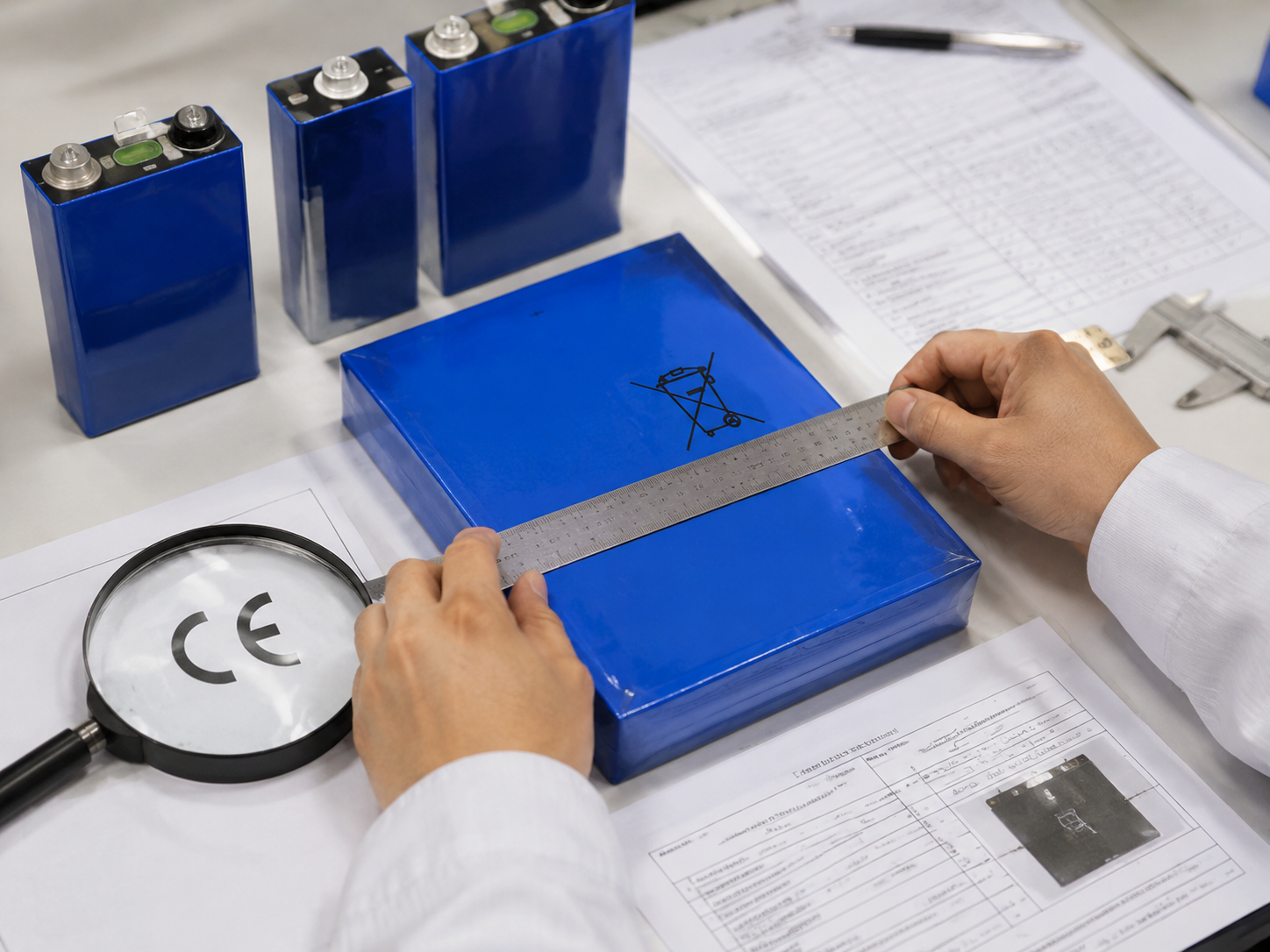
1. Hazardous substance limits: The content of toxic substances such as mercury, cadmium, and lead meets the limit requirements of the EU for the corresponding battery type. Do not rely on verbal promises, but correspond to the test report.
2. CE mark: There is a clear, indelible CE mark on the battery body or nameplate, and you cannot affix it casually — only on the premise that the manufacturer’s authorization, technical documents and conformity assessment are complete can label rectification be carried out, otherwise it is a fake CE.
3. Recycling mark: There is a unified EU crossed-out trash bin mark (representing separate collection and recycling), with compliant size and not blocked by other patterns.
4. Design requirements: If it is a portable battery product placed on the market after 2027, it must be ensured that end users can disassemble and replace it by themselves (except for special equipment such as safety and medical devices); for LMT batteries, it must be ensured that professionals can disassemble and replace them independently.
3.3 Core Compliance Documents and Conformity Assessment Verification
If the physical product is fine, you also need to check whether the documents are complete and valid. Don’t take a RoHS report as compliance:
1. Declaration of Conformity (DoC): This is the core document issued by the manufacturer declaring that the product complies with the regulation. It is necessary to check whether the model, manufacturer information, applicable regulation (must explicitly cite Regulation (EU) 2023/1542), and signatory are valid, and completely consistent with the actual goods.
2. Conformity assessment path: Confirm that the manufacturer has completed the applicable conformity assessment process — most portable batteries are Module A (internal production control, manufacturer’s self-declaration is sufficient), and high-risk batteries require the participation of a notified body. In this case, it is necessary to verify that the NB number of the notified body, the scope of the certificate are consistent with the product model, and do not use certificates of other models to make up the number.
3. Technical documents: You don’t have to hold them in your hand at any time, but you must confirm that the manufacturer can provide complete technical documents (design specifications, test reports, risk assessments, etc.), and you can produce them in time when required by the regulator.
4. Third-party test report: Not all batteries require mandatory third-party testing, but if there is a report, it is necessary to verify the qualification and capability of the laboratory, the version of the test standard, and whether the test sample is consistent with the mass-produced model.
Special reminder: RoHS reports and documents under the old Battery Directive cannot replace the compliance documents of the new Battery Regulation, and the scope of requirements of the two is very different.
3.4 EPR Producer Registration and Member State Registration
EPR has been a mandatory requirement since 2024. Without registration, you cannot sell legally at all. Here, special attention should be paid to the registration rules, and don’t be fooled by the saying that “one registration is valid for the whole EU”:
• EPR follows the principle of “first placing country + sales country”. You first need to complete EPR producer registration and pay fees in the member state where the product is first placed on the market, and the battery recycling cost is borne through this fee
• If you want to sell remotely across member states (for example, registered in Germany and sold to France and Poland), you must also confirm the EPR requirements of the target countries one by one — some countries require you to additionally register locally, or designate a local compliance organization to perform recycling obligations on your behalf
• Key point: There is currently no unified EU EPR registration portal, and the registration process, payment standards, and data reporting requirements of each member state are different
• Supplement: Usually, the importer within the EU is also the EPR producer at the same time, but the two are not absolutely equivalent — overseas brands can also designate other responsible entities within the EU to serve as EPR producers, depending on the responsibility agreement between the two parties, but the importer’s first placing compliance verification responsibility will not be exempted as a result.
3.5 Preparations for Medium- and Long-term Mandatory Obligations
Although the following obligations have not yet reached the full mandatory time, because they involve data of the entire supply chain, it is recommended to plan in advance, otherwise it will be too late to make temporary preparations when the time comes:
1. Carbon footprint obligation: Applicable to EV batteries, ≥2kWh industrial batteries, and LMT batteries. From 2024, a carbon footprint declaration that complies with the EU-specified methodology must be submitted. In 2027, a carbon footprint grade label (similar to home appliance energy efficiency labels) must be affixed. From 2028, there will be a maximum threshold, and products exceeding the threshold cannot be sold. Note that carbon footprint is not something you can calculate by yourself; it must comply with EU methodology, and third-party verification is required at some stages.
2. Battery passport obligation: The scope of application is the same as that of carbon footprint, and it will be mandatory from February 18, 2027. Simply put, it is the digital ID card of each battery, which contains information on the entire chain of raw materials, production, use, and recycling. It is necessary to sort out the data of all links of the supply chain in advance, otherwise you will not be able to collect enough information to make the passport when the time comes.
3. Supply chain due diligence: Targeting cobalt, natural graphite, lithium, nickel and their compounds, mandatory from August 18, 2025. It is necessary to screen human rights and environmental risks in the supply chain, and keep records of risk management and third-party verification. Small operators with a net turnover of no more than 40 million euros in the previous fiscal year may be exempted, but they must confirm that they meet the exemption conditions.
4. Customs Clearance and Market Entry Compliance Obligations (Customs Clearance/Listing Stage)
After the compliance preparation in the stock preparation stage is completed, the customs clearance and listing links are the focus of regulatory verification, and the following details need to be noted.
4.1 Documents to Be Submitted for Customs Clearance
The customs requirements of different member states may vary slightly, but the following are routinely required to be prepared and can be produced immediately during random inspections:
• Copy of Declaration of Conformity (DoC)
• EPR registration certificate (provided as required by the member state of entry)
• Special documents corresponding to the mandatory stage (such as carbon footprint declaration, battery passport related documents, which must be provided when the mandatory time comes)
• Third-party test reports, notified body certificates (required to be provided during customs random inspections, must meet EU requirements)
4.2 Product and Packaging Labeling Verification
Before customs clearance and listing, be sure to check the labels on the product and packaging again, so as not to have the goods detained due to label problems:
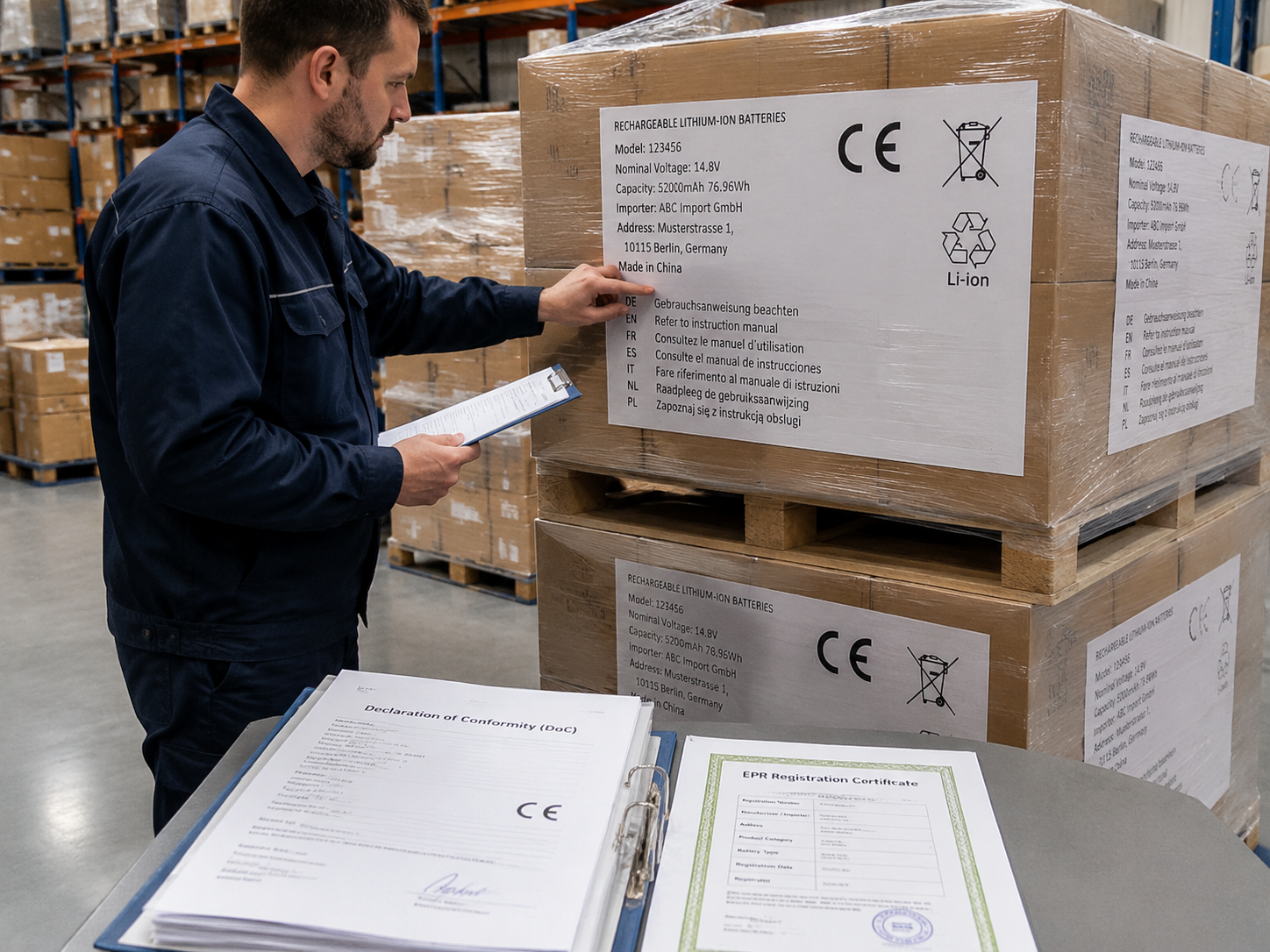
1. Entity information: The name, registered address, and contact information of the importer must be clearly identifiable. If the battery size is too small (such as a button battery), it can be placed on the packaging or in the accompanying documents.
2. Battery parameters: Information such as type, capacity, production date/batch number, and chemical system (such as lithium-ion, nickel-metal hydride) must be complete.
3. Mandatory marks: The CE mark and the crossed-out trash bin recycling mark must be clear and not blocked by marketing patterns or plastic sealing; when the labeling threshold specified by the regulation is reached, corresponding chemical symbols such as Hg/Cd/Pb must be added. This labeling is only for information purposes and does not mean that batteries are allowed to be sold exceeding the hazardous substance limit.
4. Phased new labels: From 2027, applicable batteries must also be affixed with carbon footprint grade labels, battery passport QR codes, and minimum average service time/available capacity labels.
5. Language requirements: The official language of the sales member state or general safety symbols must be used to ensure that consumers can understand — for example, when selling to Poland, the label cannot be all in English.
4.3 Responsibility for Transmitting Compliance Information to Downstream Parties
You can’t just sell the goods to distributors and ignore them; you have the obligation to pass on the compliance information:
• Provide distributors with copies of DoC and compliance certification documents to ensure that they can also cope with regulatory random inspections.
• Provide consumers with instructions for use and information on recycling channels for waste batteries.
• For industrial, EV, and LMT batteries, after mandatory implementation, users must also be provided with carbon footprint reports and access methods for battery passports (such as scanning a code to view).
4.4 Compliance Requirements for Storage and Transportation Stages
When the goods are in your hands, you must ensure that their compliance status is not damaged:
• Control storage and transportation conditions to avoid high temperature, humidity, short circuit and other situations. Otherwise, if the performance or safety of originally compliant batteries declines, it will also be considered non-compliant.
• Ensure that packaging, labels, and instructions are not damaged or fallen off. Otherwise, if there is no label during inspection, it is still your responsibility.
• Dangerous goods transportation rules (such as regulations for air transportation of lithium batteries) and battery regulations are two different things, and both must be met, and cannot replace each other.
5. Post-market Entry Continuous Compliance Obligations (Full Life Cycle)
The importer’s responsibility covers the entire life cycle of the battery. After the product is placed on the market, it is still necessary to perform continuous compliance obligations, and you cannot think that everything is fine once the goods are sold.
5.1 Traceability and Data Reporting Responsibilities
• You must establish traceability files for each batch of batteries, clearly recording the model, quantity, downstream customers, production date, and document version. These files must be kept for at least 10 years, starting from the date when the last batch of related products is placed on the market; if member states or specific documents have other requirements, the stricter requirements shall apply.
• Regularly report EPR-related data such as battery placement volume and recycling volume as required by the member state.
• After the battery passport system takes effect mandatorily, for LMT batteries, ≥2kWh industrial batteries, and EV batteries within the applicable scope, data on specified fields such as battery flow, maintenance, and recycling must be updated as required by the regulation; portable, SLI and other batteries that are not subject to the battery passport do not need to bear this obligation.
5.2 Non-compliance Handling and Grading of Corrective Measures
If a product problem is found (such as overheating, liquid leakage, bulging, false capacity labeling, missing documents, etc.), the first thing to do is to stop sales and isolate the inventory, absolutely not continue to place it on the market, and then handle it according to the risk level:
• Minor problems: For example, incomplete documents, wrong labels (not involving substantive compliance issues), you can complete the documents and rectify the labels as required, but you cannot use label rectification to cover up substantive non-compliance (for example, if hazardous substances exceed the standard, no amount of labels will help).
• Moderate problems: If there are safety hazards but the product has not yet reached the hands of consumers, sales must be stopped and all goods in the channel must be withdrawn.
• Serious problems: If the product has been sold to consumers and has major safety risks, the sold product must be recalled, and the recall information must be made public.
In any case, you must notify the regulatory authority of your member state as soon as possible and cooperate with the investigation. All disposal processes must be well documented to prove that you have eliminated the risk, otherwise the regulator will not recognize it.
5.3 Recycling and Circular Economy Related Responsibilities
The cost of recycling has been borne through EPR payment, but you still have the obligation to cooperate:
• Cooperate with the recycling system to provide battery disassembly and treatment guidelines to facilitate safe treatment by recycling agencies.
• Ensure that the batteries you place on the market meet the EU’s phased recycling targets — this part is generally implemented by EPR organizations, and you only need to pay fees and provide data as required.
5.4 Cooperation with Supervision and Complaint Handling
• When regulatory authorities require documents to be provided, they must be provided within a reasonable period, and you cannot refuse to submit documents required by the regulation on the grounds of “trade secrets”.
• Establish collection channels for consumer complaints and safety accidents, record and evaluate risks, and deal with problems in a timely manner when found.
• Regularly review the update of regulations and the validity of supplier documents. Even old stocks imported before must comply with current regulatory requirements, and you cannot say “I don’t need to care because the goods were imported before”.
6. Advanced Pitfall Avoidance: Responsibility Misconceptions and Special Situation Judgment
Nine out of ten people who do EU battery compliance have stepped on the following pitfalls. Avoiding them in advance can save a lot of money and trouble.
6.1 7 High-incidence Responsibility Misconceptions (Don’t Take the Blame for Others)
1. Misconception 1: If a third-party importer is found to act as the import agent, overseas brands do not need to bear responsibility
Wrong. Overseas brand owners are manufacturers for product compliance and still bear joint and several liability. The importer only bears the first placing verification responsibility. If a problem really occurs, the regulator can still hold the brand owner accountable.
2. Misconception 2: EPR of one member state is valid for the whole EU
Wrong. EPR follows the principle of “first placing country + sales country”. When selling across member states, you must confirm the registration requirements of the target country, and many countries require separate registration.
3. Misconception 3: Having a CE mark is equivalent to compliance
Wrong. CE is the manufacturer’s self-declaration. It must be accompanied by valid DoC and technical documents, and the physical product, labels and documents must be completely consistent to be truly compliant. A randomly affixed CE mark is useless.
4. Misconception 4: Carbon footprint and battery passport can be done by yourself
Wrong. They must comply with the EU-specified methodology, and third-party verification is required at some stages. Self-calculated and self-made ones are not valid.
5. Misconception 5: One test is permanently valid
Wrong. Updates to regulations and standards, or changes in product design and raw materials, will cause the original report to become invalid, and regular review is required.
6. Misconception 6: For battery-containing products, only the complete machine regulation needs to be followed
Wrong. The battery part must separately comply with the requirements of the battery regulation, and the CE certification of the complete machine cannot replace the compliance of the battery.
7. Misconception 7: If a distributor modifies the product without authorization, the importer also has to bear responsibility
Wrong. If the violation is caused by the distributor’s unauthorized modification of the product or packaging, the distributor shall bear the responsibility, but the importer must keep the evidence at the time of supply to prove that the goods you delivered are compliant.
6.2 Differences in Responsibilities for Different Battery Types (Quick Comparison)
The compliance requirements for different batteries vary greatly. You don’t have to apply the strictest standards to your own products. The following table can be used for quick judgment:
| Battery Type | Common Examples | EPR Requirements | Carbon Footprint/Battery Passport | Removable Requirement | Strictness Level |
| Portable batteries | Small batteries for mobile phones, power banks, laptops, toys | Mandatory | No main-line mandatory requirements | From 2027, end users can disassemble and replace by themselves (except for special equipment) | Low |
| SLI batteries | Batteries for vehicle starting, lighting, ignition | Mandatory | No main-line mandatory requirements | No special mandatory disassembly requirements | Medium-low |
| LMT batteries | Batteries for light means of transport such as electric bicycles, electric scooters | Mandatory | All applicable, implemented according to phased rules | Must meet the requirement of independent disassembly and replacement by professionals | Medium |
| Industrial/EV batteries | Industrial batteries for energy storage, forklifts, power batteries for new energy vehicles | Mandatory | Applicable to EV batteries and ≥2kWh industrial batteries, implemented according to phased rules | Implemented according to corresponding product standards | High |
Note: Although SLI batteries do not have main-line obligations such as carbon footprint and battery passport, they still need to meet general compliance requirements such as hazardous substance limits, CE marking, recycling marks, label information, EPR registration, and document verification, which cannot be omitted.
The core rule is simple: the larger the battery capacity and the stronger the industrial/transportation attribute, the higher the compliance requirements.
6.3 Responsibility Judgment Rules for Special Situations
If you encounter the following uncommon situations, you can judge according to this rule:
• Used/refurbished/remanufactured batteries: There are special regulations, and the responsibility requirements are different from new batteries, so the compliance standards for new batteries cannot be directly applied.
• Samples/gifts/spare repair parts: Judged by commercial use. As long as they are used for commercial activities, in most cases they still need to meet compliance requirements, and you cannot say “I don’t need to care because they are given away”.
• Batteries re-imported after export: If they have been legally placed on the market before and have not been modified, they can be judged according to the current compliance status, and there is no need to go through the first placing process again.
7. Importer’s Full-process Compliance Self-check List
For the convenience of comparison, we have sorted out the full-process compliance points into a directly checkable list, which can be used for checking during stock preparation, customs clearance, daily operation, and emergency handling.
7.1 Pre-import Check List (Before Stock Preparation/Contract Signing)
• [ ] Confirm that you are an importer subject to the regulation
• [ ] Confirm that the battery type is portable/LMT/SLI/industrial/EV, and match the compliance obligations of the corresponding stage
• [ ] Confirm that the battery type is within the scope of jurisdiction and there is no exemption
• [ ] Complete EPR registration in the corresponding member state
• [ ] Verify that the manufacturer has DoC, technical documents, and conformity assessment certificates for the corresponding model
• [ ] Complete product compliance verification (hazardous substances, CE mark, recycling mark, design requirements)
• [ ] The procurement contract clarifies the responsibilities for return, compensation and rectification in case of non-compliance
7.2 Customs Clearance & Market Entry Check List (Before Customs Clearance/Listing)
• [ ] Prepare all compliance documents required by customs
• [ ] Verify that the goods model and batch number are completely consistent with the DoC and test report
• [ ] Confirm that the product labeling information is complete (importer information, battery parameters, recycling mark, CE mark)
• [ ] Confirm that the label language meets the requirements of the sales member state
• [ ] Confirm whether the sales market belongs to the 27 EU countries or an independent regulatory system such as the UK, and match the corresponding compliance requirements
• [ ] Prepare compliance transmission materials for downstream parties
7.3 Post-market Entry Daily Check List
• [ ] Establish battery placement traceability files and keep them for at least 10 years
• [ ] Report operational data as required (placement volume, recycling volume, etc.)
• [ ] When selling across member states, regularly review the EPR registration, payment and data declaration requirements of the target country
• [ ] Establish a recording mechanism for consumer complaints and safety accidents
• [ ] Quarterly random check of the consistency between labels and documents of products on sale
• [ ] Regularly track regulatory updates and adjust compliance arrangements
7.4 Emergency Handling Check List (When Non-compliance Is Found)
• [ ] Immediately stop sales and isolate the inventory of the involved batch
• [ ] Verify the source, sales scope and risk level of the involved batch
• [ ] Notify the regulatory authority of the member state where you are located as soon as possible
• [ ] Notify downstream distributors to stop sales, and initiate withdrawal/recall as appropriate
• [ ] Keep all disposal records to prove that the risk has been eliminated
Final Summary
After sorting out the importer’s responsibilities under the EU new Battery Regulation, you should be able to make the following judgments:
• Quickly determine whether you are an importer subject to the regulation, clarify the responsibility boundaries of roles such as customs clearance agents, authorised representatives, and distributors, and will not confuse your identity in common business models such as FBA and private labeling;
• Corresponding to the type of batteries you operate, sort out the full-process obligations from pre-import stock preparation, customs clearance and listing to post-market recycling, and distinguish between the requirements that must be implemented now and the medium- and long-term obligations that need to be prepared in advance;
• Distinguish the responsibility boundaries between product compliance roles and EPR producers to avoid unnecessary joint and several liability;
• Avoid the 7 most high-incidence compliance misconceptions, and regularly check your own compliance progress according to the self-check list;
• When encountering non-compliance, be able to take corresponding corrective measures according to the risk level, and clarify when to stop sales and when to report to the regulator.
The requirements of the EU Battery Regulation will be gradually refined with the release of delegated acts and implementing acts. It is recommended to implement compliance in combination with your own business model, battery type and the implementing rules of the target member state, and regularly track regulatory updates to adjust compliance arrangements in a timely manner.