
Friends who work in the U.S. consumer electronics market have most likely encountered the UL 62368-1 standard when settling on platforms or selecting products for procurement. Those who are new to it often feel confused: what exactly does it regulate? Does my product need to comply with it? This article covers basic concepts, practical judgment, certificate interpretation, and pitfall avoidance tips, to help you master this standard from entry to practical operation.
Basic Understanding: What UL 62368-1 Is and Why the U.S. Market Requires Attention
Plain Language Definition and Standard Affiliation
You can think of UL 62368-1 as the “safety passing line” set by the U.S. market for electronic devices such as audio/video equipment, computers, and routers — passing this line means the product will not cause electric shock, fire, or other personal injury under normal use or even reasonable misuse. Its full name is Safety of Audio/Video, Information and Communication Technology Equipment Part 1. It is a product safety standard under the U.S. UL safety system, which is essentially the U.S. version adjusted by combining the IEC 62368-1 international standard of the International Electrotechnical Commission with local U.S. requirements.
Many people who operate in the North American market apply for U.S. and Canadian certifications together. This standard is harmonized with Canada’s CSA C22.2 No. 62368-1, so you can apply for certification with the cULus mark in combination. One test can meet the requirements of both the U.S. and Canada, saving a lot of trouble.
Background and Current Status of Replacing Old Standards
Before UL 62368-1, the U.S. had two separate sets of standards: audio/video equipment (such as TVs and speakers) was tested according to UL 60065, and information technology equipment (such as computers and routers) was tested according to UL 60950-1. However, in the past decade or so, there have been more and more cross-category products. For example, smart speakers can not only play music but also connect to WiFi as a smart control center; learning tablets can not only watch videos but also take online classes. Which set of standards to use for testing has become a problem. The old idea of “setting rules by product category” can no longer keep up with the rapid iteration of electronic products.
Now UL has uniformly replaced the original two sets of standards with 62368-1. All newly applied related products need to be tested according to this standard. The specific transition period requirements are subject to UL official announcements, and do not trust the fixed dates circulated on the Internet.
Practical Role in the U.S. Market
Many people think that UL certification is mandatory under U.S. federal law, but it is not — it has no mandatory effect at the federal level, but it is almost a “must-have” in actual market access. Safety regulations in most U.S. states, mainstream e-commerce platforms such as Amazon and Walmart, large enterprise purchasers, and even product liability insurance all take UL 62368-1 as an access threshold.
If non-compliant, common consequences include platform removal, rejection by large purchasers or insurance companies; if it involves false UL marks, product recalls, state safety regulation enforcement, or platform compliance document spot checks, it may also cause obstacles in import or sales links. In the event of a safety accident, the lack of widely recognized safety assessment may weaken the defense ability in liability determination. Moreover, UL itself is on the white list of Nationally Recognized Testing Laboratories (NRTL) of the U.S. Occupational Safety and Health Administration (OSHA), which is equivalent to official endorsement and has very high market recognition.
4 Common Misconceptions Clarified for Beginners
People who are new to this standard are easy to fall into these four cognitive pitfalls, let’s clarify them in advance:
First, it is not a performance certification. Passing UL 62368-1 only means the product is safe, and does not mean better sound quality, faster network speed, clearer picture quality, or more durability. These performance indicators have nothing to do with safety standards.
Second, it is not FCC certification. UL is responsible for personal safety and fire risk, while FCC is responsible for electromagnetic interference and wireless function compliance. The two are completely different dimensions and cannot replace each other. Usually both are required for the U.S. market.
Third, it is not globally applicable. UL 62368-1 is the U.S. local version with its own special requirements. For example, plug specifications, voltage adaptation, labeling rules, and factory inspection requirements are different from IEC standards or the EU CE LVD directive. IEC reports or CE reports cannot be directly used as UL certification.
Fourth, it is not “one certificate for all”. The certificate only covers the product models, structures and key components listed above. If you change the model, change the battery supplier, or change the shell material, you cannot directly use the old certificate, and you must re-report for evaluation.
Scope of Application and Quick Judgment Method
The question that many people care about most is “Does my product need to be made according to this standard?” In fact, the judgment logic is very clear. We will explain step by step from clearly applicable, clearly inapplicable, to the judgment method for boundary products.
Core Prerequisites for Application and Typical Products
To meet the scope of UL 62368-1, two core prerequisites must be met first: first, civil or commercial electronic equipment with a rated voltage not exceeding 600V; second, core functions including audio/video playback, information processing or data communication.
Common IT and communication products basically meet the requirements, such as computers, monitors, routers, switches, power banks, PoE power supply equipment; audio/video products such as TVs, speakers, projectors, Bluetooth headsets, power amplifiers, and set-top boxes are also within the scope; there are also many cross-category products, such as smart speakers, learning tablets, some smart home devices with screens or networking functions, as well as power supplies and battery packs sold with the main device, which are also covered by this standard.
It should be noted that power banks and battery packs sold with the host may be evaluated as part of the whole machine or system according to 62368-1; power banks sold separately may also involve special standards such as UL 2056, which need to be confirmed according to product definition and certification scheme.
Clearly Inapplicable Product Scope
There are several types of products that clearly do not need to be tested according to UL 62368-1, because they have exclusive safety standards that are more in line with category characteristics: for example, medical equipment uses the UL 60601 series, home appliances use the UL 60335 series, industrial control equipment uses the UL 508 or UL 61010 series, as well as lamps, toys, electric tools, energy storage systems, automotive electronics, aerospace electronics, all have corresponding special standards.
In addition, purely mechanical non-electrical products and equipment with a rated voltage exceeding 600V are also not within the scope of this standard.
Judgment Logic for Boundary Products
When you are unsure about cross-category products with complex functions, you can judge according to these principles:
If it is a multi-functional device, the main function and sales positioning shall prevail. For example, a smart screen focusing on video calls has core functions of information and communication, so it is classified as 62368-1; if it is a screen-equipped air fryer focusing on cooking, its core function is home appliance, so it is classified as UL 60335 home appliance standard.
If it is an external power supply or accessory, if sold separately, it needs separate certification; if sold together with the host, it can be evaluated together as part of the host system.
If it is a set product, be sure to confirm whether the certification covers the whole system or the individual components inside. For example, for a router with a power supply, if the certification only covers the router itself, then selling the power supply alone is non-compliant.
If you are really unsure, the safest way is to check the official UL standard directory, or directly consult a UL-authorized laboratory, and do not judge blindly based on experience.
1-Minute Quick Judgment Steps
You can spend one minute doing a quick check in three steps, without flipping through the thick standard:
The first step is to check the hardware threshold: confirm that it is a powered electronic device — whether it is plugged into mains power, battery-powered, or PoE network cable power supply counts, and the rated voltage does not exceed 600V. If the voltage exceeds, or it is a purely mechanical non-electrical product, directly exclude it.
The second step is to look at the core function: whether the main purpose of the product is audio/video playback, information processing or data communication. For example, although an ordinary power strip is electrified, its core function is power transfer, so it is not covered by this standard.
The third step is the elimination method: check whether the product has an exclusive safety standard. For example, medical equipment, large home appliances, industrial control equipment, lamps, toys, etc., all have special UL standards, and do not need to follow 62368-1.
If all three steps are met, it is likely that this standard applies; if you are unsure at any step, do not force the judgment by yourself. It is safer to find a UL-authorized laboratory or check the official directory for confirmation.
Core Safety Logic: Hazard-Based Protection Approach
You may be curious why this standard can cover so many different types of products. In fact, its core idea is completely different from the old standards. Understanding this logic will help you understand the underlying reasons for all safety requirements.
Limitations of the Old Standard’s Category-Based Approach
The former UL 60065 and UL 60950-1 both adopted a “category-based” approach: first define what product you are, then give you a set of corresponding rigid structural requirements, such as how thick the shell material should be, and how far the internal live parts should be from the shell. This method is fine when product categories are single, but it will get stuck when encountering cross-category products — products that are both like audio/video and IT cannot find fully matching rules. Moreover, the rigid structural regulations have too low flexibility. Many new materials and designs are obviously safer, but cannot pass certification because they do not meet the old structural requirements, and cannot keep up with the iteration speed of new categories.
Core of the New Standard: Hazard-Based Safety Engineering
UL 62368-1 adopts the “Hazard-Based Safety Engineering (HBSE)” approach. To put it simply: no matter what category of product you are, I first find all the dangerous energy that may hurt people in it, and then match the corresponding protective measures according to the danger level of the energy and the people who are exposed to it.
You can quickly understand this logic with three questions: What dangerous energy is in the product? Who may be exposed to this energy? What measures are used to separate people from dangerous energy?
The benefits of this approach are obvious: no matter what new and exotic electronic products come out, as long as you check the risks according to this logic, you can fit them into the standard, without waiting for special new category standards; and as long as the safety goal can be achieved, manufacturers can flexibly choose design solutions, without being tied down by rigid structural regulations.
4 Core Concepts to Understand the Standard
To understand the specific requirements of the standard, you only need to understand four core concepts, without memorizing complex clauses:
The first is energy source classification, which is divided into three levels ES1, ES2, and ES3 from low to high danger. ES1 is low energy that ordinary users can safely contact, such as the power of a mobile phone headphone jack; ES2 is medium energy that requires restricted contact; ES3 is dangerous high energy. The higher the level, the stricter the protection requirements. It should be noted that there is no general fixed value for the energy threshold, which will change with the standard version, AC/DC type, current frequency, and contact conditions. Do not memorize conclusions like “how many volts count as ES2”.
The second is accessibility, which is the standard for judging whether users can touch dangerous parts. It is not considered inaccessible just because the manufacturer says “users generally will not disassemble this”. It must be tested with the standard test finger specified by UL (a metal rod simulating a human finger). If it can be touched, it is considered accessible, even if a “Do Not Disassemble” label is attached.
The third is personnel classification. The standard divides people who may contact the product into three categories: ordinary users (consumers without professional knowledge, office staff), instructed personnel (operators with basic safety knowledge, such as company IT operation and maintenance), and technical personnel (professional maintenance and installation personnel). The less professional the personnel, the higher the protection requirements, after all, ordinary users do not know where the dangers are.
The fourth is protection level, which is divided into three types: basic protection is to prevent injury under normal use, such as the insulating skin outside the wire; supplementary protection is the bottom line when basic protection fails, such as grounding protection after the insulating skin is broken; reinforced protection is a single level that can equal double protection, such as a double-insulated plastic shell, which can ensure safety without grounding.
3 Scenario Conditions Covered by Assessment
Many people think that “the product is compliant as long as it works normally when turned on”, but that is not the case at all. The assessment of UL 62368-1 covers three scenarios:
The first is normal condition, which is the reasonable use according to the manual, and this is the most basic.
The second is abnormal condition, which is foreseeable misuse, such as blocking the air inlet of the projector, plugging in the wrong voltage, charging the power bank for several consecutive days. No safety problems can occur in these situations.
The third is single fault, which is the failure of a protective part in the product. For example, if the fuse for overcurrent protection is broken, it cannot cause serious injuries such as electric shock and fire at this time.
The standard usually does not take any multiple independent faults as the default assessment premise, but foreseeable misuse, abnormal operation or combination conditions clearly specified by the standard still need to be evaluated as required. In short, compliance is not “no problem when used normally”, but “no serious safety problems when used normally, used incorrectly, or a key part is broken”.
Core Safety Control Requirements
You don’t need to flip through hundreds of pages of the original standard. The core control directions of UL 62368-1 are actually six types of safety risks, each with a very simple logic that ordinary people can understand.
Electric Shock Protection: Prevent Electric Shock Injury
The control logic is very straightforward: parts that ordinary users can touch without tools such as screwdrivers and pliers must not have dangerous voltage or current.
Common protective measures include the insulating layer of the power cord, tamper-proof design of the shell, grounding or leakage protection, and sufficient safety distance between internal live parts and the shell. It should be reminded that low voltage is not absolutely safe, it also depends on the current size and contact conditions, and low voltage with large current may also cause injury.
Fire Protection: Prevent Fire Ignition and Spread
The control logic is: even if there are faults such as short circuit and overcharge inside the product, either it will not catch fire, even if it catches fire, it cannot spread outside the device, and cannot ignite surrounding items.
Common protective measures include using flame-retardant materials for the shell and circuit board, adding overcurrent and overvoltage protection to the power module, and having a charge-discharge protection circuit for the battery. High-risk areas are mainly power modules, battery compartments, connectors and high-power circuit board areas, which are the most prone to heat and short circuit.
Thermal Burn Protection: Prevent Contact Burns from High Temperatures
The control logic is: the temperature of the product surface that users can touch must not exceed the safety limit for the corresponding contact duration, and you cannot get burned just by touching it.
Common protective measures include optimizing the heat dissipation design, isolating high-temperature parts from the shell, and limiting the maximum temperature of the shell. The temperature limit is not fixed. Different materials such as metal and plastic have different thermal conductivity, different contact durations, and different types of users have different requirements — for example, products for children will have stricter temperature limits.
Mechanical Injury Protection: Prevent Physical Damage
The control logic is: during normal use or reasonable misuse, you will not be cut, pinched, or crushed.
Common protective measures include making sharp edges rounded, adding protective nets to moving parts such as fans and rotating shafts, meeting the load-bearing requirements of wall-mounted brackets, and adding anti-tip design for tall equipment. If it is a product that children may access, the protection requirements will be stricter, for example, there must be no gaps that can pinch children’s fingers.
Battery and Chemical Protection: Prevent Battery Fire and Leakage
The control logic is: the battery must not catch fire, burst or leak corrosive liquid during normal charge-discharge, abnormal charge-discharge or even transportation.
Common protective measures include that the cells and battery packs themselves must have compliant certification, the charge management circuit has overcharge, overdischarge and overcurrent protection, and replaceable batteries have anti-misinstallation design, so that no power is supplied if installed reversely. It should be particularly noted that the battery having UL certification alone does not mean that the whole machine automatically meets UL 62368-1 after being installed in the whole machine — the heat dissipation and charging circuit design of the whole machine will affect the safety of the battery, and they still need to be evaluated and tested together.
Other Energy Protection: Prevent Invisible Injuries
In addition to visible electric, fire, thermal, and mechanical injuries, there are also some invisible energies that need to be controlled, such as laser, sound pressure, and radiation-related safety risks within the scope of the standard.
The control logic is: these energies must meet the safety limits within the user-accessible range. Common protective measures include limiting the power of laser products, adding maximum sound pressure limits to headphones, and controlling the radiation level of corresponding categories. It should be noted that radio frequency emission, EMC and RF exposure usually need to be evaluated separately according to FCC rules, and UL 62368-1 cannot cover these compliance obligations.
UL Certification Process and Certificate Interpretation
Now that you know what the standard regulates, the next thing everyone cares about most is: how to do UL certification? How to check if the certificate is valid after getting it?
Simplified UL 62368-1 Certification Process
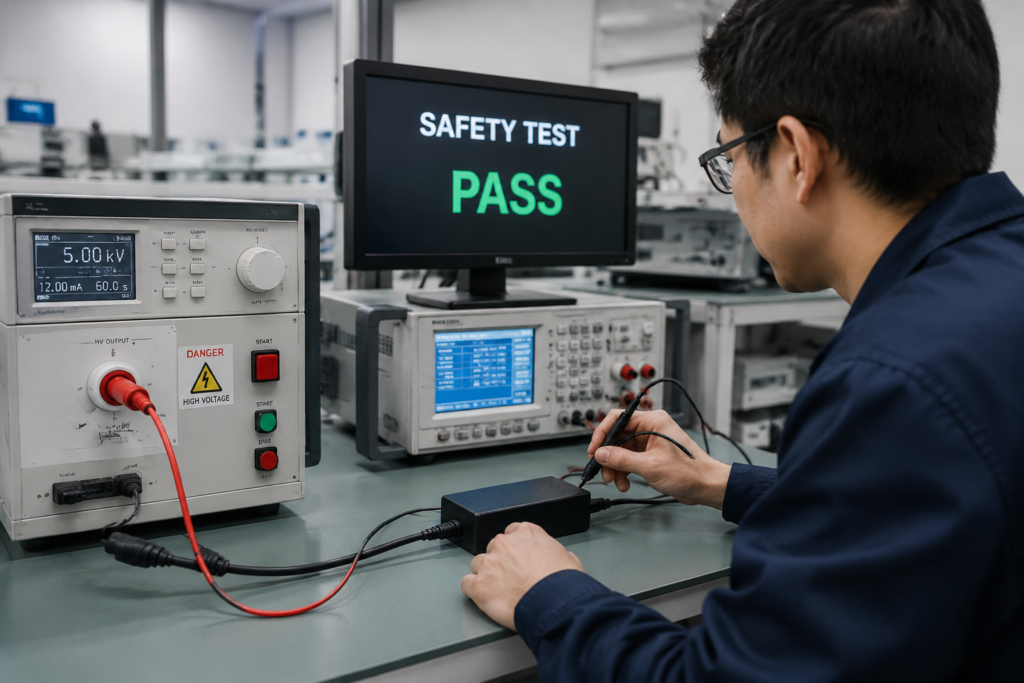
The UL certification process is complex if you say it is complex, and simple if you say it is simple. The core is four steps:
The first step is to submit documents to confirm the scope. You need to hand over materials such as product manuals, circuit diagrams, and key component lists to UL or a UL-authorized laboratory. They will first confirm which version of the standard your product applies to and which items need to be tested.
The second step is test and evaluation. Submit samples and materials to UL Solutions or its approved project channels; if using test data from a third-party laboratory, confirm in advance whether UL accepts the data and whether supplementary evaluation is required. If there is any non-compliance, you need to rectify and retest.
The third step is factory audit. Factories that apply for UL certification for the first time need to pass UL’s quality system audit to confirm that you can keep mass production consistent with the submitted test samples and will not cut corners.
The fourth step is post-certification follow-up inspection. After getting the certificate, UL will conduct unannounced spot checks at the factory according to the risk level of the product to ensure that mass-produced products always meet the requirements.
Difference Between Two Types of UL Marks
Many people think that UL marks are the same when they see them. In fact, there are two completely different types of UL marks, don’t confuse them:
| Mark Type | Applicable Object | Can Be Used for Finished Product Compliance Claim | Market Recognition |
|---|---|---|---|
| UL Listed | Complete end products (e.g., TVs, routers, power banks) | Yes | Highest |
| UL Recognized | Components/raw materials (e.g., power modules, enclosure plastic) | No, only as component support for finished product certification | Component-level recognition |
If the mark has the cULus logo, it means it meets the 62368-1 requirements of both U.S. UL and Canadian CSA, and can be used in both U.S. and Canadian markets, without the need for two separate certifications.
Key Information Interpretation Method for Certificates
After getting the UL-related certification documents, focus on four places to judge whether it can be used on your product:
First, look at the applicable product scope. The product models and configurations listed on the certificate must exactly correspond to the products you actually sell, and cannot be used beyond the scope. For example, if the certificate is for a 10W charger, you cannot use this certificate for the 20W one you sell.
Second, look at the certification status: log in to the UL Product iQ platform to confirm that the Listing status is Active, check whether the file number/control number corresponds, whether the certification category and covered models match, and whether there are records of suspension, revocation or abnormal factory follow-up services.
Third, look at the standard version. Confirm that the certificate uses the current effective standard version of UL. If the old version of the certificate has passed the transition period, it will become invalid.
Fourth, look at the key component list. Core components such as power supply, battery, and shell material must be consistent with those listed on the certificate. If the supplier or model is changed, you must re-report to UL for evaluation.
Difference Between “Compliant with UL 62368-1” and “UL Certification”
Many suppliers use the statement “compliant with UL 62368-1 standard” to confuse concepts. In fact, this is completely different from real UL certification:
Self-declaration or test reports from ordinary third-party laboratories can only show that the few submitted samples passed the test, but there is no official authorization from UL, the UL mark cannot be used, and there is no follow-up factory inspection. No one supervises whether mass-produced products meet the requirements, and the market recognition is very low.
Real UL certification is officially authorized by UL to use the UL mark, has regular factory follow-up inspections, and is also generally required by platforms and purchasers. Note: test reports from ordinary third-party laboratories are not equal to UL Listed certification, and do not have the right to use the UL mark.
Realistic Caliber of Certification Cycle and Cost
Many people will ask “How much does it cost to do UL 62368-1? How long does it take to get the certificate?” In fact, there is no unified fixed value, which completely depends on the complexity of the product, the number of rectifications, and the number of items that need to be tested.
Simple products such as ordinary power adapters have fewer test items, short cycles, and low costs; complex products such as servers and large switches have more test items, long cycles, and much higher costs.
To get an accurate quote and cycle, you need to provide information such as the product’s bill of materials, structural design, and sales market to a UL-authorized laboratory. The result given after their evaluation is reliable. Don’t believe the publicity of “thousands of dollars, get the certificate in a week”, which is mostly fake.
Common Misconceptions and Practical Pitfall Avoidance Guide
When actually doing certification or selecting products for procurement, many people will fall into various pitfalls. We have sorted out the most common types to help you avoid detours.
Common Pitfalls in Standard Version and Application
The first type of pitfall is cognitive error about the standard itself:
Many people think that IEC 62368-1 reports or CE LVD reports can directly replace UL 62368-1, but they cannot. The UL version has many special requirements for the U.S. local market, such as plug specifications, 120V voltage adaptation, labeling requirements, and factory inspection rules, which are different from the international version or the EU version, and cannot be directly used interchangeably.
Some people think that the standard is permanent and the certificate can be used all the time, but that’s not right. Standards are updated regularly. For example, the new version of the standard may adjust requirements related to outdoor equipment, wireless charging, batteries or labeling; specific differences, mandatory effective dates and transition periods must be subject to UL official announcements and project evaluation. Old version certificates need to be updated within the transition period, and will become invalid after the transition period.
Some people think that as long as it is an electronic device, it applies to UL 62368-1, but that’s not the case. Categories with exclusive safety standards such as medical, home appliances, and industrial control must use the corresponding special standards, not this one.
Common Pitfalls in Certification Use
The second type of pitfall is usage errors after getting the certificate:
Some people think that all models of the same brand can share one certificate, but they cannot. Only products listed on the certificate that belong to the same series and have the same key components and core circuits can share one certificate. New models must be reported to UL and can only be used after passing the evaluation.
Some people think that the certificate is permanently valid after getting it, but it’s not. Failure to pass factory follow-up inspections, product modification without reporting, standard expiration, and key component replacement without evaluation will all lead to certificate invalidation, and it cannot be used any longer.
Some people think that if there is a UL mark on the product, it meets UL 62368-1, but that’s not right. UL marks correspond to many different standards. For example, the UL mark for home appliances is tested according to UL 60335, and that for lamps is tested according to UL 8750. Be sure to confirm whether the corresponding standard is UL 62368-1 through the traceability information such as the file number and control number attached to the mark.
Quick Verification Method for Procurement/Model Selection
If you are in procurement or product selection, and want to verify whether the supplier’s UL certification is real, you can quickly verify it in three steps:
The first step is to check the UL mark on the product: finished products usually have the UL Listed or cULus mark, as well as corresponding traceability information such as file number, control number or category control number — the standard number may not be directly marked, and the traceability information shall prevail.
The second step is to go to UL’s official certificate query platform UL Product iQ, enter the certificate number or control number to verify the status and coverage of the certificate. Don’t just trust the scanned certificate provided by the supplier — there are too many fake certificates made by PS.
The third step is to check whether the product model, power adapter model, and key components are exactly the same as those listed on the certificate. If there is any mismatch, even if the certificate is real, it cannot be used on this product.
Practical Tips for Certification Application
When doing certification, mastering a few small skills can save a lot of money and time:
The first is series application. If several of your products are on the same design platform, have the same core circuit, and the model with the maximum power can cover the low-power ones, you can apply for series certification, without testing each model separately, which can save a lot of test fees.
The second is change management. If you later want to modify the product design, change materials, replace key components, or change the production location, you must first find a laboratory to evaluate and confirm whether you need to report to UL. Don’t change it secretly. If it is found by UL, it will be troublesome if the certificate is revoked.
The third is early intervention. It is best to find a UL-authorized laboratory to do a pre-evaluation before the product is finalized and the mold is opened, to see if there are any structural or material problems, and modify them in advance. If you find that it does not meet the requirements and need to modify after finalization and mold opening, the cost will be much higher.
High-Frequency Reasons for Test Failure
Many products fail the first test, basically for these reasons. Paying attention in advance can save a lot of detours:
The most common is insufficient power insulation level, or insufficient safety clearance of internal live parts, leading to failure of the electric shock protection test.
The second is that the flame retardant grade of the shell or PCB board does not meet the standard, and the fire test fails.
For products with batteries, it is often because the battery protection circuit fails, overheats or catches fire during the abnormal charge-discharge test, leading to failure.
Don’t underestimate labels and manuals. Many products fail the test because of wrong parameters on the labels and missing warning statements. This is the easiest pitfall to avoid.
Summary
In general, UL 62368-1 is the core safety access threshold for U.S. audio/video and information technology equipment. Its essence is to use the “hazard-based protection” approach to ensure that products will not cause serious harm to users under normal use, reasonable misuse, or even the failure of a single key part.
After reading this article, you should be able to quickly judge whether an electronic device falls within the scope of this standard, understand its core logic and six main safety control points, understand the key information of UL-related certifications, identify false claims, and avoid common pitfalls in certification applications and procurement selection. If you encounter uncertain situations such as boundary products or version differences, remember to prioritize checking UL official materials or consulting UL-authorized laboratories, and do not judge based on experience.