
Most cross-border sellers or foreign trade manufacturers operating in the Japanese market have heard of “PSE certification”, but when it comes to the testing环节, there are often many questions: Does the product need to be tested? What is the difference between diamond and round PSE? What are the core test items? What pitfalls are easy to fall into? In essence, PSE testing is a mandatory safety access rule set by Japan for electrical appliances and materials, focusing on basic safety risks such as electric shock prevention and overheating/fire prevention. This article will systematically sort out the core requirements of PSE testing from basic understanding to advanced judgment, helping readers independently complete compliance judgments in most common scenarios.
1. Basic Understanding: Legal Position and Applicable Scope of PSE Testing
What is PSE Testing
First, a plain-language definition: PSE testing is a mandatory safety testing requirement stipulated by Japan’s (abbreviated as DENAN, the core legal basis for Japan’s PSE system), and is the core technical basis of the entire PSE compliance system. The administrative authority is the Ministry of Economy, Trade and Industry of Japan (abbreviated as METI). Its core function is to排查 safety risks such as electric shock, fire, and overheating in electrical products, to ensure consumer safety in use.
A common misconception is corrected here: PSE is not a voluntary test, and obtaining a test report alone does not mean that all compliance obligations have been fulfilled. In addition to passing the test, complete PSE compliance also requires affixing the mark as required, submitting a compliance notification to METI by a domestic Japanese entity, and retaining a full set of technical documents. Any missing item constitutes a violation.
How to Judge Whether a Product Needs PSE Testing
Whether a product requires PSE shall be checked step by step in accordance with official rules, and there is no need to judge solely based on experience.
First, a preliminary screening can be conducted: if the product involves connecting to Japan’s mains electricity (i.e., 100V alternating current from wall sockets) or needs to convert mains electricity into other forms of electrical energy (such as an adapter converting 100V AC to low-voltage DC), further verification is required, but the preliminary screening cannot be used as the final basis for determination.
Final confirmation shall be carried out in four steps:
Step 1: Check the latest “List of Designated Electrical Appliances and Materials” on the METI official website, which is the most authoritative basis for determination; all products requiring PSE are within the scope of the list.
Step 2: Compare the product’s intended use, rated voltage/current, and internal structure against the list. For example, even for power adapters, those for consumer electronics and those for industrial equipment may fall under different product items, and one may be on the list while the other is not.
Step 3: Simultaneously verify supporting components. For example, when selling a low-voltage DC desk lamp, the lamp body itself may not be on the designated list, but if the配套 AC adapter and power cord are designated items, the accessories need to be compliant separately.
Step 4: Exclude statutory exemption scenarios. Some electrical products do not need to meet PSE requirements.
In terms of coverage scenarios, as long as they are designated electrical appliances and materials commercially circulated in the Japanese market, whether sold in physical stores, shipped via cross-border e-commerce, or mailed directly from overseas, they must meet PSE requirements. Common covered categories include power adapters, wire plugs, small household appliances, lighting products, transformers, and some plug-in products with batteries.
Boundaries of Statutory Exemptions
Three types of clear statutory exemption scenarios can be checked for confirmation:
Category 1: Purely mechanical products with no electrical components at all, such as manual screwdrivers and plastic storage boxes, do not belong to the category of electrical appliances and materials themselves, and do not require PSE testing.
Category 2: Product bodies that are only powered by low-voltage DC and do not connect to mains electricity, such as remote controls using dry batteries and pure Bluetooth speakers that do not plug into mains for charging, are usually not within the scope of designated items. However, it should be noted that if the supporting external AC adapters, chargers, and power cords are designated items, the accessories still need to be compliant and cannot be exempted.
Category 3: Small quantities of items for personal use and non-commercial import, such as hair dryers carried by individuals traveling to Japan and small gifts exchanged privately, do not fall under the category of commercial sales and are not subject to PSE requirements for market circulation. However, bulk imports for sale are not included in this category.
Division of Responsibilities in the Sales Chain
PSE is a domestic Japanese regulation, and the responsibility boundaries of different entities are clear:
First is the manufacturer. Regardless of the country of production, the manufacturer is responsible for ensuring that the product meets Japanese technical standards and providing complete technical documentation, such as circuit diagrams, lists and specifications of key safety components, material information, drafts of nameplates/user manuals, design change records, mass production consistency documents, etc. This is the basis of compliance.
Second is the core responsible entity, the (届出事業者), which can be understood as a domestic Japanese compliance registration entity, usually a Japanese importer, or a local Japanese compliance service agency. It is the first responsible party for PSE compliance, bearing the obligations of submitting compliance notifications to METI, affixing the PSE mark, and retaining all technical documents. This obligation cannot be fulfilled by overseas sellers on their own and must be implemented through a locally registered Japanese entity.
Finally, retailers and cross-border platforms, such as Amazon Japan, have the obligation to verify the compliance documents of products sold and may not sell non-compliant products. This is also why platforms often require sellers to upload PSE documents.
Query Path for Product Items and Technical Requirements
If there is doubt about the product item to which a product belongs or the corresponding technical requirements, you can query in three steps:
Step 1: Open the METI official website, search for “Types of Electrical Appliances and Materials” (電気用品の種類), and first match the statutory product item name corresponding to the product. When querying, the Japanese statutory product item names published by METI shall prevail, and Chinese product names or platform categories cannot be directly applied; products under the same commercial name may correspond to different statutory product items.
Step 2: Check the corresponding ministerial ordinance technical requirements, cited JIS or IEC standards, and the latest interpretation documents issued by METI against the product item. Standards may be updated or have supplementary explanations.
Step 3: If there is doubt about the item classification, for example, the product is between two items or is a new type of product not clearly listed, you can entrust a METI-registered inspection agency or a professional compliance agency to review it to avoid delays due to determination deviations.
Actual Consequences of Non-Compliance
The actual consequences of non-compliance are mainly divided into two categories:
On the market side, the most common is customs detention, where products cannot enter Japan and may be returned or destroyed, resulting in losses of freight and payment for goods. Next is the removal of products from e-commerce platforms and deletion of listings, which may cause losses in previous operations. In severe cases, sold products need to be recalled, and recall costs may far exceed the value of the goods.
On the legal side, administrative orders may be triggered, such as requiring the cessation of sales and rectification within a time limit, and in serious cases, criminal penalties may be involved. The specific penalty intensity shall be determined based on the type of illegal act, the responsible entity, and the applicable legal provisions. For example, there are differences in the degree of penalty between non-compliance caused by intentional fraud and that caused by negligence.
2. Classification Rules: Statutory Differences Between Diamond and Round PSE
After confirming that a product is a designated electrical appliance and material, the next step is to clarify its classification, which is commonly referred to as “Diamond PSE” and “Round PSE”. The two categories are statutorily determined by the Japanese government based on product risk levels, corresponding to different compliance requirements, and cannot be selected independently.
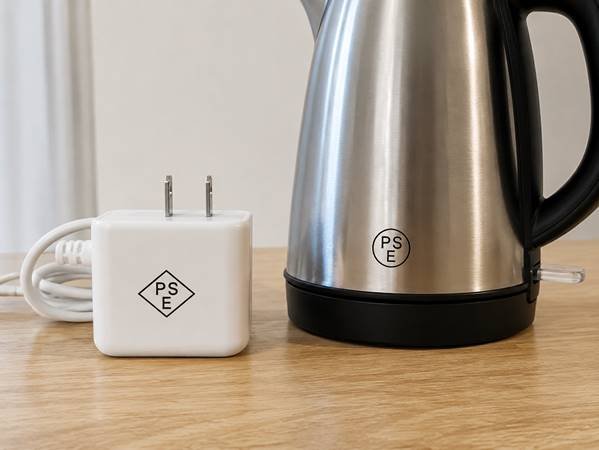
Classification Logic of the Two Types of Products
Japan divides all designated electrical appliances and materials into two categories:
One category is Specified Electrical Appliances and Materials, which are high-risk categories statutorily designated by METI, such as power adapters and wire plugs. They are likely to cause personal injury after failure, so the requirements are the strictest. They must pass the statutory conformity inspection conducted by officially recognized institutions. Their PSE mark is diamond-shaped, hence commonly known as “Diamond PSE”.
The other category is Non-Specified Electrical Appliances and Materials, that is, designated electrical appliances and materials other than the specified categories, with relatively low risks, such as ordinary electric kettles and small fans. Operators can confirm by themselves that the products meet the technical standards. Their PSE mark is round, hence commonly known as “Round PSE”.
The basic judgment method is as follows: First, confirm that the product is a designated electrical appliance and material stipulated by DENAN, then judge against the “List of Specified Electrical Appliances and Materials” (特定電気用品目录) officially released by METI: those listed in the list are Specified Electrical Appliances and Materials (Diamond PSE); those not listed in the specified list but still belonging to designated electrical appliances and materials are Non-Specified Electrical Appliances and Materials (Round PSE); if the product itself is not a designated electrical appliance and material, the PSE mark requirements do not apply. It should be noted that products of the same series also need to be checked separately according to statutory product items, rated parameters, structure, and intended use, and classification cannot be uniformly determined solely by series name or appearance.
Core Comparison of Compliance Requirements for the Two Categories
To clearly present the differences between the two categories, the following compares them from 5 core dimensions:
| Comparison Dimension | Specified Electrical Appliances and Materials (Diamond PSE) | Non-Specified Electrical Appliances and Materials (Round PSE) |
| Inspection Requirements | Statutory conformity inspection must be conducted by a METI-registered inspection agency | Conformity verification can be completed by the factory/operator independently |
| Technical Standards | Must meet all applicable technical requirements of the corresponding item | Must meet all applicable technical requirements of the corresponding item (no statutory simplification) |
| Supporting Documents | Must obtain a conformity inspection certificate from a registered agency | Must retain conformity verification records independently |
| Marking Requirements | The code of the registered inspection agency must be marked on the mark | The name of the registered operator must be marked on the mark |
| Notification Obligation | Must be declared to METI by a domestic Japanese Notifying Business Operator | Must be declared to METI by a domestic Japanese Notifying Business Operator |
Special note: Product classification is determined by statutory product items, and the type of mark cannot be selected independently.
Adjustment Rules for Classification Conclusions
Classification is not static, but there are clear rules for adjustment:
First, if the product’s function, structure, or power supply method changes, for example, a originally plug-in product is changed to a rechargeable model, or the power is upgraded from a low gear to a high gear, it is necessary to recheck the METI statutory product items to confirm whether the classification has changed.
Second, if Non-Specified Electrical Appliances and Materials are found to be non-compliant with technical standards during random inspections, they only need to be rectified and sales stopped. Their statutory classification will not be changed as a result, and they will not automatically be converted to Specified Electrical Appliances and Materials.
Third, some cross-border platforms or importers may impose commercial audit requirements higher than statutory requirements on some categories, such as requiring sellers to additionally submit third-party test reports, notification documents, importer information, or a more complete compliance package; however, these are commercial requirements rather than statutory rules, and will not change the statutory classification of the product. Non-specified products may not affix the Diamond PSE mark on their own, nor can they apply for a conformity inspection certificate for Specified Electrical Appliances and Materials with non-specified products. It is necessary to distinguish these from statutory obligations.
3. Core Test Logic: Mandatory Inspection Items and Judgment Principles by Risk Category
Whether for Diamond or Round PSE, the core test logic is the same: focus on the main safety risks of electrical products and check item by item according to corresponding standards. Readers do not need to memorize specific test operations, but only need to understand the inspection objectives and qualification logic of each item. Specific test items need to be selected according to product structure and applicable standards, and there is no universal fixed list.
Basic Prerequisites for Testing
Before conducting testing, three basic conditions must be clarified, otherwise the test results will not have compliance validity:
First, the basic parameters of Japan’s mains electricity: 100V AC, with two power frequencies: 50Hz in the east (such as Tokyo, Yokohama) and 60Hz in the west (such as Osaka, Kyoto), which are different from the mains parameters of most countries.
Second, the rules for selecting test parameters: they need to be comprehensively determined in combination with the product nameplate rating, applicable technical standards, and expected sales scope: if the product nameplate, user manual, sales area, and applicable standards are all limited to 50Hz, evaluation can be conducted only at 50Hz; if sold nationwide in Japan or through online channels, it is usually necessary to confirm that both 50/60Hz are applicable, or select the most unfavorable working condition for testing according to standard requirements. Not all products need to cover both frequencies simultaneously.
Third, sample requirements: the submitted test samples must be completely consistent with the final mass-produced version in terms of structure, materials, and core components. It is not allowed to use “optimized” samples for testing and replace materials after mass production, otherwise the test results will be invalid.
Electric Shock Protection Safety Test (First Core Risk)
Electric shock protection is the core inspection item for the vast majority of designated electrical appliances and materials, and is also the number one safety risk. In plain language: check whether there is a risk of electric leakage in parts of the product that are accessible to the human body.
Common test items (selected according to product structure and applicable standards) include:
• Insulation Resistance Test: Tests the ability of insulating materials between live parts and accessible enclosures to block current. The higher the resistance, the better the insulation effect and the lower the risk of electric leakage.
• High Voltage Withstand (Dielectric Strength) Test: Applies a voltage much higher than the normal working voltage between live parts and the enclosure and maintains it for a specified duration. For example, some power supply products require applying 2 times the rated voltage plus 1000V for 1 minute to confirm that the insulation is not broken down. The specific voltage value and holding time depend on the category standard and cannot be generalized.
• Leakage Current Test: Tests whether the leakage current at accessible parts of the product is within the safety limit under normal use or fault conditions specified by standards. For example, most Class II appliances (products with two-prong plugs and no grounding pin) require leakage current not to exceed 0.25mA. The specific limit shall be subject to the corresponding product standard.
• Grounding Resistance Test: Only applicable to products with grounding terminals or metal enclosures (such as large home appliances with three-prong plugs), used to check the connection reliability of the grounding path, ensuring that current can be discharged through the ground wire when the product leaks electricity, avoiding electric shock.
The judgment principle for this type of test is: all test results must meet the limit requirements of the technical standards for the corresponding item. Not only must they meet the standards under normal use conditions, but they must also meet the requirements under abnormal conditions specified by the standards.
Overheating and Fire Prevention Safety Test
Overheating and fire is the second largest category of safety risks, and is also one of the common causes of electrical fires in Japan. In plain language: check whether the product will cause fire or fire spread due to overheating under normal use or fault conditions.
Common test items (selected according to product structure and applicable standards) include:
• Rating Confirmation: Verifies whether the nominal parameters of the product such as power, voltage, and current match the actual values. For example, a product rated at 100V 10W with an actual power of 15W has an overheating risk and is deemed unqualified.
• Temperature Rise Test: After the product operates under specified load until the temperature stabilizes, the temperature of each key part (such as enclosure, transformer, wire connector) is tested and must not exceed the maximum allowable temperature of the material or component, otherwise the insulation may be burned out or even cause a fire.
• Abnormal Operation Test: Simulates fault conditions specified by standards, such as motor locked rotor (fan blades stuck), short circuit, and blocked ventilation openings, requiring the product not to catch fire and not to expose live parts.
• Heat and Flame Resistance Test: For non-metallic components such as plastic enclosures and insulating materials, tests such as ball pressure, glow wire, and needle flame are conducted according to standard requirements to confirm that the heat resistance and flame retardant properties of the materials meet the requirements.
The judgment principle for this type of test is: the temperature and combustion performance under all test conditions must meet the standard requirements of the corresponding item, and the test conditions are implemented according to the most stringent normal use scenarios specified by the applicable standards.
Mechanical and Structural Safety Test
The third type of risk is electric shock caused by damage to the mechanical structure. For example, if a product falls and breaks, exposing internal wires, users may get an electric shock upon contact. This type of test simulates scenarios such as bumps and pulls during normal use to check whether the product will be damaged and expose live parts.
Common test items (selected according to product structure and applicable standards) include:
• Enclosure Strength Test: Matches the corresponding drop, compression, and impact force according to the product weight and use scenario. For example, some portable or desktop products may be evaluated for drop, impact, or compression according to standards; the specific height, number of times, and direction are determined by the applicable standards, and a unified value cannot be applied. Even if the enclosure has minor damage after the test, internal live parts must not be exposed.
• Power Cord Reliability Test: Tests such as pulling and bending are conducted on the power cord. The power cord must not loosen or fall off, nor expose internal conductors.
• Opening Protection Test: A standard test finger (simulating a human finger) is inserted through openings in the enclosure (such as heat dissipation holes, joints) and must not come into contact with live parts to prevent accidental contact by users.
The judgment principle for this type of test is: after the test, the structure is not loose, live parts are not exposed, and there are no dangerous burrs on the edges.
Compliance Inspection of Markings and User Manuals
Markings and user manuals are the links where problems are most likely to be found in random inspections, and are directly related to whether users will misuse the product. In plain language: check whether the product’s identity information and safety warnings are clear and accurate, and whether Japanese consumers can correctly understand them to avoid misuse.
General mandatory inspection contents include: rated voltage/frequency, power parameters, PSE mark, Japanese safety warning text, and correct usage methods.
The judgment principle is: markings are clear and wear-resistant, information is consistent with conformity verification documents, and user manuals conform to the reading habits of Japanese consumers (must be in Japanese, and cannot only use Chinese or English).
4. Category Differences: Quick Location of Test Focus for Typical Products
The above is the general test logic, but different categories of products have different risk points, and the test focus also varies. The following introduces a general method for quickly locating the test focus, combined with typical cases for easy reference. It should be noted that ultimately, all test items must be determined based on the applicable standards of the corresponding item and the product structure, and it is not allowed to only test the key items.
General Method for Quickly Locating Test Focus
Quick location can follow the following logic:
High-risk categories (such as power supply, heating, and wire categories) have high failure probability and serious consequences, so focus on core safety items such as electric shock protection, temperature rise, abnormal operation, and heat and flame resistance;
Low-risk small appliances (such as small fans, desk lamps, and ordinary electric toys) have relatively low risks, so focus on basic items such as electric shock protection, mechanical strength, and marking inspection.
Typical Case 1: AC Adapter (Power Supply Category)
AC adapters (i.e., power adapters, chargers) are one of the categories with the highest number of inquiries from cross-border sellers.
• Item Judgment: Belongs to Specified Electrical Appliances and Materials (Diamond PSE), applicable to power supply technical standards, with relatively strict requirements.
• Test Focus: Rating confirmation, high voltage withstand, leakage current, plug specification conformity, and temperature rise are high-frequency key items. Whether they are mandatory and the limits shall be subject to the technical standards of the corresponding item and the product structure.
• Document Requirements: The certificate must be issued by a METI-registered inspection agency. Ordinary third-party reports can only be used as technical support or pre-test reference, and cannot be used as statutory compliance certificates.
• Common Misconception: CE/UL reports can directly replace PSE testing. In fact, Japan’s voltage, plug specifications, and some test requirements differ from European and American standards, and it is necessary to supplement the test items with differences from Japanese standards before meeting the requirements.
Typical Case 2: Electric Kettle (Electric Heating Category)
Electric kettles are common small electric heating appliances and are also typical representatives of Non-Specified Electrical Appliances and Materials.
• Item Judgment: Belongs to Non-Specified Electrical Appliances and Materials (Round PSE), applicable to electric heating appliance technical standards.
• Test Focus: Temperature rise, abnormal operation (such as dry burning test), heat resistance of surrounding materials, electric shock protection, and mechanical strength are high-frequency key items, subject to the applicable standards.
• Document Requirements: No need for a certificate issued by a METI-registered agency. Operators only need to retain conformity verification records by themselves, but the notification declaration must be completed.
• Common Misconception: Misunderstanding that Round PSE does not require testing. This is a common misunderstanding, consistent with the rules for Non-Specified Electrical Appliances and Materials mentioned earlier: Round PSE only differs in the inspection subject, and the technical standards are not simplified at all. Products still need to meet all applicable requirements. Verification can be completed independently but complete records must be retained. Unqualified random inspections will trigger corresponding penalties.
Typical Case 3: Mains-Powered Products with Lithium-Ion Batteries
Plug-in products with lithium-ion batteries (such as wireless vacuum cleaners and rechargeable laptops) are increasingly popular and are also a difficult point in compliance determination.
• Item Judgment: Cannot be generalized, and needs to be independently determined in three parts: ① Battery body: Portable lithium-ion batteries with a capacity exceeding the specified threshold belong to Specified Electrical Appliances and Materials; the threshold and scope of application shall be subject to METI’s current definition of portable lithium-ion batteries, and should not be roughly judged solely by mAh value or whether they are built-in. It also needs to be comprehensively determined in combination with conditions such as battery use, installation method, and whether it is portable/detachable. Batteries for fixed installation, industrial use, etc. may be exempted, subject to METI’s product items. ② Charger/adapter: If sold separately or detachable, the item must be determined separately and cannot be calculated together with the whole machine. ③ Whole machine: Determined according to the category of mains-powered products. For example, wireless vacuum cleaners are determined according to the vacuum cleaner item.
• Test Focus: In addition to the test items for the corresponding item of the whole machine, if the battery is a designated item, the corresponding safety items for the battery also need to be tested additionally.
• Boundary Reminder: Not all built-in lithium batteries need to be affixed with a separate PSE mark; in addition to PSE, batteries may also involve other regulations such as transportation safety, battery recycling, and radio (if there are functions such as Bluetooth). It cannot be considered that passing PSE means full compliance.
• Common Misconception: Misunderstanding that all products with batteries need battery PSE. In fact, it needs to be determined according to the type, capacity, and use of the battery. For example, some small-capacity batteries built into equipment and non-detachable may not need separate PSE, and only the whole machine needs to be compliant.
5. Practical Process: Key Nodes from Test Preparation to Document Retention
The following is the practical process of PSE testing, covering key nodes from test preparation to document retention, which can be implemented by comparison.
3-Step Preparation Before Testing
Step 1: Confirm the statutory classification of the product (specified/non-specified) and match the corresponding technical standards, which is the basis of compliance. If the classification is wrong, the subsequent institution selection and test items will deviate from the requirements.
Step 2: Select a suitable test or inspection agency. Special attention should be paid: for Specified Electrical Appliances and Materials, a METI-registered inspection agency must be selected, that is, an agency recognized by METI and authorized to issue statutory conformity inspection certificates for Specified Electrical Appliances and Materials. Reports issued by ordinary laboratories cannot replace statutory certificates; for Non-Specified Electrical Appliances and Materials, there is higher flexibility, and conformity verification can be completed by the factory itself, or entrusted to a third-party laboratory, as long as it can prove that the product meets the standards.
Step 3: Prepare test samples and supporting documents. The samples must be completely consistent with the final mass-produced version, with no differences in structure, materials, or core parts. Supporting documents include Japanese user manuals, nameplate design drafts, circuit diagrams, and lists of key components, which need to be prepared in advance to improve test efficiency.
Quick Self-Check List Before Testing
To avoid rework due to basic problems after submitting samples, you can quickly self-check against the following items:
□ Confirmed that the product is a designated electrical appliance and material through the METI item list, and clarified the specified/non-specified classification;
□ Confirmed that the nominal voltage and frequency of the product meet the sales requirements of the Japanese market;
□ The submitted samples are completely consistent with the final mass-produced version in structure, materials, and core parts;
□ Prepared Japanese user manuals, nameplate drafts, circuit diagrams, and lists of key components;
□ Verified whether supporting components such as external AC adapters, chargers, power cords, and plugs are separately designated electrical appliances and materials, and confirmed their compliance documents and marking requirements;
□ For specified products, an agency with METI registered inspection qualification has been selected.
2 Key Checkpoints During Testing
After submitting samples, it is not just about waiting for the results. Two key nodes need to be confirmed:
The first checkpoint: confirm that the electrical parameters and test methods adopted by the testing agency meet the applicable standards of the corresponding item, to avoid invalid test results due to parameter errors.
The second checkpoint: if there are unqualified items, first clarify the root cause (design/material/marking problem), then carry out targeted rectification, to avoid repeated testing caused by blind rework.
Mandatory Work After Testing
After obtaining the test report or certificate, two core tasks still need to be completed:
The first is document retention: retain a full set of documents such as conformity inspection certificates (for specified products), conformity verification records, test reports, and design change records in accordance with regulatory requirements. The statutory responsible entity for document retention is usually the domestic Japanese Notifying Business Operator/importer, and overseas manufacturers shall cooperate in providing corresponding documents and ensure version consistency; the specific retention period and retention obligations shall be confirmed in accordance with the current rules of DENAN and the requirements of the corresponding responsible entity. Documents cannot be discarded at will, and failure to provide them during random inspections also constitutes a violation.
The second is mass production control: during the mass production stage, materials and structures must be locked, and key materials cannot be replaced or structures adjusted without authorization; the rules for determining retesting after product changes are detailed in Chapter 6.
6. Advanced Judgment: Validity of Compliance Documents and Retesting Rules for Changes
If you have completed PSE testing or hold PSE documents provided by a third party, you can use the following content to judge the validity of the documents and the retesting rules after product changes.
Validity and Use of Three Types of Compliance Documents
Common PSE compliance documents are divided into three categories, with obvious differences in validity and use:
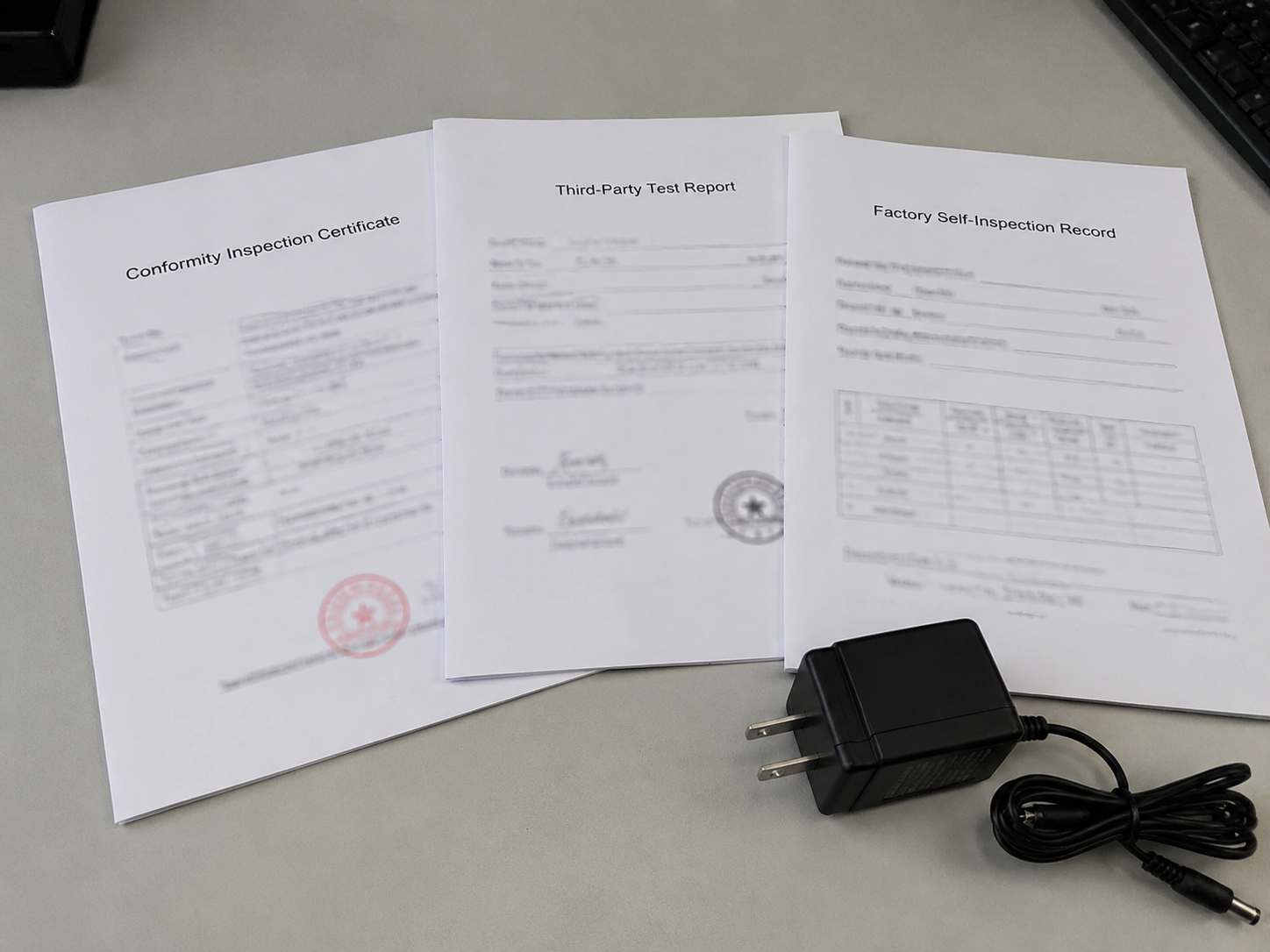
• Conformity Inspection Certificate (for specified products): Issued by a METI-registered inspection agency, it is a statutory certificate of compliance for Specified Electrical Appliances and Materials.
• Third-Party Test Report: A test report issued by an ordinary laboratory, which can be used as technical support for conformity verification, but cannot replace the statutory conformity inspection certificate for specified products.
• Factory Self-Inspection Record (for non-specified products): A conformity certificate retained by the operator of non-specified products, which does not need to be provided to external parties proactively, but must be available for production during random inspections.
A common cognitive misconception needs to be clarified here: PSE compliance documents have no statutory fixed validity period, and their validity cannot be judged simply by a fixed number of years. It is necessary to continuously confirm the version of regulations, the models and structures covered by the certificate/report, the consistency of key components, the status of mass production control, the qualification of the notifying entity, and the relevant requirements of the registered agency; when any of the above conditions change, the original document may require supplementary evaluation or retesting.
Quick Method for Judging the Validity of Compliance Documents
After obtaining a PSE document, you can quickly judge its validity through three steps:
Step 1 Check qualification: If it is a conformity inspection certificate for a specified product, it is necessary to confirm that the issuing agency is a METI-registered inspection agency, otherwise it does not have statutory certification validity.
Step 2 Check consistency: The model, structure, material, and rated parameters stated in the document must be completely consistent with the mass-produced products actually sold. Even if there is a slight difference in the model or a change in insulating material, it cannot be deemed valid.
Step 3 Check conclusion: The document must have a clear qualification judgment. If there are unqualified items, there must be complete records of rectification and retesting, otherwise it cannot be used as a compliance certificate.
Graded Retesting Rules After Product Changes
During product iteration, whether adjusting the enclosure or replacing parts requires retesting can be divided into four levels according to the degree of impact of the change on safety, corresponding to different handling methods:
• Level 1 Change: Only adjust the text of labels or user manuals, not involving rated parameters, structure, or safety-critical parts. For example, optimizing the wording of warnings in the user manual only requires rechecking marking items, no retesting is needed.
• Level 2 Change: Replace non-safety-critical components, such as enclosure decorative parts and internal plastic accessories not involving insulation. The impact on safety needs to be evaluated first. If there is no impact, no testing is needed; if there is an impact, the corresponding items need to be tested additionally.
• Level 3 Change: Replace safety-critical components, such as plugs, transformers, and insulating materials. These components directly affect safety performance, and the corresponding safety test items need to be retested.
• Level 4 Change: Change the circuit, enclosure structure, heat dissipation design, or rated parameters. For example, changing a 10W adapter to 20W or adjusting the circuit board design requires re-evaluation of all applicable test items. For specified products, a new conformity inspection application is also required.
If there is doubt about the impact of the change, a change impact assessment form can be made to check safety-related items one by one to avoid missed judgments.
Special Requirements of Cross-Border Platforms
The requirement to upload PSE compliance documents for electrical categories on cross-border platforms such as Amazon is a platform commercial rule, not a statutory requirement of DENAN. Platforms may require uploading more complete documents than the minimum statutory retention, but may not change the statutory classification of the product: non-specified products usually cannot affix the Diamond PSE mark just because of platform requirements. If the platform does not recognize self-inspection records, you should first confirm the specific type of materials required by the platform (such as third-party test reports, importer notification documents, etc.) and then supplement them accordingly. For some high-risk categories, the platform may require a conformity inspection certificate for Specified Electrical Appliances and Materials, which needs to be negotiated and handled in combination with the actual classification of the product and platform rules. Reports issued by laboratories without METI registered inspection qualifications are usually rejected by the platform.
7. Pitfall Avoidance Guide: Common Misconceptions and Quick Troubleshooting of Non-Conformities
The following summarizes the most common cognitive misconceptions and the quick troubleshooting logic for common non-conformities, which can help reduce compliance deviations.
8 Most Common Cognitive Misconceptions
Most PSE compliance problems stem from cognitive deviations caused by fragmented information. The following 8 misconceptions need to be重点 avoided:
1. CE/UL/JIS certifications can only be used as reference. The differences from Japanese standards need to be checked, and they cannot directly replace PSE testing.
2. Round PSE can be self-inspected by the operator, but it is not test-free. It still needs to meet all applicable technical standards and retain records.
3. PSE compliance documents have no statutory fixed validity period. Regulatory updates or product changes may cause the documents to become invalid.
4. Misunderstanding that only affixing the PSE mark counts as compliance. The style, position, and supporting information of the PSE mark all have statutory requirements. Affixing the mark only without compliance documents and completed declaration is a violation, with heavier penalties.
5. Misunderstanding that products tested at 220V can be directly used in the Japanese market. Japan’s mains electricity is 100V, and there is a 50/60Hz frequency difference. Testing must be conducted according to the parameters applicable in Japan, and 220V test results are not referenceable.
6. Misunderstanding that testing one model of a series of products is enough. If the differences between products of the same series affect safety (such as different power, different circuits), they need to be tested separately. The report can be shared only after confirming that the differences do not affect safety.
7. Misunderstanding that PSE covers wireless, environmental protection, and battery recycling requirements. PSE only covers electrical safety. Wireless functions need to comply with the Radio Act, and there are separate regulations for environmental protection and battery recycling. It cannot be considered that passing PSE means full compliance.
8. The conformity inspection certificate for Diamond PSE can only be issued by a METI-registered inspection agency, and reports from ordinary laboratories cannot replace it.
Quick Troubleshooting Logic for Common Non-Conformity Types
If the test is unqualified, you can troubleshoot the cause in the following order to improve rectification efficiency:
• Electric shock protection non-conformities (such as high voltage breakdown, excessive leakage current): First check whether the thickness/performance of insulating materials meets the standards, then check whether creepage distance/electrical clearance meets the requirements, and finally check whether internal wiring is reasonable and whether there are exposed conductors touching the enclosure.
• Overheating and fire non-conformities (such as excessive temperature rise, failure in glow wire test): First check whether the heat dissipation design is appropriate (such as the size of heat dissipation holes, fan power), then check whether the deviation between rated power and actual value is too large, and finally check whether the heat resistance and flame retardant grade of insulating/enclosure materials meet the requirements.
• Mechanical structure non-conformities (such as exposed live parts in drop test, power cord pulled out): First check whether the thickness/strength of the enclosure meets the standards, then check whether the power cord fixing device (cord grip) is reliable, and finally check whether the opening size and protection level meet the requirements.
• Marking non-conformities (such as marking peeling off, incomplete information): First check whether the rated parameters are accurate, then check whether the Japanese safety warnings are complete, and finally check whether the style and size of the PSE mark meet the requirements.
Summary: 5 Things You Can Independently Judge After Learning
In summary, readers can independently complete the following 5 common judgments through the content of this article:
First, you can judge whether a product is a designated electrical appliance and material through the METI item list, and whether it belongs to the specified (diamond) or non-specified (round) category, without having to guess solely based on experience.
Second, you can understand the qualification logic of the core PSE test items, clarify the types of safety risks prevented by each test item, and avoid being arbitrarily added unnecessary test items.
Third, you can quickly locate the test focus according to the product category, master the method of matching corresponding technical standards, and clarify that the final test items must be based on the item standards and product structure.
Fourth, you can prepare for PSE testing according to the process, and also identify the true validity of compliance documents through the three-step method, avoiding compliance risks caused by invalid documents.
Fifth, you can avoid common cognitive misconceptions, initially troubleshoot the causes of non-conformities, and judge whether retesting is needed after product iteration through the change grading rules.
Although PSE testing has many clauses and detailed classifications, its core always revolves around “safety”. As long as you first clarify the item and classification, then conduct corresponding tests according to risk items, and retain a full set of compliance documents, major compliance problems can basically be avoided. If you encounter scenarios with doubts about item definition, classification judgment, etc., it is recommended to entrust a METI-registered inspection agency or a professional compliance agency to review, to avoid affecting product circulation or causing compliance risks due to determination deviations.