
Electronics sellers operating in the Japanese market have most likely heard of PSE certification, but are often confused by the two types of marks: round and diamond. Which products require round PSE? What is the difference between it and the diamond PSE? Is it easy to accidentally violate regulations? In this article, we will thoroughly explain the scope of application of round PSE, covering basic understanding, judgment logic, and handling rules for special scenarios. After reading it, you will be able to independently complete preliminary product compliance checks.
First, Understand: What Exactly Is Round PSE?
Plain Language Definition: Mandatory Access Mark for Medium and Low Risk Electrical Appliances
Let’s start with the most straightforward definition: Round PSE is a mandatory access mark for medium and low risk electrical appliances in Japan. Affixing this mark means the product meets the basic electrical safety requirements of Japan and can be legally sold or given to consumers in Japan.
Japanese authorities divide regulated electrical appliances into two categories: one is high-risk “specified electrical appliances and materials”, which correspond to diamond PSE; the remaining medium and low risk ones are called “non-specified electrical appliances and materials”, which are covered by round PSE. In terms of quantity, currently PSE in Japan regulates more than 450 categories of electrical appliances, of which about 340 categories correspond to round PSE — of course, this number will be adjusted with the update of the official list, and the final version shall be subject to the latest version issued by the Ministry of Economy, Trade and Industry of Japan (abbreviated as METI).
Legal Basis and Responsible Entities
Many people think that round PSE is voluntary, which is a completely wrong perception. Its legal basis is Japan’s (abbreviated as DENAN in the industry), which is a mandatory compliance requirement, not a voluntary certification that can be done or not.
Here is a special reminder for overseas sellers: the legally responsible parties under this regulation are manufacturers or importers located in Japan. Both parties, as “notifying business operators”, shall bear the obligations of confirming product classification, keeping test records, affixing marks, and completing necessary compliance notifications (i.e., filing procedures). Overseas sellers cannot directly complete compliance on their own, and must implement it through local Japanese entities. In case of non-compliance, products may be removed from shelves or recalled in minor cases, and administrative penalties may be imposed in serious cases. The specific penalty standards shall be subject to the latest Japanese regulations.
Core Differences from Diamond PSE
Many people cannot distinguish between round and diamond PSE. In fact, the core differences can be clearly explained in a table:
| Comparison Item | Round PSE | Diamond PSE |
| Regulated Objects | Medium and low risk non-specified electrical appliances and materials | High-risk specified electrical appliances and materials |
| Compliance Mode | Self-declaration + retention of qualified test reports | Must be certified by a third-party organization registered with Japanese authorities |
| Mark Style | “PSE” printed inside a circle | “PSE” printed inside a diamond |
Both must comply with the official Japanese electrical safety technical standards, and unauthorized printing and affixing of PSE marks is strictly prohibited.
Core Judgment Logic: Confirm Whether It Is Required by Passing Four Checks
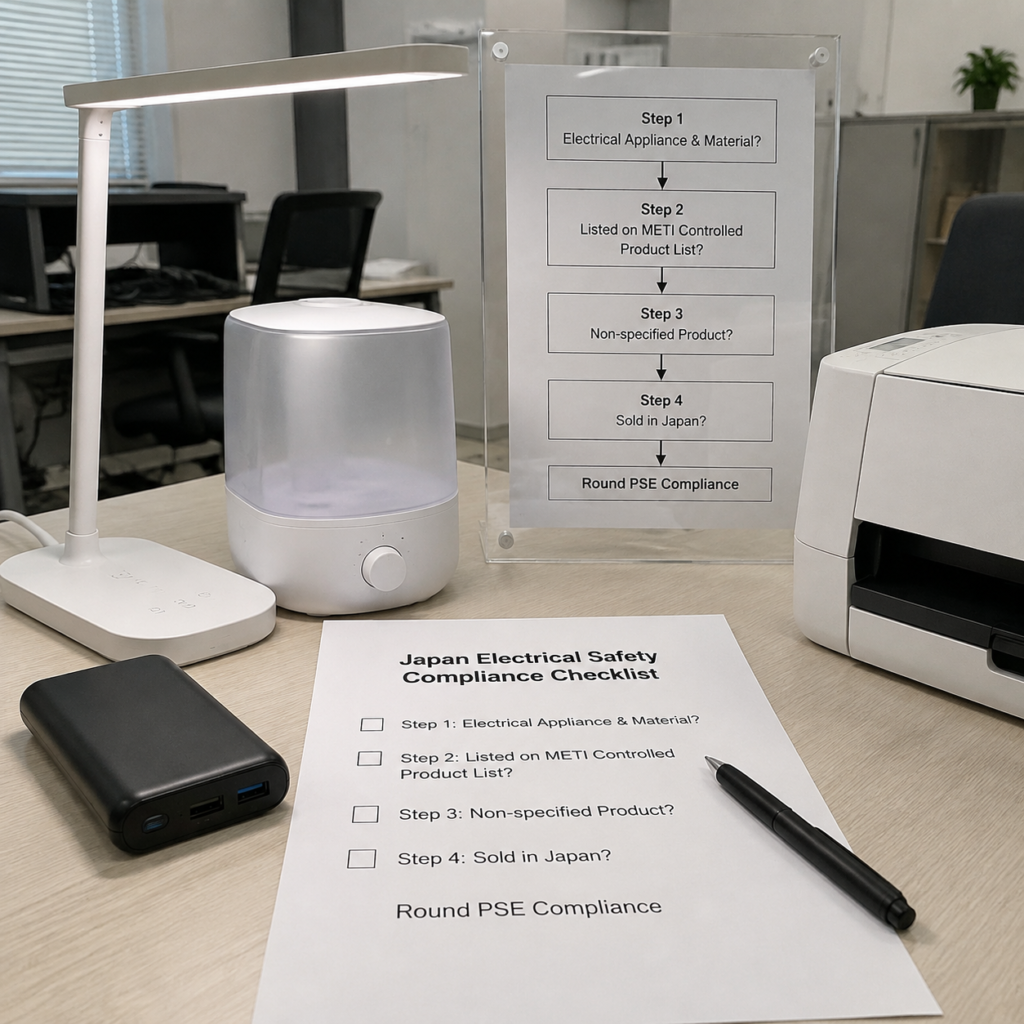
After clarifying the basic concepts, what everyone is most concerned about must be: does my product require round PSE? In fact, there is no need to memorize categories by rote. As long as you pass the four checks in order, you can get a basically accurate conclusion.
First Check: Is It an “Electrical Appliance and Material” as Defined by Law?
First, it is necessary to confirm whether the product is a finished product powered by electricity, or an electrical component that can be sold separately — the electricity here includes alternating current, as well as regulated lithium batteries.
Small low-voltage products that are powered solely by disposable dry batteries/button batteries, have no external power supply, no charging function, and are not included in the regulated list can usually be directly excluded; if they contain rechargeable lithium batteries, come with a power adapter, or are sold as part of a regulated set, they need to proceed to the next check. In addition, purely mechanical non-electrical products, and special-purpose electrical products for industrial, aviation, marine, military, medical and other special fields are also directly excluded and do not require PSE certification.
Second Check: Is It on the PSE Regulated List?
After passing the first check, it is also necessary to confirm whether the product is on the official Japanese PSE regulated list. The only basis for judgment is the latest issued by METI. When checking, it is necessary to match according to the actual use, structure, rated parameters, and power supply method of the product, not just the product name — for example, both are called “desk lamps”, ordinary household ones may be on the list, but industrial explosion-proof ones are not.
Third Check: Is It Not a High-Risk Specified Electrical Appliance and Material?
There are only two categories of PSE-regulated products. After excluding high-risk specified electrical appliances and materials (i.e., categories that require diamond PSE), the remaining non-specified electrical appliances and materials are subject to round PSE. The final judgment shall still be based on the list of “specified electrical appliances and materials” issued by METI, and do not guess based on feeling.
Fourth Check: Is the Sales Scenario Within the Scope of Mandatory Compliance?
Even if the product is a non-specified electrical appliance and material, round PSE is not required in all cases, and it also depends on the sales scenario.
Scenarios requiring compliance: new products sold or given to Japanese consumers or commercial customers.
Scenarios not requiring compliance: a small number of overseas shopping products for personal use, exhibition samples that are only for display and not for sale, and compliant second-hand resale products whose core electrical components have not been replaced.
Reference of Common Applicable Categories
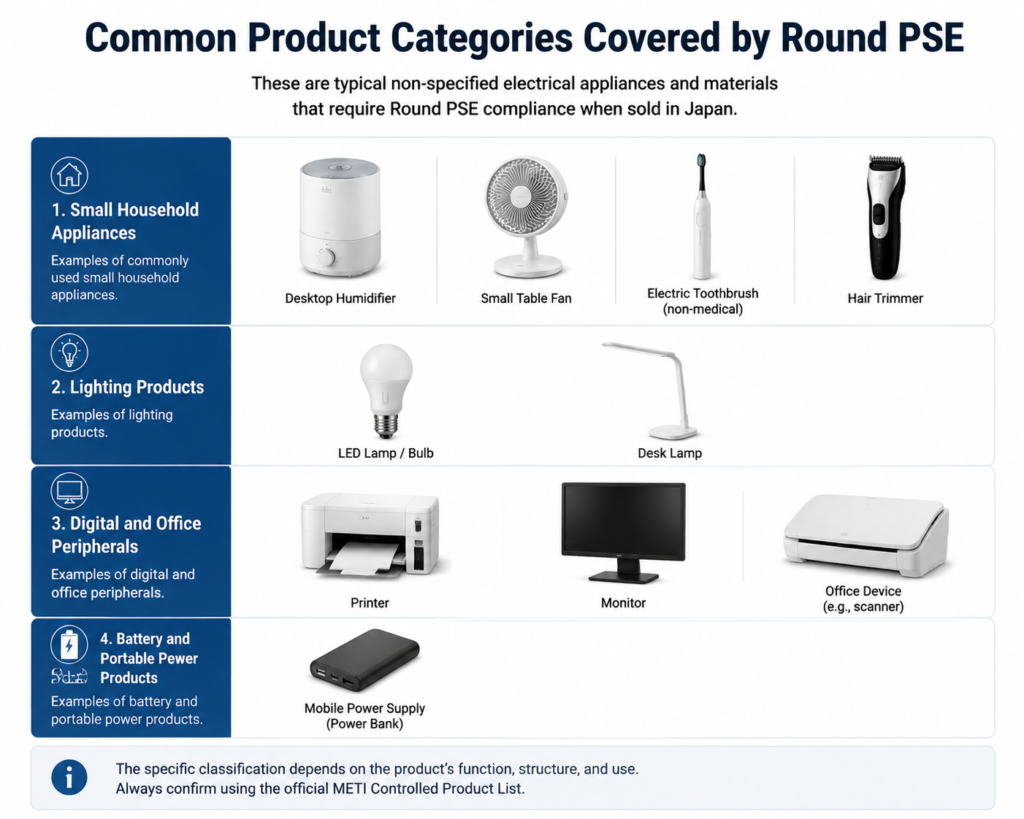
To give everyone a more intuitive concept, we have compiled several types of products commonly sold by cross-border sellers that are common examples of products that may fall within the round PSE regulation scope. Final confirmation must be made by checking the latest METI list in accordance with the aforementioned rules, and cannot be directly applied based solely on the product name.
Small Household Appliances and Personal Care Category
This category includes many daily necessities covered by round PSE, such as non-medical electric toothbrushes, hair trimmers, desktop humidifiers, small table fans, electric egg beaters, plug-in hand warmers, household clocks, electric sewing machines, plug-in electric toys for adults, etc. Note: Electrical products for children and food-contact electrical appliances may need to meet additional compliance requirements, see the special explanation later for details.
Lighting and Peripherals Category
Ordinary civilian LED bulbs, light strips, desk lamps, household holiday decorative light strings, etc., are all common reference items for round PSE applicable categories.
What is easy to get wrong here is: lighting driving power supplies sold separately need to be classified separately, and cannot be counted together with the lamps; lighting products for special purposes such as explosion-proof, automotive, and medical use are also not within this scope because they belong to special fields.
Digital and Office Peripherals Category
Daily use wired keyboards, mice, headphones, passive USB hubs, desktop wired speakers, ordinary civilian wired cameras, etc., are all common reference categories. Special note: There are differences in the classification of USB low-voltage powered, passive accessories, products with AC adapters or independent power supply, which need to be checked against the list in combination with rated input parameters and sales combinations.
Special reminder: Wall-plug USB chargers are high-risk specified electrical appliances and materials that require diamond PSE and are not within the scope of round PSE. Many sellers are prone to make mistakes here.
Battery and Portable Power Category
The commonly mentioned mobile power supplies (power banks), as well as lithium-ion storage batteries that meet the definition of Japanese laws and are used for portable power supply, are all common reference categories for round PSE. The specific applicability needs to be checked against rated parameters and use classification.
It should be noted that batteries built into complete machines, battery cells sold separately, and products powered solely by dry batteries do not fall into this category.
Reverse Exclusion: These Situations Are Not Within the Scope of Round PSE Application
It is not enough to only know which ones are applicable. Many people are prone to confuse the boundaries. Let’s clarify from the reverse: which situations are not within the scope of round PSE application at all, to avoid wasting money or violating regulations.
Products That Do Not Require PSE Certification at All
There are several types of products that have nothing to do with PSE at all: purely mechanical non-electrical products; small low-voltage products powered solely by disposable dry batteries/button batteries, with no external power supply, no charging function, and not included in the list; special-purpose electrical products for industrial, aviation, marine, military, medical and other special fields; accessories that are only internal components of complete machines and not sold separately to consumers; electrical products not included in the METI PSE regulated list.
High-Risk Products That Require Diamond PSE
If the product is a high-risk specified electrical appliance and material, it must undergo diamond PSE certification, and round PSE must never be used as a substitute. Common products of this type include: power supply products such as wall-plug power adapters, mobile phone chargers, power strips, and conversion plugs; high-risk heating products such as hair dryers, indoor electric heaters, and electric blankets; and electrical component products such as wires and cables, plugs and sockets, and fuses.
Special reminder here: Risk level cannot be judged by power, size, or product name. For example, for large home appliances such as refrigerators, air conditioners, and washing machines, whether they belong to round or diamond PSE must be confirmed by checking the official list, and do not take it for granted.
Products That Need to Comply with Additional Regulations
Some products, even if they fall within the scope of round PSE application, cannot just complete round PSE certification; they must also comply with other corresponding Japanese regulations:
• Products with wireless transmission functions (such as Bluetooth speakers, Wi-Fi adapters): need to additionally meet the technical conformity requirements stipulated in Japan’s . The commonly mentioned “technical conformity certification” is the mainstream compliance form for this requirement. TELEC is only one of the common third-party testing and certification institutions in the industry, not the name of the regulation; whether such products require technical conformity compliance depends on parameters such as the frequency band and transmission power of the specific wireless module, and cannot be generalized.
• Electrical products for children: may need to meet relevant requirements for toy safety, food hygiene, or sales channels; among them, the toy safety standard corresponding to the ST mark is usually an industry voluntary standard, and whether it is mandatory depends on product attributes, applicable regulations, and sales channel requirements.
• Food-contact electrical products: need to additionally comply with relevant Japanese regulations on food contact materials.
Note: As long as such products are within the scope of round PSE regulation, they must first meet the PSE requirements before supplementing other compliance requirements, and other certifications cannot replace PSE.
Application Rules for Special Forms and Scenarios
Judgment for ordinary products is not difficult, but some special situations are often encountered in actual sales, such as multi-functional products, sets, cross-border direct mail, second-hand goods, etc. The rules for these situations are slightly more complicated, and we will explain them one by one.
Combined/Multi-Functional Products
If a product has multiple functions, the core judgment principle is: the category corresponding to the main function of the product shall prevail. For example, a desk lamp with a USB charging port has the main function of lighting, so round PSE applies according to the lighting product category.
But there is an exception: if a core electrical component of the product itself is a specified electrical appliance and material, then this component needs to separately meet the requirements of diamond PSE, and cannot follow the round PSE rules for the whole machine.
Set/Split Sale Products
If the product is sold as a set, for example, a desk lamp set includes a desk lamp, AC adapter, power cord, and spare battery, then the PSE requirements for each separately sellable regulated component must be judged one by one, and it is not enough to only certify the main unit.
Correspondingly, the product labels and test reports must correspond to the actual sales combination. Otherwise, even if the main unit is compliant, if other components in the set are not compliant, the whole is still non-compliant.
Cross-Border E-Commerce/Overseas Direct Mail Products
This is the issue that overseas sellers are most concerned about: do products mailed directly from overseas to Japan require PSE? The answer is: as long as they are new products sold to ordinary Japanese consumers, whether shipped from local Japanese warehouses or directly mailed from overseas, they must meet the PSE compliance requirements.
The legally responsible party is the importer or manufacturer located in Japan. Overseas sellers must confirm the responsibility attribution in advance and find a reliable Japanese cooperative entity.
There is only one exception: a small number of overseas shopping products for personal use, which are not within the scope of sales, and the seller does not need to bear compliance responsibilities.
Second-Hand/Refurbished/Exhibition Samples
Second-hand products can be resold based on the original compliance without re-certification only on the premise that the original new product has completed compliance, the PSE mark and compliance materials are traceable, core components affecting electrical safety have not been replaced, and the product safety status has not changed significantly; the reseller still needs to bear corresponding product safety responsibilities in accordance with Japanese regulations.
If it is a refurbished product with core electrical components replaced, it is equivalent to a new product and needs to reconfirm PSE compliance.
As for exhibition samples, if they are only for display, not for sale or gift, there is no need to affix the PSE mark; but if they are to be sold or given to the audience on site, they must be compliant as required.
Practical Method: 3-Step Quick Self-Check for Your Products
After talking about so many rules, some people may feel that they can’t remember them. It doesn’t matter. We have compiled a 3-step self-check method. If you follow these steps for your products, there will basically be no major mistakes.
Step 1: Preliminary Screening to Exclude Obviously Inapplicable Situations
First check the two most basic points: Is the product powered by electricity? Is it sold to ordinary consumers or commercial customers?
If it is a purely mechanical product, a special-purpose product for special fields, a small low-voltage product powered solely by disposable dry batteries and without external charging function, or an internal component that is not sold separately, directly exclude it and no need to check further. If you are not sure, proceed to the next step, and do not directly determine that compliance is required.
Step 2: Check the Official List to Confirm Classification
Go to the METI official website to find the latest , and match the product classification according to the aforementioned rules. Do not reverse the judgment order: first confirm whether the product is on the regulated list, then confirm whether it belongs to “non-specified electrical appliances and materials”.
If you are not familiar with the list query rules, you can consult local Japanese compliance consultants, testing institutions, or relevant registered institutions that are familiar with DENAN/PSE classification rules; note that round PSE adopts a self-declaration mode and does not itself require mandatory certification by third-party registered institutions.
Step 3: Check Special Scenarios and Forms
Finally, confirm again: Is your product a special form such as a combined model, set, second-hand, or sample? Is the sales scenario retail, gift, display, or personal use?
Adjust the final judgment result according to the special rules mentioned earlier.
5 Common Cognitive Misconceptions That Must Be Avoided
Many people have biased understanding of round PSE and are prone to make mistakes. We have compiled the 5 most common misconceptions, which you must pay attention to.
First misconception: Round PSE is a voluntary certification, and the mark can be affixed casually.
Truth: Round PSE is a mandatory compliance requirement. Affixing the mark without meeting the standards is suspected of violating the law, and may result in removal from shelves, recall, or even penalties. After compliance, test reports meeting Japanese standards and all compliance records must be retained for official spot checks.
Second misconception: Electrical appliances with low power and small size are all applicable to round PSE.
Truth: Power and size are never judgment criteria. The core is the risk level of the product and the classification of the official list. For example, a wall-plug mobile phone charger with only 5W has very low power, but it is a specified electrical appliance and material, so it must undergo diamond PSE certification and cannot be replaced by round PSE.
Third misconception: Overseas certifications such as CE, FCC, and UL can replace round PSE.
Truth: Japan does not directly recognize safety certifications from other countries or regions. Even if you already have certifications such as CE and UL, you must retest according to Japanese standards, and only after meeting the requirements can you affix the round PSE mark.
Fourth misconception: As long as the main unit has round PSE, the entire set of products is compliant.
Truth: All separately sellable regulated components in the set, such as adapters and batteries, need to be compliant separately. For example, for a desk lamp with a charger, if the charger can be sold separately, the charger must separately meet the requirements of diamond PSE, and it is not enough to only do round PSE for the desk lamp.
Fifth misconception: Round PSE is just a test report.
Truth: Round PSE compliance is a complete set of processes, including classification judgment, testing according to Japanese standards, Japanese entities fulfilling notification obligations, retention of compliance records, correct affixing of marks, etc. Only obtaining a test report from a laboratory does not mean that all legal obligations have been completed.
To judge the scope of application of round PSE, it is necessary to combine three core dimensions: product risk level, official regulated list, and actual sales scenario. For products in doubt, priority shall be given to the latest METI classification list, and professional compliance support shall be sought when necessary to avoid compliance risks caused by blind judgment.