
Friends working in the U.S. industrial or commercial markets often confuse the relationship between UL certification and NRTL: does having the UL mark mean compliance with U.S. workplace statutory safety requirements? Why are products with UL certificates still rejected by customers or acceptance parties? This article will explain the UL NRTL program clearly, from basic understanding, applicable boundaries, operation logic to practical judgment, helping you go from beginner to being able to independently judge related issues.
First, Understand the Basics: What Exactly is UL NRTL?
Three Core Roles, Explained Clearly at Once
First, let’s clarify the three most easily confused concepts. You don’t need to memorize them by rote, just know who is in charge of what:
The first is the top-level regulator: the Occupational Safety and Health Administration (OSHA). You can think of it as the U.S. federal department in charge of “workplace safety”. Its core responsibilities are to authorize and supervise NRTL bodies, and to recognize the scope of safety standards that NRTLs may use. OSHA itself does not develop product safety standards, nor does it directly issue product certifications; specific safety standards usually come from standards organizations such as UL, NFPA, ANSI, and ASME. Only standards recognized by OSHA and included in the NRTL scope of application have legal effect.
The second is the qualification threshold: Nationally Recognized Testing Laboratory (NRTL). This is not the name of a single organization, nor a type of certificate, but a general term for the qualifications of a category of third-party bodies officially recognized by OSHA. Only bodies with NRTL qualification are eligible to carry out statutory safety certification for products used in U.S. workplaces, and the qualification requires regular re-examination; it is not valid for life.
The third is the specific service provider: the UL NRTL program. UL is a long-established private safety certification body, and one of the first NRTL bodies recognized by OSHA; the statutory safety certification services for workplace products it carries out within the scope of authorization granted by OSHA are what we commonly call the UL NRTL program.
The Real Relationship Between UL and NRTL
Many people equate UL with NRTL, and even think that UL is the official management body of NRTL. In fact, this is a misunderstanding. There are three core points to the relationship:
First, UL is not the only NRTL body. The NRTLs published on OSHA’s official website include more than 20 organizations such as Intertek (which uses the ETL certification mark), CSA Group, and TÜV Rheinland of North America. The specific names and number of bodies are subject to the real-time page of the OSHA Current List of NRTLs; UL is just the most well-known one among them.
Second, UL is a private enterprise, not a government department. Its NRTL qualification is granted by OSHA and requires regular re-examination by OSHA. If it fails to meet the requirements, the qualification may be suspended or even revoked (of course, this situation is extremely rare).
Third, not all certifications issued by UL belong to the UL NRTL program. Only certifications corresponding to product categories and safety standards within the scope of authorization granted by OSHA to UL have the legal effect of NRTL; those beyond the scope are just UL’s own commercial certifications, no different from the commercial nature of ordinary third-party certifications.
For ease of understanding, we will later refer to the judgment method of “simultaneously verifying the product’s UL certification information and whether the corresponding standard is within the NRTL authorization scope granted by OSHA to UL” as the “double-check principle”, and this logic will be used throughout the article.
Don’t Confuse Them: The Difference Between Ordinary UL Certification and UL NRTL
This is the most common pitfall. Many people think that as long as there is a UL mark, it is NRTL certification, but in fact the two are completely different. Let’s make a quick comparison with a table:
| Comparison Dimension | Ordinary UL Certification | UL NRTL Certification |
|---|---|---|
| Regulating Body | UL carries out certification in accordance with its commercial certification rules and relevant standards | Regulated by OSHA, and the standards used for certification must be recognized by OSHA |
| Applicable Scenarios | Covers multiple types of products such as consumer-grade and industrial-grade | Targets specific products for U.S. workplaces |
| Validity Attribute | Commercial voluntary certification, not equivalent to NRTL compliance basis recognized by OSHA | In workplace scenarios applicable to OSHA, it can be used as NRTL certification that meets access requirements |
| Quick Judgment Method | Certification information can be queried on UL’s official website, and the corresponding standard is not within the scope of OSHA NRTL recognition | You can check certification information on UL’s official website and check UL’s NRTL qualification for the corresponding standard on OSHA’s official website at the same time |
The simplest way to distinguish is to verify the safety standard used for product certification in accordance with the aforementioned double-check principle: if it matches, it is NRTL certification with legal effect; if it does not match, it is just ordinary UL commercial certification. It should be noted that whether the final certification is accepted by workplace acceptance also needs to be judged in combination with the specific requirements of the local AHJ and the employer; the commercial recognition of ordinary UL certification and the legal effect under OSHA’s jurisdiction belong to different categories.
First, Judge Whether It Is Needed: Scope of Application and Boundaries
After figuring out what it is, what everyone is most concerned about must be: does my product need UL NRTL? We will explain the scope of application and boundaries thoroughly, and you can judge by yourself.
In Which Cases Is It Legally Mandatory?
For legally mandatory cases, first of all, the geographical and scenario requirements must be met: products used in all regulated workplaces throughout the United States and in overseas territories under OSHA’s jurisdiction (such as Puerto Rico, Guam, etc.). Workplaces here are not only factories and construction sites, but also offices, shopping malls, restaurants, warehouses and all other places where employees work.
The core of OSHA’s supervision is equipment safety risks that may directly cause worker injuries, common types include electric shock, fire, overheating, mechanical injury, etc. However, whether NRTL certification is ultimately required cannot be judged solely by the type of risk; it shall be subject to OSHA regulatory requirements, applicable product standards, NRTL recognition scope, and AHJ/employer requirements.
Take a simple example: the same desk lamp, if sold to ordinary consumers for home use, is a consumer-grade product and does not require NRTL certification due to OSHA rules; if it is an industrial desk lamp sold for use in factory workshops, it is a workplace product involving risks of electric shock and fire, and may require NRTL certification.
What Are the Commonly Covered Products?
The specific product scope shall be judged in combination with OSHA regulations, recognized standards and official requirements. There are four common product categories that may involve NRTL certification:
- Electrical category: industrial distribution boxes, power tools, electrical equipment for hazardous locations (such as explosion-proof areas), industrial lighting, etc.
- Machinery category: industrial machine tools, lifting equipment, conveying equipment, etc.
- Fire safety category: fire alarms, fire extinguishers, emergency lighting, etc.
- Industrial protection category: some high-risk industrial personal protective equipment (PPE) that needs to meet relevant safety requirements of OSHA/ANSI/ASTM; whether it is included in the NRTL certification scope needs to be verified one by one in combination with the corresponding standards.
The above are only common directions. Only when the corresponding OSHA regulations require the product to be approved/listed/labeled, and UL has the NRTL authorization scope recognized by OSHA for this standard, does the UL NRTL path apply; purely mechanical protection, PPE or fire protection products may also be subject to ANSI, ASTM, NFPA, other OSHA clauses or local acceptance requirements, and cannot be directly assumed to be mandatory for all categories.
These “Quasi-Mandatory” Scenarios Require Certification Even If Not Explicitly Required
In some cases, although federal law does not explicitly mandate it, in practice, without NRTL certification, it is impossible to enter the market at all. We call these “quasi-mandatory” scenarios:
The first is explicit requirements from downstream purchasers. For example, employers and contractors take NRTL certification as a shortlisting condition during procurement, and will not consider products without it. This is the most common quasi-mandatory situation.
The second is the requirement of the local Authority Having Jurisdiction (AHJ). AHJ is the local department with acceptance authority, such as the fire department and building acceptance department. During on-site acceptance, they may require relevant products to have NRTL certification, otherwise they will not pass.
The third is the requirement of the insurer. In order to reduce claim risks, insurance companies will require enterprise equipment to have NRTL certification, otherwise they will not provide insurance, or the premium will be much higher.
In Which Cases Is It Not Needed: Non-Applicability and Exemptions
Of course, not all products need it. There are clear non-applicable scopes and exemption situations:
First, there are three categories of products that are clearly not applicable:
The first category is products purely for household consumers. They are usually not required to have NRTL certification due to OSHA’s workplace rules, but such products may still be subject to CPSC consumer product safety rules, FCC electromagnetic compatibility, DOE energy efficiency, state and local regulations, and may also require ordinary UL voluntary certification due to customer requirements, which does not belong to the same regulatory system as the NRTL program under OSHA’s jurisdiction.
The second category is products for non-U.S. markets. Products sold only to other countries do not need U.S. NRTL certification.
The third category is products with special regulatory systems such as military and aerospace, which are not under OSHA’s jurisdiction.
Second, there are exemption scenarios that need to be judged in combination with conditions:
Customized small-batch experimental equipment, temporary display/R&D test equipment cannot be simply assumed to be exempt. Whether they meet the exemption requirements shall be determined by OSHA or the local AHJ on a case-by-case basis. Common compliance paths include temporary use filing or separate on-site assessment processes. Large equipment assembled on site can also follow the on-site assessment path without conventional series product certification.
Finally, low-risk products: only on the premise that the product is indeed not within the statutory mandatory scope of OSHA/NRTL can it be circulated based on the manufacturer’s self-declaration. However, it still needs to meet other federal, state and local regulations, as well as relevant requirements of customers and AHJs, and “low risk” alone cannot be used as the basis for exemption.
What Does Certification Actually Cover: The Operation Logic of UL NRTL
Many people think that certification is just “sending a sample for testing and getting a certificate”, but that’s not the case. UL NRTL has a complete set of control logic, aiming to ensure that products continue to meet safety requirements.
Underlying Rules: Two “Recognitions” Are Indispensable
The core of the NRTL program is the dual recognition logic (which is also the underlying basis of the aforementioned double-check principle). Without either one, there is no legal effect:
The first is body recognition: the NRTL body itself must be reviewed and recognized by OSHA, and undergo regular re-examination to ensure that its testing and certification capabilities meet the requirements.
The second is standard recognition: the product categories and applicable safety standards that each NRTL can carry out must be individually recognized by OSHA. All authorization scopes are published on the Current List of NRTLs page on OSHA’s official website. Certifications issued beyond the scope are invalid.
Three Checkpoints: Why Certification Is Not Just Testing Samples
UL NRTL certification has three core control links, from samples to mass production to after certification, with full-process control to avoid the situation of “samples are qualified, but mass production cuts corners”:
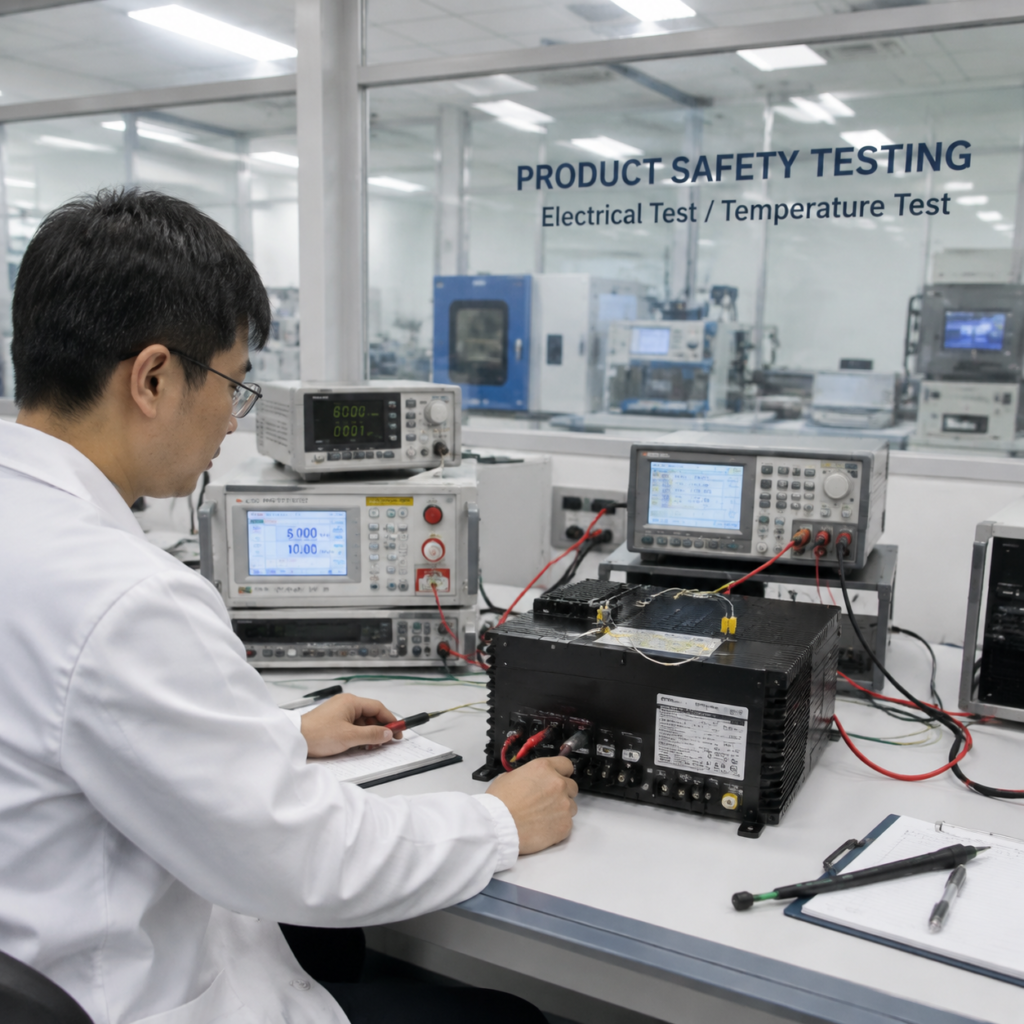
The first is sample testing: that is, taking samples that meet the design requirements to the laboratory and conducting full tests in accordance with safety standards. The core tests include insulation performance, temperature rise, withstand voltage, abnormal operation, etc., to verify that a single sample meets safety requirements. This is the foundation, but testing samples alone is not enough.
The second is factory audit: after the sample test is passed, UL will send auditors to the production factory for inspection to see if the factory has a complete quality control system and can ensure that the mass-produced products are consistent with the tested samples. After all, qualified samples do not mean that every mass-produced product is qualified.
The third is follow-up supervision: after obtaining the certificate, UL will also conduct regular spot checks, such as regular factory audits, or buying products from the market for retesting, to prevent enterprises from changing the design or replacing cheap key components without authorization after obtaining the certificate, which would cause the products to fail to meet safety requirements.
Four Common Certification Types, Don’t Use Them Wrong
There are four common certification types under the UL NRTL program, with completely different applicable scenarios. Don’t confuse them and use them in the wrong place:
The first is UL Listed. This is the most complete complete-machine certification, for complete products sold to end users, such as a complete industrial distribution box, a complete power tool, covering all safety requirements. Obtaining Listed certification within the NRTL scope means that the product itself meets the corresponding safety standards, but it should be noted that when actually put into use in the workplace, it also needs to meet installation specifications, environmental adaptation requirements, rated parameter ranges, and on-site acceptance requirements of the local AHJ. Compliance in all scenarios cannot be directly judged solely by the Listed mark.
The second is UL Recognized. This is certification for components/modules, such as power modules and switch components in distribution boxes, for use by complete-machine manufacturers for integration. This type of certification is only valid under specified use conditions (such as voltage not exceeding a certain value, ambient temperature not exceeding a certain value), and can only be used as the basis for component compliance, and cannot alone replace the complete-machine NRTL certification for workplace access.
The third is UL Classified. This type of certification only targets specific risks or limited uses, such as only testing fire resistance performance, or only testing explosion-proof performance. It only covers specified risk items or usage scenarios, does not represent full safety certification, and cannot be used as equivalent to complete Listed certification.
The fourth is on-site assessment. This type of certification is suitable for customized single equipment and temporary projects. For example, special equipment assembled on a construction site cannot undergo conventional series product certification, so UL auditors will go to the site for assessment. It is only valid for this one piece of equipment or this one project, and cannot be extended to other similar products.
How to Apply: The Full Process from Preparation to Obtaining the Certificate
If you are sure to apply for UL NRTL certification, the following application process is actually very clear, and even beginners can follow it.
Pre-Preparation: Don’t Skip These Three Steps
If you make sufficient pre-preparation, you can avoid many detours later. The core is three steps:
The first step is “double-check the scope”: first check the corresponding OSHA regulations and the official requirements of the NRTL program to confirm whether the product belongs to the category that requires NRTL certification; then confirm that UL has the certification qualification for the corresponding product standard through the UL NRTL Scope of Recognition published by OSHA and the official UL Product iQ database, to avoid useless work.
The second step is to match the standard: for the same product, different uses, different voltages, different use environments (such as ordinary environment or explosion-proof environment) may correspond to completely different safety standards. For example, the same industrial lighting, used in ordinary workshops and used in explosion-proof areas of chemical plants, have very different standards. Be sure to match the correct standard first, otherwise it will be useless to do it.
The third step is to prepare materials: common materials include product manuals, structural drawings, key component lists, rated parameters (voltage, current, power, etc.). If you have done relevant safety tests before, you can also provide them together, which can speed up the review progress.
Testing and Rectification: What If It Fails?
After the materials are ready, you can submit an application to UL, then send the samples to the laboratory designated by UL to conduct core tests such as electrical, fire protection, and mechanical tests in accordance with the corresponding safety standards.
If the test fails, UL will issue a detailed non-conformity report. You can modify the design and replace components according to the requirements, then resubmit the samples for testing; if you think the rectification cost is too high, you can also choose to terminate the project, which is voluntary.
It should be reminded that the more rectification times, the longer the certification cycle and the higher the cost. Therefore, try to adjust the product design to meet the standard requirements in the early stage, which can save a lot of trouble.
Factory Audit and Certificate Issuance
After all sample tests are passed, UL will arrange the first factory inspection, where auditors will go to the production site to verify whether the factory’s production control process and quality system meet the requirements, and whether they can ensure that mass-produced products are consistent with the samples.
Only when both the sample test and the factory audit are passed will UL issue the official UL NRTL certification certificate.
As for the cycle, the common reference cycle is 4-12 weeks. The actual duration depends on factors such as product complexity, number of rectifications, and laboratory scheduling. For example, during the peak season, the schedule is tight and the cycle will be longer.
Obtaining the Certificate Is Not the End: These Maintenance Tasks Must Be Kept Up
Many people think that everything is fine after getting the certificate, but that’s not the case. UL NRTL certification requires continuous maintenance, otherwise it is easy to become invalid:
First, regular supervision audits: the common reference frequency of supervision audits is 1-4 times a year. The actual frequency is adjusted according to product risk level, standard complexity, factory past quality performance, etc. The higher the product risk, the higher the audit frequency usually is.
Second, change notification: if the product’s key components, structural design, or production site change, you must apply to UL in advance. Only after UL evaluates and confirms that it does not affect safety can the change be officially made. If you change without authorization, the certification will be directly invalidated.
Finally, follow up on standard updates: safety standards are not static. When the corresponding safety standard is revised, there will be a transition period. You need to complete rectification, retesting or certification scope update within the transition period specified by UL, otherwise the certificate may be suspended, revoked or require re-evaluation.
How to View Certification Results: Certificates, Labels and Authenticity Verification
After obtaining certification, how to confirm that the certificate is valid? How to read the product label? How to check the authenticity? These are skills often used in practice.
How to Read the Certificate to Avoid Pitfalls
When you get the certification certificate or query the official database, focus on two dimensions, don’t just look at whether there is a certificate:
The first is the certification scope: carefully check whether the file number, certification category, product model range, applicable safety standards and versions completely match the products you want to sell. Many people fall into a pit: when they see that the same company has UL certification, they think all its products have it. In fact, the certification scopes of different products of the same company are separate. Passing certification for Product A does not mean that Product B also passes.
The second is the certification status: confirm whether the current status is Active, and whether it has been suspended, revoked or cancelled. Many UL NRTL certifications do not have a fixed “validity period”. You cannot judge the validity solely by the printing date on the certificate PDF; it shall be subject to the real-time status of the official database.
Key Points for Identifying Product Labels
The UL label on the product is the most commonly checked item during on-site acceptance. Different certification types correspond to different mark forms (for example, Listed mark, Component Recognized mark, and Classified mark cannot be mixed). Do not vaguely look for the so-called “NRTL-specific mark”; focus on verifying the following common contents: UL file number (file number, usually a combination of letters and numbers), product rated parameters (voltage, current, power, etc.), product model.
Some labels will also be marked with “cULus”, which usually means that the model has obtained certification mark authorization in accordance with applicable safety standards of the United States and Canada. However, it is still necessary to check the certificate scope, standard version, rated parameters, installation instructions and local AHJ/electrical code requirements, and it cannot be understood as automatically applicable to all scenarios.
Special attention should also be paid to the use restrictions on the label, such as “only for dry environments”, “indoor use”, “maximum installation height not exceeding X meters”, etc. If these restrictions are not met during actual use, even with certification, it is not compliant and will not pass on-site acceptance. In addition, note that the UL Recognized mark for components only represents that the component itself is compliant under limited conditions, and cannot directly replace the Listed certification required for the complete machine for on-site acceptance.
Two-Step Authenticity Check, the Most Reliable Method
There are many fake UL certifications on the market. How to check is the most reliable? Remember the two-step official query method, the core still follows the aforementioned double-check principle:
Step 1: Check the official UL database: through the UL Product iQ platform, enter the product’s UL file number, model or manufacturer name to search, verify whether the product’s certification category, model range, applicable standards, and current status are consistent with the actual situation, and confirm that UL has indeed issued the corresponding certification.
Step 2: Check the OSHA NRTL directory: through the Current List of NRTLs page on OSHA’s official website, find the corresponding Scope of Recognition for UL, and confirm that the safety standard number and version applicable to the product are indeed within UL’s NRTL authorization scope.
Only when the product, model, and corresponding standard all match the authorization scope is it a UL NRTL certification with legal effect.
Advanced Decision-Making: How to Choose and How to Judge
If you have already understood the basics, you can then master some advanced judgment logic, so that you don’t need to consult for everything and can make decisions by yourself.
Four-Step Judgment: Whether Your Product Needs UL NRTL
When you encounter products you are not sure about in the future, follow these four steps to make a quick judgment:
- First look at the usage scenario: confirm whether the final installation and usage scenario of the product belongs to a workplace under OSHA’s jurisdiction; household consumer products are usually not judged according to workplace NRTL requirements, but if they are eventually used in the workplace, they still need to be re-verified according to workplace rules.
- Then verify regulations and standards: check the certification requirements for similar equipment in the corresponding OSHA regulations, as well as the NRTL standard scope recognized by OSHA, to confirm whether the product is within the statutory mandatory category.
- Then check additional requirements: even if it is not within the statutory mandatory scope, confirm whether there are relevant requirements from downstream customers, local AHJs, or insurers. If so, it belongs to a quasi-mandatory scenario and also needs to be processed.
- Finally, check exemptions: confirm whether the product meets the exemption conditions, or whether there are other acceptable compliance methods (such as self-declaration for low-risk products). If it meets the requirements, you don’t need to do it.
Choose UL or Other NRTL Bodies?
Many people will ask: since there are more than 20 NRTLs recognized by OSHA, should I choose UL or other bodies? Here are several core judgment logics:
First, the legal effect at the federal level is completely equivalent. Certifications issued by all OSHA-recognized NRTL bodies have exactly the same legal effect at the federal level; no one is higher than the other, and OSHA itself also explicitly recognizes all NRTL certifications.
Then why do many people choose UL? Because UL’s differentiated advantages are obvious: it entered the market early, has the highest market recognition, covers a wide range of safety standards, and has the highest acceptance among downstream customers and local AHJs, so there is basically no situation where it is not recognized.
How to choose specifically? First, check whether the customer or local acceptance department explicitly specifies the UL mark. If it is explicitly specified, choosing UL is the safest; if not specified, you can compare the standard coverage, quotation, and cycle of each NRTL body and choose the most suitable one.
In Which Cases Will Certification Become Invalid?
Certification is not permanently valid after you get it. The following situations will cause the certification to become invalid, so be sure to pay attention:
First, changes to the product’s key components, structural design, or production site are not reported to UL in advance.
Second, failing to pass regular supervision audits, or failing to complete rectification after the standard update is overdue.
Third, using the mark beyond the certification scope, such as pasting the component certification mark on the complete machine, or using ordinary environment certification in an explosion-proof environment.
Fourth, UL’s corresponding NRTL qualification is suspended or revoked by OSHA (this situation is extremely rare).
Common Misconceptions and Pitfall Avoidance List
Finally, we have sorted out the most common pitfalls and a practical pitfall avoidance list to help you avoid wasting money.
4 Most Common Cognitive Misconceptions
- Misconception 1: All products sold to the United States require NRTL certification. Wrong. Only products used in U.S. workplaces that meet OSHA regulations and recognized standard requirements are legally mandatory; consumer-grade products and products for non-U.S. markets do not need it.
- Misconception 2: Having the UL mark is equivalent to having NRTL certification. Wrong. Ordinary UL consumer-grade certifications and UL certifications that are not within OSHA’s authorization scope do not belong to the NRTL category and have no legal effect for workplaces (they can be verified according to the aforementioned double-check principle).
- Misconception 3: NRTL certification is permanently valid. Wrong. Certification requires continuous maintenance. Failing to pass supervision audits, not reporting product changes, and not rectifying after standard updates will all cause the certification to become invalid.
- Misconception 4: NRTL can cover all U.S. compliance requirements. Wrong. NRTL only covers product safety in the workplace. Other requirements such as FCC electromagnetic compatibility, energy efficiency, and chemical restrictions (such as RoHS) need to be handled separately.
4 Most Common Pitfalls in Practice
- Pitfall 1: Looking for a body without OSHA NRTL authorization to do “fake certification”, spending money, but the result is not recognized during OSHA inspection or on-site acceptance, which is equivalent to doing it for nothing, and may also face fines.
- Pitfall 2: Only seeing the UL mark or UL file number, and defaulting to meeting OSHA NRTL requirements; the correct approach is to verify whether the product model and applicable standard match the authorization scope according to the aforementioned double-check principle.
- Pitfall 3: Replacing key components during production without reporting to UL in advance, and being caught by supervision spot checks, directly resulting in the certification being deemed invalid and facing penalties.
- Pitfall 4: Ignoring the installation/use restrictions on the label. For example, the product is marked for indoor use only, but is installed outdoors, so it directly fails on-site acceptance, even with a certificate it is useless.
Three-Step Pitfall Avoidance List, Just Follow It
You don’t need to remember so many misconceptions. Just follow these three steps, and you can basically avoid 90% of the pitfalls:
- Before obtaining certification: confirm through the OSHA Current List of NRTLs that the partner body is on the list, and its authorization scope matches the corresponding product standard (implemented according to the aforementioned double-check principle). Don’t just listen to what the body says.
- When obtaining certification: after getting the certificate, carefully check the certification scope (model, standard) and mark specifications, and query and confirm in the official databases of UL and OSHA at the same time; if it cannot be found or the information does not match, it cannot be used as the basis for valid UL/NRTL certification. You should first use multiple fields such as file number, model, company name, and product category to recheck, and confirm with UL or the issuing body. Only after confirming that it cannot be traced can it be treated as a fake or invalid certification.
- After obtaining certification: cooperate with supervision audits on time, report product changes in advance, and regularly follow up the update progress of corresponding standards to avoid missing the rectification transition period.
UL NRTL is one of the core compliance paths for product safety access in U.S. workplaces. Clarifying its applicable boundaries, operation rules and verification methods will enable you to independently judge certification needs and avoid common compliance risks and cost waste.