
Have you ever had this experience: when buying a new phone, wireless earbuds, or power bank, you flip to the battery itself or its packaging and see a bunch of symbols, numbers, and foreign text printed on it, not knowing which are useful and which are just randomly printed by merchants? Or even encounter merchants boasting about “super large capacity” and “ultra-long battery life”, only to find out the specifications are falsely labeled after you get the product? After the EU’s new battery regulation takes effect, these labels are no longer optional decorations, but “battery ID cards” with clear legal requirements — ordinary users can not only use them to avoid false labeling and safety hazards, but also avoid detours during repair and recycling.
In this article, we will explain battery label and information requirements thoroughly from the perspective of ordinary consumer electronics users: from the most basic “whether the battery you buy needs to comply with the regulation”, to the meaning of each symbol on the physical label, to digital QR codes, full-scenario usage, and pitfall avoidance tips. It is usable for beginners and can also help you build semi-proficient judgment ability.
First Step for Beginners: 3-Step Judgment of Whether Subject to the Regulation
Many people think that as long as a product with a battery enters the EU, it must be compliant, but that is not the case. First screen through these three steps, and you can quickly judge whether the product in your hand meets the requirements.
Step 1: First check which category the battery belongs to
Batteries related to ordinary consumer electronics are mainly divided into two categories; the remaining ones such as industrial batteries and electric vehicle power batteries are rarely encountered in daily life, so there is no need to pay special attention to them. The first category is portable batteries, which are small-capacity batteries commonly used in mobile phones, tablets, laptops, wireless earbuds, power banks, smart watches, etc. — whether they are built into the product, replaceable, or spare batteries included with the product, they all fall into this category. The second category is light means of transport (LMT) batteries, such as batteries for light mobility tools like electric scooters and electric bicycles. Because of their larger capacity and higher safety risks, the regulatory requirements are stricter than those for ordinary portable batteries.
Step 2: Then judge whether it is a commercial act of “placing on the EU market”
“Placing on the EU market” sounds very official, but to put it simply, it is a commercial act of entering the EU for the purpose of selling goods, including production in the EU for sale, import from outside the EU for sale, and refurbishment of batteries for resale. That is to say, the batteries in consumer electronics products with batteries that you buy from offline stores or online platforms in the EU should all meet these label requirements — whether they are built into the product, replaceable, or spare batteries included with the product.
If you personally purchase goods from overseas for your own use, or resell your own used second-hand products, these do not fall into the category of commercial placement, so you do not need to require merchants to supplement labels according to the new regulation, nor do you need to bear compliance obligations yourself.
Step 3: Finally check if there are exemptions or transition periods
The regulation is not a one-size-fits-all approach, and there are two special situations to note. The first is exemption cases: if the battery is particularly small and cannot fit a label at all (such as the button battery in TWS earbuds), the label can be moved to the packaging or manual, not that no labeling is required. The second is the transition period: the mandatory effective dates for different categories and different requirements are different, and existing products already on sale in the EU do not need to be supplemented with new labels — only products newly placed on the market after the regulation takes effect need to meet the requirements.
What is the use of these requirements for ordinary users?
You may say that compliance is the merchant’s business, what does it have to do with me? In fact, these labels are directly related to your consumer rights and usage safety. First of all, you can avoid pitfalls when purchasing, quickly identify the real capacity, and avoid inferior batteries with false labels or counterfeits. Secondly, it is safer during use and repair: you can clearly know the safety rules and whether you can replace it yourself, reducing the risk of bulging, leakage, or even fire. Finally, you will not violate regulations when scrapping: you know the correct recycling method, will not violate local environmental protection regulations by throwing garbage in the wrong place, and can also avoid safety hazards.
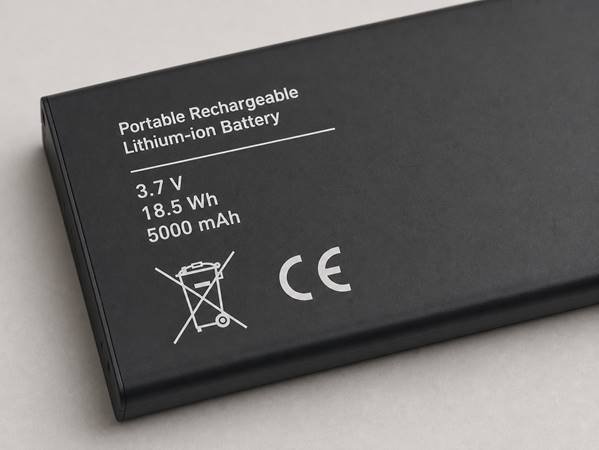
Must-Know Physical Labels: Core Information and Format Requirements
After clarifying the scope of application, let’s break down the physical labels on the battery body (or packaging) to see which are legally required and what each piece of information means.
Basic Identity Information: Traceable Battery Source
This part is equivalent to the “ID card” of the battery, so that the responsible party can be found if something goes wrong. It will be printed with the name and contact information of the manufacturer or the importer within the EU; in case of quality problems or recall of the battery, the responsible party can be contacted. There is also the battery model, batch, or production date, which can be used to match the model when buying a replacement battery, and you can quickly judge whether your battery is in the affected batch in case of a recall. In addition, the battery type must be marked, such as “portable rechargeable lithium-ion battery” or “disposable alkaline battery”, so that you can know the basic properties of the battery at a glance. As for information such as chemical system and weight, it can be printed on the battery body, or placed in the manual or digital information entry; there is no mandatory requirement that it must be printed on the body.
Capacity and Compatibility Parameters: Understand Real Battery Life
This part is the most prone to false labeling pitfalls, focus on two points. First, the real total energy depends on watt-hours (Wh). Many people are used to judging battery life by milliampere-hours (mAh), but mAh must be combined with voltage to calculate the real total energy. The conversion formula is . Wh is the unified total energy unit, and battery life can be directly compared between different products. For example, a power bank with a cell rated at 3.7V and 10000mAh has a theoretical total energy of 37Wh; during actual output, due to circuit conversion losses, the available output energy will be lower than this value, and the mAh value of the output voltage cannot be directly equated with the cell capacity.
Secondly, be careful of the word game of “cell capacity”. When buying a power bank, you often see a label of 20000mAh, but it can only charge the phone a few times in practice, because what the merchant labels is the total capacity of the internal cells, not the actual “rated capacity” that can be output — there will be losses in circuit conversion. The rated capacity (5V output caliber) of many power banks on the market is about 60%-70% of the cell capacity, but this is only a common empirical range, and the specific ratio varies with conversion efficiency, product design, and labeling rules. When purchasing, prioritize looking at the rated capacity or Wh.
In addition to capacity, the voltage and chemical system (such as lithium-ion, alkaline) on the label are also very important, used to judge whether it is compatible with your device and charger. For example, you cannot use a lithium-ion battery charger to charge alkaline batteries, which will pose safety risks.
Safety and Recycling Symbols: Every Symbol Is Relevant to You
The symbols on the label are not printed randomly. We have organized the core ones into a table for easy understanding at a glance:
| Symbol | Plain Meaning | Precautions |
| Crossed-out trash bin | Waste batteries need to go through special recycling channels and cannot be thrown into ordinary garbage | The official name is the separate collection symbol, which must be printed on the body except for micro batteries |
| Cd/Pb symbol | The cadmium/lead content in the battery exceeds the mandatory reminder threshold | The absence of this mark does not mean that it is completely free of heavy metals, only that the content is below the labeling threshold, and it cannot be directly inferred that the overall environmental performance is better |
| CE marking | The enterprise declares that the product meets the EU’s basic safety and environmental protection requirements | It is not a performance certification and does not mean that the battery has longer battery life or longer service life |
| “Non-rechargeable” text | The battery is disposable and must never be charged | Disposable batteries must be marked, otherwise incorrect charging may cause leakage or even explosion |
In addition, there are some common safety warnings, such as “flammable” and “keep away from children”. Button batteries must also be marked with swallowing risk — families with children must pay attention, as accidental swallowing of button batteries can cause serious injury.
Additional Label Requirements for Specific Categories
In addition to general requirements, several types of special batteries have additional labeling obligations. Removable batteries must be marked with the replacement method, that is, whether the user can replace it by themselves or needs a professional to replace it, and the compatible product models must also be clearly marked to avoid buying the wrong one. Disposable non-rechargeable batteries must be clearly marked “non-rechargeable” and cannot be vague.
There is also the frequently asked carbon footprint rating label (A-G grade), which is not required for all batteries — currently only built-in batteries for mobile phones, tablets, and laptops, which are clearly listed in the EU regulation and subsequent delegated acts and implementing rules, are planned to be mandatory to affix the A to G carbon footprint rating (A has the lowest carbon emission, G has the highest carbon emission) from 2027. Other categories have no requirements for the time being, and the specific list and implementation arrangements are subject to the official announcement of the EU.
Rigid Format Requirements: Basis for Judging Compliance
It is not compliant just because information is printed; there are also several rigid requirements. First is the position: it should be printed on the battery body first, and only micro batteries that are too small in size can have the label moved to the packaging or manual. Second is durability: during the normal use and storage cycle, the label must be clearly readable and not easy to wear or fall off, and printing that wipes off easily cannot be used. There is also a size requirement: the minimum size of core symbols will be adjusted according to the surface area of the battery, and even for very small batteries, it must be visible to the naked eye. Finally, the language requirement: it must be in the official language of the EU member state where it is sold. For example, products sold in Germany must have German, and products sold in France must have French, so that ordinary users can directly understand it.
Digital Information Distinction: QR Code Entry vs. Battery Passport
Now many batteries have QR codes printed on them, and the EU’s new regulation also has requirements for digital information. Many people are confused about whether the “QR code entry” and “battery passport” are the same thing, but in fact they are very different.
What is the QR Code Digital Information Entry?
It is the QR code printed on the battery or packaging, which can be scanned to view the public information required by the regulation, not advertisements. The current requirements are: light means of transport batteries, large-capacity industrial batteries, and electric vehicle batteries must be affixed with QR codes from February 2027; for portable batteries for ordinary consumer electronics, whether mandatory affixing is required and when it will be implemented still need to be clarified by the EU’s subsequent implementing rules.
What is the Battery Passport?
The battery passport is not an ordinary QR code information, but a full-life-cycle electronic file of the battery — information from raw material mining, production, transportation, use to recycling is stored in it, which is much more comprehensive than the information of ordinary QR codes. Its mandatory applicable categories are consistent with those of QR codes, and it will be first implemented in February 2027. Whether it will be extended to portable batteries for ordinary consumer electronics is subject to the official announcement of the EU.
Many people think that all information can be seen in the battery passport, but that is not the case: only safety, use, recycling, and warranty information related to consumers is public, and ordinary users cannot see trade secrets such as supply chain costs and technical parameters.
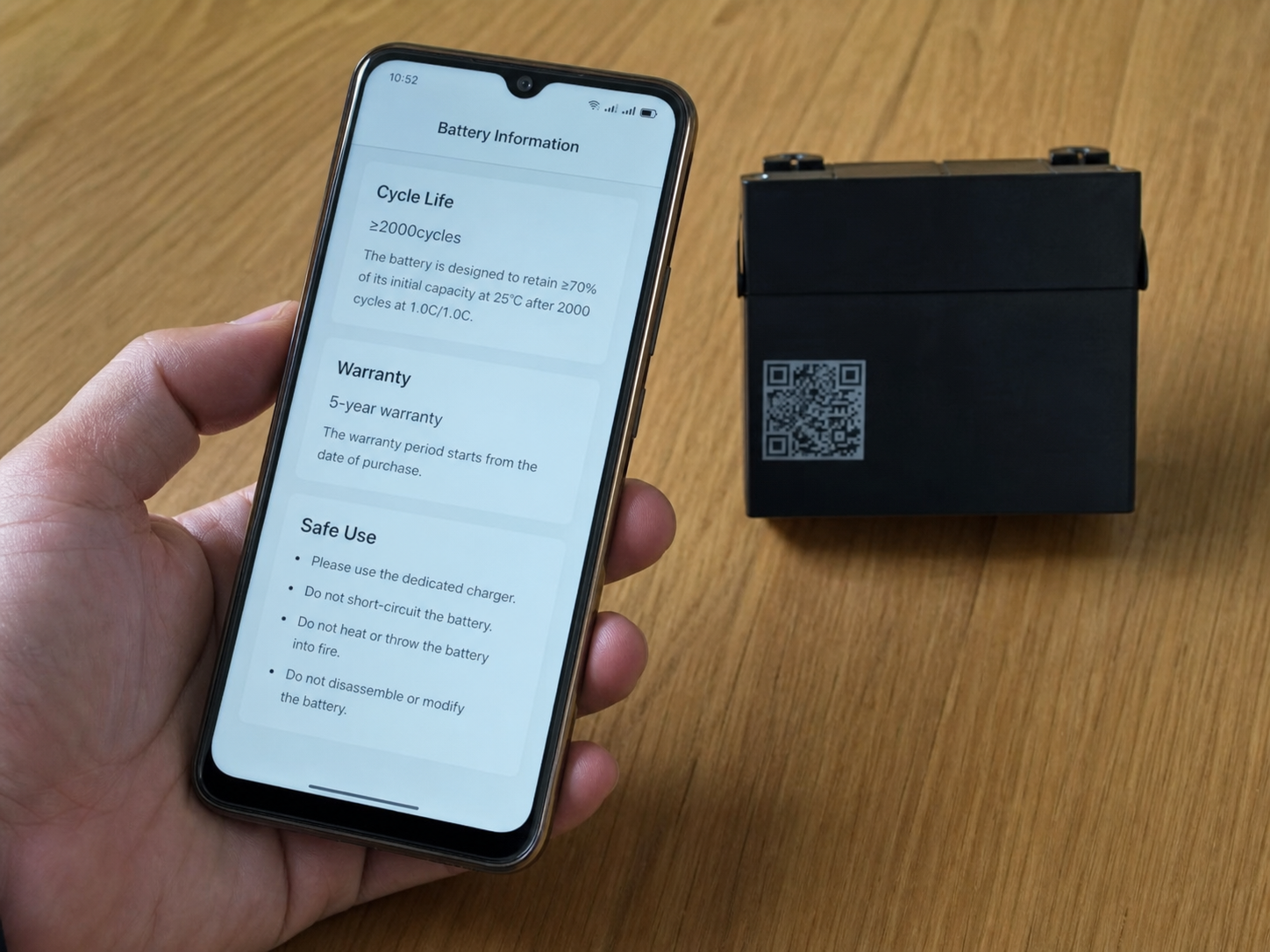
What Can Ordinary Users See When Scanning the Code?
Whether it is a QR code or the public entry of the battery passport, the core information that ordinary users can check mainly includes several categories. First is the expected battery life, that is, the number of cycles — using the battery from full charge to low power and then fully charging it counts as one complete cycle. Manufacturers generally mark “the total number of cycles when the capacity drops to 80% of the initial value”. The cycle life of different products will vary due to manufacturer test conditions, battery capacity, and chemical system, and the specific value is subject to the product labeling or the test caliber announced on the digital entry. Second is the warranty policy, that is, the conditions and duration of free battery replacement. There are also safe use instructions, guidance on formal recycling channels, and relevant instructions for compatible replacement batteries.
How to Judge Whether the Digital Entry Is Compliant?
The following judgment methods are mainly applicable to categories that have been mandatory to be equipped with digital entries; ordinary consumer electronics portable batteries are not currently mandatory to be equipped. If merchants voluntarily provide QR codes, they should also ensure that the information is true and the parameters are consistent with the physical labels, and the specific requirements are subject to the EU’s subsequent implementing rules.
When you encounter a battery with a QR code, scan it to judge whether it is compliant. First, you do not need to register, pay, or provide personal information such as mobile phone number and location to view all public content. Second, parameters such as capacity and model in the electronic information are completely consistent with those on the physical label. Also, the QR code is printed in a conspicuous position and is not deliberately hidden. If scanning it redirects to an advertisement, blank page, or irrelevant page, it is definitely non-compliant.
Requirements for Online Sales and Accompanying Documents
In addition to physical labels, there are also legal information requirements for buying batteries online or the manuals included with products.
Statutory Disclosure Requirements for Online Product Pages
For individual battery products or consumer electronics products with built-in batteries that are commercially sold to EU consumers, the online product detail page needs to disclose statutory battery information, including core content such as battery type, capacity, recycling reminder, and core safety warnings. There is no mandatory requirement to put a complete label picture, and the specific disclosure items and display forms shall be subject to EU regulations, platform rules, and regulatory requirements of the member state where the sale takes place. It should be noted that the parameters advertised on the detail page must be consistent with those on the actual battery label. For example, if the page marks 5000mAh but the actual product only has 4500mAh, it constitutes false publicity and is illegal.
Required Content of Accompanying Manual
The manual included with the product cannot only have usage methods, but must also have several parts of content related to the battery. First is the battery safety use specification, such as prompts like suitable charging temperature, prohibition of disassembly, and prohibition of throwing into fire. Second is the battery replacement guide, whether the battery can be replaced by yourself, and prompts for compatible models. There is also prompt information on local formal recycling channels.
Declaration of Conformity and Technical Documents (Users Do Not Need to Delve Into)
Many people will ask, can I ask the merchant for the battery’s qualification certificate? In fact, such documents are mainly for regulatory authorities. The enterprise itself will issue a “Declaration of Conformity” (DoC for short), plus technical materials supporting compliance, which EU regulatory authorities will check during random inspections. The CE marking we are familiar with is affixed by the enterprise based on this Declaration of Conformity. Ordinary users do not need to specially ask merchants for technical documents, even if they get them, they have no reference value.
Full-Scenario Practical Guide: Usage for the Entire Process of Buying/Using/Repairing/Selling/Recycling
After explaining all the requirements, let’s apply them to real life to see how to use these label rules to protect your rights and interests in different scenarios.
Label Verification Method When Purchasing
When purchasing, the verification focus is different for different channels. If buying offline, prioritize checking the label on the battery body or in the battery compartment to see if it is clearly printed and has complete information. If there is even no capacity or recycling symbol, it is best not to buy it. If buying online, immediately verify whether the battery parameters written on the detail page are consistent with the physical label after receiving the goods. If there is a big difference, you can directly ask the merchant for return or exchange. We have mentioned the rules for personal overseas shopping for self-use before: you do not need to worry about the merchant’s compliance obligations, but you still need to pay attention to the battery’s safety marks, air transport restrictions (such as the capacity requirement for power banks carried on board), and local waste battery recycling rules; if it is a product for commercial sale, it must meet the label requirements of the EU battery regulation.
Reference Value of Labels During Use
In daily use, labels can also help you avoid many risks. When choosing a charger, choose it according to the voltage and charging requirements on the label. Do not casually use a high-power fast charging head to charge a battery that does not support it, which may easily shorten the service life or even cause safety problems. If the battery has abnormalities such as bulging or leakage, first check the safety prompts on the label for how to deal with it, and do not disassemble it casually or throw it into an ordinary trash can. For removable batteries, first check the replacement prompt on the label. If it is marked “needs to be replaced by a professional”, do not forcefully disassemble it yourself, as it may easily damage the device or hurt yourself.
Label Rules for Battery Repair and Replacement
For ordinary users, you do not need to label replacement batteries yourself — these requirements are for merchants of replacement batteries that are commercially sold, provided as repair services, or placed on the market again after refurbishment. But when you buy replacement batteries, you can choose according to the following rules to avoid counterfeit and shoddy products. The label requirements for original replacement batteries are exactly the same as those for batteries when they leave the factory, and no information or symbols can be missing. Third-party compatible batteries must be marked “non-original” and clearly marked with compatible product models, and cannot pass off as original. Refurbished replacement batteries must be marked with the word “refurbished” and cannot be sold as new batteries.
Label Precautions for Second-Hand/Refurbished Product Transactions
The label rules in second-hand transactions are also divided into two situations. If an individual resells their own used second-hand products (such as selling their old mobile phone), there is no need to supplement new labels, but the original labels cannot be deliberately torn off. If a merchant sells second-hand or refurbished products with batteries, it must ensure that the battery labels are complete, and also truthfully inform the buyer of the actual state of the battery (such as cycle count, remaining capacity).
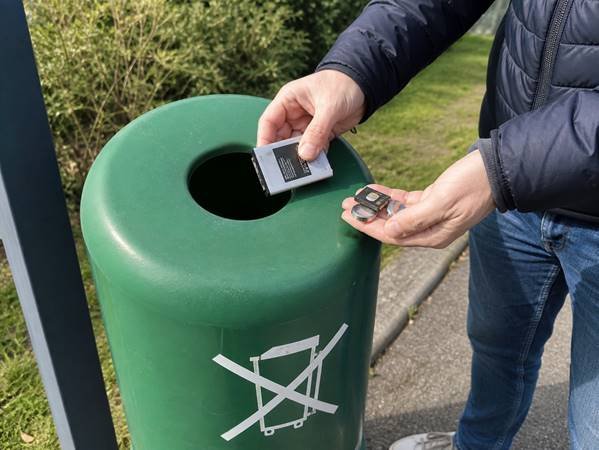
Recycling and Rights Protection Channels
When recycling, labels can help recyclers quickly identify the battery type and sort it to avoid safety accidents, so try to keep the complete label — batteries without clear labels may require further identification at the recycling point, and the processing process will be more troublesome, which is subject to local recycling rules. For electronic products with built-in batteries, you do not need to remove the battery yourself, just recycle them through the e-waste channel. Removing the battery yourself can easily cause short circuits and fires. To find a nearby recycling point, you can scan the digital QR code on the battery, or check the official website of the local environmental protection department.
If you encounter a product with non-compliant labels, prioritize contacting the merchant for return or exchange; for cross-border purchases, you can ask the platform to intervene; if it cannot be resolved, you can also complain to the local consumer protection agency.
Semi-Proficient Pitfall Avoidance: Violation Identification, Common Misconceptions and Phased Requirements
After understanding the basic rules, let’s talk about several advanced judgment skills to help you avoid 90% of the pitfalls.
3 Most Common Violation Situations of Physical Labels
There are three common types of violations of physical labels. The first is false labeling of capacity: for batteries of the same volume and type, if the labeled capacity is much higher than the mainstream level of the same type (for example, a power bank the same size as a mobile phone battery is labeled 20000mAh), it is most likely counterfeit. The second is the lack of core symbols: after the applicable date of the corresponding label obligation, and under the premise that it does not belong to the micro battery position exemption, if core information such as the crossed-out trash bin symbol, CE marking, and capacity parameters are still missing, it is a high-probability non-compliant situation. The third is non-compliant symbols: the font is too small to see clearly, the printing wipes off easily, it is covered by stickers, or the label is only on the packaging but not on the battery body (except for micro batteries), all of which are violations.
Common Violation Pitfalls of Digital Entries
There are also several common pitfalls for violations of digital entries. Scanning the code redirects to an advertisement, blank page, or irrelevant page, which is a false digital label and a violation. Requiring you to authorize personal information such as mobile phone number and location to view the content is a violation — public information does not require any authorization. If the capacity and model in the electronic information do not match the physical label, it is suspected of fraud.
7 Most Common Cognitive Misconceptions
Many people have wrong understandings of battery labels, and we have sorted out the most common ones. The first misconception is that small batteries do not need to be labeled at all. In fact, they can only be moved to the packaging or manual due to too small size, not exempt from labeling obligations. The second misconception is that all batteries must have a carbon footprint label. In fact, only built-in batteries for mobile phones, tablets, and laptops are planned to be mandatory from 2027, and other categories are not required for the time being, which is subject to the official announcement of the EU. The third misconception is that the absence of a Cd/Pb mark means it is completely free of heavy metals. In fact, it only means that the content is below the mandatory labeling threshold, not completely free of heavy metals.
The fourth misconception is that the CE marking represents good battery performance. In fact, CE only represents compliance with basic safety and environmental protection requirements, and has nothing to do with performance such as battery life and service life. The fifth misconception is that the CE marking of the whole machine means the battery is compliant. In fact, the CE of the whole machine is the compliance declaration of the whole machine, and the battery needs to meet the label requirements separately, which cannot be confused. The sixth misconception is that all batteries have a battery passport. In fact, only specific categories listed in the regulation are planned to be implemented first, and portable batteries for ordinary consumer electronics are not mandatory for the time being. The seventh misconception is that a label on the packaging means compliance. In fact, except for the exemption of micro batteries, the label must be printed on the battery body, and the packaging is only a supplement.
Phased Mandatory Requirements by Category (Subject to the Official EU Detailed Rules)
Finally, we have sorted out the mandatory effective dates for different categories for your comparison. First, the general rules: the EU’s new battery regulation has been applicable since February 18, 2024. Specific obligations such as labels and digital information will be implemented in phases according to different dates, and requirements will be gradually put forward only for battery products newly placed on the EU market after the regulation takes effect; it only applies to new products placed on the market for the first time, and existing products already on the market do not need to be supplemented with new labels; the specific implementation time is subject to the officially released implementing rules of the EU and the implementation requirements of each member state.
For your quick comparison, we have organized the core requirements into a table:
| Battery Category | Effective Date | Mandatory Requirements |
| Portable consumer electronics batteries | From August 18, 2025 | Newly launched batteries need to be affixed with the crossed-out trash bin symbol and heavy metal warning above the threshold |
| Portable consumer electronics batteries | From August 18, 2026 | Newly launched batteries need to be marked with basic identity information, capacity parameters, and CE marking |
| Portable consumer electronics batteries | From 2027 | Built-in batteries for mobile phones/tablets/laptops are planned to be mandatory to affix carbon footprint rating labels (subject to official announcement) |
| Portable consumer electronics batteries | To be determined | QR code and battery passport requirements to be clarified by the EU’s subsequent implementing rules |
| Light means of transport (LMT) batteries | 2025-2026 | Basic label requirements are consistent with portable batteries |
| Light means of transport (LMT) batteries | From February 18, 2027 | Mandatory to be equipped with QR code digital entry and battery passport |
1-Minute Quick Checklist
When you get a product with a battery, check in this order, and you can quickly judge whether it meets the requirements:
Step 1: First confirm whether it needs to meet the requirements
• ▢ Belongs to consumer electronics batteries commercially sold in the EU market
• ▢ Is a newly launched product after the regulation takes effect (existing products do not need supplementary labeling)
Step 2: Check physical labels (mandatory check)
• ▢ Has the crossed-out trash bin recycling symbol
• ▢ Has clear capacity, model, manufacturer/importer information
• ▢ Has CE compliance marking
• ▢ If it is a micro battery, there is a complete label on the packaging/manual
• ▢ The label is clear and not easy to wear, and uses the official language of the selling country
Step 3: Check digital and accompanying information (check for corresponding categories)
• ▢ Categories that need to be equipped with QR codes (ordinary consumer electronics portable batteries are not mandatory for the time being): scanning the code can view public information without authorization
• ▢ The manual has safe use, replacement method, and recycling guidance
• ▢ If buying online, the detail page parameters are consistent with the physical label
Step 4: Check special category requirements
• ▢ Removable batteries have replacement prompts and compatible models
• ▢ Disposable batteries are marked “non-rechargeable”
• ▢ Refurbished/second-hand batteries have clear marks
• ▢ Built-in batteries for mobile phones/tablets/laptops launched after 2027 have carbon footprint labels (specifically subject to the official EU announcement)
Summary: 5 Things You Can Do Directly After Reading
This article covers all battery label-related knowledge from beginner to advanced. After reading it, you don’t need to memorize it by rote, as long as you can do these 5 things: First, for any consumer electronics product with a battery, use the 3-step method to quickly judge whether it is subject to the EU’s new battery regulation. Second, understand the core information such as capacity, safety symbols, and CE marking on the physical label, and avoid common pitfalls of false labeling and counterfeiting. Third, distinguish the difference between the QR code digital entry and the battery passport, and know the digital information requirements of different categories. Fourth, be clear about the battery label rules in the full scenario of buying, using, repairing, selling, and recycling, and will not be fooled by merchants’ marketing rhetoric. Fifth, when encountering products with non-compliant labels, know the basic rights protection handling methods.