
Practitioners new to RF compliance for the U.S. market are often confused by a series of abbreviations such as EAS, TCB, FRN, and Grantee Code, and are prone to misunderstand the positioning of the EAS system: some think EAS is FCC certification itself, some believe that registering an account on their own is enough to submit an application, which eventually leads to repeated application rejections or detours. EAS is the official service system of the FCC for Certification-type authorizations. Clarifying its positioning, processes and rules can effectively improve application efficiency. This guide covers the full EAS process, special scenarios and common questions from basic cognition to advanced pit avoidance, suitable for beginners and practitioners for reference.
1. Basic EAS Cognition and Quick Judgment of Compliance Path (Must-Read for Beginners)
Plain-Language Definition and Core Positioning of EAS
The full name of EAS is Equipment Authorization System, which is the equipment authorization system, and it is the online service hall and official archive dedicated to the FCC’s management of “RF equipment certification with an FCC ID”. It has three core purposes: review and circulation of Certification-type certification applications, management of Certification-type equipment authorization records, and synchronization of approved information to the FCC public query database for public inspection.
A core misunderstanding must be clarified here: EAS is not the certification itself, it is only the system that carries the certification application process. Just like applying for a business license on a government service website, the website is not the business license; the certificate obtained after submitting materials and passing review is the compliance proof — EAS corresponds to this government service website. The actual review work is completed by FCC-recognized third-party organizations (TCBs), and the FCC authorization obtained after passing review is the real compliance proof.
There is another common misunderstanding: many people think applicants can operate EAS at will on their own, but this is not the case. At present, most core operations of EAS (such as submitting applications, uploading materials, and handling changes) are handled by TCBs. The applicant’s operation authority is subject to current FCC rules and the process of the selected TCB, and there is no need to figure out how to open operation authority on their own.
Core Related Concept Distinction (Avoid Confusion)
Newcomers can easily mix up various FCC accounts and numbers. Clear definitions can help distinguish them quickly:
- MyFCC Account: The universal login account for all FCC online systems; all services need to be logged in through this account.
- FRN (FCC registration number): Its full name is FCC Registration Number, which is the unique identity identifier issued by the FCC to enterprises or individuals, and all FCC services must be bound to this number.
- Grantee Code (authorization party code): The prefix of an FCC ID, usually 3-5 characters, representing the holding entity of the authorization.
- FCC ID: The FCC authorization number for a single product or a series of products, consisting of “Grantee Code + custom product code”.
- EAS: Only responsible for the application and recording of Certification-type authorizations. Not all FCC compliance services are handled in this system; for example, SDoC self-declaration does not need to go through EAS.
FCC RF Compliance Path Decision Tree (Judge the Path First Before Looking at EAS)
Many people ask about the operation method of EAS as soon as they reach out. In fact, before using EAS, you should first determine whether the product belongs to the Certification path; products following the SDoC, exemption or other licensing/filing paths usually do not need to use EAS compulsorily. Clarifying the compliance path first is the first step.
Step 1: First exclude completely exempt devices. For example, extremely low-frequency micro-power devices, some specific special-purpose devices, etc. The specific list shall be subject to the exemption list officially released by the FCC, and you cannot determine exemption solely based on subjective judgment of low power.
Step 2: Determine the device type. There are three common categories:
- Intentional radiator: Devices that actively emit RF signals, such as WiFi, Bluetooth, mobile phones, wireless earphones. This is the most common category that requires Certification.
- Unintentional radiator: Devices that do not actively emit RF themselves, but generate RF interference during operation, such as computers without wireless functions, home appliances, and switching power supplies.
- Other categories: For example, ISM (Industrial, Scientific, Medical) equipment (following Part 18 rules), licensed frequency band equipment (such as walkie-talkies, base stations), etc., shall be implemented in accordance with corresponding rules.
Step 3: Corresponding compliance paths.
- Certification path: Must submit an application through a TCB using EAS, and obtain an FCC ID after approval. Most intentional radiators follow this path, but the specific path still needs to be confirmed according to the corresponding Rule Part of 47 CFR, device technical characteristics and FCC/KDB guidelines, and cannot be judged solely by the name of the wireless function or sales description.
- SDoC (Supplier’s Declaration of Conformity) path: Enterprises conduct testing on their own and declare compliance by themselves, no need to find a TCB for review, nor mandatory to go through EAS. Most eligible unintentional radiators follow this path.
- Module authorization path: If the product uses a module that has passed FCC certification, the module’s authorization can be used if conditions are met. Whether the whole device needs to re-apply for authorization needs to be determined after evaluation.
- Other paths: For example, devices in licensed frequency bands need to follow the licensing or filing procedures required by the corresponding Rule Part.
Two important reminders are added here: First, the original Verification path of the FCC has been officially cancelled, please do not operate according to outdated rules. Second, you cannot judge the path solely by “whether there is a wireless function”. For example, a switching power supply without wireless function is also an unintentional radiator and needs to meet SDoC requirements, and you cannot take it for granted that no wireless function means no compliance requirement.
3-Step Quick Judgment of Whether You Need to Contact EAS
If you don’t want to study too carefully, you can use these three steps to quickly screen:
Step 1: Confirm that the product is within the scope of FCC RF control and not in the official exemption list.
Step 2: Check the compliance requirements of the Rule Part corresponding to the product, and confirm whether it must follow the Certification path.
Step 3: If you need to follow the Certification path, you need to cooperate with the TCB to use EAS; if you follow the SDoC, exemption or other paths, you do not need to use EAS compulsorily.
2. Necessary Preparations Before EAS Application (Account/Role/Materials/TCB Selection)
After confirming that the product needs to follow the Certification path and use EAS, good preliminary preparation can greatly reduce the probability of application rejection.
Identity and Account Preparation (Application Order and Consistency Requirements)
It is usually recommended to prepare in the order of MyFCC account registration → identity verification completion → FRN application → Grantee Code application; the specific entry, verification requirements, fees and maintenance rules shall be subject to the current FCC/CORES page.
The core requirement here is absolute consistency of information: the entity name and address information in all accounts must be completely consistent, and a difference of one word or one punctuation mark may lead to rejection. For example, if “ABC Electronics Co., Ltd.” is used when registering MyFCC, and “ABC Electronics Limited” is written when applying for FRN, it will definitely not pass the review.
The Grantee Code is applied for in the FCC’s CORES system. The application conditions, fees, validity period and maintenance rules are subject to the announcement on the current official FCC page. Please do not trust outdated information on the Internet.
If you are an overseas applicant (such as a Chinese manufacturer), there is another hard prerequisite: you must designate a U.S.-based agent, and the agent’s information must also be completely consistent with the information in all subsequent applications, and cannot be filled in arbitrarily.
Responsibility Matrix of All Parties (Clear Non-Transferable Responsibilities)
Many people think that finding a TCB means everything is fine, and the TCB will bear all responsibilities if something goes wrong, but this is not the case. The responsibilities of all parties are clearly divided and non-transferable:
- Grantee (authorization holder): Bears the final compliance responsibility. It is generally recommended that the brand owner, manufacturer or importer serve as the holder. Contract manufacturers are not recommended to serve as the holder, otherwise they need to bear all compliance risks.
- U.S. Agent: In accordance with the requirements of 47 CFR §2.911(d), responsible for receiving legal and regulatory inquiries from the FCC, and must provide valid contact information that meets the rules — virtual agents that only provide email addresses and have no physical address are likely to not meet the requirements, and the specific situation shall be subject to current rules.
- TCB (FCC-recognized third-party certification body): Responsible for the review of Certification applications, and the submission and maintenance of the EAS system, but does not bear the final compliance responsibility. It is mainly responsible for the review of application materials and system process operations, and the final compliance responsibility is still borne by the grantee.
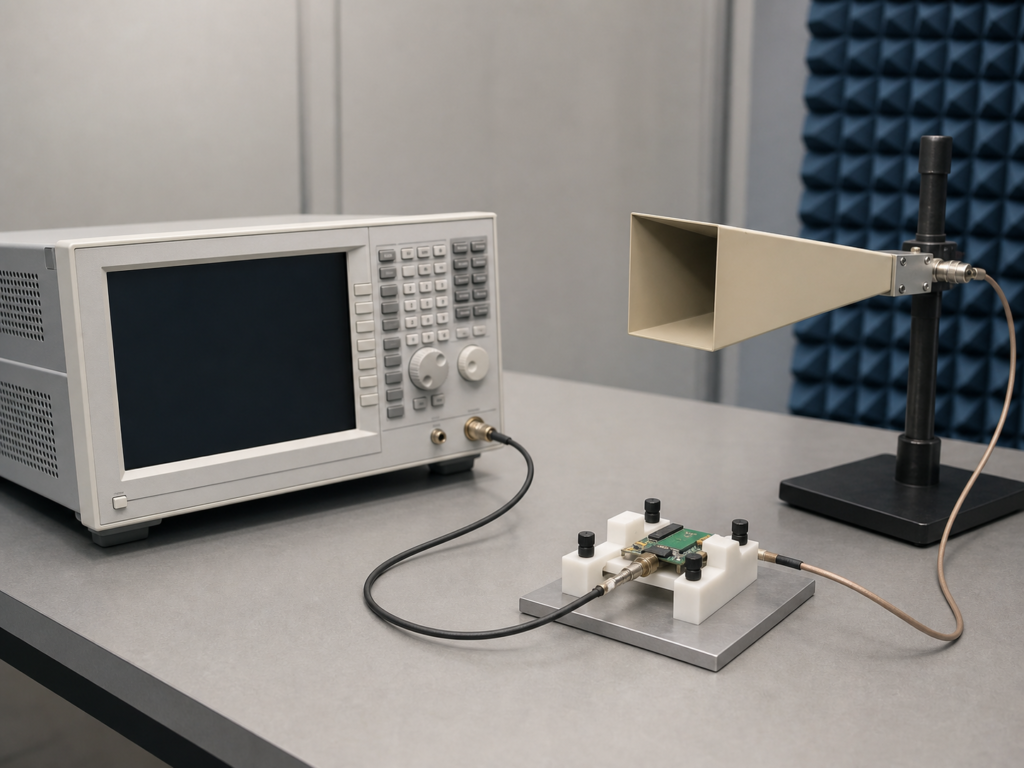
- Testing Laboratory: Responsible for issuing test reports that meet FCC requirements, must have FCC-recognized qualifications, and cannot randomly select laboratories without qualifications.
- Importer: Responsible for confirming that imported products have obtained valid authorization, cooperating with random inspections by customs and the FCC, and also needs to bear corresponding compliance responsibilities.
Application Material Preparation List (Classified by Necessity/Public Attribute)
Sorting out materials by category in advance can save a lot of communication time. EAS application materials are divided into three categories according to “whether they are mandatory to upload” and “whether they are public”:
- Mandatory + Must be public: External product photos, label drafts, user manuals — these are materials for consumers and law enforcement personnel to inspect, and confidentiality cannot be applied for.
- Mandatory + Confidentiality applicable: Test reports, internal photos, circuit block diagrams, schematic diagrams, RF exposure assessment, etc. are usually mandatory technical documents. Which of them can be kept confidential for short or long term shall be judged according to the document type and FCC/TCB rules; test setup photos and internal photos are commonly short-term confidential, core technical materials such as schematic diagrams and circuit block diagrams usually apply for long-term confidentiality. Whether test reports and RF exposure assessment documents can be kept confidential shall be subject to current rules and TCB opinions. Being eligible to apply for confidentiality does not mean automatic confidentiality, and the final confidentiality status shall be subject to the approval of the FCC/TCB.
- Provided on demand + Public/confidential: For example, products integrating certified modules need to provide module authorization certificates, those applying for confidentiality need to submit a confidentiality application letter, series models need to provide difference descriptions, U.S. agent authorization letters, etc., which shall be provided according to the actual situation of the product.
General requirements for all materials: The content must be completely consistent with the applied model and parameters. The specific format and size limits shall be subject to the requirements of the current EAS system and the selected TCB.
TCB Selection Beginner’s Method and Fee Description
Choosing the right TCB can greatly improve application efficiency and reduce the probability of pitfalls. There are only two core criteria for selecting a TCB: First, it must be on the FCC’s officially recognized TCB list, and unqualified institutions must not be selected. Second, prioritize institutions with review experience in similar products. For example, for Bluetooth speaker products, find a TCB that often reviews consumer wireless products. Such institutions are more familiar with the rules, have faster review speeds, and fewer problems.
In terms of fees, many people think that the TCB’s quotation is the total cost, but this is not the case. The total cost is generally divided into three parts:
- FCC official fees: Including CORES system-related fees, EAS application administrative fees, etc. The amount is subject to the current FCC announcement and may be adjusted annually.
- TCB service fee: The fee for TCB to provide review and application submission services. For consumer products, it generally ranges from hundreds to thousands of U.S. dollars, depending on the complexity of the product. The more functions and frequency bands, the higher the fee.
- Testing fee: Charged by FCC-recognized testing laboratories, not included in the TCB service fee — if the TCB has its own laboratory and provides testing services, it will quote separately, which needs to be confirmed clearly in advance.
When choosing a TCB, be sure to communicate clearly in advance: how long the review cycle is, whether there is an additional fee for supplementary materials, and what the service scope includes, to avoid subsequent disputes.
3. Full EAS Process for Certification Type (Mainly Operated by TCB)
After the preliminary preparation is completed, you can enter the formal application process. The core EAS application operations are completed by the selected TCB. The applicant needs to cooperate in providing accurate information, checking key nodes, and supplementing materials in a timely manner, and does not need to operate the core application links on their own.
Application Initiation and Basic Information Verification
A new application is created by the selected TCB in the EAS system, and the applicant does not need to create it on their own. In this step, three pieces of information need to be checked emphatically: whether the Grantee Code and FRN are correct, whether the U.S. agent’s information is consistent with the previous information, and whether the Rule Part corresponding to the product is selected incorrectly (for example, ordinary short-range wireless devices generally correspond to Part 15).
If you are not sure which Rule Part the product belongs to, or if you have doubts about the classification, be sure to consult the TCB for confirmation in advance. Do not choose arbitrarily on your own, otherwise subsequent rejection will waste more time.
Core Application Information Filling Specifications (Key Points for Applicant Verification)
The information filled in by the TCB is provided by the applicant, so it is necessary to clarify the error-prone points and check in advance:
First, FCC ID naming must be compliant. The FCC ID consists of “Grantee Code + custom product code”. The product code cannot be duplicated with already authorized products, and must comply with the FCC’s character rules, and special symbols cannot be used arbitrarily.
Second, product information must be written clearly. The differences between models, hardware versions, and series models must be clearly stated — only non-RF differences (such as different shell colors, different packaging), and testing covers all models, can you apply for the same FCC ID in combination.
Third, RF parameters must 100% match the test report. Parameters such as frequency range, transmit power, modulation method, and antenna gain must be completely consistent with those on the test report, and not a single number can be wrong; if the product has multiple operating modes, they must be listed one by one without omission.
Fourth, devices with multiple wireless functions must fill in parameters separately. For example, for a product with Bluetooth, WiFi, and cellular functions at the same time, each function must be filled with parameters separately; if a certified module is integrated, the FCC ID of the module must be correctly referenced, and cannot be filled in arbitrarily.
Fifth, simultaneous transmission and RF exposure assessment must be completed in advance. For multi-wireless function devices, if there are scenarios where multiple RFs work at the same time, it is not enough to test each function separately; you also need to supplement the simultaneous transmission assessment, and at the same time confirm that the RF exposure assessment meets the requirements. For example, when WiFi and Bluetooth can work at the same time, it is necessary to verify the interference level and human exposure conditions under the transmission state of both at the same time, otherwise the review cannot be passed.
Attachment Upload and Confidentiality Setting Rules
Be sure to check again before uploading attachments: whether the file content is consistent with the applied model and FCC ID, whether the pages are clear and whether there are missing pages, and whether old versions or irrelevant materials are uploaded by mistake.
Regarding confidentiality settings, the FCC has clear classifications, and not all materials can apply for confidentiality:
- Must be public: Materials for users and law enforcement such as labels, external photos, and user manuals must not apply for confidentiality.
- Short-term confidentiality: For example, commercially sensitive technical materials such as test setup photos can apply for short-term confidentiality, and will be automatically made public after expiration.
- Long-term confidentiality: For core technical materials such as schematic diagrams, a formal confidentiality application must be submitted, explaining the basis for confidentiality, and it will take effect only after approval by the FCC or TCB.
There is an important risk reminder here: do not upload customer privacy, irrelevant commercial contracts and other content in the attachments. Once the materials are made public, it is difficult to withdraw or modify them, and leakage of trade secrets will cause serious losses.
Final Checklist Before Submission
Before submitting the application, check again against these four points, which can reduce most low-level errors:
- Entity information: FRN, Grantee Code, and U.S. agent information are completely consistent and all are within the validity period.
- Parameter matching: RF parameters and operating modes 100% match the test report, and no mode is missing.
- Complete attachments: All mandatory documents have been uploaded, with clear file names, and no wrong versions have been uploaded.
- Compliance: Label drafts and user manuals meet FCC rule requirements.
Review Progress Follow-up and Supplementary Material Handling
After submission, you can check the progress through the TCB. If you have EAS query permission, you can also log in to view it by yourself. The specific status is subject to the actual display of the system.
The reference meanings of common system statuses are as follows, and the specific ones are subject to the current system display and TCB explanation:
- Draft/Submitted: May not have completed submission or not yet entered the next review link.
- Under review: The TCB is checking the materials or it is in the pending queue.
- Supplementary materials required: There are problems with the materials, which need to be supplemented or modified as required.
- Approved/Rejected: The final review result. If approved, the authorization takes effect; if rejected, it needs to be rectified as required and then resubmitted.
If you receive a request for supplementary materials, be sure to pay attention: reply to each review question item by item, clearly explain the modified content and modification position, and do not just upload files without explanation — otherwise the TCB cannot quickly confirm the modified content, and will have to communicate and confirm again, wasting time for both parties.
There is also an absolutely prohibited operation: if you find an error after submission, do not resubmit a new application. You should contact the TCB to return the original application for modification and then resubmit it, otherwise there will be duplicate application problems, which will be more troublesome.
Verification and Listing Requirements After Authorization Approval
After the application is approved, don’t rush to mass produce and launch the product. First complete the following tasks:
First, verify the authorization information. Download the electronic authorization certificate (i.e., Grant) from EAS, and query it in the FCC public database to confirm that the model, holder, and authorization status are correct, so as to avoid obtaining wrong or invalid authorization.
Second, confirm mass production consistency. The final mass-produced product configuration must be completely consistent with the test prototype, and RF parameters must not be changed without authorization — for example, increasing the transmit power to improve performance, or replacing a lower-cost antenna, these are serious violations, and will face high penalties if found.
Third, labels must be compliant. In accordance with the requirements of FCC §2.925, §15.19 and KDB 784748, the label must meet the following points:
- Paper label: Must be permanently affixed to the product, preferably in a position easily accessible to users; for devices with particularly small sizes, or built-in devices that are not accessible to users, the position can be adjusted according to the rules.
- Electronic label (e-label): Only specific types of devices can use it, and it must meet the requirement that users can easily query it, for example, it can be viewed directly in the system settings.
- Series model labels: Only models sharing the same FCC ID can use the same label, and all corresponding models must be clearly marked.
Fourth, user manual disclosure must meet requirements. Common disclosure contents include Part 15 compliance statement, interference prompt, RF exposure/safety distance description, and the module statement required to be retained when integrating modules. The specific content shall be determined according to the applicable Rule Part, KDB and TCB requirements.
Finally, it should be reminded that obtaining the FCC Grant only meets the FCC’s wireless compliance requirements. Before going on the market, other requirements such as RF exposure and import declaration must also be met. The Grant cannot be used alone as a customs clearance certificate. Please do not ignore other requirements and cause customs clearance obstruction.
4. EAS Applicability Judgment for Special Scenarios
In actual operation, product forms such as multi-model, modular, and multi-band will bring questions about EAS applicability judgment. The following explains the rules one by one for several types of high-frequency special scenarios.
Association Between SDoC Path and EAS
Many people ask: if following the SDoC path, can EAS be used?
First, clarify the scope of application of SDoC: it is mainly applicable to unintentional radiators that meet the corresponding rules. The specific judgment shall be based on clauses such as 47 CFR §15.101, and it is not that “no wireless function means definitely following SDoC”.
The relationship between EAS and SDoC is: SDoC does not require TCB review, nor does it require mandatory use of EAS, and is entirely a self-declaration by the enterprise. If the current FCC system entry and account permissions support it, enterprises can voluntarily submit or publicize relevant SDoC materials in accordance with the current process to improve verifiability; this is not equivalent to TCB review, nor will it turn SDoC into Certification.
SDoC products do not need to be marked with an FCC ID, only need to be marked with a compliance statement and U.S. responsible party information.
There is a red line that must never be touched: intentional radiators (such as products with Bluetooth and WiFi) must not illegally follow the SDoC path. Once found by the FCC, they will face high fines and even be prohibited from entering the U.S. market.
Judgment of Whole Device Integrating Certified Modules
Now many products use ready-made Bluetooth and WiFi modules. Many people think that “since the module has passed FCC certification, the whole device does not need to be certified again”, but this is not necessarily the case. Whether the module’s authorization can be used must meet three prerequisites at the same time:
- The module itself has obtained a valid FCC Certification authorization, and belongs to the type of limited modular approval or full modular approval.
- The RF-related working conditions of the module, such as antenna type, transmit power, power supply method, and shielding structure, have not been changed — for example, replacing the module’s ceramic antenna with a high-gain external antenna does not meet the requirements.
- The host environment will not affect the RF performance of the module, and requirements such as simultaneous transmission and RF exposure all comply with regulations.
Even if these three conditions are met, the whole device is not completely free of compliance work, and the following actions still need to be completed: mark the FCC ID as required, disclose module-related information in the user manual, and complete the RF exposure assessment of the whole device, etc.
If the following situations occur, you must re-apply for the FCC ID of the whole device: changing the RF parameters, antenna type or working environment of the module, or the module authorization does not support the current usage scenario.
Finally, it is emphasized: whether a re-application is required must be determined after evaluation by the TCB, and cannot be decided on your own. Otherwise, if it is not compliant, the loss shall be borne by the applicant.
Judgment of Series Models Sharing the Same FCC ID
Many manufacturers have multiple models of products with exactly the same internal RF part, but different appearances and packaging, and want to share one FCC ID. Is it feasible?
The premise of sharing is: the RF hardware, RF software, and antenna are completely consistent, testing covers all models, and non-RF differences such as appearance and packaging must be clearly disclosed in the application materials and approved by the TCB.
If the following situations exist, sharing is not allowed: there are differences in RF parameters, operating modes, antenna types, or testing does not cover all models.
There is a very common misunderstanding here: many people think that “just different appearances, definitely can share”, neither disclose the differences nor confirm with the TCB, and directly use the same FCC ID. This is a very easy pit to step on — once sampled by the FCC, it will be deemed non-compliant.
Application Selection for Multi-Band/Multi-Standard Devices
For example, a product has 2.4G WiFi, 5G WiFi, Bluetooth, and cellular network functions at the same time. Should it be combined into one application or split into multiple applications?
The premise of combined application is: the same Grantee, meets the combination rules of the corresponding Rule Part, testing covers all frequency bands, simultaneous transmission assessment is passed, and RF exposure meets the requirements.
Split applications are more suitable for the following scenarios: a certain frequency band function may be changed separately later, and different functions correspond to different Rule Parts. For example, if the cellular function may be removed later, if the application is split, only the cellular authorization needs to be processed, without changing the WiFi and Bluetooth authorizations, which is more flexible.
The specific choice should be comprehensively judged in combination with the authorization structure, later change needs and testing costs, and cannot only look at the immediate cost savings.
Exemption Judgment for Non-Sales Samples
Many people ask: just take a few samples to the U.S. for exhibitions, or for R&D testing, not for sale, do you need to apply for FCC authorization?
Samples that are only used for R&D, exhibitions, testing and do not enter the U.S. market for sale at all can be exempted from EAS authorization.
It should be noted that sample exemption does not apply to products sold to consumers, available for purchase on platforms, in commercial inventory, or delivered for sale under the name of trial use; temporary import and exhibition display still need to comply with relevant customs and FCC restrictions, and actual sales shall not be carried out in the name of “samples”.
Special reminder for cross-border e-commerce: as long as the product is sold to U.S. consumers, even if it is shipped directly from China and has no U.S. warehouse, it is deemed to have entered the U.S. market and must complete FCC authorization; currently, the FCC has relatively strong compliance spot checks on e-commerce platforms such as Amazon, please do not take chances.
5. Change Operations and Long-Term Maintenance of Authorized Products
Many people think that getting FCC authorization is a once-and-for-all thing, but this is not the case. Product changes, company changes, and rule updates may require corresponding operations, and authorization is not permanently valid.
Classification Judgment Criteria for Product Changes (Based on 47 CFR §2.1043)
Product modification is a very common situation. Not all changes require re-application for an FCC ID. The FCC divides changes into three types of permissive changes, and there are also situations where re-application is mandatory:
- Class I permissive change: Minor changes that do not affect RF performance, usually do not require supplementary testing, but still need to confirm that they do not affect RF performance and retain the evaluation basis, such as label text correction, non-RF software adjustment, non-interference appearance modification (such as shell color adjustment that does not affect RF performance).
- Class II permissive change: Changes that slightly affect RF performance but still meet the standards, require supplementary testing, such as replacing antennas of the same specification, fine-tuning transmit power, adding new series models of the same type. Such examples can only be treated as Class II if they do not exceed the original Grant restrictions, are within the scope allowed by applicable KDB, and supplementary testing proves that they still meet the requirements.
- Class III permissive change: Changes involving software-controlled RF parameters, require supplementary testing plus evaluation, such as adding a new modulation method, adjusting RF parameters in the software.
If it is a core RF hardware change, such as replacing the RF chip, adding frequency bands, increasing transmit power, changing the antenna type, or the change exceeds the scope of the original authorization, then you must re-apply for a new FCC ID and cannot go through the change process.
A supplement here: which category a specific change belongs to must be judged in combination with applicable KDB guidelines, original Grant restrictions and TCB opinions, and cannot be classified arbitrarily on your own. Otherwise, if the FCC does not recognize it, the consequences will be very serious.
Key Points of EAS Change Application Operation
After confirming to go through the change process, the original TCB shall submit the change application under the corresponding authorized FCC ID in the EAS system, and there is no need to create a new application. If TCB change is involved, the authorization management relationship adjustment shall be completed first in accordance with FCC/TCB procedures before handling subsequent changes.
Materials to be prepared include: change description, comparison before and after the change, supplementary test report (if needed), confidentiality application (if needed).
The change application is also reviewed by the original TCB. After passing, the authorization record will be updated, and no new FCC ID will be issued — that is to say, Class I, II, and III changes all use the original FCC ID, but the change trace will be kept in the authorization record.
Long-Term Maintenance Obligations After Authorization
After obtaining the authorization, there are the following long-term obligations to be fulfilled, please do not ignore:
First, record keeping. Test reports, application documents, change records and other materials must be kept for the number of years required by the FCC. Even if the product is discontinued, it must be retained for a period of time. The specific number of years shall be subject to current rules. If relevant records cannot be provided during FCC spot checks, penalties will be imposed.
Second, entity information change. If the company changes its name, merges, acquires, or changes its address, it must first update the FRN and Grantee Code information in the CORES system, and then go through the EAS authorization information change process. You cannot only update one of them.
Third, authorization transfer. If you want to transfer the FCC authorization to another company, you must submit a formal transfer application to the FCC or TCB to complete the change of the authorization subject. Private transfer has no legal effect.
Fourth, response to rule updates. FCC rules are updated from time to time. For example, the requirements for RF exposure have been adjusted in recent years. When rules are updated, it is necessary to evaluate whether existing authorizations meet the new requirements, and make changes or re-apply if necessary.
Fifth, response to market spot checks. If you receive an inquiry from the FCC or TCB, you must submit supporting materials within the specified time limit, and all communication records must be properly kept.
Finally, let’s explain the validity period: FCC authorizations usually do not have a fixed expiration date, but they are definitely not permanently valid — rule updates, product changes, authorization revocation, law enforcement requirements, etc., may all generate new compliance obligations. Please do not think that getting authorization is once and for all.
6. Common Problem Troubleshooting and Pit Avoidance (Semi-Proficient Improvement)
The following sorts out high-frequency review rejection problems, system operation troubleshooting directions and exclusive precautions for overseas users in actual practice, to help applicants reduce compliance risks.
High-Frequency Review Rejection Troubleshooting Table
We have sorted out the three most common types of rejection reasons into a table, which can be checked against:
| Problem Type | Phenomenon | Common Causes | Handling Actions | Prohibited Operations |
|---|---|---|---|---|
| Qualification type | Rejected due to inconsistent entity information | FRN/Grantee Code is inconsistent with the applicant’s information; U.S. agent information does not meet the requirements | First update the identity information in the CORES system, replace the U.S. agent that meets the requirements, and then resubmit | Directly modify the application information without updating CORES; use low-cost agents with only email/virtual addresses |
| Material type | Required to supplement materials due to material problems | The standard version/test conditions/product configuration of the test report do not cover the current application; missing necessary attachments; labels do not meet the rules | Re-test and update the report, supplement the missing materials, modify the label and re-upload | Submit reports from laboratories without FCC-recognized qualifications; privately modify the label draft |
| Parameter type | Rejected due to mismatched parameters | RF parameters are inconsistent with the test report; wrong Rule Part selected; missing operating modes | Check the test report to correct parameters, reconfirm the device category and then adjust | Falsely report parameters; randomly select Rule Part |
System Operation Problem Troubleshooting Directions
If you encounter system operation problems, you can first troubleshoot from the following directions:
- Account problems (cannot log in/cannot see the application): Check whether the FRN is correctly associated, whether the role permissions are correct, and whether the account has completed identity verification.
- Upload problems (files cannot be uploaded/display errors): Check whether the PDF format meets the requirements, whether the file size exceeds the limit, and whether the browser is compatible (priority is given to using the browser environment recommended by the current FCC page or TCB, and avoid using browsers with poor compatibility).
- Progress problems (status remains unchanged for a long time): First check whether there is a supplementary material notice in the system message, and if not, contact the TCB to confirm the review progress.
The interface, paths and functions of the EAS system will be adjusted with FCC iterations. All operations shall be subject to the current official FCC page and TCB guidelines.
Exclusive Precautions for Overseas Users
If you are an applicant outside the U.S., there are several exclusive pitfalls to avoid:
- Material language: The submitted materials need to be in English, or English translations that meet the TCB’s review requirements. Not all documents need official translations. For example, if the test report itself is in English, no additional translation is needed. The specific implementation shall be subject to the TCB’s requirements.
- Communication efficiency: There is a time difference between China and the U.S., and communication will be delayed. It is recommended to reserve a buffer time of 1-2 weeks, and do not submit on the project deadline to avoid delaying progress.
- Customs clearance instructions: The Grant downloaded from EAS is only one of the proofs of FCC compliance. Whether customs clearance can be passed depends on import declaration, device identification and the requirements of customs and other regulatory agencies. Do not think that having a Grant will definitely ensure smooth customs clearance.
- Agent selection: For the compliance requirements of U.S. agents, see the responsibility matrix above. Overseas applicants should not choose agents that cannot meet the contact requirements of §2.911(d) because of low prices.
Summary of Learning Outcomes
After completing the sorting of the above content, applicants should be able to judge whether the product needs to use EAS, complete preliminary account and material preparation, and cooperate with the TCB to complete information verification and supplementary material handling for Certification-type applications; be able to verify the authenticity of the FCC ID, authorization holder, model and authorization status in the FCC public database; be able to judge whether the label position, FCC ID marking, and user manual disclosure are consistent with the authorization; be able to handle EAS applicability judgment for special scenarios such as module integration, series models, and multi-band devices; be able to initially judge whether product changes go through EAS change or re-application according to Class I/II/III classification, and submit to the TCB for confirmation; be able to avoid common risks for overseas users applying for EAS, and effectively reduce the rejection probability.
FCC rules and the EAS system will be iterated from time to time. If product classification, module use, confidentiality settings or change levels cannot be confirmed, written confirmation shall be obtained from the TCB before submission, and shall be subject to current FCC rules, KDB guidelines and the current EAS page.