
If you live in the EU, you may have seen dedicated used battery recycling bins in supermarkets; if you fly to Europe frequently, you may have had the experience of having your power bank stopped by security; if you run a cross-border e-commerce business selling small appliances, you may have already received notifications from platforms requiring proof of battery compliance — all of these are related to the EU’s new battery regulation that is being gradually rolled out starting in 2024.
This set of rules covers all batteries circulating in the EU market, from button batteries in earphones to outdoor energy storage power supplies, all have corresponding requirements. Many people either think “this has nothing to do with me” or are intimidated by a pile of professional jargon. In fact, the core content is not complicated, and both ordinary consumers and small merchants can quickly understand it. This article focuses on the requirements for portable batteries related to consumer electronics; categories such as outdoor energy storage and electric vehicles are subject to special rules and are not within the scope of this discussion.
First, Understand: Which Products and Scenarios Are Subject to the Regulation
What Exactly Is the Regulation
This is not a single separate safety regulation, but a set of unified rules covering the entire life cycle of batteries from production and sales to recycling. Its official number is Regulation (EU) 2023/1542. It doesn’t matter if ordinary people can’t remember it; just know that it is the latest current battery regulatory rule in the EU. There are only three core goals: making batteries safer, reducing electronic waste, and ensuring consumers have clear information when making purchases.
Two Types of Consumer Electronics Portable Batteries Subject to Regulation
Consumer electronics portable batteries must first meet four criteria: sealed design, weight not exceeding 5 kg, manually portable, and specifically designed for consumer electronics products. There are two main categories that meet the conditions:
The first category is stand-alone portable batteries, which are what we commonly call power banks, sold separately and used to charge electronic products such as mobile phones and earphones.
The second category is built-in portable batteries, which are batteries that come with consumer electronics products, such as batteries in mobile phones, tablets, wireless earphones, and electric shavers.
These Products Are Not Regulated as Consumer Electronics Portable Batteries
Many easily confused products actually belong to other battery categories under the regulation and do not need to comply with the requirements for consumer electronics portable batteries:
• Large-capacity outdoor power supplies weighing more than 5 kg: the weight limit for portable batteries is 5 kg; those exceeding this must be classified into the industrial/energy storage category based on their use, and are subject to different rules;
• Batteries for electric bicycles, scooters, and electric vehicles are classified as light transport or traction batteries, and have special regulatory rules;
• Portable batteries dedicated to industrial equipment do not fall into the consumer electronics category, and these requirements do not apply to them either.
Which Scenarios Require Compliance and Which Are Exempt
Not all battery-powered products entering the EU need to go through the full compliance process; the core judgment criterion is whether it is part of commercial circulation:
• Scenarios requiring compliance: sales in offline stores in the EU, cross-platform e-commerce (including cross-border e-commerce) targeting EU users, free gifts or battery-powered products bundled with purchases — as long as it is a commercial act, it must meet the requirements.
• Personal use exemption: products carried by individuals or purchased in small quantities via cross-border shopping solely for personal use are usually not subject to this set of commercial regulatory rules, as long as they are not of a commercial circulation nature; however, the specific inspection standards may vary by customs and transport channels. The regulation does not set a unified legal quantity threshold, and the core judgment criterion is whether the products are for resale or commercial use.
• Special circumstances for second-hand products: personal idle transfer (for example, selling a used power bank on a second-hand platform) is exempt, but if it is a merchant specializing in second-hand business, the battery-powered products they sell must still meet basic safety and labeling requirements.
Why Pay Attention: The Real Impacts of Non-Compliance
Many people think battery regulations are far from their daily lives, but in fact, the impacts of non-compliance cover ordinary consumers, sellers, and the public environment, and are directly related to everyone.
Impacts on Ordinary Consumers
The most direct impact is safety risk: non-compliant batteries are prone to false capacity labeling, and even lack safety protection, posing risks of overheating and fire. Secondly, non-compliant products purchased via cross-border shopping or direct mail may be detained or returned by customs, resulting in loss of both money and goods. In addition, if you cannot find a compliant recycling channel for used batteries and discard them casually, you may violate local waste management regulations and even be fined.
Impacts on Sellers and Small Cross-Border Merchants
For merchants, the cost of non-compliance is higher: e-commerce platforms will directly remove products from shelves, deduct security deposits, or even close stores; goods may be detained or destroyed by customs when entering the country, and merchants have to bear additional logistics and disposal costs; if found by market supervision authorities, fines can reach up to a certain proportion of annual revenue, with the specific amount subject to the regulations of each member state; if there is a problem with the product, they also have to bear all recall costs, which may bankrupt small merchants in one go.
Why Requirements for Portable Batteries Are Particularly Strict
Lithium batteries themselves have risks of overheating, short circuit, swelling, and fire. Portable batteries, especially power banks, are often carried in bags, taken on planes, or left charging all night, so they have a high probability of coming into contact with the human body, and the consequences of an accident are serious. In addition, used batteries contain heavy metals and electrolytes, which will contaminate soil and water sources if mixed into ordinary household waste. That is why the entire chain from production to recycling needs to be regulated.
Must-Read for Beginners: Labeling Requirements You Can Check with the Naked Eye
You don’t need to find a professional institution for testing. Spend 1 minute checking the labels when you get the product, and you can filter out most non-compliant products. These are all mandatory requirements of the regulation, and missing any one is a problem.
Two Essential Basic Labels
First, look at the two most prominent labels:
• CE mark: Many people think the CE mark is a quality certification issued by the EU, but it is not. It is a basic label for merchants to self-declare that their products comply with EU regulations, equivalent to a “seal on a merchant’s self-guarantee letter” — having it is the minimum requirement, but it does not mean the product is definitely compliant; it must be checked together with other information.
• Crossed-out trash bin label: This label means that this battery cannot be thrown into ordinary household waste and must be specially recycled.
The regulation requires that these labels must be clearly legible and not easy to wear off or peel. Labels and explanatory information must be in the official language(s) required by the member state where the product is sold; English is more common but does not necessarily cover all countries, so cross-border sales need to be checked separately according to the target market.
Parameter Labeling: Focus on These Items
Many people only look at mAh when buying batteries, but in fact the regulation requires three core parameters to be labeled: rated capacity (unit: mAh or Ah), nominal voltage (unit: V), and available energy (unit: Wh).
Special attention should be paid to the special requirement for power banks: they must be labeled with “rated output capacity”, not just cell capacity. Cell capacity is the theoretical capacity of the internal battery cells. During actual output, there is loss due to circuit conversion. For example, a power bank labeled with a cell capacity of 10000mAh may actually only deliver more than 6000mAh to a mobile phone. If only the cell capacity is highlighted and the rated output capacity is not labeled, it is easy to mislead consumers. Therefore, the regulation clearly requires that power banks must be labeled with rated output capacity.
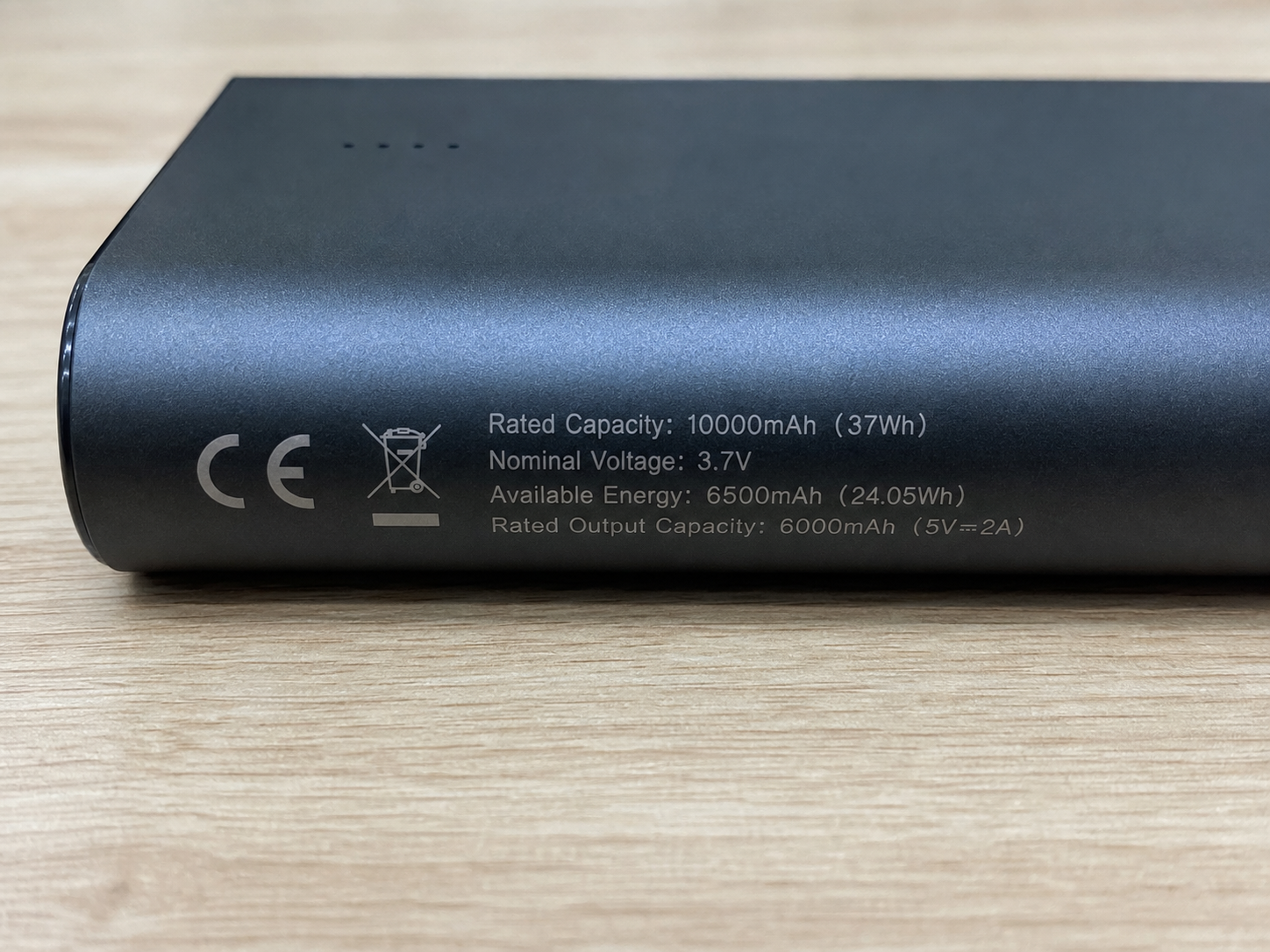
Also, remember a common sense fact: Wh is the unit that reflects the real energy of a battery, and is more reliable than mAh. Because mAh must be combined with voltage to determine actual energy. For example, for batteries with the same 10000mAh, a 3.7V one is 37Wh, and a 5V one is 50Wh, a big difference. The conversion formula is very simple: Wh = Ah × V. For example, 10000mAh is 10Ah, multiplied by 3.7V is 37Wh, you can calculate it yourself.
Responsible Entity Information: Someone to Contact When Problems Arise
Compliant products must be labeled with the name and contact information of the responsible person within the EU. This responsible person can be the manufacturer, importer, or authorized representative. If you cannot find any EU local responsible entity information on a product, you won’t be able to contact anyone if there is a problem, and the compliance risk is extremely high.
Label Positions Vary by Product
Since power banks are sold separately, their labels are directly printed on the casing or packaging, visible as soon as you get them; labels for built-in batteries can be printed on the battery itself, but must also be reflected in the product’s packaging or user manual, so users can check them without disassembling the product.
No Need to Worry About Digital Labels in Advance
Many people have heard of the “digital battery passport” and think it is very complicated. In fact, ordinary consumer-grade portable batteries do not need this for now — the digital battery passport is mainly for large-capacity batteries for industrial and automotive use. According to the current progress, only some portable batteries will need to have a QR code added starting from 2027, which can be scanned to query compliance information and recycling methods; the QR code requirement will be implemented by category and in phases, not all portable batteries will be subject to mandatory enforcement simultaneously in 2027. The specific scope of application is subject to the EU’s subsequent detailed rules, so there is no need to rush now.
Core Requirements: Safety, Performance and Environmental Protection Rules
After looking at the labels, going a little deeper, there are the safety, performance and environmental protection requirements of the battery itself. Among them, basic safety is the bottom line, and performance and environmental protection requirements can be used for advanced pit avoidance.
Basic Safety Requirements: The Bottom Line Every Beginner Must Know
Compliant portable lithium batteries must have four basic protections: overcharge protection, over-discharge protection, short circuit protection, and temperature protection. In plain terms: the battery will automatically cut off power when it is fully charged, and will automatically stop when the power is almost empty. If the interface accidentally touches keys or coins causing a short circuit, it will immediately cut off the current. When the temperature is too high, it will automatically reduce power or stop working, fundamentally avoiding fire and explosion.
Here we need to clarify a common misunderstanding: many merchants say that their products have passed the UN38.3 test, which means they are compliant, but that is not true. UN38.3 is a safety test for air transport, designed to ensure no accidents during transport, and does not equal compliance with EU market access requirements — they are two different things.
Performance Requirements: Advanced Judgment to Avoid False Labeling Pitfalls
This part is advanced content, and ordinary consumers can avoid most pitfalls after understanding it:
• Capacity tolerance: the deviation between actual capacity and nominal value must meet legal requirements, and false labeling is prohibited. Simply put, you can’t label 10000mAh but only have 5000mAh actually.
• Cycle life: only for rechargeable portable batteries (including power banks, built-in rechargeable lithium batteries in electronic products, etc.); disposable batteries are not subject to this requirement; according to current plans, it will be gradually implemented by category starting from 2027. The cycle count thresholds and effective dates applicable to rechargeable portable batteries of different capacities and uses vary, and the specifics are subject to the detailed implementation rules subsequently issued by the EU. It should be noted that cycle life values are measured under specific test conditions; temperature, discharge rate, and usage habits will affect the actual life. For example, the number of cycles at room temperature is very different from that at low temperatures, so you can’t just look at the advertised numbers.
• High-risk signal: if a battery advertises an abnormally high capacity but is obviously small in size and weight, it is most likely falsely labeled — after all, lithium batteries have a physical upper limit on energy density, and it is impossible to achieve something contrary to common sense like “lipstick-sized, 20000mAh”.
Environmental Protection and Recycling Requirements
• Heavy metal limits: the content of harmful substances such as mercury, cadmium, and lead in batteries must meet limit requirements. Special scenarios such as medical equipment and emergency lighting are exempt, and ordinary consumers don’t need to pay too much attention to this.
• Extended Producer Responsibility (EPR): this term sounds professional, but it’s actually very simple: the cost of recycling used batteries is borne by the brand owner or importer, and consumers don’t have to spend a cent; they can just find a recycling point to dispose of them.
• Two new requirements in 2027: First, built-in rechargeable portable batteries in electronic products must be designed to be easily removable for recycling and replacement. Special products such as waterproof products and medical equipment are exempt and require professional replacement; second, some categories of rechargeable portable batteries (usually consumer-grade categories with higher capacity and larger shipment volumes) need to disclose carbon footprint information, that is, carbon dioxide emissions throughout the production and use cycle; disposable portable batteries are not currently subject to carbon footprint disclosure requirements. Carbon footprint disclosure does not apply to all ordinary consumer-grade power banks at the same time; the specifics depend on the battery category, capacity/use, and the EU’s subsequent implementation rules.
• In addition, the packaging or user manual must explain the recycling channels and clearly prohibit disposal in ordinary household waste.
Compliance Documents: Available for Sellers and Detail-Oriented Users
If you are a merchant, or have relatively high requirements for products, you can request these types of compliance documents for verification:
• Declaration of Conformity (DoC): issued by the brand owner, equivalent to a formal written commitment to ensure that the product meets regulatory requirements;
• Third-party test report: an important supporting document to prove the safety and performance of the product, often required by platforms, importers, or during regulatory spot checks; not all products must be issued by EU-accredited laboratories, depending on the compliance path and product risk level;
• Traceability information: information such as manufacturer, importer, model, and batch can be queried, enabling traceability when problems arise.
Ordinary consumers can also request these documents from merchants if they are unsure whether a product is compliant.
Semi-Proficient Judgment: Differences in Requirements Across Scenarios
Many people can’t figure out the differences in requirements for different batteries. In fact, as long as you grasp a few core differences, you can make quick judgments and avoid pitfalls.
Power Banks vs Built-in Batteries in Electronic Products
These two categories are the most easily confused. The core differences can be seen in this table:
| Comparison Item | Stand-alone Portable Battery (Power Bank) | Built-in Portable Battery in Electronic Products |
| Sales form | Sold separately | Sold with the complete device |
| Compliance requirements | Must independently meet all portable battery rules | The battery itself must meet safety and environmental protection requirements, and compliance can be incorporated into the management of the complete device |
| Label position | Directly printed on casing/packaging | Label on the battery itself, also reflected in packaging/user manual |
| Removable requirement (starting 2027) | No mandatory requirement (except for models with replaceable cells) | Must be designed to be easily removable (special products are exempt) |
Rechargeable Lithium Batteries vs Disposable Portable Batteries
Not all portable batteries have the same requirements; the requirements for rechargeable lithium batteries and disposable dry batteries are very different:
| Comparison Item | Rechargeable Lithium Batteries (power banks, mobile phone batteries, etc.) | Disposable Portable Batteries (alkaline dry batteries, button lithium batteries, etc.) |
| Safety requirements | Must meet all basic safety protection requirements such as overcharge, over-discharge, short circuit, and temperature protection | Must meet basic safety standards, no exclusive requirements for charge-discharge protection |
| Performance requirements | Must meet capacity tolerance requirements; starting 2027, cycle life and carbon footprint disclosure for some categories will be implemented by category | Does not involve exclusive requirements for rechargeable batteries such as cycle life and carbon footprint; if capacity is labeled externally, it must meet capacity tolerance requirements |
| Labeling requirements | Must label full information such as rated capacity, nominal voltage, available energy (Wh), and responsible entity; power banks must additionally label rated output capacity | Must label nominal voltage, battery chemical composition (such as alkaline, lithium manganese), basic labels, recycling labels, and responsible entity information; no mandatory labeling of available energy (Wh) |
| Environmental protection requirements | Heavy metal limits + full-chain producer recycling responsibility (EPR) | Heavy metal limits + recycling requirements |
Changes in Requirements at Different Time Nodes
This set of regulations is implemented gradually, not all requirements take effect at once, and the applicable objects of different requirements vary:
• 2024-2026: All portable batteries (including rechargeable and disposable) must meet basic labeling, safety, heavy metal limit, and recycling requirements;
• Starting 2027: New requirements will be rolled out by battery type: rechargeable portable batteries must implement mandatory cycle life labeling, built-in rechargeable portable batteries in electronic products must be designed to be easily removable (special products are exempt), some categories of rechargeable portable batteries must disclose carbon footprints, and some categories of portable batteries (including rechargeable and disposable) must be affixed with QR code labels; disposable portable batteries are not subject to exclusive requirements for rechargeable batteries such as cycle life, removability, and carbon footprint.
It should be noted that different detailed rules have independent transition periods, and the specific effective dates and applicable thresholds for each category also vary. If you are unsure, refer to the latest official announcement from the EU, and don’t believe third-party rumors.
Core Judgment Logic for Product Classification
Many people classify incorrectly because they only look at capacity or appearance. In fact, there are only two core judgment criteria: use + weight, which have nothing to do with capacity size or what it looks like.
For example, for batteries with the same capacity, a consumer-grade portable power supply used to charge mobile phones, weighing 4.9 kg, is considered a portable battery; if it is used for factory testing equipment, even if the weight is the same, it is considered an industrial battery. Outdoor power supplies weighing more than 5 kg are usually classified into the industrial/energy storage category, with very different requirements, so don’t confuse them with ordinary power banks.
Practical Methods: Quick Judgment and Scenario Response
After talking about so many rules, it ultimately has to be applied to actual use. The following scenarios are the most commonly encountered by everyone, just follow the instructions directly.
1-Minute Quick Check Method for Ordinary Consumers
You don’t need to find a professional institution. Check four places when you get the product, and you can filter out most non-compliant products in 1 minute: first, check the appearance and packaging for the CE mark and the crossed-out trash bin recycling label; second, check the parameters to see if Wh, nominal voltage, and rated capacity are labeled, and for power banks, also confirm whether “rated output capacity” is labeled; third, check the responsible entity to see if there is the name and contact information of the responsible person within the EU; finally, check the user manual for safety warnings and recycling channel instructions.
Key Points for Avoiding Pitfalls in Cross-Border Purchases
If you like cross-border shopping or buying battery products from cross-border platforms, remember a few core points: when selecting products, prioritize products on EU e-commerce sites that have local warehouses and are clearly labeled as compliant; for personal use, please ensure it is for non-commercial purposes and the quantity is within a reasonable personal use range, to avoid being judged by customs as commercial circulation and requiring completion of compliance documents; the regulation does not set a unified standard for the quantity for personal use, usually based on meeting personal daily use or travel needs, and the specific inspection standards are subject to customs and platform rules; if you encounter products that only have mAh but no Wh and voltage, have blurred or peeling labels, have no traceable responsible entity, or have abnormally low prices while claiming super large capacity or full-protocol fast charging, they are most likely problematic, try not to buy them; in case of goods being detained, for personal use you can provide purchase vouchers to appeal to customs, while for commercial use you need to complete compliance documents, otherwise the goods may be returned or destroyed.
Rules for Carrying During Travel/Transport (High-Frequency Scenario)
Many people have their power banks stopped when flying, but the core rule is actually very simple:
The core judgment criterion for air carriage is Wh (watt-hours), not mAh, and this rule belongs to air dangerous goods management regulations, not the requirements of the battery regulation — don’t confuse them.

Common air rules are: those within 100Wh can usually be carried on board; those between 100-160Wh need prior approval from the airline; those exceeding 160Wh are subject to very strict restrictions. The specifics are subject to the requirements of the airline and airport, so it’s best to check in advance before traveling.
General requirements: power banks usually must be carried on board and cannot be checked in — the cargo hold is unmanned, and the risk of fire is extremely high if one occurs. The final implementation standard is subject to the airline, airport security, and departure/arrival location rules.
Pre-travel check: first, check if the casing has a clearly labeled Wh value, or if there is voltage and mAh that you can convert yourself; then check for swelling, damage, or abnormal heating — if there is any, never bring it; also, don’t put the interface together with metal objects such as keys and coins to avoid short circuits.
How to Handle Non-Compliant Products
If you buy a non-compliant product, or if there is a problem with the battery, you can handle it in the corresponding way: if purchased from e-commerce, you can directly apply for a refund and complain to the platform about the non-compliant product at the same time; if purchased offline, you can return or exchange it with the merchant with the shopping voucher, and if negotiation fails, you can complain to the local market supervision department; if the battery is already damaged, swollen, or leaking, stop using it immediately and send it to the nearest recycling point. Never discard it casually or disassemble it yourself to avoid danger.
Clarification of Common Misconceptions
Many people’s misunderstandings about battery regulations come from information asymmetry. The following are the most common ones, and understanding them in advance can avoid many pitfalls.
Labeling-Related Misconceptions
Many people think that having the CE mark means the product is definitely compliant. In fact, the CE mark is a merchant’s self-declaration, and bad merchants can print it illegally. It must be checked together with parameter consistency, responsible entity information, and compliance documents, and you can’t just look at the CE mark. Some people think that built-in batteries don’t need labels, but in fact, the built-in battery itself must have a label, which must also be reflected in the product packaging and user manual. Users don’t need to disassemble the product to check, but that doesn’t mean there are no requirements.
Capacity and Performance Misconceptions
Some people think that cell capacity is the actual usable capacity. In fact, power banks have circuit conversion losses, so the actual output capacity is lower than the cell capacity. The regulation requires that rated output capacity must be labeled, so don’t be fooled by the “20000mAh cell” advertisement.
Some people also think that the larger the mAh, the more charging times. In fact, the number of charging times depends on the battery’s energy (Wh), conversion efficiency, and the battery capacity of the device being charged. You can’t directly divide the power bank’s mAh by the phone’s mAh — the result calculated that way is inaccurate.
Some people think that the larger the capacity, the more likely it is to be non-compliant. In fact, as long as it meets safety and labeling requirements, large-capacity portable batteries (as long as the weight is within 5kg) are also compliant, but there are more restrictions on air carriage.
Finally, note that fast charging power is not the higher the better. Fast charging requires the device, charging cable, and power bank to all support the same protocol to take effect. Moreover, the higher the power, the greater the heat generation may be, and the more energy loss there is. There is no need to blindly pursue high power.
Scope of Application Misconceptions
Some people think that white-label/small brands don’t need to be compliant. In fact, all products sold in the EU market, regardless of brand size, even unbranded white-label products, must meet regulatory requirements.
Some people also think that free battery-powered products don’t need to be compliant. In fact, giving gifts is part of commercial circulation. For example, if you buy a mobile phone and get a free power bank, that power bank must also meet compliance requirements.
Some people think that old products don’t need to follow the new regulations at all. In fact, the new regulations constrain products newly placed on the market. Old products already sold to consumers don’t need to be changed, but whether there is a transition period for merchants’ inventory products depends on the specific detailed rules — not all old products can continue to be sold.
Recycling and Use Misconceptions
Some people think that used batteries have to be sent back to the brand owner for recycling. In fact, there are free used battery recycling points everywhere in the EU, many in supermarkets, communities, and appliance stores. You can just drop them off directly, no need to send them back to the brand owner.

Some people also think that built-in batteries cannot be recycled. In fact, professionals can disassemble built-in batteries for recycling; after 2027, portable batteries in compliant electronic products should in principle be easier to remove or replace, but special products such as waterproof, medical, and safety continuous power supply products may be exempt, and some scenarios still require professional handling.
Some people think that swollen batteries can still be used reluctantly. In fact, swollen, leaking, or deformed batteries are internally damaged and may catch fire or leak at any time. They must be stopped immediately and treated as hazardous waste. Don’t be reluctant to throw them away.
Finally: 3 Things You Can Now Judge Independently
You don’t need to memorize regulatory provisions by rote. After reading this article, you have mastered the most practical core content and can independently make three key judgments:
First, you can quickly determine whether a power bank or battery-powered consumer electronics product falls within the regulatory scope of consumer electronics portable batteries under the EU’s new battery regulation;
Second, by checking appearance labels and parameters, you can initially judge whether a product meets basic compliance requirements within 1 minute, avoiding most false labeling and unsafe pitfalls;
Third, you can clearly distinguish the corresponding rules for scenarios such as cross-border purchase, daily use, air carriage, and waste recycling, to avoid unconscious violations or safety risks.
Ordinary consumers can purchase compliant and safe products by mastering the above methods, while small merchants need to further combine official detailed rules or professional institution opinions, verify compliance documents and the transition period arrangements for each requirement, to ensure that products meet the full-chain regulatory requirements.