
Whether you are an ordinary consumer living in the EU buying home appliances, or a seller engaged in cross-border business exporting products to the EU, you have most likely heard of terms like ErP, CE, and energy labels. However, many people have only a vague understanding of their relationships: some think ErP is the same as energy labels, some believe that a product with the CE mark must definitely meet ErP requirements, and some sellers only rush to make up compliance after their goods are detained by EU customs or their products are delisted from platforms because they cannot figure out the rules.
The following content unfolds layer by layer according to basic concepts, scope of application, core requirements, compliance judgment and common misconceptions. Entry-level readers can quickly build up their understanding, while readers with certain foundation can also sort out the compliance logic and avoid high-frequency pitfalls.
I. First, Understand What ErP Is: The Core Framework of EU Green Access
1. Plain-Language Understanding of ErP’s Position
ErP is essentially a set of environmental access rule frameworks set by the EU for “products related to energy”. Different from ordinary finished product testing, its core logic is to control the environmental impact of products from the source of design — environmental requirements for the whole life cycle, from raw material extraction, production, transportation, use to final scrapping and recycling, must be considered, instead of only checking whether the finished product saves electricity.
Its full name is the Ecodesign Directive for Energy-related Products, with the English abbreviation ErP, and the corresponding EU regulation number is 2009/125/EC, which is part of the EU harmonized regulation system. Many people think ErP has a unified set of numerical standards, but that is not the case. It adopts a two-tier structure of “framework directive + product category implementing regulations” — the framework directive only sets general principles, while the specific energy consumption limits, test methods, and compliance requirements for a certain type of product are all stipulated by separate product category implementing regulations.
A common misunderstanding needs to be clarified first: the CE mark is not a certification issued by the EU authorities, but a self-declaration mark by manufacturers that the product complies with all applicable EU regulations. For products covered by ErP, meeting ErP requirements is one of the prerequisites for affixing the CE mark, but conversely, having the CE mark does not mean that the product must comply with ErP — because CE may only cover other regulations such as safety and electromagnetic compatibility, without including ErP.
It should also be noted that ErP is only one of the conditions for EU market access. Products also need to comply with other applicable safety, environmental protection, chemical and other regulations at the same time; passing ErP does not mean everything is fine.
2. Why Different Groups of People Should Pay Attention to ErP
For ordinary consumers, ErP has at least raised the energy efficiency access threshold for covered categories; for categories that already have resource efficiency requirements, such as large home appliances, electronic display devices, and smartphones, it may also bring longer product life, clear spare parts supply periods and more convenient repair conditions. Overall, products are more environmentally friendly and durable, which can help you avoid many “disposable” low-quality products.
For cross-border sellers and exporters, ErP is a mandatory access requirement. Non-compliant products will be detained by customs and fined, and cannot be listed on EU e-commerce platforms such as Amazon. In serious cases, they will be included in the regulatory blacklist.
In short, ErP is one of the core frameworks of EU green product rules. Whether you are buying or selling goods, as long as it involves the EU market, it is necessary to understand its basic logic.
3. From EuP to ErP to ESPR: The Evolution of Regulations
Many people will see similar abbreviations like EuP, ErP, and ESPR, which are actually three stages of EU ecodesign rules:
In 2005, the earliest EuP Directive (2005/32/EC) came into force, which at that time only governed products that directly consume energy, such as home appliances and lighting equipment that use electricity or gas.
In 2009, the EU upgraded it to the ErP Directive (2009/125/EC), expanding the scope to all “energy-related products” — that is, products that do not directly consume energy themselves but will affect the energy consumption of other products, such as insulated windows, solar panels, thermostats, etc., are all included in the jurisdiction.
The revision trend in recent years is that the implementing regulations for some new categories have begun to add circular economy requirements such as durability, repairability, and spare parts supply, but these requirements are only for specific categories and are not universal for all products.
In 2024, the new ESPR (Ecodesign for Sustainable Products Regulation, Regulation (EU) 2024/1781) officially came into force. It should be specially noted here: ESPR will not directly repeal all existing ErP implementing regulations. Its core change is to expand the scope of coverage to non-energy-related products, and add mechanisms such as digital product passports. At present, energy-related products still apply to ErP implementing regulations, and will gradually align with ESPR in the future. There is no need to worry about milestone-style sudden rule changes.
4. Correct the 2 Most Common Misconceptions for Beginners
People who are new to ErP are most likely to fall into two cognitive pitfalls, which are clarified in advance here:
The first misconception: ErP is the energy label. Wrong. ErP is a mandatory access rule framework, which determines whether a product can be sold in the EU market; the energy label is only a tool for some categories to display energy efficiency grades, helping consumers judge whether the product saves electricity. One is the threshold of “whether it can be sold”, and the other is the display of “whether it is easy to use” — they are completely different things.
The second misconception: ErP only manages home appliances and lighting. Wrong. ErP covers a very wide range of categories. In addition to household appliances and lighting, there are also industrial motors, water pumps, boilers, commercial servers, industrial lighting, etc. Specifically, which products need to comply with the rules depends on whether there are corresponding product category implementing regulations, and cannot be judged by experience.
II. Quick Judgment: Whether Your Product Is Regulated by ErP
After understanding what ErP is, the most practical question next is: how to judge whether a certain product is subject to ErP jurisdiction? In fact, just grasp two core points: first, whether the product is related to energy, and second, whether there is a corresponding mandatory implementing regulation.
1. Judgment Logic for “Energy-Related Products”
ErP governs “energy-related products”, which are specifically divided into three categories:
The first category is direct energy-consuming products: products that consume energy such as electricity, gas, and oil, such as refrigerators, air conditioners, washing machines, boilers, lighting equipment, etc. This is the category most familiar to everyone.
The second category is products that indirectly affect energy consumption: these products may not consume much energy themselves, but will directly affect the energy consumption level of other products, such as insulated windows (affecting house heating energy consumption), solar panels (producing energy), air conditioner thermostats (controlling air conditioner energy consumption), power supply components (affecting equipment power consumption efficiency), etc., which also fall within the jurisdiction of ErP.
The third category is energy consumption-related accessories placed on the market separately: if an accessory is sold separately and will affect the overall energy consumption of the final product, it may also be covered by ErP, such as separately sold high-efficiency motors, energy-saving controllers, etc.
But there is a very important mandatory premise here: ErP is only a framework directive. Only when there is a special implementing regulation officially issued for a product category, such products are mandatory to comply with ErP requirements. If there is no corresponding implementing regulation, even if the product is related to energy, it does not need to comply with the mandatory requirements of ErP for the time being — but note that this does not mean there are no other compliance obligations; it may still need to comply with other EU regulations such as safety and environmental protection.
2. Reference of Common Covered Product Categories
At present, ErP has covered more than 30 major product categories, and common ones can be divided into several types:
Household category: refrigerators, washing machines, air conditioners, televisions, household chargers, household lighting products, etc. These are the ones people contact most in daily life.
Commercial/industrial category: servers, water pumps, boilers, motors, industrial lighting, transformers, etc. The requirements for these products are usually different from those for household products, and household standards cannot be applied.
There are also some categories that need to be verified separately, such as smartphones (covered by the newly added resource efficiency implementing regulations in recent years), electric vehicle chargers (need to be judged in combination with the specific functions of the product and current regulations, there is no unified conclusion). Do not directly apply the rules of other categories.
3. These Situations Usually Do Not Require ErP Compliance
There are also some products excluded from ErP jurisdiction, but the specific exclusion scope may vary for each category’s implementing regulations, which needs to be checked item by item. Common exceptions include:
Military and national defense special equipment, prototypes for research and development, customized non-mass products: these products are usually excluded, but it depends on the provisions of the corresponding category regulations, and cannot be generalized.
Second-hand products: only products first placed on the EU market or first put into service need to comply with the new ErP rules at that time; if it is a second-hand product already circulating in the EU market, without import, major modification or remanufacturing, it does not need to comply with ErP requirements again.
Products governed by special regulations: such as means of transport, medical devices and other products managed by special EU regulations, usually do not apply to ErP.
4. Official Inquiry Channels and Judgment Steps
If you are not sure whether your product is subject to ErP jurisdiction, do not guess by experience. It is safest to verify layer by layer according to the official path to avoid missing revisions or transition period rules:
Step 1: First judge whether the product is directly or indirectly related to energy consumption or production. If it is completely unrelated, it can basically be excluded.
Step 2: Go to the ErP section on the official energy website of the European Commission, check the officially updated list of covered product groups, and confirm whether your product is included.
Step 3: Enter the detail page of the corresponding product group, find the currently valid implementing regulations, amendments and key applicable dates, then go to EUR-Lex (EU regulation database) to check the complete original text information such as the consolidated version of the regulation, amendment records, and repeal/replacement status.
Remember, the latest official regulation text is the final basis. Do not draw a conclusion only by searching the basic directive number.
III. The Two-Tier Rules of ErP: General Obligations + Category-Specific Requirements
Many people will be confused when looking for ErP standards: why can’t they find a unified ErP limit? This is because ErP is a two-tier rule system, which must be viewed at different levels.
1. First Tier: General Obligations That All Covered Products Must Comply With
No matter what type of product it is, as long as it is covered by ErP implementing regulations, it must first comply with three framework general obligations:
First, the environmental impact of the product’s whole life cycle must be assessed at the design stage. Simply put, it is necessary to calculate the “environmental account” from manufacturing to disposal, and cannot only focus on the energy consumption in the use stage.
Second, complete technical documentation for conformity must be kept. Market surveillance authorities of EU countries can conduct random inspections at any time, and failure to produce the documentation will be judged as non-compliant.
Third, in accordance with the requirements of the corresponding implementing regulations, energy efficiency and environmental protection-related information of the product must be disclosed to protect the right to know of consumers and regulators.
2. Second Tier: Specific Mandatory Requirements Formulated Separately for Each Product Category
This tier is the specific indicator for the implementation of ErP, and is also the “compliance requirement” that people often talk about, which is completely formulated separately by product category.
The requirements of different categories vary greatly: some categories mainly manage energy efficiency, some also manage noise and emissions, and newly revised categories in recent years will also add resource efficiency requirements such as durability and repairability. These indicators will also be revised and tightened regularly, for example, the energy efficiency threshold will be raised every few years.
When checking the product category implementing regulations, there are several key times and rules that must be clarified, otherwise it is easy to fall into the transition period pitfall: the date of entry into force of the regulation, the official application date (that is, products placed on the market from this date must meet the requirements), the sales rules for old product inventory, the conversion period of old labels, and the difference between the time nodes of “placing on the market” and “putting into service” — this is a semi-proficient knowledge point: the judgment of the transition period is usually based on the time of “placing on the market” (that is, the product first enters the EU market), rather than the time when consumers buy it home and “put it into service”. For example, if the transition period ends at the end of 2023, products imported into the EU before December 31, 2023 may be implemented according to the old rules even if they are sold in 2024.
3. Compliance Requires Simultaneous Satisfaction of Both Tiers of Requirements
General obligations are the underlying rules, and product category implementing regulations are the specific implementation standards. Both are indispensable. The core conclusion is: there is no universal ErP numerical standard. In any case, it is necessary to find the latest implementing regulations of the corresponding category to determine the specific compliance requirements. Do not apply the requirements of category A to category B, which will most likely go wrong.
IV. Common Core Requirements of ErP (Applicable by Product Category)
Although the requirements of each category are different, the core requirements of ErP can be roughly divided into six categories. Different categories will cover several of them, and not all products need to meet all requirements.
1. Energy Efficiency Requirements: Energy Consumption Access Threshold in the Use Phase
This is the most well-known requirement, and the vast majority of direct energy-consuming categories have relevant regulations.
Typical indicators include minimum energy efficiency limits (for example, the energy efficiency ratio of air conditioners cannot be lower than a certain value), energy consumption per unit function (for example, the power consumption of a washing machine per kilogram of laundry). The basis for judging compliance is the energy efficiency test report and energy efficiency grade calculation results issued according to the test methods specified in the corresponding regulations.

Some low-power products or products for special purposes may be exempted from energy efficiency requirements, depending on the regulations.
2. Low-Power Mode Requirements: Energy Consumption Limits in Standby/Off State
Many electrical and electronic products have low-power states such as standby, off, and networked standby. Although the energy consumption in these states is not high, the total energy consumption is considerable when the quantity is large, so many categories have low-power mode requirements.
Typical indicators are power consumption limits in different states, such as standby power consumption, off power consumption, and networked standby power consumption. The limits for different states are different. The judgment basis is the low-power test report made according to the requirements of the regulations.
Products without standby function or with extremely low power may not need to meet this requirement.
3. Durability and Spare Parts Supply Requirements: Reducing Disposable Products
This is a circular economy requirement newly added in recent ErP revisions. Only some newly revised categories (such as large home appliances, electronic display devices) have clear provisions, not all products.
Typical indicators include minimum service life or cycle times, performance retention rate after a certain period of use, and supply period of key spare parts. For example, the implementing regulations for some large home appliances require that the supply period of key spare parts shall not be less than 5 years — but this is only an example of a specific category, not a general rule, do not apply it directly.
The judgment basis includes life test reports, manufacturers’ spare parts supply commitments, and the spare parts period marked on the manual. Old categories and low-cost small products usually do not have this requirement.
4. Repairability and Recyclability Requirements: Circular Economy-Related Requirements
Similar to durability requirements, repairability and recyclability requirements only cover some resource efficiency categories revised in recent years, such as smartphones and large home appliances.
Typical requirements include: product design should be easy to disassemble and repair, materials should be easy to separate and recycle, packaging should be reduced as much as possible, etc. The open objects, content and provision period of repair and maintenance information are determined according to the corresponding category regulations: some only require opening to professional maintenance personnel, some require providing basic guidance to end users, and may also involve details such as special maintenance tools, diagnostic software access rights and spare parts ordering conditions.
For example, the ecodesign rules related to smartphones set phased requirements for battery replaceability, tools required for disassembly, and repair subjects (users or professionals), but there are technical exceptions such as waterproof and safety design, which cannot be simply understood as all mobile phones must support users to replace batteries with bare hands.
The judgment basis includes disassembly assessment reports, repair instruction documents, material composition declarations, etc. Most traditional industrial categories and small low-value products have not been covered by this requirement for the time being.
5. Information Disclosure Requirements: The Right to Know of Consumers and Regulators
All products covered by ErP need to disclose relevant information in accordance with the requirements of the corresponding regulations, and some categories also need to comply with the EU energy label regulation at the same time.
Specific requirements usually include: energy label (only categories covered by the energy label regulation need to be affixed, not all ErP products need), product information sheet, energy efficiency and scrapping treatment requirements marked on the manual, and products sold online need to display complete compliance information on the detail page.
The judgment basis is the product’s label, manual, and the public content on the online detail page. Here is a supplement: the QR code on the energy label will link to the EU Energy Product Database (EPREL), but only products covered by the energy label need to be registered in EPREL, not all ErP products. Don’t get confused.
6. Full Life Cycle Environmental Impact Requirements: Managing Environmental Protection from the Source
However, at present, only some categories with high environmental impact have clear quantitative full life cycle requirements, for example, it is necessary to calculate the carbon footprint and resource consumption of the whole process of production, transportation, use and scrapping. Most small and medium-sized categories only need to consider the full life cycle impact in a framework manner at the design stage, and do not need to issue a formal quantitative assessment report.
The judgment basis includes Life Cycle Assessment (LCA) reports, environmental impact statements and other documents. This is also the core difference between ErP and a single energy efficiency standard.
V. Compliance Judgment Practice: From Consumer Self-Check to Seller Compliance
After understanding the requirements, how to judge whether a product complies with ErP? Different groups have different judgment methods, which are explained from simple to complex here.
1. Quick Judgment Method for Ordinary Consumers
If you just buy things in the EU and want to make a preliminary judgment on whether the product is compliant, you can start with these points:
First, look at the energy label: since 2021, most categories covered by energy labels that have completed recalibration have begun to use the new A-G 7-level label, canceling the original A+/A++/A+++ grading. If you still see old grading labels online or offline, do not directly judge them as non-compliant — first check whether the category has completed label conversion, whether the product is old inventory in the transition period that is allowed to be sold, or is not within the coverage of the energy label itself.
Second, you can scan the QR code on the label, which will jump to the product filing information in the EU EPREL database. If you can’t find it, you should be careful.
If it is online shopping, categories applicable to energy labels must display the complete energy label and product information sheet on the detail page. Those that are not displayed may be non-compliant.
However, it should be reminded that having an energy label only means that the product’s energy efficiency grade meets the standard, and does not mean that it fully meets all ErP requirements. For example, requirements such as durability and repairability will not be reflected on the energy label.
2. Four-Step General Compliance Judgment (Applicable to All Groups)
If sellers or purchasers need to make formal compliance judgments, they can follow these four steps:
Step 1: Confirm whether the product is within the jurisdiction of ErP, and verify it with the scope judgment method and official channels mentioned above.
Step 2: Find the latest implementing regulations of the corresponding category, and carefully check the effective time, scope of application, and transition rules, especially the several key time nodes mentioned above, do not use old versions of regulations.
Step 3: Check whether the compliance evidence chain is complete and whether there are corresponding test reports, declaration documents, etc.
Step 4: Confirm that the mass-produced product is consistent with the version used for compliance testing and design at that time. You cannot change materials or structures to reduce costs without redoing the compliance assessment.
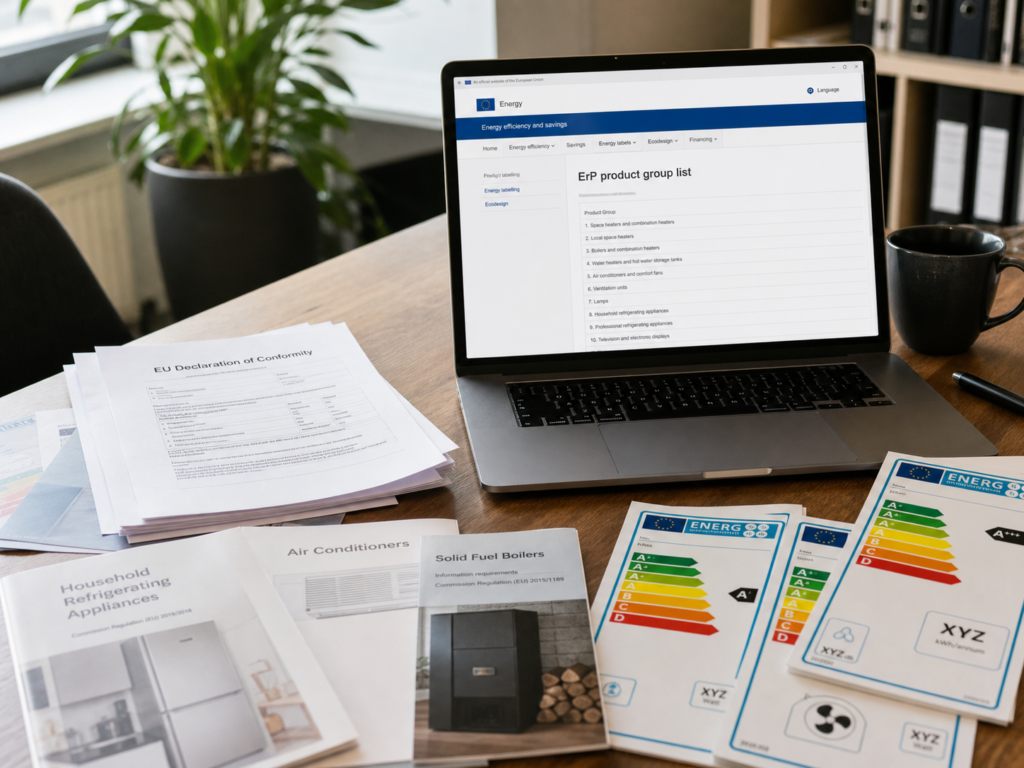
3. Core Components of ErP Compliance Evidence Chain
A complete ErP compliance evidence chain usually includes these documents:
First is the product classification basis, that is, documents proving which implementing regulation this product is subject to, to avoid wrong application of regulations.
Then there are the applicable regulation version and corresponding test standards, because both regulations and test standards will be updated, and it is necessary to clarify which version is used.
Next are various test reports or design calculation documents, such as energy efficiency tests, low-power tests, life tests, etc., depending on the category requirements.
There are also risk assessment and environmental impact analysis documents, corresponding to the full life cycle assessment requirements in the general obligations.
Then there is the EU Declaration of Conformity (DoC), which is a written compliance guarantee issued by the manufacturer. It must list all applicable ErP implementing regulations. Products without a DoC cannot be affixed with the CE mark.
There are also product labels, information sheets, and public publicity content, which must be consistent with the compliance content, and cannot falsely publicize energy efficiency grades or environmental protection performance.
In addition, there must be records of supply chain or design changes. For example, if materials are changed or suppliers are replaced, there must be records to prove that the changes still meet the requirements.
Finally, there are relevant records of market surveillance response, such as replies and rectification records after random inspections by regulatory authorities.
4. Breakdown of Compliance Obligations for Cross-Border Stakeholders
ErP compliance responsibility does not only fall on manufacturers. Different roles in the cross-border chain have corresponding obligations:
Manufacturers are the first responsible parties, responsible for product design and testing, preparing DoC and technical documentation, and affixing the CE mark. Technical documentation usually needs to be kept for 10 years from the completion of the last product, and the specific duration is subject to the corresponding regulations.
The EU Authorised Representative is the agent designated by the manufacturer in the EU, responsible for keeping technical documentation and DoC on behalf of the manufacturer, and cooperating with random inspections by regulatory authorities.
Importers are the entities that import products into the EU. They need to verify the manufacturer’s information, the validity of the DoC, whether the technical documentation is available, and ensure that the product is affixed with the correct marks.
Distributors (including offline retailers and wholesalers) shall ensure that the products they sell meet the marking requirements and shall not sell obviously non-compliant products.
E-commerce platforms need to check product compliance in accordance with EU platform responsibility rules, but it should be noted that the platform’s own requirements are not equal to legal obligations. For example, some platforms require sellers to upload compliance certificates in advance, but the final compliance responsibility still lies with the manufacturer and importer.
A common misconception should also be clarified here: ErP conformity assessment can usually be completed by manufacturers through internal design control, and not all products require the participation of EU Notified Bodies (third-party compliance assessment bodies). Whether a third-party institution is required to participate depends on whether there are clear requirements in the corresponding implementing regulations. There is no general rule that “high-risk products must be certified by a third party”, so don’t be cheated by unnecessary certification fees.
VI. Quick Distinction of Easily Confused EU Compliance Regulations
There are many EU environmental protection and compliance regulations with similar names, which many people can’t figure out. Here is a comparison of the most easily confused regulations with ErP, so you can distinguish them at a glance.
| Regulation/Mark | Core Function | Regulated Link | Relationship with ErP |
|---|---|---|---|
| EU Energy Label | Display product energy efficiency grade to assist consumers in purchasing | Energy efficiency display in use phase | Only some ErP-covered categories need to use it at the same time |
| CE Mark | Self-declaration mark that the product complies with all applicable EU regulations | Full-category compliance publicity | ErP is one of the regulations that CE may apply to |
| RoHS | Restrict specific hazardous substances in electrical and electronic products | Material composition | Complementary and non-overlapping, most electrical and electronic products need to comply with both |
| WEEE | Regulate the recycling and treatment of waste electrical and electronic products | End-of-life treatment | Complementary and non-overlapping, most electrical and electronic products need to comply with both |
| ESPR | Next-generation sustainable product regulation, expanding coverage to non-energy products | Full-category sustainability requirements | Does not directly repeal ErP, will gradually align in the future |
In practice, it can be quickly distinguished by “what documents to check”: ErP and CE compliance mainly check the Declaration of Conformity (DoC), technical documentation and test reports of the corresponding implementing regulations; energy label compliance mainly checks product labels, information sheets and EPREL database filings; WEEE, packaging, battery regulations also involve producer responsibility registration or recycling system arrangements.
In addition to the above, there are several regulations that often apply in parallel with ErP that you can briefly understand:
REACH Regulation: governs the registration, evaluation, authorization and restriction of chemicals, involving chemical substances in product materials, and almost all products may be involved.
RED/EMC/Low Voltage Directive: govern radio equipment, electromagnetic compatibility, and electrical safety respectively. Most electrical and electronic products need to comply with these items at the same time.
Packaging/Battery Regulations: govern packaging recycling and battery environmental protection requirements, which partially overlap with the resource efficiency requirements in ErP, and need to be complied with separately.
VII. Guide to Avoiding High-Frequency Misconception Pitfalls
Finally, 5 of the most common ErP cognitive misconceptions are sorted out, which can help both consumers and sellers avoid fewer pitfalls.
Misconception 1: ErP only manages “power saving”
Many people think that ErP only has energy efficiency requirements, and as long as the product saves electricity, it is compliant. This is wrong.
ErP requirements for some categories also include multiple dimensions such as durability, repairability, recyclability, and information disclosure. What specific requirements there are depends entirely on the implementing regulations of the corresponding category.
Pitfall avoidance action: When checking compliance requirements, go through all the requirement items of the corresponding implementing regulations, don’t just look at energy consumption indicators.
Typical consequence: Only doing energy efficiency tests and ignoring resource efficiency requirements, resulting in customs detention of goods and platform delisting of products.
Misconception 2: Products with higher energy efficiency grades are more environmentally friendly
Many people think that products with A-grade energy labels are definitely more environmentally friendly than those with lower grades, but this is not necessarily the case.
Energy efficiency is only one dimension of environmental protection. The environmental friendliness of the whole life cycle also depends on whether the product is durable, whether the materials are environmentally friendly, and whether it can be recycled. A very small number of high-energy-efficiency products may have a greater overall environmental impact than products with one lower energy efficiency grade because they use rare materials and have higher carbon emissions in the production process.
Pitfall avoidance action: Ordinary consumers can prioritize energy efficiency when purchasing, but if it is for compliance or publicity, you cannot casually say “most environmentally friendly” without full life cycle data support.
Typical consequence: Publicizing the product as “most environmentally friendly” without basis, which is suspected of false publicity and will be punished by the regulatory authorities.
Misconception 3: ErP requirements are the same for all products
This is the pitfall that novice sellers are most likely to fall into: thinking that there is a set of universal ErP standards, and the requirements of category A can be directly applied to category B.
In fact, ErP is a framework directive, and the implementing regulation requirements, test methods, and effective times of each category are different, and there is no universal standard.
Pitfall avoidance action: Every time you do compliance for a new product, you must re-search the latest implementing regulations and corresponding test methods by product group, and do not directly apply the rules or old experience of other categories.
Typical consequence: Using wrong regulation requirements, resulting in non-compliant products and customs detention of goods.
Misconception 4: Having a CE mark equals compliance with ErP
Many people think that if a product has the CE mark, it must meet ErP requirements. This is a common misunderstanding.
The scope of regulations covered by the CE mark is determined by the harmonized regulations applicable to the product, which may include ErP, or may only cover other requirements such as safety and electromagnetic compatibility.
Pitfall avoidance action: Directly ask for the Declaration of Conformity (DoC) issued by the manufacturer, and check whether the corresponding category’s ErP implementing regulation is listed in it.
Typical consequence: Purchasing products with CE marks but not completed ErP compliance, which are detained by customs during import, and fines need to be paid.
Misconception 5: ErP compliance is valid for life after one completion
Some people think that once a product completes ErP compliance, it can be sold all the time without further management. This is also wrong.
First, ErP implementing regulations will be revised and tightened regularly, for example, the energy efficiency threshold will be raised every few years; second, if the product is modified, such as changing materials, changing structures, updating software, it is necessary to reconfirm the compliance; in addition, the regulatory authorities of EU member states can conduct random inspections at any time, and the law enforcement intensity varies by country, product, and period.
Pitfall avoidance action: Check at least once a year whether the applicable regulations have been updated; re-evaluate compliance after product modification; sort out a full set of technical documents in advance to be ready to respond to regulatory random inspections at any time.
Typical consequence: Using old version of energy labels, or not redoing compliance after product modification, resulting in platform delisting and customs detention of goods.
Summary
To master the ErP compliance logic, the focus is on four things:
You can quickly judge whether a certain type of product may be subject to ErP jurisdiction, and also know to check the list of implementing regulations on official channels such as the European Commission’s energy website and EUR-Lex;
You can understand the EU’s 2021 version of the A-G seven-level energy label, know how to scan the QR code to check EPREL filings, and can make a preliminary compliance judgment on products covered by the energy label;
You can distinguish ErP from common EU compliance concepts such as CE, energy labels, RoHS, and WEEE, and also know to check the regulation list in the DoC to confirm ErP compliance;
You can also avoid the 5 most common ErP cognitive misconceptions and complete basic compliance self-checks according to the four-step method.
Whether you are an ordinary consumer choosing more environmentally friendly products, or a cross-border seller doing compliance layout for the EU market, this knowledge can help you avoid a lot of detours.