
Many sellers who have just started operating on Amazon EU sites may have encountered similar frustrating issues: a well-performing listing is suddenly taken down, and the backend performance notification mentions “WEEE non-compliance”. They neither know what WEEE is nor understand why Amazon is in charge of this matter. Some sellers even think “I’m a small seller / I do self-fulfillment, so this shouldn’t apply to me”.
In fact, WEEE is an unavoidable compliance requirement for EU sellers of electrical and electronic products. Whether you are a new seller who just opened a store or an experienced seller looking to expand to new sites after operating for a while, you must sort this matter out clearly. This article starts from the most basic definitions, and covers practical operation steps, site differences, pitfall avoidance and appeals, to thoroughly explain the WEEE requirements for Amazon EU sites. After reading it, you can handle basic compliance on your own.
First, Understand: What WEEE Is and Why You Must Take It Seriously
What is the core logic of WEEE
Simply put, WEEE is a special EU regulation on the recycling of waste electrical and electronic products, with the full name of the Waste Electrical and Electronic Equipment Directive. Its core logic falls under the EU’s “Extended Producer Responsibility” principle – to put it plainly, “whoever puts products on the market is responsible for the recycling costs after the products are scrapped”. It is not something that consumers can just throw away, nor is it covered by the local government. Sellers have to pay for the “aftercare” of their products. The English abbreviation of this principle is EPR (Extended Producer Responsibility), which you may encounter in other compliance requirements later.
Many people think that WEEE compliance is just “getting a number and submitting it to Amazon”. In fact, it has two independent dimensions: first, the product’s own labeling and information must meet the requirements; second, the seller must submit compliance qualifications in the Amazon backend. Only when both are satisfied can it be considered truly compliant.
What role does Amazon play
Many sellers think that Amazon is deliberately setting up barriers to make things difficult for them, but that is not the case. Under the EU EPR regulatory framework and the local implementation rules of each member state, Amazon collects sellers’ compliance certificates according to the requirements of different sites and categories, and prompts rectification or takes restrictive measures on non-compliant products. After all, if there are too many non-compliant sellers on the platform, the platform itself may face regulatory penalties. As one of the largest e-commerce channels in the EU, Amazon’s compliance audit requirements are relatively more complete.
It should be clarified that: Sellers are the first responsible party for WEEE compliance. Amazon is only responsible for auditing and urging you to comply. It will not handle recycling for you, nor will it bear the relevant costs of registration, declaration, payment and recycling on your behalf. Currently, Amazon EU Seller Central already provides a dedicated compliance submission portal and status query tool, which sellers can operate directly in the backend.
What are the consequences of non-compliance
The impact of WEEE non-compliance is more than just listing removal. It can be divided into three categories according to the responsible subject:
• Platform side: The most common situation is that corresponding listings are removed or search is suppressed, and new products cannot be listed; in severe cases, account health scores will be deducted, and even store funds will be frozen.
• Regulatory side: If found by local regulatory authorities, you may not only be required to pay back the recycling fees corresponding to historical sales, but also be fined according to the local rules of each member state (the specific proportion depends on local regulations). Stopping sales does not exempt you from liability.
• Operation side: After the listing is removed, replenishment cannot be warehoused, advertisements have to be stopped, the accumulated ranking weight is difficult to recover, and future expansion to other EU sites will also be restricted.
4 Common Cognitive Misconceptions for New Sellers
When first exposed to WEEE, many sellers have these misunderstandings. Correcting them in advance can save a lot of detours:
1. Not only large sellers need compliance: As long as your products are within the scope of control, regardless of sales volume or store level, you must meet the requirements. Small sellers and new stores are no exception.
2. Having CE certification / packaging law compliance does not mean you don’t need WEEE: The three are completely independent regulations – CE covers product safety, the packaging law covers packaging material recycling, and WEEE covers the recycling of electrical and electronic products themselves. They cannot replace each other.
3. Amazon does not handle recycling for you: Amazon is only a supervisory platform. The recycling responsibility and all costs must be borne by the seller themselves.
4. Self-fulfilled shipments are not exempt: As long as your products are sold to end consumers in the EU, whether it is FBA (Fulfillment by Amazon) or self-fulfilled shipments sent directly from outside the EU, you need to meet WEEE requirements.
Quick Judgment: Do Your Store and Products Need to Meet WEEE Requirements?
Which sellers need to comply
As long as any of the following conditions is met, you need to complete WEEE compliance:
• Sellers who list electrical and electronic products on any Amazon EU site;
• Regardless of whether you use FBA (Fulfillment by Amazon) or self-fulfillment mode;
• Regardless of whether the store is registered inside or outside the EU;
• Sellers participating in the Pan-European Program or Multi-Country Inventory need to cover the requirements of all countries where inventory is located.
For example: If you have a store registered with a Chinese company, use the Pan-European Program, and store inventory in Germany, France, and Spain, you must meet the WEEE requirements of all three countries, not just register one country.
Which products are within the scope of control
The judgment standard is very simple: civilian consumer products whose core functions rely on plug-in power, batteries, or charging to work are basically within the scope of control.
Common controlled categories on Amazon include wireless earbuds, electric toothbrushes, desk lamps, power banks, small kitchen appliances, children’s electric toys, etc. There are also some categories that are easily missed and require special attention: accessories with electronic functions (such as luminous hair clips), luminous toys, USB small fans, smart door locks, chargers, fast charging data cables with chips. These products that do not look like “large home appliances” are within the scope of control as long as they operate with electricity.
Also note: Although products containing batteries are also subject to battery regulations, this does not exempt them from WEEE compliance obligations. Both requirements must be met.
Are there any exceptions
There are three main types of exception scenarios explicitly listed in the WEEE regulation, which are not within the scope of control:
• Special equipment for military / national security purposes, specific large fixed industrial tools and other categories explicitly exempted by regulations;
• Implantable medical electronic devices (such as pacemakers);
• Purely mechanical products without any electronic components (such as manual screwdrivers, ordinary plastic phone cases).
Special note: Electrical and electronic products for ordinary commercial or B2B scenarios cannot be directly judged as exempt under “industrial use”. If you are unsure about the category attribute, it shall be subject to the local WEEE classification rules of the country of sale.
10-Second Quick Self-Check Method
If you are still unsure, as long as the following three conditions are met at the same time, you must comply:
1. The product is a civilian consumer product that operates with electricity;
2. The sales target is ordinary consumers in the EU;
3. The product is listed on an Amazon EU site.
If you are really unsure, go directly to the compliance requirement page of the corresponding category in Amazon’s backend to check. The platform’s requirements are synchronized with local regulations and are the most accurate.
Core Obligations: 4 Requirements That Must Be Met for WEEE Compliance
After figuring out whether you need to comply, you need to know what exactly to do. There are 4 core requirements for WEEE compliance, all of which are indispensable.
Hold a valid WEEE registration number for the corresponding country
This is the most basic requirement, but there are several key points that many people get wrong:
• WEEE is a framework directive at the EU level, specifically implemented by each member state separately. There is no EU-wide WEEE registration number. Whichever country you sell to and whichever country your inventory is stored in, you need the registration number of that country.
• The registration number is bound to the compliance responsible entity. You cannot use the supplier’s or other sellers’, nor can you share it between stores of different entities.
• The registration number is only valid for the brand, category, and country you submitted during registration. For example, if you only reported wireless earbuds during registration, and later add the electric toothbrush category, you need to complete supplementary category registration, otherwise it is not considered compliant.
Affix compliance labels on products, packaging, and manuals
The WEEE label is the EU-unified “crossed-out trash bin” pattern, which is used to remind consumers that this product cannot be thrown into ordinary domestic waste and must be recycled separately.
The basic requirement for the label is that it is clearly visible and not easy to wear; if the product is too small (such as Bluetooth earbuds) to be printed directly on the product, it can be printed on the packaging, manual, or product tag.
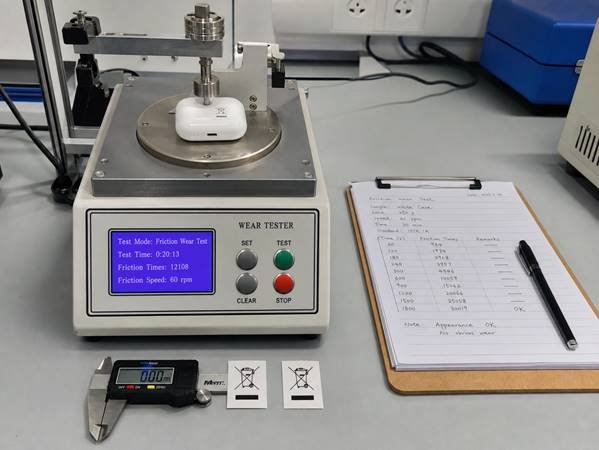
In addition, the product manual must include recycling instructions in the local language of the country of sale. For example, products sold to Germany must have recycling instructions in German, not just English.
Bear the recycling and treatment costs after product disposal
The core of WEEE is that sellers bear the recycling cost. The cost is not fixed, and is calculated based on the product category, weight, and the actual sales volume you declare – the more you sell, the higher the recycling fee you have to pay.
The fee must be paid to the officially authorized recycling institution of the corresponding country. Some sites may provide service provider docking, declaration or payment assistance through Amazon EPR-related services. Whether it is available, and the covered countries and category scope, shall be subject to the service content and official terms displayed in the seller’s backend. The payment cycle is usually once a year, and some countries require quarterly declaration and payment, depending on the regulations of the corresponding country.
Submit compliance proof in Amazon’s backend and pass the audit
It is not enough to complete compliance on your own. You also need to submit the proof to Amazon for approval to be considered compliant.
The submission portal can be found in the “Compliance Tools” in Amazon’s backend, or on the compliance requirement page of the corresponding category. The materials to be submitted generally include the WEEE registration certificate, registration number, and supporting documents for the corresponding category.
There are three core points of platform audit: first, whether the subject of the registration number is consistent with the subject of the Amazon store; second, whether the country of the registration number matches the site; third, whether the category covered by the registration number includes the products you sell. Any mismatch will result in rejection.
Full Practical Process: Steps for New Sellers to Complete Compliance from Scratch
Now that you know what to do, just follow the steps. New sellers can handle it even on their first try.
Step 1: Pre-sorting, clarify the scope of compliance and the responsible entity
Don’t rush to find an institution to register first. Sort out your own situation first, otherwise you may waste money:
First, sort out a list of all electrical products, classified by category, weight, country of sale, and brand, to avoid under-reporting or over-reporting.
Then determine who is the responsible entity:
• If you operate your own brand or private label (your brand is printed on the product), you are the responsible entity and need to register yourself;
• If you purchase goods from local EU suppliers and resell them directly (the supplier’s brand is on the product), if the supplier is already the WEEE responsible entity, you can directly ask for their compliance proof without registering yourself, but you must confirm that their registration number covers the products you sell and the countries of sale;
• If you are an overseas seller (for example, the company is in China), some EU countries mandate the appointment of a local EU authorized representative, which needs to be confirmed in advance.
Finally, confirm your sales model: single-site self-fulfillment, Pan-European Program, or multi-country inventory. Different models require registration in different countries, which will be explained in detail in the site differences section later.
Step 2: Choose a formal recycling institution to complete registration
WEEE registration must be handled through the officially authorized recycling institution of the corresponding country. When choosing an institution, pay attention to two standards: first, it must have the official recycling qualification of the corresponding country; second, it is best to have experience in serving cross-border sellers, so that communication is smoother and they understand Amazon’s requirements better.
Special pitfall to avoid: Don’t believe false propaganda such as “EU-wide WEEE number” or “number issued in 1 day” – registration in each country is independent, there can be no universal number. The normal registration cycle is at least 2 weeks, it is impossible to get a number in 1 day.
The materials required for registration generally include: product list, proof of responsible entity (such as business license), proof of store entity, brand registration information (if you have a brand).
The audit cycle varies by country: Germany and France take about 4-8 weeks, Spain and Italy take about 2-4 weeks. It is recommended to plan the time in advance, don’t rush to handle it when you are about to list the product.
Step 3: Product-side rectification, labeling + updating manuals
You can carry out product-side rectification at the same time as registration to save time:
The size of the WEEE label is usually not less than 5mm, which can be adjusted according to the size of the product. The core requirement is clear color contrast and resistance to wear. For small-volume products that cannot be printed on the body, it is acceptable to print on the outer packaging, manual or tag.
The manual should be updated to include recycling instructions and the WEEE label in the language of the corresponding country of sale. Do not only include Chinese or English.
Step 4: Submit in the backend and confirm the audit is passed
After getting the registration number and certificate, you can go to the compliance portal of the corresponding Amazon site to submit the materials.
Before submitting, be sure to check three pieces of information: whether the subject information is consistent with the store, whether the country corresponds to the site, and whether the category covers all sold products. These three are the most common reasons for rejection.
After submission, save the submission record and the audit pass voucher, and keep them for at least 3 years, in case of subsequent platform or regulatory spot checks. The specific retention period and traceability requirements shall be subject to the regulations of the country of sale and Amazon’s official notice.
Step 5: Long-term maintenance to avoid invalidation of the registration number
WEEE registration is not a one-and-done thing. Poor post-maintenance can easily lead to invalidation:
• You must declare the actual sales volume according to the cycle required by the corresponding country, and pay the recycling fee on time. Overdue payment will cause the registration number to be invalid;
• If you add new categories, brands, or new sales sites / inventory countries in the future, you must complete the corresponding registration in advance. Don’t wait until you are inspected;
• If the company subject, address, or brand information changes, you must promptly notify the recycling institution, and also update it in the Amazon backend, to avoid compliance invalidation caused by inconsistent subjects.
Site Differences: Differences in Requirements for Different Amazon EU Sites
Many sellers wonder: they are all EU sites, why are the requirements different? Let’s explain it clearly here.
Why are the requirements different for each country
WEEE is essentially a framework directive at the EU level, which only sets minimum requirements. The specific implementation rules, charging standards, and regulatory intensity are formulated by each member state. Each Amazon site implements the local regulations of the corresponding country, so the requirements of different sites naturally vary.
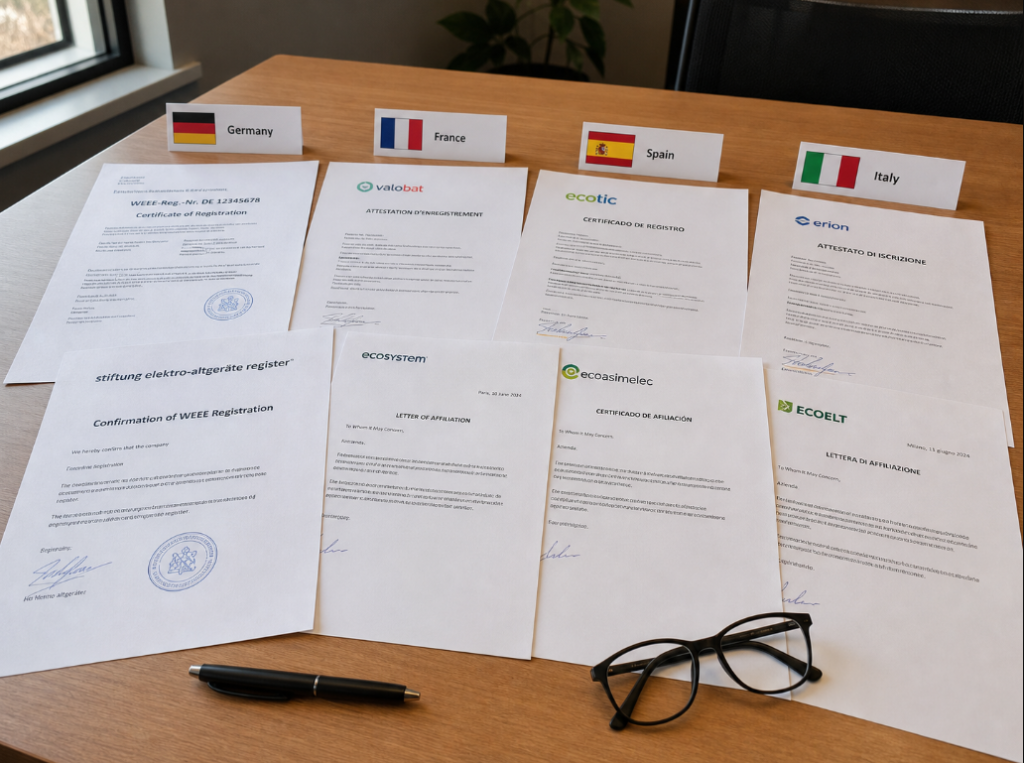
Comparison of Core Differences of Mainstream Sites
For your quick understanding, here is a table of the core differences of several mainstream sites:
| Site | Regulatory Intensity | Registration Cycle | Cost Level | Core Special Requirements |
| Germany site | Strictest (most spot checks) | 4-8 weeks | Relatively high | Producers established overseas or not locally are usually required to appoint a local German authorized representative / responsible entity, subject to the requirements of ElektroG and the registration institution |
| France site | Strict | 4-8 weeks | Medium to high | Overseas producers are usually required to appoint a local French authorized representative; additional requirement to affix the Triman environmental label, recycling fees are calculated by category tier |
| Spain / Italy sites | Medium | 2-4 weeks | Relatively low | Overseas producers are usually required to appoint a local responsible person, regulatory intensity is slightly looser than Germany and France |
| Nordic sites such as Sweden / Denmark | Medium to strict | Relatively long | Medium | Strict language requirements, need to connect with local recycling institutions, registration process is relatively complex |
Note: The Triman label required by France is an environmental label that provides consumers with sorting and recycling guidance. It coexists with the WEEE crossed-out trash bin label and France’s WEEE registration obligation, and none can replace the others.
How do multi-site sellers determine which countries to register
This is the most frequently asked question by multi-site sellers. It can be judged in three situations according to the sales model:
1. Pan-European Program / Multi-Country Inventory: As long as your inventory is stored in a certain EU country, you need a WEEE registration number for that country. For example, if inventory is stored in Germany, France, and Spain, you need numbers for all three countries.
2. Single-site self-fulfillment (direct shipping from outside the EU): If you only open a single site, only sell to consumers in the country where the site is located, do not enable cross-border delivery to other EU countries, and have no inventory in other EU countries, you only need to register the country corresponding to this site. For example, if you only do self-fulfillment on the Italy site and only sell to Italy, you only need the Italian number. If you deliver to consumers in multiple EU countries through a single site, you also need to additionally consider the compliance requirements of the actual country of destination for sales.
3. New sites / inventory countries: It is recommended to start registration 1-2 months in advance to avoid the registration number not being ready and affecting product listing.
Will the requirements change, and when do they tend to change
WEEE requirements are not static. There are two common change scenarios:
First, when the EU updates the WEEE directive framework, the local rules of each member state will be adjusted simultaneously, and sellers should pay attention to platform notifications;
Second, Amazon’s audit intensity will be dynamically adjusted with the tightness of EU regulation. Generally, the frequency of spot checks is higher during peak seasons (such as before Black Friday and Christmas). It is recommended to check your compliance status yourself before the peak season.
Pitfall Avoidance and Appeals: Common Misconceptions, Audit Failures, and Remedies for Listing Removal
6 Advanced Misconceptions Easily Encountered in Practice
In addition to the introductory misconceptions mentioned earlier, there are several pitfalls that are easy to step on during the compliance process, and many experienced sellers have also fallen for them:
1. Just use the supplier’s WEEE number: The WEEE number is bound to the responsible entity. If you are the compliance responsible entity for your own brand, misusing the supplier’s number will be rejected by Amazon’s audit due to inconsistent subjects; it can only be used when the supplier is the legal responsible entity of the product (such as reselling the supplier’s own brand products).
2. One registration number can cover the entire EU: WEEE registration numbers of each country are independent of each other, only valid in the corresponding country. Submitting a registration number from a country other than the site’s country will be rejected due to country mismatch. There is no so-called “EU-wide WEEE number”.
3. One registration is valid for life: The WEEE registration number has a validity period. You need to regularly declare sales volume and renew the fee according to local requirements. Overdue failure to maintain will lead to direct invalidation. It is not a one-and-done thing.
4. Having a registration number equals full compliance: WEEE compliance is a full-process requirement. In addition to a valid registration number, you also need to meet conditions such as category coverage, label compliance, and timely declaration and payment. Missing any one may lead to listing removal.
5. Different stores can share the same WEEE number: Sharing WEEE numbers between stores with inconsistent subjects will be checked and rejected by Amazon, and may even trigger compliance penalties.
6. Second-hand / refurbished / bundles with electronic accessories do not need compliance: Such products must be judged for compliance requirements according to their overall nature. For example, selling a phone case with a free luminous stand requires WEEE compliance because the bundle contains electrical products.
Common Reasons for Amazon Audit Failure
If your compliance application is rejected, it is most likely due to the following reasons:
• The subject of the registration number is inconsistent with the Amazon store subject (such as misspelled company name, completely different subject);
• The category corresponding to the registration number does not cover the currently sold products;
• The country of the registration number does not match the site (for example, submitting a Spanish number to the Germany site);
• The WEEE label does not meet the size, position, or language requirements;
• The submitted registration certificate has expired or has incomplete information.
How to Appeal if a Product is Removed Due to WEEE
If you encounter product removal, don’t panic. Follow the steps to solve it:
Step 1: First go to the performance notification to see the specific reason for non-compliance – whether it is no registration number, category mismatch, or label problem. Don’t submit an appeal blindly, otherwise it will be more troublesome if you fail.
Step 2: Targeted rectification: If you don’t have a registration number, hurry up to apply for one; if the category doesn’t match, adjust the category mapping or complete supplementary category registration; if there is a problem with the label, modify the label and reprint.
Step 3: Prepare appeal materials: valid WEEE registration certificate, rectification proof (such as updated photos of the label, screenshots of the manual), compliance commitment letter (promising to comply with the requirements in the future).
Step 4: Submit the appeal on the Amazon backend performance page. Generally, the result will be available in 3-7 working days. Just pay attention to the backend notification during this period.
Practical Suggestions for Long-Term Compliance
To avoid pitfalls, you just need to develop a few habits:
• Register in advance. Don’t wait until the listing is removed to make up for it. The slowest registration cycle takes 2 months, and by the time you get the number, the listing weight will have long been lost;
• Check the compliance status once a quarter, confirm the validity period of the registration number and the status of declaration and payment. It is best to set a calendar reminder to avoid forgetting to renew;
• All compliance-related documents and vouchers should be kept for at least 3 years. The specific retention period shall be subject to the regulations of the country of sale and platform requirements. You can produce them whether it is a platform spot check or a regulatory department inspection;
• Judge the WEEE category before listing new products. Don’t wait until the product is listed, inspected and removed, wasting the traffic of the new product period.
Pre-Launch Checklist: Quickly Check Compliance Status
Before listing new products or opening new sites every time, you can quickly check against the list below to ensure nothing is missed:
Product-side Check
• [ ] Products within the WEEE control scope have been affixed with compliant WEEE labels
• [ ] The label is clear and wear-resistant, and the position meets the requirements
• [ ] The manual includes recycling instructions in the local language
Qualification-side Check
• [ ] A valid WEEE registration number for the corresponding country of sale / inventory country has been obtained
• [ ] The subject of the registration number is consistent with the subject of the Amazon store
• [ ] The registration number covers all brands and categories currently sold
• [ ] The registration number is within the validity period
Backend-side Check
• [ ] WEEE compliance proof has been submitted to the corresponding Amazon site
• [ ] The platform audit has been passed, and there is no pending rectification prompt
• [ ] The product category mapping is consistent with the registered category
Operation-side Check
• [ ] The compliance requirements of all sales sites / inventory countries have been covered
• [ ] The current period’s sales volume declaration and fee payment have been completed as required
• [ ] New categories / brands have been supplemented with compliance in advance
Final Summary
WEEE compliance may seem trivial, but it is essentially a basic operational guarantee for EU sellers of electrical and electronic products. As long as you sort out the logic and implement it step by step, it is not complicated. You can first quickly judge whether you need to comply through the three standards: “electrical civilian consumer products, sold to ordinary EU consumers, listed on Amazon EU sites”. Then advance around the four core obligations: “hold a valid registration number for the corresponding country, complete product label and manual rectification, bear recycling and treatment costs, submit proof in the backend and pass the audit”. At the same time, cover the requirements of the corresponding countries according to your own sales model and inventory layout. In daily operations, you can use the pre-launch checklist to check regularly, plan ahead and maintain consistently, so you can avoid most compliance risks, and avoid unnecessary losses such as listing removal and fines.