
Xiao Zhou, a cross-border seller selling LED lights on EU marketplaces, had his listings removed by Amazon just after dozens of orders, with the reason being the lack of a WEEE registration number. He thought that only sticking the “crossed-out trash bin” label on products was enough, not expecting that separate registration, recycling fee payment, and even potential fines of tens of thousands of euros were required. This is not an isolated case: many people doing EU electronics and electrical appliance business only have a superficial understanding of WEEE as “needing registration and labeling”, and only panic when they encounter platform delisting, customs detention of goods, or even fine notices. Some confuse it with CE and RoHS, some think small sellers or self-shipping sellers will not be inspected, and others believe that signing a contract can shift liability to suppliers — these cognitive deviations are the core reasons for violating regulations and falling into pitfalls.
Starting from basic judgment, this article systematically sorts out the penalty scope, liable parties, amount standards, investigation and handling procedures, and response methods for WEEE violations. It not only helps beginners quickly get started and avoid pitfalls, but also allows experienced sellers to master the logic of risk assessment and respond to problems reasonably.
Basic Cognition: First Understand the Basic Logic of WEEE and Violation Penalties
The core logic of WEEE in plain terms is very simple: when you sell electronic products to the EU, after consumers use them up and discard them, the costs of recycling, treatment, and environmentally friendly disposal cannot be borne by local governments or taxpayers, and must be the responsibility of the seller. Its official full name is the Waste Electrical and Electronic Equipment Directive (WEEE for short), a framework regulation formulated at the EU level, with specific implementation rules determined by each member state on its own.
The essence of WEEE violation penalties is not that regulatory authorities impose fines for the sake of making money, but that when merchants fail to fulfill their recycling obligations, penalties are used to force them to assume environmental protection responsibilities. The ultimate goal is to ensure that e-waste is treated in compliance with regulations and reduce environmental pollution.
Here, we must first distinguish three easily confused EU compliance requirements: CE covers product safety, RoHS covers restricted hazardous substances in products, and WEEE covers recycling of products after disposal. The three are completely independent obligations and cannot replace each other. Even if you already have a CE certificate and RoHS report, none of the required WEEE registration, fee payment, and labeling can be omitted.
Which Parties Will Be Penalized
WEEE liability follows the principle of “who first places the product on the EU market”. It is specifically divided into four types of liable parties, with different liability boundaries and precautions for each:
• EU-based producers/brand owners: Entities that produce products themselves and sell them under their own brand shall bear full-process WEEE compliance responsibilities. As long as the product is placed on the market under its own brand name, regardless of whether the production link is outsourced, it is a liable party.
• EU-based importers: Entities that first introduce non-EU produced products into the EU market are the first liable parties. Even if the actual seller is an overseas seller, as long as the goods are cleared into the EU in the name of the importer, the importer shall bear the corresponding compliance responsibilities.
• Non-EU distance sellers: Overseas entities that directly sell products to EU consumers through e-commerce platforms or independent websites are statutory liable parties. Such entities need to designate an EU-based compliance entity (usually an authorized representative) to liaise with local regulators, but two key points must be noted: first, the authorized representative only assumes the role of performing obligations on behalf and liaising with regulators, and the ultimate compliance responsibility still lies with the seller who places the products on the market; second, it cannot be assumed that one authorized representative covers all EU countries, and its registration and declaration qualifications in the corresponding sales countries, corresponding brands and product categories must be verified.
• EU-based distributors/retailers: Entities that only resell products of others shall also bear corresponding responsibilities if they fail to verify upstream compliance qualifications, fail to label as required, or fail to inform consumers of recycling information.
There is a very critical rule that must be remembered: WEEE is a statutory obligation and cannot be transferred solely through civil contracts. For example, if you are a Chinese cross-border seller and have signed a contract with a domestic supplier agreeing that “WEEE liability shall be borne by the supplier”, if a violation actually occurs, EU regulators will only look for you, the entity that placed the product on the EU market, and will not directly approach the domestic factory. Contract disputes between you and the supplier can only be pursued afterwards on your own, and cannot be used to confront regulators.
Which Products Are Within the Jurisdiction
Here is a 3-second judgment method: as long as a product operates on electric current, batteries, or electromagnetic fields, it is basically within the jurisdiction of WEEE. Common examples such as large home appliances, mobile phones and computers, small home appliances, LED lamps, toys with electronic functions, electric tools, etc., all fall under the covered categories.
There are also clear exemption situations that do not require compliance: first, purely mechanical equipment without any electronic components, such as manual screwdrivers and ordinary can openers; second, personal non-commercial second-hand resale, such as reselling a used personal mobile phone on a second-hand platform, which is not counted if the seller is not specialized in second-hand business; third, test samples that have not entered the circulation market, which are only used for internal testing and will not be sold to consumers, do not require compliance.
Violation Behaviors That Most Easily Trigger Penalties
WEEE violation scenarios cover multiple links such as registration, fee payment, declaration, and labeling, and completing registration does not mean everything is fine. The following is sorted by frequency and severity, which can be used for self-inspection:
Registration-related Violations (Most Common, Relatively Heavy Penalties)
This is the most frequent type of violation with a relatively high starting point for penalties. The core is the failure to complete legal registration in the corresponding market. Common scenarios include:
• Selling before completing WEEE registration in the target sales country: WEEE is managed by country. You need to register the qualification of the country whose market you are entering. Selling without registration is a clear violation.
• False registration information or failure to update in time: Incorrect filling of information such as product category, brand name, company entity, and contact information, or failure to synchronize updates to official registration after changes, will be regarded as invalid registration and treated as unregistered.
• Borrowing third-party registration but not being officially registered oneself: For example, using the registration quota of a service provider or upstream supplier, but one’s own brand and entity information are not filed in the official system, it is still a violation once inspected.
• Registered in only one country but conducting distance sales to other EU countries: This is the most common cognitive misunderstanding. WEEE only has framework requirements at the EU level. Specific registration, declaration, and fee payment are all managed by each member state on its own. There is no EU-wide registration qualification, and distance sales to other member states must complete local compliance separately.
Recycling and Fee Payment Violations
Registration is only the first step of compliance. The subsequent recycling docking and fee payment are the core of fulfilling obligations. Common violations include:
• Not joining a locally officially recognized compliance recycling scheme: You must join an officially qualified recycling and treatment organization (responsible for handling registration, declaration, recycling docking and other matters for enterprises). Finding an unqualified recycler on your own does not count as compliance.
• Failure to pay recycling and treatment fees on time and in full: Recycling and treatment fees, also known as eco-contribution fees, are used to pay for the recycling and disposal costs of products after disposal. Late payment or underpayment are violations, and late fees may also be incurred.
• Handing over waste equipment to unqualified treatment providers: If an enterprise recycles waste products on its own, it must hand them over to officially recognized qualified treatment providers. Handing them over to unqualified individuals or small workshops will be regarded as failure to fulfill recycling obligations.
Declaration and Record Violations
WEEE requires merchants to regularly declare sales and recycling data, and keep compliance records for inspection. Many people easily fall into pitfalls in details:
• Failure to declare sales volume/recycling volume on schedule: Each country has a fixed declaration cycle (usually quarterly or annual), and failure to declare after the deadline is a violation.
• Concealing or underreporting sales volume: For example, omitting self-shipped sales volume, not counting overseas warehouse inventory, concealing sales volume from promotional activities, etc., all count as violations. If fees are underpaid as a result, penalties will be further increased.
• False declaration information: Intentionally reporting wrong product categories or underreporting product weight to pay less recycling fees will be dealt with severely based on the underpaid fees once inspected.
• Failure to keep compliance records as required: There is no uniform fixed retention period for compliance records in the EU. The specific period shall be subject to the regulations of member states and the requirements of local recycling schemes. It is recommended to keep at least the following materials: WEEE registration certificate, authorized representative/recycling scheme contract, previous declaration forms, basis for calculating sales quantity and weight, payment vouchers, recycling and treatment records, rectification communication records, etc. Failure to provide them during regulatory inspection will also constitute a violation.
Labeling and Information Violations
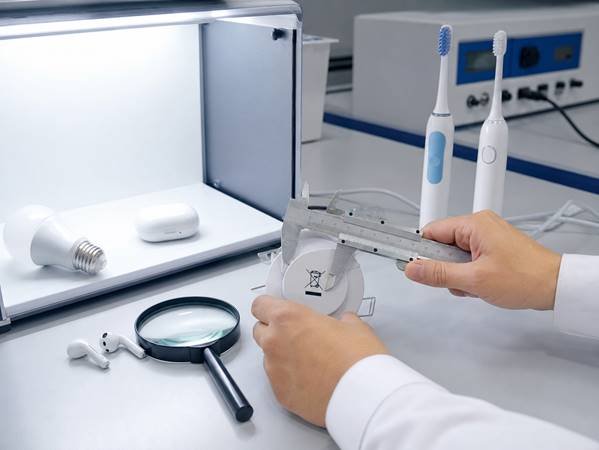
This refers to the recycling mark commonly known as the “crossed-out trash bin”. Although it is just a small mark, the requirements are very detailed. Common violations include:
• Products not labeled with recycling marks: Failure to affix the “crossed-out trash bin” mark as required is a clear violation.
• Labels not conforming to specifications: If the size, position, and clarity of the label do not meet requirements, or if the affixation/printing is not firm, peels off or becomes blurry after a period of use and cannot be retained for a long time, it also does not count as compliance. In principle, labels should be affixed to the product body first; if labeling on the body is not possible due to limitations such as too small product size or special functions, it shall be marked on the packaging, manual, or accompanying warranty documents in accordance with local rules, and ensure that it is clear, durable, and recognizable by consumers.
• Failure to inform consumers of free recycling channels: It is necessary to clearly inform consumers of free recycling channels for waste products in product manuals, store pages, etc. Failure to fulfill the obligation of notification also counts as a violation.
• Failure to provide product information to recycling and treatment organizations: It is necessary to provide recycling organizations with information such as product disassembly instructions and locations of hazardous components to facilitate their compliant disposal. Failure to provide such information is a violation.
Serious Violations (Directly Trigger Heavy Penalties)
There are also several types of serious violations with egregious nature, which directly trigger high-level penalties once triggered: forging WEEE registration numbers, compliance documents or declaration data; intentionally concealing brands, actual sales volume or sales countries; refusing to correct after receiving rectification notices; causing major environmental pollution or safety hazards due to illegal disposal of e-waste. These situations not only result in high fines, but may also involve more serious legal liabilities.
Penalty Types and Amount Ranges
The EU does not have a unified WEEE fine standard, and only formulates framework requirements. Specific penalty rules and amounts are formulated by each member state on its own, with large differences between countries. The following are common ranges from public cases in 2023-2024, for risk reference only. The specific situation shall be subject to local current regulations and case-by-case discretion.
6 Common Penalty Forms (Sorted from Light to Heavy)
• Rectification warning: The regulatory authority issues a notice of correction within a time limit, without direct fines. It is generally applicable to very minor first-time violations.
• Administrative fine: The most common type of penalty, where a fine is paid directly according to the circumstances of the violation.
• Back payment + late fee: The unpaid recycling and treatment fees must not only be paid in full, but also late fees must be paid, and even the audit fees of the regulatory authority may be borne.
• Market restrictions: Including delisting products from e-commerce platforms, customs detention of goods, confiscation of illegal products, suspension of local sales qualifications, etc.
• Qualification restrictions: Prohibition from participating in EU public procurement, revocation of WEEE registration qualifications, and even prohibition from entering the EU market for a certain period.
• Criminal liability: Only applicable to a very small number of particularly serious cases, such as intentional fraud, large-scale fee evasion, and causing major environmental harm. Not only will fines be imposed, but imprisonment may also be faced.
In addition, it should be noted that if losses are caused to third parties due to violations (such as claims caused by land pollution), this falls under the category of civil claims, not administrative penalties from regulatory authorities, and needs to be handled separately.
Reference of Common Fine Ranges in Major Member States
| Country/Region | Minor Violations (Reference from Public Cases) | Moderate Violations (Reference from Public Cases) | Serious Violations (Reference from Public Cases) | Law Enforcement Focus |
| Germany | 1,000-10,000 EUR (labeling errors, late declaration, etc.) | 10,000-50,000 EUR (unregistered, underpaid fees, etc.) | 50,000-100,000 EUR, illegal gains may be confiscated (fraud, refusal to rectify, etc.) | Strictest law enforcement, focusing on registration compliance, high platform cooperation |
| France | 500-8,000 EUR | 8,000-30,000 EUR (unregistered, underreported, etc.) | Up to 50,000 EUR + back payment of owed fees | Focusing on eco-contribution fee payment and consumer information disclosure |
| Netherlands/Nordic Countries | No unified public range | No unified public range, heavy penalties for non-compliance | Subject to the rules of local competent authorities | Focusing on completion of recycling targets and data authenticity |
| Southern/Eastern Europe | 30%-50% lower than Germany and France | Mainly rectification + back payment, supplemented by fines | Subject to the rules of local competent authorities | Law enforcement has become stricter in recent years, prioritizing urging compliance |
| UK (post-Brexit) | Requires separate verification | Requires separate verification | Requires separate verification | Applies its own independent rules, EU standards cannot be directly applied |
3 Precautions for Interpreting Fine Information
To avoid the risk of misjudgment, three premises should be noted when looking at fine figures:
First, the figures must correspond to specific scenarios: you cannot only look at the amount, but must also combine the type of violation, duration, and sales scale. For the same unregistered situation, the fine for selling 100 units and 10,000 units may differ by ten times.
Second, pay attention to the validity of the regulation version: After 2020, many EU countries have revised their national WEEE regulations and raised the upper limit of fines. Older figures from earlier periods have limited reference value.
Third, individual cases do not represent universal standards: For example, someone was only fined 2,000 EUR for being unregistered, which may be due to particularly small sales volume, being a first-time offender, and taking the initiative to rectify. It does not mean that everyone will only be fined that much.
Core Determinants of Penalty Severity
The severity of penalties is not randomly determined, but is mainly decided by four core factors. Mastering these can help you estimate the risk level on your own:
First, the severity of the violation type (the most core). The order from heaviest to lightest is basically: fraud/refusal to rectify > unregistered > underpaid/unpaid fees > late declaration/underreporting > labeling errors. The earlier the violation is in the order, the higher the starting point of the penalty.
Second, the duration and scale of the violation. The longer the duration, the heavier the fine. If it spans multiple declaration cycles, the penalty will be significantly increased. The larger the sales volume, the higher the goods value, and the more countries involved, the heavier the fine. After all, the more illegal profits, the higher the corresponding penalty. In addition, if the product involves highly polluting and high-risk electronic components (such as high mercury and lead content, large-capacity batteries), the penalty will be stricter, because improper disposal of such products causes greater environmental harm.
Third, subjective fault and attitude of cooperation. Those who intentionally avoid compliance (such as intentionally concealing sales volume, forging documents) will definitely be fined more heavily than those who forget to declare due to negligence; those who are negligent will be fined more heavily than first-time offenders who are completely unaware. If you take the initiative to rectify and cooperate with the investigation after receiving the notice, many countries will reduce or mitigate the penalty; if you refuse to rectify and refuse to mend your ways despite repeated admonitions, the penalty will be doubled, or even directly upgraded to a more serious level.
Fourth, differences in law enforcement styles among member states. Although they are all in the EU, each country has different law enforcement priorities and strictness: Germany has the strictest law enforcement, especially valuing registration compliance, and e-commerce platforms also take the initiative to cooperate with regulators to verify registration numbers, so there are the most violation cases on German marketplaces; France pays more attention to whether eco-contribution fees are paid on time and whether recycling information is clearly disclosed to consumers; the Netherlands and Nordic countries pay more attention to the completion of recycling targets and the authenticity of declaration data; small and medium-sized countries in Southern and Eastern Europe used to have looser law enforcement, but the intensity has increased significantly in recent years, but they still prioritize rectification and back payment, with relatively lower fine amounts.
Full Process of WEEE Violation Investigation and Handling
The investigation and handling of WEEE violations has a fixed process, and fines are not imposed immediately upon discovery. Understanding the process can help you seize the opportunity for remediation.
Common Channels for Discovering Violations
• Compliance spot checks by e-commerce platforms: Large platforms such as Amazon and AliExpress now take the initiative to verify sellers’ WEEE registration numbers. Those that fail will have their products directly delisted, and in serious cases, their accounts will be frozen.
• Market patrols/spot checks by member state regulatory authorities: Including random spot checks of offline physical stores and online stores, covering both large and small sellers.
• Customs clearance inspection: When goods enter EU customs, if WEEE compliance certificates cannot be provided, they will be directly detained.
• Reports: Competitors, consumers, and environmental organizations can all report. As long as the clues are true, regulators will intervene.
• Data comparison warning: Now regulators in various countries are promoting data connectivity. If the declared sales volume does not match customs import data, platform sales data, or logistics data, the system will automatically issue a warning and trigger an inspection.
Rules and Requirements for the Rectification Period
After discovering a violation, most countries will not impose fines immediately. They will first issue a rectification notice to give a chance to correct. The rectification period is generally 7 to 30 days. In case of an emergency involving hazardous waste, it may be shortened to 3 days. Rectification requirements usually include supplementary registration, supplementary labeling, back payment of fees, submission of compliance certificates, etc. Here is a penalty reduction tip: if you voluntarily stop selling illegal products during the rectification period, the regulatory authority will generally take this as a basis for lighter penalties.
Formal Penalty and Appeal Rules
If rectification is not completed within the time limit or the violation itself is particularly serious, the regulatory authority will issue a formal penalty decision. After receiving the fine notice, first check several key pieces of information: whether the category of the violating product is correct, whether the sales period is accurate, what the basis for the penalty is, whether there is a rectification period, and what the appeal deadline is.
If you have objections to the penalty, you can appeal. The appeal period is generally 14 to 30 days after receiving the fine notice, and the specific period is subject to the regulations of each country. When appealing, prepare relevant materials, such as registration certificates, payment vouchers, sales data, rectification records, etc. All materials that can prove compliance or completed rectification must be attached.
If you have no objection to the fine but refuse to pay it, late fees will be incurred, and it may also lead to compulsory enforcement, suspension or restriction of sales qualifications. In serious cases, you will be included in the blacklist of EU market entities, affecting subsequent EU-wide business operations and the compliance status of platform accounts; for cases involving fraud, criminal investigations, or effective court judgments, the consequences shall be separately determined in accordance with the laws of the corresponding member state.
Quickly Judge Your Violation Risk Level
You can quickly judge your own violation risk level through a 4-step self-inspection method, so you don’t have to panic until you receive a notice:
Step 1: Define the scope — Confirm whether the product is within the jurisdiction of WEEE and exclude exemption situations. For example, if you sell purely mechanical hand tools, you don’t need to worry about WEEE at all, so there is no violation problem.
Step 2: Verify qualifications — Confirm whether you are a liable party and whether you have completed WEEE registration in all sales countries. For example, if you only registered in Germany but also sell on French and Italian marketplaces, then these two countries are in an unregistered violation state.
Step 3: Calculate the scale — Count the duration of the violation, the involved sales volume and goods value, and the number of involved countries. For example, a violation lasting 3 months, with 500 units sold and only involving Germany, has a completely different risk level from a violation lasting 2 years, with 100,000 units sold and involving 5 countries.
Step 4: Estimate the level — Compare the severity ranking of violation types and the fine range of the corresponding country to roughly estimate the risk level.
Risk Differences in Different Sales Scenarios
Many people have misunderstandings about the compliance requirements of different sales models. The following explains them one by one:
• Self-shipping model: Many people think that if goods are shipped from China, they don’t need to comply with WEEE. In fact, as long as the product is sold to EU consumers, compliance is required regardless of where it is shipped from. In recent years, there have been more and more cases of self-shipped goods being detained and delisted, so don’t take chances.
• Overseas warehouse model: Compliance is required not only in the country where the warehouse is located, but also in the receiving country. The liable party is generally the importer or distance seller. Don’t think that you don’t need to worry just because the goods are stored in an overseas warehouse.
• Opening a store on a platform: The platform only verifies the registration number, and the compliance responsibility is entirely on the seller. Without a registration number, the platform will directly delist the products, and subsequent fines still need to be borne by the seller themselves.
• Samples/gifts/after-sales replacement parts: As long as they are for commercial use, they are considered placed on the market and require compliance; only samples for internal testing that will not be sold to consumers are exempt.
“Non-violation” Situations Easily Misjudged
There are also several situations that are easily misjudged as violations, but actually there is no need to worry:
• Products that are purely mechanical without electronic components are originally not within the scope of WEEE;
• If the full-process WEEE compliance for the corresponding member state, corresponding brand and category has been completed by an EU-based importer/authorized representative, and official written proof can be provided, the corresponding placing entity can judge the risk based on this arrangement; however, the authenticity and coverage of the proof must be verified by oneself, and statutory obligations will not be automatically transferred due to contractual agreements;
• Personal non-commercial resale of second-hand items (individual sellers not specialized in second-hand business);
• Test samples that have not entered the circulation market and will not be sold to consumers.
Violation Risk Level Reference
Risk levels are usually divided into four categories, which can be used for reference:
• Low risk: Only minor labeling problems, first-time late declaration, already actively corrected, no actual harm caused. Generally a warning or small fine, or even possible exemption from penalty.
• Medium risk: Unregistered but very small sales volume, underreported for 1 declaration cycle, small amount of owed fees. Generally back payment plus a small fine, and rectification in place is sufficient.
• High risk: Unregistered with large sales volume, lasting more than 1 year, involving multiple countries, with false declaration. The fine amount is relatively high, and may also lead to delisting and goods detention.
• Major risk: Already received a formal fine notice or recall notice, involved in criminal investigation, refusing to rectify. This is a very serious situation and must be dealt with as soon as possible.
Pitfall Avoidance and Response Methods
For daily compliance and violation response, you can refer to the following practical methods:
3 Core Actions for Daily Compliance
These three actions can cover the most common risks of registration, labeling, declaration and fee payment, and are must-dos for beginner sellers:
The first is pre-sales preparation: first confirm the product category, and complete WEEE registration in all target sales countries; non-EU enterprises must designate a qualified EU authorized representative, and do not seek cheap and unreliable institutions.
The second is compliance during sales: affix recycling labels on products, packaging, and manuals as required, with size, position, and durability all meeting requirements; declare sales volume truthfully on schedule, pay recycling and treatment fees in full, and do not conceal or underreport.
The third is regular review: it is best to check whether registration information, product categories, and declaration data match every six months. For example, when adding new brands, adding new product categories, or changing the company entity, the registration information must be updated in time. Don’t wait until you are inspected to remember to make changes.
Correct Response Steps After Receiving a Violation Notice
Step 1: First verify the authenticity of the notice. Now there are many scammers pretending to be regulatory authorities or platforms sending emails saying there is a violation and asking for money. You must confirm through official regulatory channels or the platform backend. Do not click links in emails casually, nor transfer money casually.
Step 2: Immediately suspend the sales and shipping of violating products to avoid further expansion of risks — the more you sell, the heavier the subsequent fines may be.
Step 3: Complete compliance rectification as soon as possible during the rectification period. Register if supplementary registration is needed, pay back if back payment is needed, add labels if supplementary labeling is needed. At the same time, organize all supporting materials, such as registration certificates, payment vouchers, sales data, rectification records, etc.
Step 4: Submit rectification proof, take the initiative to communicate with the regulator to explain the situation, and apply for lighter or exempted penalties. Many countries will be lenient towards first-time offenders who take the initiative to rectify.
Effective Conditions for Applying for Penalty Reduction
If any of the following conditions is met, the success rate of penalty reduction will be much higher:
• First, it is a first-time violation and has not caused actual environmental harm;
• Second, take the initiative to rectify in time after receiving the notice and voluntarily stop illegal sales;
• Third, it can be proven that the violation was caused by the mistake of a third-party service provider (for example, the agent you found took the money but did not register), and evidence such as contracts and communication records must be provided;
• Fourth, there are reasonable force majeure factors (for example, logistics delays lead to labeling delays), and relevant supporting materials must be provided.
When to Seek Professional Help
In the following situations, it is recommended not to handle it by yourself, and to find a professional compliance agency or lawyer for assistance as soon as possible:
• First, cases involving multiple member states, with years of historical sales, and particularly complex data calculation;
• Second, cases where formal notices of fines, sales suspension, recall or criminal investigation have been received;
• Third, cases where there is a dispute over whether one is a liable party;
• Fourth, cases where sales records are incomplete and historical compliance fees cannot be accurately calculated.
Clarification of Common Misconceptions
The following are high-frequency cognitive misconceptions, which can be checked against:
Rule Cognition Category
• Misconception: WEEE fines are a unified EU standard → Truth: The EU only sets the framework, and penalty rules are formulated by each member state on its own, with large differences.
• Misconception: With CE/RoHS reports, you don’t need to worry about WEEE → Truth: The three are completely independent compliance obligations and cannot replace each other.
• Misconception: Registration in one country can cover the entire EU → Truth: WEEE is managed by country, and distance sales to other member states require separate local compliance.
Subject Liability Category
• Misconception: Only large sellers will be inspected, small sellers are fine → Truth: Platform spot checks, customs inspections and reports are not only targeted at large sellers, small sales volume may also be inspected; but once a penalty is imposed, sales volume, goods value and duration will still affect the severity of the fine.
• Misconception: Self-shipping does not need to comply with WEEE → Truth: As long as the product is sold to EU consumers, compliance is required regardless of the shipping model.
• Misconception: Products are made in China, so the responsibility lies with domestic factories → Truth: Whoever first places the product on the EU market is responsible, and importers/distance sellers are the first liable parties.
• Misconception: Signing a contract to let the supplier be responsible means no liability → Truth: WEEE is a statutory obligation and cannot be transferred solely through civil contracts. Regulators will still hold the corresponding liable party accountable, and contract disputes can only be pursued for compensation afterwards.
Penalty Response Category
• Misconception: After being fined, you can avoid it by changing a store → Truth: Regulators will track information such as brands and company entities. Changing stores is easy to be penalized in association, and in serious cases, you may be banned from the market.
• Misconception: Fines are all small amounts → Truth: Fines range from thousands to hundreds of thousands of euros, and serious cases involve criminal liability.
• Misconception: No notice means compliance → Truth: There is a lag in regulation, and historical violations may still be investigated and handled retroactively.
In summary, after mastering the core logic of WEEE violation penalties, you can achieve three practical goals: first, quickly judge whether your products and business need to comply with WEEE, and distinguish between violation and exemption scenarios; second, estimate the violation risk level and approximate amount range based on the actual situation; third, clarify the key points of daily compliance, respond according to the process after receiving a violation notice, and reasonably strive for lighter treatment.

WEEE compliance is essentially a mandatory requirement of the EU for the environmentally friendly treatment of e-waste. As long as you plan ahead and implement according to the rules, you can effectively avoid risks. Do not take chances and lose the big for the small.