
Have you ever encountered these situations: you plug a newly bought low-cost fast charger into the desk socket, and the nearby WiFi suddenly lags, buffering for a long time when you try to watch videos; or you plug a cheap car charger into your car, the radio immediately crackles, and GPS positioning also seems unstable? These phenomena may sometimes be related to electromagnetic interference, but they may also be caused by factors such as network, power supply, equipment failure, or installation environment. You cannot judge that a product fails EMC requirements solely based on these phenomena. Many people have heard of EMC, but always think it is a matter for manufacturers or laboratories and has nothing to do with themselves. In fact, whether you buy charging products for use or run a cross-border business to sell goods, EMC is a hurdle you cannot get around.
First, Get the Basics Straight: What Exactly Is EMC?
Let’s first clarify the core of EMC in the most easy-to-understand terms: it is a set of “coexistence rules” for electronic products in the same electromagnetic environment — they do not arbitrarily interfere with other devices, nor do they break down immediately when affected by external interference. The professional name of this set of rules is **Electromagnetic Compatibility**, abbreviated as EMC. For example, a qualified 65W fast charger plugged next to a router to charge a laptop should not cause unacceptable impact on WiFi under normal installation and intended use conditions; when a nearby microwave oven is working, it should also have anti-interference capability consistent with applicable standards. This is the desired effect of EMC compliance.
EMC testing is mainly divided into two categories, which exactly correspond to the two requirements of “not disturbing others” and “not being disturbed”:
The first category is **EMI (Electromagnetic Interference)**, which tests whether the electromagnetic noise emitted by the product exceeds the limit, equivalent to checking if it “disturbs the public”. There are two propagation paths of interference: one is “conducted interference” that travels along wires such as power cords and USB cables, and the other is “radiated interference” that propagates directly through the air.
The second category is **EMS (Electromagnetic Immunity)**, which tests whether the product can work normally when encountering external interference, equivalent to checking if it “can take a hit”. Laboratories simulate various common interference scenarios: such as static electricity when plugging and unplugging charging cables in winter, power grid surges when high-power air conditioners are turned on at home, signal interference from nearby wireless devices, etc. The allowable performance degradation of the device under interference, whether temporary loss of function is permitted, and whether automatic recovery is required depend on the performance criteria specified in applicable product standards; some situations require self-recovery, some allow recovery after user operation, but damage, data loss or functional failure not allowed by the standards shall not occur.
Many people confuse EMC with other common certifications. Here we specifically clarify two most easily confused concepts:
The first is **Safety**. Safety and EMC usually belong to different regulatory and testing dimensions: Safety mainly controls hazards such as electric shock, fire, mechanical and thermal hazards, while EMC mainly controls emission and immunity. But the two are not completely without overlap; if electromagnetic interference affects protection or safety-related functions, it may indirectly form safety risks. Take the most common example: a charger that does not leak electricity when touched and does not get hot after charging all night, which means it seems to have no problems in some Safety performance; but as soon as it is plugged in, the nearby WiFi drops out, you cannot conclude that EMC is unqualified solely based on this phenomenon, and further investigation and testing are still needed. Passing Safety does not mean meeting EMC requirements, and vice versa.
The second is **wireless certification**. For example, compliance requirements involved in WiFi and Bluetooth products, in addition to communication frequency bands, transmission performance and other content, also need to meet corresponding EMC requirements under some market and regulatory frameworks. Wireless compliance cannot replace the assessment of applicable EMC requirements for the whole device — even a fast charger without any wireless function may need to meet applicable EMC requirements.
Where Do EMC Risks for Charging Products Come From?
You may be curious: for small fast chargers and charging cables, how do these interferences occur, and how do they affect other devices? Let’s combine the characteristics of charging products to explain the ins and outs of the risks clearly.
First, let’s talk about the core sources of interference, which are mainly divided into two places:
One is at the **charger end**. Most current fast chargers use a switching power supply structure, and the internal current switches tens of thousands or even hundreds of thousands of times per second. This high-frequency change is the main source of interference. When the power increases, the current and energy changes in the circuit usually also increase, and the difficulty of interference control may increase accordingly; if manufacturers cut corners on materials and components, omit parts such as filter capacitors and shielding sheets, or have defects in circuit design, the risk of interference will also increase.
The other is at the **cable and signal end**. For example, during PD fast charging, the charger and the mobile phone need to negotiate power. The transition speed of this protocol signal is very fast, and the signal changes during data transmission of high-speed data cables may also bring high-frequency noise. Therefore, fast charging cables with smart chips and USB-C cables that support high-speed transmission usually need to pay more attention to interference control and signal integrity in the overall design.
After interference is generated, it propagates mainly through two paths: conducted interference travels along power cords, USB cables, and even ground wires. For example, the noise generated by a fast charger may affect other devices in the same power supply system along the power cord; radiated interference is when noise propagates directly through the air and is received by antennas or circuits of surrounding devices. There is also a “cable antenna effect” that many people don’t know: charging cables and data cables are essentially a metal wire, which may work like an antenna under specific frequencies and arrangements — cable length, shielding, termination and routing methods will affect the degree to which it radiates noise outward or receives external interference.
In addition to the design of the product itself, there are some special risk points that are easily overlooked:
From the perspective of the product itself, multi-port chargers need to handle internal crosstalk well because multiple sets of circuits work simultaneously inside; the protocol signal of PD fast charging may be affected by external interference, and also needs to rely on reasonable design to maintain stability; plastic-shell chargers do not provide certain shielding effect like metal-shell chargers, so they rely more on internal shielding and filtering design.
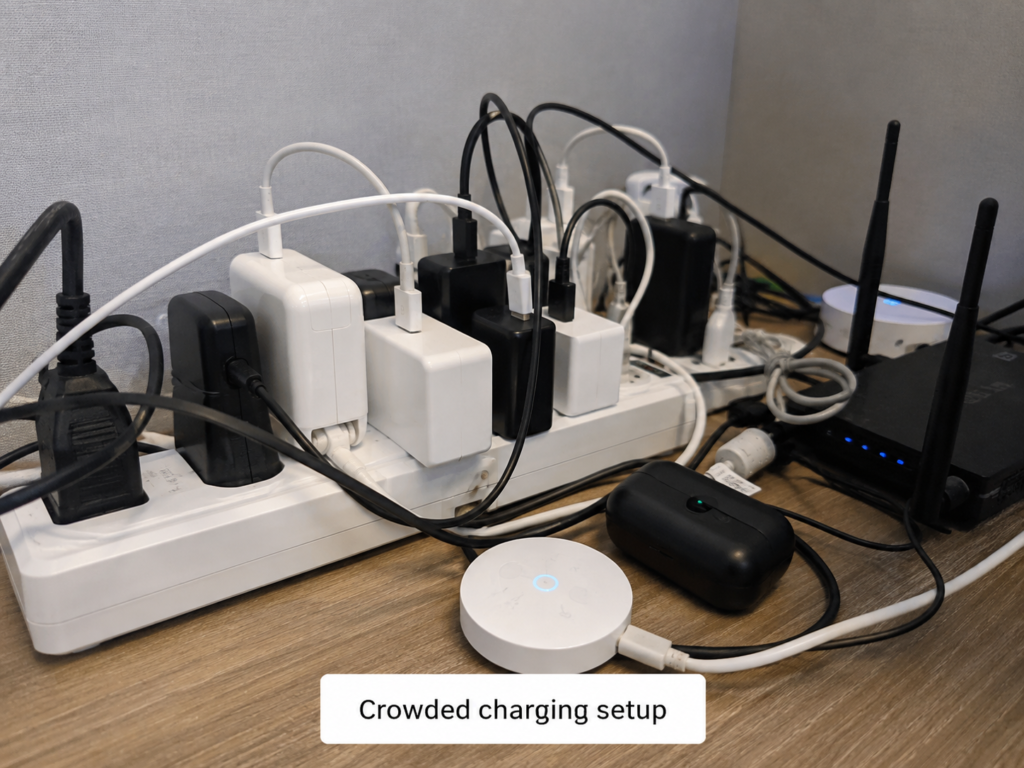
From the perspective of usage scenarios, power strips in homes or offices are full of fast chargers, routers, and Bluetooth devices, with high equipment density, and the electromagnetic environment may be more complex; in in-vehicle or travel scenarios, the space is small, there are many cables, and the vehicle power supply often fluctuates (such as when starting the engine), which will also increase the difficulty of troubleshooting. The most common external interference sources in daily life are mainly static electricity in winter, power grid fluctuations, and high-power household appliances such as microwave ovens and induction cookers.
Hard Constraints in Overseas Markets: Non-Compliant Products Cannot Be Sold at All
If you live in mainstream markets such as the European Union and the United States or do cross-border business, you will know that EMC is often not an option, but an important market access requirement. Before products enter the target market, they should meet applicable EMC regulations and conformity procedures, and have technical documents and declarations required by regulations ready; test reports are often one of the key evidences to prove conformity, but the specific documents, labels and whether they need to be presented depend on the product category and the rules of the target market.
The rules of mainstream overseas markets need to be specifically confirmed according to products and jurisdictions: most applicable products in the European Union need to complete conformity assessment according to the EMC Directive, compile technical documents and EU Declaration of Conformity, and affix the CE mark; but it should first be confirmed whether the product is within the scope of this directive, or whether other more specific regulations apply. Equipment subject to FCC rules in the United States must complete corresponding equipment authorization according to its category, and many unintentional radiators use SDoC instead of FCC certification. Canada, Australia and New Zealand also have corresponding electromagnetic compatibility or interference control requirements, but applicable ISED, ACMA/RCM procedures and labeling requirements should be confirmed according to specific product categories.
Specifically for charging products, the applicable EMC standards and test items are not one-size-fits-all, but are jointly determined by product category, use environment, power supply and communication ports, functional configuration and target market requirements, and cannot be uniformly judged only by 65W, whether with a chip or whether there is shielding. For USB-C cables, it is particularly necessary to confirm whether they are independently regulated products, or part of the whole machine test configuration, and determine whether corresponding emission or immunity tests are required according to applicable standards.
If you take a chance to sell non-compliant products, the price is actually very high. First is market supervision and import links: once found to be non-compliant with applicable requirements, you may face sales suspension, rectification, product return, fines or other dispositions, and the specific consequences depend on local regulations and law enforcement. Then is the platform side: mainstream overseas e-commerce platforms such as Amazon and eBay may have relatively strict requirements for compliance materials. Once complained or spot-checked for insufficient materials or products that do not meet requirements, products may be removed from the shelves, and in serious cases, seller accounts may be affected. Finally is the commercial side: if problems are found after the products have been sold, the cost of recall and rectification, and the cost of after-sales handling are often much higher than doing compliance evaluation in advance, and will also affect brand reputation and channel cooperation, which is simply not worth the loss.
What Practical Benefits Does EMC Compliance Bring to Ordinary Users?
EMC is not a paper indicator that only compliance departments care about. It is directly related to your daily experience of using electronic devices, and may also be related to device stability.
The most intuitive benefit is to reduce the risk of causing unacceptable interference to other nearby devices. The most common ones are WiFi drops out and sudden drop in network speed when a fast charger is placed next to a router, or static in Bluetooth earphones; it is more obvious in in-vehicle scenarios, and some poorly designed car chargers may affect nearby wireless reception. However, non-compliant or poorly designed vehicle power supplies may cause interference to nearby wireless reception, but whether it specifically affects positioning, the degree of impact and the cause need to be confirmed through investigation or measurement. EMC-compliant products can reduce the risk of causing or receiving unacceptable interference under their intended use environment and specified configuration, but cannot guarantee that there will be no interference in all device combinations and all environments.
Secondly, it helps to ensure the stability of charging and data transmission. Charging interruption, speed reduction, transmission failure, screen flickering or restart when near interference sources may be related to electromagnetic immunity or signal integrity, and may also be related to cable specification and length, interface contact, power supply, device compatibility or software and hardware failures. Whether it is EMC non-compliance needs to be tested under controlled conditions according to applicable standards or investigated by professionals. Qualified products should have corresponding stable working ability under the test conditions and intended use environment specified by applicable standards, but the performance in daily use will still be affected by the matching of the whole set of equipment and environmental conditions.
Finally, EMC compliance also helps to reduce the risk of equipment abnormalities in interference environments. Strong electromagnetic interference may cause temporary abnormalities of equipment; for safety-related functions, designers should evaluate the consequences of their failure in combination with applicable EMC and Safety standards. Whether it will cause long-term aging, abnormal output or safety risks cannot be generally inferred solely from “EMC non-compliance”, and needs to be verified in combination with specific circuits, failure modes and applicable standards.
How to Preliminarily Judge EMC Compliance Without Professional Equipment
Since EMC is so important, for us ordinary users, is there a way to preliminarily judge whether a charging product has potential compatibility problems without going to the laboratory? In fact, some preliminary observations can be made from compliance information and daily use performance, but it should be clarified first: these methods cannot replace standard EMC testing.
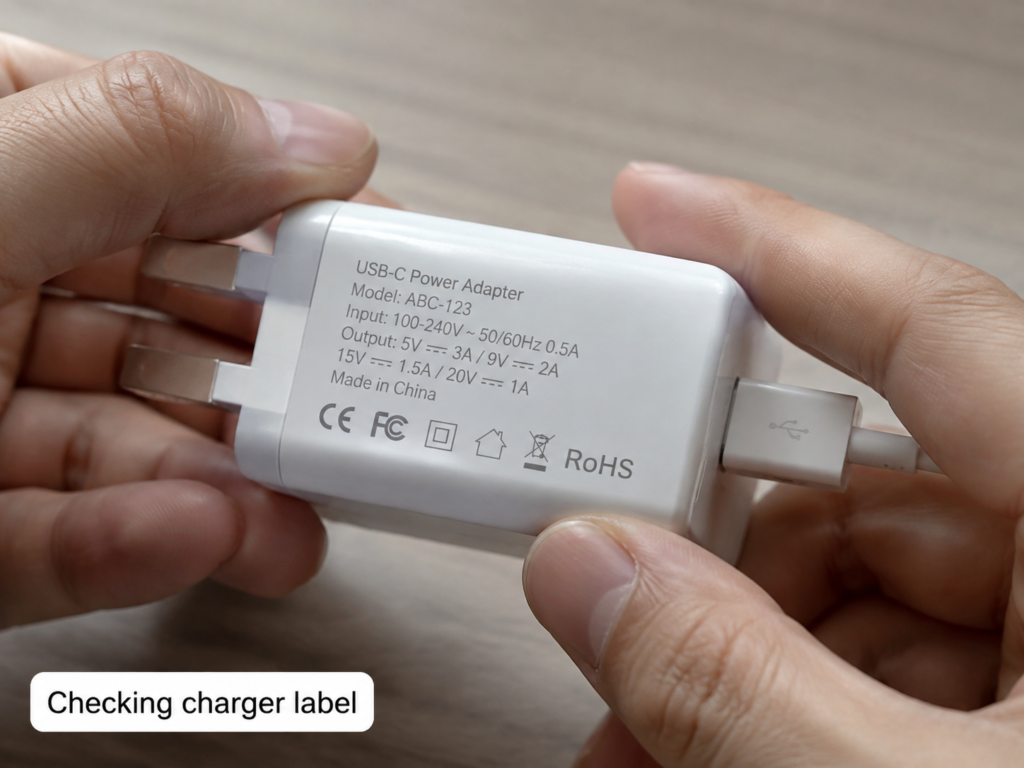
The first method is to make a quick preliminary judgment by looking at compliance information. You can first check whether the product has compliance labels required by the target market, manufacturer or importer information and accompanying conformity information, but do not take the label itself as a certificate of conformity. The EU CE mark is not a third-party certification; US products should be verified according to the applicable FCC authorization procedures, and products with wireless certification can usually be queried through FCC ID; Canada should be verified according to applicable ISED/ICES requirements. Here are two pitfalls to avoid: first, be wary of labels with rough printing that come off as soon as you scratch them. Many low-cost products with no brand, manufacturer information, and quality certification may have labels that lack reliable basis; second, don’t trust the “universal certificate” mentioned by merchants. When purchasing, you should confirm that the technical documents or reports cover the actual product and its representative configuration, version, ports and accessories, rather than just looking at whether the brand is the same.
The second method is to do a few simple daily observations without any professional tools. For example, if you find WiFi abnormalities, charging interruption, restart or transmission failure during charging, you can first replace known normal power supplies, cables and devices for cross-verification; when data transmission is unstable, you should also confirm whether the cable specification, interface status, host and device capabilities match. These observations can only be used to find possible compatibility or quality problems, and cannot determine whether EMI or EMS meets the standards. When EMC compliance needs to be confirmed, applicable documents should be checked or a capable laboratory should be entrusted to test according to standards. Do not repeatedly generate electrostatic discharge for testing purposes, so as not to damage equipment or cause data risks.
Finally, there are several key points to avoid pitfalls when selecting and purchasing products. When buying a charger, prioritize regular products with compliance information for the target market, and don’t buy ultra-low-cost products with no brand or label — abnormally low prices may indicate risks in materials, quality control or compliance documents, but you cannot conclude that EMC is unqualified solely based on price. When buying data cables, don’t just look at the “ferrite core” advertised by merchants. When purchasing, you can pay attention to whether it meets the required USB specifications, rated current and data rate, and whether the manufacturer provides applicable compliance and quality information; whether the shielding structure and ferrite core are effective depends on the specific design of the cable and the whole machine and the interference frequency band. If it is a bulk purchase, be sure to check the model, cable length, power, interface and version covered by the test report or technical documents to ensure that they are consistent with the actual product and representative configuration, and don’t be fooled by irrelevant materials provided by merchants. In a word: EMC is not something that only manufacturers care about, it is directly related to every ordinary user. Choosing regular products and paying attention to the compliance information of the target market can usually reduce the risk of buying inferior products.
The Most Common Cognitive Misconceptions
Finally, let’s clarify a few most common cognitive misconceptions to avoid being fooled by merchants’ propaganda.
The first misconception: only high-power electronic products need EMC testing. Many people think that low power will not cause interference, but that’s not true. Even a 20W low-power fast charger, or even an adapter with a chip, products with switching circuits or high-speed signals may also produce conducted or radiated emissions, but the performance and intensity will vary with design, use state and environment. As for whether EMC testing is mandatory and which items to test are determined by the target market, product attributes and applicable standards, not that low power definitely does not need to be done.
The second misconception: passive charging cables do not need EMC testing at all. Some people think that charging cables have no power supply and are passive, so there will be no EMC problems, but that’s also not true. Fast charging cables with smart chips and high-speed data cables may need to be evaluated accordingly according to their product attributes, sales market and applicable standards — cables may not only conduct noise, but also may radiate or receive interference like an antenna under specific conditions. As for whether ordinary low-voltage charging cables need to meet specific EMC requirements and how to evaluate them, it still depends on whether they are sold as independent products, or as part of the whole machine configuration, as well as the specific rules of the target market.
The third misconception: products with certification labels will 100% not have interference. This is also a misunderstanding of many people. In fact, certification or declaration of conformity is only a qualified conclusion made under applicable standards, test conditions and representative configurations, and is not omnipotent. If you match a qualified fast charger with a poor-quality unbranded cable, or use it under overload, or in an extremely harsh electromagnetic environment (such as a high-power industrial equipment next to it), interference problems may still occur. Certification is the bottom line of compliance, not an absolute guarantee.
Overall, EMC seems to be a somewhat professional term, but its core is actually very simple: it is to let electronic products “coexist peacefully” in the same electromagnetic environment, neither disturbing others nor being disturbed by others. It is not a useless indicator in the laboratory, but an important access requirement for many overseas markets, and is directly related to your daily experience of using charging products. In the future, when you encounter small problems such as sudden WiFi drops out, inexplicable charging interruption of fast chargers, or frequent file transfer failures, you can take electromagnetic interference as one of the possible causes, and at the same time investigate network, power supply, cable, interface, protocol compatibility and equipment failures. When choosing products, pay more attention to the compliance information required by the target market, and prioritize products from regular brands, which can usually avoid a lot of troubles in use.