
Practitioners in the electronics industry operating in the EU market have most likely heard the term REACH: either they are required to provide REACH-related documents during customs clearance, or downstream customers request SVHC declarations, and some even only find out that their Bluetooth headsets and phone cases also need to comply with REACH when their goods are detained. Many people’s first reaction is: Doesn’t REACH only regulate chemical factories? What does it have to do with me who makes electronic products?
This article will break down the core rules, compliance requirements, and basic self-inspection methods of REACH from the perspective of the electronic product supply chain, helping practitioners quickly clarify the boundaries of responsibility and avoid common cognitive misunderstandings.
1. First, Grasp the Basics: What is REACH, and Does It Apply to Electronic Products?
Many people feel that REACH is far from themselves, essentially because they do not understand what it regulates. Let’s start with the most basic concepts.
Plain Language Definition and Basic Information
REACH is essentially a set of current chemical management regulations in the EU, which regulates chemical substances in all products entering the EU market — it does not only regulate pure chemical raw materials; as long as your product contains chemical substances, it is subject to REACH.
Its full name is the Regulation on Registration, Evaluation, Authorisation and Restriction of Chemicals, abbreviated as REACH. The implementation of the rules is coordinated by the European Chemicals Agency (abbreviated as ECHA, the EU-level chemical management agency), which is responsible for registration management, risk assessment, and list updates. The competent authorities of each member state are responsible for local law enforcement inspections and penalties.
This regulation officially entered into force on June 1, 2007, covering all EU member states, as well as Norway, Iceland, and Liechtenstein in the European Economic Area (EEA). Unlike many EU directives that need to be transposed into national law by each country, REACH is a regulation directly applicable at the EU level, and the basic standards implemented by all member states are consistent, so there is no need to worry about different core requirements in Lisbon and Berlin.
The core regulatory logic of REACH runs through the entire life cycle of chemical substances — from production/import, circulation and use, supply chain information transmission to risk connection in the waste stage, rather than only regulating the market entry of finished products. It has two core goals: first, to reduce the risks of harmful chemical substances to human health and the environment; second, to promote the transparency of chemical substance information throughout the supply chain. The core principle of responsibility it follows is: whoever places chemical substances or products containing chemical substances on the EU market needs to bear compliance responsibility and prove that the use risks of the relevant substances are controllable, rather than requiring regulatory authorities or consumers to prove that the product has risks. Specific responsibilities will be differentiated according to supply chain roles and product types, which we will correspond to in detail later.
Three Types of Regulated Objects: First, Figure Out Which Category Your Product Belongs To
REACH divides regulated objects into three categories, with completely different obligations for each category. Those in the electronics industry should first match their product to the corresponding category before aligning with the requirements later.
| Regulated Object | Plain Language Definition | Common Examples in the Electronics Industry |
|---|---|---|
| Substance | A single chemical element or compound, i.e., the chemical raw material itself | Lead, phthalates, pure tin |
| Mixture | Two or more substances mixed together, with no fixed shape | Solder paste, glue, thermal grease, paint |
| Article | A product with a fixed shape and a specific function when produced | Mobile phones, circuit boards, battery cells, plastic casings, chargers |
For the electronic product supply chain, complete machines, components, and casings basically belong to “articles”, and only chemical raw materials used in the production process (such as glue, plastic pellets, flux) are substances or mixtures. Many people think that REACH only regulates the first two categories and has nothing to do with the articles they make, which is the biggest misunderstanding — articles also have corresponding compliance requirements, which we will explain in detail later.
Why the Electronics Supply Chain Must Pay Attention to REACH
Electronic products look like they are made of metal and plastic, but in fact, they contain a large number of high-risk chemical substances: plasticizers and flame retardants in plastic casings, heavy metals in solder, screen coatings, battery raw materials, and even ink on labels may all be high-risk substances regulated by REACH.
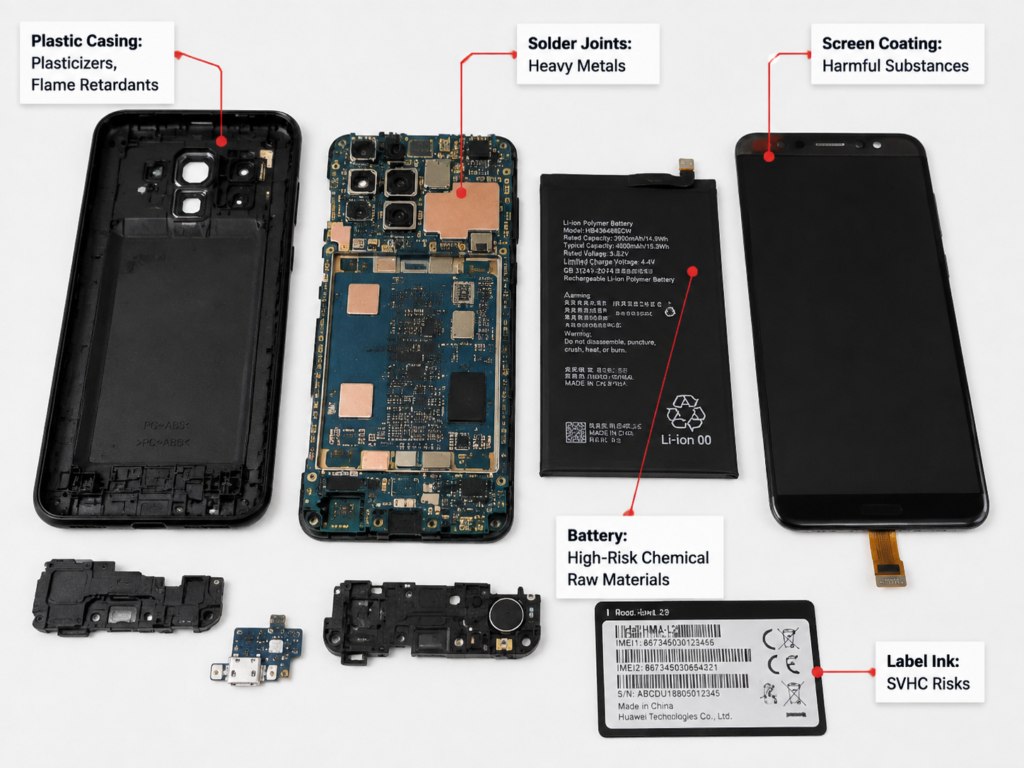
In addition, the supply chain of electronic products on the market is generally very long: from plastic pellet factories to casing factories, from circuit board factories to assembly factories, and finally to brand owners selling to the EU. Each link has the responsibility of information transmission, not only the most upstream chemical factories have to bear responsibility.
If you violate the regulations, the cost is not low: in mild cases, goods are detained and cannot be cleared; in severe cases, there are fines and EU-wide recalls, which directly affect EU market access.
Which Situations Have Exemptions or Special Rules
Of course, not all products related to electronics are fully managed in accordance with REACH article requirements. The following categories of situations have exemptions or special rules:
- Second-hand electronic products for personal non-commercial use: No need to perform REACH commercial compliance obligations, such as individuals carrying old mobile phones to travel to the EU, or individuals purchasing second-hand headphones overseas for personal use; however, the wholesale and sale of second-hand electronics for commercial purposes still need to comply with corresponding requirements.
- Electronic products for national defense use: Need to comply with the national defense exemption rules of the corresponding member state. Not all military supplies are automatically exempt from REACH restrictions; the specific provisions of the member state shall prevail.
- Electronic product parts that come into direct contact with food: Such as waterway contact parts of coffee machines and food-contact plastic parts of blenders, need to first meet the special regulations on food contact materials; at the same time, it is still necessary to verify the applicable restriction entries in REACH and the supply chain information transmission obligations.
- Categories covered by other special regulations: Categories managed by special EU regulations, such as radioactive substances and pharmaceuticals, need to be combined with specific scenarios to determine the applicable scope of REACH.
2. Core Logic: Four Major Regulatory Mechanisms of REACH (Combined with Electronics Scenarios)
The name REACH hides its four core mechanisms: Registration, Evaluation, Authorisation, and Restriction.
Registration: Chemical Substances in Large Quantities Must Be Reported First
Registration is the most “heavy” requirement in REACH. The core rule is: when a single chemical substance produced or imported within the EU reaches 1 ton or more per year, EU manufacturers, EU importers, or the Only Representative (OR) designated by non-EU manufacturers when eligible, need to submit a complete substance safety information report to ECHA, which is registration.
The substances here include not only pure chemical raw materials that exist alone, but also substances in mixtures, and substances intentionally released from articles under specific circumstances; polymers such as plastic pellets themselves are usually exempt from registration, but if the monomers and functional additives in them meet the tonnage requirements, they may trigger registration obligations.
This obligation mainly falls on upstream chemical raw material suppliers and importers within the EU — for example, if you make plastic pellets, and a certain registrable substance contained in a certain type of plastic pellets you sell to the EU every year accumulates to more than 1 ton, then the corresponding responsible entity needs to complete the registration.
For mid- and downstream component factories, assembly factories, and cross-border sellers, there is basically no need to do registration themselves, because the chemical raw materials you purchase (such as plastic pellets, solder, glue) have already been registered by upstream suppliers, and you only need to get the upstream information and pass it down.
Here is a practical judgment point: if the annual volume of a single substance placed on the EU market is less than 1 ton, registration is not required, but you still have to comply with other requirements such as restrictions and information transmission mentioned later, it is not that you don’t need to care about REACH at all.
Evaluation: EU Official Spot Checks and Risk Updates
Registration is not a once-and-for-all solution. ECHA regularly spot-checks the registration materials submitted by enterprises, and also follows up on the latest global toxicological and environmental research on chemical substances to dynamically assess the harmful risks of known and newly discovered substances.
The results of evaluation usually include three categories: requiring registered enterprises to supplement more safety data, adding substances to the SVHC (Substances of Very High Concern) list, and promoting the upgrading of substances to authorization or restriction control objects.
For the electronics supply chain, this dynamic evaluation will be transmitted along the chain: if substances in upstream raw materials are required to supplement data or adjust risk classification, downstream enterprises may need to simultaneously update SDS, SVHC compliance declarations, test coverage, and even re-evaluate whether materials trigger new authorization or restriction requirements.
Authorisation: Extremely Hazardous Substances Require a Permit to Use
Some chemical substances are particularly hazardous, such as carcinogenic, mutagenic, and reprotoxic substances (abbreviated as CMR), as well as persistent organic pollutants. These substances are not completely prohibited from use, but you need to apply for authorisation from ECHA first, proving either that the risk of the amount used is controllable, or that no safer alternative can be found. After approval, the Annex XIV substance / mixture containing the substance can be used or placed on the market within the EU under the uses and conditions covered by the authorisation decision.
Substances that require authorisation are listed in Annex XIV of REACH. Common ones in the electronics industry include some phthalates (plasticizers for wire sheaths) and some cadmium compounds (battery raw materials).
It is necessary to specially explain the applicable boundaries here: REACH authorisation mainly restricts the production and use of Annex XIV substances within the EU, as well as the act of placing them on the market as substances or mixtures; when imported electronic articles contain relevant substances, the focus is usually on verifying SVHC information transmission, SCIP notification, and Annex XVII restriction requirements, which cannot be directly equated with the need to apply for authorisation.
In addition, it must be noted that the SVHC list of substances of very high concern that people often hear about is only a “candidate pool” for authorised substances. Not all SVHCs require authorisation — only those officially included in Annex XIV will trigger authorisation requirements for corresponding scenarios.
Restriction: The Mandatory Red Line That Cannot Be Touched
Restriction is the strictest requirement in REACH and is a mandatory red line. Restricted substances listed in Annex XVII are either completely prohibited from use in specific purposes, or have clear maximum allowed content limits. As long as they do not meet the restriction requirements, the product cannot be placed on the EU market.
The scope of restriction is not necessarily all categories, and may only be for specific uses or specific products. For example, some phthalates are only prohibited from use in electronic plastic parts for children, and can be used for adults if they meet the conditions.
Common restricted substances in the electronics industry include some polybrominated diphenyl ethers (flame retardants for plastic casings), some phthalates (children’s electronic accessories), and cadmium and its compounds.
Many people can’t tell the difference between authorisation and restriction. Simply put: Restriction is a hard red line. If you don’t meet the requirements, you are in violation, and there is no room for negotiation; authorisation means that after meeting the conditions and passing the application, you can carry out the corresponding activities in compliance.
3. The Most Frequent Compliance Point: Full Explanation of SVHC (Substances of Very High Concern)
For people in the electronics industry dealing with REACH, the vast majority of daily scenarios involve SVHC, such as customers asking you for SVHC declarations, or freight forwarders asking you to provide SVHC-related test reports. In this part, we will explain the core rules of SVHC clearly, especially the threshold calculation that is most easily misunderstood.
What is SVHC: Why Everyone is Talking About It
The full name of SVHC is Substances of Very High Concern. Simply put, it is a batch of chemical substances that “may cause serious irreversible harm” regularly updated by the EU, such as carcinogenic substances, endocrine-disrupting substances, and substances that cannot be degraded in the environment for hundreds of years and accumulate in the human body (abbreviated as PBT/vPvB).
The EU updates the SVHC list 1-2 times a year. As of 2024, there are about 240 candidate list entries. The specific substance names, entry scope and quantity shall be subject to the latest official Candidate List of ECHA.
What is the relationship between SVHC and the authorisation and restriction mentioned above? It is equivalent to a “candidate pool”: newly discovered highly hazardous substances are first added to the SVHC list, and after a period of observation, they may be upgraded to substances requiring authorisation, or even directly become restricted substances. Therefore, when enterprises pay attention to SVHC, they are actually responding to future compliance requirements in advance.
High-Risk Parts of SVHC in Electronic Products
You don’t need to check every part of your product, just focus on these high-risk parts:
- Soft plastics: such as PVC cables, sealing rings, soft rubber buttons, plasticizers and flame retardants in plastic casings;
- Electronic components: circuit boards, solder, metal plating, batteries;
- Adhesive coatings: screen back glue, structural adhesive, ink, coatings, labels, surface treatment materials.
These parts use a lot of chemical substances and are the hardest hit areas for SVHC exceeding the standard. Priority verification can save a lot of trouble.
How to Calculate the 0.1% Threshold: Don’t Get the Calculation Basis Wrong
SVHC has a unified threshold: 0.1%, which is a weight ratio (w/w). But many people get the calculation unit of this ratio wrong — it is not calculated based on the entire finished product, nor based on homogeneous materials (such as plastic pellets used to make casings), but based on individual articles.
What is an individual article? It is a single component that has a fixed shape and a specific function when produced, such as the plastic casing of a charger, a single battery cell, or a circuit board. This calculation basis was clearly ruled by the European Court of Justice in 2015 and has legal effect.
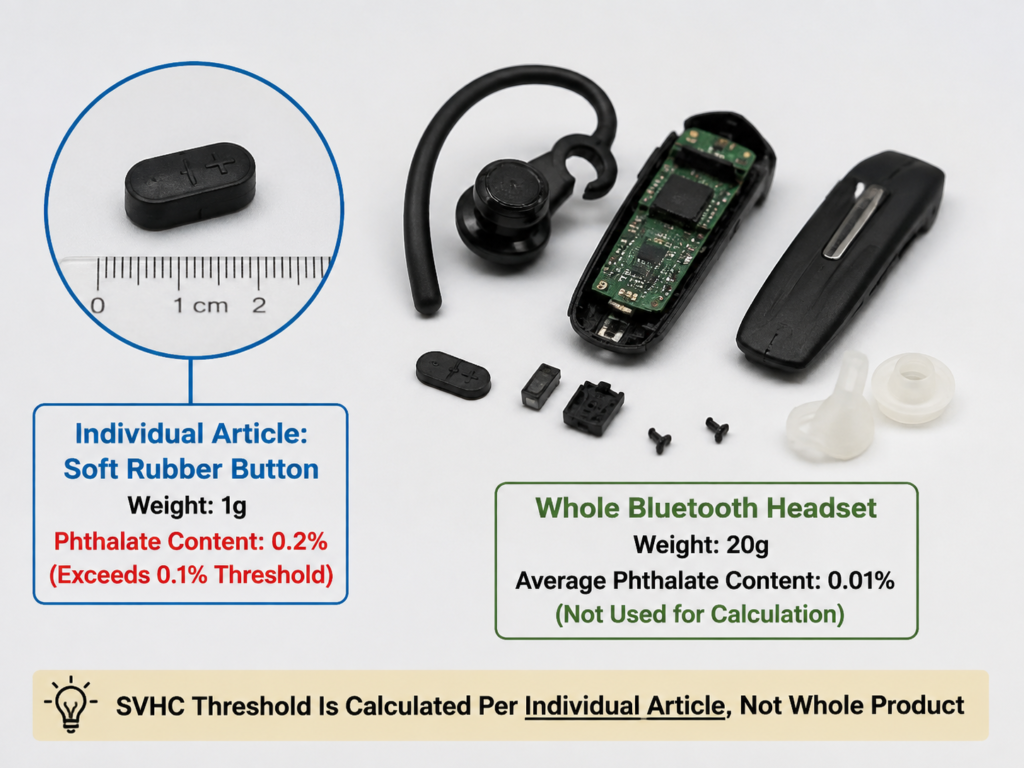
Take the most common example: the soft rubber button of a Bluetooth headset weighs 1 gram, and the detected phthalate content in it is 0.002 grams, accounting for 0.2% of the weight of the button, which exceeds the 0.1% threshold. Even if the entire Bluetooth headset weighs 20 grams, and spreading this 0.002 grams over the entire headset is only 0.01%, it doesn’t count — because the button is an individual article, it must be calculated separately, and the weight of the entire finished product cannot be used to dilute it.
Many people have another misunderstanding: they think it is calculated by homogeneous material like RoHS, for example, as long as the SVHC content in plastic pellets does not exceed 0.1%, it is fine. In fact, this is wrong — it must be calculated based on the total weight of the entire individual article. For example, the phthalate content in plastic pellets is 0.08%, but when making buttons, other phthalate-containing additives are added, and the content of the entire button becomes 0.15%, which is still exceeding the standard.
Of course, the article boundary of complex products is sometimes difficult to judge. For example, a circuit board with many resistors and capacitors soldered on it — is it an individual article? In this case, you should refer to the latest guidelines issued by ECHA, and you cannot define it arbitrarily.
Three Core Obligations for SVHC Exceeding the Standard
Many people think that if SVHC exceeds 0.1%, it cannot be sold to the EU. In fact, this is not the case — exceeding the standard only requires fulfilling the corresponding obligations, and it is not prohibited from being placed on the EU market. There are three specific obligations:
- Supply chain notification obligation: If the SVHC content in an article is ≥0.1%, it is necessary to proactively provide the name of the substance and relevant information sufficient to ensure safe use to downstream buyers; when ordinary consumers make requests regarding related issues, a free reply must be given within 45 days.
- ECHA notification obligation: If the total annual volume of the same SVHC in related articles placed on the EU market by the producer/importer is ≥1 ton and the content is ≥0.1%, the use of the substance must be notified to ECHA. The responsible entity for this obligation is usually the producer or importer within the EU; non-EU suppliers only need to provide information such as substance name, content, use, and tonnage to assist the EU responsible party in completing the notification. If it can be proven that the substance will not cause exposure to humans or the environment during normal or reasonably foreseeable use and disposal stages, or that the substance has completed REACH registration for this use, the notification obligation can be exempted.
- SCIP database notification: Articles containing ≥0.1% SVHC must be notified to the EU SCIP database. It should be noted that the SCIP requirement comes from the EU Waste Framework Directive, not an obligation of REACH itself, but its threshold and article scope are directly linked to REACH SVHC requirements; this obligation is usually submitted by importers, suppliers or their designated entities within the EU, and overseas sellers only need to cooperate in providing relevant information such as parts, substances, concentration ranges, and safe use.
4. Match Your Role: REACH Responsibilities of Each Role in the Electronics Supply Chain
REACH responsibilities are divided according to supply chain roles, and not all enterprises have to do the same things. First, compare your own role, and you will know what you need to do, so you don’t have to work blindly.
Upstream Raw Material/Chemical Suppliers
For example, manufacturers of plastic pellets, solder, glue, and thermal paste have three core responsibilities: if the annual volume of a single chemical substance placed on the EU market reaches more than 1 ton, REACH registration must be completed; provide material safety data sheets (i.e., SDS, only applicable to substances/mixtures) to downstream customers; inform downstream customers of the SVHC and restricted substance content in your products.
If the annual placement volume is less than 1 ton, registration is not required, but you still have to comply with restriction requirements and transmit chemical substance information to downstream parties, it is not that you don’t need to care at all.
Midstream Component/Assembly Suppliers
For example, manufacturers of circuit boards, batteries, screens, and plastic casings have the core responsibility of transmitting the chemical substance information of their components to downstream customers, cooperating with downstream SVHC investigations, and ensuring that their components meet REACH restriction requirements.
Many midstream manufacturers have a misunderstanding: they think they also need to do REACH registration, but in fact they don’t — the chemical raw materials you use have already been registered by upstream suppliers, and you only need to pass the information given by the upstream down.
Downstream Finished Product Brands/Cross-Border Sellers (Outside the EU)
For example, cross-border e-commerce sellers with their own brands and finished product brand owners, if you are not located in the EU, the core responsibilities are: confirm that all parts of the finished product meet REACH restriction requirements; if there is SVHC exceeding the standard, cooperate with the EU responsible party to fulfill the notification obligation; prepare the substance information required for SCIP notification for submission by the EU importer or designated entity.
There are two points to note here:
First, the “Only Representative (OR) within the EU” under REACH is not a mandatory requirement for all non-EU electronic finished product sellers. The OR is usually an entity designated by non-EU substance/mixture producers or specific article producers who need to fulfill registration obligations to bear compliance responsibilities within the EU; ordinary non-EU electronic finished product sellers generally do not need to mandatorily designate an OR. REACH’s market entry compliance obligations are usually borne by importers or distributors within the EU. Whether it is necessary to designate an OR can be judged based on product type, transaction structure, and the requirements of the EU importer. The OR should not be regarded as a necessary prerequisite for customs clearance of all electronic products.
Second, you cannot use “my supplier says it’s compliant” as a shield — although legal responsibilities are mostly borne by entities within the EU, as the supplier of the product, you are responsible for the authenticity of the product information you provide. Therefore, you must verify the compliance materials provided by the supplier, and cannot just listen to verbal promises, otherwise it may affect the EU market access of the product.
EU Importers/Distributors
If you are an importer or distributor within the EU, the core responsibilities are: verify whether the products you import meet REACH requirements, keep all compliance materials properly, and cooperate with official spot checks. If overseas sellers do not provide sufficient compliance information, you, as the responsible entity within the EU, need to bear corresponding responsibilities — that’s why many EU buyers repeatedly ask you for compliance materials, to avoid their own risks.
5. Practical Skills: How to Identify Authenticity of Compliance Documents and How to Use Them
Compliance work inevitably involves receiving various documents. Many people can’t tell which are useful and which are not, and some even get scammed into buying fake certificates. This part teaches you how to identify common REACH compliance documents.
Scope of Application of Common Compliance Documents
There are three main types of common REACH-related documents on the market, with completely different scopes of application. Don’t mix them up:
- Material Safety Data Sheet (SDS): Only applicable to substances and mixtures (such as glue, solder paste, paint, thermal grease), and contains information such as substance hazards, protective measures, storage requirements, and spill emergency response.
- SVHC Compliance Declaration: Issued by the enterprise itself, stating which version of the SVHC list the product corresponds to, whether it exceeds the standard, and which product models and material ranges it covers. This document is an enterprise self-declaration, which does not require a third-party seal, but it is only valid when the information is complete.
- Material Test Report: Test results issued by a third-party testing institution for submitted samples, such as screening heavy metals with XRF and testing organic substances with GC-MS. The test report only represents the situation of the submitted samples, and cannot directly prove that all bulk goods are compliant, nor can it replace the information verification of the entire supply chain.
There are two common misunderstandings about SDS that need to be clarified: First, finished electronic products belong to the category of “articles”, and usually do not need to provide a complete machine SDS. The so-called “complete machine SDS” does not meet regulatory requirements, is not officially recognized, and cannot replace the separate SDS of each chemical raw material. Second, if substances/mixture consumables such as glue, cleaning agents, and flux are sold with the product, or customers request safety information of components such as batteries due to transportation, storage, or occupational safety requirements, corresponding materials should be provided in accordance with relevant regulations, and reasonable requests cannot be rejected with the general statement that “articles have no SDS”.
Judgment Criteria for Valid Compliance Documents
Whether it is a declaration or a test report, it is only useful if it meets these criteria:
First, there must be clear product models, material/component ranges, and the identity of the supplier issuing the document — a declaration that doesn’t even state which product it is for or which supplier issued it is equivalent to waste paper.
Second, the corresponding SVHC list/restriction list version, as well as the date of the declaration/test, must be indicated — because both types of lists are updated every year, and old version declarations cannot cover newly added control requirements.
Third, if it is a test report, it must also state what the test object is, what the concentration unit is, and which substances are covered by the test — a report that only writes “REACH test passed” but does not say which substances were tested or which component was tested is useless at all.
It should be noted that SVHC testing or compliance declarations only cover the requirements of the Candidate List of Substances of Very High Concern, and do not equal full REACH compliance; the compliance of Annex XVII restricted substances needs to be verified separately according to the corresponding entries.
The Truth About “REACH Certification”
Many people have heard of “REACH certification” and even spend a lot of money to buy it. Here is a clear statement: There is no official “REACH certification” body in the EU, nor is there a unified REACH certificate.
The “REACH reports” you can buy on the market are either sample test reports issued by third-party testing institutions or compliance declarations made by enterprises themselves. There is no such thing as an “officially issued REACH certification certificate” at all.
Pitfall reminder: Don’t believe the claim that “one REACH certificate covers all your products and is permanently valid”, which is basically a scam.
6. Pitfall Avoidance Guide: 7 Most Common REACH Cognitive Misunderstandings
Doing REACH compliance is often not difficult in operation, but difficult in cognitive errors, which leads to wasted money and pitfalls. We have compiled 7 of the most common misunderstandings, and you can check if you have fallen for them.
Misunderstanding 1: REACH Only Regulates Chemical Factories and Has Nothing to Do with Electronic Products
REACH regulates all products containing chemical substances. Consumer electronics belong to the “article” category of regulated objects and are definitely regulated. Only specific parts that are second-hand for personal non-commercial use, meet national defense exemption conditions, or are fully covered by special regulations can apply exemptions or special rules. You cannot default that electronic products are not within the scope of regulation.
Misunderstanding 2: Passing RoHS Equals Complying with REACH
RoHS and REACH are two completely independent regulations: RoHS only targets electrical and electronic equipment and regulates the limits of 10 hazardous substances; REACH regulates all products containing chemical substances, covering hundreds of substances, and also has multiple types of obligations such as information transmission and notification. Some substances such as lead and cadmium are regulated by both, but RoHS compliance absolutely does not replace REACH compliance, and must be verified separately.
Misunderstanding 3: If SVHC Exceeds 0.1%, It Cannot Be Placed on the EU Market
SVHC exceeding the standard only requires fulfilling corresponding obligations such as notification, reporting, and SCIP, and is not prohibited from being placed on the EU market. Only when this SVHC also falls under the restriction entries of Annex XVII and does not meet the corresponding limits, uses, or exemption conditions, the product shall not be placed on the EU market.
Misunderstanding 4: All Electronic Product Enterprises Need to Do REACH Registration
Only EU-based manufacturers, importers, or designated ORs with a single chemical substance placed on the EU market annually ≥1 ton need to register, and they are basically upstream chemical raw material-related enterprises. Mid- and downstream assembly factories, component factories, and finished product sellers basically do not need to do registration themselves as long as they do not involve mass production/import of pure chemical raw materials or registrable substances, so there is no need to waste money.
Misunderstanding 5: The SVHC Threshold Is Calculated by Homogeneous Material or Whole Machine Average
The 0.1% SVHC threshold is calculated based on the total weight of each individual article. It cannot be calculated based on homogeneous materials such as plastic pellets, nor can the weight of the entire mobile phone or computer be used to dilute locally high-concentration parts. This basis is supported by the ruling of the European Court of Justice, so do not adjust the calculation method on your own.
Misunderstanding 6: A Long-Term Valid REACH Declaration Is Enough
REACH’s SVHC list and restriction list are updated every year, and product formulas and suppliers may also change. There is no “long-term valid” REACH declaration. A valid declaration must clearly indicate the corresponding list version, issuance date, covered product models and material ranges. Expired or incomplete declarations have no reference value.
Misunderstanding 7: SCIP Is Part of REACH
The requirements of the SCIP database come from the EU Waste Framework Directive and do not belong to the four core mechanisms of REACH. Only its threshold and article scope are directly linked to REACH SVHC requirements, so they are often discussed together. The two have different legal sources, so don’t confuse them.
7. Ready to Use: 4-Step Beginner-Level REACH Compliance Self-Inspection
We have compiled a set of beginner-level self-inspection steps. Whether you are a seller or a supplier, following them will help you complete basic compliance.
Step 1: Clarify Your Own Role and Corresponding Obligations
First, compare with the role division in the fourth part to determine your position in the supply chain: are you an upstream raw material supplier, midstream component supplier, downstream seller, or EU importer?
There are three core judgment points: Do you directly supply products to the EU? What is the approximate annual supply scale? Do you produce or import pure chemical raw material products? After figuring out these three questions, you will know which obligations you need to fulfill, and you won’t do useless work.
Step 2: Sort Out High-Risk Materials and Collect Valid Compliance Documents
You don’t need to check all materials, first focus on the high-risk materials mentioned earlier: plastic casings, wires, batteries, solder, coatings, circuit boards, glue.
Then collect core materials from your upstream suppliers: if it is chemical raw materials, request SDS reports; all materials require SVHC compliance declarations, and if necessary, material test reports. If you are in high-demand scenarios such as automotive electronics, you can also use material data systems such as IMDS/CAMDS to sort out substance information for higher efficiency.
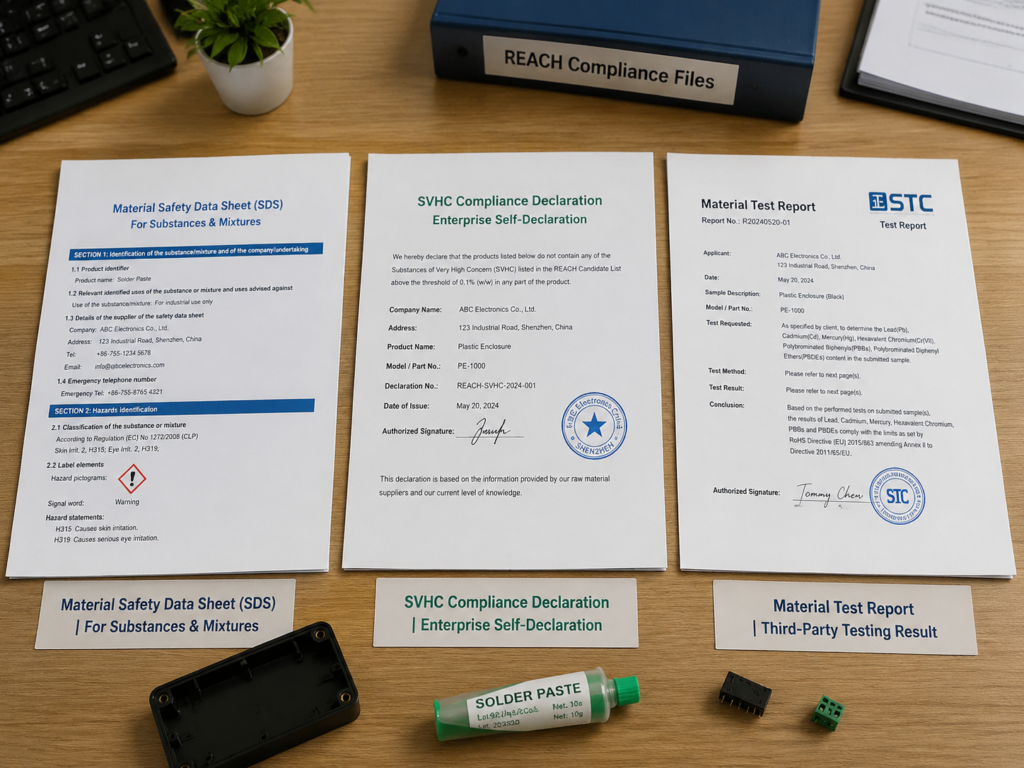
The collected materials should be verified according to the valid criteria mentioned in the fifth part, and invalid materials without dates, models, or list versions should be returned to the supplier for re-issuance.
Step 3: Compare with Official Lists to Judge Compliance
After obtaining valid materials, you need to check two EU official lists separately: SVHC corresponds to the ECHA Candidate List, and restriction requirements correspond to REACH Annex XVII (Restriction List). When comparing, prioritize using English substance names, EC numbers, and CAS numbers for retrieval, confirm the product types, uses, concentration limits, and exemption conditions applicable to the entries, and do not judge only based on Chinese common names or general classifications.
Both lists can be queried for free in ECHA’s official public database, and there is no need to obtain them through third-party payment.
Step 4: Fulfill Corresponding Compliance Obligations
After the inspection, do the corresponding things according to different situations:
- If all materials meet the requirements: keep all compliance materials properly for EU official spot checks, and regularly track ECHA’s list updates so that you don’t miss new substances added.
- If SVHC exceeds the standard, but the total annual volume of the corresponding substance placed on the EU market is less than 1 ton: inform downstream buyers of the name of the exceeding substance and safety tips, reply within 45 days if consumers inquire, and cooperate with the EU importer or designated entity to do SCIP notification.
- If SVHC exceeds the standard, and the total annual volume of the corresponding substance placed on the EU market is ≥1 ton: cooperate with the EU responsible party to complete ECHA notification, or evaluate replacing with low-risk alternative materials.
- If restricted substances do not meet the requirements: first compare with the specific entries of Annex XVII to confirm whether there are applicable exemptions or concentration/use exceptions; if they indeed do not meet the restriction requirements, materials should be replaced immediately and shall not be placed on the EU market, otherwise they may face penalties such as goods detention and fines.
8. Clarify Boundaries: The Relationship Between REACH and Other EU Electronic Regulations
In the electronics industry operating in the EU market, you often encounter terms such as RoHS, WEEE, and CE. Many people can’t figure out their relationship with REACH. We will explain it clearly with a table:
| Regulation/Mark | Core Regulatory Scope | Core Requirements | Relationship with REACH |
|---|---|---|---|
| RoHS | Only electrical and electronic equipment | Restrict the maximum content of 10 hazardous substances | Some substances (such as lead and cadmium) are regulated by both. RoHS compliance does not replace REACH compliance, and separate verification is required |
| WEEE | Electronic waste | Require producers to bear the responsibility of recycling and treatment | They belong to different stages of the product life cycle: REACH regulates chemical substance risks before market entry, WEEE regulates recycling after scrapping; SVHC information needs to be connected with waste treatment requirements |
| CLP | Chemical substances and mixtures | Require hazard classification, labeling, and standardized packaging | Chemicals used in electronic production (such as flux, glue) need to meet the requirements of both REACH and CLP |
| CE Mark | Safety compliance mark for specific products | Prove that the product meets relevant EU safety regulations | There is no separate “REACH CE certificate”. REACH compliance materials need to be included in the product’s technical document management, but the CE mark itself does not represent REACH compliance |
Simply put, these regulations each manage their own area. REACH regulates chemical substances in all products, with the widest scope. Other regulations have their own focuses, cannot replace each other, and all need to be complied with separately.
9. Basic Judgments You Should Be Able to Make After Reading
After sorting out all the content, you should be able to independently complete the following basic judgments and operations:
- Can judge whether REACH covers your electronic products, and clarify the applicable boundaries of common exemption scenarios such as second-hand for personal use and national defense use;
- Can distinguish the three types of regulated objects: substances, mixtures, and articles, and correspond to different scopes of compliance obligations;
- Can distinguish the differences between the four core mechanisms of registration, evaluation, authorisation, and restriction, as well as their respective impacts on different links of the electronics supply chain;
- Can sort out the hierarchical relationship between the SVHC Candidate List, Authorisation List (Annex XIV), and Restriction List (Annex XVII), and not confuse the requirements of the three types of lists;
- Can correctly judge the “individual article” calculation basis of the 0.1% SVHC threshold, and avoid common wrong calculation methods such as homogeneous material and whole machine average;
- Can compare with their own role in the supply chain, clarify the REACH responsibilities that need to be fulfilled, neither making useless compliance investments nor missing core obligations;
- Can identify invalid REACH compliance documents, and avoid common scams such as “official REACH certification” and “one certificate covers all products”;
- Can independently complete beginner-level REACH compliance self-inspection of electronic products, and complete basic risk investigation according to the four-step process;
- Can sort out the regulatory boundaries between REACH and RoHS, WEEE, CLP, and CE marks, and not confuse the applicable scope and requirements of different regulations;
- Can avoid high-frequency REACH cognitive misunderstandings, and reduce unnecessary compliance costs and violation risks.
In general, as an EU-level chemical management regulation, when it comes to entry-level compliance in the electronic product supply chain, the core of REACH is four basic tasks: “clarify your own role, focus on high-risk materials, check official lists, and retain compliance documents”. Violations will directly affect EU market access, and practitioners need to pay attention but do not need to be overly anxious. Specific compliance requirements shall be subject to the latest public information of ECHA and the legal responsibility requirements of EU importers. Do not believe the false propaganda on the market that “one certificate covers all products and is permanently valid”.