
Friends who deal in charging products and want to enter the Indonesian market have most likely heard the term “SDPPI certification” — some say all chargers need it, some say only wireless chargers do, and others claim CE certification is enough to get by, making it hard to distinguish truth from falsehood. Every year, many sellers who fail to understand SDPPI end up with their goods detained by customs at the port, their products forcibly removed from e-commerce stores, or even fined. Today, we will focus specifically on charging products and explain SDPPI certification clearly from basic concepts, scope of application, core requirements to application and pitfall avoidance. After reading this, you will be able to judge by yourself whether your product needs certification, and avoid 90% of common pitfalls.
Basic Understanding: What Exactly is SDPPI Certification
First, here is the most straightforward definition: the commonly mentioned SDPPI certification in the market is a market access certification implemented by Indonesia for regulated telecommunications equipment and devices. Whether a product requires certification depends on whether it falls into the equipment category covered by Indonesia’s applicable technical standards; without completing the corresponding required certification, regulated products cannot be legally manufactured, assembled, imported, traded or used in Indonesia.
This type of certification is often called “SDPPI certification” or “Postel certification” in the market, and these names come from old institutions and old systems. When handling applications and verifying certificates now, you shall take the Indonesian Ministry of Communications and Digital (Komdigi), its current DJID certification system, current regulations and technical standards as the basis, and do not judge solely based on old certificates or old names.
Many people confuse it with quality certification. In fact, this type of telecommunications equipment certification focuses on whether the equipment complies with applicable technical standards, such as radio spectrum use and signal interference control. For example, if you sell a smart charger with Bluetooth, if the wireless part does not meet local requirements on frequency band, power or spurious emissions, it may affect other legal wireless devices; this is exactly what the certification needs to focus on. It is not equivalent to how fast the charger charges or whether it will leak electricity, which may involve other compliance systems.
At this point, someone will definitely ask: isn’t a charger just for charging? How is it related to wireless certification? Here we must firmly establish a core logic: Whether a charging product requires SDPPI/DJID certification shall depend on whether it is a regulated telecommunications equipment or device in Indonesia and whether relevant technical standards apply. Wireless functions such as Bluetooth, WiFi, cellular, and NFC are usually important clues, but other regulated wireless functions such as wireless power transmission shall also be included in the judgment. You cannot only look at the product name, nor can you take “whether there is a wireless communication module” as the only condition.
If a product that should be certified is manufactured, imported, traded or used in Indonesia without completing certification, the consequences are straightforward: goods may be blocked during customs clearance, e-commerce platforms may also require compliance documents, and in serious cases, penalties may be faced. Therefore, as long as you are a seller, importer or purchaser of charging products in the Indonesian market, you must understand the rules of SDPPI/DJID.
Friends who are new to this can easily confuse SDPPI with other common certifications. We have compared several certifications commonly involved in charging products, so you can tell them apart at a glance:
| Certification Type | Regulatory Focus | Can it be used directly in Indonesia? |
| SDPPI/DJID Telecommunications Equipment Certification | Applicable technical standards for telecommunications equipment, including radio spectrum, signals, interference, etc. | It is a local Indonesian telecommunications equipment market access requirement |
| SNI | Indonesian national standard system, specific requirements vary by product and regulation | Whether it is mandatory depends on product category, HS classification and current regulations |
| CE/FCC/SRRC | Wireless or safety certifications of the European Union/United States/China | Cannot directly replace Indonesia’s SDPPI/DJID certification or other Indonesian compliance requirements; test data may be used as reference |
We also need to mention a combined requirement here: if your charging product is both a regulated telecommunications equipment that requires SDPPI/DJID certification and covered by current mandatory SNI regulations, energy efficiency label regulations or other licensing requirements, you need to meet the corresponding requirements respectively. Whether mandatory SNI, energy efficiency labels or other licenses are required must be confirmed based on the specific product category, HS classification and the regulations in force at the time, and you cannot conclude that a product must also require SNI just because it has Bluetooth.
Scope of Application: Which Charging Products Require SDPPI Certification
Now that we understand the basic logic, let’s go directly to what everyone cares about most: among charging products, which may be mandatory, and which usually do not fall within the scope of this type of certification?
Common Charging Products That May Require SDPPI Certification
Products with regulated wireless functions or falling within the scope of applicable relevant technical standards require further confirmation. The common ones are as follows:
1. Smart chargers, smart power strips/sockets with WiFi or Bluetooth APP control — for example, those that can be timed via mobile phone, adjust power, or display charging data, because they have Bluetooth or WiFi modules;
2. Wireless chargers with Bluetooth or wireless remote control — for example, those that can be remotely controlled to switch on/off or switch modes, with radio frequency communication functions;
3. Car chargers and fast charging heads with 2.4G or Bluetooth remote control — for example, those that can switch the power of charging ports through a remote control;
4. Shared power banks, charging cabinets, and outdoor energy storage power supplies with wireless functions that have built-in cellular network or Bluetooth — for example, shared power banks need to be connected to the Internet for billing, and outdoor power supplies can be connected to an APP to check power level;
5. USB-C docking stations and smart charging stations with wireless communication functions — for example, docking stations that can connect to WiFi to transmit data, or charging stations that can be managed remotely;
6. Individually sold wireless charging receivers with communication functions — for example, receivers plugged into mobile phones that can transmit data in addition to charging.
Common Charging Products That Usually Do Not Fall Within the Key Scope of SDPPI
Conversely, the following products usually do not have regulated telecommunications functions, but shall still be subject to actual configuration and product classification:
1. Ordinary wired chargers and power adapters — only have USB/USB-C output, pure charging function, without any wireless modules;
2. Qi wireless chargers without data communication functions such as Bluetooth and WiFi — this does not automatically mean that SDPPI/DJID certification is not required. The wireless charging transmitter may fall within the scope of application of Indonesia’s technical standards for wireless power transmission equipment, which shall be confirmed based on the product’s operating frequency, power, structure and the classification result of the competent authority;
3. Ordinary charging cables, adapters, AC plugs — pure physical connection, no wireless transceiver;
4. Multi-port chargers without wireless modules, ordinary wired charge-discharge power banks — the most common type of power bank that can only be charged by cable, without Bluetooth or WiFi.
Boundary Judgment Methods and Special Cases
Actual products are all kinds of strange, and there are always ambiguous times. At this time, you can judge by yourself according to the following methods, and if you are really unsure, consult a professional institution:
First, check the parameters: look through the product specification sheet to see if there are clearly marked parameters of wireless functions such as Bluetooth, WiFi, 2.4G, cellular, NFC, and also pay attention to whether it has functions covered by applicable technical standards such as wireless power transmission;
Then, check the functions: whether the product can be connected to a mobile phone APP, whether it can be controlled by wireless remote control, whether it has remote management, whether it can transmit data wirelessly — these functions usually have radio frequency modules behind them;
The core judgment principle: The judgment shall be based on the actual functions of the product, operating parameters, and whether it falls under the category of regulated equipment in Indonesia, and must never be based solely on the product name. For example, some products are called “smart wireless chargers” and may not have Bluetooth or WiFi, but the wireless charging transmitter still needs to be confirmed according to the rules of wireless power transmission equipment; conversely, some products are called “fast charging heads” but have a hidden Bluetooth module that can connect to the APP, which shall also be further confirmed whether certification is required.
If you are really unsure, you must find an institution familiar with DJID/SDPPI requirements to do product classification, don’t guess randomly — the cost of guessing wrong is much higher than the classification fee.
There are also several special cases to note, which are all easy pitfalls for sellers:
• Same appearance with different configurations: for example, the same charger has a standard version and a smart version, with exactly the same appearance, only the smart version has Bluetooth. They shall be confirmed respectively according to the actual configuration and applicable standards, and do not blindly share the certificate;
• Firmware or hardware changes: if you add wireless functions to the product later, or increase the transmit power of the wireless module, you must re-evaluate the certification and cannot continue to use the original certificate;
• Differences in sales scenarios: scenarios such as R&D, testing, exhibition or specific personal use may be eligible for certification exemption or special procedures, but the purpose, quantity, import requirements and whether approval from the competent authority is required shall be verified in advance; a small number of samples for personal use or testing cannot be automatically regarded as exempt from certification. Batch commercial import, trade or use shall usually be handled in accordance with formal certification requirements.
Core Requirements: What Does SDPPI Inspect for Charging Products
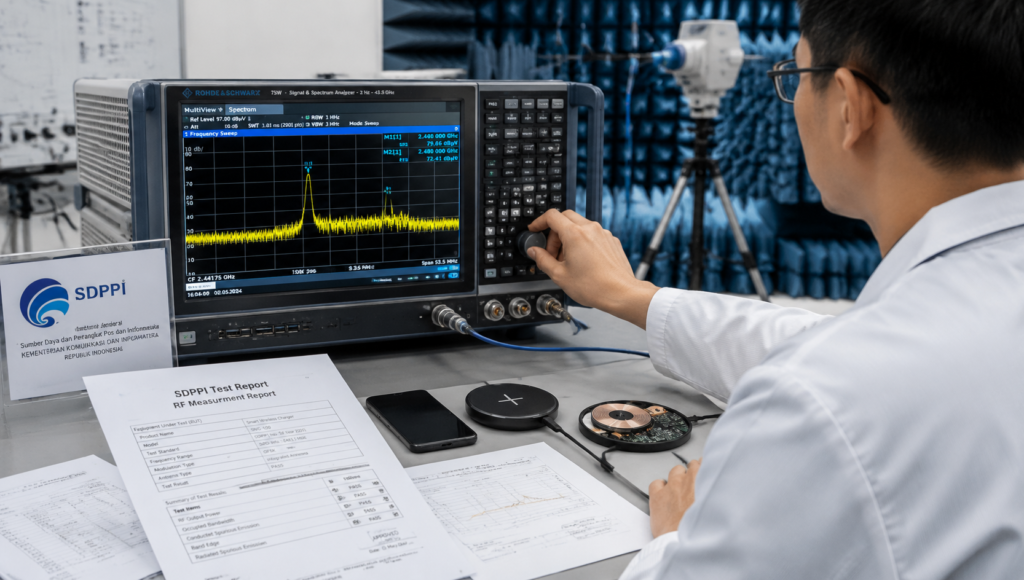
Many people think that certification is just “paying money to get a certificate”, but it is not. DJID/SDPPI certification depends on whether the product meets its applicable technical standards. The specific items for different equipment categories are not exactly the same, and all charging products cannot be treated as the same set of test rules.
First, let’s talk about the most straightforward core compliance logic, just three points:
First, the wireless frequency band you use must comply with Indonesia’s applicable technical standards, and you cannot use unallowed frequency bands indiscriminately;
Second, the wireless transmit power must meet the limit requirements in the applicable standards, excessive power may interfere with other equipment;
Third, the equipment must not cause harmful interference to other legal wireless equipment.
For charging products with wireless functions or wireless power transmission functions, the applicable technical standards may involve the following aspects:

1. RF Transmit Power: It is the actual signal strength emitted by the wireless module. Whether it is compliant shall be judged according to the Indonesian technical standards applicable to the product, and is often expressed in parameters such as EIRP. The 2.5mW of Bluetooth Class 2 is the definition of Bluetooth power class, and cannot be directly regarded as the unified legal upper limit for all Bluetooth devices in Indonesia;
2. Frequency Band Occupation: Signals can only be transmitted in permitted frequency bands and cannot stray into other frequency bands, for example, 2.4G equipment cannot operate in other frequency bands without authorization;
3. Spurious Emissions: To put it simply, they are unnecessary emissions generated by the equipment in addition to the normal working signals. Applicable technical standards may set requirements and limits for this;
4. Electromagnetic Compatibility: Applicable technical standards may include EMC and other requirements, but the specific whether to test, test limits and test methods shall be subject to the Indonesian technical standards applicable to the product;
5. Information Consistency: The product model, the model of the wireless module used, antenna type, etc., shall be consistent with the materials submitted when applying for certification. You cannot use module A when applying and replace it with cheaper module B during mass production.
Finally, let’s talk about several basic attributes of the certificate itself, which are all key contents to be verified:
• Certificate Holder Requirements: Overseas applicants usually need to handle it through a qualified local Indonesian responsible entity, and the specific entity arrangement shall be confirmed according to current application rules;
• Validity Period: The valid status stated on the certificate and current regulations shall be checked. According to current general provisions, the validity period of telecommunications equipment or device certification certificates is 10 years, and can be extended in accordance with regulations; old certificates or transitional arrangements shall be verified in accordance with the rules at the time of their issuance and current applicable rules;
• Coverage Rules: The certificate shall cover the actually sold products and their applicable wireless functions and configurations. For example, if a product has both Bluetooth and WiFi, you cannot judge based on only one function.
Application Guide: How to Apply for SDPPI Certification for Charging Products
If your product really needs SDPPI/DJID certification, how to start? We have sorted out the most simplified process for beginners, as well as the cycle and cost issues that everyone cares about most.
Pre-Application Preparations
Prepare these things first, which can save a lot of time:
1. Sort out wireless parameters: such as wireless standards (Bluetooth 5.3, WiFi 6, etc.), operating frequency bands, transmit power, specific model of the wireless module, antenna type (built-in or external);
2. Prepare product materials: complete specification sheet, clear photos of product appearance and nameplate, user manual; if the product has a charging function, corresponding charging parameters shall also be provided, such as PD power, output port specifications;
3. Confirm the certificate holder entity: implement a qualified local Indonesian importer or authorized representative;
4. Select a service provider: choose a test agent or laboratory with DJID/SDPPI related accreditation qualifications, don’t go to those unqualified small workshops, the test will be useless.
Simplified Application Process
The whole process is actually not complicated, the core is five steps:
1. Sample Submission and Testing: Send samples to a qualified laboratory, complete the tests applicable to the product, and obtain a test report;
2. Document Submission: Submit the test report, product materials, and qualification documents of the certificate holder entity to the current application system together;
3. Official Review: The competent authority will check whether your materials and test results are compliant, and will request corrections if there are problems;
4. Certificate Issuance and Number Acquisition: After passing the review, obtain the official certificate and the corresponding certificate number;
5. Market Listing Labeling: After obtaining the certification, the certification mark and required information shall be affixed or displayed in accordance with the current DJID/Komdigi certification label rules. The label position, electronic labels or packaging replacement methods shall be implemented according to product conditions and official rules, and it shall not be assumed that products, packaging and manuals must all be labeled at the same time.
Factors Affecting Cycle and Cost
Many people ask “how much? how long does it take to get the certificate?” as soon as they come up. In fact, there is no fixed answer, it mainly depends on several factors:
• Cycle: There is no unified fixed value for the total cycle, and the laboratory test cycle and the competent authority’s acceptance and review time limit shall be confirmed respectively. The more complex the wireless function and the more incomplete the materials, the longer it usually takes. No service can guarantee that non-compliant products will be certified; whether it is real and effective shall be verified through the official system for certificate and product information, rather than judged solely by the length of the cycle;
• Cost: It is proportional to the number of wireless functions, the number of test items, and the complexity of the product — for example, a single-function charger with only Bluetooth usually involves fewer items than a shared power bank with Bluetooth, WiFi and cellular functions;
• Test Report Requirements: If you already have wireless test reports from overseas ILAC mutual recognition laboratories, you can submit them as reference, but some products still need to supplement some tests locally in Indonesia, and not all overseas reports can be used directly.
Certificate Verification: How to Judge Whether SDPPI Certification is Valid
Whether it is a certificate you applied for yourself or a certificate provided by your supplier, you must learn to verify its validity, otherwise getting a fake or invalid certificate will only hurt yourself.
First of all, the certificate and the product must completely match the following key information, none of which can be missing:
1. Model Matching: The product model on the certificate must be exactly the same as the model on the actual product nameplate and packaging, not even one letter difference;
2. Wireless Configuration Matching: The wireless standards, module model, and antenna type stated on the certificate must be exactly the same as those in the actual product, and you cannot use the original certificate after changing the module;
3. Function Coverage: The certificate must cover all actually applicable wireless functions of the product. For example, if the product actually has WiFi and Bluetooth but the certificate only covers Bluetooth, further confirmation is needed on whether the full configuration is covered;
4. Charging Parameter Matching: Charging parameters involved in product materials, such as PD power and output specifications, shall be consistent with the actual product. Whether changes to the charging circuit affect the certification scope needs to be re-evaluated according to applicable standards;
5. Valid Status Matching: The certificate must be in valid status; revoked or no longer applicable certificates cannot be used;
6. Entity Matching: The certificate holder shall be a valid local Indonesian responsible party; when the entity changes, confirm whether a change or re-application is required.
So how to check the authenticity of the certificate? In fact, it is very simple, just go through official channels:
1. Log in to the current official DJID/SDPPI certificate query system;
2. Enter the certificate number or the name of the certificate holding company to search;
3. Check the query results one by one with the certificate and product information you have. Only when they are completely consistent is it valid.
Common Invalid Certification Scenarios
We have sorted out several of the most common invalid situations, you can compare them to avoid pitfalls:
• Certificate Misappropriation: Using a genuine certificate of another model to impersonate, for example, products with the same appearance but different configurations, using the high-configuration certificate for low-configuration products;
• Invalid Certificate: The certificate has been officially revoked, has abnormal status, or is no longer applicable to the actual product, but is still used;
• Function Mismatch: The certificate only covers part of the wireless functions, while the actual product has more wireless functions;
• Forged Certificate: A certificate that cannot be verified in the official system at all, a fake certificate edited by the seller;
• Model Change Without Update: The product has changed wireless modules, added wireless functions, but has not re-evaluated or applied for certification, still using the old certificate;
• Module Certificate Replacing Whole Machine Certificate: This is the most common pitfall — many suppliers say “our wireless module already has SDPPI certification, so the whole machine doesn’t need it”, but this cannot be directly concluded. Module certification does not automatically cover the whole machine; after being installed in the whole machine, the whole machine’s circuit, antenna, housing, etc. may affect wireless performance, so it is necessary to confirm whether the module certificate can cover the whole machine scenario, and in many cases, whole machine certification is still required.
Pitfall Avoidance Guide: Common Misconceptions About SDPPI for Charging Products
Finally, we have sorted out the most common pitfalls, divided into entry-level cognitive misconceptions and exclusive pitfall avoidance points for cross-border sellers. After reading, you can avoid most troubles.
Common Entry-Level Cognitive Misconceptions
1. Misconception 1: All chargers and charging cables require SDPPI
Correction: You cannot make such a general statement. It depends on whether the product is a regulated telecommunications equipment or device in Indonesia and whether relevant technical standards apply. Ordinary wired chargers and charging cables usually do not involve such certification, but shall be subject to actual functions and classification.
2. Misconception 2: All wireless charging pads do not need SDPPI
Correction: The absence of data communication functions such as Bluetooth and WiFi does not automatically mean that Qi wireless chargers do not need SDPPI/DJID certification. The wireless charging transmitter may be subject to Indonesia’s technical standards for wireless power transmission equipment, which shall be confirmed based on its operating parameters and the classification of the competent authority.
3. Misconception 3: CE and FCC certifications can directly replace SDPPI
Correction: Indonesia does not directly recognize any overseas certification to replace locally applicable telecommunications equipment certification requirements. CE and FCC test reports can be used as reference materials, but whether they are acceptable and whether supplementary testing is required still needs to be judged per Indonesian rules.
4. Misconception 4: SDPPI is SNI certification
Correction: The two belong to different compliance systems. SDPPI/DJID certification focuses on applicable technical standards for telecommunications equipment; SNI is the Indonesian national standard system. Whether a specific product is subject to mandatory SNI, energy efficiency labels or other requirements shall be confirmed per product category, HS classification and current regulations, and they cannot replace each other.
5. Misconception 5: All products with USB-C interfaces require SDPPI
Correction: The interface type itself cannot determine whether certification is required. Even if an ordinary USB-C charger has no Bluetooth or WiFi, it shall still be confirmed whether it falls into the category of regulated equipment based on actual product attributes; conversely, products with wireless functions or wireless power transmission functions cannot be judged solely by the interface.
Key Pitfall Avoidance Points for Cross-Border Sellers
If you are a cross-border seller doing business in the Indonesian market, you must keep these points in mind:
• Be sure to classify the product before stocking up to confirm whether certification is required. Don’t wait until the goods are shipped to find out that a certificate is needed, resulting in heavy losses from customs detention;
• Don’t trust so-called “universal certificates” or “low-cost misappropriated certificates”. These certificates may be invalid, and if found, will bring risks in customs clearance, platform or market supervision;
• Before listing on e-commerce platforms, prepare all certifications and product materials required by the platform to avoid sales restrictions due to insufficient materials;
• When the product is remodeled, as long as the wireless module is changed, wireless functions are added, or the charging circuit is modified which may affect the certification scope, be sure to re-evaluate the certification;
• Don’t easily believe suppliers who say “the module has a certificate so the whole machine doesn’t need it”. Be sure to confirm whether the module certificate can cover the whole machine scenario; in many cases, whole machine certification is required;
• After firmware updates, also re-evaluate the certification scope. For example, if the firmware upgrade increases the wireless transmit power, the original certificate may no longer be applicable;
• If the manufacturer, brand or certificate holder is changed, it is necessary to confirm whether a certificate change or re-application is required, and the original certificate cannot be used directly.
Quick Decision-Making: SDPPI Certification Checklist for Charging Products
To facilitate everyone’s quick judgment, we have sorted out a checklist, you can check it item by item against your own product:
| Check Category | Check Item | Yes/No |
| Product Attributes | Does it have wireless transceiver functions such as WiFi, Bluetooth, cellular, NFC, 2.4G, etc.? | |
| Product Attributes | Does it have functions such as wireless power transmission that may be subject to Indonesian technical standards? | |
| Product Attributes | Is it an ordinary pure wired charging product with no other regulated wireless or telecommunications functions? | |
| Product Attributes | Are the actual functions of the product consistent with the name, and the judgment is not based solely on the name? | |
| Market and Compliance | Will the product be manufactured, assembled, imported, traded or used in Indonesia? | |
| Market and Compliance | Is there a local Indonesian importer or authorized representative that can act as the certificate holder? | |
| Market and Compliance | Do the wireless parameters comply with the frequency band, power and other limits in the applicable Indonesian technical standards? | |
| Market and Compliance | Have SDPPI/DJID, SNI, customs clearance and other different compliance requirements been distinguished? | |
| Market and Compliance | Will the certification scope be re-evaluated after product remodeling or firmware update? |
If your product is a regulated telecommunications equipment or device in Indonesia and is planned to be manufactured, assembled, imported, traded or used in Indonesia, you should usually further confirm the SDPPI/DJID certification requirements. B2B sales, B2C sales and commercial deployment cannot ignore certification just because they are not for end consumers; whether exemption applies shall be separately confirmed per explicit provisions.
Learning Summary
Seeing here, you should have a complete understanding of Indonesia’s SDPPI wireless certification: the commonly mentioned SDPPI certification in the market is not a “charger quality certification”, but a market access requirement implemented by Indonesia for regulated telecommunications equipment and devices, with the core of checking whether the product meets applicable technical standards.
You should now be able to initially judge whether common charging products need further confirmation of SDPPI/DJID certification, understand the key information of the certificate, identify common fake and invalid certificates, and also know the basic application process and key points of pitfall avoidance.
Finally, a reminder: for charging products with wireless functions or wireless power transmission functions entering Indonesia, in addition to SDPPI/DJID certification, it is often necessary to pay attention to other compliance requirements such as SNI, energy efficiency labels, and customs clearance. Don’t attend to one thing and lose another. If you are unsure about product classification, be sure to find a professional institution to confirm, don’t act based on feeling, otherwise the cost of falling into pitfalls will be very high.