
If you’ve hunted for second-hand laptop power adapters overseas or checked the nameplate of an old multi-port charger at home, you’ve most likely seen the string “IEC 60950-1”. Some merchants package it as a “high-end international certification” to jack up prices, while others say it’s a long-obsolete old standard that’s completely useless. Who should you believe? In this article, we’ll break down this safety standard closely related to older IT charging products, covering everything from basic definitions and scope of application to practical judgments for second-hand purchases and cross-border use. After reading, you’ll be able to avoid pitfalls on your own.
1. Basic Understanding: Standard Positioning and Core Role
Let’s first clarify the most basic concept: IEC 60950-1 is a basic safety passing line for information technology equipment, issued by the International Electrotechnical Commission (IEC, an international organization that develops global electrical technical specifications) — note that it is a “passing line”, not some high-end certification. Its core role is to control risks that directly threaten personal and property safety, such as electric shock, fire, and mechanical injury. It does not assess performance indicators like charging speed, device compatibility, or energy efficiency at all. However, electrical parameters such as charging voltage and current are included in the scope of safety assessment. For example, if a product is marked with a 20V 5A output, its safety must be tested against these parameters to see if it meets the standard.
What is “Transition Reference”?
Many people wonder whether this standard has already been “abolished”. In fact, it depends on the level: it was once the mainstream safety compliance basis for many traditional information technology equipment and their external power supplies. However, the specific standard used for mobile phone chargers and power adapters shall be subject to the regulations of the target market, product use, certification certificates, and actual testing standards. Early products may adopt IEC 60950-1 or corresponding national versions, or may be subject to the IEC 61558, IEC 60335 series, or other special standards. It cannot be judged solely by the name “charger”.
At present, the IEC has revoked the current status of IEC 60950-1, replacing it with the new IEC 62368-1 standard. However, this does not mean it has completely lost its meaning — its actual compliance effectiveness depends on the regulations of the target market, product category, and the transition period arrangements of the certification body.
Its main applicable scenarios are now concentrated in judgments related to older products: for example, compliance traceability of older products, safety reference for second-hand/existing products, verification of old reports or old certificates, assessment of design changes for products already on the market, and traceability basis for product recalls.
Whether an old certificate can continue to be used as a basis for compliance cannot be simply reduced to “must be within a unified fixed validity period” or “automatically becomes invalid if any change occurs”. You should check the current status of the certificate and the validity rules of the certification body, confirm that the mass-produced product is consistent with the certified sample and the filed structure, and confirm that any changes to design, key components, or rated parameters that affect safety have been evaluated by the certification body; at the same time, it must also comply with the currently applicable regulations and transition requirements of the target market.
What’s the use of ordinary users understanding it?
You don’t have to think this is just an industry matter. For ordinary consumers, its uses are very practical: first, when buying second-hand old chargers and power adapters, it can be used as a basis for safety reference; second, you can understand the safety labels of old electronic products and avoid obviously non-compliant used goods; third, you can understand the connection logic between old and new safety regulations, and won’t be fooled by merchants who use “old standard certification” as a gimmick to make you spend more money.
Several basic concepts that are easily confused
If you can’t distinguish these concepts, it’s easy to be misled by marketing rhetoric later. Let’s clarify them all at once here:
- IEC standards are international technical specifications, usually voluntary technical specifications; whether they are mandatory and whether they can be used as a basis for market access depends on the laws and regulations, mandatory standards, regulatory documents, and certification rules of the target country or region;
- Standard ≠ certification: a standard is the “requirement to be met”, while certification is a third-party organization or regulatory authority proving that “the product meets this requirement”. The two are completely different things;
- CE, UL, UKCA and the like are regional compliance marks, not equivalent to the IEC standard itself — they may use IEC standards as the testing basis, but the marks themselves are regional access identifiers, not issued by the IEC;
- When a merchant says “compliant with IEC 60950-1”, you can’t just listen to the promotion. You must confirm the specific version number and test scope; empty claims don’t count.
Versions and national adoption rules
At present, the common versions of IEC 60950-1 are the 2005 version and subsequent revised and merged versions. It should be noted that the version number is not directly equivalent to market access qualification. Whether a product can be sold in a certain region depends on local adoption requirements — many countries/regions have their own “national deviations”, that is, some localized adjustments to international standards. The final valid version shall be subject to the one marked on the certification certificate.
2. Applicable Boundaries: Four Steps to Determine Whether Charging Products Should Be Judged by This Standard
Many people think that “all chargers with USB ports are subject to IEC 60950-1”, but that’s not the case at all. You can’t directly classify them just by whether they have a USB port or whether the product is a charger. You must make a comprehensive judgment based on four dimensions: use, structure and function, voltage boundary, and target market regulations. Moreover, the same product may involve multiple safety standards at the same time, not an either-or relationship.
Which typical charging products may involve this standard
Among the IT charging products we come into contact with daily, power adapters (charging heads) for mobile phones and laptops, multi-port chargers with USB/USB-C output that are specially matched for IT equipment, charging ports built into IT equipment such as laptops and routers, and safety-related requirements for original matching charging cables of IT equipment may all fall within the scope of IEC 60950-1 or its national adopted versions.
However, “meeting the four dimensions” alone cannot conclude that a certain type of charger is necessarily subject to IEC 60950-1. It must also be confirmed in combination with the product classification, intended use, structure, and regulatory requirements of the target market; mobile phone charging heads and multi-port chargers may also be subject to different or parallel standards, and cannot be classified solely based on “being matched for IT equipment”.
Which products also need to be combined with other standards
If the product is not a charging product purely matched for IT equipment, it often needs to be combined with other standards: for example, chargers for household appliances such as electric toothbrushes and shavers must be combined with the IEC 60335 household appliance safety series standards; car chargers must be combined with special standards for automotive electronics; outdoor power banks must be combined with multiple standards for batteries and power supplies; separately sold universal charging cables must be combined with relevant standards for cables and connectors, and are not under the jurisdiction of IEC 60950-1.
Four-step judgment rule (by priority)
When making a judgment, you can follow this order and screen step by step:
- Look at the use: The product is mainly used to power/charge information technology equipment, not for special fields such as household appliances, medical treatment, or industry — for example, a charger for electric bicycles, even if the voltage meets the requirements, is not applicable if the use is wrong;
- Look at the structure: It is a power supply component directly connected to the mains, or a built-in power supply module of IT equipment;
- Look at the voltage boundary: The rated voltage does not exceed 600V AC — note that this is only a prerequisite, and you cannot judge applicability solely by voltage;
- Look at compliance requirements: It must meet the standard selection requirements of the target market regulations and certification system, after all, adoption rules vary from region to region.
This method can only help ordinary users make preliminary judgments, and cannot replace the formal determination of standard applicability by manufacturers, certification bodies, or regulatory authorities.
3. Core Safety Requirements: What Exactly Does This Standard Test?
You don’t need to memorize complex testing terms. Starting from the risks that users can perceive, let’s see what aspects of safety requirements for charging products this standard covers.
Protection against electric shock hazard
The most intuitive risk is electric shock: during normal use or in the event of a fault, parts accessible to the human body carry dangerous voltage, which will cause electric shock.
The corresponding protective designs are mainly double insulation, grounding protection, and SELV (Safety Extra Low Voltage) circuits — simply put, they are low-voltage circuits designed to not carry dangerous voltage under normal and fault conditions. But note: SELV is not absolutely safe. It is constrained by voltage limits, isolation, grounding, and fault conditions, and SELV limits vary by standard, so they cannot be used interchangeably.
Core test items include contact current, withstand voltage, insulation resistance, and clearance/creepage distance measurement (that is, the air distance between live parts and accessible parts, and the distance along the plastic surface; if these are insufficient, breakdown and leakage are likely to occur).
For users, remember: for qualified products, accessible parts will not have dangerous voltage during normal use; but if the product is faulty, water enters, or the casing is damaged, it may still be live; in addition, this standard does not assess waterproof performance, so don’t use it as a basis for waterproof chargers.
Protection against energy hazard
Many people think low voltage is absolutely safe. In fact, low voltage with high current can also cause burns and fires, for example, when the output is short-circuited.
Protective design mainly controls output energy through current limiting, protection circuits, etc. The standard does not have a unified requirement for what circuit form to use, as long as it can meet the safety requirements.
Core test items include abnormal operation, short circuit, and overcurrent protection tests.
Users should note: during normal use, the product will not be abnormally hot or smoke; but the large capacitors inside the charger may temporarily store electricity after power off. Never disassemble it by yourself to avoid electric shock.
Protection against overheating and fire hazards
Excessively high temperature under full load or fault conditions can cause burns in mild cases, and internal fire spread causing property damage in severe cases.
Protective designs include flame-retardant casings and over-temperature/overload protection mechanisms, and there is also no unified implementation requirement.
Core test items include normal temperature rise, abnormal temperature rise, flame retardancy, and component heat resistance tests.
Users should note: during normal use, there will be no obvious abnormal heating or plastic burning smell; if the charger is placed in a poorly ventilated place such as under a quilt or pillow, the risk of overheating will increase significantly.
Protection against mechanical hazard
Dropping and repeated plugging and unplugging may cause the casing to crack, the prongs or ports to loosen, exposing internal live parts and causing electric shock.
The protective design mainly ensures the strength of the casing, the firm fixation of the prongs, and that the ports have sufficient plugging and unplugging life.
Core test items include drop, plugging and unplugging, casing strength, and accessibility tests.
It should be noted that this protection only covers accidental scenarios during normal use, such as accidentally dropping on the ground. Intentional damage such as smashing or disassembly is not within the scope of protection.
Single fault safety
There is another very important requirement: when a single component fails, it must not cause chain safety accidents such as electric shock or fire.
The protective design idea is redundant protection and fail-safe — that is, when a part breaks, the product will automatically enter a safe state without the user having to take action to avoid danger.
The core test item is the single fault simulation test, for example, intentionally short-circuiting/open-circuiting a component or disabling the protection circuit to see if safety problems occur.
Users shouldn’t think that “not heating up during normal use” means absolute safety. Qualified products should meet the corresponding safety judgment requirements for electric shock, fire, etc. under the single fault conditions specified in the standard; this does not mean that the product is absolutely safe against all component failures, severe damage, misuse, or multiple faults.
4. Certification and Labeling: How to Understand the Safety “ID Card” of Charging Products
Just looking at the marks printed on the product is useless. You must first understand the differences between different certification types, and then know how to check the authenticity, so as not to be deceived by counterfeit marks.
Several types of easily confused safety concepts
For easy comparison, we have organized several common safety-related concepts into a table, so you can see the differences at a glance:
| Type | What it is | What to note |
|---|---|---|
| Manufacturer’s self-declaration | The manufacturer completes and saves conformity assessment materials on its own, declaring that the product meets applicable requirements | This may be a formal conformity assessment method permitted by regulations, but the manufacturer still bears responsibility for technical documents, testing, and ongoing compliance |
| CB test report/certificate | International mutual recognition result based on IEC standards, convertible into multi-country certifications | Countries may have local special requirements, and it cannot be directly equated with local market access |
| Third-party certification such as UL | Usually represents third-party testing or certification completed by a specific certification body | Must correspond to the correct product category, model, and test standard |
| CCC | A mark in China’s mandatory product certification system | Whether third-party certification is required or self-declaration can be used depends on the product catalog and specific conformity assessment method |
| UKCA | UK market compliance mark | Whether a designated body is required to participate depends on specific regulations and product category |
| CE | Compliance mark indicating conformity with applicable EU regulations | Whether a notified body is required to participate depends on specific product regulations, and CE cannot be regarded as a unified third-party certification level |
It is particularly reminded that: all marks and certificates must be checked against the compliance information provided by the official or responsible entity. Counterfeit printed marks are meaningless. Whether a product has undergone third-party certification also cannot alone prove that a certain product is necessarily safer.
Must-see safety information on the nameplate of charging products
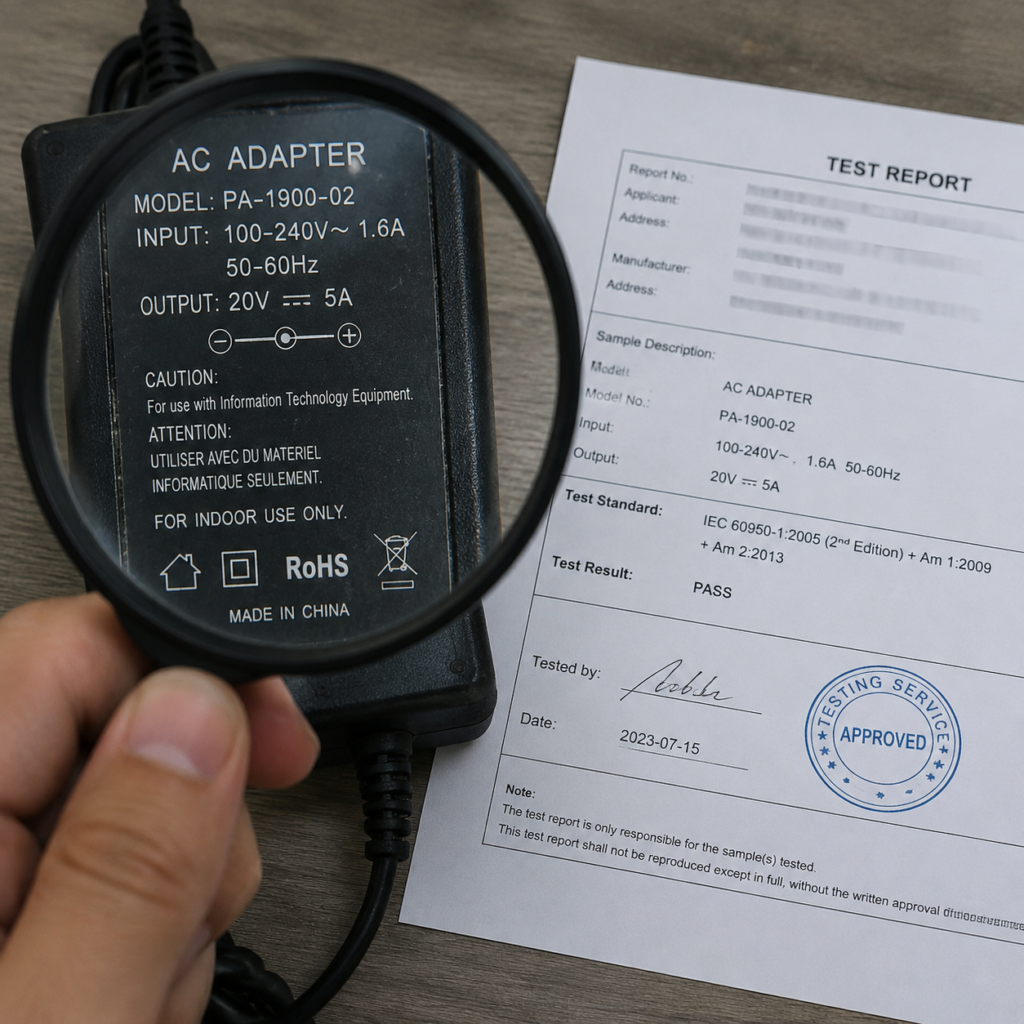
When buying an old charger, first look at the nameplate on the product casing (the label with parameters printed on it). The following information should be checked with emphasis:
- Manufacturer or responsible entity information and product model required by the target market;
- Rated input voltage, frequency, and output voltage, current, power; multi-gear fast charging products should be able to confirm all supported gears;
- Applicable certification or compliance information, and confirm that the mark corresponds to the correct product category;
- IEC 60950-1 standard number and its version information; if marked on the product or documents, it should be consistent with the certification filing or compliance documents.
The IEC standard number, specific version number, and certification mark do not have to be printed on the charger nameplate in all countries and for all products. The mandatory information on the nameplate is specified by the target market regulations and specific product standards, and the standard number may also appear in technical documents, declarations of conformity, or certificates. The fact that the product does not have the IEC 60950-1 standard number printed only reduces the convenience of verification, and cannot be used alone as a basis for judging non-compliance.
Valid boundaries of certification/test results
Many people think that “once certified, it’s valid for life”. In fact, the effectiveness of certification has boundaries:
- Certification is usually for the submitted test sample, and covers the declared input and output parameters, ambient temperature, and series model range — for example, if the submitted sample is a 20W single-port charger, this certification cannot be used for a 65W multi-port charger;
- You should check the current status of the certificate and the validity rules of the certification body, and confirm that the mass-produced product is consistent with the submitted test sample and the filed structure;
- When changes occur to designs, key components, or rated parameters that affect safety, a change assessment or retesting by the certification body is usually required;
- If you privately disassemble, repair, modify, or replace non-original key accessories, the original certification documents may no longer apply to the modified product;
- Grid voltages and plug structures vary from country to country, test results may have regional differences, and cannot be directly universally applied.
How ordinary users can check the authenticity of certificates
Actually, you don’t need professional knowledge. Just check according to the following method:
Step 1: First confirm the certification body marked on the product, such as UL, TÜV, or the issuing body of CCC;
Step 2: Find the product model or certificate number. UL, some TÜV, or CCC certificates can be queried in the public database of the corresponding body;
Step 3: Check the filing or certificate information: standard version, product model, manufacturer, output configuration, and whether the certificate status is valid;
Step 4: Confirm that the filing information is completely consistent with the actual product you have. If not, the credibility is questionable.
If it is a CE product, you cannot require that there must be a unified “official CE filing record”. Usually, you should check the EU declaration of conformity, applicable regulations and standards provided by the manufacturer or importer; if the relevant regulations require the participation of a notified body, then check the notified body number and the EU NANDO database.
Remember: you must always rely on the formal compliance documents provided by the certification body, manufacturer, or importer, and don’t just trust the standard number or mark printed by the merchant themselves.
5. Old-New Transition: Differences and Transition Rules with IEC 62368-1
Since IEC 60950-1 has been replaced by IEC 62368-1, what exactly is the difference between the two? Is the new standard necessarily stricter? Here we clarify the core differences.
Why replace it?
The old standard was formulated by equipment type: IEC 60950 series for IT equipment, IEC 60065 series for audio-visual equipment. But now the boundaries of products are becoming increasingly blurred. For example, a charging head can charge both a computer (IT equipment) and a speaker (audio-visual equipment). The method of adopting different equipment category standards respectively is not flexible enough.
The new IEC 62368-1 adopts a “hazard-based engineering method” — no matter what type of equipment it is, first identify what energy sources there are (such as electrical energy, thermal energy), then design corresponding protection according to the hazard level of the energy source, covering more systematically.
However, multi-port, fast charging, or GaN technology itself does not automatically exclude IEC 60950-1, nor does it automatically determine that the product must adopt IEC 62368-1. Which set of standards actually applies is still determined by the product scope, target market regulations, and certification rules.
Core differences for charging products
The two are not in a “which is better” relationship, but have completely different logics:
- Different classification logic: The old standard divides the scope of application by equipment type, while the new standard divides it by energy source type and protection level;
- Different assessment logic: The old standard focuses on whether accessible parts are live/carry energy, while the new standard focuses on the matching degree between the hazard level of the energy source and protection;
- Different adaptability: The new standard has stronger compatibility with cross-category power products, covering both IT and audio-visual equipment, but the new standard also has no clauses specifically for a certain fast charging protocol, and similarly does not assess charging performance.
It must be emphasized here: you cannot simply judge that “the new standard is stricter than the old one”. It must be judged in combination with specific product types and test items. For some items, the old standard has more detailed requirements, and for some items, the new standard covers more comprehensively.
Market transition rules
There is no unified switching time globally: the IEC only revoked the current status of the old standard, and its actual effectiveness depends on the regulations of the target market. The switching time, transition period, and exemption clauses in mainstream markets such as the EU, the US, and China are all different, and the specifics shall be subject to the requirements of local regulatory or certification bodies.
For products that have been legally placed on the market and have not undergone changes affecting compliance, whether they can continue to be sold or circulated shall be confirmed according to the specific rules of the target market on market placement, continuous supply, second-hand products, recall, and transition period. Old certificates can only be used as historical compliance clues, and cannot replace current regulations and product status verification.
Don’t judge safety solely by the oldness or newness of the standard number
Many people think that “new standard products are definitely safer than old standard ones”, but that’s not the case at all: old standard products with valid certification and whose product status matches the certification conditions are a positive signal that they met the requirements when they were launched. Of course, you still have to check the actual status of the product; on the contrary, those no-name products, even if they falsely mark the new standard number, may not have done any testing at all and are completely non-compliant.
6. Practical Guide: How to Preliminarily Judge the Safety of Old Charging Products
With the previous knowledge, let’s apply it to actual use: how to quickly judge whether there are safety risks with the old charger or second-hand power adapter you have?
Step 1: Label verification
First look at the product labels, follow these steps:
- Check the manufacturer, model, input and output rated parameters and other information required by the target market;
- Check if there are formal certification or compliance marks for the target market, and prioritize checking the filing information on the official website of the certification body;
- Check whether the product model and manufacturer information are consistent with the labels, compliance documents, or filed content. Be wary of products that are randomly pasted with generic labels;
- If the product only says “compliant with international safety standards” but has no other information sufficient to confirm the manufacturer, model, and rated parameters, you should be more vigilant; but the fact that the IEC standard number is not printed itself cannot alone prove that the product is non-compliant or must be stopped from use.
Step 2: Non-contact preliminary screening
If the product has no labels, or you have doubts about its status, you can first screen it with a non-contact method — note that this screening can only be used to judge “whether to stop using it”, and cannot prove that the product is compliant, because internal indicators such as temperature rise, withstand voltage, and insulation must be confirmed by laboratory tests.
The key points of screening are very simple:
- Look at the appearance: The casing is not cracked, there are no burrs or skewed metal pieces inside the ports, the cable is not damaged, there are no blackened or burnt marks on the ports, and the labels are clear and not blurry;
- Listen to the sound: There is no abnormal howling or buzzing during normal charging;
- Smell the odor: There is no burnt or plastic burning smell;
- Usage experience: It does not repeatedly disconnect charging, the prongs are not obviously loose, and there is no abnormal sound of parts when shaking the product.
Stop using immediately if these red flag signals appear
Regardless of whether there is certification, as long as the following situations occur, you should stop using it first:
- “Three-no” products with no model, no manufacturer, and no certification mark;
- Blurry labels, output parameters inconsistent with packaging and instructions;
- Cracked casing, loose prongs, damaged cable, blackened ports;
- Abnormally hot during charging, peculiar smell, abnormal noise, repeated charging disconnection;
- Water ingress, casing rupture or obvious drop damage, or the product model is officially recalled.
For recall situations, you should check the model, batch, and disposal requirements in the official announcement; do not continue to power on without inspection or confirmation. Simply “having been dropped” does not mean it must be damaged, but if the internal status cannot be confirmed, stopping use and replacing it is usually safer.
Safety judgment of matching charging cables
Many people think that if the charger is certified, the matching cable must be safe, but that’s not the case:
- You should confirm the rated voltage, current, power, and supported protocols from the manufacturer’s specifications, packaging, instructions, or cable labels, and judge whether they match the maximum output power of the charger;
- USB-C high-power cables usually require an E-Marker (a small chip in the cable used to inform the devices at both ends of the power specification supported by the cable) to support 5A power levels of 100W and above;
- Cable safety is not within the core assessment scope of IEC 60950-1 for chargers. Original matching cables may be tested together with the charger, while separately sold, non-original cables cannot be automatically regarded as covered.
Take a practical example: you have a 100W certified charger. If you match it with an ordinary 3A cable, USB Power Delivery will usually negotiate a power not exceeding 3A according to the cable’s capability, so the charger cannot output at full power of 20V/5A, only about the 60W level of 20V×3A. A rated and qualified 3A cable should not overheat due to “3A” itself within the rated current; but do not forcibly bypass the negotiation, and do not use cables of unknown quality, poor contact, or already damaged.
Additional checks for cross-border use
If you want to take an old charger to other countries for use, you need to do two more checks:
First, confirm that the rated input range of the charger covers the nominal voltage and frequency of the destination. The common nominal voltage in the US is 120V, and in most parts of Europe it is 230V. A charger that only supports 220/230V connected to a 120V grid may not start or work properly, and unconfirmed voltage conversion solutions should not be used;
Second, check that the prong shape complies with local standards. If you use a conversion plug, the conversion plug itself must also have compliance certification.
7. Avoiding Common Misconceptions
These are the pitfalls that users are most likely to fall into, so we’ll clarify them separately here:
- Misconception: Having IEC 60950-1 certification means it’s a high-end charger Truth: It’s just the basic safety passing line, completely unrelated to charging speed, compatibility, or build quality. How to avoid the pitfall: Complying with this standard is the most basic requirement. Don’t spend more money just because the merchant marks this.
- Misconception: All old standard products are unsafe, you must buy new standard products Truth: Old standard products cannot be directly judged as unsafe just because the standard is older; if the product was legally placed on the market, has no changes affecting compliance, and meets the specific requirements of the target market on continuous supply or circulation, the old standard certification can still be used as a historical compliance clue. How to avoid the pitfall: For second-hand regular old chargers, check the actual status, recall information, and current market rules at the same time. You don’t have to only look at the standard number and chase the new standard.
- Misconception: Having certification marks such as CE/UL means it must comply with IEC 60950-1 Truth: The mark may be counterfeit, or only cover part of the test scope or other product categories, and may not correspond to this standard. How to avoid the pitfall: Try to check the certified model, standard number, or formal compliance documents, don’t just look at the mark. Whether CE requires third-party participation depends on the applicable EU regulations, and you cannot judge that a product is necessarily safer just by whether it has third-party certification.
- Misconception: Low-voltage USB output will never cause electric shock Truth: In cases of moisture, insulation damage, input side failure, or water ingress, dangerous voltage may also appear at the USB end. How to avoid the pitfall: Don’t touch the charging port with wet hands. Stop using the charger immediately after water ingress, casing rupture, or obvious drop damage, and wait for inspection or replacement.
- Misconception: All chargers with USB ports are subject to IEC 60950-1 Truth: It needs to be judged jointly by use, structure, and target market regulations, and many products also involve other standards. How to avoid the pitfall: First judge the intended use of the product, then correspond to the applicable safety standards. Don’t use this standard to judge the safety of household appliances or car chargers.
- Misconception: If the charger is certified, the matching charging cable must be safe Truth: Certification usually only covers the charger itself, not separately sold/non-original cables. How to avoid the pitfall: High-power charging should be matched with cables of corresponding rated parameters, and do not use damaged cables.
8. Frequently Asked Questions
Is IEC 60950-1 still valid now?
At the IEC level, it has been replaced by IEC 62368-1, and its actual effectiveness depends on the target market regulations, product category, and transition period. For legally launched old products, their old standard certification still has reference value in the corresponding market, but whether they can continue to be sold, circulated, or imported still needs to be checked against the current local rules.
Is it enough for a charger to have the CE mark?
CE means the product claims to comply with applicable EU regulations, and does not mean it has necessarily passed third-party certification. Manufacturers usually need to complete the corresponding conformity assessment, prepare technical documents, and issue an EU declaration of conformity; whether a notified body must participate depends on specific regulations and product categories. You need to check the regulations, standards, and product information corresponding to CE, not just look at the mark.
Which is better, IEC 60950-1 or IEC 62368-1?
The two have an old-new replacement relationship, and there is no simple distinction between good and bad. The new standard is more flexible for adapting to cross-category products, while the old standard is more targeted at traditional IT equipment. The safety of a product depends on whether it effectively complies with the corresponding standard, not the oldness or newness of the standard number.
Can old chargers with IEC 60950-1 certification still be used?
It cannot be determined solely by the old standard number. As long as the product has no obvious damage or abnormality, has not been officially recalled, the certification documents and product status still correspond, and meet the current requirements of the target market on use, sale, or circulation, the old standard certification can be used as a safety reference. If problems such as overheating, abnormal noise, cracking, water ingress, or obvious drop damage occur, stop using it immediately.
Is the charging cable included in the IEC 60950-1 certification of the charger?
Usually only the original matching cable is included; separately sold, non-original cables are not within the scope of certification. During high-power charging, you need to separately confirm whether the cable’s rated parameters, power capability, and supported protocols match.
Study Summary: Safety Judgments You Can Make Independently
After reading this article, you can already independently complete these safety judgments related to old IT charging products:
Basic understanding category
You can distinguish the definition and role of IEC 60950-1 and the true meaning of “transition reference”; you can distinguish the differences between IEC standards, certification, and regional compliance marks, and will not have concepts confused by marketing rhetoric.
Applicability judgment category
You can use the four-step judgment method of “use-structure-voltage-compliance” to preliminarily judge whether a charging product may involve this standard; you can distinguish the applicable scenarios of the old standard and IEC 62368-1, and will not be fooled by the rhetoric that “the new standard is definitely safer”.
Practical judgment category
You can understand the safety labels of old charging products, and query certification filings or compliance documents step by step; you can identify problematic chargers that need to be stopped immediately through non-contact screening; you can judge the power matching between the charging cable and the charger to avoid overheating risks; when buying second-hand old chargers or using them cross-border, you can make basic safety judgments.
Safety judgment decision logic for old chargers
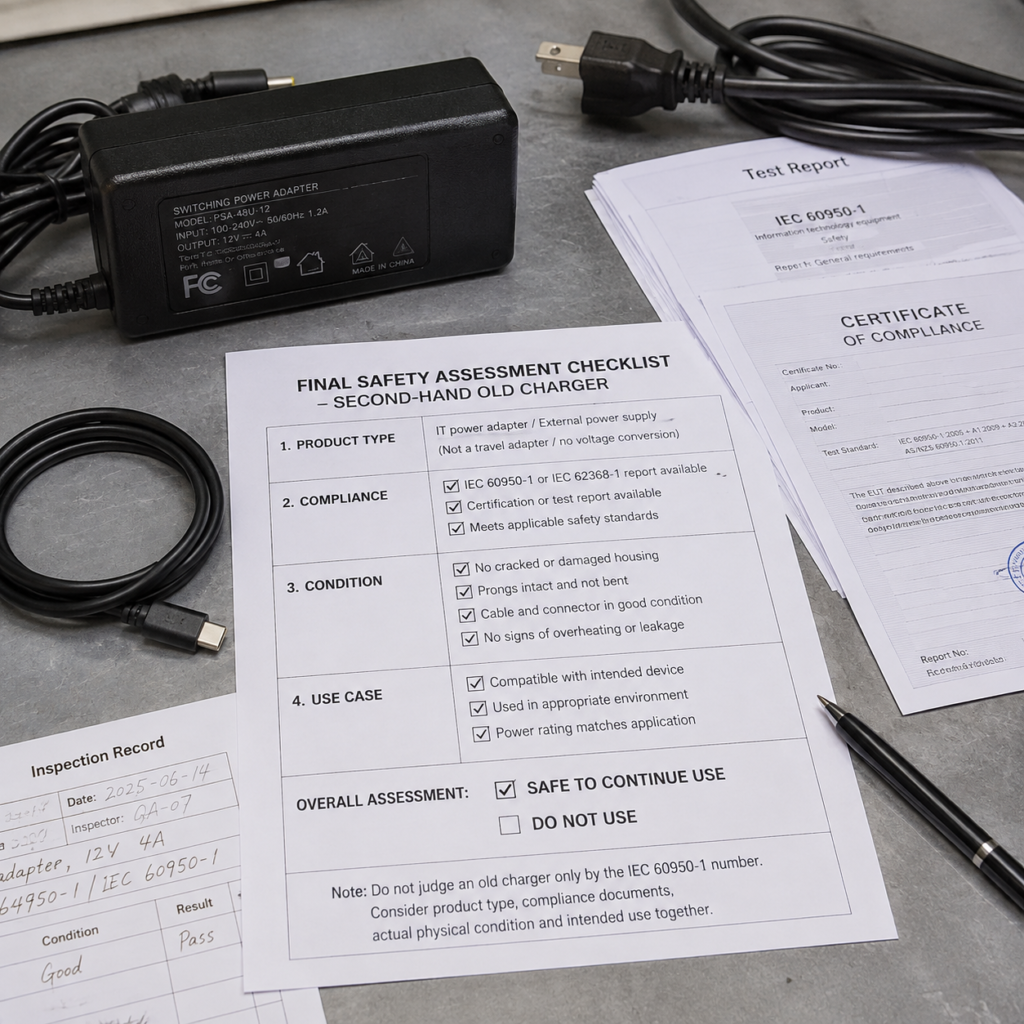
Finally, here is a set of judgment processes you can directly follow, in four steps:
Step 1: Judge whether the product is a charging product matched for IT equipment, and confirm the product classification of the target market;
Step 2: Verify whether the labels, certification filings, or compliance documents are consistent with the actual product;
Step 3: Conduct appearance and usage status screening, confirm there are no red flag signals, and check whether it involves official recall;
Step 4: Conduct additional checks combined with usage scenarios (such as cross-border, high power).
Overall, although IEC 60950-1 is already an old standard in transition, it still has practical reference value in the safety judgment of old IT charging products. You don’t have to regard it as a “high-end certification”, nor should you dismiss all old standard products outright. Learning to look at the scope of application, check compliance documents, and screen appearance and usage status can help you avoid many electrical safety pitfalls, especially when hunting for second-hand or overseas old accessories, it can save you a lot of worry.