
If you do cross-border e-commerce to Japan, or often buy Japanese plug-in electrical appliances, you must have seen the diamond-shaped or circular PSE mark printed on products. Many people have misunderstandings about its attributes, classification and judgment rules. This article will thoroughly explain the core logic of PSE to help you quickly master the basic compliance judgment methods.
Basic PSE Knowledge: Core Information Essential for Getting Started
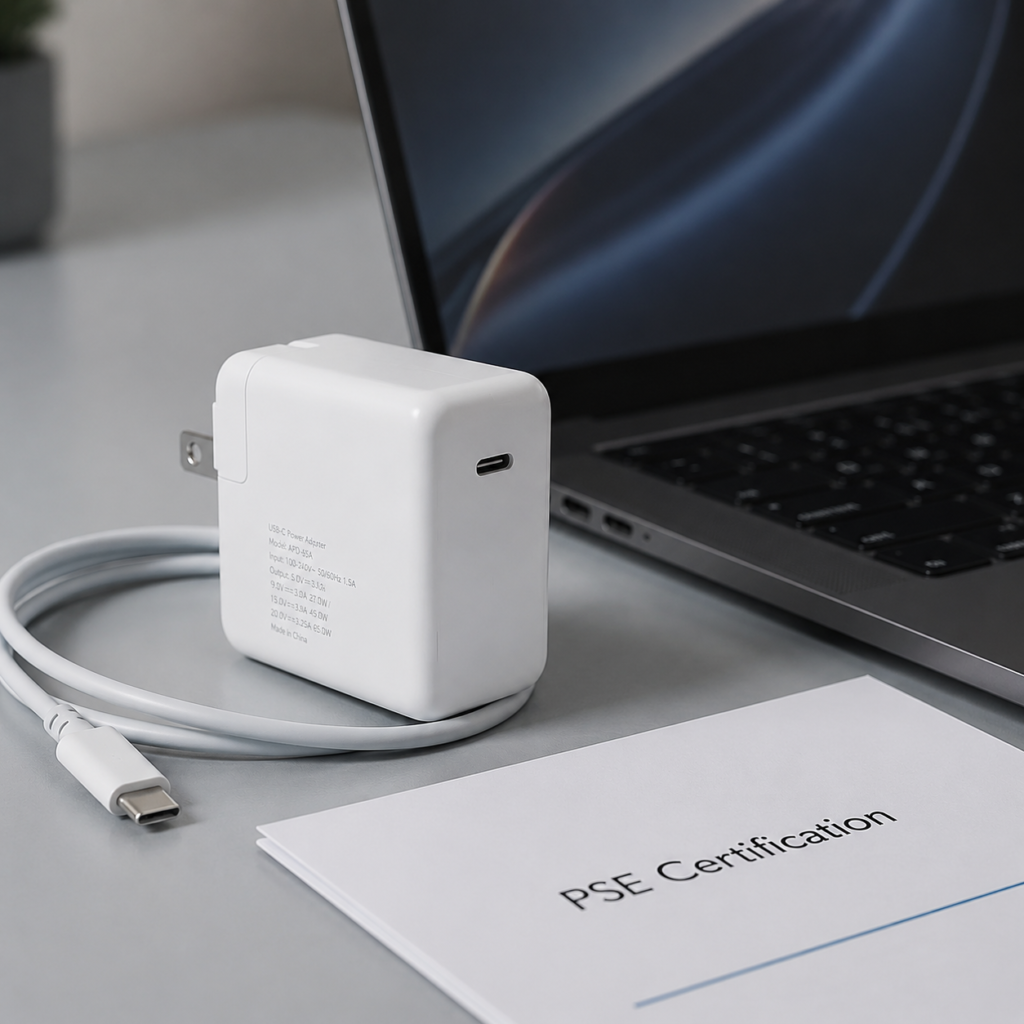
Let’s start with the most basic definition. The full English name of PSE is Product Safety of Electrical Appliance & Materials. It is essentially Japan’s mandatory safety compliance system for electrical appliances and materials, with the core function of preventing electrical safety risks such as electric shock, fire, and overheating. Its scope of validity is limited to the Japanese market; it is not a globally recognized certification and has no compliance validity in other countries and regions. It should be clarified here that PSE only assesses electrical safety-related indicators, and does not involve quality dimensions such as product performance, battery life, or durability, so it cannot be equated with “good quality”.
In terms of governance rules, the legal basis of PSE is Japan’s (abbreviated as DENAN), and the competent authority is the Ministry of Economy, Trade and Industry of Japan (abbreviated as METI). Unlike certifications in many regions, the primary responsible entity for PSE is not overseas brands or manufacturers, but importers or compliance representatives within Japan. That is to say, overseas sellers or brands cannot directly apply for PSE on their own; they must assume compliance responsibilities through a responsible entity within Japan, which is a mandatory requirement. For ordinary consumers, there is no need to apply for PSE themselves; they only need to identify compliance through the mark on the product.
Non-compliance has practical impacts on both operators and consumers. For operators, non-compliant electrical appliances and materials may be required to supplement compliance materials during import customs clearance, platform review, or market circulation. If valid certificates cannot be provided, they may be refused listing, ordered to be removed from shelves, recalled, or even face administrative penalties. For consumers, products without a compliant PSE mark have much higher electrical safety risks, so they should try not to purchase them.
Why Are There Two Types of PSE: Diamond and Circular? Classification Logic and Differences
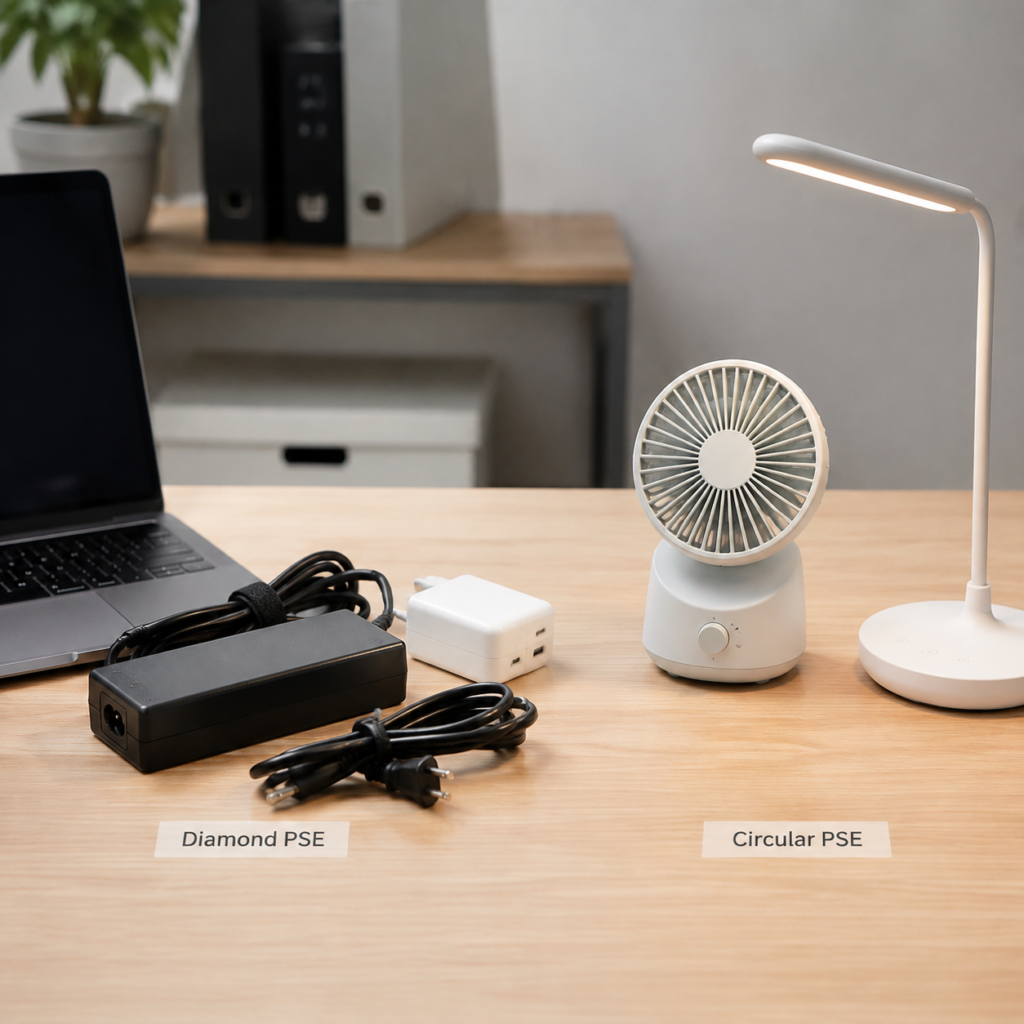
Many people will wonder when they first see the PSE mark: why some have a diamond frame and some have a circular frame? This is actually Japan’s classification based on the electrical safety risk level of products. The specific scope of control is subject to the latest catalog and laws issued by METI, which will be dynamically adjusted with regulatory revisions. Currently, it covers hundreds of types of electrical appliances and materials in total. For example, power banks commonly used by people were added to the PSE control catalog in recent years, and the specific classification needs to be confirmed by comparing the product structure and parameters with the official catalog.
High-risk products are called “Specified Electrical Appliances”, corresponding to the diamond-shaped PSE mark. Such products usually have high risks of electric shock and fire. Currently common regulated categories include power adapters, plugs and sockets, power cords, LED drive power supplies, etc., which are ultimately subject to the METI catalog. The compliance requirements for diamond-shaped PSE are the strictest: testing and certification must be carried out by a third-party organization registered with METI, and some categories also require factory inspections and subsequent supervised spot checks. Its validity period depends on the product category, and there is no unified standard.
Medium and low-risk products are called “Non-specified Electrical Appliances”, corresponding to the circular PSE mark. The safety risks of such products are relatively controllable. Representative categories include small USB fans, wired desk lamps, ordinary rice cookers, hair dryers, household LED lamps, etc. The catalog must be checked item by item according to specifications, and ultimately subject to METI requirements. The compliance path for circular PSE is more flexible: enterprises can conduct self-testing or entrust a laboratory to complete conformity testing according to corresponding technical standards. After sorting out a full set of technical documents, the Japanese responsible entity shall submit a business notification (i.e., compliance information filing) to METI. Only after completing the business notification, conformity confirmation, and retaining all documents as required can the responsible entity assume sales compliance responsibilities. It should be noted that circular PSE is not a third-party certification certificate, nor is it an official approval of METI for a single product model, and the compliance responsibility is always borne by the reporting entity. Circular PSE has no mandatory fixed validity period; as long as the product design and structure do not change, the compliance record can be used continuously.
To help you quickly distinguish between the two types, we have sorted out the core differences between the two types of PSE into a table:
| Comparison Dimension | Diamond-shaped PSE (Specified Electrical Appliances) | Circular PSE (Non-specified Electrical Appliances) |
| Risk Level | High (high risks of electric shock and fire) | Medium to low (risks are relatively controllable) |
| Assessment Method | Must be tested and certified by a METI-registered third-party organization | Enterprise self-test/entrusted test + METI business notification |
| Mark Style | PSE characters wrapped in a diamond-shaped outer frame | PSE characters wrapped in a circular outer frame (mixing is strictly prohibited) |
| Responsibility Logic | Third-party organization assumes certification and audit responsibilities | The enterprise itself assumes all compliance responsibilities |
How to Judge Whether a Product Requires PSE: Scope of Application and Quick Judgment Method
The core principle for judging whether a product requires PSE is only one: whether it is a regulated electrical appliance or material entering the Japanese market for circulation. You can use three steps to make a quick preliminary judgment, but the final result is still subject to the official METI catalog. The first step is to look at the category attribute — if the product needs to be connected to Japan’s AC100V mains power, or itself has electrical functions such as voltage transformation, charging, electric heating, lighting, or motors, it falls into the broad category of electrical appliances and materials; the second step is to check the official catalog — compare with the issued by METI to confirm whether the product is within the scope of control, after all, not all electrical appliances and materials are subject to supervision; the third step is to determine the specific type — according to parameters such as product voltage, power, and structure, compare with the classification rules in the catalog to determine whether diamond-shaped or circular PSE is required.
There are several types of scenarios that must meet PSE requirements: brand-new electrical appliances and materials publicly sold in the Japanese market, whether imported or locally produced in Japan; electrical appliances and materials for commercial and public use within Japan; electrical appliances and materials listed on mainstream Japanese cross-border e-commerce platforms; and second-hand electrical appliances and materials sold commercially, for which it is necessary to confirm that the compliance mark on the product body is complete, the responsible entity information is clear, and the product safety status meets requirements. If the product specifications and structure have not changed in a way that affects compliance, the valid compliance records from when the product was new can continue to be used.
There are also some scenarios that do not require PSE, which are exceptions: reasonable quantities for personal use, carried or mailed into the country from abroad and not entering market circulation, do not require compliance; products only for export and not sold within Japan also do not require it; ships, aircraft, motor vehicles, medical or industrial special equipment are governed by special regulations and do not fall within the scope of PSE control; and low-risk accessories powered purely by low-voltage batteries, without AC access, voltage transformation or energy storage functions, such as small wall clocks that only use dry batteries, generally do not belong to the regulated category, but the final judgment is still based on the official catalog.
When encountering scenarios with blurred boundaries, judgment can be made according to several detailed rules: for cross-border e-commerce purchasing on behalf or direct mail, if it is profitable commercial sales targeting unspecified consumers, it needs to meet PSE requirements — it is not that direct mail can be exempted; for set products, each electrical component must be split and judged separately. For example, for a small fan with a power adapter, the adapter and the fan must be checked against the catalog separately; different versions of the same product, such as different voltages, powers, or divided into household and industrial use, may have completely different classifications; if you are really unsure, the safest way is to consult the official METI or a METI-registered certification body, and do not guess based on experience.
Full Compliance Process and Mark Verification: How to Do It and How to Check Authenticity
If it is confirmed that the product requires PSE, there are obvious differences in the processes and mark requirements of the two types of certification. First, let’s look at the complete process of diamond-shaped PSE: first, confirm the product classification, then prepare samples and technical documents, such as specifications, key component lists, etc., then send them to a METI-registered laboratory for testing. After passing the test, submit them to the certification body for review. Some categories also require factory inspections, and sales can only be launched after obtaining the certification certificate. Subsequently, if the key components of the product change, a re-evaluation is required, and the original certificate cannot be directly used. The statutory marking requirements for diamond-shaped PSE are very strict: the mark must be marked on the product body; printing only on the packaging is not considered compliant. In addition to the diamond-shaped PSE mark, information such as certification body information, certification number, rated voltage, power, model, and responsible entity must also be marked according to the requirements of the corresponding category.
The process of circular PSE is relatively simple: first confirm the product classification, then complete self-testing or entrusted testing according to the corresponding technical standards, sort out the test report and technical documents. These documents need to be retained for at least 10 years for spot checks. Then the Japanese responsible entity submits a business notification to METI. Only after completing the notification, conformity confirmation, and retaining all documents as required can the responsible entity assume sales compliance responsibilities. The circular PSE mark must also be marked on the product body, and needs to include the circular PSE mark, reporting entity information, rated voltage, power, model and other content; marking only on the packaging is also invalid.
For overseas entities, a necessary prerequisite for applying for PSE is that there must be a compliance responsible entity within Japan, that is, an importer or Japanese representative. If not, it is necessary to first connect with a suitable compliance partner before proceeding with the subsequent processes. As for the cycle and cost, there is no unified standard: diamond-shaped PSE usually takes several weeks to several months, which is specifically affected by laboratory scheduling, test complexity, and document completeness. If the documents are incomplete and need to be supplemented, the cycle will be longer; circular PSE is faster, mainly depending on the speed of document preparation. In terms of cost, the fees for different product types, certification paths, and test items vary greatly, and specific evaluation is required for specific products.
Whether you are a consumer or a seller, it is very practical to learn to identify fake PSE marks. There are several quick judgment tips: if the mark only has the PSE characters, without an outer frame or with the wrong outer frame shape (such as square or frameless), it is definitely non-compliant; if the corresponding number, institution or reporting entity information is not marked as required, there is also a problem; if the mark is printed blurry and easy to wipe off, it is most likely a fake mark; and for products such as adapters that are clearly included in the Specified Electrical Appliances catalog, if only the circular PSE is marked, it does not meet compliance requirements.
If you need to verify the authenticity of compliance, the verification methods for the two types of PSE are different. Currently, Japan does not have a unified public PSE authenticity query database. Diamond-shaped PSE can be verified in two steps: first, check through the official METI website whether the issuing agency is a formally registered third-party certification body, and then verify the valid status of the certificate with the issuing agency using the certification number. Circular PSE follows the self-declaration plus business notification model, and the responsible entity can be required to present the original receipt document of the METI business notification. During verification, four core fields must be focused on: certification/notification number, entity name, product model, and valid status. If any one does not match, there may be compliance issues.
Boundaries Between PSE and Other Common Certifications: Can They Replace Each Other?
Many friends who do cross-border business will ask: I already have CE and UL certifications, do I still need to do PSE? A core principle must be clarified here: certifications from other regions and other fields cannot replace PSE. Only partially overlapping test data can be referenced during compliance to save a little time and cost, but the complete compliance process must follow Japanese requirements.
First, let’s look at the differences from mainstream overseas compliance marks: CE is the EU market access conformity system, covering multiple types of requirements such as safety, health, and environmental protection. It is not a single safety certification. Its applicable regions, standard framework, and legal system are all different from Japan’s, so it cannot replace PSE; UL is a common third-party safety testing and certification mark in the North American market, belonging to the category of non-governmental organization certification. Its scope of control and technical standards also differ from PSE, so it also cannot replace PSE.
Next, let’s look at the boundaries with other domestic compliance requirements in Japan. Many products need to meet multiple requirements at the same time, so don’t confuse them. First is TELEC/MIC certification, which is Japan’s wireless certification. It governs the radio frequency compliance of radio equipment. For example, electrical products with Bluetooth and Wi-Fi functions need both PSE to ensure electrical safety and TELEC to ensure wireless compliance. Second is VCCI certification, which governs the electromagnetic compatibility of information technology equipment and is a voluntary certification. Household IT electrical products may be required by customers to have VCCI, but it cannot replace PSE, as the two govern completely different directions. There is also JIS, the Japanese Industrial Standards, which is Japan’s general industrial standard system. PSE may reference some JIS safety standards, but the JIS mark itself cannot replace PSE. One is mandatory safety access, and the other is an industrial standard system; they are not the same thing.
Common Misconceptions and Pitfall Avoidance Guide
Precisely because there are many details in PSE rules, many people have cognitive deviations or even fall into pitfalls. We have compiled the most common misconceptions and key points for avoiding pitfalls, which can be referenced by both consumers and sellers.
Common Cognitive Misconceptions
1. Misconception: All electronic products require PSE → Only regulated electrical appliances and materials explicitly listed in the METI catalog require it.
2. Misconception: PSE is a quality certification → It only assesses electrical safety indicators and has nothing to do with quality dimensions such as performance and durability.
3. Misconception: Circular PSE is voluntary and unimportant → It is also a mandatory compliance obligation stipulated in the , but adopts the path of self-declaration plus notification. Non-compliance will also be punished.
4. Misconception: Overseas certifications such as CE and UL can replace PSE → They cannot replace it; only partially overlapping test data can be referenced during compliance.
Key Pitfall Avoidance Points for Consumers
When purchasing Japanese electrical products, remembering a few core actions can avoid most PSE-related pitfalls: first check the PSE mark on the product body, and do not only rely on packaging or merchant publicity; for high-risk plug-in products (such as power adapters), prioritize regular products with verifiable compliance information, and reject low-priced products without any compliance marks; do not easily believe the claim that “Japan direct mail is definitely compliant”, and still need to check the compliance marking on the product body.
Key Pitfall Avoidance Points for Small and Medium Sellers
For small and medium sellers operating in the Japanese market, falling into PSE pitfalls often leads to greater losses, so several points require special attention. The most common mistake is not figuring out the product classification, and applying circular PSE to products that require diamond-shaped PSE. In the end, either customs clearance is blocked, or the product is removed from the platform after listing, which is not worth the loss. So the first step must be to confirm the product classification. Second, do not buy so-called “certificate borrowing” services, that is, using others’ certification certificates for your own products, or using one certificate for multiple different products. This is a clear violation, and if caught by regulatory spot checks, you will face penalties and also affect store reputation. Products of the same series cannot directly share certification either; it must be confirmed that the structure, key components, and power are completely consistent. As long as one core parameter changes, re-evaluation is required. All compliance documents, including test reports, certification certificates, and notification records, must be fully retained to deal with platform reviews or regulatory spot checks at any time, and should not be lost. In addition, before listing on cross-border e-commerce platforms, it is best to first confirm the specific PSE requirements of the platform. The review strictness and document submission requirements of different platforms may vary. Preparing in advance saves time and avoids delaying listing.
Common Causes of Compliance Invalidation
Many sellers think that once PSE is done, it’s done once and for all, but that’s not the case. Several common situations will lead to compliance invalidation. The most common is that the key components of the product have changed, such as replacing transformers or power cords of different specifications, without re-evaluation. In this case, the original compliance record is invalid. Second, the mark does not meet requirements, such as printing the PSE mark only on the packaging, or the marked information is incomplete or in the wrong format, which are all considered non-compliant. There is also the situation where technical documents are incompletely retained or lost, and the corresponding test reports and certification documents cannot be produced during regulatory spot checks, which will also be judged as non-compliant. In addition, diamond-shaped PSE certificates have validity periods, which vary by category. If they expire and are not renewed, compliance will also be invalidated.
Real Scenario Judgment Cases
We use three common product cases to help you familiarize yourself with the specific judgment logic:
Case 1: Mobile Phone Fast Charger
Judgment result: It belongs to the Specified Electrical Appliances in the current METI catalog, and requires diamond-shaped PSE.
Core basis: It is directly connected to AC100V mains power, belongs to high-risk power supply products, and has been included in the METI control catalog.
Responsible entity: Importer or compliance representative within Japan.
Document requirements: Third-party certification certificates, test reports, and key component lists must be retained for inspection.
Case 2: Small USB Fan with Power Adapter
Judgment result: The adapter is a high-risk power supply product and usually requires diamond-shaped PSE; the fan body is low-voltage powered, which needs to be checked against the catalog according to specific parameters, and is mostly circular PSE or non-regulated.
Core basis: Set products need to be split into components for separate judgment.
Responsible entity: Importer or compliance representative within Japan.
Document requirements: Adapter certification documents and fan test reports (if regulated) must be retained for at least 10 years.
Case 3: Household LED Desk Lamp with Bluetooth Function
Judgment result: LED desk lamps belong to lighting electrical appliances and materials, and the corresponding PSE type needs to be determined according to specifications; the Bluetooth function requires additional TELEC certification.
Core basis: Electrical appliances with wireless functions need to meet both electrical safety and radio frequency compliance requirements at the same time.
Responsible entity: Importer or compliance representative within Japan.
Document requirements: PSE compliance documents and TELEC certification documents must be retained separately for inspection.
Summary
The above are the core rules and basic judgment methods of PSE certification. Whether it is consumers purchasing Japanese electrical products, or small and medium sellers deploying in the Japanese market, mastering the classification logic and judgment steps can avoid most common compliance pitfalls. When encountering scenarios with blurred boundaries, the safest way is to consult the official METI or a certification body with METI registration qualifications, and do not guess based on experience to avoid unnecessary losses.