
If you often buy charging products on Canadian e-commerce platforms, or have shipped wireless chargers or fast charging adapters to Canada, you’ve most likely seen the “IC” number or “ISED compliant” wording on the packaging or the bottom of the product. Many people confuse it with safety certification, and don’t know which products actually require this certification—after all, merchants often claim “full complete certifications” in their promotions, making it hard to tell true from false. Today we will explain ISED certification (formerly IC certification) thoroughly, especially the parts related to daily-use chargers and charging cables; after reading this, you’ll be able to judge for yourself and verify authenticity on your own.
Beginner Basics: First Understand the Core Concepts
ISED certification is a mandatory access requirement of the Canadian federal government for radio equipment, broadcasting equipment, and interference-generating equipment, with core control over spectrum use and electromagnetic interference. The “IC certification” many people have heard of is its old name—this certification was previously administered by Industry Canada, hence the name IC certification; after the departmental restructuring in 2015, it came under the administration of Innovation, Science and Economic Development Canada (ISED), and its official name was changed to ISED certification. The two belong to the same system; IC certifications obtained in earlier years are valid for a long time as long as the product specifications and design have not changed, and there is no need to re-apply. The “IC ID” (also called IC number) we often refer to is the unique identifier of officially certified products, in the format of “IC: [company code]-[product code]”; after IC certification was renamed to ISED certification, this numbering system was directly retained and used, and no new “ISED number” system was introduced.
As a mandatory access requirement, if charging products are non-compliant, the consequences are clear: customs will detain the goods, and fines may be imposed; e-commerce platforms such as Amazon will also directly remove non-compliant products, which is not a trivial matter.
Control Boundaries for Charging Products
Many people think ISED only regulates charging products with wireless functions, but that is not the case. Its control over charging products is divided into two categories: one is charging products with wireless functions, which need to meet spectrum compliance requirements; the other is all charging products with active circuits (even ordinary wired fast charging adapters), which need to meet electromagnetic interference requirements.
It is important to note that ISED only manages radio and electromagnetic interference; charging products entering Canada also need to meet many parallel independent requirements: for example, electrical safety must pass cULus or CSA certification, plug dimensions must meet Canadian standards, energy efficiency must meet the corresponding level, and products with lithium batteries must also meet transportation safety regulations. These requirements are not subordinate to each other and cannot replace each other.
The core goal of ISED is actually directly related to the daily experience of ordinary users: to prevent electromagnetic signals generated by charging products during operation from interfering with civilian equipment such as WiFi, Bluetooth headsets, and car radios. You may have experienced that when using a cheap fast charging adapter, the Bluetooth speaker lags or the WiFi speed slows down; most likely, the electromagnetic interference of this fast charging adapter exceeds the limit and does not meet ISED requirements.
Practical Value for Ordinary Users
Understanding ISED certification has two tangible benefits: first, when buying charging products, you can filter out some inferior products through compliance labels, avoiding buying products that interfere with other electronic devices at home; second, if you encounter merchants boasting about certifications indiscriminately, you can see through it at a glance, and won’t pay extra for non-existent “high-end certifications”.
Scope of Application: Does Your Charging Product Need Compliance?
After finishing the basic concepts, what you care about most must be: do the chargers and charging cables you have need ISED certification? Which process should be followed? We will explain in three categories according to the types of charging products, and finally give you a two-step judgment method, so you can quickly judge by yourself.
Products Requiring Formal Certification (with Unique IC ID)
The core judgment standard for this type of product is: products with functions regulated by RSS standards such as radio transmission, wireless communication, or wireless power transmission must undergo strict spectrum compliance testing and obtain an officially recognized IC ID before they can be sold in Canada. Common charging products include Qi wireless chargers, smart fast charging adapters with Bluetooth or WiFi functions, power banks with built-in wireless charging function, USB power strips with wireless charging, etc.
It should be noted that the control logic and applicable standards for products with different functions are not the same: Bluetooth and WiFi are wireless communication transmitting equipment, while Qi wireless charging belongs to wireless power transmission (WPT) category; the specific categories of RSS standards corresponding to the two are different. Qi wireless charging mainly refers to RSS-216 and the current classification requirements of ISED, and cannot be simply equated with ordinary communication transmitting equipment.
Products Only Requiring Electromagnetic Compatibility Supplier’s Declaration of Conformity (SDoC)
This type of product does not have wireless transmission function, but has active circuits—that is, it has chips for power conversion, signal control, etc., which will generate electromagnetic interference during operation, so it needs to meet electromagnetic compatibility requirements, but does not need to go through the official certification process. SDoC here is the abbreviation of “Supplier’s Declaration of Conformity”; in plain terms, the manufacturer confirms that the product meets the requirements by itself, and keeps the test report on file for inspection.
The most common such products include ordinary USB-C PD fast charging adapters, original mobile phone charging adapters, and power adapters without wireless functions; they all have AC-DC or DC-DC power conversion circuits, so they all fall within the control scope of SDoC. Never think that SDoC means “no need for compliance”; if ISED or customs conducts random inspections and the manufacturer cannot produce a qualified test report, it may still be deemed a violation, facing goods detention, platform removal, rectification or punishment.
Charging Accessories That Need to Be Evaluated According to Circuit Functions
The compliance requirements for charging accessories cannot be generalized, it depends on the internal structure: if it is a purely passive accessory, such as an ordinary copper-core charging cable, an adapter without a chip, or a magnetic head without a circuit, it neither emits radio signals nor generates additional electromagnetic interference, so there is no ISED requirement at all; but if it has active circuits, such as a fast charging cable with an E-Marker chip, a charging cable with LED power display, or an active conversion adapter, it must meet electromagnetic compatibility requirements; if it also has wireless functions, such as a charging cable with Bluetooth anti-loss function, or a wireless transmission adapter, then it must go through the formal certification process and obtain an IC ID just like wireless chargers.
Two-Step Quick Judgment Method
If you don’t want to memorize the classifications, you can quickly figure it out with the two-step method:
Step 1: First confirm whether the product has radio transmission, wireless communication or wireless power transmission functions regulated by RSS standards—don’t just look at the “smart” in the product name, look at the actual functions, such as whether it can connect to Bluetooth, whether it can charge wirelessly. As long as it falls within the above control scope, take the formal certification path;
Step 2: If there is no wireless function, check whether there is an active circuit, such as functions that require chip operation like power conversion, power display, device identification. If yes, take the SDoC path; if not (such as pure copper cables), there is no need to care about ISED at all.
Core Requirements: Key Rules for Compliance
No matter which path you take, the core requirements for compliance are clear. We will explain them in three parts, which you can also check against when shopping.
Radio Spectrum Compliance (Only Required for Products with Wireless Functions)
Products with wireless transmission functions need to meet ISED’s RSS series radio standards, among which wireless charging (WPT) products mainly refer to the RSS-216 standard. To judge whether a wireless charging product is compliant, there are four core dimensions: whether the operating frequency is within the allowable range, whether the transmission power or field strength exceeds the limit, whether the spurious signals (spurious emissions) leaked out in addition to the main frequency exceed the standard, and whether the product configuration during testing is consistent with the actual sold product.
One point to add here: the operating frequency of Qi wireless chargers is not fixed; products of different versions and different power levels have different frequencies, which must correspond to the corresponding categories in the RSS standard, and cannot be generalized.
Electromagnetic Compatibility Requirements (Required for All Products with Active Circuits)
All charging products with active circuits need to meet ISED’s ICES series electromagnetic compatibility standards. Here we need to correct a common misstatement: there is no so-called unified “ISED EMC certification”; electromagnetic compatibility is part of ISED’s control, not a separate certification.
Many people understand electromagnetic compatibility as “neither interfering with others nor being afraid of interference from others”, but the core of ISED’s ICES series standards is to control emission requirements—that is, the radio noise and electromagnetic interference generated by the product during operation shall not exceed the limit, so as to avoid interfering with the normal use of other civilian equipment. As for “immunity” (that is, the ability of the product to resist external interference), it usually falls within the scope of requirements of other safety or complete EMC systems, and is not a core mandatory control item of ISED ICES.
As for which specific standard applies, products with wireless functions must meet both the RSS radio standard and the corresponding ICES standard; ordinary wired charging products generally apply to ICES-003 (digital equipment category), but the final decision should be based on the actual function and working mode of the product, as well as the current ISED standards, and cannot be memorized rigidly.
Product Labeling Requirements
Product labeling is information you can directly check when shopping, and the requirements for different compliance paths are different:
For products that go through formal certification, the IC number (IC ID) must be marked, in the format of “IC: [company code]-[product code]”, where the company code is a unique number issued by ISED to the applicant enterprise, and the product code is the number corresponding to this product, both are combinations of numbers or letters. It is not allowed to only print vague words such as “compliant with ISED” or “passed IC certification”; there must be a clear number.
For products that go through SDoC, they must also be marked with the corresponding conformity statement according to the applicable ICES standard, such as “compliant with ICES-003 standard” and so on.
These labels are usually printed on the bottom of the charging adapter, the back of the wireless charger, or the side of the packaging box. If it is a particularly small product (such as a mini adapter), if it cannot be printed on the body, it can also be printed on the packaging or instruction manual, which is compliant.
Compliance Paths: Differences Between the Two Modes
You may be curious about the specific process differences between the two paths: formal certification and SDoC? We will explain them clearly, which is useful whether you are an ordinary user who wants to understand the logic behind it, or a small seller preparing to enter the Canadian market.
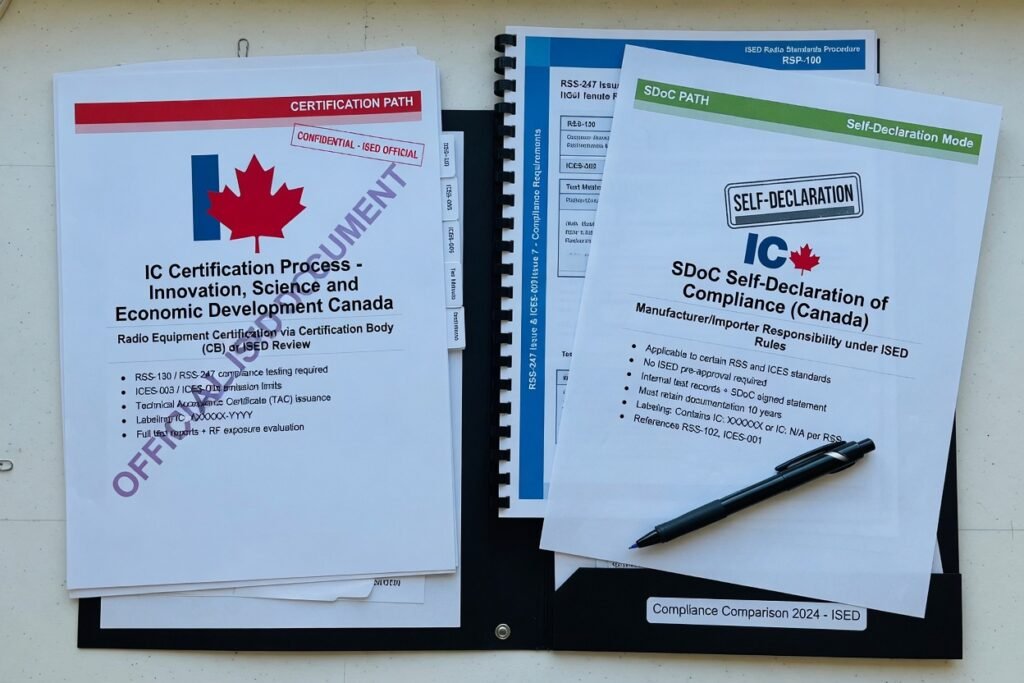
Formal Certification Path (Applicable to Products with Wireless Functions)
Many people think that the certification is issued directly by ISED, but that is not the case. There are four clear role divisions in the entire process: the manufacturer or importer is the first responsible party, responsible for the compliance of the product and submitting the application; then find an ISED-recognized laboratory to conduct testing according to the corresponding standards and issue a test report; next, an ISED-recognized certification body reviews the report, and after passing the review, it will issue the IC ID and enter the product information into ISED’s public database; ISED itself is only responsible for supervision and maintaining the database, and does not issue certificates directly.
If the wireless module used in the product has obtained ISED certification, it can simplify testing and reuse part of the certification data on the premise of meeting the module usage conditions, without repeating all tests, which can save a lot of time and cost; but if the whole machine changes the antenna type, installation position, housing material or power supply structure, the compliance still needs to be re-evaluated, which is why many manufacturers use pre-certified modules.
Self-Declaration Path (SDoC, Applicable to Ordinary Wired Charging Products)
The SDoC path is much simpler: the manufacturer can test by itself, or entrust an ISED-recognized laboratory to test. After confirming that the product meets the standards, sign a declaration of conformity, and keep the full set of test reports and technical documents on file for inspection (the compliance requirements are consistent with the previous description). The entire process does not need to be submitted to the official for review, and there is no public unique number, so it is normal that you cannot find an IC ID on ordinary fast charging adapters.
Change Requirements
No matter which path you take, as long as the product involves changes to wireless parameters or circuits—such as changing the coil of the wireless charger, changing the power chip, or changing the model—the compliance must be re-evaluated, and re-testing is required if necessary; the original certification or declaration cannot be directly used.
Authenticity Verification: 3 Steps to Judge the Validity of Formal Certification
For ordinary users, the most practical skill is to judge whether the ISED formal certification of a product is real. Don’t look for the number right away; follow these three steps, and the accuracy is very high.
Step 1: First Judge Whether the Product Should Have a Formal IC ID
Many people buy an ordinary wired fast charging adapter and think it is fake if they can’t find the IC ID, but it is a misunderstanding—purely passive accessories and ordinary wired fast charging adapters take the SDoC path, and there is no public IC ID at all, which is normal. Only wireless chargers, smart charging products with Bluetooth/WiFi and other products that take the formal certification path must have an IC ID.
There is also a common situation that needs to be explained: if the product uses a pre-certified wireless module and fully complies with the module’s usage rules (such as no changes to antenna type, installation position, housing material, power supply structure, etc.), the testing process can be simplified and part of the certification data can be reused, but the whole machine still needs to complete the corresponding compliance assessment, which cannot be directly equated to the whole machine automatically obtaining certification; if the limited use conditions of the module are changed, re-testing and evaluation are still required.
Step 2: Check Whether the Labeling of the Product/Packaging Is Standardized
For formally certified products, there must be a clear number starting with IC, and it is not allowed to only print empty words such as “compliant with ISED” or “IC certification”. The number format must be correct, it must be in the form of “IC: [company code]-[product code]”, for example, “IC: 8765A-WPC100”.
If it is a particularly small product that cannot fit the label on the body, then check whether the packaging, instruction manual or the brand’s official website has the corresponding number published; only when a clear label can be found does it meet ISED’s labeling specifications.
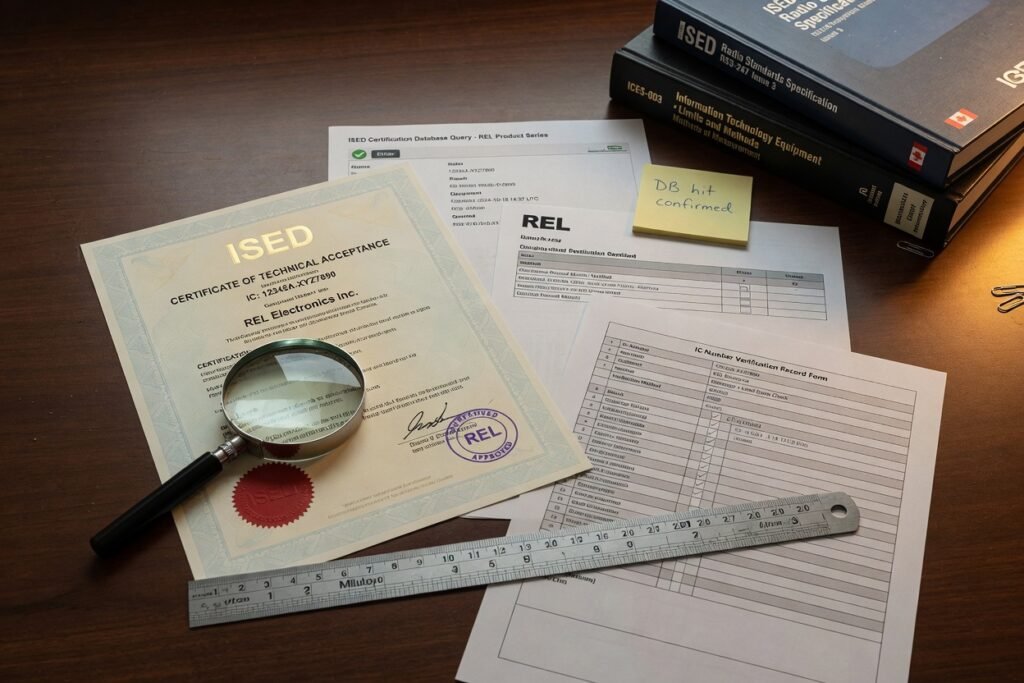
Step 3: Official Database Verification
You can directly search for “ISED Certification Database” to find the official ISED certification query entry, don’t trust third-party query websites. Enter the complete IC number, company name or product model to query.
When checking, focus on verifying four dimensions: first, whether the company number and product number are completely consistent with those on the product label; second, whether the certified product model, frequency range, and function category match the actual product, for example, if you bought a wireless charger but the certification found is for a Bluetooth headset, there must be a problem; third, whether the certification status is valid (for example, whether it has been revoked or cancelled), and whether the effective date is reasonable; fourth, whether the relationship between the applicant and the brand, the foundry is reasonable. Many brands do not produce by themselves, but find foundries to manufacture, and the foundry applies for certification. As long as the brand has authorization, it is normal, and you don’t have to think it is fake.
Finally, the judgment logic is very clear: only when it can be found in the official database and all information completely matches the actual product can the formal certification of this product be deemed valid; if it cannot be found, or the information does not match, either the certification is invalid, or it is a fake.
Confusing Comparison: Differences from Other Common Certifications
Many people confuse ISED certification with other common certifications. We have compiled a comparison table, so you can see the difference at a glance:
| Comparison Dimension | ISED (Canada) | FCC (United States) | CE (European Union) | cULus/CSA (Canadian Safety) |
| Applicable Market | Canada | United States | EU market access mark, cannot replace Canadian ISED requirements | Canada (both cULus/CSA are applicable) |
| Core Control Content | Radio spectrum compliance, electromagnetic interference emission | Radio spectrum compliance, electromagnetic interference emission | Multi-dimensional such as health, safety, electromagnetic compatibility, environmental protection | Electrical safety (electric shock, fire, overheating, etc.) |
| Compliance Mode | Formal certification (with IC ID) + SDoC self-declaration | Certification (with FCC ID) + SDoC self-declaration | Mainly self-declaration, some categories require notified body participation | Third-party laboratory testing + certification |
| Can It Replace ISED | – | No | No | No |
In short, certifications in each region are independent, with different control directions, and cannot replace each other. For charging products to enter the Canadian market, they also need to meet other parallel access requirements such as safety, energy efficiency, and plugs; it is not that passing one certification is enough.
Pitfall Avoidance Guide: 6 Common Misconceptions
Many people’s misunderstandings about ISED certification come from merchants’ vague promotions. We have compiled 6 of the most common pitfalls to help you avoid them.
First misconception: All charging products require ISED certification. Purely passive charging cables and adapters without chips neither emit radio nor have active circuits, so there is no ISED requirement at all. If a merchant uses “ordinary charging cable passed ISED” as a selling point, it is basically a concept swap.
Second misconception: ISED certification is Canadian safety certification. This is the most easily confused point. ISED only manages radio spectrum and electromagnetic interference, that is, whether it will interfere with other devices, and does not care about electrical safety at all—such as whether it will cause electric shock, catch fire, or overheat, these are all managed by safety certifications such as cULus and CSA. Don’t think that a charger is very safe just because it has an IC number; the two are completely different things.
Third misconception: US FCC certification can replace ISED certification. FCC and ISED do have similar control directions, both involving radio and electromagnetic compatibility, but FCC is a US certification, and Canada does not directly recognize it. Even if the test report can be used as a reference, to sell in Canada, you still need to obtain ISED compliance certification separately. You cannot say “passed FCC meets Canadian requirements”, which is non-compliant.
Fourth misconception: Having wireless module certification means the whole machine is compliant. Many manufacturers will say “the wireless module we use has passed ISED certification, so the whole machine must be compliant”, but that is not necessarily true. The certification of the module has usage restrictions, such as requiring a specific type of antenna, being installed in a specific position, and using a specific material for the housing. If the whole machine changes these parameters, such as changing the plastic housing to metal, or changing the antenna, then it may not meet the requirements. You can’t rest assured just by looking at the module’s certification.
Fifth misconception: ISED certification requires annual review and payment. Some agency companies will fool customers into saying that certification requires annual payment for review, but that is not the case at all. As long as the product design and specifications have not changed, ISED certification is valid for a long time, no annual payment, no annual review.
Sixth misconception: Charging products without WiFi/Bluetooth don’t need to care about ISED. Although ordinary wired fast charging adapters do not require formal radio certification, they still need to meet ISED’s ICES electromagnetic compatibility requirements and take the SDoC compliance path; excessive interference may also be deemed a violation.
Study Summary
At this point, you should have a complete understanding of ISED certification. To sum up, after reading this article, you should be able to do these 5 things independently:
First, you can quickly judge whether a charging product requires ISED formal certification and which compliance path it should take;
Second, you can distinguish the differences between ISED certification and safety certification, FCC certification, and CE certification, and know that Canadian charging products need to meet multiple sets of parallel access requirements such as ISED, safety, and energy efficiency at the same time;
Third, you can understand what the IC ID and ICES labels on charging products mean respectively;
Fourth, you can verify the authenticity of formal certification through product labels and the ISED official database;
Fifth, you can avoid common certification promotion misconceptions of merchants, and won’t pay extra for false certification selling points.
Next time you buy charging products, or ship electronic products to Canada, you can use this knowledge to judge by yourself, and no longer be led by merchants’ vague promotions.