
If you sell chargers to China via cross-border e-commerce, or have purchased a niche charger from overseas for personal use through cross-border shopping, you have most likely seen a green “e”-shaped mark printed on the product or its packaging. Some say this is a safety certification, some call it a fast charging label, and others mistake it for a recyclable mark — in fact, it is the exclusive mark of China RoHS. This article starts with the most familiar products such as chargers, charging cables, and adapters, to thoroughly explain China RoHS from basic definitions to practical judgment, helping you understand this regulation related to both health and environmental protection.
First, get it straight: What exactly is China RoHS
Put simply, China RoHS is China’s “toxic substance restriction regulation” for electrical and electronic products: it requires controlling the content of hazardous and toxic substances in products from the production front end, and proactively disclosing relevant information to consumers, so as to reduce full-cycle pollution and protect human health and the environment.
Its official regulatory name is the , commonly known as China RoHS in the industry. It is supported by two core standards: one specifies the limit requirements for hazardous substances (GB/T 26572), and the other specifies how to affix marks and disclose information (SJ/T 11364). Testing methods refer to the GB/T 39560 series. Ordinary users do not need to memorize these standard numbers, just know that there are unified implementation rules.
The core rules can be understood at different levels: all applicable electrical and electronic products produced, sold, or imported within the territory of China must complete hazardous substance marking and information disclosure in accordance with the requirements of SJ/T 11364; if a product is included in the (a list of strictly regulated products issued by the state), it must also complete conformity assessment in accordance with requirements such as GB/T 26572, and upload relevant information to the official platform.
For charging products, the scope of China RoHS control is very clear: it only controls hazardous substances in materials such as the plastic shell of chargers, solder joints, metal plating, and the insulation layer of cables, **and does not involve usage-related indicators such as charging efficiency, safety performance, fast charging protocols, or power consumption at all** — this point is very important and is also the most easily misunderstood part.
Most easily confused concepts
Many people confuse China RoHS with other certifications, so let’s draw clear boundaries here:
• It is not a safety certification: it has nothing to do with the CCC mandatory safety certification. It does not address safety risks such as electric shock or fire, but only controls toxic and hazardous substances in materials.
• It is not an energy efficiency or fast charging certification: it does not involve usage experience indicators such as charging speed, protocol compatibility, or power consumption. Do not mistake the e mark for a fast charging certification.
• It is not a recycling mark: RoHS is a “front-end toxic substance restriction” requirement at the production end, which controls whether there are toxic substances in the product. It is completely different from recyclable marks or the Green Dot mark.
• It is not EU RoHS: the two sets of rules are completely independent. Even if a product already complies with EU RoHS, it cannot be directly applied when sold to China. The specific differences will be explained in detail later.
Applicable boundaries: Which charging products need to meet the requirements
To determine whether a charging product needs to comply with China RoHS, first look at three general conditions, all of which must be met for compliance to be required:
First, product attribute: it must be an electrical and electronic product that relies on electric current or electromagnetic fields to work, as well as its supporting parts. Purely mechanical products that do not use electricity at all, such as cable ties and charger storage boxes, are not within the scope of control.
Second, voltage boundary: AC voltage not exceeding 1000V, DC voltage not exceeding 1500V. The civilian charging products we usually use, such as mobile phone chargers, laptop adapters, and charging cables, are basically within this range.
Third, geographical requirement: all products produced, sold, or imported within the territory of China count. Even chargers and charging cables sold together with mobile phones or laptops need to meet the requirements.
For products that meet these three conditions, compliance requirements are divided into two categories:
• Mandatory for all applicable products: affix compliance marks in accordance with SJ/T 11364, and disclose hazardous substance content information to consumers.
• Products included in the : in addition to the above requirements, they must additionally complete conformity assessment — that is, either the enterprise makes a self-declaration and files for the record, or obtains the state-promoted voluntary RoHS certification (referred to as state-promoted RoHS certification, which has higher credibility), and uploads the conformity assessment information to the official platform. If it is a charger or cable supporting a complete machine in the catalogue (such as a laptop), it can be assessed together with the complete machine; for separately sold charging accessories, the latest official catalogue shall prevail.
Common applicable charging products
Specifically for charging products we come into contact with daily, the following are all within the scope of control:
Charger category: mobile phone chargers, laptop power adapters, fast chargers, desktop charging stations, car chargers, magnetic chargers;
Cable category: charging cables with various interfaces, data cables with chips, adapters;
Supporting category: power strips with USB ports, wall socket panels with charging functions, charging modules of docking stations.
Scenarios exempt from sales-side compliance
There are also some special situations where sales-side compliance requirements do not need to be met, which overseas users should pay special attention to:
• Charging products only exported to markets outside China;
• Samples and prototypes temporarily imported for exhibition, testing, scientific research, and not for sale;
• A small number of exclusive spare parts for maintenance;
• A small number of charging products for personal use, carried non-commercially or purchased via cross-border shopping;
• Medical, industrial, and military charging products shall be judged in accordance with the exclusive regulations of the corresponding fields, and cannot be directly assumed to be exempt.
Quick judgment method
When encountering a product you are unsure about, you can follow three steps:
Step 1: Check whether it works by electricity or transmits electrical signals — purely mechanical products definitely do not count;
Step 2: Check whether it is sold or imported for the Chinese market — those only sold overseas do not need to be considered;
Step 3: Check whether it is included in the — corresponding to different compliance requirements; those not in the catalogue only need to complete marking and disclosure.
Core control requirements: Restricted substances and judgment rules
What hazardous substances does China RoHS actually control? What counts as compliance? There is a core rule that 90% of people get wrong, let’s explain it step by step.
6 controlled hazardous substances
Currently, China RoHS controls 6 substances that have long-term toxic effects on humans and the environment, and will release toxic gases when incinerated:
• 4 heavy metals: lead (commonly found in solder, alloys), mercury, cadmium (commonly found in plating, pigments), hexavalent chromium (commonly found in metal anti-corrosion layers);
• 2 flame retardants: polybrominated biphenyls (PBB), polybrominated diphenyl ethers (PBDE, commonly found in flame-retardant plastic shells, such as the shell of chargers).
The limit requirements for these substances implement the GB/T 26572 standard, and testing methods refer to the GB/T 39560 series.
The most easily misunderstood core rule: Calculation by homogeneous material
Many people think that taking the entire charger or the entire charging cable for testing, and meeting the standard with the average content counts as compliance — this is completely wrong. The limit of China RoHS is calculated based on **homogeneous materials**.
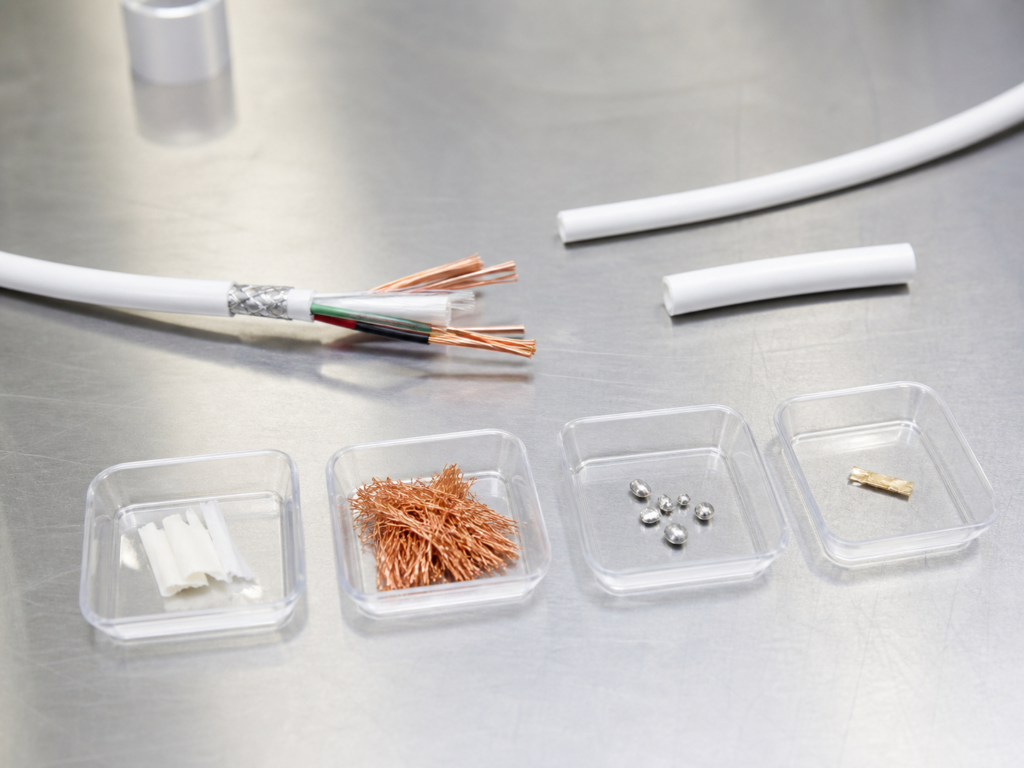
The so-called homogeneous material, in plain terms, is a single material that cannot be further split by mechanical methods. For example, for an ordinary charging cable, you cannot test the average content of the whole cable directly; it must be split into multiple independent single materials such as plastic sheath, copper conductor, solder joints, insulation layer, and surface plating. Each item is tested separately, and all must meet the limit requirements to be compliant. Even if the average content of the entire cable meets the standard, as long as the cadmium in a certain layer (such as metal plating) exceeds the limit, it is still non-compliant.
Specific limit values
The limit standards are actually very simple, no need to memorize them deliberately:
• Cadmium has the strictest requirement, with a mass proportion in homogeneous materials not exceeding 0.01% (i.e., 100ppm);
• The limits for the other 5 substances are all 0.1% (i.e., 1000ppm, mass proportion in homogeneous materials).
Compliance prerequisites for materials exceeding limits
If the hazardous substances in some materials exceed the limit, it is not necessarily non-compliant, but strict prerequisites must be met: first, it must fall under circumstances explicitly permitted by legal exemptions or standards, and the enterprise’s self-claim of “technically irreplaceable” alone cannot be used as a basis for compliance; second, it must be proactively disclosed in accordance with the requirements of the SJ/T 11364 standard — that is, mark “×” in the corresponding position of the hazardous substance content table, and at the same time indicate the Environmental Friendly Use Period (EFUP). If it is a product in the catalogue, it must also meet the requirements of conformity assessment.
Let’s clarify in advance here: marking “×” does not mean violation. It is just a truthful notification to consumers that some substances exceed the limit and meet the exemption requirements, which is a legal and compliant information disclosure.
How to read compliance marks: From the e mark to the hazardous substance table
For ordinary users, the most directly accessible China RoHS information is the mark on the product. We will explain from basic requirements to special rules for catalogue products respectively.
Meaning of the two types of exclusive marks
All applicable charging products must be affixed with an exclusive e-shaped mark in accordance with SJ/T 11364, which is specifically divided into two types:
• Pure green “e”-shaped mark: indicates that the hazardous substance content of all homogeneous materials of the product does not exceed the limit, and the product is in full compliance.
• “e”-shaped mark with a number: indicates that some homogeneous materials in the product have hazardous substances exceeding the limit, and the number on it is the **Environmental Friendly Use Period (EFUP)**. It is important to note here: this number is neither the service life of the product nor the quality grade. It only means that if used normally within this period without disassembly or damage, the internal hazardous substances will not leak and will not cause harm to humans and the environment.
How to read the hazardous substance content table
Many products also come with a hazardous substance content table in their packaging or manual. The core columns are generally part name, corresponding results of 6 hazardous substances, and result marks:
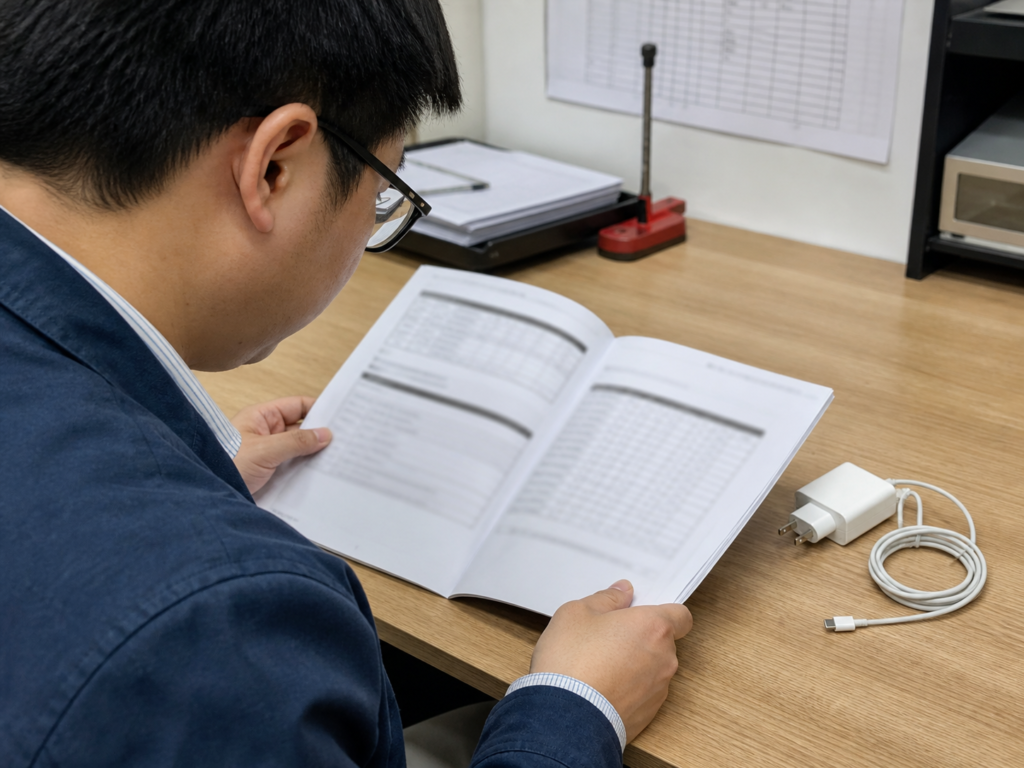
• Marked with “○”: indicates that the hazardous substances of all homogeneous materials of this part do not exceed the limit;
• Marked with “×”: indicates that at least one homogeneous material in this part has hazardous substances exceeding the limit.
For charging products, the parts most often marked with “×” are PCB circuit boards, solder joints, metal plating, and high-temperature flame-retardant plastics — due to process limitations, it is sometimes indeed difficult to completely replace hazardous substances in these parts, and they are compliant as long as they meet the exemption requirements.
Mark positions for charging products
Many people buy a charging cable and cannot find the RoHS mark, so they think it is non-compliant. In fact, the mark positions are different for products of different sizes:
• Chargers and power adapters of sufficient size are generally printed directly on the nameplate of the shell, which is easy to find;
• For small-sized charging cables and adapters that cannot be printed on the product, the mark can be printed on packaging, manuals, or even electronic materials such as e-commerce product detail pages and official website product pages;
• Products sold cross-border to China must have clear and traceable Chinese marks; all-English marks do not meet the requirements.
Conformity assessment methods for products in the catalogue
For charging products included in the , in addition to the above marking and disclosure requirements, they must also complete conformity assessment. There are two main optional methods:
• Self-declaration mode: after the enterprise conducts testing by itself or entrusts a third-party institution to test, it files relevant information on the official platform as required;
• State-promoted RoHS certification mode: a voluntary environmental protection certification promoted by the state, which requires review by an officially recognized third-party institution and has higher credibility. Generally, mid-to-high-end products of big brands choose this mode.
China RoHS vs EU RoHS: Core differences
Many overseas users will ask: I already have EU RoHS compliance, do I still need to do China’s? The answer is yes — the two are completely independent sets of regulations and cannot replace each other. The core differences can be quickly understood through the following table:
| Comparison dimension | China RoHS | EU RoHS |
| Types of controlled substances | 6 types (4 heavy metals + 2 flame retardants) | 10 types (4 additional phthalate plasticizers) |
| Marking requirements | Must be affixed with exclusive e-shaped mark, and hazardous substance content table must be disclosed | No separate RoHS mark, included in the CE compliance system |
| Public filing requirements | Products in the Catalogue for Compliance Management must be filed on the official platform | Only enterprises keep technical documents by themselves, no public filing |
| Exemption for personal use / temporary import | Relatively lenient | Relatively strict |
The “relatively lenient” here only applies to specific scenarios such as temporarily imported samples for non-sales purposes and a small number of items for personal use. The actual situation needs to be judged in combination with the import method, sales attribute, product category, and local specific rules.
In addition to the content in the table, there are several details related to charging products that need attention:
• The testing and limit logic of the two are similar, both calculated by homogeneous materials, with cadmium at 100ppm and other traditional substances at 1000ppm, but other compliance requirements are completely different;
• The exemption scope of industrial-grade charging equipment varies greatly between the two, and cannot be directly applied;
• For new products with wireless charging function, the product classification logic of the two sides may be different, and compliance requirements will also vary;
• There is a very practical judgment point: if the product only exceeds the limit for phthalate plasticizers, it does not affect China RoHS compliance, but does not meet EU RoHS requirements.
Practical judgment: How to verify the compliance of charging products
How can ordinary users or cross-border sellers quickly judge whether a charging product complies with China RoHS? In fact, it only takes two steps, plus two quick exclusion tips.
Step 1: First look at the mark on the product or packaging. Look for the exclusive green or numbered “e”-shaped mark. Be careful not to mistake the CE mark, recycling mark, or other environmental marks for the RoHS mark. If it is a small-sized charging cable or adapter and you cannot find the mark on the product, check the Chinese instructions on the packaging, manual, or e-commerce product detail page.
Step 2: Check filing and supporting materials. If it is a product in the Catalogue for Compliance Management, you can first confirm its conformity assessment method: for those using self-declaration, you can query the filing information on the China RoHS Public Service Platform; for those using state-promoted RoHS certification, you can verify the certificate through the official website of the Certification and Accreditation Administration of the People’s Republic of China (CNCA) or the official channels of the corresponding certification body. For non-catalogue products, since there is no mandatory filing requirement, you can make a comprehensive judgment based on the product’s hazardous substance content table, the enterprise’s public statement, and compliance documents provided by the supplier.
Quick tips to exclude non-compliant products
• No-name products that cannot even find any Chinese RoHS-related information are most likely non-compliant;
• Products on sale that only mark “compliant with EU RoHS” and have no China RoHS marks or information at all definitely do not meet China’s compliance requirements.
Connection with charging product recycling: Front-end prevention and control
Many people associate China RoHS with e-waste recycling. The two are indeed related, but their division of labor is completely different.
The core value of China RoHS is **front-end prevention and control**: reducing toxic and hazardous substances in products from the production link, so that when charging products are scrapped and become e-waste, the pollution to soil and water sources will be much less, and it can also reduce the occupational health risks of workers in recycling enterprises during disassembly. For charging products, the most common restricted carriers are the plastic sheath of charging cables and the circuit boards of chargers, which are also the parts with the highest pollution risk during recycling.
The Environmental Friendly Use Period mentioned earlier is also directly related to recycling: if used normally within the period without disassembly or damage, hazardous substances will not leak and it is safe; if the Environmental Friendly Use Period is exceeded, it is recommended to send it to a formal e-waste recycling point, and do not discard it randomly in domestic waste to avoid environmental pollution.
However, it should be clear that RoHS controls front-end toxic substance restriction at the production, sales, and import ends, **and does not restrict the recycling and disassembly link**. Recycling and disassembly are governed by special regulations such as solid waste and e-waste pollution prevention and control. RoHS certification is also not equivalent to recycling qualification, and cannot be used as a compliance certificate for the recycling link.
Pitfall avoidance guide and core ability summary
Pitfall avoidance for common cognitive misunderstandings
We have sorted out 7 of the most common cognitive misunderstandings to help you avoid pitfalls:
1. Not all charging products need state-promoted RoHS certification: only products in the catalogue need conformity assessment. Most ordinary products only need to complete marking and disclosure, and state-promoted certification is voluntary.
2. EU RoHS compliance ≠ China RoHS compliance: the two sets of rules are independent, and China’s marking, disclosure, and filing requirements must be met separately.
3. Passed complete machine testing ≠ compliant parts: the judgment standard is homogeneous materials. The average compliance of the complete machine does not mean that every single material meets the standard.
4. e mark with a number ≠ the product is not environmentally friendly or violates regulations: this is compliant information disclosure, indicating that some substances exceed the limit but meet the exemption requirements.
5. It is not that small charging cables and adapters do not need RoHS marking: it is just that they are too small to be printed on the product, so the mark can be printed on packaging, manuals, or electronic materials.
6. Having a CE mark or high price ≠ complying with China RoHS: the exclusive e mark of China RoHS shall prevail, and neither CE nor price can be used as proof of compliance.
7. No paper test report ≠ non-compliant: for products using the self-declaration mode, enterprises do not need to provide paper test reports to consumers, and only need to complete marking and disclosure as required.
Exclusive pitfall avoidance for overseas users/sellers
• For charging products sold to the Chinese market, especially those in the catalogue, be sure to complete compliance and official filing in advance, otherwise they cannot be sold normally;
• For chargers and charging cables purchased via cross-border shopping for personal use, if the quantity is small, there is no need to specially complete China RoHS compliance;
• The consequences of violation are relatively serious: products will be removed from shelves and confiscated, and production or sales enterprises may also be fined.
Core ability summary
After mastering these contents, you will basically gain several practical abilities: you can recognize the two types of China RoHS marks and understand their core functions; you can judge whether common charging products are within the scope of control; you can verify the compliance of products through official channels; you can distinguish the differences between China RoHS and EU RoHS, safety certification, and fast charging certification; you also know its connection with e-waste recycling and can correctly dispose of scrapped charging products. Whether you are buying charging products for personal use or doing cross-border business to sell to China, this knowledge can help you avoid compliance misunderstandings, and also make you clearer about the practical significance of this regulation for health and environmental protection.