
Sellers of charging products targeting the UK market often encounter pitfalls in “energy efficiency compliance”: some think that if there is no energy efficiency label, they do not need to worry about it; some confuse energy efficiency with the UKCA mark; others directly use EU ERP reports to cope with UK spot checks. In the end, either products are detained and removed from e-commerce platforms, or they face fines. In fact, although UK energy efficiency rules seem complicated, for charging external power supplies, over 90% of standalone wall-plug chargers and power adapters only need to complete ecodesign reporting (retain compliance documents) and do not require energy label registration — this is the core conclusion you need to clarify first, which can help you avoid many detours.
1. First, Understand: Two Core Sets of Rules for Energy Efficiency Compliance
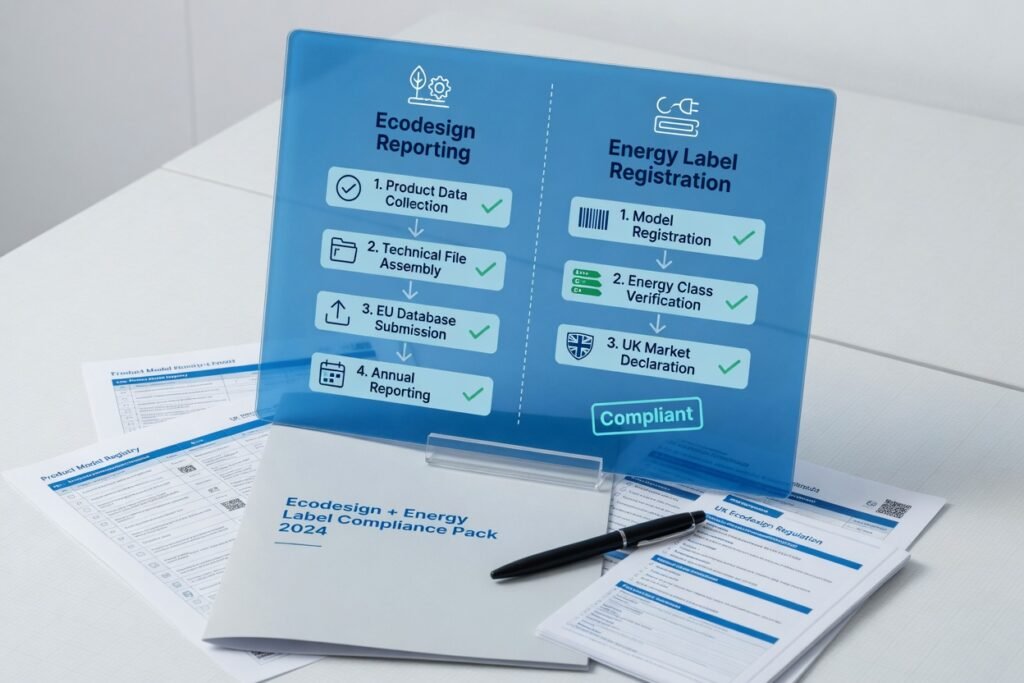
Many people confuse “reporting” and “registration” when they first come into contact with this field. In fact, these are two completely independent energy efficiency rules with very different applicable scenarios:
• Ecodesign (commonly known as “energy efficiency reporting” in the industry): Equivalent to setting a minimum energy efficiency passing line for products, it is a mandatory requirement that all external power supplies within the applicable scope must meet. The compliance method is that the UK legal responsible party retains the full set of documents proving the product meets the standards. There is no need to actively submit them to the authorities; they only need to be retrieved and provided in case of market spot checks or platform audits, and there is no need to affix a consumer-visible energy efficiency label.
• Energy Labelling (commonly known as “energy efficiency registration” in the industry): It is an information disclosure rule for consumers, only applicable to specific categories explicitly listed in regulations (currently mainly large home appliances, lighting, electronic displays, etc.). For such products, not only must compliance be proven, but information must also be entered into the official database to generate an A-G energy efficiency rating label, which is affixed to the product, packaging, and detail page for consumer reference. Most external power supplies such as ordinary USB chargers and laptop adapters are not included in the energy label catalogue. Whether registration is required must be checked one by one against the product catalogue of specific regulations, and registration cannot be assumed by default just based on the “charger” category name.
2. Quick Judgment: Does Your Product Need Compliance?
When you get a charging-related product, you can first make a preliminary judgment according to the four-step logic: first, check whether the input is mains (AC) or direct current (DC); second, check whether it has AC to DC power conversion function; third, check whether it is a standalone sold external power supply product; fourth, check whether it falls into the special scope of energy labels or other regulations. Then refine the judgment against common product categories:
| Product Type | Requires External Power Supply Energy Efficiency Compliance | Remarks |
| Standalone wall-plug USB chargers, fast charging heads, GaN chargers | Yes | Typical external AC-DC power supply, core requirement is to meet ecodesign requirements, most do not require energy label registration |
| ≤250W consumer external AC-DC power supplies, laptop power adapters | Yes | Products with power exceeding 250W require separate assessment of corresponding rules |
| Multi-port charging docks, standalone wireless chargers with AC plugs | Yes (only the power supply part) | Only the internal AC-DC power supply module is assessed as an external power supply, the wireless charging transmission part requires separate checking of corresponding regulations |
| Adapters/charging cables with AC to DC function | Yes (limited to specific categories) | Only products with built-in mains to DC power conversion circuits that can be plugged into the wall independently for power supply fall under the category of external power supplies; cables only with protocol identification, current limiting, or signal conversion functions are not applicable |
| Passive ordinary charging cables (no power conversion function) | No | Only transmit power, no voltage conversion function |
| Pure conversion plugs (no voltage transformation/regulation function) | No | Only convert plug shape, do not change power parameters |
| Conventional in-car chargers | No | DC input (cigarette lighter 12V/24V), not subject to the energy efficiency rules for mains external power supplies; 2-in-1 models with AC plugs require assessment of their AC-DC part |
| Ordinary power banks/portable chargers (no AC plug) | Usually not applicable | Not judged by the rules for external AC-DC power supplies, require separate assessment according to the whole product and other applicable regulations; for 2-in-1 models with AC plugs, their AC-DC power supply part needs to be assessed as an external power supply |
| Whole products with built-in power supplies such as mobile phones and laptops | Usually not applicable | Judged according to the energy efficiency rules of the corresponding whole product, not subject to external power supply requirements |
Special attention should be paid to the judgment of boundary products: for example, a 2-in-1 power bank with an AC plug is equivalent to a charger when used plugged into the wall, so the power supply part must be assessed according to the requirements of external power supplies; while for ordinary wireless chargers, only the internal power module that converts mains electricity to low voltage meets the definition of an external power supply, and the wireless transmission part has separate assessment standards, so the whole product cannot be directly counted as an external power supply.
3. Responsible Entities and Core Regulatory Basis
How to Determine the Legally Responsible Party
The primary legally responsible party for UK energy efficiency compliance is the manufacturer within the UK; if the manufacturer is not located in the UK, the UK importer assumes primary responsibility.
The UK Authorised Representative (UK AR) is not a mandatory requirement for all products: only when permitted by specific regulations and formally designated in writing by the responsible party can the authorised representative undertake part of the clearly listed obligations such as document retention and regulatory liaison, and cannot be generally regarded as the core responsible party for all products.
For Chinese cross-border sellers, it is necessary to confirm whether it is necessary to entrust a UK local entity (such as a cooperative importer, a formally designated authorised representative) to handle compliance matters according to their own sales model, importer arrangement and specific regulatory requirements; the registration eligibility for the energy label database needs to be checked according to the rules of specific categories, and the eligible registration entities may vary for different categories. In addition, note that unless there is a clear legal responsibility agreement, the foundry does not bear compliance responsibility for market access; the ultimate responsibility is borne by the brand owner or importer, and contractual agreements cannot exempt the legally responsible party from their obligations.
Core Applicable Regulations
UK energy efficiency regulations related to external power supplies are divided into two categories: framework regulations and specific implementation rules. All technical limits and test requirements shall be subject to the latest valid version of the implementation rules:
1. Ecodesign-related: The framework regulation is the . The specific energy efficiency limits, test methods, and applicable scope of external power supplies are stipulated by the implementation rules for external power supplies under this regulation. Readers can search for “external power supply ecodesign” on the GOV.UK official website to check the latest valid version. All applicable external power supplies must meet ecodesign requirements, the core of which is that the product meets the standards and complete technical documents are retained, no consumer-visible label is required.
2. Energy Labelling-related: The framework regulation is the . The specific applicable category catalogue, label format, and registration requirements need to be checked against the implementation rules of the corresponding category, and most external power supplies are not within the scope of the energy label catalogue.
In addition, it should be clarified that after Brexit, the energy efficiency system in the GB region is independent of the EU ERP system, and the applicable regulations, responsible entities, and marking requirements are not interchangeable; whether test reports can be used across regions cannot be generalized solely based on the region where the laboratory is located, three conditions need to be checked: first, the test method meets the regulatory requirements of the target region, second, the test model is completely consistent with the actual product, third, the credibility of the report is recognized by the target region’s regulator (or the responsible party confirms that it can be used as conformity evidence).
Regional Compliance Differences
The energy efficiency systems in different regions of the UK are different, and applicable rules need to be checked separately:
⚠️ Important reminder: Requirements such as database registration, A-G energy efficiency labels, product information sheets, and QR codes only apply to products explicitly included in the catalogue under energy label regulations; most external power supplies such as ordinary USB chargers and laptop adapters, whether sold to GB or NI, do not need to go through the energy label registration process.
• GB region (England, Scotland, Wales): Applicable to the UK’s domestic ecodesign and energy label regulations. If the product falls into the category covered by energy labels, it needs to be registered in the official database on GOV.UK; technical documents for ecodesign categories are retained by the UK legally responsible party on their own.
• Northern Ireland (NI): According to current regulatory arrangements, applicable to EU ecodesign and energy label rules. If the product falls into the category covered by energy labels, it needs to be registered in the EU EPREL database; ecodesign documents are retained by the corresponding responsible party in accordance with EU requirements.
If the product is sold to both GB and Northern Ireland, it is necessary to meet the regulatory requirements of the corresponding regions respectively, prepare corresponding compliance documents, and one set of materials cannot be used universally.
4. Compliance Requirements and Test Rules
For consumer external AC-DC power supplies with rated output power ≤250W, energy efficiency assessment mainly focuses on two indicators; the better the value, the more power-saving. The specific test conditions and limits shall be subject to the implementation rules for external power supplies in ecodesign regulations:
1. No-load power consumption (commonly known as standby power consumption): Refers to the power consumption of the product when it is connected to the mains but there is no load at the output end (no device connected for charging). Its limit varies depending on the rated output power and type of the product. 0.1W is a common typical limit for low-power external power supplies, but it is not a unified requirement for all ≤250W products. The specific limit shall be subject to the limit table in the regulations, and the test must meet the ambient temperature, input voltage frequency and other conditions specified in the regulations.
2. Average active efficiency (commonly known as average working efficiency): Refers to the ratio of output effective power to input active power when the product is working under load, reflecting the power utilization efficiency during charging. The regulations set limits in three tiers according to rated output power: ≤15W, 15-50W, and 50-250W. The test load points and average calculation methods for different power tiers are different (some power intervals need to include the 10% load point), and test points must be selected and the average calculated strictly in accordance with the requirements of the corresponding implementation rules.
Test Qualification Requirements
Regulations require that technical documents must include verifiable energy efficiency test evidence. Testing can be completed by the manufacturer itself, or entrusted to a third-party laboratory; to reduce the risk of evidence acceptance during spot checks, it is usually recommended to choose a laboratory accredited by UKAS (United Kingdom Accreditation Service) or compliant with UK regulatory requirements to issue reports, subject to applicable regulations, platform or customer requirements.
Test Coverage and Model Sharing Rules
This part is the most prone to pitfalls, the core judgment standard is whether the core characteristics affecting energy efficiency are consistent:
• Test scenario coverage requirements: For multi-port fast charging products, the test must cover representative working modes such as single-port maximum output and multi-port simultaneous output. The tester or technical responsible person shall confirm the “worst-case configuration” with the worst energy efficiency to ensure that the test results can cover all usage scenarios of the product.
• Core points of material checking: The model and core parameters on the test report must be completely consistent with the actual product; the power and output parameters publicly advertised on product packaging and detail pages cannot be higher than the rated values in the test report.
• Model family sharing judgment: If only the color, appearance, packaging language, and silk screen content are different, and the power supply topology, core components (main control chip, transformer, rectifier device, etc.), rated output power range, output mode, and software version affecting energy efficiency control are completely consistent, they can be classified into the same “product family”. Select the model with the worst-case configuration for testing, and other models share the report, but a written difference analysis must be attached to the technical documents to prove that the energy efficiency of other models will not be lower than the tested model. If characteristics such as output power, number of ports, core components, and output gears change, technical personnel or laboratories need to assess the impact of the difference on energy efficiency, and cannot directly default to sharing or mandatory retesting. Special attention should be paid: products of the same series with different powers, even if they look exactly the same, cannot directly share test reports, and must undergo energy efficiency difference assessment.
5. Required Materials List
Energy efficiency compliance materials are divided into two categories: legally required documents and recommended/common platform required materials. Do not blindly prepare extra materials:
Legally Required Documents (all applicable products must be prepared)
1. Basic product information: including model, brand, rated power, interface type, all output gears;
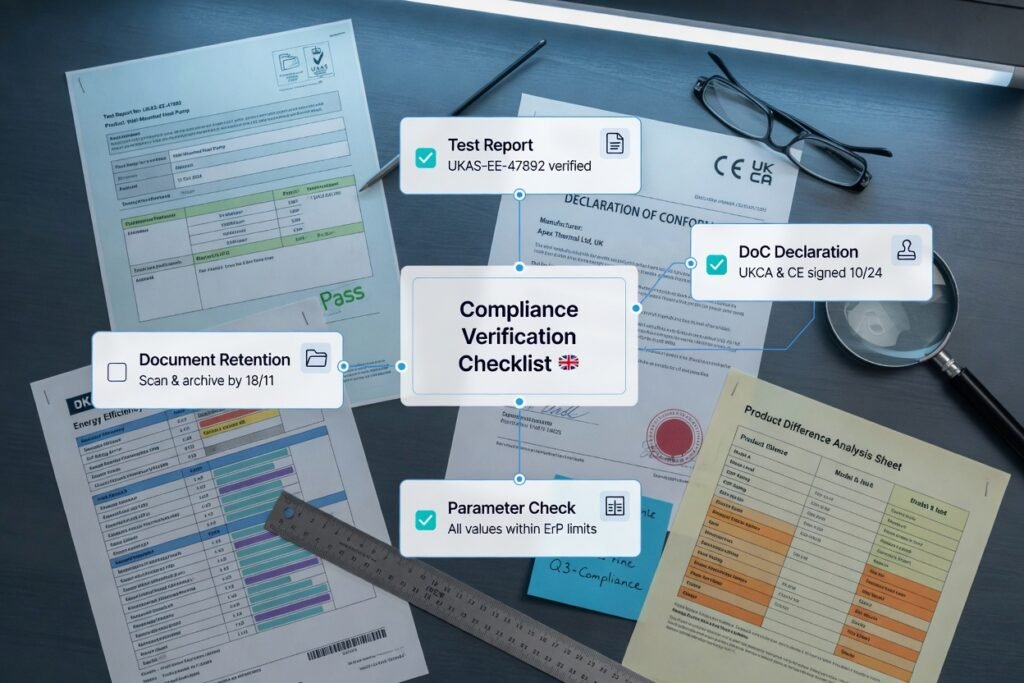
2. Energy efficiency test evidence: test reports, calculation records, etc., which can prove that the product meets energy efficiency requirements, and the test method matches the regulations;
3. Technical documents: including product description, applicable rule description, test conclusion, difference analysis (if there is a product family), etc.;
4. UK Declaration of Conformity (UK DoC): signed by a UK-based entity that assumes legal responsibility (manufacturer/importer/formally designated authorised representative), declaring that the product meets the requirements of corresponding regulations;
5. Identity and authorization relationship proof of the legally responsible entity: such as importer qualification documents, authorised representative power of attorney, etc., which can verify the legal identity and authorization relationship of the responsible entity.
Recommended/Common Platform Required Materials
Such materials are not legally mandatory, but some e-commerce platforms and customers may additionally require them, including: test reports issued by UKAS-accredited laboratories, additional qualification certification documents of the responsible party, etc.
6. Full Process Operation Steps
After understanding the basic requirements, the next step is the specific operation process, which is divided into four steps:
Step 1: Confirm 3 Must-Check Items in the Early Stage
Before officially starting, first confirm the three core issues clearly, otherwise you will find mistakes halfway and waste time:
First, confirm the compliance type of the product: first use the four-step judgment method above to confirm whether it falls within the applicable scope of external power supply ecodesign, then check the product catalogue of energy label regulations to determine whether only ecodesign compliance retention is required, or additional energy label registration is required;
Second, confirm the sales region: whether it is only sold in the GB region, or also sold in Northern Ireland, or both regions, corresponding to different regulatory systems;
Third, confirm the legally responsible party: clarify whether the UK importer assumes responsibility, or a qualified UK authorised representative has been designated, to ensure that there is a UK-based entity to interface with regulatory requirements.
Step 2: Test and Material Preparation
After confirmation, first select a suitable test channel to complete the energy efficiency test, prioritize confirming that the test method meets UK regulatory requirements, and for multi-port products, confirm with the test party in advance that all representative working modes are covered. After passing the test, sort out all documents according to the material list above, then check the consistency of parameters again to ensure that the publicly advertised parameters are not higher than the measured values in the test report. If it is a product family sharing a report, prepare the difference analysis document in advance.
Note: Testing is only a technical verification link. Completing the test does not mean completing compliance. It is also necessary to sort out technical documents, sign the declaration of conformity, and implement the legally responsible entity. For energy label categories, database registration also needs to be completed.
Step 3: Submit or Retain by Category
After the materials are prepared, handle them separately according to compliance type:
If it is ecodesign compliance, there is no need to actively submit to the authorities, all documents are uniformly retained by the UK legally responsible party, but it must be ensured that they can be retrieved quickly, and can be provided within the required time in case of market spot checks or platform audits.
If it is energy label registration (only applicable to products in the catalogue), it is necessary to register an official database account for the corresponding region with the information of the eligible responsible party: for the GB region, use the official GOV.UK system, for Northern Ireland, use the EU EPREL system. Fill in product information and upload materials according to system requirements and wait for review. The review cycle varies by category and application volume, usually 1-2 weeks, and may be extended during peak periods. If it fails, you can modify it according to feedback and resubmit.
Step 4: Market Launch Implementation
When the product is launched, also do the corresponding work according to the compliance type, and pay attention to distinguishing the boundary between mandatory regulatory requirements and marketing promotion:
• Ecodesign products: information required by regulations (such as rated input and output parameters, manufacturer/responsible party information) must be marked on the product nameplate as required; product parameters on packaging and sales web pages must be consistent with technical documents and test reports, and false promotion of energy efficiency levels is prohibited.
• Energy label products (only applicable to those in the catalogue): A-G grade energy efficiency labels must be produced in accordance with regulatory requirements and affixed to conspicuous positions on the product and packaging; when selling online, the energy efficiency label, product information sheet and registration-related marks must be displayed in a prominent position on the product detail page; if energy efficiency grades are involved in advertising, they must meet regulatory requirements.
7. Common Misconceptions and Pitfall Avoidance
Many people fall into pitfalls due to conceptual confusion. Here are the most common misconceptions and corresponding core checking actions sorted out:
1. Misconception: No energy efficiency label means no need to worry about energy efficiency → Checking action: First check whether it falls within the applicable scope of ecodesign. Ecodesign is a mandatory requirement, even if no label is required, the product must meet the standards and documents must be retained.
2. Misconception: Energy efficiency compliance means registering in the official database → Checking action: First check the product catalogue of energy labels. Most external power supplies only need to retain ecodesign documents and do not need active registration.
3. Misconception: Energy efficiency compliance and UKCA are the same thing → Checking action: The two belong to completely independent regulatory systems: energy efficiency governs energy-saving performance, corresponding to ecodesign/energy label regulations; UKCA is the conformity mark for the UK market, corresponding to regulations such as low voltage, electromagnetic compatibility, radio, and RoHS applicable to the product. Charging products usually need to meet multiple sets of regulations at the same time, and which ones are applicable need to be checked item by item, and they cannot replace each other. In addition, the current transition policy for conformity marks in the GB market (such as the applicable time limit for CE marking) shall be subject to the latest announcement of the UK government.
4. Misconception: EU ERP reports can be directly used in the UK → Checking action: Check from three dimensions: test method, model consistency, and qualification recognition, and cannot directly default to being universal or invalid.
5. Misconception: Products of the same series can share test reports casually → Checking action: Judge according to the model sharing rules above. Shared reports must have worst-case model testing and difference analysis records, and cannot be shared just based on the same appearance.
6. Misconception: Passing platform review equals regulatory approval → Checking action: Platforms usually only conduct formal reviews, and official spot checks will test product performance. If the actual test fails, you will be punished even if you pass the platform review.
7. Misconception: In-car chargers and wireless chargers are all counted as external power supplies → Checking action: Go back to the four-step judgment method, first check the input type and whether there is AC-DC conversion, not just look at the product name.
If you find a third party to handle energy efficiency compliance on your behalf, you can also use four standards to judge reliability: first, whether they are familiar with the energy efficiency rules for charging external power supplies (rather than only doing categories such as large home appliances and lighting); second, whether they can provide test channels that meet UK qualification requirements, or guide the preparation of technical evidence that meets the requirements; third, whether they can clearly distinguish the difference between ecodesign compliance and energy label registration, and will not generally require all products to be registered; fourth, whether they clearly inform subsequent maintenance requirements, spot check response processes and fee details, with no hidden fees.
8. Post-Reporting Maintenance and Spot Check Response
Many people think that compliance is a one-and-done thing, but in fact, subsequent maintenance and spot check response are also very important.
Information Update and Document Retention
When the following situations occur, it is necessary to timely assess whether compliance documents need to be updated:
• Product modification: including changes that affect energy efficiency such as replacement of core components, adjustment of internal structure, changes in output gears/power, etc.;
• Entity change: changes in information such as brand owner, UK responsible party, product model, etc.;
• New sales region: for example, originally only sold in GB, now adding the NI market.
The specific update requirements shall be implemented in accordance with the corresponding applicable regulations:
• Ecodesign category: If the modification affects the energy efficiency level, retesting is required and technical documents are updated, and the latest version shall be retained by the UK responsible party;
• Energy label category: If product information or energy efficiency grade changes, it is usually necessary to submit an update to the corresponding database within 1 month after the change, and the specific time limit is subject to system prompts and regulatory requirements.
The document retention period shall be implemented in accordance with the latest requirements of applicable regulations, usually required to be retained for 10 years after the product is discontinued, and cannot be destroyed in advance without authorization. In addition, energy efficiency compliance has no fixed “validity period”: as long as the product is not modified and the applicable regulations are not revised, the compliance documents remain valid; if the regulations are updated, the product conformity needs to be re-assessed according to the new requirements.
Core Inspection Items of Market Spot Checks
Energy efficiency spot checks by UK market regulatory authorities usually check the following content:
1. Whether the public parameters on the product nameplate, packaging, and sales web page are consistent with the information in the compliance documents;
2. Whether the responsible party has retained complete compliance evidence such as technical documents, test reports, and declarations of conformity;
3. If it falls into the category covered by energy labels, whether the energy efficiency label is posted/displayed as required, and whether the label information is consistent with the registered information;
4. Whether the information of the UK-based responsible party is clear and verifiable, and whether it can timely interface with regulatory requirements.
During spot checks, regulatory authorities may require samples to be provided for actual testing. If the actual test results are inconsistent with the declared ones, it will be judged as non-compliant.
Response Logic for Non-Conforming Spot Checks
If you receive a non-compliance notice from the regulator, it is recommended to handle it according to the following logic:
1. Immediately suspend the sales of related products and remove the corresponding links to avoid the expansion of the scope of violation;
2. Carefully check the rectification requirements of the regulatory authority and clarify the specific reasons for non-compliance (such as inconsistent parameters, missing documents, unqualified actual testing, etc.);
3. Complete rectification as required: such as supplementary testing, correcting public parameters, improving technical documents, re-registering (if necessary), etc.;
4. After the rectification is completed, submit it to the regulatory authority for review. Whether it can be re-launched is subject to the final conclusion of the regulatory authority. Serious cases may face penalties such as fines and goods detention.
Core Competency Check
After reading this content, you can judge whether you have mastered the basic requirements against three core competencies:
• For a charging-related product, you can quickly judge whether external power supply energy efficiency compliance is required and the compliance type through the four-step method of “input type – whether there is AC-DC conversion – whether it is sold independently – whether it falls into a specific category”;
• You can sort out the core process, required materials and responsible entity requirements of compliance, and complete the preliminary preparation work;
• You can identify common compliance misconceptions, avoid high-frequency pitfalls, and respond to basic platform audits and market spot checks.
UK energy efficiency compliance seems to have many provisions, but for charging external power supplies, in most cases, only the document retention of ecodesign needs to be done well. As long as you understand the core rules and do not take chances, it is actually not difficult.