
For anyone selling charging products into the South Korean market, almost the first question is always “How much does KC certification cost?” But you’ll find that asking ten service providers may get you ten wildly different quotes, ranging from over a thousand to tens of thousands of yuan, which is confusing. Before discussing fee details, you must first understand three most basic prerequisites; otherwise, even the cheapest quote could be a trap.
3 Prerequisites You Must Know Before Calculating KC Fees
Applicable Boundary of KC for Charging Products
KC is South Korea’s safety compliance system for electrical appliances. Whether a product requires KC for import and sale, and which type of KC it needs, must be comprehensively judged based on rated input voltage, product structure, intended use, and the current official Korean product category catalog. Conclusions cannot be drawn solely based on “whether it is a charger” or “whether it has a plug”. This article only covers charging-related products such as chargers, power adapters, charging cables, charging interface accessories, power banks, and wireless chargers; other categories are not within the scope of discussion. The compliance classification of common charging products can be roughly divided into the following categories, the final determination shall be subject to the current electrical appliance safety management product category catalog published by the Korean Agency for Technology and Standards (KATS, the official agency responsible for certification supervision in South Korea) and the judgment of designated certification bodies:
- Charging products with Korean-standard AC plugs that connect directly to the mains: such as mobile phone chargers, power adapters, and integrated charging cables/power cords with AC plugs. Most are subject to KC safety management, but the specific type of certification depends on power, structure, and catalog classification, and cannot be generalized.
- Low-voltage side charging accessories: such as ordinary USB/USB-C charging cables and charging adapters. Judgment must be made based on whether they have active electronic components and rated current/voltage parameters. Some fall under the scope of Safety Confirmation or Supplier’s Declaration of Conformity (SDoC), and not all are uniformly classified.
- Charging products with batteries or wireless functions: In addition to electrical safety, power banks and wireless chargers may also involve battery and radio-related compliance requirements, which require separate verification against the catalog.
- Categories that usually do not require KC electrical safety certification: Pure mechanical accessories with no electrical functions at all, such as charger storage cases and cable organizers, generally do not involve KC electrical safety certification, but if they have additional functions, separate judgment is required.
If a product falls within the KC control scope but has not completed compliance, it may be required to rectify, have its circulation restricted, be recalled, or be fined during import and sales. The specific consequences depend on the product type and the severity of the violation.
3 Types of KC Compliance Systems: The Core Reason for Fee Differences
Even for charging products, KC fees can differ by ten times. The core reason is that products corresponding to different risk levels are subject to completely different compliance systems. The three types of formal systems for the safety management of electrical appliances currently in effect in South Korea are as follows, the specific applicable type shall be subject to the official product category catalog and cannot be judged solely by subjective risk assessment:
- Safety Certification: For high-risk electrical appliances, full-item testing by a Korean designated certification body is required, along with on-site inspection of the manufacturing factory (referred to as factory audit, i.e., verifying whether the production process and quality control can stably produce qualified products). After the certificate is issued, there are regular supervision requirements. The overall process is the most complex and the cost is the highest.
- Safety Confirmation: For medium-risk electrical appliances, testing must be completed by a designated body in accordance with standards, and confirmation is completed after passing the test. Generally, no initial factory audit is required, but when subsequent substantive changes are made to the product or standards are updated, reporting is still required as required. The cost is moderate, and this is a common type among charging accessories.
- Supplier’s Declaration of Conformity (SDoC): For passive electrical accessories with extremely low risk, there is no need to apply for a certificate from an official body. The manufacturer or importer can complete testing on their own, keep the report, and mark relevant information as required. The cost is the lowest, but it must be confirmed that the product is within the official SDoC catalog; otherwise, it will not be recognized by the Korean official authorities.
Why Can’t Anyone Give You a “Fixed Price”?
The cost of KC certification is not a fixed package, but is calculated separately based on “applicable compliance system + test items + service content + subsequent maintenance”. Even for products with the same name, power level, number of models, certification type, and whether rectification is required can make the total cost differ by several times. Therefore, a quote without clear product parameters and certification type has no practical reference value at all, and may even be a low-price bait trap.
Where Does the KC Certification Money Go? Full Breakdown of 4 Types of Fees
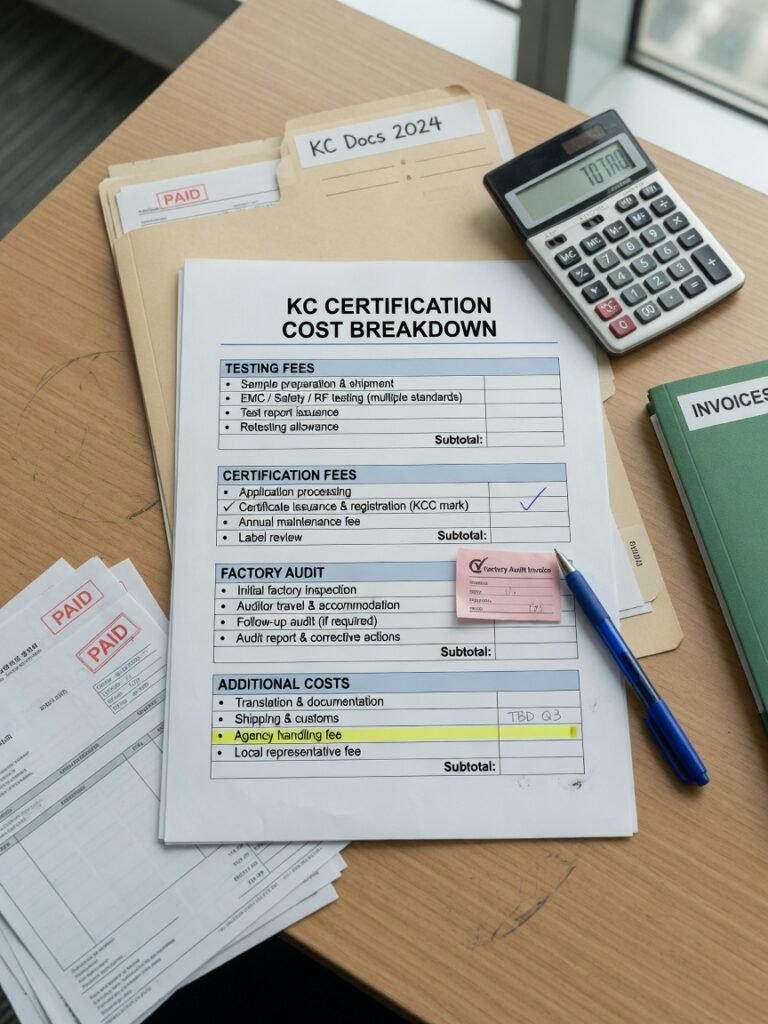
After understanding the prerequisites, we break down all KC certification fees into 4 parts. You can check whether each expense is reasonable against them, the specific fee items and standards shall be subject to the applicable certification system and the requirements of the designated body:
Core Fees Required to Obtain the Certificate
This part is the main mandatory expense under the paths that require official application for certification, such as Safety Certification and Safety Confirmation. If the SDoC (Supplier’s Declaration of Conformity) path is used, there will be no official registration and certification fee, but testing must still be completed and reports retained as required:
- Testing Fee: This is the main component of the cost, usually accounting for 60%-70% of the total fee in a regular single-model quote. It is charged based on the actual test items performed and corresponding standards; the more items, the higher the fee. Common test items for charging products include electrical safety, electromagnetic compatibility (EMC, simply put, the product does not interfere with other devices when operating, nor is it interfered with by other devices), fast charging protocol compatibility (if applicable, whether it is included in the test scope of the KC certification quote must be determined based on the product’s claimed functions, interface configuration, certification body requirements, and customer/platform requirements; not all KC electrical safety assessments will mandate testing of the proprietary fast charging protocol itself), battery safety (for products with batteries), etc.
- Official Application/Certificate Fee: Charged by a KATS-accredited designated certification body, it is an administrative fee related to registration and certification issuance. The amount varies depending on the type of certification.
- Factory Audit Fee: Only payable when the product falls under a certification system that requires factory inspection (such as Safety Certification). It is calculated based on audit person-days, travel costs, etc. The specific fee varies depending on the factory location and audit scope.
Optional Service Fees Commonly Used by First-Timers
If you are doing KC certification for the first time and are not familiar with the process, you may use these optional services, which are not legally mandatory expenses:
- Agency Service Fee: The service provider helps organize application materials, liaise with testing bodies, and follow up on the entire process, saving you the trouble of handling procedures yourself. It is suitable for first-timers.
- Pre-Testing Fee: A preliminary test is conducted before official submission for testing to identify obvious non-conformities, avoiding higher rectification and retesting fees if the official test fails.
- Rectification Service Fee: If the official test fails, the service provider provides technical guidance to help you adjust the product to meet the standards, and charges based on the severity of the problem.
Easily Overlooked Subsequent Maintenance Fees
Many people think everything is fine once they get the certificate. In fact, different certification systems have different subsequent maintenance requirements, especially for Safety Certification products, which may incur the following costs:
- Regular Audit/Annual Fee: Some certification types (such as Safety Certification) require regular factory audits or payment of annual fees to maintain the validity of the certificate. Specific requirements depend on the certification system and the notice from the body.
- Product Change Notification Fee: If substantive changes are made to the product (such as adjusting the core circuit, changing the manufacturing factory, adding new models that meet the series requirements), it is necessary to report to the certification body. Some changes require supplementary testing, which will incur corresponding fees.
- Supplementary Testing Fee for Standard Updates: If relevant Korean safety standards are revised and the product is within the affected scope, corresponding items must be supplemented and tested as required; otherwise, the validity of the certificate may be affected. Specific supplementary testing requirements depend on the transition arrangements for the standard update.
Easily Ignored Hidden Miscellaneous Costs
These fees are not high in amount, but if not planned in advance, they can also disrupt the budget:
- Sample Production/Shipping Fee: Testing requires providing mass-produced samples that meet the requirements, usually 2-3 units. At the same time, you need to bear the costs of express delivery, customs clearance, etc. for sending samples to the laboratory. The specific quantity and requirements are subject to the notice of the testing body.
- Korean Language Material Related Fees: Materials such as product nameplates, manuals, and labels usually need to meet Korean language requirements. If there is no ready-made compliant version, translation and review fees may be incurred. Specific requirements are subject to regulations and certification body provisions.
- Korean Local Entity Service Fee: Some certification types require a local Korean importer or agent to participate in the application. If you do not have a cooperating Korean entity, you may need to entrust a third party to provide relevant services, incurring corresponding fees.
Reference Fee Range for KC Certification of Charging Products
The following ranges are compiled based on RMB quotes from domestic KATS-accredited service providers around 2024, for budget estimation reference only. They are not official Korean fee standards, and actual fees are subject to the written quote of the body.
Default quote prerequisites: single model, sample passes testing in one go, domestic factory, conventional parameters, including testing fee, certification application fee, and basic agency service fee; excluding sample production/shipping fee, rectification and retesting fee, expediting fee, Korean local entity service fee, annual audit maintenance fee, and taxes.
| Compliance System Type | Common Charging Products | Fee Range (RMB) | Core Features |
|---|---|---|---|
| Safety Certification (factory audit required, high-risk category) | Multi-port laptop power adapters above 65W that require Safety Certification as determined by the KATS catalog | 6,000-12,000 yuan | Factory audit required; the higher the power and the more interfaces, the more test items, and the higher the fee |
| Integrated charging cables with Korean-standard AC plugs that require Safety Certification as determined by the KATS catalog | 2,500-5,000 yuan | Fee is adjusted based on wire diameter, rated current, and test items | |
| USB-C PD fast chargers above 100W that require Safety Certification as determined by the KATS catalog | 8,000-15,000 yuan | Many test items, factory audit required | |
| Safety Confirmation (medium risk, most common) | Single-port mobile phone fast chargers requiring Safety Confirmation (20W-30W conventional models) | 3,000-6,000 yuan | Only testing + confirmation and certification issuance, no initial factory audit required |
| USB-A to Lightning/USB-C ordinary charging cables (no AC plug) | 1,200-2,500 yuan | Fewer test items; specific adjustment based on rated current and whether active components are included | |
| Ordinary low-voltage USB-C to C charging cables (no AC plug) | 1,200-3,000 yuan | Need to confirm whether there is an E-Marker chip and the rated current; different classifications lead to different fees | |
| Charging port adapters (C to A/C to Micro, etc.) | 1,000-2,000 yuan | Simple structure; specific classification confirmed based on function and parameters | |
| Power banks requiring Safety Confirmation (5,000mAh-20,000mAh conventional models) | 4,000-8,000 yuan | Includes battery safety testing; the higher the capacity and power, the higher the fee | |
| SDoC (Supplier’s Declaration of Conformity) | Pure passive charging accessories that meet the SDoC catalog | 500-1,500 yuan | Only need to keep the test report on hand, no official registration and certification fee; must first confirm the product is within the SDoC catalog |
Note:
- The certification type classification of all products shall be subject to the current electrical appliance safety management product category catalog published by KATS; the classifications and power ranges in the table are only for reference of common quoting scenarios, and power level is not the legal basis for dividing certification types.
- Products with radio transmission functions such as Bluetooth and Wi-Fi require additional verification of compliance requirements of the Korea Radio Management Bureau (RRA). Fees are calculated separately based on the frequency band used, whether the module has obtained Korean certification, product combination method, etc.; the electrical safety testing of wireless chargers and radio compliance are independent items and cannot be confused.
7 Key Variables Affecting KC Fees
After knowing the basic range, you can adjust the budget according to your own situation. These 7 factors are the core reasons for price fluctuations:
Certification Type Matching Degree
This is the most critical prerequisite. If you choose the wrong one, you will either waste money or fail the compliance audit. If you apply for Safety Certification for a product that should be subject to Safety Confirmation, you will waste a lot of money; but if you apply for a low-level category for a product that should be subject to Safety Certification, the product may face compliance risks when entering the Korean market. If you are unsure, you can confirm the corresponding certification type of the product through the official product category catalog published by KATS, or consult a designated certification body. Do not rely solely on subjective judgment.
Core Product Parameters (Exclusive to Charging Products)
The parameters of charging products directly affect the number of test items. The more complex the parameters, the more test items, and the higher the fee:
- Power: The higher the power, the more safety items need to be verified, and the fee usually rises accordingly. For similar products, the testing fee for a 100W product is usually about 20%-40% higher than that of a 20W product, depending on the actual number of additional test items.
- Interfaces and Protocols: Multi-interface products require testing the safety performance of each interface. For products with fast charging protocols such as PD, QC, and PPS, if relevant protocol testing is included in the requirements by the standard or certification body, corresponding items need to be additionally tested, and the fee will increase.
- Structure: Integrated adapters with cables have more cable-related test items than bare adapters, so the fee is higher.
- Additional Functions: Products with wireless charging or built-in batteries require additional testing of corresponding safety items, and the fee will increase.
Number of Models and Series Division
More models do not necessarily mean higher total cost; the key is whether they meet the series division rules. The core judgment standard for the same series is: the product’s core circuit, rated safety parameters, key safety structure, and key components are consistent, and only non-safety elements such as appearance, color, and silk screen are different, then you can apply for same-series certification. In terms of fees, the main model is usually charged at full price, and qualified derivative models only need to pay an additional 10%-30% of the main model’s fee for testing or reporting, which greatly reduces the cost per model. It should be noted that models with a power difference of more than about 20%, or different core circuits or safety structures, should not be forcibly merged into the same series; otherwise, they will be rejected by the certification body, wasting time and money instead. The specific series division rules are subject to the judgment of the designated certification body.
Testing Rectification Situation
If the sample passes the test in one go, this part of the fee will not be incurred; if the test fails, you need to pay for rectification and retesting. Common rectification points for charging products include: Korean-standard plug size not meeting requirements, insufficient insulation distance, unqualified cable flame retardant grade, EMC exceeding standards, etc. Minor problems (such as adjusting labels, small structural adjustments) have low fees, while major problems (such as modifying PCB, re-opening molds) have high fees. After rectification, retesting of unqualified items is required, and the retesting fee is charged based on the actual retested items.
Factory Location
This factor only affects the fee when the product falls under a certification type that requires factory audit. If the factory is in China, the auditor’s travel cost is lower, and the factory audit-related fees are less; if the factory is overseas (such as Southeast Asia, Europe, and the United States), additional international travel expenses, translation fees, etc. are required, and the factory audit-related fees are usually 50%-100% higher than those of domestic factories. The specific range depends on the factory location, audit person-days, and translation arrangements.
Selection of Certification/Testing Body
Quotes and service scopes vary among different bodies. When choosing, first confirm whether the body’s qualifications cover the corresponding product and standards:
- Korean local designated certification bodies (such as KTC, KTL): These are officially designated certification bodies in South Korea, with business scope covering most electrical appliances and high recognition, but communication costs and fees may be slightly higher.
- Domestic KATS-accredited testing laboratories: Can undertake testing work for corresponding standards, with convenient communication and relatively low fees. However, it is necessary to confirm whether their test reports are accepted by Korean designated certification bodies and whether they cover the product category you are applying for.
It should be noted that you must choose a body with corresponding qualifications. Reports or certificates issued by unqualified bodies are not recognized by the Korean official authorities, which means you are wasting money.
Cycle Requirement
The regular KC certification cycle is generally 4-8 weeks (varies depending on product type and body scheduling), with no additional fees. If expedited processing is required, the cycle can be shortened to 1-3 weeks, and the expediting fee is usually 20%-50% of the basic fee; moreover, the premise of expediting is that the sample passes the test in one go. If rectification is required, the expedited cycle may not be guaranteed, and the fee may be adjusted accordingly.
How to Judge Whether a KC Quote Is Reliable? 3-Step Practical Method
After understanding the fee structure and influencing factors, you can judge whether the service provider’s quote is reliable by yourself, instead of only comparing the total price.
5 Items That a Formal Quote Must Include
After getting the quote, first check whether these 5 items are included. Missing any one may be a pitfall:
First, clear certification type and certificate scope: It must be clearly stated whether it is Safety Certification, Safety Confirmation, or SDoC, and whether it includes official registration/certification issuance, or only provides test reports.
Second, specific test item list: It must be clearly listed whether it includes electrical safety, EMC, fast charging protocol, battery safety, wireless-related testing, etc., and cannot only vaguely write the words “testing fee”.
Third, service and maintenance content included in the fee: Whether it includes factory audit fee (if required), annual maintenance fee/regular audit fee, agency service fee, material review fee, Korean translation fee, etc., must be listed item by item.
Fourth, charging rules for changes and exceptions: For example, the charging standards for adding models, product rectification, and retesting must be clearly agreed in advance.
Fifth, body qualification and certificate query method: The name and qualification scope of the certification/testing body, as well as the official query channel for the certificate, must be clarified.
Common Traps of Low-Price Quotes
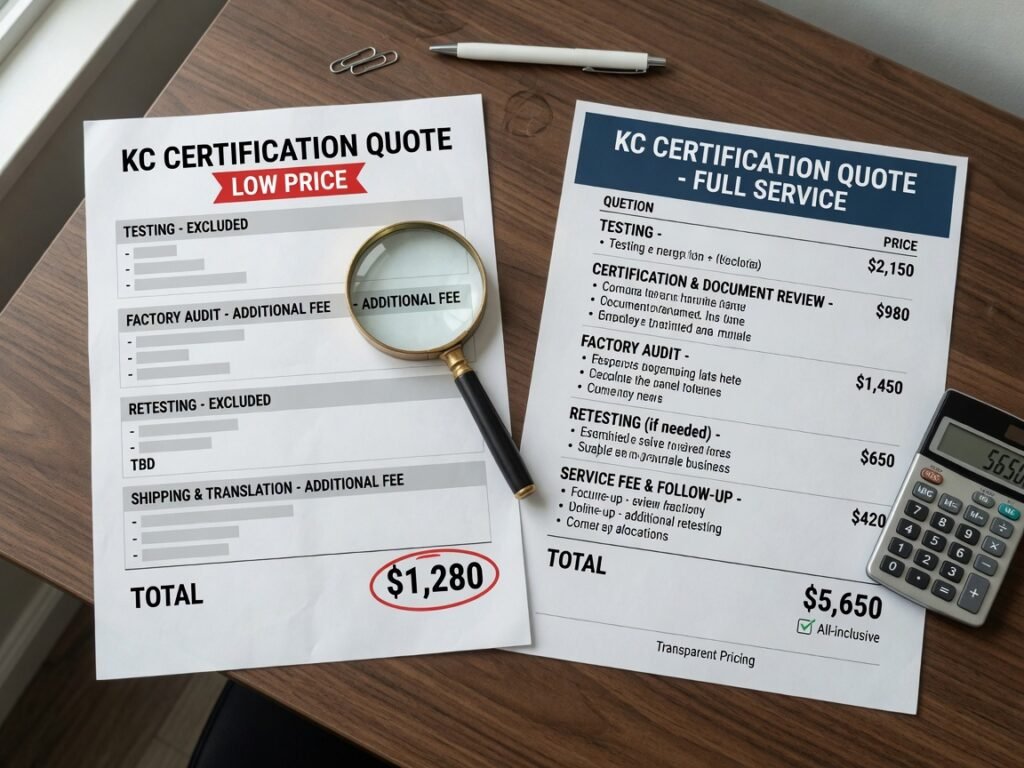
If the quote you get is far below the conventional market level, you must be careful; there is a high probability that there is a trap:
- Omitted Item Quote: Only part of the test items are quoted (for example, only safety testing is quoted, EMC is omitted, or additional test items such as fast charging protocol, battery safety, and wireless compliance corresponding to product functions are omitted), and money is continuously added later on the grounds of “supplementary testing”.
- Excluding Necessary Fees: Rectification service fee, retesting fee, or even Korean local entity cooperation fee (if required) are not included. After you pay, they will say you need to pay extra, otherwise you can’t get the certificate.
- Fake/Copied Certificate: If the quote is far below the cost, it may be a forged certificate or a certificate copied from another manufacturer. If found by the Korean official authorities, you will face risks such as product detention and fines. To verify the authenticity of the certificate, you can check the certificate number, model, manufacturer and other information through the official Korean safety certification product database or the query page of the designated certification body. However, the query result only proves the registered information of the certificate and cannot replace the verification of the consistency between the actual product and the certificate scope.
Confirm the Boundary of “All-Inclusive Price” Clearly
Many service providers like to quote an “all-inclusive price”, which sounds worry-free, but you must ask clearly about the scope of the “all-inclusive”:
How many models are included? What are the corresponding power, interfaces, and parameters? How much is charged for adding models?
How many times of rectification and retesting are included? How much is charged after exceeding the number of times?
What documents are delivered in the end? Is it an official KC certificate plus test report, or only a test report?
Does it include the first-year maintenance fee? What is the subsequent annual fee standard?
Are the excluded items listed separately? Don’t pay the money in a daze, only to find that key items are not covered in the end.
How to Plan KC Certification Budget? Legal Cost Reduction + Must-Save Red Lines
Finally, let’s talk about how to plan the budget, which can save money legally without stepping on compliance red lines.
3 Steps to Quickly Estimate Total Cost
You don’t need to find a service provider, you can calculate the approximate budget by yourself first:
Step 1: First determine the corresponding certification type of the product (Safety Certification/Safety Confirmation/SDoC), corresponding to the basic fee range above.
Step 2: Collect core product information: how much power, how many interfaces, whether it has cables/batteries/wireless functions, how many models, where the factory is located.
Step 3: Adjust the budget according to influencing factors: for example, if there are derivative models that meet the same series rules, the fee can be added at a rate of about 15% per model; if expediting is required, an expediting budget of about 30% of the basic fee can be reserved; if the factory is overseas and requires factory audit, an additional 50%-100% of factory audit-related fees will be added; finally, reserve a contingency fund of 20%-30% of the basic budget to deal with unexpected situations such as rectification and retesting.
5 Legal Cost-Saving Tips
On the premise of compliance, these methods can help you save a lot of money:
First, package certification for same-series products: Applying for multiple models that meet the same series rules together can greatly reduce the average cost per model, which is much more cost-effective than doing each model separately.
Second, meet Korean standard requirements at the design stage: For example, use Korean-standard plugs that meet the size requirements, leave enough insulation distance, and use qualified flame-retardant cables from the beginning to reduce the possibility of rectification at the source.
Third, do pre-testing when necessary: Although it costs a little pre-testing fee, it can avoid high rectification and retesting fees after the official test fails, which is equivalent to spending a small amount of money to save a large amount.
Fourth, choose qualified domestic testing laboratories: If domestic laboratories have KATS accreditation for the corresponding products, communication is convenient, and part of the travel and translation costs can be saved. As long as the report is accepted by the Korean designated certification body, the recognition is not affected.
Fifth, plan the cycle in advance: Try to avoid the scheduling peak of the year-end stocking season, and apply 2-3 months in advance, so you don’t have to pay expediting fees.
3 Compliance Costs That Cannot Be Saved
Some money can be saved, but some money absolutely cannot be saved; saving it is planting a mine for yourself:
First, the fee for core test items required by law: Safety items such as insulation, flame retardancy, and temperature rise are the basis for ensuring product safety and compliance. You must not reduce prices by omitting test items; otherwise, not only will you fail the certification, but if a safety problem occurs with the product, you will be fully responsible.
Second, the factory audit/regular inspection fee required by the corresponding certification system: If the product falls under a certification type that requires factory audit, the audit must be completed as required. Do not believe the claim that “you can get the certificate without factory audit”; otherwise, the legality of the certificate cannot be guaranteed.
Third, the necessary change notification and standard update fees: If substantive changes are made to the product, or relevant standard updates require supplementary testing, you must complete the notification and supplementary testing in accordance with regulations; otherwise, the validity of the certificate may be affected, resulting in the product being unable to be sold normally.
Budget Reserve Suggestions
When making a budget, don’t make it too tight; leave some room. For first-time certification, it is recommended to reserve a contingency fund of 20%-30% of the basic budget to deal with unexpected situations such as rectification and retesting. If the product sales cycle exceeds 1 year, you also need to reserve an additional maintenance budget for regular audits and standard updates to avoid certificate problems later.
6 Common KC Fee Misconceptions
Finally, let’s correct a few common misconceptions to avoid pitfalls:
Misconception 1: CE/FCC Certification Can Directly Offset KC Fees
Many people think that CE and FCC test reports can be directly used for KC without further testing. This is not the case. CE and FCC test reports cannot directly replace all tests for KC certification. Some general safety items, if they meet Korean standard requirements and the qualification of the laboratory that issued the report is recognized, may be eligible for a reduction or exemption of the corresponding test fee. However, the accepted items can usually only reduce the total fee by about 10%-20% at most, and must be reviewed and confirmed item by item by the Korean designated certification body, and cannot be directly assumed to be fully offset. Korea-specific requirements for charging products — such as Korean-standard plug size, temperature rise test under 220V 60Hz environment, and local Korean EMC standard requirements — usually still need to be tested separately in accordance with KC regulations and cannot be replaced by CE/FCC reports.
Misconception 2: Safety Confirmation Is Less Effective Than Safety Certification
Some people think that Safety Confirmation is less reliable than Safety Certification, and insist on getting Safety Certification for low-risk products, spending several times more money. In fact, both systems are officially recognized compliance modes in South Korea, but they correspond to different product risk levels and have different requirements. As long as the product meets the requirements of the corresponding system, it is legal and compliant. For low-risk products, Safety Confirmation is sufficient, and there is no need to spend extra money.
Misconception 3: Sticking a KC Mark on the Product Means Certification Is Completed
Some people think that just printing a KC mark and sticking it on the product is enough, which is completely wrong. The KC mark must correspond to a valid KC certificate/confirmation document, and the style, position, and information of the mark must be consistent with those on the certificate and product nameplate. Wrongly pasting or fraudulently using the KC mark will result in immediate removal from shelves, fines, and even product detention if found.
Misconception 4: Doing Multiple Models Together Is Definitely More Expensive
Many people dare not add models when doing it for the first time, afraid of extra cost. In fact, as long as they meet the same series rules, the cost per model is lower when multiple models are done together. Of course, you can’t randomly group models that don’t meet the rules; otherwise, they will be rejected and waste money instead.
Misconception 5: The Lower the Quote, the More Cost-Effective It Is
When looking for a service provider, many people only look at the total price and choose the cheapest one. As a result, there are all kinds of supplementary fees later, and the final cost is even higher than the more expensive quote, or even a fake certificate is obtained. To judge whether a quote is good, first check whether the quote’s scope is complete, whether the included items are consistent, and whether there are any problems with the body’s qualifications, then compare the total price; otherwise, it is meaningless.
Misconception 6: Getting the Certificate Means It’s Done Once and for All
Many people think that once they get the KC certificate, they can use it forever and don’t need to worry about it. This is not the case. Different certification types have different subsequent maintenance requirements. For example, Safety Certification requires regular audits, product changes need to be reported, and standard updates may require supplementary testing. If these maintenance tasks are not done properly, the certificate may become invalid, and the product can no longer be sold in South Korea.
Conclusion
In general, the core logic of planning KC certification budget can be summarized into four points: first, identify the corresponding certification type of the product; second, break down the full-cycle fee structure; third, verify the completeness of the quote and the qualification of the body; finally, reserve subsequent maintenance and emergency contingency funds. On the premise of ensuring compliance and effectiveness, through reasonable model planning, pre-design optimization, and advance scheduling, it is entirely possible to control costs without stepping on red lines and successfully complete the market access preparation for South Korea.