
Many cross-border sellers entering the U.S. market for the first time have the misconception that finding a reliable freight forwarder is enough to get goods into the U.S. It is only when their goods are detained by customs at the port, they receive a demurrage bill, or even are required to return the goods that they realize product compliance and customs clearance are interrelated but distinct requirements. Customs clearance and release do not mean that the product already meets U.S. sales requirements, federal regulatory agency requirements, or state-level regulatory requirements; for products subject to specific regulatory requirements, applicable obligations should be confirmed before import and sale.
This article uses the most common charging electronic products (ordinary charging cables, USB-C cables, wall chargers, power adapters, separately sold USB connectors) as the default subject of explanation. All rules are based on the official requirements of the U.S. CBP (Customs and Border Protection), FCC (Federal Communications Commission), DOE (Department of Energy), and CPSC (Consumer Product Safety Commission). It should be noted in advance that purely industrial non-retail parts, built-in power supplies for equipment, medical/child-specific charging products, and custom non-sale samples are not within the default coverage of this article; charging products with lithium batteries, in addition to customs clearance compliance, also need to meet additional air/sea/land transportation compliance requirements. This article mainly focuses on the rules of the import customs clearance process.
2. Basic Rules of Customs Clearance: Who is Responsible, What Qualifications are Required
After clarifying the regulatory logic, we start with “who is responsible for customs clearance”—this is the part where novices most easily make mistakes.
Importer of Record (IOR)
All legal responsibilities for customs clearance (including compliance, tax payment, and cooperation with investigations) are borne by the **Importer of Record (IOR)**. The IOR can be a U.S. entity or a qualified foreign non-resident importer. When declaring, it is usually necessary to use a CBP-recognized importer identification number, such as EIN, SSN, or a number assigned by CBP to non-resident importers.
It must be emphasized here: **freight forwarders, customs brokers, and e-commerce platforms (such as Amazon) do not automatically assume IOR responsibility**. Especially for sellers shipping FBA, be sure to confirm the ownership of the IOR for the freight forwarder’s consignment in advance, and do not wait until the goods are detained to find that no one is taking legal responsibility.
Required Qualifications and Bonds for Importers
To import goods as an IOR, two basic qualifications are required:
1. **Identification Number**: U.S. domestic companies usually use an EIN (Employer Identification Number), and individuals or specific situations may use an SSN; foreign entities can apply for a non-resident importer number from CBP.
2. **Customs Bond**: Equivalent to a “guarantee deposit” for customs. If there is tax arrears, violation, etc., customs can deduct from the bond. There are two types of bonds: single-entry bonds are suitable for sellers with low-frequency imports, and continuous bonds are suitable for sellers with multiple batches of imports throughout the year; some low-value goods or specific import modes may be exempt from bonds. For details, you can consult a licensed customs broker.
Harmonized Tariff Schedule of the United States (HTSUS) and Tariffs
The HTSUS is the product classification code of U.S. Customs, equivalent to the “customs ID card” of the product, which directly determines the tariff rate, whether additional taxes are payable, and the corresponding regulatory requirements.
For the classification direction of common charging products, you can refer to: chargers/power adapters are generally classified under codes starting with 8504, and charging cables are generally classified under codes starting with 8544. However, the final classification must be based on the official ruling of CBP, and you cannot directly apply the old code given by the supplier or the product name of the e-commerce platform. In addition, note that some electronic products of Chinese origin are subject to Section 301 additional tariffs, so the actual tax rate should be checked according to the latest tariff schedule before import.
Special Rules for Low-Value Goods (de minimis)
Many people have heard the saying that “small packages under $800 are tax-free”, but they only know half of it.
Under general rules, goods with a value of no more than $800 per shipment that meet the requirements of 19 USC 1321 and CBP may be eligible for de minimis, but the country of origin, goods category, mode of transport, and administrative measures in effect at the time will affect eligibility. Goods originating in mainland China and Hong Kong should especially be verified according to the latest CBP announcement at the time of shipment.
Even if de minimis applies, it does not exempt from declaration, prohibited/restricted shipment, intellectual property, product safety, and other regulatory obligations, and it should not be interpreted as exempting all taxes and fees. CBP still has the right to spot-check the compliance of goods, and non-compliant small packages will still be detained.
The red line that must never be crossed is: splitting bulk large goods into multiple small packages under $800 to deliberately evade taxes or avoid compliance supervision. Once CBP determines it is malicious splitting, it will be directly treated as a violation. In addition, this policy is adjusted relatively frequently, so the latest CBP rules shall prevail before import.
4. Compliance Matching Comparison Table for Common Charging Products
For your quick verification, we have compiled the general compliance directions for common charging products, but please note: this is only a general reference, and must be confirmed according to the actual parameters, functions, and sales scenarios of the product, and cannot be directly applied.
| Product Type | Core Compliance Requirements to Be Verified | Main Applicable Basis | Notes/Inapplicable Situations |
| Pure passive charging cable/USB data cable (no electronic components/chips) | Applicable CPSC consumer product safety regulations, material and labeling requirements, and CBP country of origin labeling requirements | CPSC product safety regulations, CBP country of origin requirements | Not applicable to child-specific products or products with chips/electronic components; if there are no applicable mandatory safety rules, there is usually no separate “CPSC certification” |
| USB-C fast charging cable with E-Marker chip/data cable with data chip | FCC Part 15B SDoC (confirmed by classification), applicable CPSC consumer product safety regulations, material and labeling requirements, country of origin labeling | FCC Part 15B, CPSC product safety regulations, CBP country of origin requirements | Not applicable to passive cables, child-specific products, or products with active wireless functions |
| Ordinary wall-mounted charger/power adapter (no wireless, connected to mains electricity) | Applicable FCC Part 15B authorization, applicable DOE EPS energy efficiency standards (confirmed by definition and parameters), applicable CPSC consumer product safety regulations, country of origin labeling | FCC Part 15, DOE 10 CFR Part 430, CPSC product safety regulations, CBP country of origin requirements | Built-in power supplies, vehicle input, medical/industrial-specific products, etc. may not be subject to the corresponding DOE rules; cannot be judged solely by product name |
| Smart charger with Bluetooth/Wi-Fi | FCC Certification/FCC ID for the wireless transmission part, as well as applicable authorization requirements for the whole machine’s digital circuits and unintentional radiators; applicable DOE EPS energy efficiency standards, applicable CPSC consumer product safety regulations, country of origin labeling | FCC Parts 2 and 15, DOE EPS rules, CPSC product safety regulations, CBP country of origin requirements | When using a certified module, the host integration conditions in the module authorization must also be met; vehicle input, no mains interface, industrial-specific products, etc. may not be subject to DOE EPS rules |
| Charger with wireless charging function | FCC Part 15/18 and RF exposure requirements (confirmed by operating frequency band, purpose, operating mode, and communication function), applicable DOE EPS energy efficiency standards, applicable CPSC consumer product safety regulations, country of origin labeling | Corresponding FCC rules, DOE EPS rules, CPSC product safety regulations, CBP country of origin requirements | Cannot directly apply the FCC certification of ordinary Bluetooth products; RF classification must be done first |
| Separately sold passive USB interface/connector finished products | Applicable CPSC consumer product safety regulations, material and labeling requirements, and CBP country of origin labeling requirements | CPSC product safety regulations, CBP country of origin requirements | Not applicable to products with electronic components or child-specific products; if there are no applicable mandatory safety rules, there is usually no separate “CPSC certification” |
| Car charger (only 12V/24V DC input) | Applicable FCC Part 15 authorization (confirmed by classification), applicable CPSC consumer product safety regulations, country of origin labeling | FCC Part 15, CPSC product safety regulations, CBP country of origin requirements | For those with a mains input interface, the DOE EPS rules need to be re-evaluated |
| Charging products with lithium batteries (such as power banks) | Match corresponding compliance according to functions, additional transportation compliance | Corresponding federal rules, transportation regulations (IATA/IMDG/49 CFR) | Transportation requirements vary depending on lithium battery capacity and installation status |
6. After Customs Clearance: State-Level Supplementary Compliance Requirements
Federal compliance is part of the entry and sales compliance system. If you want to sell in U.S. states, you must also meet the additional rules of the corresponding states—especially California, which, as the largest consumer market in the U.S., has stricter regulations than the federal level.
California (The Core Market with the Strictest Regulations)
For products sold in California, at least three requirements should be noted:
1. **Proposition 65 (Prop 65)**: If consumer products sold in California cause consumers or occupational exposure to chemicals listed in Prop 65, and the exposure is not within the applicable safe harbor or other exemption scope, a warning that complies with current rules is usually required. Whether a warning is needed should be determined based on material and exposure assessments, and the warning method is not limited to labeling on the product. High-incidence scenarios for charging products are lead-containing parts such as cable plastic sheaths and solder.
2. **California Energy Commission (CEC) Energy Efficiency**: For external power supplies (EPS) sold in California, it must be confirmed whether they need to be registered in the CEC database according to applicable regulations and product categories. Energy efficiency requirements cannot be simply summarized as fully consistent with DOE Level VI, **DOE registration also cannot automatically replace CEC registration**.
3. **Battery Recycling Requirements**: Products with lithium batteries should check the applicable California battery, electronic waste, and producer responsibility regulations; only producers that fall under regulated product or battery categories need to fulfill corresponding registration, recycling plan, reporting, and labeling obligations.
New York State
If the product is Covered Electronic Equipment as stipulated in New York State’s Electronic Equipment Recycling and Reuse Act, obligations such as producer registration, recycling plan, reporting, and brand labeling should be confirmed according to product category; it cannot be generalized that all electronic products need to be affixed with a general recycling label.
Notes for Other States
States not listed such as Texas and Florida may also have requirements such as sales tax, consumer protection, electronic waste, and chemical control. You cannot default to no additional obligations, and must verify one by one according to your own sales scope.
7. Pitfall Avoidance Guide: Common Misconceptions, Cargo Detention Risks, and Document Authenticity Verification
This part is the core content to help you go from “knowing the rules” to “being able to avoid pitfalls and make judgments”, and it is also the place where many novices fall into the most pitfalls.
5 Most Common Cognitive Misconceptions
1. **The CE mark is mainly used in markets such as the European Union where its rules apply. The U.S. will not deem a product to meet U.S. regulatory requirements just because it has the CE mark**. Do not think that CE can replace the applicable U.S. compliance requirements.
2. **Most UL reports are voluntary standards**. There is no mandatory UL requirement at the federal level, but platforms or retailers may require them.
3. Under general rules and applicable conditions at the time, eligible goods with a value of no more than $800 per shipment may be eligible for de minimis; goods originating in mainland China, Hong Kong, and other goods affected by policy adjustments should be verified according to CBP rules at the time of shipment. Even if applicable, it does not exempt from declaration, product compliance, and other regulatory responsibilities.
4. Platform audit standards and customs/regulatory requirements are two systems. Platform requirements are often higher. For example, Amazon may require UL reports, but there is no mandatory requirement at the federal level.
5. Only products subject to specific mandatory CPSC rules require a GCC. **Ordinary charging products do not have unified CPSC certification requirements**; however, applicable materials, chemicals, flammability, and other consumer product safety regulations must still be checked.
Common Trigger Factors for Customs Detention/Spot Check
CBP conducts targeted inspections combined with risk analysis, cargo and entity information, and may also conduct random or other law enforcement inspections. The following types of situations may increase the risk of inspection or delay:
• **Abnormal Declaration**: Declared value is too low, product name is vague (for example, only “electronic products” is written without specific model), model/quantity/country of origin is inconsistent with the actual goods.
• **Missing Documents**: Lack of necessary compliance documents, incomplete declaration information.
• **Entity Risk**: New importers importing for the first time, entities with previous violation records.
• **Product Risk**: Involving intellectual property issues, high-risk categories notified by regulators, inconsistent labeling and documents.
Judgment of Compliance Document Authenticity and Validity
Many suppliers provide fake certification documents, or use reports of other models to make up the number. Learning to check by yourself can avoid many common mistakes:
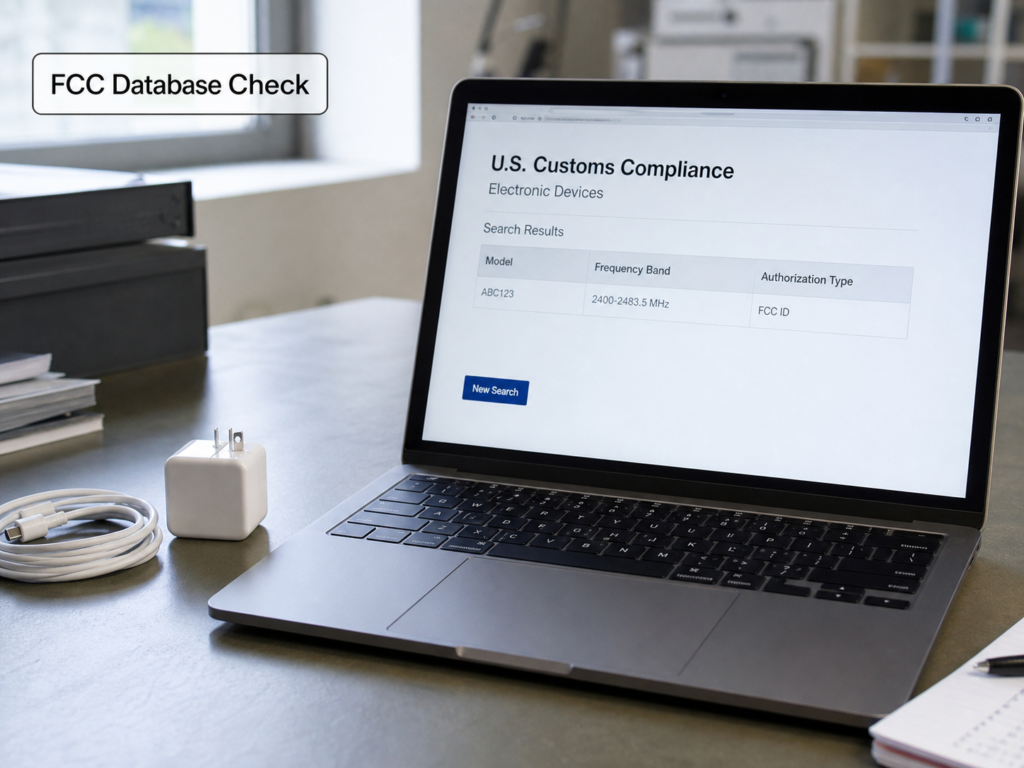
• **FCC Documents**: For those with an FCC ID, directly query the official FCC database to check whether the model, frequency band, and authorization type are consistent; for SDoC, check whether the test basis, test configuration, report model, responsible party, and technical records meet FCC requirements. If specific rules require accredited laboratories or products to go through Certification, then verify the corresponding laboratory qualifications.
• **DOE Energy Efficiency**: Go to the DOE CCMS database, enter the product model to query the registration, and check whether the parameters are consistent.
• **Safety Test Report**: If it is mandatory (such as CPC for children’s products), confirm that the laboratory is in the CPSC-recognized list and meets the applicable laboratory qualification requirements; for voluntary UL/ETL reports, confirm the qualification of the issuing agency, and the report model is consistent with the actual product.
Regarding the validity period, many people think that certification is “valid for one year”. In fact, FCC authorization usually does not have a unified fixed validity period. When the product or key components change, it should be judged according to FCC change rules whether it is no need for filing, requires permissive change, requires supplementary testing, or requires re-application. Whether the update of regulations or standards triggers re-authorization also depends on the specific transition provisions.
Common invalid documents include: using a single-port charger report to cover multi-port fast charging products. The FCC authorization of a wireless module cannot automatically cover all FCC obligations of the whole machine. The host can only rely on the module authorization when the module authorization conditions and host integration requirements are met; the whole machine still needs to evaluate requirements such as unintentional radiators, labeling, user instructions, and RF exposure.
Compliance Differences Across Different Sales Channels
Compliance requirements vary across different channels. Do not use the same set of standards for all channels:
• **Amazon FBA/Large E-commerce Platforms**: Audit standards are generally higher than the minimum customs requirements, and may additionally require voluntary safety reports such as UL/ETL, and even require product liability insurance.
• **Independent Site Self-Shipment**: The probability of spot checks for small packages is relatively low, but for bulk large goods, compliance documents must be fully prepared to avoid regulatory inspections triggered by consumer complaints.
• **Offline Wholesale/Retail**: Additional attention should be paid to the supplementary requirements of the state where the sale is located. Most large retailers require voluntary safety reports and product liability insurance.
4 Compliance Red Lines That Must Never Be Crossed
1. Forging compliance documents or fraudulently using others’ certification numbers.
2. Under-declaring cargo value, splitting packages to evade taxes or avoid compliance supervision.
3. Product model and core parameters are completely inconsistent with compliance documents.
4. Falsifying country of origin labeling—only labeling, repackaging, or transshipping in a third country will not change the country of origin determination; if it should be marked Made in China, it must be marked.
8. Pre-Clearance Self-Inspection: Complete Process from Judgment to Verification
Finally, we have compiled a set of directly usable judgment processes and self-inspection checklists. Going through them before customs clearance can reduce delays and law enforcement risks caused by incomplete information, inconsistent declarations, or obvious non-compliance, but it cannot guarantee that the goods will not be inspected, detained, or punished.
6-Step Quick Judgment of Product Compliance
1. Confirm the input type (mains/vehicle/other) → preliminarily judge whether DOE EPS rules apply.
2. Confirm whether it contains digital circuits/electronic components → preliminarily judge whether FCC Part 15 authorization needs to be evaluated.
3. Confirm whether it has active wireless transmission/wireless charging function → preliminarily judge whether FCC Part 15/18 and RF exposure requirements apply.
4. Confirm whether it is covered by specific mandatory CPSC rules → judge whether third-party testing and GCC/CPC are required.
5. Confirm the sales state and sales channel → supplement state-level requirements and platform/customer requirements.
6. Organize the corresponding document package, and verify the consistency of “certificate – physical product – declaration”.
Pre-Clearance Quick Self-Inspection Checklist
□ **Product Attribute Self-Inspection**
• Confirm product type (cable/charger/adapter/connector/product with battery)
• Confirm input type (mains/vehicle/other)
• Confirm whether it has electronic components/active wireless transmission/wireless charging function
• Confirm whether it is a retail finished product or industrial/medical-specific
□ **Compliance Document Self-Inspection**
• Corresponding applicable compliance has been handled according to the judgment process
• The model and parameters of the compliance documents are completely consistent with the actual product
• The validity of compliance that can be queried in the official database has been verified
• The product/packaging has been printed with the country of origin and corresponding certification marks as required
□ **Customs Clearance Document Self-Inspection**
• All documents are in English, with accurate and consistent information
• Importer identification number and customs bond (if required) are ready
• HTSUS code, country of origin, and declared value have been verified by the customs broker
• ISF declaration has been submitted for sea freight goods as required
Summary
After reading this content, you should be able to independently judge which federal compliance requirements need to be verified for your charging products imported into the U.S., know how to prepare customs clearance documents and complete the declaration according to the process, and also be able to distinguish the authenticity of compliance documents and avoid common misconceptions and red lines.
U.S. customs clearance compliance seems to have many items, but the core logic is very clear: judge in advance, prepare in advance, and ensure consistency. As long as you confirm the compliance before placing an order, instead of cramming at the last minute after the goods are shipped, it will help reduce delays and law enforcement risks caused by incomplete information, inconsistent declarations, or obvious non-compliance, but it cannot guarantee that the goods will definitely not be inspected, detained, or punished. If you are unsure about the classification or compliance requirements of a specific product, it is recommended to directly consult a licensed customs broker or compliance laboratory for confirmation, and do not guess based on experience.