
Sellers of charging products on EU, Australia and New Zealand marketplaces have almost all run into pitfalls with CE and RCM: some spend thousands of yuan on a “CE certificate”, only to have their goods detained by EU customs for lack of technical documentation and economic operator information; others affix the RCM mark to list products on Amazon Australia, only to have their listings taken down within days and be required to provide EESS registration proof. In fact, 90% of these pitfalls stem from one basic misunderstanding — you think CE and RCM are “certificates you can get by paying money”, but in reality they are compliance marks backed by a full set of regulatory requirements.
First, Understand the Essence: CE and RCM Are Not “a Single Certificate” at All
Let’s nail down the core conclusion first: there is no unified “official CE certificate”, nor is there a standalone “RCM certification program”. Neither CE nor RCM is a single certificate that can be simply purchased; they are compliance marks used after a product meets applicable regulatory requirements. Whether a certain mark is required must be judged item by item based on product type, sales country, and applicable regulations.
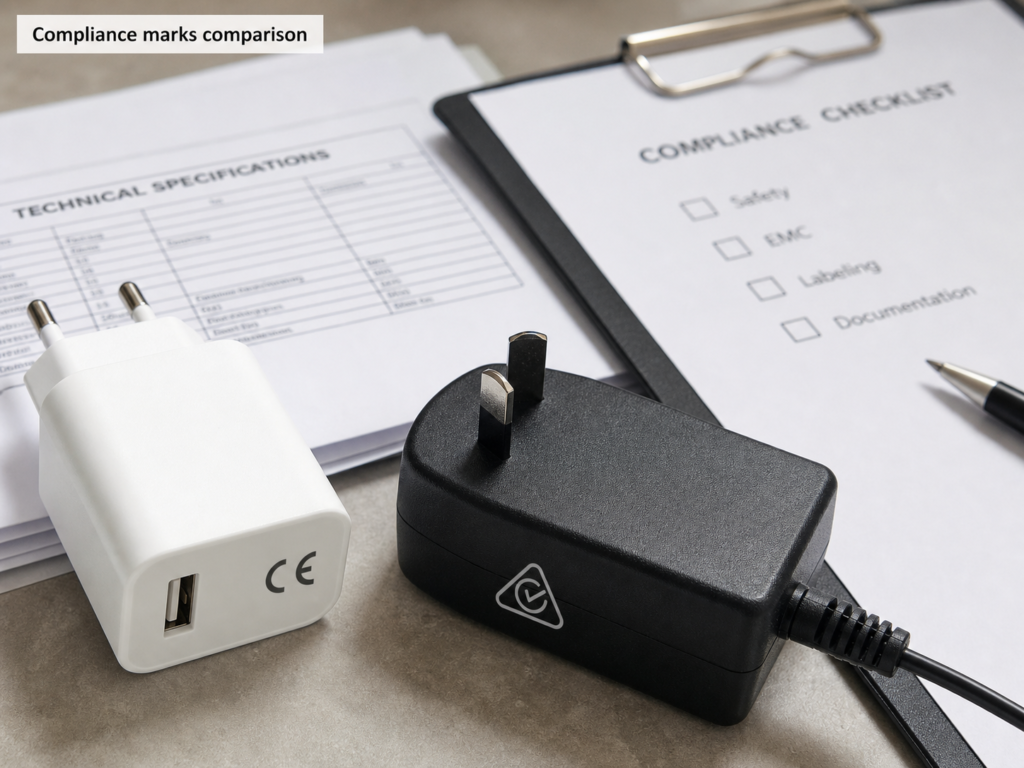
The essence of CE is manufacturer’s self-declaration + compliance mark: if a product falls within the scope of one or more EU harmonized regulations that require the CE mark, the manufacturer must complete conformity assessment, organize test reports and technical documentation, and sign the declaration of conformity in accordance with corresponding requirements, before affixing the CE mark and placing the product on the market. EU authorities do not issue a unified “CE certificate” to enterprises, but the conformity assessment procedures for some products require the participation of EU Notified Bodies (often abbreviated as NB bodies).
RCM is a compliance mark used jointly by Australia and New Zealand, but it is not a single certification program covering all products. Australia and New Zealand each have their own regulatory requirements for electrical safety, electromagnetic compatibility, radio, energy efficiency, etc. Whether RCM is mandatory, whether registration is required, and who bears the responsibility must be judged according to specific national and product rules, and there is no single “RCM certificate” uniformly issued by the authorities.
The judgment logic for beginners is very simple: first check which local rules apply to your product, then confirm whether testing is needed, whether registration is required, and how to affix the mark, instead of saying “I need CE/RCM certification” right off the bat.
CE Mark: Compliance Mark for Products Subject to EU Harmonized Regulations
CE is a statutory compliance mark applicable to products subject to relevant EU harmonized regulations. The CE mark may or must be used only when the product falls within the scope of one or more EU harmonized regulations that require the CE mark and meets corresponding requirements; not all products sold in the EU are universally required to bear the CE mark.
In terms of applicable regions, CE generally applies to EU member states as well as Norway, Iceland, and Liechtenstein in the European Economic Area (EEA), but the specific applicability still depends on product regulations. Markets such as the United Kingdom, Switzerland, and Turkey require separate verification of local regulations. The UK currently recognizes eligible CE marks in multiple product regulation areas; whether UKCA applies, as well as the scope, duration, and conditions of CE recognition, must be confirmed based on product categories and the latest UK government regulations.
In terms of responsible entities, the manufacturer bears primary responsibility for product compliance. For applicable products, there must also be an economic operator within the EU, such as the manufacturer’s authorized representative, importer, or fulfillment service provider, to bear corresponding obligations for market traceability and regulatory liaison. When regulatory authorities conduct spot checks, they should be able to contact the corresponding entity and obtain compliance documents.
For charging products, not all categories need to follow the same set of CE compliance procedures; regulations must be matched according to product attributes. For example, ordinary passive charging cables may not fall within the scope of equipment under low voltage or electromagnetic compatibility regulations, but they still need to be checked against other potentially applicable product regulations such as RoHS.
RCM Mark: A Compliance Mark Shared by Australia and New Zealand but with Independent Rules
RCM is a compliance mark used jointly by Australia and New Zealand, but whether it is mandatory, what testing, registration, and responsible entity requirements must be met, shall be judged according to the specific regulatory rules of Australia or New Zealand. RCM cannot be generalized as a single certification that is mandatory for all products in Australia and New Zealand.
Although Australia and New Zealand use the same style of RCM mark, the regulatory obligations of the two regions are not exactly the same. Australia and New Zealand have Trans-Tasman mutual recognition or acceptance arrangements for some electrical equipment safety compliance, but not all products, standards, and regulatory obligations are automatically mutually recognized. National differences, supplier responsibilities, and registration requirements still need to be verified separately.
Taking Australia as an example, the regulatory system behind RCM usually needs to be understood by breaking it down:
- EESS (Electrical Equipment Safety System) mainly manages electrical equipment safety, and sets different certificate and registration requirements according to risk levels;
- ACMA (Australian Communications and Media Authority) mainly covers requirements for electromagnetic compatibility, radio spectrum, and related communications equipment;
- GEMS (Green Energy and Minimum Energy Efficiency Standards) is responsible for energy efficiency and minimum energy efficiency standard requirements for products within Australia’s product categories.
New Zealand has its own independent regulatory framework for electrical safety, electromagnetic compatibility, and energy efficiency. New Zealand’s supplier responsibilities, marking, and registration obligations cannot directly apply Australian EESS rules.
RCM-related requirements for charging products need to be matched according to specific country, product risk level, function, and category, and the procedures that different products need to complete vary greatly.
Why Must Cross-Border Sellers Pay Attention?
For cross-border e-commerce sellers, CE and RCM-related compliance requirements are often hard thresholds for sales: European, Australian, and New Zealand sites of platforms such as Amazon, eBay, and Temu may require corresponding compliance documents when listing products; without documents or with inapplicable documents, listings may not be allowed or sellers may be required to make rectifications.
If non-compliant, the consequences are also serious: in mild cases, goods are detained by customs, listings are taken down, or sales are banned; in severe cases, products are recalled, administrative penalties are imposed, and in serious circumstances, it may even involve civil or criminal liability.
Charging products, in particular, are high-risk electrical categories and are key targets for spot checks by regulatory authorities in both regions, so never take chances.
Align Before Comparison: What Category Does Your Product Belong To?
Many people get more confused the more they read comparison articles, the core reason is that they don’t align the comparison baseline — different products have vastly different compliance requirements. All the following comparisons are based on a unified consumer-grade charging product scenario, so you can first match your own product accordingly.
Unified Comparison Baseline
Our baseline products are 5-100W USB-A/C wall chargers, passive/E-Marker-equipped data cables, and desktop power adapters, all of which are brand-new mass-produced consumer-grade charging products sold separately via cross-border e-commerce.
Products with wireless communication functions, car chargers, and battery energy storage products (such as power banks) are not within the scope of this comparison; such products require separate assessment of compliance requirements.
5 Steps to Determine What Your Charging Product Needs
You don’t need to memorize complex regulation names; following these 5 steps can help you initially judge which requirements your product needs further verification for:
- First confirm whether the product falls within the scope of relevant regulations. If connected to mains power, electrical safety assessment is usually added, but all test items cannot be determined solely based on this; products not connected to mains power may also involve RoHS, EMC, radio, energy efficiency, battery, or other regulations.
- If it is an external power supply, such as a charger or adapter, further verify the specific EU ErP implementing regulations or the scope of Australian GEMS products. Only when it falls within the corresponding regulation catalog and meets applicable conditions is energy efficiency compliance, registration, or labeling required.
- Confirm whether it has wireless communication or wireless transmission functions. Functions such as Bluetooth, Wi-Fi, and NFC usually require additional radio compliance assessment; even without communication functions, wireless power transmission equipment may be subject to radio rules due to operating frequency and transmission method.
- If it is a separately sold cable, distinguish whether there is an electronic circuit inside, the power supply method, and whether it has functions such as data conversion, then match different regulations.
- Confirm whether the product is a local controlled device or falls within a specific product catalog. Whether a notified body, accredited laboratory, third-party certificate, or official registration is required shall be judged according to specific regulations, product categories, and conformity assessment modules. For categories such as EESS Level 2 and Level 3 in Australia, certificate and registration requirements shall also be confirmed in accordance with current EESS rules; this rule cannot be directly applied to all controlled catalogs or New Zealand.
Core Dimensions of Comparison
Next, we will compare from four dimensions that sellers are most concerned about: access nature and responsible entities, compliance coverage requirements and standard relevance, application process cost and cycle, and mark use and post-market supervision.
These Situations Will Change the Conclusion, Don’t Force Fit
If your product meets any of the following situations, compliance requirements may be significantly upgraded, and you cannot directly apply the subsequent comparison conclusions; you need to re-evaluate:
- Power exceeding 100W: safety level and test items may increase;
- With wireless communication or other wireless transmission functions: new radio compliance requirements are added;
- Belonging to local controlled categories: need to confirm whether third-party institutions, certificates, or registration are required according to specific conformity assessment modules;
- Changes to plugs, core hardware, or parameters: original compliance documents may no longer be fully applicable, and re-evaluation is required.
Item-by-Item Comparison of Core Dimensions: What’s the Difference Between CE and RCM?
To help you quickly grasp the key points, here is a simplified comparison table first, and details will be explained in detail later:
| Comparison Dimension | CE (EU) | RCM (Taking Australia as an Example) |
|---|---|---|
| Core of Access | Applicable to products subject to relevant EU harmonized regulations; mainly manufacturer’s self-declaration, some products require notified bodies | Whether RCM and corresponding registration are required shall be confirmed according to specific requirements of EESS, ACMA, GEMS, etc. |
| Core Coverage Requirements | LVD safety, EMC, RoHS; ErP energy efficiency shall be judged according to specific catalogs and implementing regulations | EESS safety, ACMA EMC/radio, GEMS energy efficiency, all judged according to specific product scopes |
| Responsible Entities | Manufacturer + EU economic operator | Australia confirms supplier responsible entity according to specific regulatory systems |
| Mark Requirements | Height ≥5mm, affixed in the prescribed manner, and economic operator information provided | Comply with official specifications; whether other registration or numbers are required shall be confirmed according to specific regulatory systems |
| Document Retention | Generally retained for 10 years | Implemented in accordance with corresponding regulatory requirements, no unified period for all categories |
Access Nature and Responsible Entities
The core logic of CE is “manufacturer’s self-responsibility”: if a product falls within the scope of EU harmonized regulations that require the CE mark, the manufacturer must complete all applicable regulatory requirements, conduct appropriate conformity assessment, organize technical documentation, and sign the Declaration of Conformity (DoC), before affixing the CE mark and placing the product on the market. For most ordinary chargers subject to regulations such as LVD, EMC, and RoHS, the manufacturer can conduct conformity assessment on its own without a notified body; however, it must still meet all applicable regulations, technical documentation, DoC, labeling, economic operator, and post-market obligations. Whether a data cable falls within the scope of a certain regulation shall be judged according to its specific structure and function.
Whether a notified body participates is not simply based on whether the product is “high-risk”, but is determined by specific regulations and the conformity assessment modules specified therein. Some categories such as medical devices and gas equipment may require the participation of notified bodies, but the rules for a certain product category cannot be directly extended to all products.
The core logic of RCM is not “affixing the mark equals certification”. In Australia, the applicable scope, supplier responsibilities, certificate, and registration requirements of EESS, ACMA, and GEMS shall be verified separately. Australian EESS supplier registration is a requirement in the Australian system and cannot be directly applied to New Zealand. New Zealand shall confirm supplier responsibilities, marking, and registration obligations in accordance with its own electrical safety, electromagnetic compatibility, and energy efficiency rules.
The common point between the two is: for products falling within the relevant mandatory regulatory scope, sales are usually not allowed before applicable compliance obligations are completed; cross-border sellers can, in accordance with local rules, entrust EU economic operators, Australian local suppliers, or other eligible service providers to bear corresponding responsibilities. However, “having a service provider” does not mean that sellers can bear no product compliance responsibility at all; product information and documents must still be consistent with the actually sold products.
Compliance Coverage Requirements and Standard Relevance
CE compliance requirements are matched with corresponding EU directives or regulations according to products. Common applicable requirements for charging products include:
- LVD (Low Voltage Directive): Usually targets related products within the range of 50-1000V AC and 75-1500V DC, mainly focusing on electrical safety;
- EMC (Electromagnetic Compatibility) Directive: Focuses on whether the product causes unacceptable interference to other equipment when operating, and whether it has sufficient anti-interference capability;
- RoHS Directive: Restricts the use of hazardous substances such as lead, mercury, and cadmium in products;
- Specific implementing regulations under the ErP framework: Whether external power supplies need to meet energy efficiency requirements shall be judged according to specific product definitions, rated power, and applicable scope. For example, EU external power supplies may involve Regulation (EU) 2019/1782, but a conclusion cannot be drawn solely based on “it is an adapter”.
RCM-related compliance requirements are a combination of multiple systems. Taking Australia as an example:
- EESS manages electrical equipment safety according to product categories and risk levels;
- ACMA is responsible for the supervision of electromagnetic compatibility, radio spectrum, and related communications equipment;
- GEMS is responsible for energy efficiency and minimum energy efficiency standard requirements for products within the catalog.
New Zealand cannot directly apply Australian GEMS conclusions, but shall confirm energy efficiency obligations in accordance with its own EECA, MEPS, and related regulations. There may be harmonization or mutual recognition arrangements for some energy efficiency or electrical safety requirements between Australia and New Zealand, but specific products and national differences still need to be verified.
The standards of the two regions have certain technical relevance: many basic safety and EMC standards are derived from IEC international standards; the EU may adopt EN versions, and Australia and New Zealand may adopt AS/NZS versions. Therefore, test items and basic principles sometimes overlap, but this does not mean that reports are automatically mutually recognized. Standard versions, national differences, limits, plug structures, and certification procedures may still differ.
For charging products, common differences include:
- The EU requires verification of hazardous substance restriction requirements such as RoHS;
- Australian energy efficiency requirements only apply to products within the GEMS catalog that meet applicable conditions;
- New Zealand confirms in accordance with its own EECA, MEPS, and related regulations, and GEMS cannot be directly regarded as a common requirement for Australia and New Zealand.
Application Process, Cost and Cycle
First look at the differences in general processes.
The CE process is relatively straightforward:
Confirm the EU regulations or directives applicable to the product → Conduct appropriate product testing and conformity assessment → Compile complete technical documentation → Manufacturer signs the Declaration of Conformity (DoC) → Affix the CE mark as required and fulfill relevant information obligations.
RCM-related processes need to be split by country. Taking Australia as an example, the following are usually required:
Confirm EESS safety level, ACMA requirements, and whether GEMS applies → Arrange testing that meets applicable standards → Complete local supplier registration or confirm supplier qualification → If it falls under a device level that requires registration, complete corresponding certificate and device registration → After confirming all requirements are met, use the RCM mark as required.
We use a common cross-border 65W single C-port PD/PPS wall charger (wide voltage 100-240V, no wireless function, no ready-made CB report, equipped with EU/Australian standard plugs respectively) as a reference example. This example can only be used to illustrate the assessment approach and cannot be used as a fixed cost or cycle quote. The cost and time of actual projects must be assessed on a case-by-case basis by laboratories or compliance service providers based on the following factors:
- Which regulations and specific standards apply to the product in the EU;
- Whether the product is a regulated device under EESS in Australia, and which risk level it belongs to;
- Whether ACMA-related testing, registration, or other documents are required;
- Whether it falls within the Australian GEMS catalog;
- Whether there are additional domestic requirements in New Zealand;
- Whether there is a valid and applicable test report;
- Whether the standard version, plug, hardware, and product model of the test report are consistent;
- Whether the data is complete, and whether the laboratory needs supplementary testing or re-assessment.
Therefore, cost and cycle cannot be simply attributed to local registration fees and standard difference testing, nor can a universally applicable “2-6 weeks” conclusion be given. The time for EESS Level 3 certificates, ACMA registration, GEMS registration, or EU supplementary testing may be significantly different. Formal quotations and scheduling shall be based on product classification, test scope, certificate type, registration level, and data completeness.
The core variables affecting cost and cycle are clear: on the cost side, it mainly depends on whether there is a valid report, whether difference testing is required, whether a certificate or device registration is needed, whether it has wireless functions, product complexity, and plug and version differences; on the cycle side, it mainly depends on the number of test items, registration or audit requirements, laboratory scheduling, and completeness of data preparation.
Mark Use and Post-Market Supervision
In terms of mark use, the CE mark shall usually be affixed to the product, and the height of the mark shall generally not be less than 5mm. Only when the nature of the product does not allow or make it possible can the mark be placed on the packaging or accompanying documents in accordance with applicable regulations; “the product is too small” cannot be used as a unified judgment standard alone.
The name and address of the EU economic operator shall be provided in the location specified in Regulation (EU) 2019/1020 and specific product regulations; they can be placed on the product, packaging, accompanying documents, or other permitted locations according to applicable rules, and do not necessarily have to be printed on the product together with the CE mark.
The style of the RCM mark must comply with official specifications, and its size and use method shall be implemented in accordance with the requirements of the corresponding regulatory system. Whether supplier numbers, device registration information, or other markings are also required shall be judged according to the specific regulatory rules of Australia or New Zealand; not all products need to be printed with the same type of number.
In terms of document retention, CE technical documentation and declarations of conformity generally need to be retained for 10 years, with the specific period subject to applicable regulations; RCM-related test reports and compliance documents shall be retained in accordance with the requirements of EESS, ACMA, GEMS, or the corresponding New Zealand regulatory system, and there is no unified period applicable to all products.
In terms of violation consequences, the two are basically the same: customs detention of goods, platform listing removal, sales ban, product recall, rectification requirements, administrative penalties, and in serious circumstances, civil or even criminal liability. Charging products are key targets for spot checks in both regions:
- CE focuses on safety, EMC, RoHS, and applicable energy efficiency requirements;
- Australian RCM-related regulation focuses on electrical safety, EMC, radio, and applicable energy efficiency requirements;
- New Zealand conducts regulation in accordance with its corresponding domestic rules.
Affixing the mark does not mean everything is fine; products may still be subject to spot testing or required to provide documents after being placed on the market.
Exclusive for Charging Products: Compliance Requirements Vary by Product
Many people think that all charging products have the same compliance requirements, but in fact the differences are huge. We will explain them separately by commonly sold categories.
USB/USB-C Chargers and Desktop Power Adapters
This type of product is the focus of regulation in both regions, and common requirements usually include electrical safety and EMC, but the specific applicable standards depend on product classification, structure, intended use, rated parameters, and the locally adopted standard version.
Many information technology USB chargers adopt IEC/EN/AS/NZS 62368-1 or its locally adopted version. However, it cannot be asserted that all USB chargers and desktop power adapters are necessarily subject to IEC 62368-1; the final safety standard still needs to be confirmed based on product definition and local standard catalogs.
For CE, it is necessary to match applicable LVD, EMC, and RoHS requirements; external power supplies falling within the scope of specific EU ErP implementing regulations must also meet corresponding energy efficiency requirements.
For Australia, it is necessary to confirm whether the product is a regulated device under EESS, which risk level it belongs to, and whether it simultaneously involves ACMA and GEMS requirements. Many power supplies and chargers may fall into the scope of EESS Level 2 or Level 3 devices, but they cannot be directly judged as Level 3 without classification. Only after confirming that it belongs to a level requiring registration, corresponding certificate and device registration shall be processed. If the product falls within the GEMS catalog and meets applicable conditions, corresponding energy efficiency registration and labeling must also be completed.
Special reminder: for multi-port chargers, testing only single-port output is not allowed; the temperature rise, output capability, and protection functions during simultaneous multi-port output must be evaluated. Single-port test results cannot automatically represent the safety performance when multiple ports are working simultaneously.
USB/USB-C Data Cables and Connectors
Compliance requirements for cable categories are the easiest to confuse; don’t just look at the interface shape, distinguish by internal structure and function:
- Ordinary passive charging cables: If there are no electronic components inside, they usually do not belong to LVD or EMC devices, but still need to be checked against potentially applicable product obligations such as RoHS, REACH, WEEE, and GPSR. For Australia and New Zealand, it is also necessary to first confirm whether they fall within the scope of EESS, electrical safety, or ACMA regulated devices, and cannot be generally classified as “RCM low-risk accessories”.
- Fast charging cables with E-Marker chips: E-Marker is an electronic device in the cable, but whether independent EMC or electrical safety testing is required cannot be concluded solely based on “containing a chip”. Whether EMC, safety, radio and other requirements apply shall be judged based on circuit function, power supply method, data transmission characteristics, and product definition.
- Active conversion cables: For example, USB-C to HDMI cables with power supply function, due to involving signal conversion and power supply, require additional assessment of their signal transmission, electromagnetic compatibility, and safety requirements in both regions.
Pitfall avoidance reminder: don’t just look at “USB-C interface” and count it as high risk, nor think that cables don’t need any compliance assessment at all. Be sure to check whether there are electronic components, rated parameters, power supply method, whether there is data transmission or conversion function, and the product definition of the sales location.
Wireless Charging and Charging Products with Wireless Communication
This type of product is prone to having redundant or missing radio requirements; you can’t just look at whether there is Bluetooth or Wi-Fi, but should judge in combination with operating frequency, transmission method, and local device definition.
- Inductive wireless chargers without communication functions: Even without Bluetooth, Wi-Fi, or other communication functions, it is necessary to assess whether the emission generated by wireless power transmission triggers EU RED or Australian ACMA radio requirements, and also assess applicable safety and EMC requirements; it cannot be generally assumed that only safety and EMC are needed.
- Charging products with wireless communication functions such as Bluetooth, Wi-Fi, and NFC: In addition to safety and EMC, they usually need to additionally meet radio compliance requirements.
- Products with integrated wireless modules: Even if the wireless module used has been separately certified, it cannot automatically cover the whole device. The antenna, firmware, radio frequency parameters, installation method, and use conditions approved for the module shall be verified, and then according to applicable regulations, determine which tests or evidence can be reused, and which items require supplementary testing or re-conformity assessment.
Doing CE and RCM Simultaneously: How to Save Money and Time
Many sellers expand into both EU and Australia-New Zealand markets at the same time, and doing compliance separately is not only costly but also time-consuming. Since some safety and EMC standards in the two regions have technical relevance, many basic materials can be reused, but “technical relevance” cannot be interpreted as automatic mutual recognition.
These Contents Can Be Reused or Used as Technical Evidence
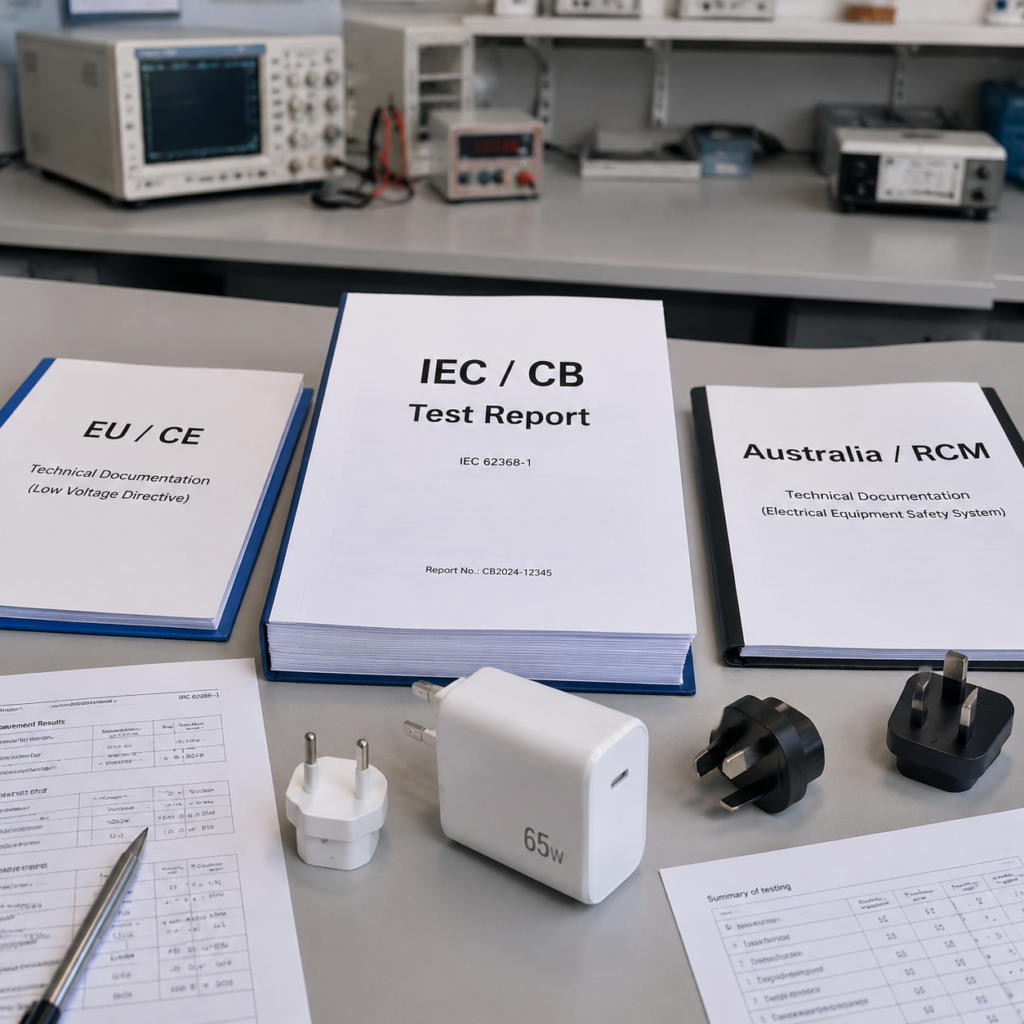
As long as the product model, hardware version, and core configuration are completely consistent, the following materials can usually be used as basic materials for assessment in both markets:
- Basic product materials: structural drawings, Bill of Materials (BOM), risk assessment report;
- Core test data: basic safety and EMC test records based on IEC standards;
- General compliance documents: component certification certificates, hazardous substance declarations for materials, production consistency control documents;
- Valid IEC or CB test reports: when laboratory qualification, product consistency, standard version, and national differences all meet requirements, they can be used as technical evidence to help reduce repeated testing.
However, these materials cannot automatically complete compliance for both markets. The EU still needs to verify applicable EN standards, harmonized standards, and regulatory requirements; Australia and New Zealand also need to verify AS/NZS versions, national differences, accreditation body qualifications, and specific requirements such as EESS and ACMA.
Remember the prerequisite for reuse: the core configuration of the product cannot be changed, and the test scope of the report must be consistent with the actually sold product. As long as the core hardware, plug, or key parameters are changed, the reuse conditions must be re-evaluated.
These Contents Cannot Be Directly Interchanged
Some requirements are unique to each region and cannot be used universally:
- Compliance declarations: The CE DoC and relevant Australia-New Zealand compliance documents apply to different regulations, cannot replace each other, and need to be prepared separately;
- Registration and responsible entities: Official registrations and local responsible entities in the two regions are independent of each other; an EU economic operator cannot automatically replace an Australian supplier, and vice versa;
- Local differentiation requirements: plug style, label language, energy efficiency labeling, national difference testing, such as the pin structure requirements of Australian standard plugs, all require separate confirmation;
- Standard differences: Although basic standards may be derived from IEC, the test conditions, limits, and national differences of the EN version and AS/NZS version may be different, requiring supplementary difference testing;
- Final conformity assessment: CB or IEC reports are only technical evidence and do not equal automatic CE or RCM compliance.
3 Practical Tips for Cost Reduction and Efficiency Improvement
First, select a third-party laboratory that has both CE and RCM-related testing capabilities, arrange assessment and testing simultaneously, reduce repeated communication, and also facilitate early detection of difference requirements between the EU and Australia-New Zealand.
Second, prepare a valid CB test report and ask the laboratory to confirm whether it is applicable to the target product and sales location. Only when conditions such as product consistency, standard version, national differences, and accreditation qualifications are met can the CB report be used as technical evidence for both regions to help reduce repeated testing. The CB report itself does not equal automatic completion of CE or RCM compliance; it is still necessary to complete the EU DoC, Australia-New Zealand responsible entities, registration, and necessary difference testing separately.
Third, prepare technical documents and registration materials for both regions simultaneously, without waiting for the entire process of one market to end before starting the other, which can reduce overall waiting time.
Pitfall Avoidance Guide: Don’t Be Tricked by These Common Misconceptions
There are many pitfalls on the road to compliance, these are the most common ones, and avoiding them in advance can save a lot of money and trouble.
5 Most Common Cognitive Misconceptions
First misconception: CE is a certificate issued by EU authorities.
Correct answer: CE is a compliance mark applicable to products subject to relevant EU harmonized regulations. For many ordinary chargers subject to regulations such as LVD, EMC, and RoHS, the manufacturer can conduct conformity assessment on its own without a notified body, but it must still complete all applicable regulatory requirements, technical documentation, declaration of conformity, labeling, economic operator, and post-market obligations. Whether a data cable falls within the scope of a certain regulation also needs to be judged according to its specific structure and function.
Most so-called “CE certificates” on the market are test reports issued by third-party laboratories, not documents uniformly issued by the EU.
Second misconception: Having the RCM mark equals full compliance.
Correct answer: RCM is just a compliance mark and cannot alone prove that a product has met all applicable Australian or New Zealand regulatory requirements. True compliance requires simultaneously meeting applicable safety, EMC, radio, energy efficiency and other requirements, and having corresponding test reports, certificates, registration documents, and responsible entity information.
Third misconception: CE and RCM can be fully mutually recognized.
Correct answer: Some basic test standards of the two have technical relevance, and many test data can be reused, but the regulatory systems, registration requirements, local differences, and responsible entities of the two regions are different, so they cannot be directly mutually recognized. Having CE still requires completing applicable registration, responsible entity confirmation, and difference assessment in Australia and New Zealand, and vice versa.
Fourth misconception: Test reports are compliance certificates.
Correct answer: Test reports are only one of the compliance evidences, not the whole. Compliance also requires a declaration of conformity, technical documentation, corresponding certificates or registration (if required), and the report must match the actually sold product.
If the report tests an EU standard plug but the sold product uses an Australian standard plug, the report cannot directly prove that the whole device meets the requirements of the Australian sales location. However, data in the report related to shared power modules, EMC, or some safety items may still have evidentiary value; it is also necessary to complete applicability assessment and necessary supplementary testing for Australian standard plugs and national differences.
Fifth misconception: Compliance documents provided by suppliers can be used directly.
Correct answer: The compliance documents provided by many suppliers are general templates, or are made for other customers or other models, and cannot be used directly at all. After getting the documents, be sure to check whether the brand, model, hardware version, plug, rated parameters, responsible entity, and test scope are consistent with the purchased product. Even if a supplier or service provider is entrusted to handle compliance, the actual seller should still confirm the applicability of the documents.
How to Verify Compliance Documents?
After getting the supplier’s documents, check according to these key points, and you can basically screen out most invalid documents:
- CE verification key points: Request the Declaration of Conformity (DoC), test report, and technical documentation summary, and check whether product information, applicable regulations, and standard versions are consistent; if a notified body is involved, also verify the qualification of the notified body and the scope of its participation.
- RCM verification key points (taking Australia as an example): First check whether the supplier’s EESS registration qualification is valid, then check whether the product belongs to a level requiring device registration or certificate, and whether the registration status is normal; at the same time, check whether ACMA and GEMS have additional requirements. For New Zealand, the responsible entity, marking, and registration obligations shall be confirmed in accordance with domestic regulatory rules.
- General report applicability verification: Check key components (chips, transformers, etc.), plug type, standard version, report test scope, and product change records. Different plugs or key components do not mean the entire report is completely invalid, but it cannot be directly regarded as the whole device being compliant in the target market; differences must be assessed and supplementary testing conducted as needed.
These Situations Will Cause Compliance to Become Invalid
Product compliance is not a one-time thing for good; when the following changes occur, the validity of compliance must be re-evaluated:
- Core component changes: For example, replacement of chips, transformers, MOSFETs, interfaces, requires risk assessment, and supplementary difference testing if necessary;
- Structural or parameter changes: For example, adjustments to housing, PCB, power, fast charging protocols, cable specifications, require re-evaluation of compliance coverage, and may require supplementary testing or even re-testing;
- Wireless-related changes: For example, adjustments to antennas, firmware, radio frequency parameters, require re-evaluation of radio compliance;
- Change of responsible entity or manufacturing factory: Compliance documents need to be updated, and re-testing or registration is required if necessary;
- Regulation or standard updates: Compliance needs to be regularly assessed and adjusted according to new requirements.
Quick Start: Decision Logic and Launch Checklist
Finally, we have sorted out several ready-to-use tools to help you make decisions quickly and avoid pitfalls.
Quick Decision Logic for Certification Selection
- Sold only in EU/EEA markets: First confirm whether the product falls within the scope of EU harmonized regulations that require the CE mark, then complete conformity assessment, technical documents, and CE declaration of conformity in accordance with applicable regulations; products that can be self-assessed do not need to find a notified body, and categories that require notified body participation should find a qualified NB body.
- Sold only in Australia-New Zealand markets: Match EESS, ACMA, GEMS, or New Zealand’s domestic applicable requirements according to Australian and New Zealand product categories respectively, and confirm whether RCM, supplier registration, device registration, certificates, or other marks are required.
- Sold in both markets simultaneously: Prioritize simultaneous assessment, reduce costs and shorten cycles through CB or IEC report reuse, difference testing, and data reuse, but still need to complete conformity assessment and registration obligations for both regions separately.
4 Must-Ask Questions When Communicating with Suppliers
When sourcing goods from factories, asking these 4 questions directly can screen out most unreliable suppliers:
- Which EU regulations does this product correspond to for CE, and which regulatory requirements does it correspond to for Australia and New Zealand?
- Is the Australian EESS supplier registration valid? Does the product belong to a level requiring device registration or certificate? What are the corresponding responsibility and registration requirements for New Zealand?
- If the appearance, core components, power, or plug are changed, will the compliance documents still be applicable? What change process is required?
- Are the brand, model, hardware version, plug, and parameters of the provided test report and compliance documents completely consistent with the purchased product?
Pre-Launch Quick Checklist
Check these 6 items before listing, and you can basically avoid most compliance problems:
- Are product classification and applicable compliance requirements (CE regulations, Australian and New Zealand regulatory systems) matched?
- Is the information of local responsible entities (EU economic operator, Australian local supplier, or applicable New Zealand responsible entity) valid and provided as required?
- Are the model, hardware version, plug, and parameters of the test report and compliance declaration consistent with the actually sold product?
- Do the mark style, size, and location (including packaging or manual requirements) comply with local regulations?
- For products subject to energy efficiency requirements, have corresponding registration, testing, and labeling been completed?
- Are compliance documents retained for the period required by local regulations?
Overall, neither CE nor RCM is a “certification certificate” that can be purchased directly. Whether CE applies depends on whether the product falls within the scope of EU harmonized regulations that require the CE mark; whether RCM needs to be used depends on the specific regulatory rules of Australia and New Zealand respectively. For cross-border charging product business, you don’t need to memorize regulations by rote; first clarify your product type and sales market, use a decision tree to initially match the requirements, and then find a reliable laboratory or service provider for assessment.
When operating in both markets simultaneously, remember to use valid IEC or CB reports, basic test data, and technical data reuse to reduce costs, but do not interpret reports as automatic mutual recognition. Be sure to verify the documents provided by suppliers and check against the checklist before launching to avoid most compliance pitfalls.
If you need to check the latest regulatory requirements, be sure to query through official channels and do not trust outdated information online: for the EU, you can check the European Commission’s CE mark and product compliance related pages; for Australia, you can check the EESS electrical safety official website, ACMA official website, and GEMS energy efficiency official website; for New Zealand, you can check official pages such as WorkSafe New Zealand and EECA. Regulations and standards are updated regularly, so be sure to check the latest requirements before applying to avoid useless work.