
Many overseas merchants and product developers operating in the Japanese market are most easily confused by the “validity period” when they first encounter TELEC certification: some say it expires after 3 years, some say it needs to be renewed every 5 years, and others say it is permanently valid once obtained. Which one is correct?
If you make a wrong judgment, it may affect cargo customs clearance, platform listing, and even expose you to compliance risks. In this article, we start from the most basic concepts to clarify the rules, judgment methods, and key pitfall avoidance points for TELEC certification validity. Even if you are encountering it for the first time, you can complete basic validity judgments on your own.
1. Start with the Basics: The Fundamental Boundaries of TELEC Certification and Validity Period
First, Fully Understand TELEC Certification
The commonly referred to “TELEC certification” is the industry’s colloquial term for Japan’s radio equipment compliance certification. TELEC (Telecommunication Engineering Center of Japan) is one of the third-party certification bodies recognized by Japan’s Ministry of Internal Affairs and Communications (MIC), not the only issuing authority. Compliance certificates issued by all MIC-recognized bodies have the same legal effect, so there is no need to worry about whether the certificate is issued by TELEC headquarters.
From a regulatory perspective, this type of certification is essentially a compliance access certificate for radio equipment under Japan’s . However, not all products with wireless functions require certification: you must first determine whether the product is a radio equipment regulated by the , and then confirm the applicable certification path and requirements based on its operating frequency band, transmission power, usage method, and product purpose. Consumer and industrial wireless products we encounter daily, such as Bluetooth headsets, Wi-Fi routers, and cellular communication modules, are the most common categories requiring certification.

After passing the certification, equipment subject to the Giteki Mark system must be affixed with the Giteki Mark (the official compliance mark for Japanese radio equipment) in accordance with the corresponding certification rules when placed on the Japanese market. The form of the mark, printing position, accompanying certification number, and whether electronic identification (such as screen display) is allowed must all be strictly implemented in accordance with the applicable certification system and the requirements of the certificate/certification documents. Labeling requirements may vary for different product categories and certification types, and compliance cannot be determined solely by the presence of a number on the product.
In addition, it should be clarified that TELEC certification is a “compliance certificate for the equipment itself”, not a radio station license. For example, when selling high-power walkie-talkies, having compliance certification for the equipment only means that the equipment itself meets technical requirements. If the operating frequency band falls within the scope requiring a license, the user must separately apply for a usage license from Japan’s Ministry of Internal Affairs and Communications. These are two completely independent compliance requirements.
Why Overseas Users Must Pay Attention to Validity Period
For those operating in the Japanese market, the validity of certification is directly related to the circulation and sales of products. Three common types of risks have clear applicable prerequisites:
First, Import customs clearance stage: When importing into Japan, customs or relevant regulatory authorities may verify radio compliance documents, product labels, and other content based on product category, declaration information, and current law enforcement requirements. If the certification status is questionable or compliance certificates cannot be provided, it may affect the customs clearance process. The specific situation shall be subject to official law enforcement requirements;
Second, Platform listing stage: The compliance requirements of major Japanese e-commerce platforms such as Amazon and Rakuten are implemented in accordance with the currently announced rules of each platform. Products whose certification status does not meet the requirements may be unable to be listed or may be removed from shelves;
Third, Market supervision stage: Japan’s Ministry of Internal Affairs and Communications or local regulatory authorities will conduct random market inspections in accordance with regulations. If it is verified that the product violates the requirements of the (such as no valid certification, inconsistency between the product and certification, non-compliant labels, etc.), measures such as rectification, sales suspension, recall, or administrative penalties may be taken depending on the circumstances. The specific situation shall be subject to official formal determination.
3 Sets of Basic Concepts That Are Most Easily Confused
Before discussing specific rules, we must first clarify the three most easily confused sets of concepts, otherwise the more you read, the more confused you will be:
First, Certification validity period ≠ Test report validity period. A test report is a technical document submitted when applying for certification, which only proves that “the submitted sample meets the requirements at the time of testing”; while certification validity is the official conclusion on compliance access. The judgment logic of the two is completely different.
Second, Certification validity period ≠ Product warranty period. Warranty is the after-sales promise made by merchants to consumers, such as “1-year replacement, 2-year warranty”, which is a civil liability agreed by the merchant itself. It has nothing to do with government compliance requirements, and the warranty period cannot be applied to the certification validity period.
Third, Certification validity period ≠ Fixed renewal cycle. Many people apply the experience of ISO system certification and driver’s license annual renewal, thinking that all certifications require annual review and renewal upon expiration. In fact, most mass-produced TELEC certifications do not have a fixed calendar expiration date and do not require regular renewal. This is the most core cognitive difference.
The Essence of “Validity Period” Is Not a Single Calendar Expiration Date
At this point, you may ask: if there is no fixed expiration date, what exactly is the “validity period”?
In fact, for most mass-produced TELEC certifications, the certificate will not have a “validity period” field. Its validity essentially refers to “whether the certification status is still valid” (that is, whether the certificate is in an officially recognized status such as valid, suspended, or revoked). Three prerequisites must be met simultaneously: first, the certificate itself has not been revoked or suspended; second, the actually produced and sold product is completely consistent with the sample/design at the time of certification; third, the regulations and technical standards applicable to the certification are still currently valid and have not been abolished.
Simply put, it does not expire on a fixed calendar date like a passport or driver’s license. Instead, it remains valid as long as the three prerequisites are met simultaneously, regardless of how long the certificate has been held. This is completely different from the regular annual review and renewal logic of ISO system certification.
To avoid confusion, we will unify terminology in the following text: for fixed-term certificates with a clear “validity period”, we use the expressions “term expiration” and “renewal”; for certificates without a fixed term, we use the expressions “valid certification status”, “certification no longer covers”, and “certification revoked/suspended”. We will no longer mix ambiguous terms such as “expired” or “due”.
2. Core Rules: How to Calculate the Validity Period of Different Types of TELEC Certification
Now that we understand the basic logic, let’s look at the specific rules. TELEC certifications for different certification systems and different equipment categories have different validity judgment methods, and cannot be generalized.
General Judgment Principles
Many people have heard the saying that “after the revision of Japan’s in 2020, all certifications become permanently valid”, which is actually inaccurate. The adjustment of validity period related to the 2020 law revision officially took effect on June 1, 2020, and its scope of application mainly covers low-power, common consumer wireless devices (such as Wi-Fi, Bluetooth, ordinary cellular terminals, etc.) under the Technical Conformity Certification and Construction Design Certification. Most newly issued certificates of this type do not have a fixed validity period; however, special regulated categories such as high-power dedicated radio equipment and satellite terminals may still have a fixed term of 5-10 years in accordance with corresponding rules. The specific situation shall always be subject to the “validity period” field on the certificate and the official rules for the corresponding category, and cannot be directly judged solely by the year of issuance.
Old certificates issued before 2020 shall still be implemented in accordance with the originally marked period and the system rules applicable at that time. If you need to adjust to the certification under the new rules, you can verify with the original issuing authority whether the corresponding category and system support reissuance.
Differences Between 3 Types of Statutory Equipment Certification
To understand the validity of different certificates, it is recommended to judge in the order of “first check the certification type → then find the validity period field → finally verify the product usage restrictions”. Below are the core rules for three types of statutory equipment certification under Japan’s . Each type is accompanied by a plain language explanation when first mentioned, for quick correspondence:
| Japanese Name of Statutory System | Common Chinese Translation (Plain Language Explanation) | Applicable Objects | Mass Production Applicability | Basis for Validity Judgment |
| 技術基準適合証明 | Technical Conformity Certification (model certification based on testing of samples of specific models, one certificate per model) | Radio equipment of specific models that meet specific technical standards, mostly used for consumer and industrial mass-produced radio products | Can be used for mass production and sales of the models specified in the certificate | If the certificate does not mark a validity period, judge according to the three validity prerequisites mentioned in Chapter 1; if marked, implement according to the specified period |
| 工事設計認証 | Construction Design Certification (platform certification issued based on product design plans, multiple models under the same design architecture can share it) | Issued for the design plans of radio equipment; multiple models that meet the design rules under the same design platform can be included in the coverage scope | Can be used for mass production and sales of multiple models that meet the design rules | Consistent with Technical Conformity Certification, with the additional requirement of maintaining consistency between mass-produced products and the certified design plan |
| 個別認定 | Individual Certification (special certification for special non-mass production scenarios, not for ordinary mass production) | Applicable to radio equipment for specific non-mass production scenarios, common examples include test and measurement equipment, temporary exhibition prototypes, small-batch customized equipment, etc. The specific applicable purposes must be subject to the restrictions specified in the certificate | Can only be used for the specific scenarios specified in the certificate, and cannot be used for general mass production and sales | The validity period and scope of application are verified by the issuing authority on a case-by-case basis; common temporary uses in the industry are 6-12 months, and small-batch customization is 1-3 years. This range is only for empirical reference and does not have unified regulatory effect. The final result shall always be subject to the period and usage restrictions specified in the certificate |
Special reminder: Individual certification is a special certification for specific scenarios. It can only be used for the specific purposes and quantities specified in the certificate, and cannot be used for general mass production and sales, otherwise it will have no compliance effect.
The Effects of Module Certification and Whole Machine Certification Cannot Be Mixed
There is another pitfall that beginner users are particularly prone to: if a wireless module has TELEC certification, does the whole machine automatically comply? The answer is not necessarily.
The TELEC certification of a wireless module only covers the compliance of the module itself, and does not automatically extend to all whole machine products that integrate the module. When installing the module into the whole machine, it must strictly comply with all usage restrictions specified in the module certification documents, including but not limited to the specified antenna model and gain range, installation position, power supply method, transmission power limit, etc. If you replace a high-gain antenna, change the module installation position, adjust the transmission power, etc., which exceed the limit scope of the module certification, the module certification will no longer cover the compliance of the whole machine, and the compliance requirements of the whole machine need to be evaluated separately.
Do Not Misinterpret the Dates on the Certificate
Many people, when they get a certificate, will randomly pick a date as the expiration date. In fact, there are several types of dates on the certificate, with completely different meanings:
• Application date: The time when the certification application is submitted, which is only a process node and has nothing to do with validity;
• Issuance date: The time when the certification is passed and the certificate is issued by the authority. If it is a fixed-term certificate and it is clearly agreed that the validity period starts from the issuance date, the period shall be calculated according to this rule; for certificates without a fixed term, the issuance date is only a time record and does not affect validity;
• Revision date: If certificate information changes or minor product changes are updated later, the revision date will be marked on the certificate. This is only the update time, not the expiration date;
• Only fields clearly marked “validity period” or “Expiration Date” are the term expiration date of a fixed-term certificate.
Logical Differences from Common Overseas Certifications
If you are familiar with the certification rules of other countries, you can quickly compare the logical differences through the table below. Note that this is only a rough analogy of compliance maintenance logic. Specific requirements must be subject to local regulations, and you cannot directly apply the rules of other countries to judge the effectiveness of TELEC certification:
| Certification Type | Region | Core Validity Logic | System Type |
| TELEC Equipment Certification | Japan | Most have no fixed term; validity depends on the simultaneous satisfaction of certificate status, product consistency, and current regulations | Product compliance certificate issued by a third party |
| FCC ID | United States | No fixed validity period; compliance needs to be re-evaluated when product design or regulations change | Product compliance certificate |
| CE RED | European Union | No fixed validity period; manufacturers need to complete applicable conformity assessment, establish technical documentation, and issue an EU declaration of conformity; whether the specific assessment procedure requires the participation of a notified body depends on the equipment category and applicable regulatory modules | Manufacturer conformity assessment system |
| ISO System Certification | Internationally accepted | Has a fixed certification cycle + annual audit, requires regular renewal to maintain qualification | Management system certification |
Simply put, the validity logic of TELEC equipment certification is relatively close to that of the US FCC ID, neither of which follows the “regular annual review and renewal” model, and is completely different from the logic of ISO system certification.
3. Intermediate Judgment: What Situations Will Cause Certification to No Longer Apply
Now that we understand the normal validity rules, let’s talk about something more important: even for certificates without a fixed term, or certificates still within the fixed term, encountering the following situations may cause them to no longer cover the current product, requiring re-evaluation of validity.
Product-side Changes Cause Certification to No Longer Cover
The most common situation where certification does not apply is when the product itself undergoes changes that may affect radio frequency (RF) performance or certification consistency. The judgment cannot be unilaterally decided by the enterprise based on experience. It is necessary to first compare the requirements for antenna, power, installation method, software parameters, etc. specified in the original certification documents (including usage restrictions of module certification), and then evaluate based on the content of the change. Whether a change or re-certification is required ultimately shall be subject to the written judgment of the original issuing authority.
Common high-risk changes include:
• Core RF hardware changes: Replacing core RF components such as RF chips, antennas, power amplifiers, and RF filters, or adjusting circuit designs and shielding structures that affect RF performance;
• RF parameter/software changes: Adjusting wireless parameters such as transmission power, operating frequency band, modulation method, and channel range, or updating firmware that affects RF performance;
• Out-of-scope usage conditions: Not using in accordance with the conditions specified in the certification documents (such as using non-designated antennas, changing installation methods, exceeding gain or power limits);
• Key information changes: Changes to product model, label, or production site that are not reported as required, and affect RF performance or label compliance.
Updates to Regulations and Standards Cause Old Certificates to No Longer Apply
There is no unified answer to whether standard updates will invalidate old certificates. It depends entirely on the content of the revision announcement issued by Japan’s Ministry of Internal Affairs and Communications. Rules vary for different categories and different revisions. You can quickly judge according to the following four steps:
1. Check official announcements: Find the standard revision announcement for the corresponding category issued by Japan’s Ministry of Internal Affairs and Communications, and confirm whether the revision content covers your product;
2. Verify the effective time: Clarify the official effective date of the new regulations, and distinguish whether it only binds products applying for new certification, or also involves already certified products;
3. Check the scope of the transition period: If there is a transition period (that is, the compliance adjustment time reserved for enterprises after the standard update, during which products that meet the old regulations can still be circulated in accordance with regulations), confirm which behaviors among production, import, and sales are covered by the transition period. Transition period rules for different categories cannot be generalized;
4. Match the time of product-related behaviors: Compare the production/import/sales date of your product to determine whether it is within the transition period or the scope of application of the old regulations.
If you cannot judge whether the old certification still applies on your own, you can contact the original issuing authority or the relevant window of Japan’s Ministry of Internal Affairs and Communications to obtain formal compliance opinions.
Failure to Fulfill Compliance Obligations Leads to Certification Revocation/Suspension
If the certificate holder fails to fulfill the obligations required by the and certification rules, it may trigger rectification, certification suspension, revocation, or other regulatory measures. The specific consequences depend on the facts of the violation, the applicable certification system, and the formal decision of the competent authority. Common high-risk situations include:
• Change of the name of the certificate-holding legal entity (i.e., the certificate-holding company entity registered on the certificate): It is necessary to apply to the issuing authority for certificate information update in accordance with the requirements of the corresponding certification system. Failure to update in a timely manner may affect the consistency of certificate information. Usually, it will not directly lead to certification revocation, but may affect market random inspections or customs clearance verification;
• Transfer of the certificate-holding entity, change of manufacturer: It is necessary to judge whether transfer is allowed according to the certification system. In most cases, re-evaluation or application for a new certification is required, and the effectiveness of the certificate cannot be transferred privately;
• Maintenance obligations for special categories: For some special categories with regular report and annual confirmation requirements, failure to submit maintenance documents on time may lead to certification suspension or revocation;
• Serious violations: Submitting false materials when applying for certification, or refusing to cooperate during market random inspections, or inspection results showing that the product seriously does not meet certification requirements, may face heavier penalties such as certification revocation.
After the certification is suspended or revoked, the corresponding products can no longer be produced, imported, or sold based on this certification. The specific situation shall be subject to the formal notice of the issuing authority.
Changes That Usually Do Not Affect Certification Validity
Of course, not all changes affect certification. The following types of changes usually have lower risks, but still need to be confirmed against the requirements of certification documents, and the issuing authority should be consulted if necessary:
1. Appearance and packaging changes that do not involve RF performance and labels: For example, only adjusting the product appearance color, outer packaging design, UI interface of non-RF functions, and without changing the antenna layout, shielding structure, or label information;
2. Non-core component changes: If the replaced components do not involve RF circuits, power supply characteristics, or shielding structures (such as ordinary buttons, non-conductive shell decorative parts), and preliminary evaluation shows that they do not affect RF performance; if replacing components that may affect power supply stability or shielding effect, such as batteries, power modules, and metal shells, an RF impact assessment must be completed first, and it cannot be directly judged as having no impact;
3. Brand party change: If the product design, manufacturer, and RF configuration have not changed, and only the brand party changes, it is necessary to confirm whether it is necessary to update the certificate label information or complete filing in accordance with the label requirements of the corresponding certification system, to ensure that the correspondence between product labels and certification information meets the requirements.
4. Practical Methods: 4 Steps to Quickly Check Whether TELEC Certification Is Currently Valid
After talking about so many rules, you may ask: I have a TELEC certificate in hand, how can I quickly judge whether it is valid now? In fact, as long as you follow these four steps, ordinary people can complete basic verification.
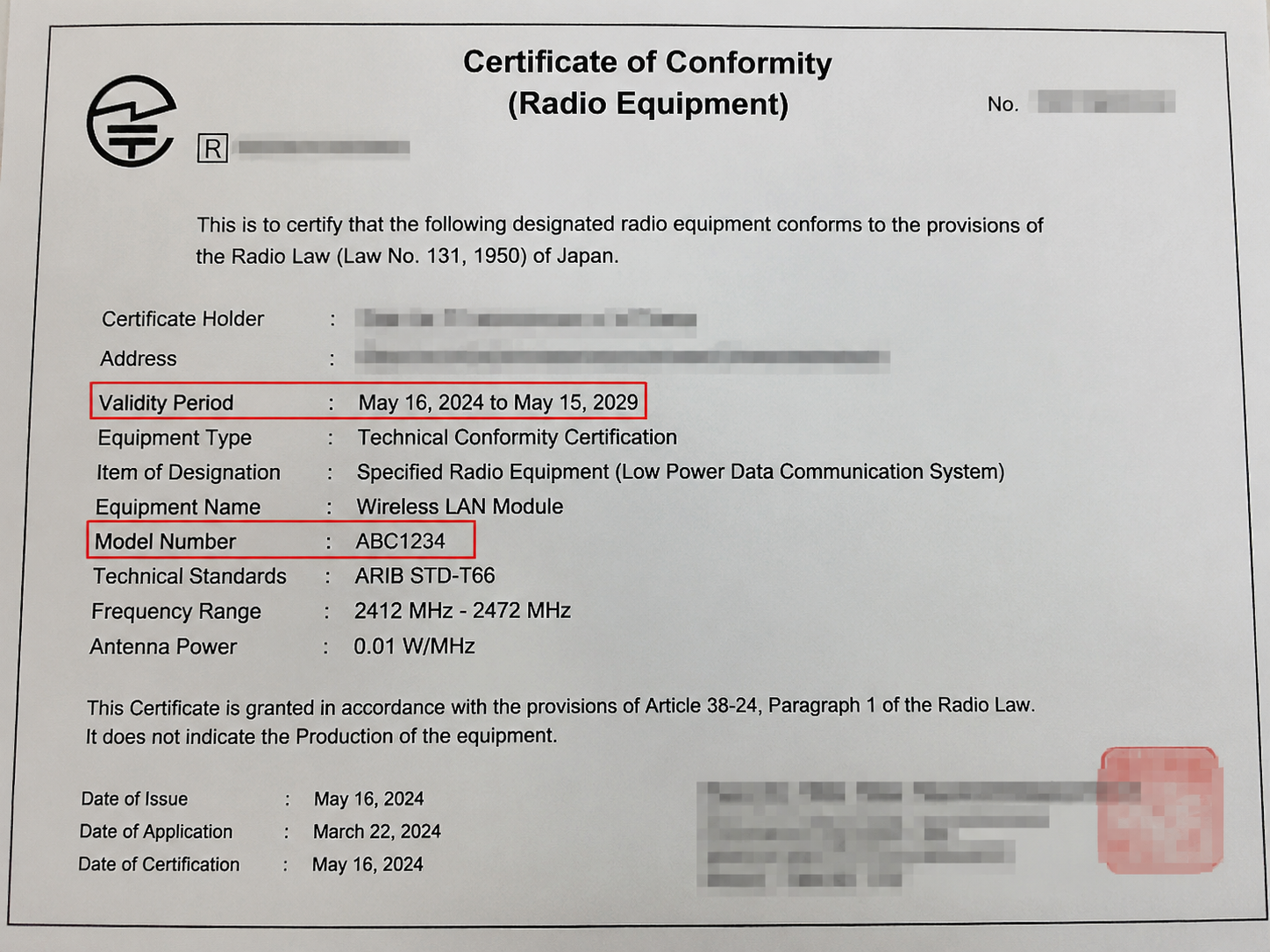
Step 1: Check the Core Fields of the Certificate
First, get the original certificate, and first look for the “validity period” field: if there is a clear term expiration date, it is a fixed-term certificate, which is valid within the period and when other prerequisites are met; if there is no such column, or it is clearly marked as having no fixed term, then judge according to the three prerequisites mentioned in Chapter 1.
At the same time, verify the basic information: whether the certification type matches, whether the product model is the model you want to sell, whether the applicable frequency band and transmission power are consistent with the product parameters, and whether the certificate holder and certification number match the information provided by the supplier. If these basic information do not match, you need to verify the authenticity first.
Step 2: Verify the Consistency Between the Product and the Certification
It is useless to just look at the certificate; you must also confirm that the actual product is consistent with the status at the time of certification. You can ask the supplier for the official technical documents at the time of certification (such as test report summaries, design certification documents), and verify the following points:
• Hardware: Whether the RF chip model, antenna model and gain, and core RF circuit design are consistent with the certification materials;
• Software: Whether parameters such as wireless firmware version, transmission power, and operating frequency band are consistent with those at the time of certification;
• Labels: Whether the Giteki Mark and certification number on the product completely match those on the certificate.
If the product is different from the certification materials and involves RF performance or labels, even if the certificate is real, it may no longer apply.
Step 3: Verify Information Through Official Channels
The scope of information that can be queried through public channels and issuing authorities is different, and you can choose hierarchically according to actual needs:
1. Basic registration information verification (publicly queryable): Through the public certification database of Japan’s Ministry of Internal Affairs and Communications (MIC), or the official query portal of the original issuing authority, enter the certification number to verify the publicly announced basic registration information such as the certificate holder, product model, and applicable frequency band. Note that the number format and field names of different certification systems may be different, and the official number on the certificate shall prevail.
2. In-depth status confirmation (requires contacting the authority): Information such as whether the certificate is suspended/revoked, unannounced historical changes, and additional usage restrictions may not be updated in real time or fully announced in public databases. You must directly contact the original issuing authority or competent authority to apply for confirmation. For major decisions such as large-volume procurement and long-term cooperation, be sure to keep the written reply from the issuing authority as a basis, and do not rely solely on public query results.
Step 4: Confirm the Current Validity of Applicable Standards
The last step is to confirm that the technical standards on which the certification is based are still currently valid and have not been abolished. If the standards are updated, compare the transition period, applicable behaviors, and product time in the announcement to determine whether newly produced/imported products can still use the old certification. The specific situation shall be subject to the official announcement. If you are unsure, you can directly consult the issuing authority or a professional compliance agent, without blindly searching for announcements on your own.
5. Solutions: Handling Methods After Certification No Longer Applies
If the verification shows that the certification has expired, the status is invalid, or the product needs to be remodeled, how to handle it? We will explain it in several situations.
Maintenance Requirements for Certificates Without a Fixed Term
If your certificate has no fixed term, you do not need to go through regular renewal procedures. The core is to do two things well:
First, ensure that the design and production of the product are consistent with the status at the time of certification. All RF-related changes must be evaluated in advance and cannot be changed privately;
Second, regularly track the updates of applicable regulations and standards. If there are changes in products or regulations, proactively evaluate the impact on certification effectiveness, and apply for changes or re-certification if necessary.
Usually, you only need to properly keep documents such as certificates, conformity declarations, and production records, and provide them during market random inspections.
Renewal Process for Fixed-Term Certificates
For certifications with a specified fixed validity period, it is recommended to prepare the renewal application in advance according to the acceptance cycle of the issuing authority, to avoid certification gaps due to the review cycle, which may affect product customs clearance or sales.
The specific requirements for renewal (such as whether supplementary testing is required and what materials to submit) depend on factors such as the certification type, whether the product has changed, and whether applicable standards have been updated. Not all renewals do not require full re-testing. If the product has not changed and the applicable standards have not been adjusted, the review process is usually simpler than a new application. The specific situation shall be subject to the material list and requirements given by the issuing authority.
Common reasons for renewal failure include: the product has undergone changes that affect RF performance, does not meet the requirements of the latest version of technical standards, etc.
Remediation and Inventory Handling After Certification Invalidity
If the certification has expired (fixed term) or the status is invalid (no fixed term), the corresponding handling method must be selected according to the reason for invalidity and the product status:
• If only the fixed-term certificate has expired, and the product has not undergone any changes and still meets the requirements of current standards, you can apply to the issuing authority for renewal or re-certification;
• If the product has undergone changes that affect RF performance, resulting in the certification no longer covering it, you need to re-apply for certification according to the new model or new design, and cannot continue to use the original certification.
Regarding the compliance judgment of inventory products, special attention should be paid: you cannot directly presume that products produced/imported during the valid period of certification are illegal just because the subsequent certification term expires or the status becomes invalid, but you also cannot determine that they can continue to be sold or used solely based on the production/import time. Whether they can continue to be circulated needs to be confirmed on a case-by-case basis, considering factors such as the compliance status of the product at the time of production/import, the reason for certification invalidity (such as whether it was revoked due to unqualified products), whether there is a corresponding recall/sales suspension order, and the transition clauses of standard updates. The final result shall be subject to the formal determination of the regulatory authority. If there are situations such as certification being revoked, products not meeting requirements, or the regulatory authority clearly requiring sales suspension, sales should be immediately suspended and the competent authority or compliance professionals should be contacted to confirm the handling method.
Judgment Logic for Product Changes
When a product needs to be changed, it can be handled according to the following logic:
Step 1: Compare with the original certification documents (including usage restrictions of module certification), list all changes, and conduct a preliminary assessment of whether they involve RF performance, labels, or certification information. If the changes only involve appearance, packaging, or non-RF functions, and preliminary judgment shows that they do not affect antennas, shielding, power supply, and RF parameters, you can keep change records, while still reserving the possibility of confirming with the issuing authority;
Step 2: If the changes involve RF-related hardware, software, usage conditions, or certification information, you need to organize detailed change materials (including before-and-after comparison, impact assessment, etc.) and submit them to the original issuing authority for evaluation;
Step 3: Handle according to the written evaluation result of the authority: if it is an allowed minor change, just go through the change certification process to update the certificate; if it is a major change, you need to re-apply for certification.
During the entire process, all written evaluation records and communication vouchers with the issuing authority must be kept, to be used as a basis for subsequent market random inspections.
6. Pitfall Avoidance Guide: 7 Common Validity Period Misconceptions for Overseas Users
Finally, we sort out several common validity period misconceptions that overseas users often fall into, to help you avoid risks in advance.
Misconception 1: All TELEC certifications expire after 3/5 years
Correct judgment: There is no unified fixed term. Most mass-produced consumer electronics certifications have no fixed term. The specific situation shall be subject to the validity period and certification system specified in the certificate. For detailed rules, see Chapter 2.
Misconception 2: Expired test report = invalid certification
Correct judgment: A test report is technical evidence for a certification application, and its validity period is not directly equivalent to certification effectiveness. Whether a certification is valid depends on the compliance status and has no direct relationship with the timeliness of the test report itself.
Misconception 3: After certification becomes invalid, all sold/inventory products are illegal
Correct judgment: Certification effectiveness usually restricts new production and new import behaviors after invalidity. Whether existing inventory can continue to be sold needs to be judged based on multiple factors such as production/import time, reason for invalidity, and regulatory requirements, and cannot be generalized. For detailed judgment logic, see Chapter 5.
Misconception 4: If a wireless module has a TELEC certificate, the whole machine is automatically compliant
Correct judgment: Module certification only covers the module itself. The whole machine must comply with all usage restrictions of the module certification to be compliant. Otherwise, the compliance of the whole machine needs to be evaluated separately. For specific restrictions, see the module certification section in Chapter 2.
Misconception 5: Having a certification number on the product equals valid certification
Correct judgment: It is necessary to verify the authenticity of the number through official channels, confirm that the certificate has not been suspended/revoked, and that the product model and parameters corresponding to the number are consistent with the actual product.
Misconception 6: If the certification is valid under regulations, it will definitely pass platform review
Correct judgment: Some platforms or purchasers may set additional thresholds (such as requiring the remaining validity period of fixed-term certificates to be no less than 3-6 months). This is not a unified requirement of the , and the specific situation shall be subject to the current policy of the target platform.
Misconception 7: TELEC certification = Japan radio station license
Correct judgment: TELEC is the compliance certification of the equipment itself. For some high-power radio equipment and equipment with special frequency bands, a separate radio station license is required for use. These are two different compliance requirements.
7. Practical Checklists for Different Scenarios
To facilitate your quick inspection in different scenarios, we have sorted out several practical checklists that you can directly follow to verify.
Procurement/Product Selection Stage Checklist
• Request the original certificate and confirm that it has a clear certification number, issuing authority name, and seal;
• Verify that the product model, applicable frequency band, transmission power, and antenna specifications are consistent with the content specified in the certificate;
• Confirm that the authorization relationship between the supplier and the certificate holder is clear, to avoid obtaining counterfeit or mismatched certificates.
Import/Platform Pre-listing Checklist
• Verify the basic registration information of the certification through official channels, and if necessary, apply to the issuing authority for written confirmation of the current status of the certificate;
• Confirm that the technical standards applicable to the certification are the current valid version, or comply with the transition period rules;
• Check that the Giteki Mark and certification number on the product are clearly printed and completely consistent with the certificate information;
• Verify the additional compliance requirements of the target e-commerce platform or purchaser in advance, and confirm that they meet the relevant rules.
Product Change Checklist
• List all changes, and compare with the original certification documents to determine whether they involve RF performance, labels, or certification information;
• For changes that are preliminarily judged not to affect RF performance and compliance labels, keep records;
• For changes involving RF performance or certification information, contact the issuing authority in advance to confirm the handling method, and cannot decide to continue using the original certification on your own.
Market Random Inspection Preparation Checklist
• Properly keep a full set of compliance documents such as certificates, test reports, change records, and conformity declarations. The retention period can be confirmed in combination with applicable regulatory requirements, issuing authority regulations, and internal enterprise traceability needs;
• Ensure that the correspondence between production batches, software versions, and material configurations is traceable, and can prove the consistency of sold products with those at the time of certification;
• Keep documents such as communication vouchers with the issuing authority and change evaluation records, to explain the situation during random inspections.
Summary
After reading this article, you should be able to independently complete the basic judgment of TELEC certification validity, and master four core abilities:
First, you can verify the basic information and current status of certification through certificate fields and official channels, and will not be misled by the saying of “unified 3-year/5-year expiration”;
Second, you can identify common scenarios that may cause certification to no longer apply, and evaluate risks in advance when products change or standards are updated;
Third, you can choose appropriate handling methods according to the specific situation of certification term expiration, status invalidity, or product changes, to avoid unnecessary certification costs;
Fourth, you can avoid common cognitive misconceptions of overseas users and reduce compliance risks in import and sales links.
The core logic of TELEC certification validity has never been a fixed calendar date, but a state where “the certificate status is valid, the product is consistent with the certification, and the applicable regulations are current” are simultaneously satisfied. Grasping this core, you can quickly sort out most compliance judgment issues.